
Fraud and Risk in Big
Data
Data Engineering and Cloud Computing Department
Reva University
SRN:R16MDC06
Outline
1. Introduction
2. What is Big Data
3. Fraud
4. Risk
Introduction
Big Data may well be the Next Big Thing in the IT world.
Big data burst upon the scene in the first decade of the 21st century.
The first organizations to embrace it were online and startup firms. Firms like Google,
eBay, LinkedIn, and Face book were built around big data from the beginning.
Like many new information technologies, big data can bring about dramatic cost
reductions, substantial improvements in the time required to perform a computing task, or
new product and service offerings.
Big Data
‘Big Data’ is similar to ‘small data’, but bigger in size
but having data bigger it requires different approaches:
Techniques, tools and architecture
an aim to solve new problems or old problems in a better way
Big Data
Walmart handles more than 1 million customer transactions every hour.
Face book handles 40 billion photos from its user base.
Decoding the human genome originally took 10 years to process; now it can be achieved
in one week.
Fraud
Fraud as a Crime: Fraud is a generic term, and embraces all the multifarious means that
human ingenuity can devise, which are resorted to by one individual, to get an advantage
by false means
Corporate Fraud: Corporate fraud is any fraud committed by, for, or against a business
corporation.
Management Fraud: Management fraud is the intentional misrepresentation of
corporate or unit performance levels
Fraud
One of the most common forms of fraudulent activity is credit card fraud.
Social media and mobile phones are forming the new frontiers for fraud.
Risk
It would be an understatement to say that risk management is data-driven
The two most common types of risk management are credit risk management and market
risk management.
Credit risk analytics focus on past credit behaviors to predict
Market risk analytics focus on understanding the likelihood that the value of a portfolio
will decrease due to the change in stock prices, interest rates, foreign exchange rates.
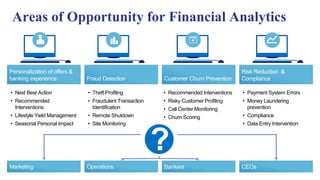
Marketing Operations Bankers CEOs
• Next Best Action
• Recommended
Interventions
• Lifestyle Yield Management
• Seasonal Personal Impact
• Theft Profiling
• Fraudulent Transaction
Identification
• Remote Shutdown
• Site Monitoring
• Recommended Interventions
• Risky Customer Profiling
• Call Center Monitoring
• Churn Scoring
• Payment System Errors
• Money Laundering
prevention
• Compliance
• Data Entry Intervention
?
Personalization of offers &
banking experience
Risk Reduction &
ComplianceCustomer Churn PreventionFraud Detection
Areas of Opportunity for Financial Analytics
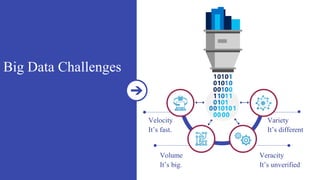
Big Data Challenges
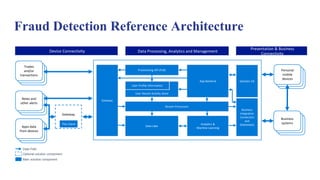
Fraud Detection Reference Architecture
Apps data
from devices
News and
other alerts
Solution UX
Provisioning API (Pull)
User Profile Information
Stream Processors
Analytics &
Machine Learning
Business
Integration
Connectors
and
Gateway(s)
User Recent Activity Store
Gateway
Data Lake
Gateway
App Backend
Data Path
Optional solution component
Main solution component
Thin Client
Presentation & Business
Connectivity
Data Processing, Analytics and ManagementDevice Connectivity
Personal
mobile
devices
Trades
and/or
transactions
Business
systems
Benefits of Big Data
Newest research finds that organizations are using big data to target customer-centric
outcomes, tap into internal data and build a better information ecosystem.
Big Data is already an important part of the $64 billion database and data analytics
market
Fraud and Risk in Big Data

Fraud and Risk in Big Data

  • 1.
    Fraud and Riskin Big Data Data Engineering and Cloud Computing Department Reva University SRN:R16MDC06
  • 2.
    Outline 1. Introduction 2. Whatis Big Data 3. Fraud 4. Risk
  • 3.
    Introduction Big Data maywell be the Next Big Thing in the IT world. Big data burst upon the scene in the first decade of the 21st century. The first organizations to embrace it were online and startup firms. Firms like Google, eBay, LinkedIn, and Face book were built around big data from the beginning. Like many new information technologies, big data can bring about dramatic cost reductions, substantial improvements in the time required to perform a computing task, or new product and service offerings.
  • 4.
    Big Data ‘Big Data’is similar to ‘small data’, but bigger in size but having data bigger it requires different approaches: Techniques, tools and architecture an aim to solve new problems or old problems in a better way
  • 5.
    Big Data Walmart handlesmore than 1 million customer transactions every hour. Face book handles 40 billion photos from its user base. Decoding the human genome originally took 10 years to process; now it can be achieved in one week.
  • 6.
    Fraud Fraud as aCrime: Fraud is a generic term, and embraces all the multifarious means that human ingenuity can devise, which are resorted to by one individual, to get an advantage by false means Corporate Fraud: Corporate fraud is any fraud committed by, for, or against a business corporation. Management Fraud: Management fraud is the intentional misrepresentation of corporate or unit performance levels
  • 7.
    Fraud One of themost common forms of fraudulent activity is credit card fraud. Social media and mobile phones are forming the new frontiers for fraud.
  • 8.
    Risk It would bean understatement to say that risk management is data-driven The two most common types of risk management are credit risk management and market risk management. Credit risk analytics focus on past credit behaviors to predict Market risk analytics focus on understanding the likelihood that the value of a portfolio will decrease due to the change in stock prices, interest rates, foreign exchange rates.
  • 9.
    Marketing Operations BankersCEOs • Next Best Action • Recommended Interventions • Lifestyle Yield Management • Seasonal Personal Impact • Theft Profiling • Fraudulent Transaction Identification • Remote Shutdown • Site Monitoring • Recommended Interventions • Risky Customer Profiling • Call Center Monitoring • Churn Scoring • Payment System Errors • Money Laundering prevention • Compliance • Data Entry Intervention ? Personalization of offers & banking experience Risk Reduction & ComplianceCustomer Churn PreventionFraud Detection Areas of Opportunity for Financial Analytics
  • 10.
  • 11.
    Fraud Detection ReferenceArchitecture Apps data from devices News and other alerts Solution UX Provisioning API (Pull) User Profile Information Stream Processors Analytics & Machine Learning Business Integration Connectors and Gateway(s) User Recent Activity Store Gateway Data Lake Gateway App Backend Data Path Optional solution component Main solution component Thin Client Presentation & Business Connectivity Data Processing, Analytics and ManagementDevice Connectivity Personal mobile devices Trades and/or transactions Business systems
  • 12.
    Benefits of BigData Newest research finds that organizations are using big data to target customer-centric outcomes, tap into internal data and build a better information ecosystem. Big Data is already an important part of the $64 billion database and data analytics market

Editor's Notes

  • #10 A host of opportunities exist to utilize this technology suite in the arena of financial analytics. Left to Right Personalization of offers and tailored banking experiences allow opportunities to engage with customers in a positive way based on their data. Next best action offers surface suspected needs and offer the opportunity for sales lift. Recommended interventions allow for programmatic intervention based upon customer churn. Lifestyle yield management allows for bankers to tailor plans & recommendations based on the life state of customers (retiree versus recent graduate) Many customers of financial institutions are impacted by seasonality in their employment or lifestyle. By recognizing and making offers to these customers based on their needs, banks can increase their profitability. Fraud Detection allows banks to reduce risk and their cost of operations. Theft profiling & fraudulent transaction detection allow for proactive intervention & prevention of fraud. Remote shutdown & site monitoring allow banks to reactively intervene in ATM and physical locations in the event of fraud. Customer Churn Prevention increases revenue by increasing customer lifetime. Churn scoring allows for identification of at-risk customers, and is the basis for all other churn applications. Personalized interventions allow for customized per-customer interventions to be created based upon churn scoring & personalization. Similarly risky customers can be profiled to identify characteristics and intervene. Call center monitoring allows for use of perceptual intelligence to be applied to identify churn behavior based on call center operations. Risk Reduction & Compliance are a key way institutions can reduce operational costs. Prevention of Payment System errors and Money Laundering prevention can substantially reduce risk to fines & lost funds. Data entry is similarly a source of risk; identifying and preventing data entry errors can save time & money.
  • #11 With the large amounts of data potentially available for analysis, managing data flows efficiently can be a challenge. Huge amounts of data to process (volume) A mixture of structured and unstructured data (variety) New data that’s generated extremely frequently (velocity) Data quality so that it can be trusted (veracity)