ANALYTICS IN BANKING AND
FINANCIAL SERVICES
Roshitha Sunil
MEANING
• By applying data mining and predictive analytics to extract actionable
intelligent insights and quantifiable predictions, banks can gain
insights that encompass all types of customer behavior.
• It can help improve how banks segment, target, acquire and retain
customers.
• Improvements to risk management, customer understanding, risk and
fraud enable banks to maintain and grow a more profitable customer
base.
USE OF ANALYTICS
• Data analytics in banking and financial sector play a crucial role in
 Informed decision making to drive organizations forward
 Improve efficiency
 Increase returns
 Achieve business goals.
• Monitor and Assess large amounts of customer data
• Create personalized/customized products and services specific to
individual consumers.
AREAS OF USE
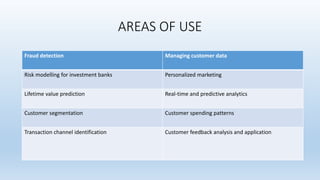
Fraud detection Managing customer data
Risk modelling for investment banks Personalized marketing
Lifetime value prediction Real-time and predictive analytics
Customer segmentation Customer spending patterns
Transaction channel identification Customer feedback analysis and application
USE CASES
• Operational Risk Dashboard
• Forensic analytics
• Predictive Maintenance
• Customer Analytics
• Application screening
Operational Risk Dashboard
• An Operational risk dashboard offers a web-based view of the risk
exposures to the client.
• The solution leverages descriptive analytics, providing latest insights
into risk data and features tools to slice and dice, drill down, filtering
and more, for the risk leadership to make informed decisions.
• Banks can consolidate and refresh the risk dashboard periodically
Forensic analytics
• Employing Advanced analytics techniques, Banks and Finance
organizations can learn, understand and analyse fraud transactions
that occurred in the past along with its trends, patterns and other
parameters.
• Advanced modelling techniques could be used to build a machine
learning based predictive model that predicts the probability of any
fraudulent transactions
Predictive Maintenance
• To detect the probability of ATM failures
• Enabling better utilization of maintenance staff
• Significantly reducing operational expenses.
Customer Analytics
• Advanced analytics techniques can be leveraged to combine big data
sets such as customer demographics, key characteristics, products
held, credit card statements, among others to classify the customer
base and identify similarities and create micro segments among the
customer base.
• Helps to customize marketing campaigns for each individual micro
segments by defining “next-best-product-to-buy” models, improving
the effectiveness of such campaigns.
Application screening
• Predictive modelling and machine learning techniques can be utilized
to create a model which accepts the customer details and predicts
the probability of the customer defaulting.
• Bigdata technologies can help in building an efficient screening
process.
• The solution can also assess repayment capability of a customer by
looking at various parameters which is usually impossible via manual
screening.
• It also reduces the probability of an asset turning into a Non-
Performing Assets (NPA).
THANK YOU

Analystics in banking and financial services

  • 1.
    ANALYTICS IN BANKINGAND FINANCIAL SERVICES Roshitha Sunil
  • 2.
    MEANING • By applyingdata mining and predictive analytics to extract actionable intelligent insights and quantifiable predictions, banks can gain insights that encompass all types of customer behavior. • It can help improve how banks segment, target, acquire and retain customers. • Improvements to risk management, customer understanding, risk and fraud enable banks to maintain and grow a more profitable customer base.
  • 3.
    USE OF ANALYTICS •Data analytics in banking and financial sector play a crucial role in  Informed decision making to drive organizations forward  Improve efficiency  Increase returns  Achieve business goals. • Monitor and Assess large amounts of customer data • Create personalized/customized products and services specific to individual consumers.
  • 5.
    AREAS OF USE Frauddetection Managing customer data Risk modelling for investment banks Personalized marketing Lifetime value prediction Real-time and predictive analytics Customer segmentation Customer spending patterns Transaction channel identification Customer feedback analysis and application
  • 6.
    USE CASES • OperationalRisk Dashboard • Forensic analytics • Predictive Maintenance • Customer Analytics • Application screening
  • 7.
    Operational Risk Dashboard •An Operational risk dashboard offers a web-based view of the risk exposures to the client. • The solution leverages descriptive analytics, providing latest insights into risk data and features tools to slice and dice, drill down, filtering and more, for the risk leadership to make informed decisions. • Banks can consolidate and refresh the risk dashboard periodically
  • 8.
    Forensic analytics • EmployingAdvanced analytics techniques, Banks and Finance organizations can learn, understand and analyse fraud transactions that occurred in the past along with its trends, patterns and other parameters. • Advanced modelling techniques could be used to build a machine learning based predictive model that predicts the probability of any fraudulent transactions
  • 9.
    Predictive Maintenance • Todetect the probability of ATM failures • Enabling better utilization of maintenance staff • Significantly reducing operational expenses.
  • 10.
    Customer Analytics • Advancedanalytics techniques can be leveraged to combine big data sets such as customer demographics, key characteristics, products held, credit card statements, among others to classify the customer base and identify similarities and create micro segments among the customer base. • Helps to customize marketing campaigns for each individual micro segments by defining “next-best-product-to-buy” models, improving the effectiveness of such campaigns.
  • 11.
    Application screening • Predictivemodelling and machine learning techniques can be utilized to create a model which accepts the customer details and predicts the probability of the customer defaulting. • Bigdata technologies can help in building an efficient screening process. • The solution can also assess repayment capability of a customer by looking at various parameters which is usually impossible via manual screening. • It also reduces the probability of an asset turning into a Non- Performing Assets (NPA).
  • 12.