make connections • share ideas • be inspired
 India’s Largest Analytics Forum


Enterprise Fraud Management
B.Radha Krishna
Practice Manager, Risk & Fraud Management
SAS Institute India Pvt. Ltd


     Copyright © 2011, SAS Institute Inc. All rights reserved.
Agenda

                       Business Issues
                       Key Themes of Enterprise Fraud Management
                           • Customer Classification
                           • Detection Methodologies
                           • Investigation
                                      − Alert Management
                                      − Case Management


Copyright © 2011, SAS Institute Inc. All rights reserved.
Business Issues


            REGULATORY EMPHASIS
            INDUSTRY DRIVERS
            CUSTOMER ISSUES
            ANALYST VIEW


Copyright © 2011, SAS Institute Inc. All rights reserved.
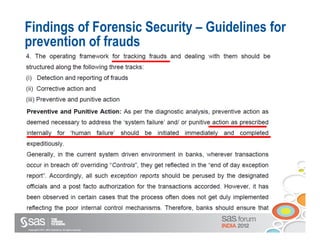
Findings of Forensic Security – Guidelines for
prevention of frauds


Copyright © 2011, SAS Institute Inc. All rights reserved.
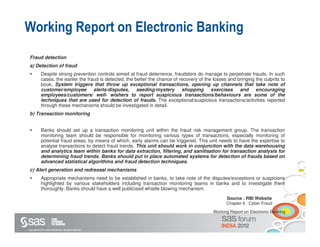
Working Report on Electronic Banking
 Fraud detection
 a) Detection of fraud
             Despite strong prevention controls aimed at fraud deterrence, fraudsters do manage to perpetrate frauds. In such
             cases, the earlier the fraud is detected, the better the chance of recovery of the losses and bringing the culprits to
             book. System triggers that throw up exceptional transactions, opening up channels that take note of
             customer/employee alerts/disputes, seeding/mystery shopping exercises and encouraging
             employees/customers/ well- wishers to report suspicious transactions/behaviours are some of the
             techniques that are used for detection of frauds. The exceptional/suspicious transactions/activities reported
             through these mechanisms should be investigated in detail.
 b) Transaction monitoring


             Banks should set up a transaction monitoring unit within the fraud risk management group. The transaction
             monitoring team should be responsible for monitoring various types of transactions, especially monitoring of
             potential fraud areas, by means of which, early alarms can be triggered. This unit needs to have the expertise to
             analyse transactions to detect fraud trends. This unit should work in conjunction with the data warehousing
             and analytics team within banks for data extraction, filtering, and sanitisation for transaction analysis for
             determining fraud trends. Banks should put in place automated systems for detection of frauds based on
             advanced statistical algorithms and fraud detection techniques.
 c) Alert generation and redressal mechanisms
             Appropriate mechanisms need to be established in banks, to take note of the disputes/exceptions or suspicions
             highlighted by various stakeholders including transaction monitoring teams in banks and to investigate them
             thoroughly. Banks should have a well publicised whistle blowing mechanism.
                                                                                                      Source : RBI Website
                                                                                                      Chapter 6 : Cyber Fraud
                                                                                                Working Report on Electronic Banking


Copyright © 2011, SAS Institute Inc. All rights reserved.
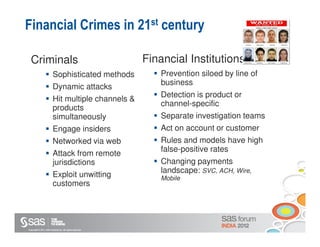
Financial Crimes in 21st century

  Criminals                                                 Financial Institutions
                          Sophisticated methods                Prevention siloed by line of
                                                               business
                          Dynamic attacks
                                                               Detection is product or
                          Hit multiple channels &
                                                               channel-specific
                          products
                          simultaneously                       Separate investigation teams
                          Engage insiders                      Act on account or customer
                          Networked via web                    Rules and models have high
                                                               false-positive rates
                          Attack from remote
                          jurisdictions                        Changing payments
                                                               landscape: SVC, ACH, Wire,
                          Exploit unwitting                    Mobile
                          customers


Copyright © 2011, SAS Institute Inc. All rights reserved.
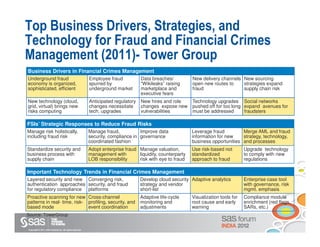
Top Business Drivers, Strategies, and
Technology for Fraud and Financial Crimes
Management (2011)- Tower Group
Business Drivers in Financial Crimes Management
Underground fraud                                           Employee fraud           Data breaches/          New delivery channels New sourcing
economy is organized,                                       spurred by               “Wikileaks” raising     open new routes to    strategies expand
sophisticated, efficient                                    underground market       marketplace and         fraud                 supply chain risk
                                                                                     executive fears
New technology (cloud,                                      Anticipated regulatory   New hires and role      Technology upgrades Social networks
grid, virtual) brings new                                   changes necessitate      changes expose new      pushed off for too long expand avenues for
risks computing                                             tech. upgrades           vulnerabilities         must be addressed       fraudsters

FSIs’ Strategic Responses to Reduce Fraud Risks
Manage risk holistically,                                   Manage fraud,           Improve data             Leverage fraud         Merge AML and fraud
including fraud risk                                        security, compliance in governance               information for new    strategy, technology,
                                                            coordinated fashion                              business opportunities and processes
Standardize security and                                    Adopt enterprise fraud Manage valuation,         Use risk-based not        Upgrade technology
business process with                                       management with        liquidity, counterparty   standardized              to comply with new
supply chain                                                LOB responsibility     risk with eye to fraud    approach to fraud         regulations

Important Technology Trends in Financial Crimes Management
Layered security and new Converging risk,                                            Develop cloud security Adaptive analytics         Enterprise case tool
authentication approaches security, and fraud                                        strategy and vendor                               with governance, risk
for regulatory compliance platforms                                                  short-list                                        mgmt. emphasis
Proactive scanning for new Cross-channel                                             Adaptive life-cycle     Visualization tools for   Compliance module
patterns in real- time, risk- profiling, security, and                               monitoring and          root cause and early      enrichment (red flags,
based mode                    event coordination                                     adjustments             warning                   SARs, etc.)
Source: TowerGroup


Copyright © 2011, SAS Institute Inc. All rights reserved.
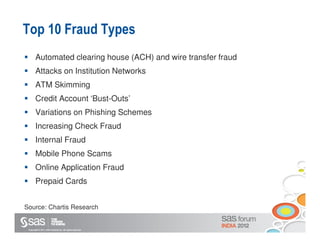
Top 10 Fraud Types
        Automated clearing house (ACH) and wire transfer fraud
        Attacks on Institution Networks
        ATM Skimming
        Credit Account ‘Bust-Outs’
        Variations on Phishing Schemes
        Increasing Check Fraud
        Internal Fraud
        Mobile Phone Scams
        Online Application Fraud
        Prepaid Cards


Source: Chartis Research


 Copyright © 2011, SAS Institute Inc. All rights reserved.
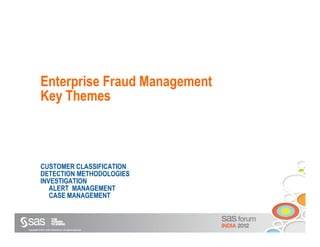
Enterprise Fraud Management
            Key Themes


            CUSTOMER CLASSIFICATION
            DETECTION METHODOLOGIES
            INVESTIGATION
               ALERT MANAGEMENT
               CASE MANAGEMENT


Copyright © 2011, SAS Institute Inc. All rights reserved.
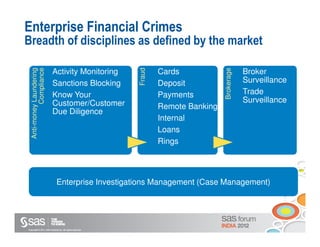
Enterprise Financial Crimes
Breadth of disciplines as defined by the market
   Anti-money Laundering
             Compliance


                                                            Fraud


                                                                                     Brokerage
                           Activity Monitoring                      Cards                        Broker
                           Sanctions Blocking                       Deposit                      Surveillance
                           Know Your                                Payments                     Trade
                           Customer/Customer                                                     Surveillance
                                                                    Remote Banking
                           Due Diligence
                                                                    Internal
                                                                    Loans
                                                                    Rings


                              Enterprise Investigations Management (Case Management)


Copyright © 2011, SAS Institute Inc. All rights reserved.
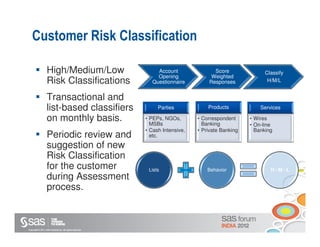
Customer Risk Classification

                   High/Medium/Low                               Account              Score               Classify
                                                                 Opening             Weighted
                   Risk Classifications                        Questionnaire        Responses              H/M/L


                   Transactional and
                   list-based classifiers                        Parties            Products            Services

                   on monthly basis.                        • PEPs, NGOs,
                                                              MSBs
                                                                                • Correspondent
                                                                                  Banking
                                                                                                    • Wires
                                                                                                    • On-line
                                                            • Cash Intensive,   • Private Banking     Banking
                   Periodic review and                        etc.

                   suggestion of new
                   Risk Classification
                   for the customer                          Lists                  Behavior                H/M/L
                   during Assessment
                   process.


Copyright © 2011, SAS Institute Inc. All rights reserved.
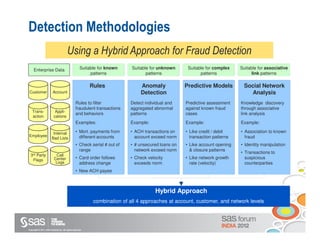
Detection Methodologies
                                         Using a Hybrid Approach for Fraud Detection
     Enterprise Data                                   Suitable for known    Suitable for unknown     Suitable for complex    Suitable for associative
                                                            patterns                patterns                patterns               link patterns

                                                            Rules                Anomaly             Predictive Models         Social Network
Customer                  Account                                                Detection                                       Analysis
                                                  Rules to filter           Detect individual and    Predictive assessment    Knowledge discovery
                                                  fraudulent transactions   aggregated abnormal      against known fraud      through associative
    Trans-                  Appli-
                                                  and behaviors             patterns                 cases                    link analysis
    action                 cations
                                                  Examples:                 Example:                 Example:                 Example:

                          Internal                • Mort. payments from     • ACH transactions on    • Like credit / debit    • Association to known
Employee                                            different accounts        account exceed norm      transaction patterns     fraud
                         Bad Lists
                                                  • Check serial # out of   • # unsecured loans on   • Like account opening   • Identity manipulation
                                                    range                     network exceed norm      & closure patterns
                                                                                                                              • Transactions to
  3rd Party                 Call
   Flags                   Center                 • Card order follows      • Check velocity         • Like network growth      suspicious
                            Logs                    address change            exceeds norm             rate (velocity)          counterparties
                                                  • New ACH payee


                                                                                        Hybrid Approach
                                                             combination of all 4 approaches at account, customer, and network levels


Copyright © 2011, SAS Institute Inc. All rights reserved.
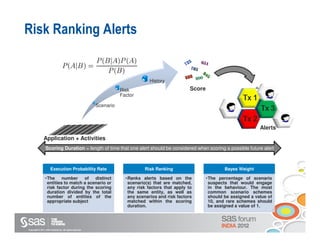
Risk Ranking Alerts


                                                                                    History
                                                                       Risk                            Score
                                                                       Factor

                                                            Scenario


                                                                                                                                       Alerts
                Application + Activities
                  Scoring Duration = length of time that one alert should be considered when scoring a possible future alert


                       Execution Probability Rate                                 Risk Ranking                         Bayes Weight

                 •The     number    of   distinct                        •Ranks alerts based on the            •The percentage of scenario
                  entities to match a scenario or                         scenario(s) that are matched,         suspects that would engage
                  risk factor during the scoring                          any risk factors that apply to        in the behaviour. The most
                  duration divided by the total                           the same entity, as well as           common scenario schemes
                  number of entities of the                               any scenarios and risk factors        should be assigned a value of
                  appropriate subject                                     matched within the scoring            10, and rare schemes should
                                                                          duration.                             be assigned a value of 1.


Copyright © 2011, SAS Institute Inc. All rights reserved.
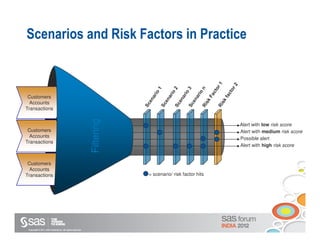
Scenarios and Risk Factors in Practice


 Customers
  Accounts
Transactions
                                                             Filtering

                                                                                                        Alert with low risk score
 Customers                                                                                              Alert with medium risk score
  Accounts                                                                                              Possible alert
Transactions
                                                                                                        Alert with high risk score


 Customers
  Accounts
Transactions                                                             = scenario/ risk factor hits


 Copyright © 2011, SAS Institute Inc. All rights reserved.
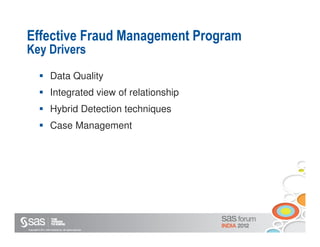
Effective Fraud Management Program
Key Drivers
                       Data Quality
                       Integrated view of relationship
                       Hybrid Detection techniques
                       Case Management


Copyright © 2011, SAS Institute Inc. All rights reserved.
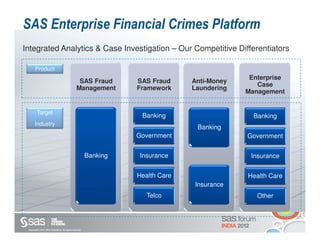
SAS Enterprise Financial Crimes Platform
Integrated Analytics & Case Investigation – Our Competitive Differentiators

        Product
                                                                                                   Enterprise
                                                     SAS Fraud         SAS Fraud     Anti-Money
                                                                                                     Case
                                                    Management         Framework     Laundering
                                                                                                  Management


          Target
                                                                        Banking                     Banking
       Industry
                                                                                      Banking
                                                                       Government                 Government


                                                             Banking    Insurance                  Insurance


                                                                       Health Care                Health Care
                                                                                     Insurance
                                                                          Telco                      Other


 Copyright © 2011, SAS Institute Inc. All rights reserved.
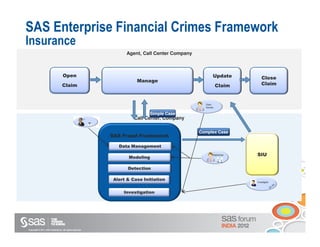
SAS Enterprise Financial Crimes Framework
Insurance
                                                                  Agent, Call Center Company


                                    Open                                                            Update     Close
                                                                       Manage
                                    Claim                                                            Claim     Claim


                                                                              Simple Case
                                                                      Call Center, Company

                                                                               Or SIU
                                                                                               Complex Case
                                                            SAS Fraud Framework

                                                               Data Management
                                                                                                              SIU
                                                                   Modeling

                                                                   Detection

                                                             Alert & Case Initiation

                                                                 Investigation


Copyright © 2011, SAS Institute Inc. All rights reserved.
Q&A


Copyright © 2011, SAS Institute Inc. All rights reserved.
make connections • share ideas • be inspired
India’s Largest Analytics Forum


Thank You
B.Radha Krishna
radhakrishna.b@sas.com


     Copyright © 2010, SAS Institute Inc. All rights reserved.

Fraud Management Solutions

  • 1.
    make connections •share ideas • be inspired India’s Largest Analytics Forum Enterprise Fraud Management B.Radha Krishna Practice Manager, Risk & Fraud Management SAS Institute India Pvt. Ltd Copyright © 2011, SAS Institute Inc. All rights reserved.
  • 2.
    Agenda Business Issues Key Themes of Enterprise Fraud Management • Customer Classification • Detection Methodologies • Investigation − Alert Management − Case Management Copyright © 2011, SAS Institute Inc. All rights reserved.
  • 3.
    Business Issues REGULATORY EMPHASIS INDUSTRY DRIVERS CUSTOMER ISSUES ANALYST VIEW Copyright © 2011, SAS Institute Inc. All rights reserved.
  • 4.
    Findings of ForensicSecurity – Guidelines for prevention of frauds Copyright © 2011, SAS Institute Inc. All rights reserved.
  • 5.
    Working Report onElectronic Banking Fraud detection a) Detection of fraud Despite strong prevention controls aimed at fraud deterrence, fraudsters do manage to perpetrate frauds. In such cases, the earlier the fraud is detected, the better the chance of recovery of the losses and bringing the culprits to book. System triggers that throw up exceptional transactions, opening up channels that take note of customer/employee alerts/disputes, seeding/mystery shopping exercises and encouraging employees/customers/ well- wishers to report suspicious transactions/behaviours are some of the techniques that are used for detection of frauds. The exceptional/suspicious transactions/activities reported through these mechanisms should be investigated in detail. b) Transaction monitoring Banks should set up a transaction monitoring unit within the fraud risk management group. The transaction monitoring team should be responsible for monitoring various types of transactions, especially monitoring of potential fraud areas, by means of which, early alarms can be triggered. This unit needs to have the expertise to analyse transactions to detect fraud trends. This unit should work in conjunction with the data warehousing and analytics team within banks for data extraction, filtering, and sanitisation for transaction analysis for determining fraud trends. Banks should put in place automated systems for detection of frauds based on advanced statistical algorithms and fraud detection techniques. c) Alert generation and redressal mechanisms Appropriate mechanisms need to be established in banks, to take note of the disputes/exceptions or suspicions highlighted by various stakeholders including transaction monitoring teams in banks and to investigate them thoroughly. Banks should have a well publicised whistle blowing mechanism. Source : RBI Website Chapter 6 : Cyber Fraud Working Report on Electronic Banking Copyright © 2011, SAS Institute Inc. All rights reserved.
  • 6.
    Financial Crimes in21st century Criminals Financial Institutions Sophisticated methods Prevention siloed by line of business Dynamic attacks Detection is product or Hit multiple channels & channel-specific products simultaneously Separate investigation teams Engage insiders Act on account or customer Networked via web Rules and models have high false-positive rates Attack from remote jurisdictions Changing payments landscape: SVC, ACH, Wire, Exploit unwitting Mobile customers Copyright © 2011, SAS Institute Inc. All rights reserved.
  • 7.
    Top Business Drivers,Strategies, and Technology for Fraud and Financial Crimes Management (2011)- Tower Group Business Drivers in Financial Crimes Management Underground fraud Employee fraud Data breaches/ New delivery channels New sourcing economy is organized, spurred by “Wikileaks” raising open new routes to strategies expand sophisticated, efficient underground market marketplace and fraud supply chain risk executive fears New technology (cloud, Anticipated regulatory New hires and role Technology upgrades Social networks grid, virtual) brings new changes necessitate changes expose new pushed off for too long expand avenues for risks computing tech. upgrades vulnerabilities must be addressed fraudsters FSIs’ Strategic Responses to Reduce Fraud Risks Manage risk holistically, Manage fraud, Improve data Leverage fraud Merge AML and fraud including fraud risk security, compliance in governance information for new strategy, technology, coordinated fashion business opportunities and processes Standardize security and Adopt enterprise fraud Manage valuation, Use risk-based not Upgrade technology business process with management with liquidity, counterparty standardized to comply with new supply chain LOB responsibility risk with eye to fraud approach to fraud regulations Important Technology Trends in Financial Crimes Management Layered security and new Converging risk, Develop cloud security Adaptive analytics Enterprise case tool authentication approaches security, and fraud strategy and vendor with governance, risk for regulatory compliance platforms short-list mgmt. emphasis Proactive scanning for new Cross-channel Adaptive life-cycle Visualization tools for Compliance module patterns in real- time, risk- profiling, security, and monitoring and root cause and early enrichment (red flags, based mode event coordination adjustments warning SARs, etc.) Source: TowerGroup Copyright © 2011, SAS Institute Inc. All rights reserved.
  • 8.
    Top 10 FraudTypes Automated clearing house (ACH) and wire transfer fraud Attacks on Institution Networks ATM Skimming Credit Account ‘Bust-Outs’ Variations on Phishing Schemes Increasing Check Fraud Internal Fraud Mobile Phone Scams Online Application Fraud Prepaid Cards Source: Chartis Research Copyright © 2011, SAS Institute Inc. All rights reserved.
  • 9.
    Enterprise Fraud Management Key Themes CUSTOMER CLASSIFICATION DETECTION METHODOLOGIES INVESTIGATION ALERT MANAGEMENT CASE MANAGEMENT Copyright © 2011, SAS Institute Inc. All rights reserved.
  • 10.
    Enterprise Financial Crimes Breadthof disciplines as defined by the market Anti-money Laundering Compliance Fraud Brokerage Activity Monitoring Cards Broker Sanctions Blocking Deposit Surveillance Know Your Payments Trade Customer/Customer Surveillance Remote Banking Due Diligence Internal Loans Rings Enterprise Investigations Management (Case Management) Copyright © 2011, SAS Institute Inc. All rights reserved.
  • 11.
    Customer Risk Classification High/Medium/Low Account Score Classify Opening Weighted Risk Classifications Questionnaire Responses H/M/L Transactional and list-based classifiers Parties Products Services on monthly basis. • PEPs, NGOs, MSBs • Correspondent Banking • Wires • On-line • Cash Intensive, • Private Banking Banking Periodic review and etc. suggestion of new Risk Classification for the customer Lists Behavior H/M/L during Assessment process. Copyright © 2011, SAS Institute Inc. All rights reserved.
  • 12.
    Detection Methodologies Using a Hybrid Approach for Fraud Detection Enterprise Data Suitable for known Suitable for unknown Suitable for complex Suitable for associative patterns patterns patterns link patterns Rules Anomaly Predictive Models Social Network Customer Account Detection Analysis Rules to filter Detect individual and Predictive assessment Knowledge discovery fraudulent transactions aggregated abnormal against known fraud through associative Trans- Appli- and behaviors patterns cases link analysis action cations Examples: Example: Example: Example: Internal • Mort. payments from • ACH transactions on • Like credit / debit • Association to known Employee different accounts account exceed norm transaction patterns fraud Bad Lists • Check serial # out of • # unsecured loans on • Like account opening • Identity manipulation range network exceed norm & closure patterns • Transactions to 3rd Party Call Flags Center • Card order follows • Check velocity • Like network growth suspicious Logs address change exceeds norm rate (velocity) counterparties • New ACH payee Hybrid Approach combination of all 4 approaches at account, customer, and network levels Copyright © 2011, SAS Institute Inc. All rights reserved.
  • 13.
    Risk Ranking Alerts History Risk Score Factor Scenario Alerts Application + Activities Scoring Duration = length of time that one alert should be considered when scoring a possible future alert Execution Probability Rate Risk Ranking Bayes Weight •The number of distinct •Ranks alerts based on the •The percentage of scenario entities to match a scenario or scenario(s) that are matched, suspects that would engage risk factor during the scoring any risk factors that apply to in the behaviour. The most duration divided by the total the same entity, as well as common scenario schemes number of entities of the any scenarios and risk factors should be assigned a value of appropriate subject matched within the scoring 10, and rare schemes should duration. be assigned a value of 1. Copyright © 2011, SAS Institute Inc. All rights reserved.
  • 14.
    Scenarios and RiskFactors in Practice Customers Accounts Transactions Filtering Alert with low risk score Customers Alert with medium risk score Accounts Possible alert Transactions Alert with high risk score Customers Accounts Transactions = scenario/ risk factor hits Copyright © 2011, SAS Institute Inc. All rights reserved.
  • 15.
    Effective Fraud ManagementProgram Key Drivers Data Quality Integrated view of relationship Hybrid Detection techniques Case Management Copyright © 2011, SAS Institute Inc. All rights reserved.
  • 16.
    SAS Enterprise FinancialCrimes Platform Integrated Analytics & Case Investigation – Our Competitive Differentiators Product Enterprise SAS Fraud SAS Fraud Anti-Money Case Management Framework Laundering Management Target Banking Banking Industry Banking Government Government Banking Insurance Insurance Health Care Health Care Insurance Telco Other Copyright © 2011, SAS Institute Inc. All rights reserved.
  • 17.
    SAS Enterprise FinancialCrimes Framework Insurance Agent, Call Center Company Open Update Close Manage Claim Claim Claim Simple Case Call Center, Company Or SIU Complex Case SAS Fraud Framework Data Management SIU Modeling Detection Alert & Case Initiation Investigation Copyright © 2011, SAS Institute Inc. All rights reserved.
  • 18.
    Q&A Copyright © 2011,SAS Institute Inc. All rights reserved.
  • 19.
    make connections •share ideas • be inspired India’s Largest Analytics Forum Thank You B.Radha Krishna radhakrishna.b@sas.com Copyright © 2010, SAS Institute Inc. All rights reserved.