A Quick Review Of
Framing Effect Studies
Amir Mohammad Tahamtan
Outline
• A Brief review of Economic Choice Modelling
• Expected Utility Theory
• Prospect Theory
• Selected Studies Of Framing Effect in
• Game Theory
• WTP/WTA
• Law and economics
• Insurance behavior
• Health behavior
• International Trade
Expected utility theory
Prospect theory
• The value of a risky prospect is calculated as follows:
• ∏(p)*v(x) + ∏(q)*v(y)
outcome probability
x p
y q
Status quo 1-p-q
Properties of the value function v(.)
• is commonly S-shaped, concave above the reference point and convex
below it
• the response to losses is more extreme than the response to gains
• Consider, for example, the Asian disease problem
The Example Of “Asian Disease Outbreak”
• Problem 1 :
Program A: 200 people will be saved; (72%)
Program B: 1/3 probability 600 people will be saved and 2/3 will be
saved; (28%)
• Problem 2:
Program C: 400 people will die; (22%)
Program D: 1/3 probability nobody will die and 2/3 probability 600
people will die; (78%)
The value function of the above example
Properties of the ∏(.)
• ∏(0) = 0
• ∏(1) = 1; but the function is not well-behaved near the endpoints
• low probabilities are overweighted, moderate and high probabilities
are underweighted;
• ∏(pq)/ ∏(p) < ∏(pqr)/ ∏(pr); for 0<p,q,r≤1
Framing effect in game theory
• Anomalies: Ultimatums, Dictators and Manners, Camerer, Colin and Thaler, Richard H.,
Journal of Economic Perspective, 1995;
• Developments in non-expected utility theory: the hunt for a descriptive theory of choice
under risk, Starmer, Chris, Journal of economic literature; 2000
• The effects of framing and negotiator overconfidece on bargaining behaviors and
outcomes, Neale, Margaret, Bazerman, Max, Academy of management journal, 1985;
• Comparing students to workers: the effects of social framing on behavior in
distribution games, Carpenter, Jeffrey P., Burks, Stephen, Verhoogen, Eric, 2005;
• Cognition and framing in sequential bargaining for gains and losses, Camerer, Colin,
Johnson, Eric J.,
• Warm-Glow Versus Cold-Prickle: The Effects of Positive and Negative Framing on
Cooperation in Experiments, Andreoni, James, Oxford journal, 1995;
• Warm-glow versus cold-prickle: a further experimental study of framing effects on
free-riding, Park, Eun-Soo, 2000
Cognition and framing in sequential
bargaining for gains and losses
• Studies have found systematic deviations between the offers people make and
perfect equilibrium offers derived from backward induction
• In previous experiments, subjects actually offer the second player something
between the $1.25 equilibrium and $2.50, an equal split of the initial pie. Mean
offers are around $2.00. Lower offers, including equilibrium offers of $1.25, are
often rejected
Cognition and framing in sequential
bargaining for gains and losses
• Two players bargain by making a finite number of alternating offers;
Three-round game with a pie of $5.00 and a 50-percent discount
factor
• Subjects began with $5 for each round. Then the players bargained
over division of a loss of $5.00 in the first round, a loss of $7.50 in the
second round, and a loss of $8.75 in the third round
• Results: the average offer was $2.22, i.e. player 1 offered player 2 a
loss of -$2.78. low offers were very frequently rejected.
The Effects of Positive and Negative Framing
on Cooperation in Experiments
• The lack of free riding in experiments presents an especially
interesting challenge for economists
• Free riding is a dominant-strategy Nash equilibrium
• Saying that an investment in the public good will make others better
off is equivalent to stating that an investment in the private good will
make others worse off
• ∏i= xi +1/2gi +1/2 𝑖≠𝑗 gi, s.t. gi + xi = 60 : making others better off
• ∏i= xi +1/2gi +1/2 𝑖≠𝑗
(60 − xi) = xi +1/2gi-1/2 𝑖≠𝑗 xj: making others
worse off
The Effects of Positive and Negative Framing
on Cooperation in Experiments
• Positive frame condition: cooperation starts 47% and decay to 21%,
overall contribution 34%.
• Negative frame condition: cooperation starts 27% and decay to 1%,
overall contribution 16.2%.
Warm-glow vs cold prickle: further study
• There is a significant difference between the two framing conditions
in terms of overall contribution rates, there is no significant difference
for some subjects.
• The data strongly suggest that the negative framing has a most salient
effect on the subjects who have individualistic value orientation,
whereas the negative framing has a rather insignificant effect on the
subjects who have cooperative value orientation.
The effects of framing on bargaining behaviors and outcomes
• Negotiation often is viewed in terms of what players have to
lose
• Consider, for example, labor-management bargaining over wage
• Following the prospect theory’s proposition, they will
respond in a risk-seeking manner and are likely to choose
arbitration
The effects of framing on bargaining behaviors and outcomes
• The negatively-framed condition:
Any concessions beyond those granted will represent serious financial losses to the
company. Please remember that your primary objective is to minimize such losses
to the company…
• The positively-framed condition:
Any union concession from their current position will result in gains for the
company. Please remember that your primary objective is to maximize such losses
to the company…
Results
Comparing students to workers
• Verbal cues are not the only factor that shapes subjects’ beliefs;
Subjects’ beliefs are also influenced by the real-life social context.
• The Ultimatum Game and the Dictator Game are conducted among
Middlebury college and people in a publishing distribution warehouse
in Kansas city.
• To control for the demographic characteristics of the participant
populations, a third round of the experiment was run in which the
participant are the students of a junior college near the warehouse.
Results
• Both groups of students exhibit a large drop in mean allocations
between the UG and DG experiments, while the workers offer the
same amount, on average, in both games.
• Explanation: Workers see each other every day. However, students
are more likely to be in competition for grades,
Selected Studies in Health WTP/WTA
• A Review of WTA/WTP Studies, Horowitz, John K. and McConnell, Kenneth
E., 1999,
• Are Experimental Economists Prone to Framing Effects?, Gächter, Simon et,al.,
2008,
• The Influence of Framing on Willingness to Pay: An Explanation for the
Uncertainty Effect, Yang, Yang,, Loewenstein, George,
Are Experimental Economists Prone To
Framing Effect?
• The participants were junior and senior experimental scientists
(mostly economists) who registered for the 2006 Economic Science
Association (ESA) meeting in Nottingham, UK
• The experimental framing manipulation concerned the fee for
late/early registration.
Are Experimental Economists Prone To
Framing Effect?
• “We take this opportunity to remind you that the discounted
conference fee for early registration is available until 10 July 2006.”
• “We take this opportunity to remind you that the conference fee will
include penalty for late registration after 10 July 2006.”
Are Experimental Economists Prone To
Framing Effect?
Are Experimental Economists Prone To
Framing Effect?
The Influence Of Framing On WTP
• The concept of “Uncertainty Effect” or UE;
• A Risky Prospect Is Valued Less Than Its Worst Possible Outcome
• The average WTP of $26 for a $50 gift certificate for Barnes and
Noble, but only $16 for a lottery of winning $50 or $100 with equal
probability.
The Influence Of Framing On WTP
• Why does the UE occur when people value lotteries, but not when
they value equivalent uncertain outcomes in the form of consumer
promotions or uncertain gift certificates?
• Framing a prospect as a “lottery ticket”, “raffle”, “gamble”, or “coin
flip” dramatically reduces WTP as opposed to framing it as an
“uncertain gift certificate” or “voucher”.
The Influence Of Framing On WTP
• What Causes WTP To Be Lower Under The Lottery, Coin Flip, Raffle, And
Gamble Frame?
• Subjective Uncertainty
• Processing Disfluency
• Negative Attitudes Towards Lotteries
• Differences In Aleatory Uncertainty Or Mental Representations Of
Uncertainty
• Anticipated Disappointment
• Anchoring
• Associations With The Concept Gambling
• Beliefs About What Others Would Be Willing To Pay Under These Frames.
The Influence Of Framing On WTP
• Framing affects only WTP but not WTA
• The only explanation that is consistent across all twelve experiments
is that these frames evoke lower reference prices.
Selected Studies in law and Economics
• Experimental Law and economics, Colin, Camerer and Talley, Eric, 2004;
• Expressive law: framing or equilibrium selection, Bohnet, Iris and Cooter, Robert,
2001;
• Framing the Jury: Cognitive perspectives on pain and suffering awards,
McCaffery, Edward and Kahneman, Daniel, Virginia Law review, 1995
Expressive law: framing or equilibrium
selection
• Law’s largest effects come from coordination
• Normative systems have multiple equilibria, so announcing a new law
can change expectations and cause behavior to jump from one
equilibrium to another
• Prison dilemma was run in which choosing defection results in
penalty 10% of the time
• The power of the penalty to coordinate increased as the proportion
of actors decreased whose cooperation was needed to tip the system
to a Pareto superior equilibrium
Selected readings in insurance behavior
• Framing, Probability distortions, and insurance decisions, Johnson, Eric,
Hershely, John, Journal of risk and uncertainty, 1993
Framing, Probability distortions, and insurance
decisions
• Eisner and Strotz (1961) argue that people pay far more for flight insurance than
they should
• Kunreuther et al. (1978) have demonstrated that people do not buy flood
insurance even when it is greatly subsidized and priced far below its actuarially
fair value
• There are three component of insurance decision:
• the risk itself
• the policy premium
• the benefit
Selected readings in health behavior
• Framing of decisions and selection of alternatives in health care, Wilson, Dawn, Kaplan, Robert, social
behavior, 1987
• Fuzzy-trace Theory and Framing Effects in choice: Gist Extraction, Truncation, and conversion, Journal
of behavioral decision making, 1991;
• Is there something more important behind framing? Li, Shu and Adams, Austin, organizational
behavior and human decision process, 1995
• Risky decision making and allocation of resources for leukemia and AIDS programs, Levin, Irwin and
Chapman, Daniel, health psychology, 1993;
• Shaping perceptions to motivate healthy behavior: the role of message framing, Rothman, Alexander,
Salovey, Peter, Psychological bulletin,1997
• The effect of message framing on breast self-examination attitudes, intentions, and behavior,
Meyerowitz, Beth, Journal of personality and social psychology, 1987
• The effects of message framing on mammography utilization, Banks, Sara, health psychology, 1995
• The influence of message framing on intentions to perform health behaviors, Rothman, Alexander,
journal of experimental social psychology, 1993
Framing effect
and health
behavior
Public health
decisions
AIDS
Nuclear
accidents
Cancer
Natural gas
explosionss
Personal health
decisions
Whether to
undergo surgery
Breast self-
examination
Selected studies in international trade
• Through a glass and a darkly: Attitudes Toward International Trade and the
Curious Effects of Issue Framing, Hiscox, Michael J., 2004
Attitudes Toward International Trade and the
Curious Effects of Issue Framing
The Framing of Decisions and the Psychology
of Choice
• The Framing Of Acts
• The Framing Of Contingencies
• The Framing Of Outcomes
The Framing Of Acts
• Problem 3:
Imagine that you face the following pair of concurrent decisions
Decision I:
A. a sure gain of $240; (84%)
B. 25% chance to gain $1000 and 75% to gain nothing; (16%)
Decision II:
C. a sure loss of $750; (13%)
D. 75% chance to lose $1000 and 25% to lose nothing; (87%)
N = 150
The Framing Of Acts
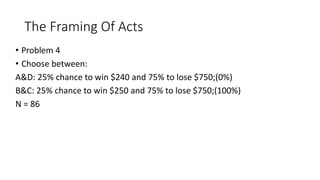
• Problem 4
• Choose between:
A&D: 25% chance to win $240 and 75% to lose $750;(0%)
B&C: 25% chance to win $250 and 75% to lose $750;(100%)
N = 86
The framing of contingencies
• Problem 5
Which of the following option do you prefer?
I) A sure loss of $30;(78%)
II) 80% chance to win $45;(22%)
The framing of contingencies
• Problem 6 [N = 85]:
• Consider the following two stage game. In the first stage, there is a
75% chance to end the game without winning anything, and a 25%
chance to move into the second stage. If you reach the second stage,
you have a choice between:
• C. a sure win of $30 [74 percent]
• D. 8% chance to win $45 [26 percent]
• Your choice must be made before the game starts, i.e., before the
outcome of the first stage is known. Please indicate the option you
prefer?
The framing of contingencies
• Problem 7 [N = 81]:
• Which of the following options do you prefer?
• E. 25% chance to win $30 [42 percent]
• P. 2Wh chance to win $45 [58 percent]
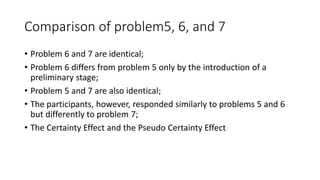
Comparison of problem5, 6, and 7
• Problem 6 and 7 are identical;
• Problem 6 differs from problem 5 only by the introduction of a
preliminary stage;
• Problem 5 and 7 are also identical;
• The participants, however, responded similarly to problems 5 and 6
but differently to problem 7;
• The Certainty Effect and the Pseudo Certainty Effect
The Framing Of Outcomes
• Outcomes are commonly perceived as positive or negative in relation to a reference
outcome that is judged neutral.
• Variations of the reference point can therefore determine whether a given outcome is
evaluated as a gain or as a loss.
• We propose that people generally evaluate acts in terms of a minimal account, which includes
only the direct consequences of the act.
The Framing Of Outcomes
• Problem 8 [N = 183]:
• Imagine that you have decided to see a play where admission is $10
per ticket. As you enter the theater, you discover that you have lost a
$10 bill. Would you still pay $10 for a ticket for the play?
• Yes [88 percent] No [12 percent]
The Framing Of Outcomes
• Problem 9 [N = 200]:
• Imagine that you have decided to see a play and paid the admission
price of $10 per ticket. As you enter the theater, you discover that you
have lost the ticket. The seat was not marked and the ticket cannot be
recovered. Would you pay $10 for another ticket?
• Yes [46 percent] No [54 percent]

Framing effect studies

  • 1.
    A Quick ReviewOf Framing Effect Studies Amir Mohammad Tahamtan
  • 2.
    Outline • A Briefreview of Economic Choice Modelling • Expected Utility Theory • Prospect Theory • Selected Studies Of Framing Effect in • Game Theory • WTP/WTA • Law and economics • Insurance behavior • Health behavior • International Trade
  • 3.
  • 4.
    Prospect theory • Thevalue of a risky prospect is calculated as follows: • ∏(p)*v(x) + ∏(q)*v(y) outcome probability x p y q Status quo 1-p-q
  • 5.
    Properties of thevalue function v(.) • is commonly S-shaped, concave above the reference point and convex below it • the response to losses is more extreme than the response to gains • Consider, for example, the Asian disease problem
  • 6.
    The Example Of“Asian Disease Outbreak” • Problem 1 : Program A: 200 people will be saved; (72%) Program B: 1/3 probability 600 people will be saved and 2/3 will be saved; (28%) • Problem 2: Program C: 400 people will die; (22%) Program D: 1/3 probability nobody will die and 2/3 probability 600 people will die; (78%)
  • 7.
    The value functionof the above example
  • 8.
    Properties of the∏(.) • ∏(0) = 0 • ∏(1) = 1; but the function is not well-behaved near the endpoints • low probabilities are overweighted, moderate and high probabilities are underweighted; • ∏(pq)/ ∏(p) < ∏(pqr)/ ∏(pr); for 0<p,q,r≤1
  • 9.
    Framing effect ingame theory • Anomalies: Ultimatums, Dictators and Manners, Camerer, Colin and Thaler, Richard H., Journal of Economic Perspective, 1995; • Developments in non-expected utility theory: the hunt for a descriptive theory of choice under risk, Starmer, Chris, Journal of economic literature; 2000 • The effects of framing and negotiator overconfidece on bargaining behaviors and outcomes, Neale, Margaret, Bazerman, Max, Academy of management journal, 1985; • Comparing students to workers: the effects of social framing on behavior in distribution games, Carpenter, Jeffrey P., Burks, Stephen, Verhoogen, Eric, 2005; • Cognition and framing in sequential bargaining for gains and losses, Camerer, Colin, Johnson, Eric J., • Warm-Glow Versus Cold-Prickle: The Effects of Positive and Negative Framing on Cooperation in Experiments, Andreoni, James, Oxford journal, 1995; • Warm-glow versus cold-prickle: a further experimental study of framing effects on free-riding, Park, Eun-Soo, 2000
  • 10.
    Cognition and framingin sequential bargaining for gains and losses • Studies have found systematic deviations between the offers people make and perfect equilibrium offers derived from backward induction • In previous experiments, subjects actually offer the second player something between the $1.25 equilibrium and $2.50, an equal split of the initial pie. Mean offers are around $2.00. Lower offers, including equilibrium offers of $1.25, are often rejected
  • 11.
    Cognition and framingin sequential bargaining for gains and losses • Two players bargain by making a finite number of alternating offers; Three-round game with a pie of $5.00 and a 50-percent discount factor • Subjects began with $5 for each round. Then the players bargained over division of a loss of $5.00 in the first round, a loss of $7.50 in the second round, and a loss of $8.75 in the third round • Results: the average offer was $2.22, i.e. player 1 offered player 2 a loss of -$2.78. low offers were very frequently rejected.
  • 12.
    The Effects ofPositive and Negative Framing on Cooperation in Experiments • The lack of free riding in experiments presents an especially interesting challenge for economists • Free riding is a dominant-strategy Nash equilibrium • Saying that an investment in the public good will make others better off is equivalent to stating that an investment in the private good will make others worse off • ∏i= xi +1/2gi +1/2 𝑖≠𝑗 gi, s.t. gi + xi = 60 : making others better off • ∏i= xi +1/2gi +1/2 𝑖≠𝑗 (60 − xi) = xi +1/2gi-1/2 𝑖≠𝑗 xj: making others worse off
  • 13.
    The Effects ofPositive and Negative Framing on Cooperation in Experiments • Positive frame condition: cooperation starts 47% and decay to 21%, overall contribution 34%. • Negative frame condition: cooperation starts 27% and decay to 1%, overall contribution 16.2%.
  • 14.
    Warm-glow vs coldprickle: further study • There is a significant difference between the two framing conditions in terms of overall contribution rates, there is no significant difference for some subjects. • The data strongly suggest that the negative framing has a most salient effect on the subjects who have individualistic value orientation, whereas the negative framing has a rather insignificant effect on the subjects who have cooperative value orientation.
  • 15.
    The effects offraming on bargaining behaviors and outcomes • Negotiation often is viewed in terms of what players have to lose • Consider, for example, labor-management bargaining over wage • Following the prospect theory’s proposition, they will respond in a risk-seeking manner and are likely to choose arbitration
  • 16.
    The effects offraming on bargaining behaviors and outcomes • The negatively-framed condition: Any concessions beyond those granted will represent serious financial losses to the company. Please remember that your primary objective is to minimize such losses to the company… • The positively-framed condition: Any union concession from their current position will result in gains for the company. Please remember that your primary objective is to maximize such losses to the company…
  • 17.
  • 18.
    Comparing students toworkers • Verbal cues are not the only factor that shapes subjects’ beliefs; Subjects’ beliefs are also influenced by the real-life social context. • The Ultimatum Game and the Dictator Game are conducted among Middlebury college and people in a publishing distribution warehouse in Kansas city. • To control for the demographic characteristics of the participant populations, a third round of the experiment was run in which the participant are the students of a junior college near the warehouse.
  • 19.
    Results • Both groupsof students exhibit a large drop in mean allocations between the UG and DG experiments, while the workers offer the same amount, on average, in both games. • Explanation: Workers see each other every day. However, students are more likely to be in competition for grades,
  • 20.
    Selected Studies inHealth WTP/WTA • A Review of WTA/WTP Studies, Horowitz, John K. and McConnell, Kenneth E., 1999, • Are Experimental Economists Prone to Framing Effects?, Gächter, Simon et,al., 2008, • The Influence of Framing on Willingness to Pay: An Explanation for the Uncertainty Effect, Yang, Yang,, Loewenstein, George,
  • 21.
    Are Experimental EconomistsProne To Framing Effect? • The participants were junior and senior experimental scientists (mostly economists) who registered for the 2006 Economic Science Association (ESA) meeting in Nottingham, UK • The experimental framing manipulation concerned the fee for late/early registration.
  • 22.
    Are Experimental EconomistsProne To Framing Effect? • “We take this opportunity to remind you that the discounted conference fee for early registration is available until 10 July 2006.” • “We take this opportunity to remind you that the conference fee will include penalty for late registration after 10 July 2006.”
  • 23.
    Are Experimental EconomistsProne To Framing Effect?
  • 24.
    Are Experimental EconomistsProne To Framing Effect?
  • 25.
    The Influence OfFraming On WTP • The concept of “Uncertainty Effect” or UE; • A Risky Prospect Is Valued Less Than Its Worst Possible Outcome • The average WTP of $26 for a $50 gift certificate for Barnes and Noble, but only $16 for a lottery of winning $50 or $100 with equal probability.
  • 26.
    The Influence OfFraming On WTP • Why does the UE occur when people value lotteries, but not when they value equivalent uncertain outcomes in the form of consumer promotions or uncertain gift certificates? • Framing a prospect as a “lottery ticket”, “raffle”, “gamble”, or “coin flip” dramatically reduces WTP as opposed to framing it as an “uncertain gift certificate” or “voucher”.
  • 27.
    The Influence OfFraming On WTP • What Causes WTP To Be Lower Under The Lottery, Coin Flip, Raffle, And Gamble Frame? • Subjective Uncertainty • Processing Disfluency • Negative Attitudes Towards Lotteries • Differences In Aleatory Uncertainty Or Mental Representations Of Uncertainty • Anticipated Disappointment • Anchoring • Associations With The Concept Gambling • Beliefs About What Others Would Be Willing To Pay Under These Frames.
  • 28.
    The Influence OfFraming On WTP • Framing affects only WTP but not WTA • The only explanation that is consistent across all twelve experiments is that these frames evoke lower reference prices.
  • 29.
    Selected Studies inlaw and Economics • Experimental Law and economics, Colin, Camerer and Talley, Eric, 2004; • Expressive law: framing or equilibrium selection, Bohnet, Iris and Cooter, Robert, 2001; • Framing the Jury: Cognitive perspectives on pain and suffering awards, McCaffery, Edward and Kahneman, Daniel, Virginia Law review, 1995
  • 30.
    Expressive law: framingor equilibrium selection • Law’s largest effects come from coordination • Normative systems have multiple equilibria, so announcing a new law can change expectations and cause behavior to jump from one equilibrium to another • Prison dilemma was run in which choosing defection results in penalty 10% of the time • The power of the penalty to coordinate increased as the proportion of actors decreased whose cooperation was needed to tip the system to a Pareto superior equilibrium
  • 31.
    Selected readings ininsurance behavior • Framing, Probability distortions, and insurance decisions, Johnson, Eric, Hershely, John, Journal of risk and uncertainty, 1993
  • 32.
    Framing, Probability distortions,and insurance decisions • Eisner and Strotz (1961) argue that people pay far more for flight insurance than they should • Kunreuther et al. (1978) have demonstrated that people do not buy flood insurance even when it is greatly subsidized and priced far below its actuarially fair value • There are three component of insurance decision: • the risk itself • the policy premium • the benefit
  • 33.
    Selected readings inhealth behavior • Framing of decisions and selection of alternatives in health care, Wilson, Dawn, Kaplan, Robert, social behavior, 1987 • Fuzzy-trace Theory and Framing Effects in choice: Gist Extraction, Truncation, and conversion, Journal of behavioral decision making, 1991; • Is there something more important behind framing? Li, Shu and Adams, Austin, organizational behavior and human decision process, 1995 • Risky decision making and allocation of resources for leukemia and AIDS programs, Levin, Irwin and Chapman, Daniel, health psychology, 1993; • Shaping perceptions to motivate healthy behavior: the role of message framing, Rothman, Alexander, Salovey, Peter, Psychological bulletin,1997 • The effect of message framing on breast self-examination attitudes, intentions, and behavior, Meyerowitz, Beth, Journal of personality and social psychology, 1987 • The effects of message framing on mammography utilization, Banks, Sara, health psychology, 1995 • The influence of message framing on intentions to perform health behaviors, Rothman, Alexander, journal of experimental social psychology, 1993
  • 34.
    Framing effect and health behavior Publichealth decisions AIDS Nuclear accidents Cancer Natural gas explosionss Personal health decisions Whether to undergo surgery Breast self- examination
  • 35.
    Selected studies ininternational trade • Through a glass and a darkly: Attitudes Toward International Trade and the Curious Effects of Issue Framing, Hiscox, Michael J., 2004
  • 36.
    Attitudes Toward InternationalTrade and the Curious Effects of Issue Framing
  • 37.
    The Framing ofDecisions and the Psychology of Choice • The Framing Of Acts • The Framing Of Contingencies • The Framing Of Outcomes
  • 38.
    The Framing OfActs • Problem 3: Imagine that you face the following pair of concurrent decisions Decision I: A. a sure gain of $240; (84%) B. 25% chance to gain $1000 and 75% to gain nothing; (16%) Decision II: C. a sure loss of $750; (13%) D. 75% chance to lose $1000 and 25% to lose nothing; (87%) N = 150
  • 39.
    The Framing OfActs • Problem 4 • Choose between: A&D: 25% chance to win $240 and 75% to lose $750;(0%) B&C: 25% chance to win $250 and 75% to lose $750;(100%) N = 86
  • 40.
    The framing ofcontingencies • Problem 5 Which of the following option do you prefer? I) A sure loss of $30;(78%) II) 80% chance to win $45;(22%)
  • 41.
    The framing ofcontingencies • Problem 6 [N = 85]: • Consider the following two stage game. In the first stage, there is a 75% chance to end the game without winning anything, and a 25% chance to move into the second stage. If you reach the second stage, you have a choice between: • C. a sure win of $30 [74 percent] • D. 8% chance to win $45 [26 percent] • Your choice must be made before the game starts, i.e., before the outcome of the first stage is known. Please indicate the option you prefer?
  • 42.
    The framing ofcontingencies • Problem 7 [N = 81]: • Which of the following options do you prefer? • E. 25% chance to win $30 [42 percent] • P. 2Wh chance to win $45 [58 percent]
  • 43.
    Comparison of problem5,6, and 7 • Problem 6 and 7 are identical; • Problem 6 differs from problem 5 only by the introduction of a preliminary stage; • Problem 5 and 7 are also identical; • The participants, however, responded similarly to problems 5 and 6 but differently to problem 7; • The Certainty Effect and the Pseudo Certainty Effect
  • 44.
    The Framing OfOutcomes • Outcomes are commonly perceived as positive or negative in relation to a reference outcome that is judged neutral. • Variations of the reference point can therefore determine whether a given outcome is evaluated as a gain or as a loss. • We propose that people generally evaluate acts in terms of a minimal account, which includes only the direct consequences of the act.
  • 45.
    The Framing OfOutcomes • Problem 8 [N = 183]: • Imagine that you have decided to see a play where admission is $10 per ticket. As you enter the theater, you discover that you have lost a $10 bill. Would you still pay $10 for a ticket for the play? • Yes [88 percent] No [12 percent]
  • 46.
    The Framing OfOutcomes • Problem 9 [N = 200]: • Imagine that you have decided to see a play and paid the admission price of $10 per ticket. As you enter the theater, you discover that you have lost the ticket. The seat was not marked and the ticket cannot be recovered. Would you pay $10 for another ticket? • Yes [46 percent] No [54 percent]

Editor's Notes

  • #39 This pattern of risk aversion in choices involving gains and risk seeking in choices involving losses is attributable to the properties of v and . The most common pattern (A and D) was chosen by 73 percent of respondents, while the least popular pattern (B and C) was chosen by only 3 percent of respondents. However, the combination of B and C is definitely superior to the combination A and D.