HOW CHOICE MODIFIES
PREFERENCE: NEURAL
CORRELATES OF CHOICE
JUSTIFICATION
Jungang Qin and et al.
5/15/2016 1
OUTLINE
Introduction
Determining the regions of interest (ROI)
Materials and methods
Data analysis
Results
 Behavioral results
 fMRI Results
Discussion
 Neural mechanisms of choice justification
 Neural markers of preferences
 Neural activations that predicted choices
Conclusion
5/15/2016 2
INTRODUCTION
Cognitive dissonance theory and research dominated social
psychology from the 1950s until the 1970s.
The theory revolutionized thinking about psychological processes,
particularly regarding how rewards affect attitudes and behavior and
how behavior and motivation affect perception and cognition.
Festinger theorized that, when an individuals holds two or more
elements of knowledge that are relevant to each other but
inconsistent with one another, a state of discomfort is created called
dissonance.
The degree of dissonance in relation to a cognition =
𝐷
𝐷+𝐶
5/15/2016 3
INTRODUCTION
Experimental paradigms used to test the theory
 Free choice: Brehm, 1956, examined the theory for post-decision processing.
 Induced compliance: Festinger and Carlsmith,1959, hypothesized that dissonance
should be aroused when a person acts in a way that is contrary to his or her
attitudes.
 Effort justification: dissonance is aroused whenever a person engages in an
unpleasant activity to obtain some desirable outcome. Dissonance should be
greater, the greater the unpleasant effort required to obtain the outcome. Aronson
and Mills, 1959, had women undergo a severe and mild “initiation” to become a
member of a group.
5/15/2016 4
DETERMINING THE REGIONS OF
INTEREST (ROI)
Van Veen et al. (2009) found that neural activity in the dorsal
ACC(detection of cognitive dissonance) and in the anterior insula
(aversive somatic arousal) increased to statements that conflicted
with subjective feelings.
Jarcho et al. have found choice justification is reliably predicted by
increased in the right inferior frontal gyrus(inhibition of competing
information) and medial frontoparietal regions(inhibition conscious
attention) during the choice.
Sharot et al. (2009) found that the attitude change involved in
dissonance was mirrored by caudate activations in relation to the
chosen and rejected items after the choice.
5/15/2016 5
DETERMINING THE REGIONS OF
INTEREST (ROI)
Steele(1988) has found that choice justification is eliminated when
one's sense of the self is affirmed after making a difficult choice 
self-related brain regions: ventral MFPC, and dorsal/ventral lateral
prefrontal cortex.
Because the public sense of the self involves taking the perspectives
of others  mind-reading brain regions: temporal–parietal
junction(TPJ) and dorsal MPFC.
Since individuals justify their choices by inhibiting choice inconsistent
information while augmenting choice-consistent information:
regulation regulation brain areas: the dorsal MPFC, the dorsal LPFC,
the inferior frontal gyrus.
Choice justification might be tracked by neural activity that is related
to subjectively experienced preferences  preferences-related brain
areas: caudate, ventral MPFC, and/or PCC.5/15/2016 6
MATERIALS AND METHODS
Subjects: 16 undergrads and grads.
Stimuli: 60 popular music CDs, including 48 CDs and 12
European/American.
Experimental design
 Pre-scanning procedure
 Pre-choice session
 Free Choice
 Post-choice session
 Post-scanning procedure
5/15/2016 7
DATA ANALYSIS
There were six types of trials in the experiment:
1. Preference judgments for chosen CDs during pre-choice session
2. Preference judgments for rejected CDs during pre-choice session
3. Preference judgments for chosen CDs during post-choice session
4. preference judgments for rejected CDs during post-choice session
5. Recency judgment during pre-choice session
6. Recency judgment during post-choice session
Reversely contrasting signal of BOLD (blood oxygenation level dependent)
of (1,3),(2,4),((5,6),(1,2,3,4))
5/15/2016 8
BEHAVIORAL RESULTS
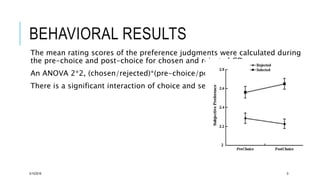
The mean rating scores of the preference judgments were calculated during
the pre-choice and post-choice for chosen and rejected CDs.
An ANOVA 2*2, (chosen/rejected)*(pre-choice/post-choice)
There is a significant interaction of choice and session.
5/15/2016 9
fMRI Results
To identify neural activities associated with post-choice
attitude change, the change in preference rating by
subtracting the rating score of each CD in the pre-choice
sessions from rating score of the same CD in the post-
choice session.
5/15/2016 10
fMRI Results
5/15/2016 11
DISCUSSION: NEURAL MECHANISM
OF CHOICE JUSTIFICATION
The increase of liking for chosen CDs was highly significant, but the
decrease of liking for rejected CDs was not  the CDs were not
highly attractive.
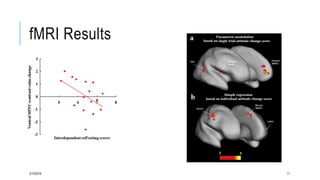
The fMRI results uncovered neural activities associated with trial-by-
trial attitude change in the ventral MPFC(self-reference processing),
right TPJ(perspective taking during mental attribution), anterior
insula(negative somatic arousal), and bilateral cerebellum.
There was a positive relationship between overall attitude change
score with the dorsal MPFC, left LPFC, and right precentral cortex.
5/15/2016 12
NEURAL MARKERS OF
PREFERENCES
Parametric modulation analysis showed that PCC activity was
positively correlated with subjects' preference.
PCC is positively correlated with the perceive desirability of objects or
the subjective value of delayed monetary rewards.
Because the PCC is also implicated in self-referential processing and
autobiographic memory, this brain region might play a significant
role in indexing preferences that are grounded in the personal self.
5/15/2016 13
NEURAL MECHANISM THAT
PREDICTED CHOICES
Activations in the anterior insula  preference judgment of rejected
CDs.
Activations in the PCC  preference judgment of chosen CDs.
5/15/2016 14
CONCLUSION
The fMRI study suggests that that self-reflection (the ventral MPFC)
that is mediated by perspective taking (TPJ) is crucially involved in
choice justification.
The study found a correlation between the variation of the ventral
MPFC activity and subjective ratings of interdependent self contrual.
5/15/2016 15

How choice midifies preference

  • 1.
    HOW CHOICE MODIFIES PREFERENCE:NEURAL CORRELATES OF CHOICE JUSTIFICATION Jungang Qin and et al. 5/15/2016 1
  • 2.
    OUTLINE Introduction Determining the regionsof interest (ROI) Materials and methods Data analysis Results  Behavioral results  fMRI Results Discussion  Neural mechanisms of choice justification  Neural markers of preferences  Neural activations that predicted choices Conclusion 5/15/2016 2
  • 3.
    INTRODUCTION Cognitive dissonance theoryand research dominated social psychology from the 1950s until the 1970s. The theory revolutionized thinking about psychological processes, particularly regarding how rewards affect attitudes and behavior and how behavior and motivation affect perception and cognition. Festinger theorized that, when an individuals holds two or more elements of knowledge that are relevant to each other but inconsistent with one another, a state of discomfort is created called dissonance. The degree of dissonance in relation to a cognition = 𝐷 𝐷+𝐶 5/15/2016 3
  • 4.
    INTRODUCTION Experimental paradigms usedto test the theory  Free choice: Brehm, 1956, examined the theory for post-decision processing.  Induced compliance: Festinger and Carlsmith,1959, hypothesized that dissonance should be aroused when a person acts in a way that is contrary to his or her attitudes.  Effort justification: dissonance is aroused whenever a person engages in an unpleasant activity to obtain some desirable outcome. Dissonance should be greater, the greater the unpleasant effort required to obtain the outcome. Aronson and Mills, 1959, had women undergo a severe and mild “initiation” to become a member of a group. 5/15/2016 4
  • 5.
    DETERMINING THE REGIONSOF INTEREST (ROI) Van Veen et al. (2009) found that neural activity in the dorsal ACC(detection of cognitive dissonance) and in the anterior insula (aversive somatic arousal) increased to statements that conflicted with subjective feelings. Jarcho et al. have found choice justification is reliably predicted by increased in the right inferior frontal gyrus(inhibition of competing information) and medial frontoparietal regions(inhibition conscious attention) during the choice. Sharot et al. (2009) found that the attitude change involved in dissonance was mirrored by caudate activations in relation to the chosen and rejected items after the choice. 5/15/2016 5
  • 6.
    DETERMINING THE REGIONSOF INTEREST (ROI) Steele(1988) has found that choice justification is eliminated when one's sense of the self is affirmed after making a difficult choice  self-related brain regions: ventral MFPC, and dorsal/ventral lateral prefrontal cortex. Because the public sense of the self involves taking the perspectives of others  mind-reading brain regions: temporal–parietal junction(TPJ) and dorsal MPFC. Since individuals justify their choices by inhibiting choice inconsistent information while augmenting choice-consistent information: regulation regulation brain areas: the dorsal MPFC, the dorsal LPFC, the inferior frontal gyrus. Choice justification might be tracked by neural activity that is related to subjectively experienced preferences  preferences-related brain areas: caudate, ventral MPFC, and/or PCC.5/15/2016 6
  • 7.
    MATERIALS AND METHODS Subjects:16 undergrads and grads. Stimuli: 60 popular music CDs, including 48 CDs and 12 European/American. Experimental design  Pre-scanning procedure  Pre-choice session  Free Choice  Post-choice session  Post-scanning procedure 5/15/2016 7
  • 8.
    DATA ANALYSIS There weresix types of trials in the experiment: 1. Preference judgments for chosen CDs during pre-choice session 2. Preference judgments for rejected CDs during pre-choice session 3. Preference judgments for chosen CDs during post-choice session 4. preference judgments for rejected CDs during post-choice session 5. Recency judgment during pre-choice session 6. Recency judgment during post-choice session Reversely contrasting signal of BOLD (blood oxygenation level dependent) of (1,3),(2,4),((5,6),(1,2,3,4)) 5/15/2016 8
  • 9.
    BEHAVIORAL RESULTS The meanrating scores of the preference judgments were calculated during the pre-choice and post-choice for chosen and rejected CDs. An ANOVA 2*2, (chosen/rejected)*(pre-choice/post-choice) There is a significant interaction of choice and session. 5/15/2016 9
  • 10.
    fMRI Results To identifyneural activities associated with post-choice attitude change, the change in preference rating by subtracting the rating score of each CD in the pre-choice sessions from rating score of the same CD in the post- choice session. 5/15/2016 10
  • 11.
  • 12.
    DISCUSSION: NEURAL MECHANISM OFCHOICE JUSTIFICATION The increase of liking for chosen CDs was highly significant, but the decrease of liking for rejected CDs was not  the CDs were not highly attractive. The fMRI results uncovered neural activities associated with trial-by- trial attitude change in the ventral MPFC(self-reference processing), right TPJ(perspective taking during mental attribution), anterior insula(negative somatic arousal), and bilateral cerebellum. There was a positive relationship between overall attitude change score with the dorsal MPFC, left LPFC, and right precentral cortex. 5/15/2016 12
  • 13.
    NEURAL MARKERS OF PREFERENCES Parametricmodulation analysis showed that PCC activity was positively correlated with subjects' preference. PCC is positively correlated with the perceive desirability of objects or the subjective value of delayed monetary rewards. Because the PCC is also implicated in self-referential processing and autobiographic memory, this brain region might play a significant role in indexing preferences that are grounded in the personal self. 5/15/2016 13
  • 14.
    NEURAL MECHANISM THAT PREDICTEDCHOICES Activations in the anterior insula  preference judgment of rejected CDs. Activations in the PCC  preference judgment of chosen CDs. 5/15/2016 14
  • 15.
    CONCLUSION The fMRI studysuggests that that self-reflection (the ventral MPFC) that is mediated by perspective taking (TPJ) is crucially involved in choice justification. The study found a correlation between the variation of the ventral MPFC activity and subjective ratings of interdependent self contrual. 5/15/2016 15