CAN SMALL DEVIATIONS FROM
RATIONALITY MAKE
SIGNIFICANT DIFFERENCES TO
ECONOMIC EQUILIBRIA?
George A. Akerlof and
Janet L. Yellen
OUTLINE
Introduction
Implications of the Envelope Theorem
Near-Rational Behavior in a Pure Exchange Economy
The Welfare Effects of Near-Rational Behavior in the presence of
Distortions
 Monopoly and Technical Change
 The welfare Consequences of Money Supply Shocks
Conclusion
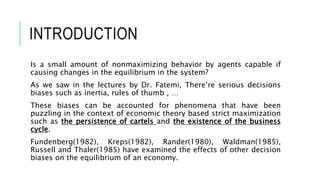
INTRODUCTION
Is a small amount of nonmaximizing behavior by agents capable if
causing changes in the equilibrium in the system?
As we saw in the lectures by Dr. Fatemi, There’re serious decisions
biases such as inertia, rules of thumb , …
These biases can be accounted for phenomena that have been
puzzling in the context of economic theory based strict maximization
such as the persistence of cartels and the existence of the business
cycle.
Fundenberg(1982), Kreps(1982), Rander(1980), Waldman(1985),
Russell and Thaler(1985) have examined the effects of other decision
biases on the equilibrium of an economy.
IMPLICATIONS OF THE ENVELOPE
THEOREM: THE BASIC LOGIC OF
THE PAPER
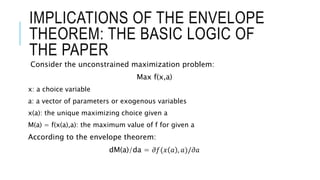
Consider the unconstrained maximization problem:
Max f(x,a)
x: a choice variable
a: a vector of parameters or exogenous variables
x(a): the unique maximizing choice given a
M(a) = f(x(a),a): the maximum value of f for given a
According to the envelope theorem:
dM(a)/da = 𝜕𝑓(𝑥 𝑎 , 𝑎)/𝜕𝑎
IMPLICATIONS OF THE ENVELOPE
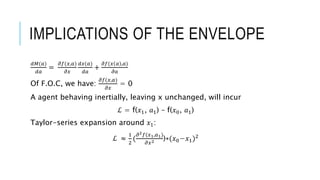
𝑑𝑀(𝑎)
𝑑𝑎
=
𝜕𝑓(𝑥,𝑎)
𝜕𝑥
𝑑𝑥(𝑎)
𝑑𝑎
+
𝜕𝑓(𝑥 𝑎 ,𝑎)
𝜕𝑎
Of F.O.C, we have:
𝜕𝑓(𝑥,𝑎)
𝜕𝑥
= 0
A agent behaving inertially, leaving x unchanged, will incur
ℒ = f(𝑥1, 𝑎1) – f(𝑥0, 𝑎1)
Taylor-series expansion around 𝑥1:
ℒ ≈
1
2
(
𝜕2 𝑓(𝑥1,𝑎1)
𝜕𝑥2 )∗(𝑥0−𝑥1)2
IMPLICATIONS OF THE ENVELOPE
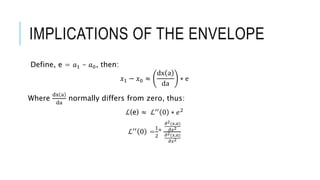
Define, e = 𝑎1 – 𝑎0, then:
𝑥1 − 𝑥0 ≈
dx a
da
∗ e
Where
dx a
da
normally differs from zero, thus:
ℒ(e) ≈ ℒ′′ 0 ∗ 𝑒2
ℒ′′
0 =
1
2
*
𝜕2(𝑥,𝑎)
𝜕𝑥2
𝜕2(𝑥,𝑎)
𝜕𝑥2
IMPLICATIONS OF THE ENVELOPE
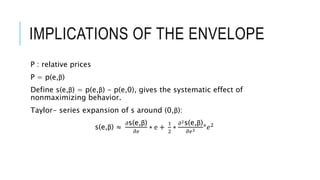
P : relative prices
P = p(e,β)
Define s(e,β) = p(e,β) - p(e,0), gives the systematic effect of
nonmaximizing behavior.
Taylor- series expansion of s around (0,β):
s(e,β) ≈
𝜕s(e,β)
𝜕𝑒
∗ e +
1
2
∗
𝜕2s(e,β)
𝜕𝑒2 *𝑒2
NEAR-RATIONAL BEHAVIOR IN A PURE
EXCHANGE ECONOMY
Proposition 1:
𝑑𝑈 𝑚
𝑑𝑒
=
𝑑𝑈 𝑛
𝑑𝑒
𝑑𝑉 𝑚
𝑑𝑒
=
𝑑𝑉 𝑛
𝑑𝑒
𝑈 𝑚(e,β) = u(p(e, β),𝑥1
−
+p(e, β) 𝑥2
−
(1 + 𝑒))
𝑑𝑈 𝑚
𝑑𝑒
= λ1[𝑝 𝑜 𝑥2
−
+(𝑥2
−
-𝑥2
𝑜
)
𝑑𝑝
𝑑𝑒
]
NEAR-RATIONAL BEHAVIOR IN A
PURE EXCHANGE ECONOMY
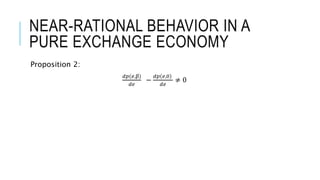
Proposition 2:
𝑑𝑝(𝑒,β)
𝑑𝑒
−
𝑑𝑝 𝑒,0
𝑑𝑒
≠ 0
Monopoly and Technical Change
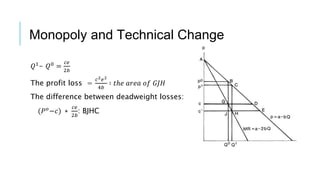
𝑄1- 𝑄0 =
𝑐𝑒
2𝑏
The profit loss =
𝑐2 𝑒2
4𝑏
∶ 𝑡ℎ𝑒 𝑎𝑟𝑒𝑎 𝑜𝑓 𝐺𝐽𝐻
The difference between deadweight losses:
(𝑃 𝑜
−𝑐) ∗
𝑐𝑒
2𝑏
: BJHC
The welfare Consequences of Money
Supply Shocks
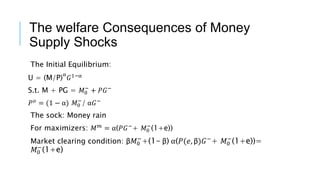
The Initial Equilibrium:
U = (M/P)
α
𝐺1−α
S.t. M + PG = 𝑀0
−
+ 𝑃𝐺−
𝑃 𝑜
= (1 − α) 𝑀0
−
/ α𝐺−
The sock: Money rain
For maximizers: 𝑀 𝑚 = α(𝑃𝐺−+ 𝑀0
−
(1+e))
Market clearing condition: β𝑀0
−
+(1- β) α(𝑃(𝑒, β)𝐺−
+ 𝑀0
−
(1+e))=
𝑀0
−
(1+e)
THE WELFARE CONSEQUENCES OF
MONEY SUPPLY SHOCKS
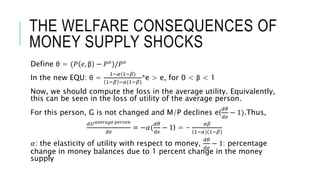
Define θ = (𝑃 𝑒, β − 𝑃 𝑜)/𝑃 𝑜
In the new EQU: θ =
1−𝛼(1−𝛽)
1−𝛽 −𝛼(1−𝛽)
*e > e, for 0 < β < 1
Now, we should compute the loss in the average utility. Equivalently,
this can be seen in the loss of utility of the average person.
For this person, G is not changed and M/P declines e(
𝑑𝜃
𝑑𝑒
− 1).Thus,
𝑑𝑈 𝑎𝑣𝑒𝑟𝑎𝑔𝑒 𝑝𝑒𝑟𝑠𝑜𝑛
𝑑𝑒
= −𝛼(
𝑑𝜃
𝑑𝑒
− 1) = -
𝛼𝛽
(1−𝛼)(1−𝛽)
𝛼: the elasticity of utility with respect to money,
𝑑𝜃
𝑑𝑒
− 1: percentage
change in money balances due to 1 percent change in the money
supply
CONCLUSION
There are serious welfare and policy implications due to decision
biases identified.

Can small deviation from rationality make significant differences to economic equilibia

  • 1.
    CAN SMALL DEVIATIONSFROM RATIONALITY MAKE SIGNIFICANT DIFFERENCES TO ECONOMIC EQUILIBRIA? George A. Akerlof and Janet L. Yellen
  • 2.
    OUTLINE Introduction Implications of theEnvelope Theorem Near-Rational Behavior in a Pure Exchange Economy The Welfare Effects of Near-Rational Behavior in the presence of Distortions  Monopoly and Technical Change  The welfare Consequences of Money Supply Shocks Conclusion
  • 3.
    INTRODUCTION Is a smallamount of nonmaximizing behavior by agents capable if causing changes in the equilibrium in the system? As we saw in the lectures by Dr. Fatemi, There’re serious decisions biases such as inertia, rules of thumb , … These biases can be accounted for phenomena that have been puzzling in the context of economic theory based strict maximization such as the persistence of cartels and the existence of the business cycle. Fundenberg(1982), Kreps(1982), Rander(1980), Waldman(1985), Russell and Thaler(1985) have examined the effects of other decision biases on the equilibrium of an economy.
  • 4.
    IMPLICATIONS OF THEENVELOPE THEOREM: THE BASIC LOGIC OF THE PAPER Consider the unconstrained maximization problem: Max f(x,a) x: a choice variable a: a vector of parameters or exogenous variables x(a): the unique maximizing choice given a M(a) = f(x(a),a): the maximum value of f for given a According to the envelope theorem: dM(a)/da = 𝜕𝑓(𝑥 𝑎 , 𝑎)/𝜕𝑎
  • 5.
    IMPLICATIONS OF THEENVELOPE 𝑑𝑀(𝑎) 𝑑𝑎 = 𝜕𝑓(𝑥,𝑎) 𝜕𝑥 𝑑𝑥(𝑎) 𝑑𝑎 + 𝜕𝑓(𝑥 𝑎 ,𝑎) 𝜕𝑎 Of F.O.C, we have: 𝜕𝑓(𝑥,𝑎) 𝜕𝑥 = 0 A agent behaving inertially, leaving x unchanged, will incur ℒ = f(𝑥1, 𝑎1) – f(𝑥0, 𝑎1) Taylor-series expansion around 𝑥1: ℒ ≈ 1 2 ( 𝜕2 𝑓(𝑥1,𝑎1) 𝜕𝑥2 )∗(𝑥0−𝑥1)2
  • 6.
    IMPLICATIONS OF THEENVELOPE Define, e = 𝑎1 – 𝑎0, then: 𝑥1 − 𝑥0 ≈ dx a da ∗ e Where dx a da normally differs from zero, thus: ℒ(e) ≈ ℒ′′ 0 ∗ 𝑒2 ℒ′′ 0 = 1 2 * 𝜕2(𝑥,𝑎) 𝜕𝑥2 𝜕2(𝑥,𝑎) 𝜕𝑥2
  • 7.
    IMPLICATIONS OF THEENVELOPE P : relative prices P = p(e,β) Define s(e,β) = p(e,β) - p(e,0), gives the systematic effect of nonmaximizing behavior. Taylor- series expansion of s around (0,β): s(e,β) ≈ 𝜕s(e,β) 𝜕𝑒 ∗ e + 1 2 ∗ 𝜕2s(e,β) 𝜕𝑒2 *𝑒2
  • 8.
    NEAR-RATIONAL BEHAVIOR INA PURE EXCHANGE ECONOMY Proposition 1: 𝑑𝑈 𝑚 𝑑𝑒 = 𝑑𝑈 𝑛 𝑑𝑒 𝑑𝑉 𝑚 𝑑𝑒 = 𝑑𝑉 𝑛 𝑑𝑒 𝑈 𝑚(e,β) = u(p(e, β),𝑥1 − +p(e, β) 𝑥2 − (1 + 𝑒)) 𝑑𝑈 𝑚 𝑑𝑒 = λ1[𝑝 𝑜 𝑥2 − +(𝑥2 − -𝑥2 𝑜 ) 𝑑𝑝 𝑑𝑒 ]
  • 9.
    NEAR-RATIONAL BEHAVIOR INA PURE EXCHANGE ECONOMY Proposition 2: 𝑑𝑝(𝑒,β) 𝑑𝑒 − 𝑑𝑝 𝑒,0 𝑑𝑒 ≠ 0
  • 10.
    Monopoly and TechnicalChange 𝑄1- 𝑄0 = 𝑐𝑒 2𝑏 The profit loss = 𝑐2 𝑒2 4𝑏 ∶ 𝑡ℎ𝑒 𝑎𝑟𝑒𝑎 𝑜𝑓 𝐺𝐽𝐻 The difference between deadweight losses: (𝑃 𝑜 −𝑐) ∗ 𝑐𝑒 2𝑏 : BJHC
  • 11.
    The welfare Consequencesof Money Supply Shocks The Initial Equilibrium: U = (M/P) α 𝐺1−α S.t. M + PG = 𝑀0 − + 𝑃𝐺− 𝑃 𝑜 = (1 − α) 𝑀0 − / α𝐺− The sock: Money rain For maximizers: 𝑀 𝑚 = α(𝑃𝐺−+ 𝑀0 − (1+e)) Market clearing condition: β𝑀0 − +(1- β) α(𝑃(𝑒, β)𝐺− + 𝑀0 − (1+e))= 𝑀0 − (1+e)
  • 12.
    THE WELFARE CONSEQUENCESOF MONEY SUPPLY SHOCKS Define θ = (𝑃 𝑒, β − 𝑃 𝑜)/𝑃 𝑜 In the new EQU: θ = 1−𝛼(1−𝛽) 1−𝛽 −𝛼(1−𝛽) *e > e, for 0 < β < 1 Now, we should compute the loss in the average utility. Equivalently, this can be seen in the loss of utility of the average person. For this person, G is not changed and M/P declines e( 𝑑𝜃 𝑑𝑒 − 1).Thus, 𝑑𝑈 𝑎𝑣𝑒𝑟𝑎𝑔𝑒 𝑝𝑒𝑟𝑠𝑜𝑛 𝑑𝑒 = −𝛼( 𝑑𝜃 𝑑𝑒 − 1) = - 𝛼𝛽 (1−𝛼)(1−𝛽) 𝛼: the elasticity of utility with respect to money, 𝑑𝜃 𝑑𝑒 − 1: percentage change in money balances due to 1 percent change in the money supply
  • 13.
    CONCLUSION There are seriouswelfare and policy implications due to decision biases identified.

Editor's Notes

  • #4 There are beta of the population fails to maximize. The rest is totally rational. An equilibrium of such an economy is termed near rational if nonmaximizer stands to gain a significant amount by becoming a maximizer.
  • #5 the envelope theorem: the change in the objective function caused by a change in a is identical whether the agent adjusts optimally or not at all. Inertial behavior is virtually costless. The theorem is easily extended to constrained maximization problems.