IT in Healthcare – Us v/s US By Dr Kunalsen Sawant
Healthcare in 2020?
Stakeholder perspectives on IT Patients Point of care convenience Expecting Increased awareness pertaining to their health Providers (Hospitals) Reducing cost of care delivery Adhering to regulations Enhancing operational efficiencies Enhancing quality of care Physicians Deluge of information to process & manage Shorter decision and patient interaction span Regulatory Compliance & performance pressures (P4P) Payers Reduce malpractice & frauds Reduce medical errors & consequent financial loss Ensure greater accountability of transactions Ensure adherence to correct/ cost-efficient treatment path Competitive & regulatory pressures Enhancing quality of clinical care  Reducing Medical errors & evolving physician support tools Cost pressures Key Drivers for IT implementation
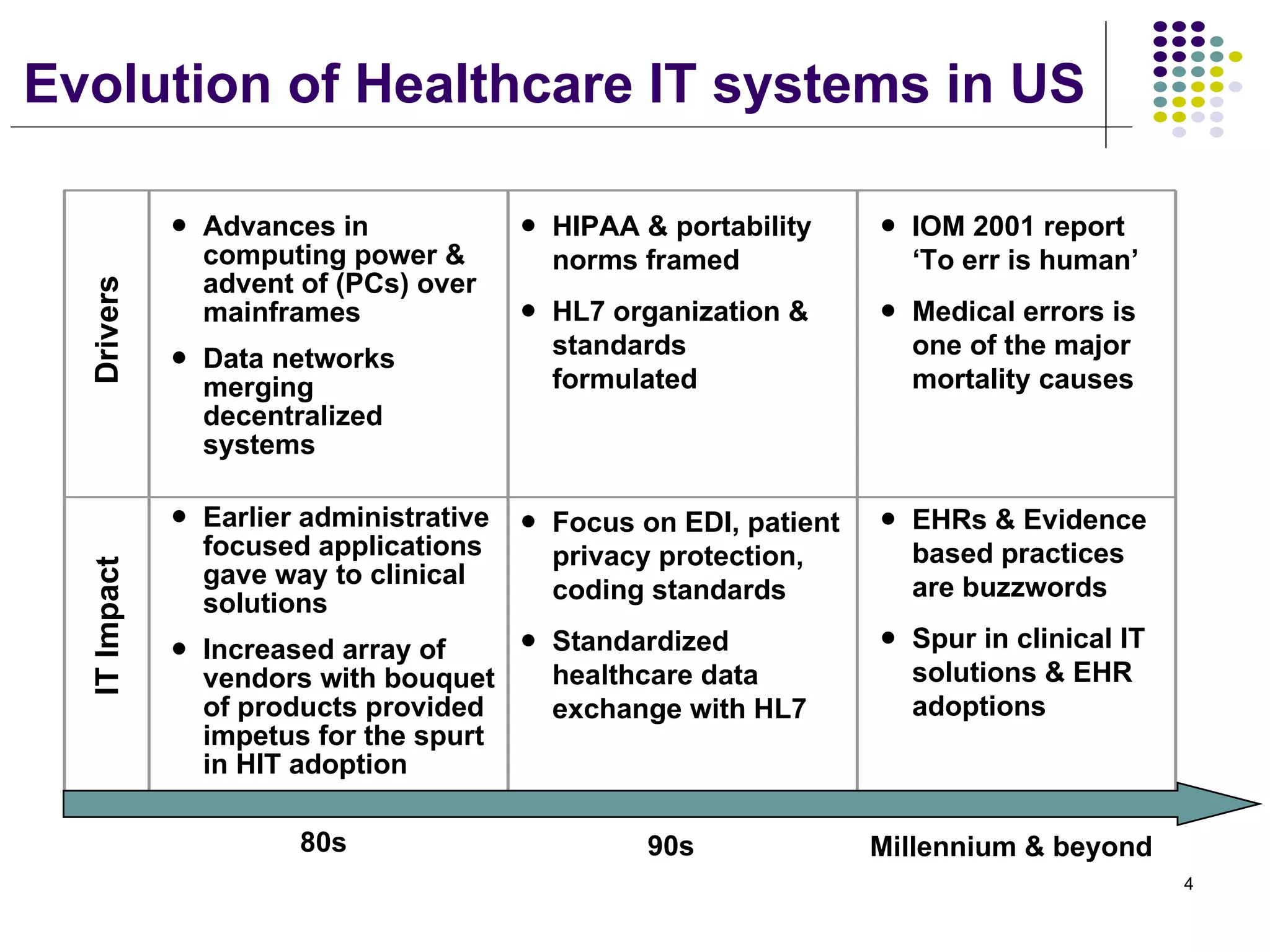
Evolution of Healthcare IT systems in US Drivers IT Impact 80s 90s Millennium & beyond Advances in computing power & advent of (PCs) over mainframes Data networks merging decentralized systems IOM 2001 report ‘To err is human’ Medical errors is one of the major mortality causes HIPAA & portability norms framed HL7 organization & standards formulated EHRs & Evidence based practices are buzzwords Spur in clinical IT solutions & EHR adoptions Focus on EDI, patient privacy protection, coding standards Standardized healthcare data exchange with HL7 Earlier administrative focused applications gave way to clinical solutions  Increased array of vendors with bouquet of products provided impetus for the spurt in HIT adoption
Spectrum of HIT applications Access Systems Generic Care Systems eMAR Emergency  Critical Care Operating Room Disease Management Plans And Protocol Management Ambulatory Care Enterprise Master Person Index Registration Scheduling Benefits Mgmt. Eligibility & Necessity Cardiology Oncology Gynecology Pediatric Orthopedics Blood Banking Specialty Care Systems Clinical Center Systems Laboratory Radiology Imaging / PACS Pharmacy Clinical Trials Finance and Operational System Patient Accounting Financial Accounting Supply Chain HIM Outcomes Measurement  Knowledge Driven Care Solutions Inherent Solutions Technologies Rules engine Reporting  BI Analytics Benchmarking Drug Database Referential Knowledge Closed Loop Med.Process HIPAA compliance Clinical Decision Support Resource planning Interface Engine Medical Device Interfaces Mobile Solutions Bar coding Active Patient Tracking Best–in–Class Approach Physician Portal CPOE Robotic Dispensing Coding Chart Management and more…
Where is everybody heading to? Source: HIMSS Analytics 2007 As EMR Maturity increases US Providers’ adoption of Electronic Health Records
Upcoming focus areas In-patient Ambulatory Self / home care Patient Portals PHRs Medical Device interfaced solutions Disease Management interactive solutions  PDA based solutions Practice management / ambulatory care solutions EHR-based applications Physician portals Integration across the spectrum Analytics driven decision making Moving away from hospital based care 1 3 2 1.  2.  Increased focus on integration, standardization of EHR based applications 3.  Portability of records for patients and physicians
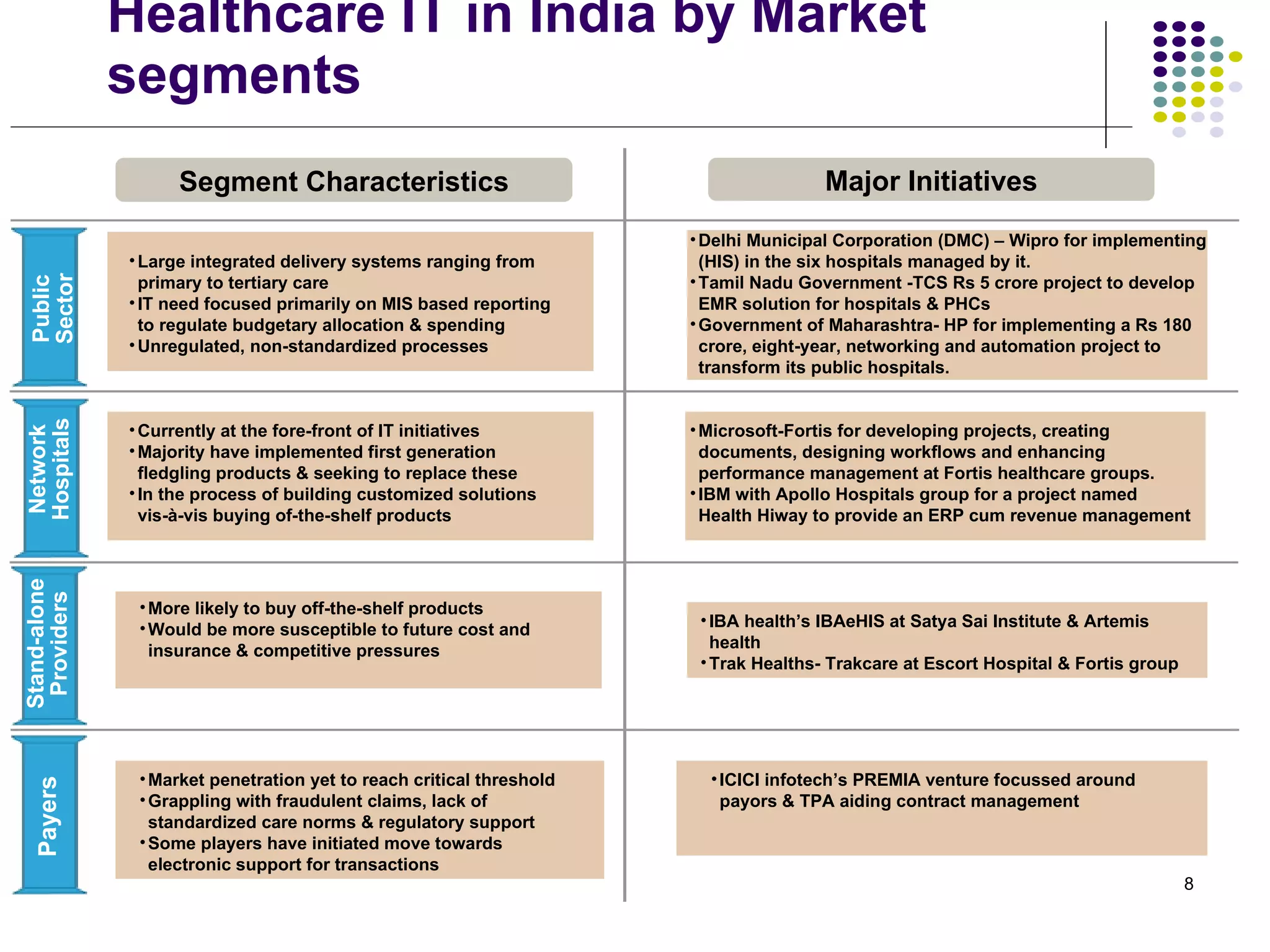
Healthcare IT in India by Market segments Segment Characteristics Major Initiatives Network Hospitals Stand-alone Providers Payers Large integrated delivery systems ranging from primary to tertiary care IT need focused primarily on MIS based reporting to regulate budgetary allocation & spending Unregulated, non-standardized processes Currently at the fore-front of IT initiatives  Majority have implemented first generation fledgling products & seeking to replace these In the process of building customized solutions vis-à-vis buying of-the-shelf products More likely to buy off-the-shelf products Would be more susceptible to future cost and insurance & competitive pressures Public Sector Market penetration yet to reach critical threshold Grappling with fraudulent claims, lack of standardized care norms & regulatory support Some players have initiated move towards electronic support for transactions Delhi Municipal Corporation (DMC) – Wipro for implementing (HIS) in the six hospitals managed by it. Tamil Nadu Government -TCS Rs 5 crore project to develop EMR solution for hospitals & PHCs Government of Maharashtra- HP for implementing a Rs 180 crore, eight-year, networking and automation project to transform its public hospitals.  Microsoft-Fortis for developing projects, creating documents, designing workflows and enhancing performance management at Fortis healthcare groups. IBM with Apollo Hospitals group for a project named Health Hiway to provide an ERP cum revenue management IBA health’s IBAeHIS at Satya Sai Institute & Artemis health Trak Healths- Trakcare at Escort Hospital & Fortis group ICICI infotech’s PREMIA venture focussed around payors & TPA aiding contract management
US v/s Indian HIT Regulatory Environment Quality Focus Comparative Spend IT Buying  Behaviour Role of Insurance US Scenario Indian Scenario Defined guidelines under JCAHO advocating stringent care protocols CMS regulated reimbursement norms facilitated by IT Largely unregulated allowing a fragmented delivery mechanism without any need for IT intervention Increasing focus on ensuring adequate quality of care (severity adjusted DRGs, P4P, PQRI) Some of the major players focused towards accreditation & quality Not viewed as a market differentiator due to lack of regulatory support Larger IT spend (~10-15% budgetary allocation) Increased focus on EHR/ clinical solutions Minimal IT spend (Average 1-2%of revenues-  Frost & Sullivan report ) Viewed as non-core spending with a lower priority Initial focus on streamlining revenue cycle operations with slower shift to core clinical systems Best-of-breed approach Tendency to implement enterprise-wide systems ranging from clinical to billing to house-keeping Most players open to Build option  Majority of patients being insured providers obliged to adhere to their norms EDI transactions are incentivised as well as facilitate claim tracking No set guidelines for promoting electronic claim or reimbursement process
Indian HIT going forward Encouraging trends with industry slated to grow at 12-15% till 2012  (FICCI) IT spending alone would be to the tune of $300 million in the next 3-4 yrs.  (ehealthonline) Boost for IT implementation with anticipated boom in medical tourism The Opportunity High degree of customization renders implementation non-profitable Low IT budgets combined with unreasonable demands Low clinical & physician adoption Non-mandatory usage as well as no perceived business advantage The Challenges… And the road ahead… Insurance penetration would be a key driver towards adoption Mass penetration would primarily focus around tangible ROI provided by RCM & non-clinical solutions Slow shift to specialty offerings rather than providing extra but unused modules
Thank you

Healthcare IT- A comparison between US and Indian Healthcare

  • 1.
    IT in Healthcare– Us v/s US By Dr Kunalsen Sawant
  • 2.
  • 3.
    Stakeholder perspectives onIT Patients Point of care convenience Expecting Increased awareness pertaining to their health Providers (Hospitals) Reducing cost of care delivery Adhering to regulations Enhancing operational efficiencies Enhancing quality of care Physicians Deluge of information to process & manage Shorter decision and patient interaction span Regulatory Compliance & performance pressures (P4P) Payers Reduce malpractice & frauds Reduce medical errors & consequent financial loss Ensure greater accountability of transactions Ensure adherence to correct/ cost-efficient treatment path Competitive & regulatory pressures Enhancing quality of clinical care Reducing Medical errors & evolving physician support tools Cost pressures Key Drivers for IT implementation
  • 4.
    Evolution of HealthcareIT systems in US Drivers IT Impact 80s 90s Millennium & beyond Advances in computing power & advent of (PCs) over mainframes Data networks merging decentralized systems IOM 2001 report ‘To err is human’ Medical errors is one of the major mortality causes HIPAA & portability norms framed HL7 organization & standards formulated EHRs & Evidence based practices are buzzwords Spur in clinical IT solutions & EHR adoptions Focus on EDI, patient privacy protection, coding standards Standardized healthcare data exchange with HL7 Earlier administrative focused applications gave way to clinical solutions Increased array of vendors with bouquet of products provided impetus for the spurt in HIT adoption
  • 5.
    Spectrum of HITapplications Access Systems Generic Care Systems eMAR Emergency Critical Care Operating Room Disease Management Plans And Protocol Management Ambulatory Care Enterprise Master Person Index Registration Scheduling Benefits Mgmt. Eligibility & Necessity Cardiology Oncology Gynecology Pediatric Orthopedics Blood Banking Specialty Care Systems Clinical Center Systems Laboratory Radiology Imaging / PACS Pharmacy Clinical Trials Finance and Operational System Patient Accounting Financial Accounting Supply Chain HIM Outcomes Measurement Knowledge Driven Care Solutions Inherent Solutions Technologies Rules engine Reporting BI Analytics Benchmarking Drug Database Referential Knowledge Closed Loop Med.Process HIPAA compliance Clinical Decision Support Resource planning Interface Engine Medical Device Interfaces Mobile Solutions Bar coding Active Patient Tracking Best–in–Class Approach Physician Portal CPOE Robotic Dispensing Coding Chart Management and more…
  • 6.
    Where is everybodyheading to? Source: HIMSS Analytics 2007 As EMR Maturity increases US Providers’ adoption of Electronic Health Records
  • 7.
    Upcoming focus areasIn-patient Ambulatory Self / home care Patient Portals PHRs Medical Device interfaced solutions Disease Management interactive solutions PDA based solutions Practice management / ambulatory care solutions EHR-based applications Physician portals Integration across the spectrum Analytics driven decision making Moving away from hospital based care 1 3 2 1. 2. Increased focus on integration, standardization of EHR based applications 3. Portability of records for patients and physicians
  • 8.
    Healthcare IT inIndia by Market segments Segment Characteristics Major Initiatives Network Hospitals Stand-alone Providers Payers Large integrated delivery systems ranging from primary to tertiary care IT need focused primarily on MIS based reporting to regulate budgetary allocation & spending Unregulated, non-standardized processes Currently at the fore-front of IT initiatives Majority have implemented first generation fledgling products & seeking to replace these In the process of building customized solutions vis-à-vis buying of-the-shelf products More likely to buy off-the-shelf products Would be more susceptible to future cost and insurance & competitive pressures Public Sector Market penetration yet to reach critical threshold Grappling with fraudulent claims, lack of standardized care norms & regulatory support Some players have initiated move towards electronic support for transactions Delhi Municipal Corporation (DMC) – Wipro for implementing (HIS) in the six hospitals managed by it. Tamil Nadu Government -TCS Rs 5 crore project to develop EMR solution for hospitals & PHCs Government of Maharashtra- HP for implementing a Rs 180 crore, eight-year, networking and automation project to transform its public hospitals. Microsoft-Fortis for developing projects, creating documents, designing workflows and enhancing performance management at Fortis healthcare groups. IBM with Apollo Hospitals group for a project named Health Hiway to provide an ERP cum revenue management IBA health’s IBAeHIS at Satya Sai Institute & Artemis health Trak Healths- Trakcare at Escort Hospital & Fortis group ICICI infotech’s PREMIA venture focussed around payors & TPA aiding contract management
  • 9.
    US v/s IndianHIT Regulatory Environment Quality Focus Comparative Spend IT Buying Behaviour Role of Insurance US Scenario Indian Scenario Defined guidelines under JCAHO advocating stringent care protocols CMS regulated reimbursement norms facilitated by IT Largely unregulated allowing a fragmented delivery mechanism without any need for IT intervention Increasing focus on ensuring adequate quality of care (severity adjusted DRGs, P4P, PQRI) Some of the major players focused towards accreditation & quality Not viewed as a market differentiator due to lack of regulatory support Larger IT spend (~10-15% budgetary allocation) Increased focus on EHR/ clinical solutions Minimal IT spend (Average 1-2%of revenues- Frost & Sullivan report ) Viewed as non-core spending with a lower priority Initial focus on streamlining revenue cycle operations with slower shift to core clinical systems Best-of-breed approach Tendency to implement enterprise-wide systems ranging from clinical to billing to house-keeping Most players open to Build option Majority of patients being insured providers obliged to adhere to their norms EDI transactions are incentivised as well as facilitate claim tracking No set guidelines for promoting electronic claim or reimbursement process
  • 10.
    Indian HIT goingforward Encouraging trends with industry slated to grow at 12-15% till 2012 (FICCI) IT spending alone would be to the tune of $300 million in the next 3-4 yrs. (ehealthonline) Boost for IT implementation with anticipated boom in medical tourism The Opportunity High degree of customization renders implementation non-profitable Low IT budgets combined with unreasonable demands Low clinical & physician adoption Non-mandatory usage as well as no perceived business advantage The Challenges… And the road ahead… Insurance penetration would be a key driver towards adoption Mass penetration would primarily focus around tangible ROI provided by RCM & non-clinical solutions Slow shift to specialty offerings rather than providing extra but unused modules
  • 11.