Loss Aversion and the Endowment EffectDr. Russell James IIITexas Tech University
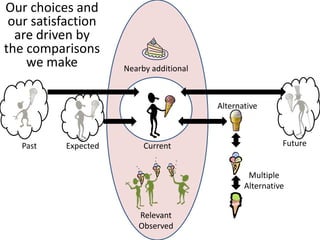
Our choices and our satisfaction are driven by the comparisons we make  Nearby additionalAlternativeFuturePastExpectedCurrentMultiple AlternativeRelevant Observed
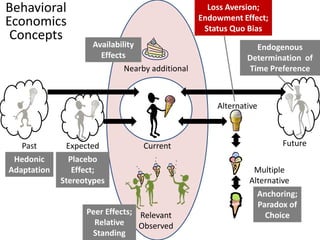
Behavioral Economics ConceptsLoss Aversion; Endowment Effect; Status Quo BiasAvailability EffectsEndogenous Determination  of Time PreferenceNearby additionalAlternativeFuturePastExpectedCurrentHedonic AdaptationPlacebo Effect; StereotypesMultiple AlternativeAnchoring; Paradox of Choice Peer Effects; Relative StandingRelevant Observed
Two behavioral economics principles1. The endowment effect“Ownership creates satisfaction”2. Loss aversion“People are more motivated by avoiding a loss than acquiring a similar gain”Kahneman and Tversky’s “Prospect Theory”  describes how people evaluate gains and losses; it includes concepts such as status quo bias, loss aversion, and the endowment effect
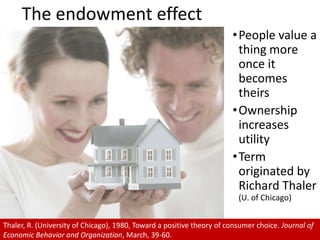
The endowment effectPeople value a thing more once it becomes theirs Ownership increases utility Term originated by Richard Thaler(U. of Chicago)Thaler, R. (University of Chicago), 1980, Toward a positive theory of consumer choice. Journal of Economic Behavior and Organization, March, 39-60.
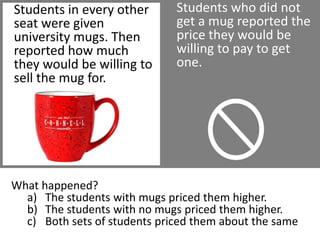
Students who did not get a mug reported the price they would be willing to pay to get one.Students in every other seat were given university mugs. Then reported how much they would be willing to sell the mug for.What happened?The students with mugs priced them higher.The students with no mugs priced them higher.Both sets of students priced them about the same
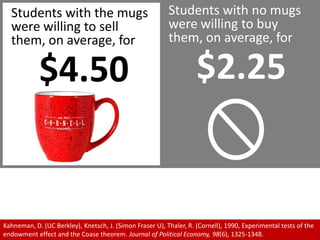
Students with no mugs were willing to buy them, on average, for $2.25Students with the mugs were willing to sell them, on average, for $4.50Kahneman, D. (UC Berkley), Knetsch, J. (Simon Fraser U), Thaler, R. (Cornell), 1990, Experimental tests of the endowment effect and the Coase theorem. Journal of Political Economy, 98(6), 1325-1348.
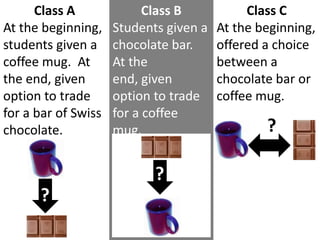
Class BStudents given a chocolate bar.  At the end, given option to trade for a coffee mug.Class CAt the beginning, offered a choice between a chocolate bar or coffee mug. Class AAt the beginning, students given a coffee mug.  At the end, given option to trade for a bar of Swiss chocolate.???
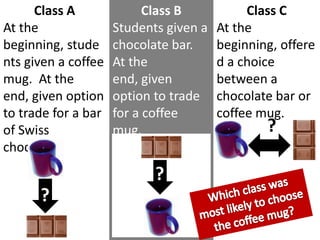
Class BStudents given a chocolate bar.  At the end, given option to trade for a coffee mug.Class CAt the beginning, offered a choice between a chocolate bar or coffee mug. Class AAt the beginning, students given a coffee mug.  At the end, given option to trade for a bar of Swiss chocolate.??Which class was most likely to choose the coffee mug??
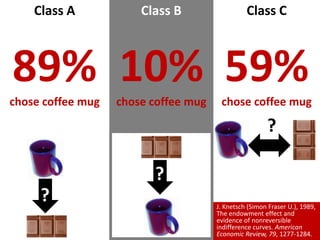
Class B10% chose coffee mugClass C59% chose coffee mugClass A89% chose coffee mug???J. Knetsch (Simon Fraser U.), 1989, The endowment effect and evidence of nonreversible indifference curves. American Economic Review, 79, 1277-1284.
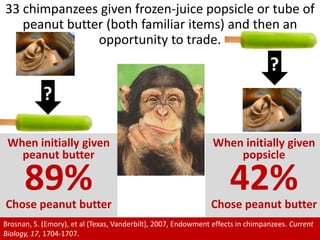
33 chimpanzees given frozen-juice popsicle or tube of peanut butter (both familiar items) and then an opportunity to trade.??When initially given peanut butter 89% Chose peanut butterWhen initially given popsicle42% Chose peanut butterBrosnan, S. (Emory), et al (Texas, Vanderbilt), 2007, Endowment effects in chimpanzees. Current Biology, 17, 1704-1707.
Endowment effect in basketball tickets?Dr. Dan Ariely, Duke Universityhttp://www.youtube.com/watch?v=drEVExtrUgQCarmon, Ziv and Dan Ariely (2000), “Focusing on the Forgone: How Value Can Appear So Different to Buyers and Sellers,” Journal of Consumer Research, 27 (December), 360–70.
The endowment effect in artDr. Dan Gilbert, Harvard Universityhttp://www.youtube.com/watch?v=LTO_dZUvbJA8:25-13:57
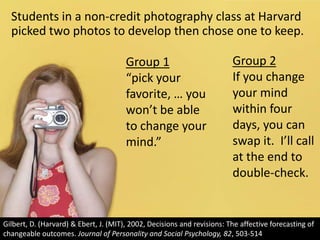
Students in a non-credit photography class at Harvard picked two photos to develop then chose one to keep.Group 2If you change your mind within four days, you can swap it.  I’ll call at the end to double-check.Group 1“pick your favorite, … you won’t be able to change your mind.”Gilbert, D. (Harvard) & Ebert, J. (MIT), 2002, Decisions and revisions: The affective forecasting of changeable outcomes. Journal of Personality and Social Psychology, 82, 503-514
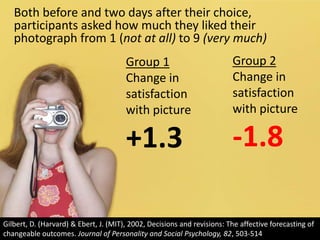
Both before and two days after their choice, participants asked how much they liked their photograph from 1 (not at all) to 9 (very much)Group 2Change in satisfaction with picture-1.8Group 1Change in satisfaction with picture+1.3Gilbert, D. (Harvard) & Ebert, J. (MIT), 2002, Decisions and revisions: The affective forecasting of changeable outcomes. Journal of Personality and Social Psychology, 82, 503-514
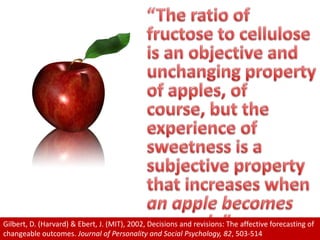
“The ratio of fructose to cellulose is an objective and unchanging property of apples, of course, but the experience of sweetness is a subjective property that increases when an apple becomes my apple”Gilbert, D. (Harvard) & Ebert, J. (MIT), 2002, Decisions and revisions: The affective forecasting of changeable outcomes. Journal of Personality and Social Psychology, 82, 503-514
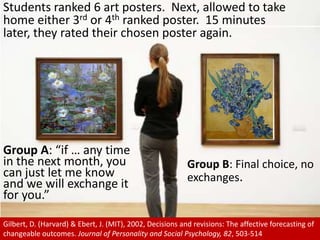
Students ranked 6 art posters.  Next, allowed to take home either 3rd or 4th ranked poster.  15 minutes later, they rated their chosen poster again. Group A: “if … any time in the next month, you can just let me know and we will exchange it for you.”Group B: Final choice, no exchanges.Gilbert, D. (Harvard) & Ebert, J. (MIT), 2002, Decisions and revisions: The affective forecasting of changeable outcomes. Journal of Personality and Social Psychology, 82, 503-514
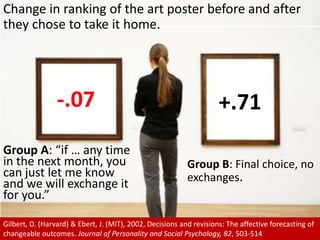
Change in ranking of the art poster before and after they chose to take it home.-.07+.71Group A: “if … any time in the next month, you can just let me know and we will exchange it for you.”Group B: Final choice, no exchanges.Gilbert, D. (Harvard) & Ebert, J. (MIT), 2002, Decisions and revisions: The affective forecasting of changeable outcomes. Journal of Personality and Social Psychology, 82, 503-514
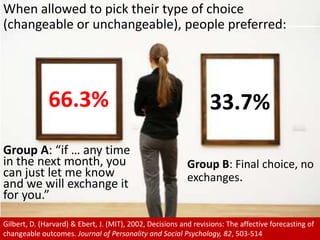
When allowed to pick their type of choice (changeable or unchangeable), people preferred:66.3%33.7%Group A: “if … any time in the next month, you can just let me know and we will exchange it for you.”Group B: Final choice, no exchanges.Gilbert, D. (Harvard) & Ebert, J. (MIT), 2002, Decisions and revisions: The affective forecasting of changeable outcomes. Journal of Personality and Social Psychology, 82, 503-514
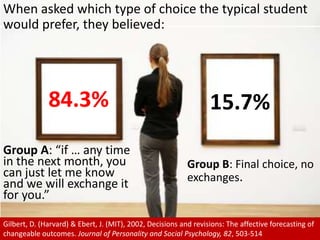
When asked which type of choice the typical student would prefer, they believed:84.3%15.7%Group A: “if … any time in the next month, you can just let me know and we will exchange it for you.”Group B: Final choice, no exchanges.Gilbert, D. (Harvard) & Ebert, J. (MIT), 2002, Decisions and revisions: The affective forecasting of changeable outcomes. Journal of Personality and Social Psychology, 82, 503-514
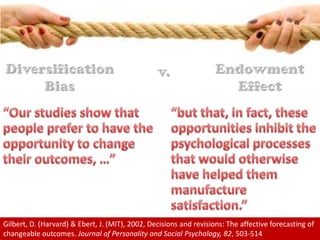
Diversification Bias Endowment Effectv.“Our studies show that people prefer to have the opportunity to change their outcomes, …” “but that, in fact, these opportunities inhibit the psychological processes that would otherwise have helped them manufacture satisfaction.”Gilbert, D. (Harvard) & Ebert, J. (MIT), 2002, Decisions and revisions: The affective forecasting of changeable outcomes. Journal of Personality and Social Psychology, 82, 503-514
Dr. Dan Gilbert, Harvard UniversitySummaryhttp://www.youtube.com/watch?v=LTO_dZUvbJA  14:19-19:05
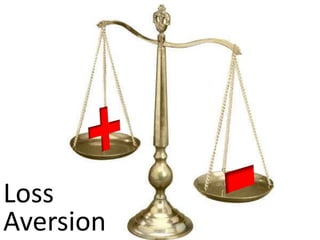
-+Loss Aversion
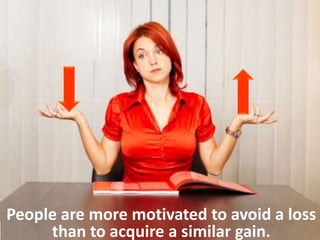
People are more motivated to avoid a loss than to acquire a similar gain.
Loss aversion and endowment effectOnce I own something, not having it becomes more painful, because it is a loss.If I don’t yet own it, then acquiring it is less important, because it is a gain.
Loss aversion and framingIf the same choice is     framed as a loss, 	rather than as a 	  gain, different 	   decisions will 	      be made.
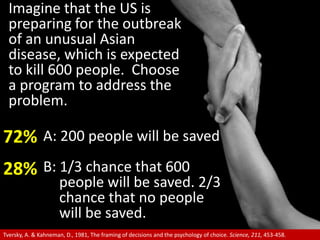
Imagine that the US is preparing for the outbreak of an unusual Asian disease, which is expected to kill 600 people.  Choose a program to address the problem.A: 200 people will be savedB: 1/3 chance that 600 people will be saved. 2/3 chance that no people will be saved.
Imagine that the US is preparing for the outbreak of an unusual Asian disease, which is expected to kill 600 people.  Choose a program to address the problem.72%A: 200 people will be savedB: 1/3 chance that 600 people will be saved. 2/3 chance that no people will be saved.28%Tversky, A. & Kahneman, D., 1981, The framing of decisions and the psychology of choice. Science, 211, 453-458.
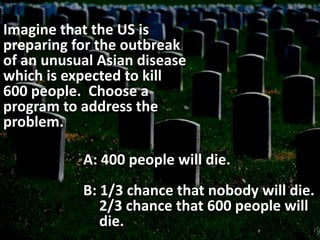
Imagine that the US is preparing for the outbreak of an unusual Asian disease which is expected to kill 600 people.  Choose a program to address the problem.A: 400 people will die.B: 1/3 chance that nobody will die.2/3 chance that 600 people will die.
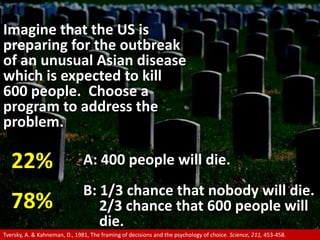
Imagine that the US is preparing for the outbreak of an unusual Asian disease which is expected to kill 600 people.  Choose a program to address the problem.A: 400 people will die.B: 1/3 chance that nobody will die.2/3 chance that 600 people will die.22%78%Tversky, A. & Kahneman, D., 1981, The framing of decisions and the psychology of choice. Science, 211, 453-458.
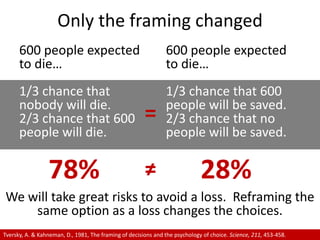
Only the framing changed600 people expected to die…1/3 chance that nobody will die. 2/3 chance that 600 people will die.600 people expected to die…1/3 chance that 600 people will be saved. 2/3 chance that no people will be saved.=78%28%≠We will take great risks to avoid a loss.  Reframing the same option as a loss changes the choices.Tversky, A. & Kahneman, D., 1981, The framing of decisions and the psychology of choice. Science, 211, 453-458.
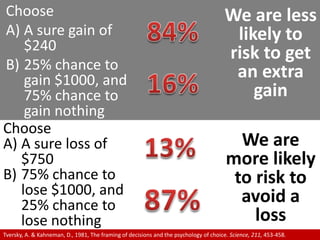
ChooseA sure gain of $24025% chance to gain $1000, and 75% chance to gain nothingWe are less likely to risk to get an extra gainWe are more likely to risk to avoid a loss84%16%ChooseA sure loss of $750 75% chance to lose $1000, and 25% chance to lose nothing13%87%Tversky, A. & Kahneman, D., 1981, The framing of decisions and the psychology of choice. Science, 211, 453-458.
Framing a gamble as a loss or a gainhttp://www.youtube.com/watch?v=Ng9V2JneJ68  start – 5:54
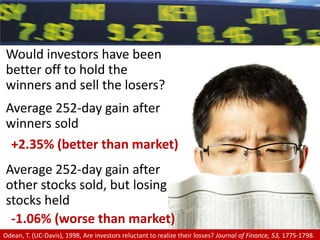
When an investor sells a losing stock, she is committing to the loss.  Does loss aversion cause investors to hold losing stocks longer than winning stocks?
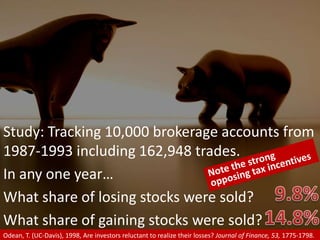
Study: Tracking 10,000 brokerage accounts from 1987-1993 including 162,948 trades.In any one year…What share of losing stocks were sold?What share of gaining stocks were sold?
Study: Tracking 10,000 brokerage accounts from 1987-1993 including 162,948 trades.In any one year…What share of losing stocks were sold?What share of gaining stocks were sold?Note the strong opposing tax incentives 9.8%14.8%Odean, T. (UC-Davis), 1998, Are investors reluctant to realize their losses? Journal of Finance, 53, 1775-1798.
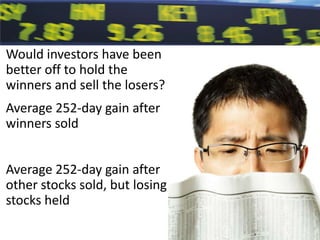
Would investors have been better off to hold the winners and sell the losers?Average 252-day gain after winners soldAverage 252-day gain after other stocks sold, but losing stocks held
Would investors have been better off to hold the winners and sell the losers?Average 252-day gain after winners soldAverage 252-day gain after other stocks sold, but losing stocks held+2.35% (better than market)-1.06% (worse than market)Odean, T. (UC-Davis), 1998, Are investors reluctant to realize their losses? Journal of Finance, 53, 1775-1798.
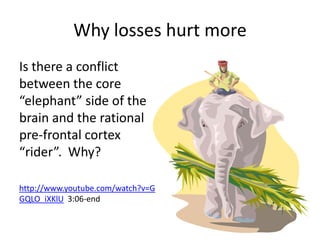
Why losses hurt moreIs there a conflict between the core “elephant” side of the brain and the rational pre-frontal cortex “rider”.  Why?http://www.youtube.com/watch?v=GGQLO_iXKlU  3:06-end
Using prospect theory to pursue your goalsMake it a habit (status quo bias) Own it (endowment effect)Fear its loss (loss aversion)
1. Make it a habit (Goal pursuit becomes the status quo)“Creating a good habit requires much conscious effort, but once the groove has been produced the acts which make up a habitual pattern are not consciously willed.”H. Keane (Australian National University), 2000, Setting yourself free: Techniques of recovery. Health, 4, 324-346.
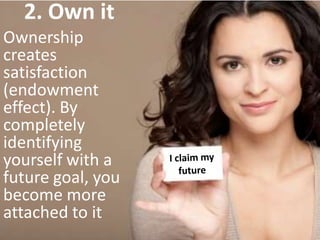
2. Own it Ownership creates satisfaction (endowment effect). By completely identifying yourself with a future goal, you become more attached to itI claim my future
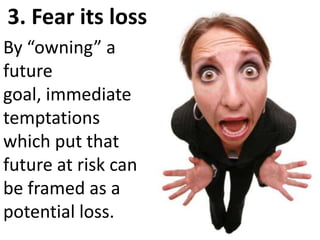
3. Fear its lossBy “owning” a future goal, immediate temptations which put that future at risk can be framed as a potential loss.
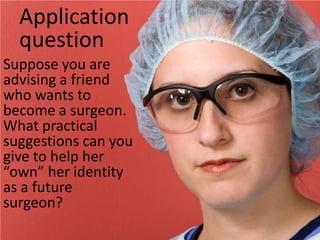
Application questionSuppose you are advising a friend who wants to become a surgeon.  What practical suggestions can you give to help her “own” her identity as a future surgeon?
Slides by: Russell James III, J.D., Ph.D., CFP®Associate Professor Division of Personal Financial Planning Texas Tech Universityrussell.james@ttu.eduPlease use these slides!  If you think you might use anything here in a classroom, please  CLICK HEREto let me know.  Thanks!The outline for this behavioral economics series is at http://www.slideshare.net/rnja8c/outline-for-behavioral-economics-course-component

Loss Aversion & Endowment Effect

  • 1.
    Loss Aversion andthe Endowment EffectDr. Russell James IIITexas Tech University
  • 2.
    Our choices andour satisfaction are driven by the comparisons we make Nearby additionalAlternativeFuturePastExpectedCurrentMultiple AlternativeRelevant Observed
  • 3.
    Behavioral Economics ConceptsLossAversion; Endowment Effect; Status Quo BiasAvailability EffectsEndogenous Determination of Time PreferenceNearby additionalAlternativeFuturePastExpectedCurrentHedonic AdaptationPlacebo Effect; StereotypesMultiple AlternativeAnchoring; Paradox of Choice Peer Effects; Relative StandingRelevant Observed
  • 4.
    Two behavioral economicsprinciples1. The endowment effect“Ownership creates satisfaction”2. Loss aversion“People are more motivated by avoiding a loss than acquiring a similar gain”Kahneman and Tversky’s “Prospect Theory” describes how people evaluate gains and losses; it includes concepts such as status quo bias, loss aversion, and the endowment effect
  • 5.
    The endowment effectPeoplevalue a thing more once it becomes theirs Ownership increases utility Term originated by Richard Thaler(U. of Chicago)Thaler, R. (University of Chicago), 1980, Toward a positive theory of consumer choice. Journal of Economic Behavior and Organization, March, 39-60.
  • 6.
    Students who didnot get a mug reported the price they would be willing to pay to get one.Students in every other seat were given university mugs. Then reported how much they would be willing to sell the mug for.What happened?The students with mugs priced them higher.The students with no mugs priced them higher.Both sets of students priced them about the same
  • 7.
    Students with nomugs were willing to buy them, on average, for $2.25Students with the mugs were willing to sell them, on average, for $4.50Kahneman, D. (UC Berkley), Knetsch, J. (Simon Fraser U), Thaler, R. (Cornell), 1990, Experimental tests of the endowment effect and the Coase theorem. Journal of Political Economy, 98(6), 1325-1348.
  • 8.
    Class BStudents givena chocolate bar. At the end, given option to trade for a coffee mug.Class CAt the beginning, offered a choice between a chocolate bar or coffee mug. Class AAt the beginning, students given a coffee mug. At the end, given option to trade for a bar of Swiss chocolate.???
  • 9.
    Class BStudents givena chocolate bar. At the end, given option to trade for a coffee mug.Class CAt the beginning, offered a choice between a chocolate bar or coffee mug. Class AAt the beginning, students given a coffee mug. At the end, given option to trade for a bar of Swiss chocolate.??Which class was most likely to choose the coffee mug??
  • 10.
    Class B10% chosecoffee mugClass C59% chose coffee mugClass A89% chose coffee mug???J. Knetsch (Simon Fraser U.), 1989, The endowment effect and evidence of nonreversible indifference curves. American Economic Review, 79, 1277-1284.
  • 11.
    33 chimpanzees givenfrozen-juice popsicle or tube of peanut butter (both familiar items) and then an opportunity to trade.??When initially given peanut butter 89% Chose peanut butterWhen initially given popsicle42% Chose peanut butterBrosnan, S. (Emory), et al (Texas, Vanderbilt), 2007, Endowment effects in chimpanzees. Current Biology, 17, 1704-1707.
  • 12.
    Endowment effect inbasketball tickets?Dr. Dan Ariely, Duke Universityhttp://www.youtube.com/watch?v=drEVExtrUgQCarmon, Ziv and Dan Ariely (2000), “Focusing on the Forgone: How Value Can Appear So Different to Buyers and Sellers,” Journal of Consumer Research, 27 (December), 360–70.
  • 13.
    The endowment effectin artDr. Dan Gilbert, Harvard Universityhttp://www.youtube.com/watch?v=LTO_dZUvbJA8:25-13:57
  • 14.
    Students in anon-credit photography class at Harvard picked two photos to develop then chose one to keep.Group 2If you change your mind within four days, you can swap it. I’ll call at the end to double-check.Group 1“pick your favorite, … you won’t be able to change your mind.”Gilbert, D. (Harvard) & Ebert, J. (MIT), 2002, Decisions and revisions: The affective forecasting of changeable outcomes. Journal of Personality and Social Psychology, 82, 503-514
  • 15.
    Both before andtwo days after their choice, participants asked how much they liked their photograph from 1 (not at all) to 9 (very much)Group 2Change in satisfaction with picture-1.8Group 1Change in satisfaction with picture+1.3Gilbert, D. (Harvard) & Ebert, J. (MIT), 2002, Decisions and revisions: The affective forecasting of changeable outcomes. Journal of Personality and Social Psychology, 82, 503-514
  • 16.
    “The ratio offructose to cellulose is an objective and unchanging property of apples, of course, but the experience of sweetness is a subjective property that increases when an apple becomes my apple”Gilbert, D. (Harvard) & Ebert, J. (MIT), 2002, Decisions and revisions: The affective forecasting of changeable outcomes. Journal of Personality and Social Psychology, 82, 503-514
  • 17.
    Students ranked 6art posters. Next, allowed to take home either 3rd or 4th ranked poster. 15 minutes later, they rated their chosen poster again. Group A: “if … any time in the next month, you can just let me know and we will exchange it for you.”Group B: Final choice, no exchanges.Gilbert, D. (Harvard) & Ebert, J. (MIT), 2002, Decisions and revisions: The affective forecasting of changeable outcomes. Journal of Personality and Social Psychology, 82, 503-514
  • 18.
    Change in rankingof the art poster before and after they chose to take it home.-.07+.71Group A: “if … any time in the next month, you can just let me know and we will exchange it for you.”Group B: Final choice, no exchanges.Gilbert, D. (Harvard) & Ebert, J. (MIT), 2002, Decisions and revisions: The affective forecasting of changeable outcomes. Journal of Personality and Social Psychology, 82, 503-514
  • 19.
    When allowed topick their type of choice (changeable or unchangeable), people preferred:66.3%33.7%Group A: “if … any time in the next month, you can just let me know and we will exchange it for you.”Group B: Final choice, no exchanges.Gilbert, D. (Harvard) & Ebert, J. (MIT), 2002, Decisions and revisions: The affective forecasting of changeable outcomes. Journal of Personality and Social Psychology, 82, 503-514
  • 20.
    When asked whichtype of choice the typical student would prefer, they believed:84.3%15.7%Group A: “if … any time in the next month, you can just let me know and we will exchange it for you.”Group B: Final choice, no exchanges.Gilbert, D. (Harvard) & Ebert, J. (MIT), 2002, Decisions and revisions: The affective forecasting of changeable outcomes. Journal of Personality and Social Psychology, 82, 503-514
  • 21.
    Diversification Bias EndowmentEffectv.“Our studies show that people prefer to have the opportunity to change their outcomes, …” “but that, in fact, these opportunities inhibit the psychological processes that would otherwise have helped them manufacture satisfaction.”Gilbert, D. (Harvard) & Ebert, J. (MIT), 2002, Decisions and revisions: The affective forecasting of changeable outcomes. Journal of Personality and Social Psychology, 82, 503-514
  • 22.
    Dr. Dan Gilbert,Harvard UniversitySummaryhttp://www.youtube.com/watch?v=LTO_dZUvbJA 14:19-19:05
  • 23.
  • 24.
    People are moremotivated to avoid a loss than to acquire a similar gain.
  • 25.
    Loss aversion andendowment effectOnce I own something, not having it becomes more painful, because it is a loss.If I don’t yet own it, then acquiring it is less important, because it is a gain.
  • 26.
    Loss aversion andframingIf the same choice is framed as a loss, rather than as a gain, different decisions will be made.
  • 27.
    Imagine that theUS is preparing for the outbreak of an unusual Asian disease, which is expected to kill 600 people. Choose a program to address the problem.A: 200 people will be savedB: 1/3 chance that 600 people will be saved. 2/3 chance that no people will be saved.
  • 28.
    Imagine that theUS is preparing for the outbreak of an unusual Asian disease, which is expected to kill 600 people. Choose a program to address the problem.72%A: 200 people will be savedB: 1/3 chance that 600 people will be saved. 2/3 chance that no people will be saved.28%Tversky, A. & Kahneman, D., 1981, The framing of decisions and the psychology of choice. Science, 211, 453-458.
  • 29.
    Imagine that theUS is preparing for the outbreak of an unusual Asian disease which is expected to kill 600 people. Choose a program to address the problem.A: 400 people will die.B: 1/3 chance that nobody will die.2/3 chance that 600 people will die.
  • 30.
    Imagine that theUS is preparing for the outbreak of an unusual Asian disease which is expected to kill 600 people. Choose a program to address the problem.A: 400 people will die.B: 1/3 chance that nobody will die.2/3 chance that 600 people will die.22%78%Tversky, A. & Kahneman, D., 1981, The framing of decisions and the psychology of choice. Science, 211, 453-458.
  • 31.
    Only the framingchanged600 people expected to die…1/3 chance that nobody will die. 2/3 chance that 600 people will die.600 people expected to die…1/3 chance that 600 people will be saved. 2/3 chance that no people will be saved.=78%28%≠We will take great risks to avoid a loss. Reframing the same option as a loss changes the choices.Tversky, A. & Kahneman, D., 1981, The framing of decisions and the psychology of choice. Science, 211, 453-458.
  • 32.
    ChooseA sure gainof $24025% chance to gain $1000, and 75% chance to gain nothingWe are less likely to risk to get an extra gainWe are more likely to risk to avoid a loss84%16%ChooseA sure loss of $750 75% chance to lose $1000, and 25% chance to lose nothing13%87%Tversky, A. & Kahneman, D., 1981, The framing of decisions and the psychology of choice. Science, 211, 453-458.
  • 33.
    Framing a gambleas a loss or a gainhttp://www.youtube.com/watch?v=Ng9V2JneJ68 start – 5:54
  • 34.
    When an investorsells a losing stock, she is committing to the loss. Does loss aversion cause investors to hold losing stocks longer than winning stocks?
  • 35.
    Study: Tracking 10,000brokerage accounts from 1987-1993 including 162,948 trades.In any one year…What share of losing stocks were sold?What share of gaining stocks were sold?
  • 36.
    Study: Tracking 10,000brokerage accounts from 1987-1993 including 162,948 trades.In any one year…What share of losing stocks were sold?What share of gaining stocks were sold?Note the strong opposing tax incentives 9.8%14.8%Odean, T. (UC-Davis), 1998, Are investors reluctant to realize their losses? Journal of Finance, 53, 1775-1798.
  • 37.
    Would investors havebeen better off to hold the winners and sell the losers?Average 252-day gain after winners soldAverage 252-day gain after other stocks sold, but losing stocks held
  • 38.
    Would investors havebeen better off to hold the winners and sell the losers?Average 252-day gain after winners soldAverage 252-day gain after other stocks sold, but losing stocks held+2.35% (better than market)-1.06% (worse than market)Odean, T. (UC-Davis), 1998, Are investors reluctant to realize their losses? Journal of Finance, 53, 1775-1798.
  • 39.
    Why losses hurtmoreIs there a conflict between the core “elephant” side of the brain and the rational pre-frontal cortex “rider”. Why?http://www.youtube.com/watch?v=GGQLO_iXKlU 3:06-end
  • 40.
    Using prospect theoryto pursue your goalsMake it a habit (status quo bias) Own it (endowment effect)Fear its loss (loss aversion)
  • 41.
    1. Make ita habit (Goal pursuit becomes the status quo)“Creating a good habit requires much conscious effort, but once the groove has been produced the acts which make up a habitual pattern are not consciously willed.”H. Keane (Australian National University), 2000, Setting yourself free: Techniques of recovery. Health, 4, 324-346.
  • 42.
    2. Own itOwnership creates satisfaction (endowment effect). By completely identifying yourself with a future goal, you become more attached to itI claim my future
  • 43.
    3. Fear itslossBy “owning” a future goal, immediate temptations which put that future at risk can be framed as a potential loss.
  • 44.
    Application questionSuppose youare advising a friend who wants to become a surgeon. What practical suggestions can you give to help her “own” her identity as a future surgeon?
  • 45.
    Slides by: RussellJames III, J.D., Ph.D., CFP®Associate Professor Division of Personal Financial Planning Texas Tech Universityrussell.james@ttu.eduPlease use these slides! If you think you might use anything here in a classroom, please CLICK HEREto let me know. Thanks!The outline for this behavioral economics series is at http://www.slideshare.net/rnja8c/outline-for-behavioral-economics-course-component

Editor's Notes

  • #18 Creative commons licensedhttp://www.flickr.com/photos/wallyg/1392910765/http://www.flickr.com/photos/jajankie/3691060595/