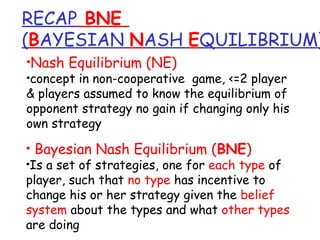
RECAP BNE
(BAYESIAN NASHEQUILIBRIUM)
•Nash Equilibrium (NE)
•concept in non-cooperative game, <=2 player
& players assumed to know the equilibrium of
opponent strategy no gain if changing only his
own strategy
• Bayesian Nash Equilibrium (BNE)
•Is a set of strategies, one for each type of
player, such that no type has incentive to
change his or her strategy given the belief
system about the types and what other types
are doing
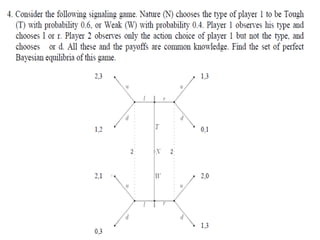
4.
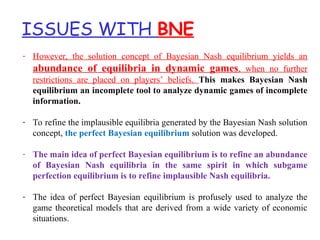
ISSUES WITH BNE
-However, the solution concept of Bayesian Nash equilibrium yields an
abundance of equilibria in dynamic games, when no further
restrictions are placed on players’ beliefs. This makes Bayesian Nash
equilibrium an incomplete tool to analyze dynamic games of incomplete
information.
- To refine the implausible equilibria generated by the Bayesian Nash solution
concept, the perfect Bayesian equilibrium solution was developed.
- The main idea of perfect Bayesian equilibrium is to refine an abundance
of Bayesian Nash equilibria in the same spirit in which subgame
perfection equilibrium is to refine implausible Nash equilibria.
- The idea of perfect Bayesian equilibrium is profusely used to analyze the
game theoretical models that are derived from a wide variety of economic
situations.
5.
Slide 5 of24
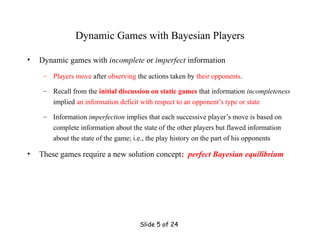
Dynamic Games with Bayesian Players
• Dynamic games with incomplete or imperfect information
– Players move after observing the actions taken by their opponents.
– Recall from the initial discussion on static games that information incompleteness
implied an information deficit with respect to an opponent’s type or state
– Information imperfection implies that each successive player’s move is based on
complete information about the state of the other players but flawed information
about the state of the game; i.e., the play history on the part of his opponents
• These games require a new solution concept: perfect Bayesian equilibrium
6.
Slide 6 of24
Perfect Bayesian Equilibrium
Gibbons gives the following four requirements for a perfect Bayesian equilibrium:
1. For each game turn, the moving player must have a belief about the state of the game,
i.e. the play history to that point, in the form of a probability distribution over the set of
the possible game sub-states at that point.
2. Given their beliefs, the players’ strategies must be sequentially rational.
Note: An example of irrational (but effective under some circumstances) strategy is tit-for-tat in
repeated prisoner’s dilemma games. [Axlerod, Sigmund]
3. At each game state on the equilibrium path, beliefs are formed by observation-driven
Bayes’ rule and players’ equilibrium strategies.
(For a given equilibrium in a sequential game, a game state is on the equilibrium path if it will be reached with
positive probability when the game is played according to equilibrium strategies. Otherwise, the state is off the
equilibrium path.)
4. For game states off the equilibrium path, beliefs are formed by Bayes’ rule and
players’ equilibrium strategies where possible.
7.
Slide 7 of24
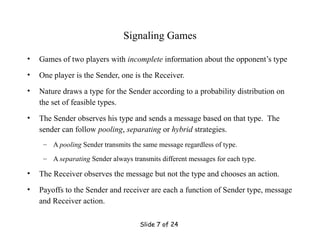
Signaling Games
• Games of two players with incomplete information about the opponent’s type
• One player is the Sender, one is the Receiver.
• Nature draws a type for the Sender according to a probability distribution on
the set of feasible types.
• The Sender observes his type and sends a message based on that type. The
sender can follow pooling, separating or hybrid strategies.
– A pooling Sender transmits the same message regardless of type.
– A separating Sender always transmits different messages for each type.
• The Receiver observes the message but not the type and chooses an action.
• Payoffs to the Sender and receiver are each a function of Sender type, message
and Receiver action.
8.
Slide 8 of24
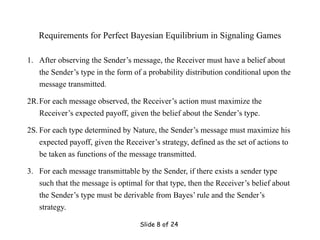
Requirements for Perfect Bayesian Equilibrium in Signaling Games
1. After observing the Sender’s message, the Receiver must have a belief about
the Sender’s type in the form of a probability distribution conditional upon the
message transmitted.
2R.For each message observed, the Receiver’s action must maximize the
Receiver’s expected payoff, given the belief about the Sender’s type.
2S. For each type determined by Nature, the Sender’s message must maximize his
expected payoff, given the Receiver’s strategy, defined as the set of actions to
be taken as functions of the message transmitted.
3. For each message transmittable by the Sender, if there exists a sender type
such that the message is optimal for that type, then the Receiver’s belief about
the Sender’s type must be derivable from Bayes’ rule and the Sender’s
strategy.
9.
Slide 9 of24
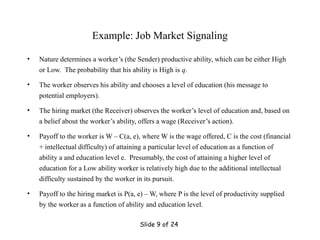
Example: Job Market Signaling
• Nature determines a worker’s (the Sender) productive ability, which can be either High
or Low. The probability that his ability is High is q.
• The worker observes his ability and chooses a level of education (his message to
potential employers).
• The hiring market (the Receiver) observes the worker’s level of education and, based on
a belief about the worker’s ability, offers a wage (Receiver’s action).
• Payoff to the worker is W – C(a, e), where W is the wage offered, C is the cost (financial
+ intellectual difficulty) of attaining a particular level of education as a function of
ability a and education level e. Presumably, the cost of attaining a higher level of
education for a Low ability worker is relatively high due to the additional intellectual
difficulty sustained by the worker in its pursuit.
• Payoff to the hiring market is P(a, e) – W, where P is the level of productivity supplied
by the worker as a function of ability and education level.
10.
Slide 10 of24
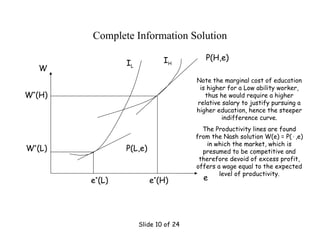
Complete Information Solution
P(L,e)
P(H,e)
IL
IH
e
W
e*
(L) e*
(H)
W*
(L)
W*
(H)
Note the marginal cost of education
is higher for a Low ability worker,
thus he would require a higher
relative salary to justify pursuing a
higher education, hence the steeper
indifference curve.
The Productivity lines are found
from the Nash solution W(e) = P(,e)
in which the market, which is
presumed to be competitive and
therefore devoid of excess profit,
offers a wage equal to the expected
level of productivity.
11.
14-11
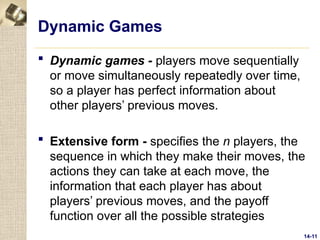
Dynamic Games
Dynamicgames - players move sequentially
or move simultaneously repeatedly over time,
so a player has perfect information about
other players’ previous moves.
Extensive form - specifies the n players, the
sequence in which they make their moves, the
actions they can take at each move, the
information that each player has about
players’ previous moves, and the payoff
function over all the possible strategies
12.
14-12
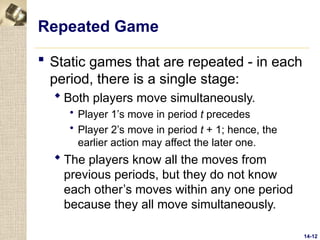
Repeated Game
Staticgames that are repeated - in each
period, there is a single stage:
Both players move simultaneously.
Player 1’s move in period t precedes
Player 2’s move in period t + 1; hence, the
earlier action may affect the later one.
The players know all the moves from
previous periods, but they do not know
each other’s moves within any one period
because they all move simultaneously.
13.
14-13
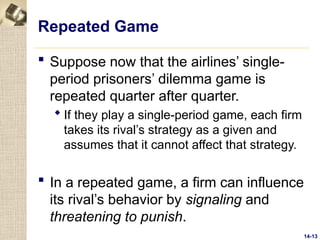
Repeated Game
Supposenow that the airlines’ single-
period prisoners’ dilemma game is
repeated quarter after quarter.
If they play a single-period game, each firm
takes its rival’s strategy as a given and
assumes that it cannot affect that strategy.
In a repeated game, a firm can influence
its rival’s behavior by signaling and
threatening to punish.
14.
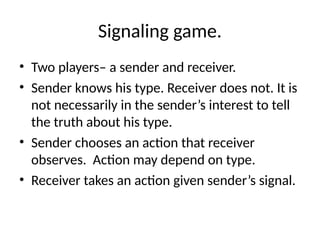
Signaling game.
• Twoplayers– a sender and receiver.
• Sender knows his type. Receiver does not. It is
not necessarily in the sender’s interest to tell
the truth about his type.
• Sender chooses an action that receiver
observes. Action may depend on type.
• Receiver takes an action given sender’s signal.
15.
Pooling and Separating
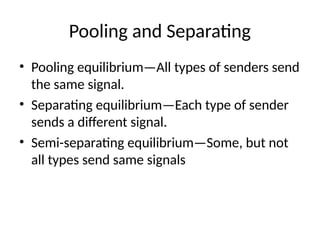
•Pooling equilibrium—All types of senders send
the same signal.
• Separating equilibrium—Each type of sender
sends a different signal.
• Semi-separating equilibrium—Some, but not
all types send same signals
Example: Problem 1,Chapter 11
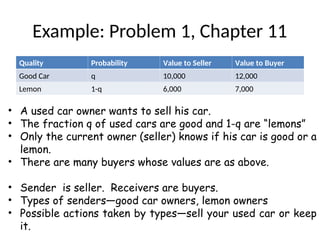
Quality Probability Value to Seller Value to Buyer
Good Car q 10,000 12,000
Lemon 1-q 6,000 7,000
• A used car owner wants to sell his car.
• The fraction q of used cars are good and 1-q are “lemons”
• Only the current owner (seller) knows if his car is good or a
lemon.
• There are many buyers whose values are as above.
• Sender is seller. Receivers are buyers.
• Types of senders—good car owners, lemon owners
• Possible actions taken by types—sell your used car or keep
it.
Is there apooling equlibrium?
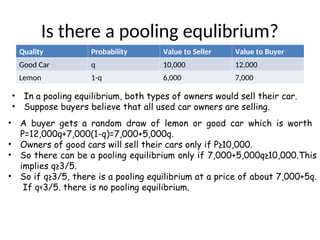
Quality Probability Value to Seller Value to Buyer
Good Car q 10,000 12,000
Lemon 1-q 6,000 7,000
• In a pooling equilibrium, both types of owners would sell their car.
• Suppose buyers believe that all used car owners are selling.
• A buyer gets a random draw of lemon or good car which is worth
P=12,000q+7,000(1-q)=7,000+5,000q.
• Owners of good cars will sell their cars only if P≥10,000.
• So there can be a pooling equilibrium only if 7,000+5,000q≥10,000.This
implies q≥3/5.
• So if q≥3/5, there is a pooling equilibrium at a price of about 7,000+5q.
If q<3/5. there is no pooling equilibrium.
20.
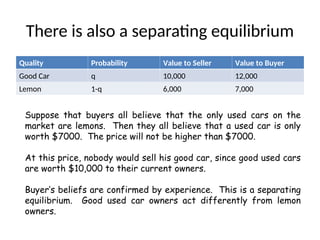
There is alsoa separating equilibrium
Quality Probability Value to Seller Value to Buyer
Good Car q 10,000 12,000
Lemon 1-q 6,000 7,000
Suppose that buyers all believe that the only used cars on the
market are lemons. Then they all believe that a used car is only
worth $7000. The price will not be higher than $7000.
At this price, nobody would sell his good car, since good used cars
are worth $10,000 to their current owners.
Buyer’s beliefs are confirmed by experience. This is a separating
equilibrium. Good used car owners act differently from lemon
owners.
21.
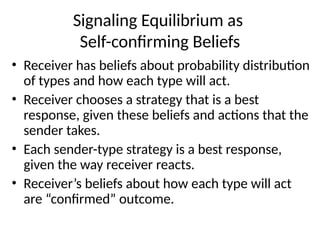
Signaling Equilibrium as
Self-confirmingBeliefs
• Receiver has beliefs about probability distribution
of types and how each type will act.
• Receiver chooses a strategy that is a best
response, given these beliefs and actions that the
sender takes.
• Each sender-type strategy is a best response,
given the way receiver reacts.
• Receiver’s beliefs about how each type will act
are “confirmed” outcome.

![Slide 6 of 24
Perfect Bayesian Equilibrium
Gibbons gives the following four requirements for a perfect Bayesian equilibrium:
1. For each game turn, the moving player must have a belief about the state of the game,
i.e. the play history to that point, in the form of a probability distribution over the set of
the possible game sub-states at that point.
2. Given their beliefs, the players’ strategies must be sequentially rational.
Note: An example of irrational (but effective under some circumstances) strategy is tit-for-tat in
repeated prisoner’s dilemma games. [Axlerod, Sigmund]
3. At each game state on the equilibrium path, beliefs are formed by observation-driven
Bayes’ rule and players’ equilibrium strategies.
(For a given equilibrium in a sequential game, a game state is on the equilibrium path if it will be reached with
positive probability when the game is played according to equilibrium strategies. Otherwise, the state is off the
equilibrium path.)
4. For game states off the equilibrium path, beliefs are formed by Bayes’ rule and
players’ equilibrium strategies where possible.](https://image.slidesharecdn.com/week6dynamic23-251220071456-4ed84391/85/WEEK-6_DYNAMIc_23-12-2022-ppt-incomplete-information-6-320.jpg)