
© 2006 Cisco Systems, Inc. All rights reserved. Cisco PublicITE I Chapter 6 1
Frame Relay
cisco
© 2006 Cisco Systems, Inc. All rights reserved. Cisco PublicITE 1 Chapter 6 2
Objectives
 Describe the fundamental concepts of Frame Relay technology
in terms of Enterprise WAN services including Frame Relay
operation, Frame Relay implementation requirements, Frame
Relay maps, and LMI operation.
 Configure a basic Frame Relay PVC including configuring and
troubleshooting Frame Relay on a router serial interface and
configuring a static Frame Relay map.
 Describe advanced concepts of Frame Relay technology in
terms of Enterprise WAN services including Frame Relay sub-
interfaces, Frame Relay bandwidth and flow control.
 Configure an advanced Frame Relay PVC including solving
reachability issues, configuring Frame Relay sub-interfaces,
verifying and troubleshooting Frame Relay configuration.
© 2006 Cisco Systems, Inc. All rights reserved. Cisco PublicITE 1 Chapter 6 3
Fundamental Concepts of Frame Relay
Technology
Frame Relay ?
 Frame Relay is a packet-switched, connection-oriented, WAN
service that operates at the data link layer of the OSI reference
model
 A high-performance WAN protocol that operates at the physical
and data link layers of the OSI reference model.
 Eric Scace, an engineer at Sprint International, invented Frame
Relay as a simpler version of the X.25 protocol to use across
Integrated Services Digital Network (ISDN) interfaces.
 Frame Relay has become one of the most extensively used WAN
protocols, because
 It is inexpensive compared to dedicated lines.
 Configuring user equipment in a Frame Relay network is very
simple.
© 2006 Cisco Systems, Inc. All rights reserved. Cisco PublicITE 1 Chapter 6 4
Fundamental Concepts of Frame Relay
Technology
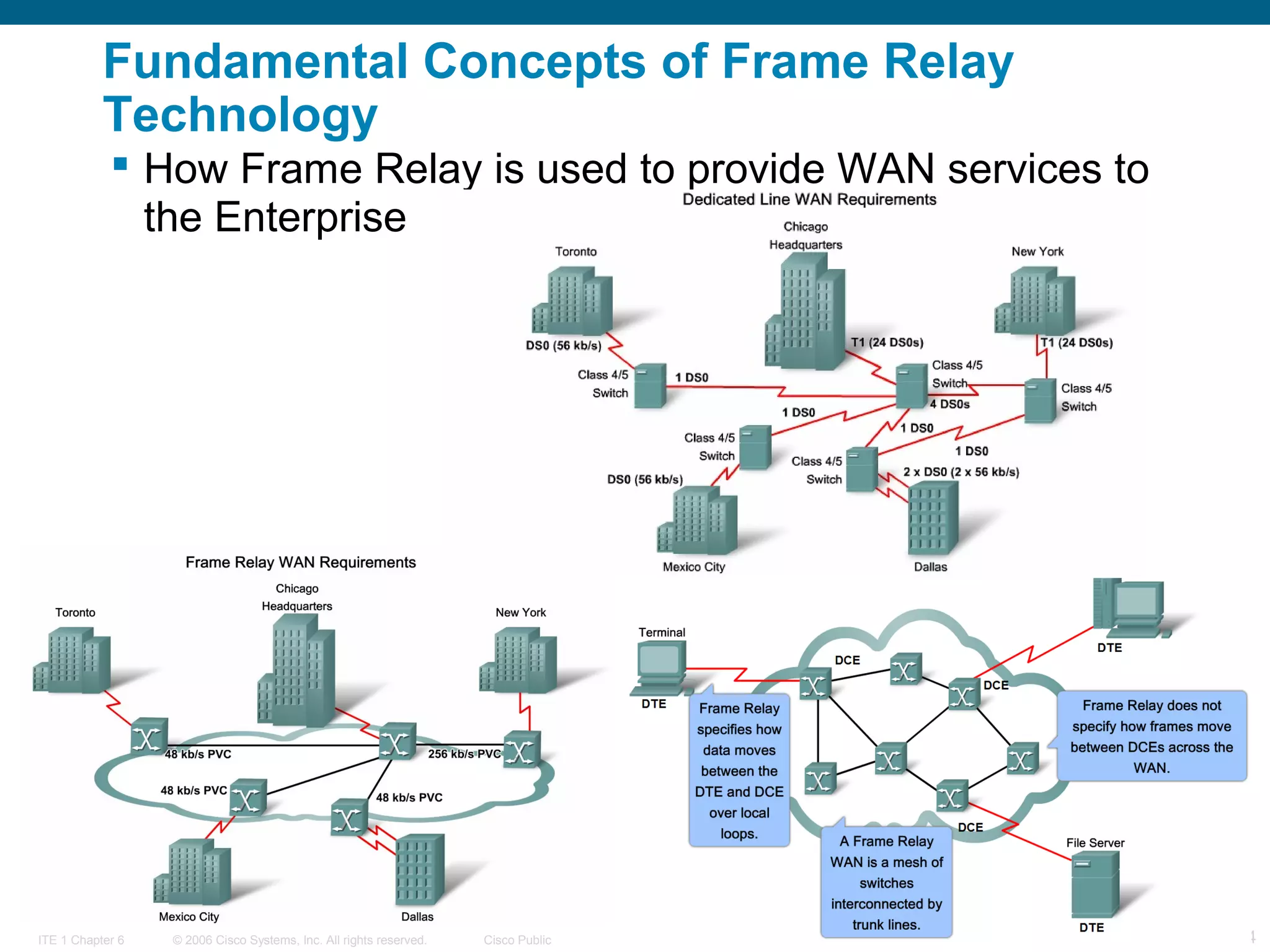
 How Frame Relay is used to provide WAN services to
the Enterprise
© 2006 Cisco Systems, Inc. All rights reserved. Cisco PublicITE 1 Chapter 6 5
Fundamental Concepts of Frame Relay
Technology
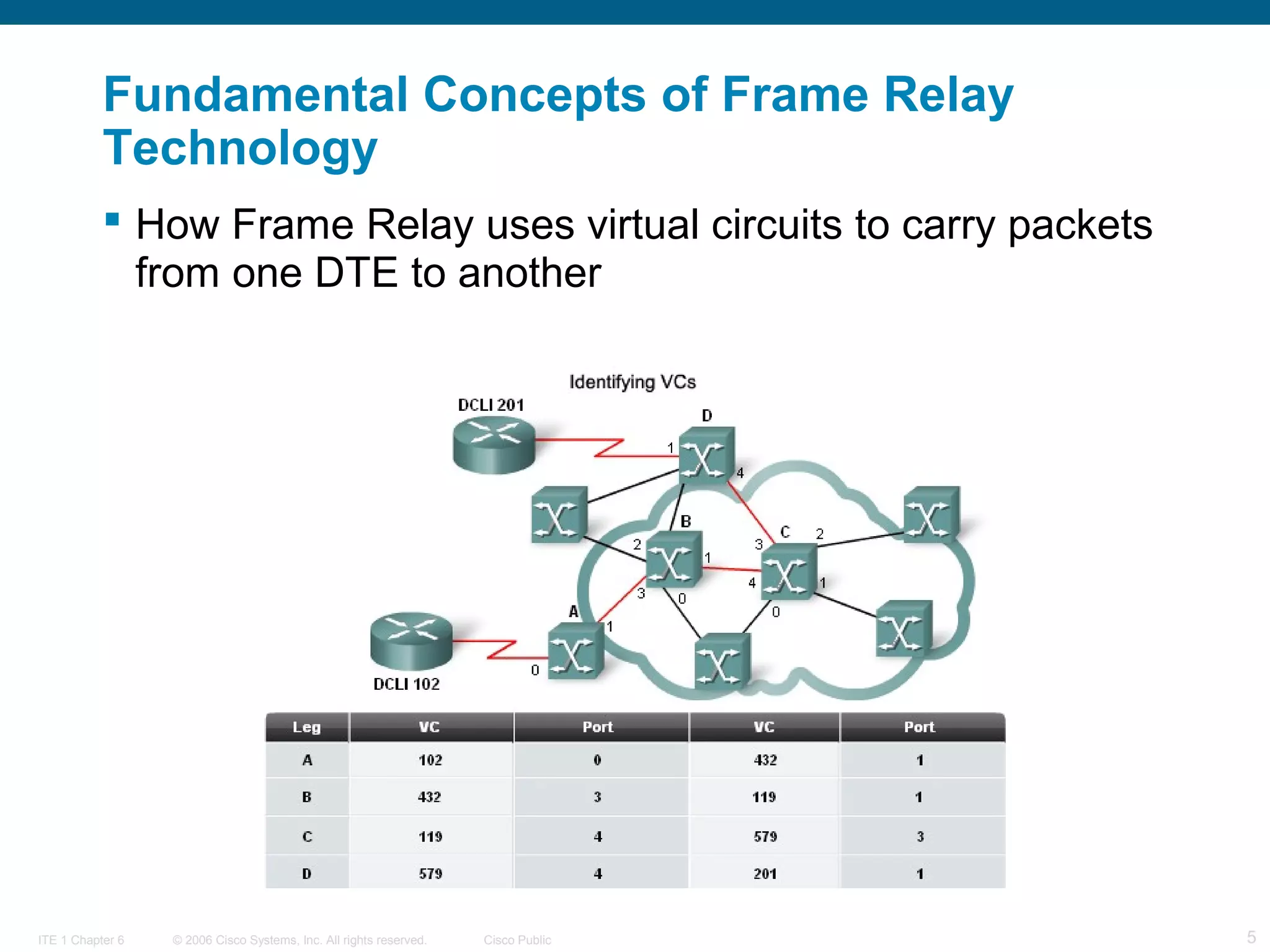
 How Frame Relay uses virtual circuits to carry packets
from one DTE to another
© 2006 Cisco Systems, Inc. All rights reserved. Cisco PublicITE 1 Chapter 6 6
Fundamental Concepts of Frame Relay
Technology
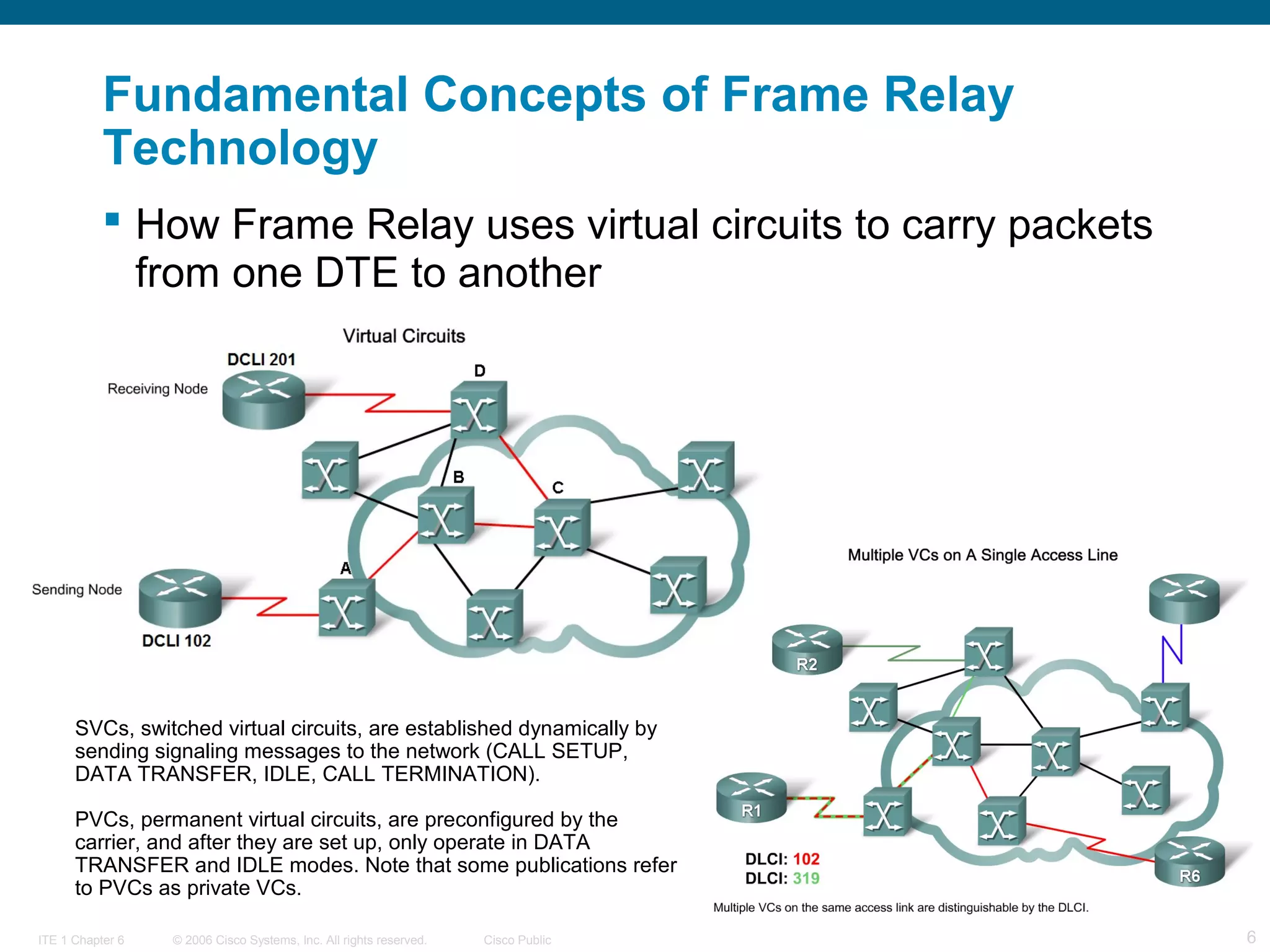
 How Frame Relay uses virtual circuits to carry packets
from one DTE to another
SVCs, switched virtual circuits, are established dynamically by
sending signaling messages to the network (CALL SETUP,
DATA TRANSFER, IDLE, CALL TERMINATION).
PVCs, permanent virtual circuits, are preconfigured by the
carrier, and after they are set up, only operate in DATA
TRANSFER and IDLE modes. Note that some publications refer
to PVCs as private VCs.
© 2006 Cisco Systems, Inc. All rights reserved. Cisco PublicITE 1 Chapter 6 7
Fundamental Concepts of Frame Relay
Technology
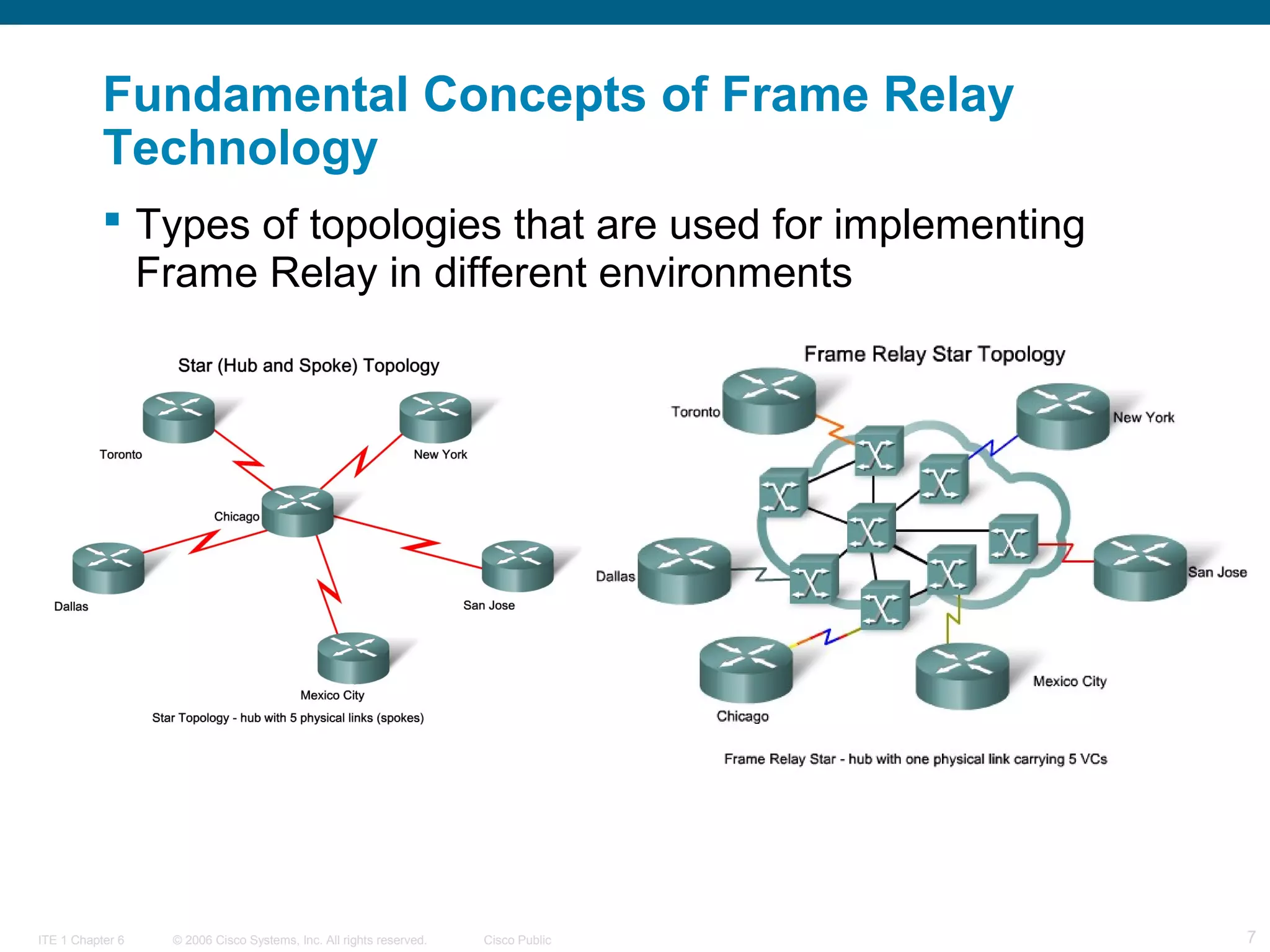
 Types of topologies that are used for implementing
Frame Relay in different environments
© 2006 Cisco Systems, Inc. All rights reserved. Cisco PublicITE 1 Chapter 6 8
Fundamental Concepts of Frame Relay
Technology
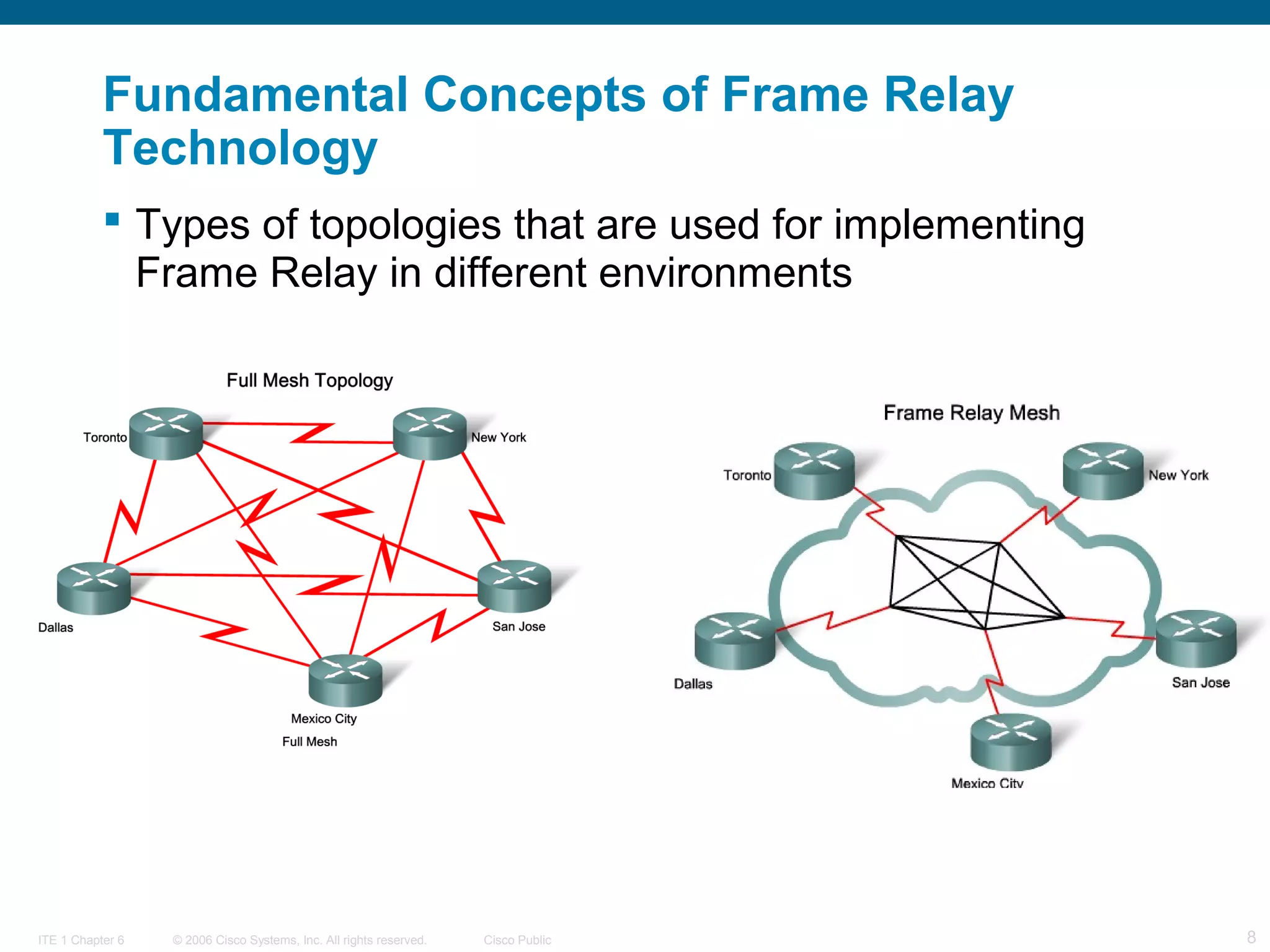
 Types of topologies that are used for implementing
Frame Relay in different environments
© 2006 Cisco Systems, Inc. All rights reserved. Cisco PublicITE 1 Chapter 6 9
Fundamental Concepts of Frame Relay
Technology
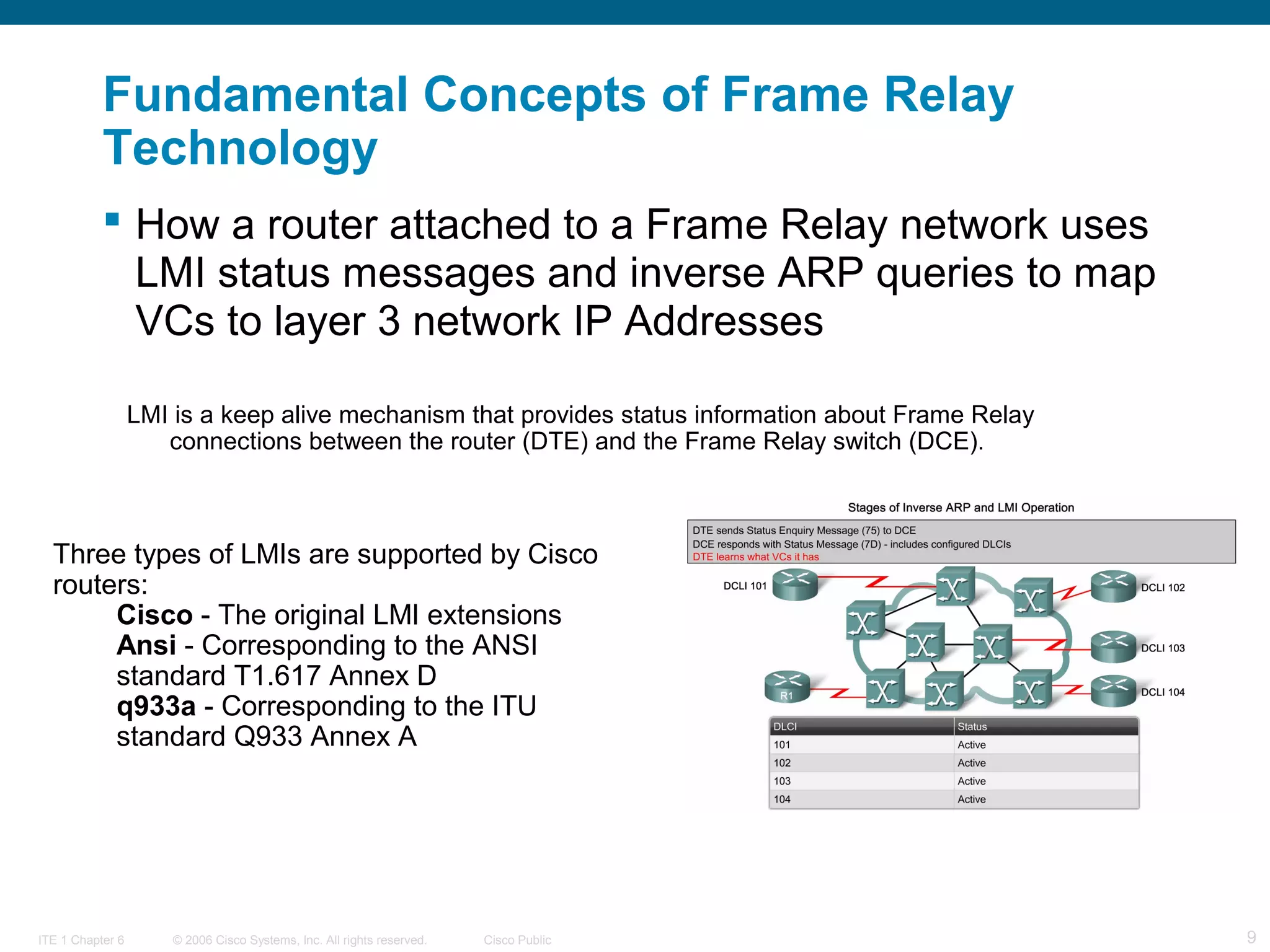
 How a router attached to a Frame Relay network uses
LMI status messages and inverse ARP queries to map
VCs to layer 3 network IP Addresses
LMI is a keep alive mechanism that provides status information about Frame Relay
connections between the router (DTE) and the Frame Relay switch (DCE).
Three types of LMIs are supported by Cisco
routers:
Cisco - The original LMI extensions
Ansi - Corresponding to the ANSI
standard T1.617 Annex D
q933a - Corresponding to the ITU
standard Q933 Annex A
© 2006 Cisco Systems, Inc. All rights reserved. Cisco PublicITE 1 Chapter 6 10
Configure a Basic Frame Relay PVC
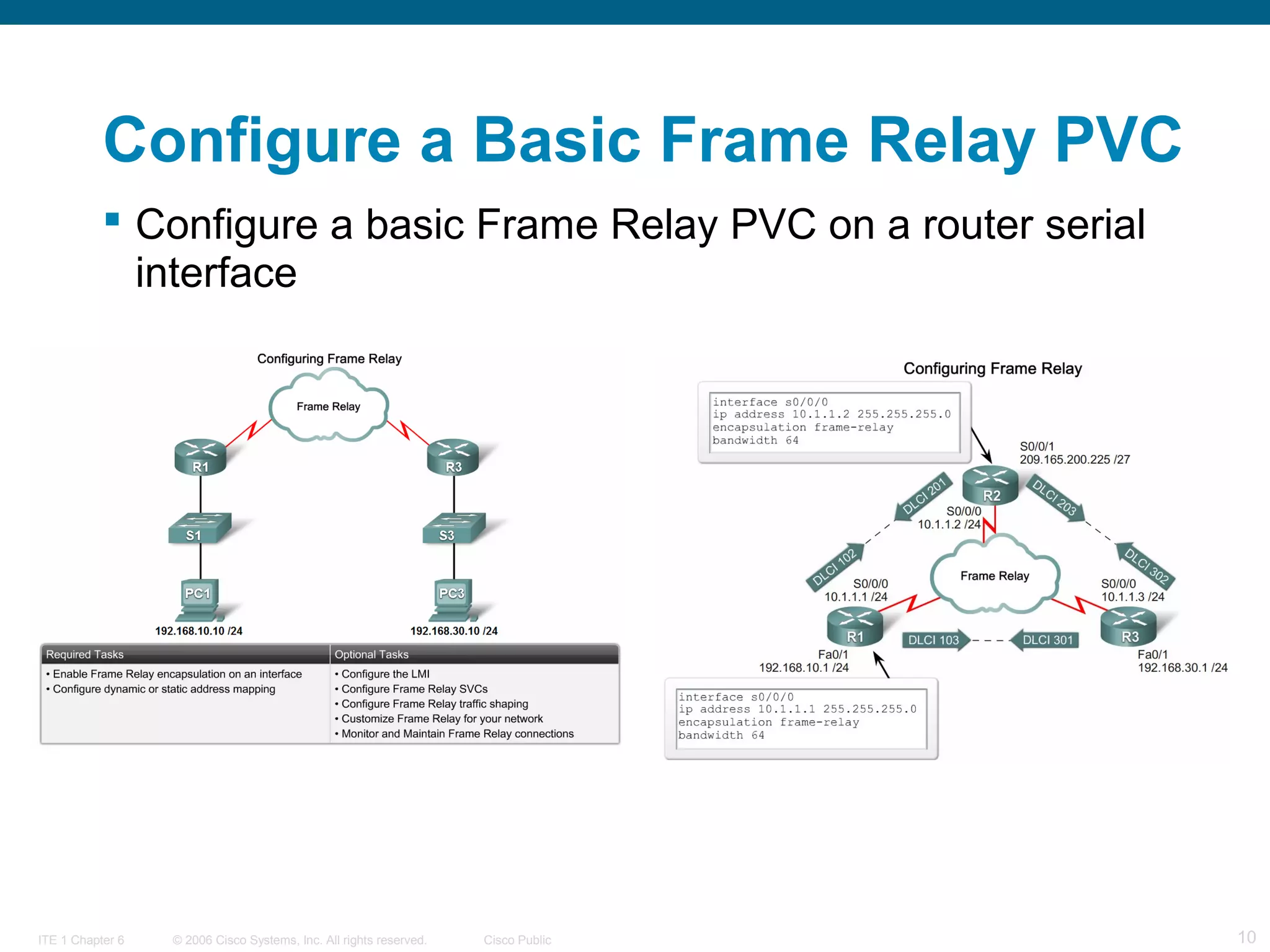
 Configure a basic Frame Relay PVC on a router serial
interface
© 2006 Cisco Systems, Inc. All rights reserved. Cisco PublicITE 1 Chapter 6 11
Configure a Basic Frame Relay PVC
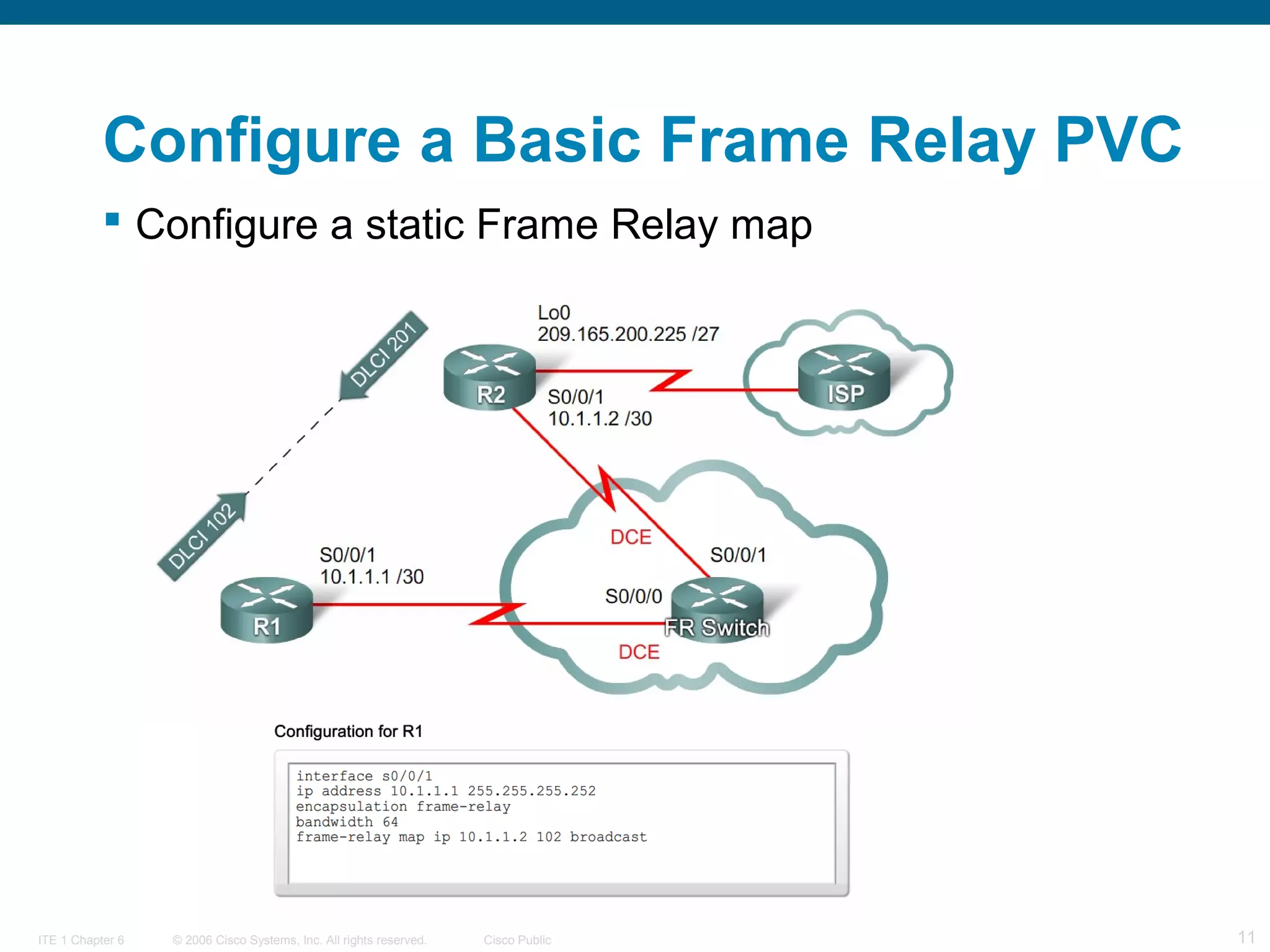
 Configure a static Frame Relay map
© 2006 Cisco Systems, Inc. All rights reserved. Cisco PublicITE 1 Chapter 6 12
Advanced Concepts of Frame Relay Technology
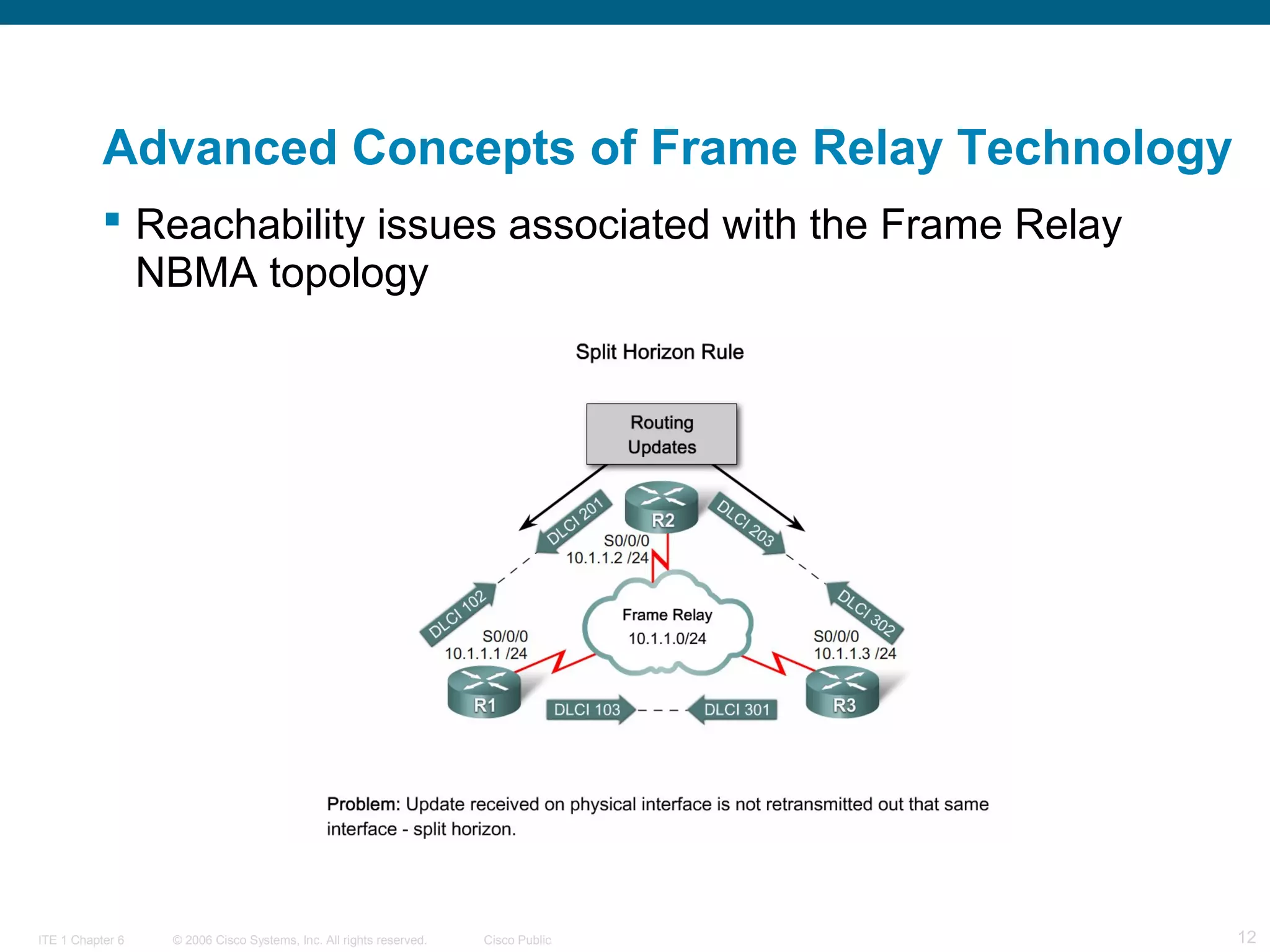
 Reachability issues associated with the Frame Relay
NBMA topology
© 2006 Cisco Systems, Inc. All rights reserved. Cisco PublicITE 1 Chapter 6 13
Advanced Concepts of Frame Relay Technology
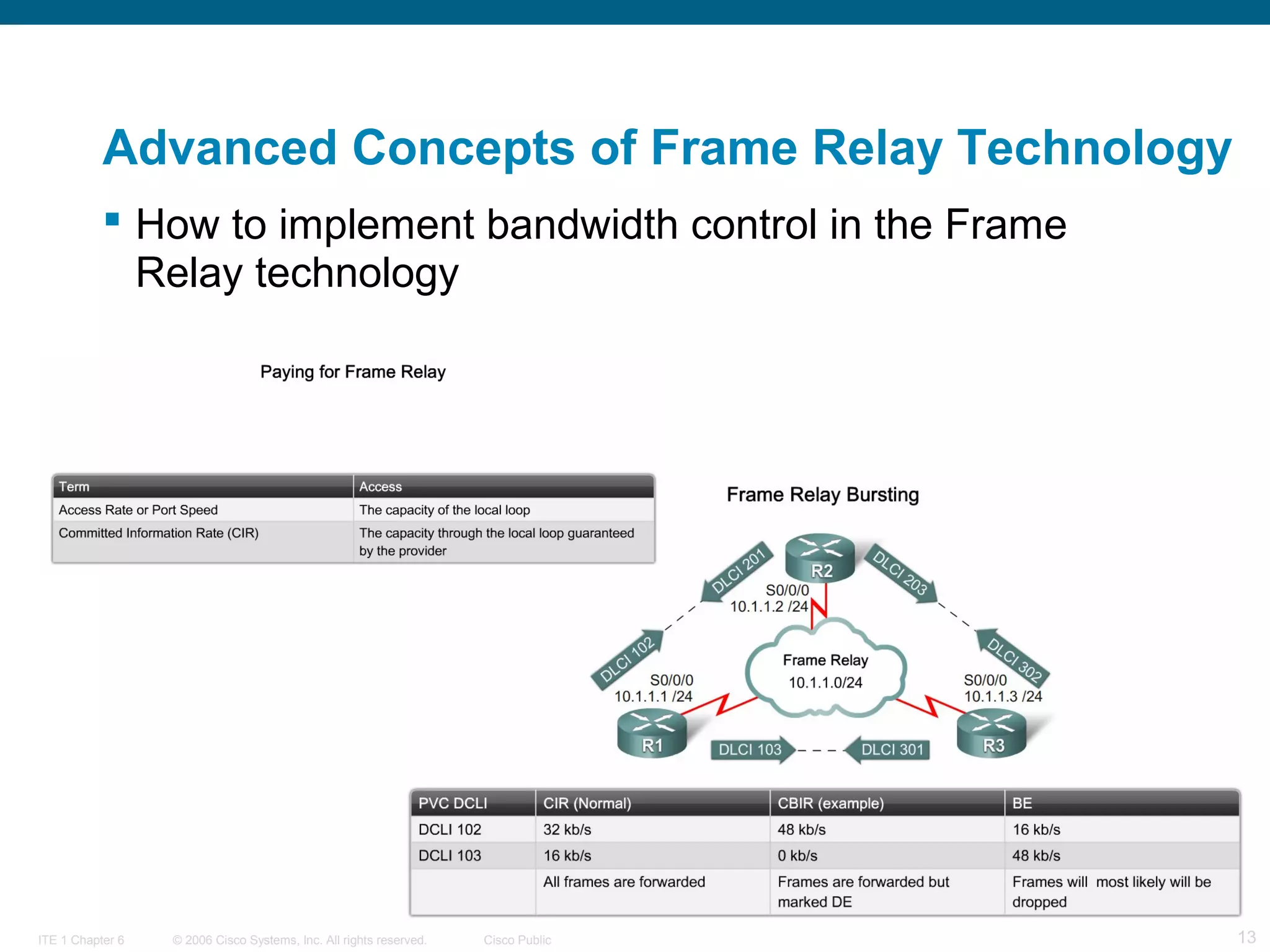
 How to implement bandwidth control in the Frame
Relay technology
© 2006 Cisco Systems, Inc. All rights reserved. Cisco PublicITE 1 Chapter 6 14
Advanced Concepts of Frame Relay Technology
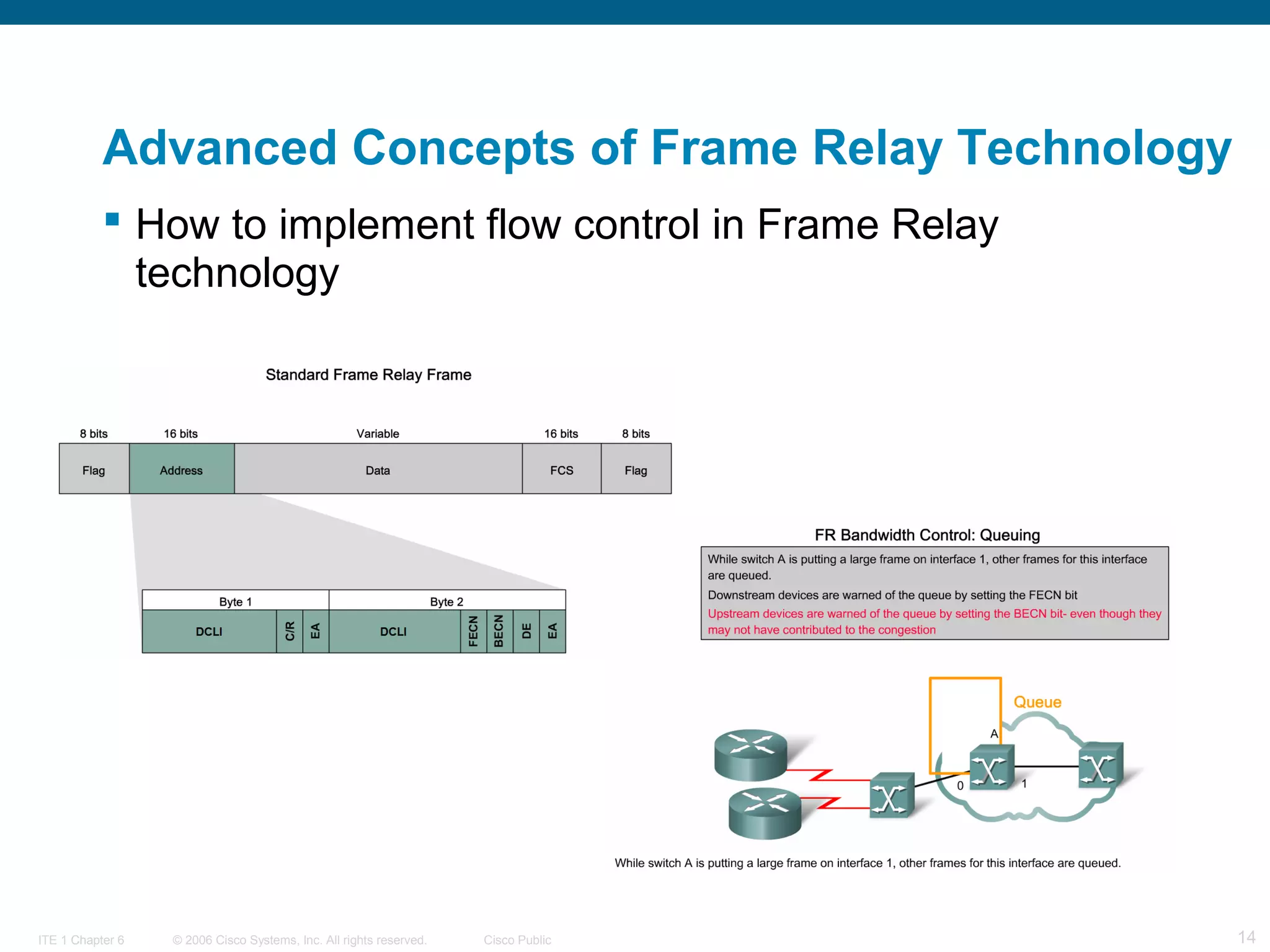
 How to implement flow control in Frame Relay
technology
© 2006 Cisco Systems, Inc. All rights reserved. Cisco PublicITE 1 Chapter 6 15
Configure an Advanced Frame Relay PVC
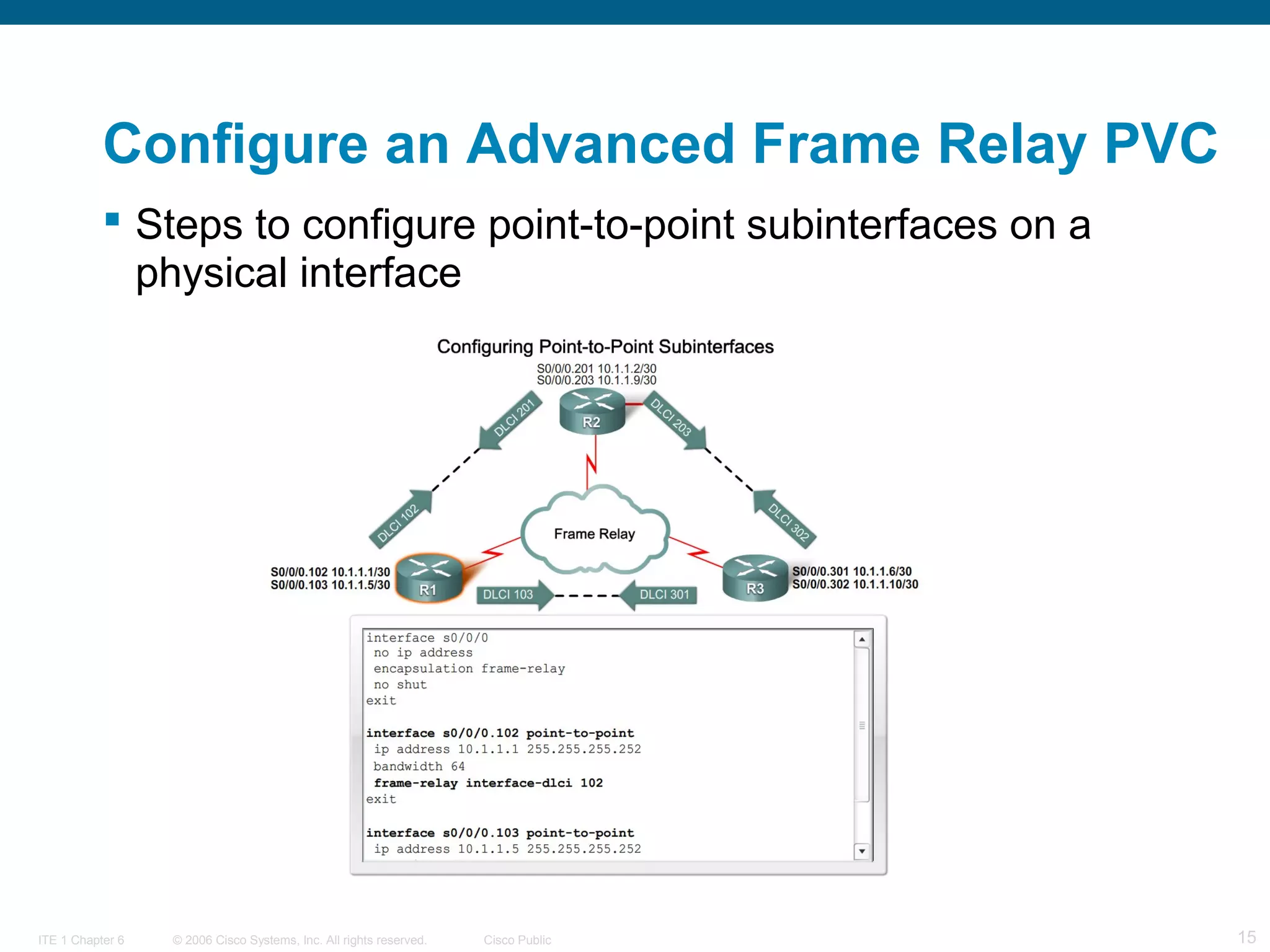
 Steps to configure point-to-point subinterfaces on a
physical interface
© 2006 Cisco Systems, Inc. All rights reserved. Cisco PublicITE 1 Chapter 6 16
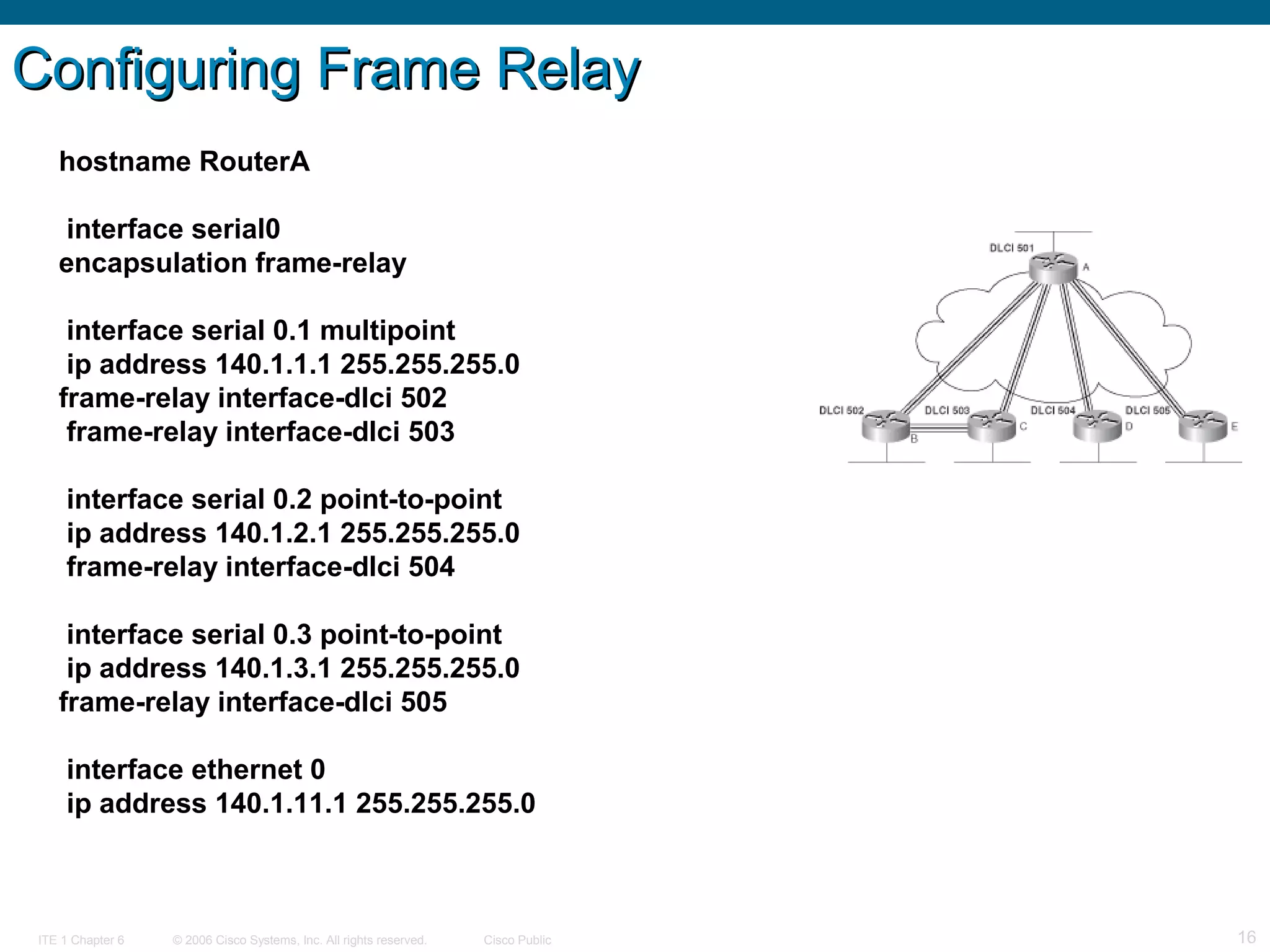
Configuring Frame RelayConfiguring Frame Relay
hostname RouterA
interface serial0
encapsulation frame-relay
interface serial 0.1 multipoint
ip address 140.1.1.1 255.255.255.0
frame-relay interface-dlci 502
frame-relay interface-dlci 503
interface serial 0.2 point-to-point
ip address 140.1.2.1 255.255.255.0
frame-relay interface-dlci 504
interface serial 0.3 point-to-point
ip address 140.1.3.1 255.255.255.0
frame-relay interface-dlci 505
interface ethernet 0
ip address 140.1.11.1 255.255.255.0
© 2006 Cisco Systems, Inc. All rights reserved. Cisco PublicITE 1 Chapter 6 17
Configuring Frame RelayConfiguring Frame Relay
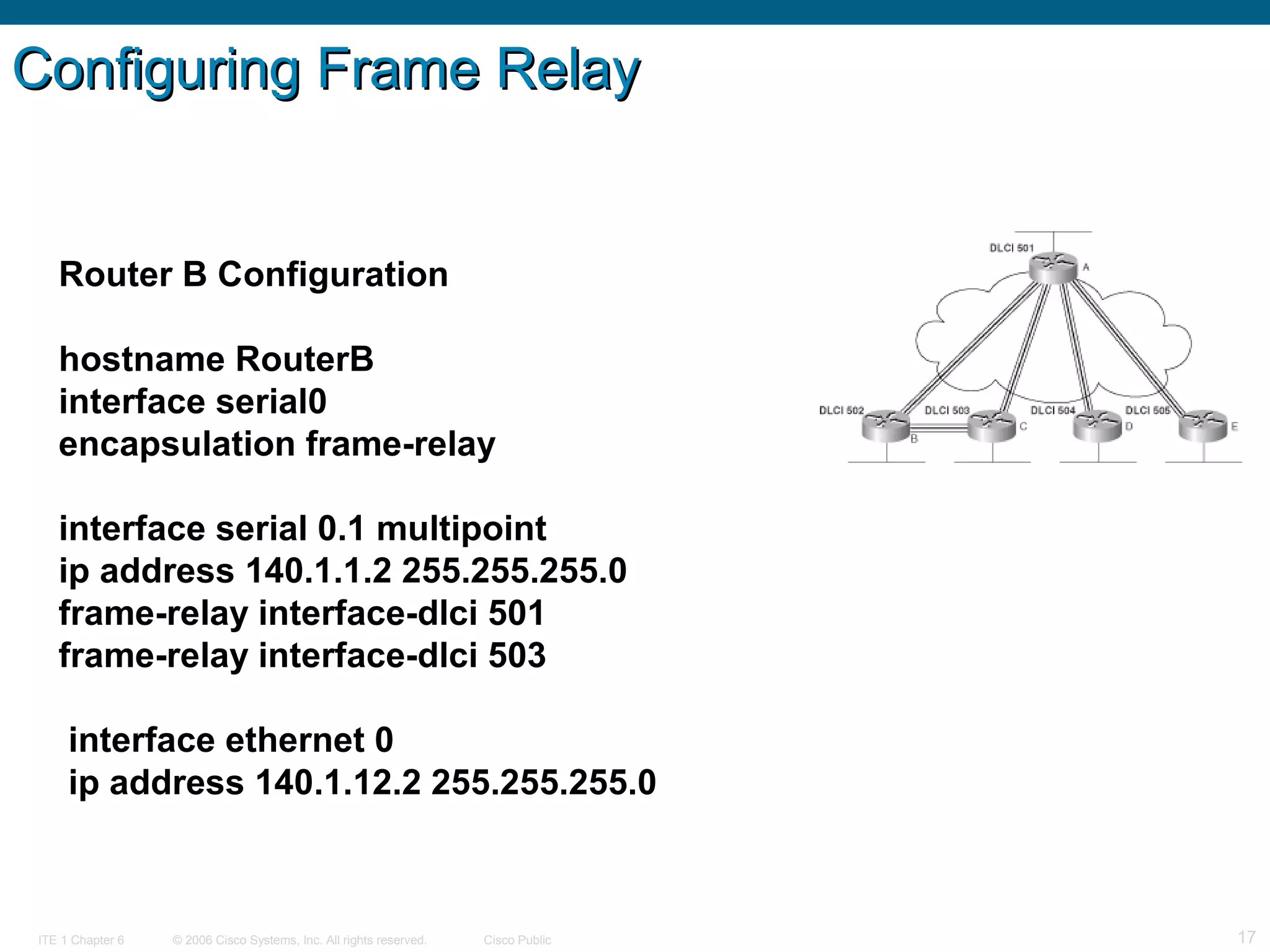
Router B Configuration
hostname RouterB
interface serial0
encapsulation frame-relay
interface serial 0.1 multipoint
ip address 140.1.1.2 255.255.255.0
frame-relay interface-dlci 501
frame-relay interface-dlci 503
interface ethernet 0
ip address 140.1.12.2 255.255.255.0
© 2006 Cisco Systems, Inc. All rights reserved. Cisco PublicITE 1 Chapter 6 18
Configuring Frame RelayConfiguring Frame Relay
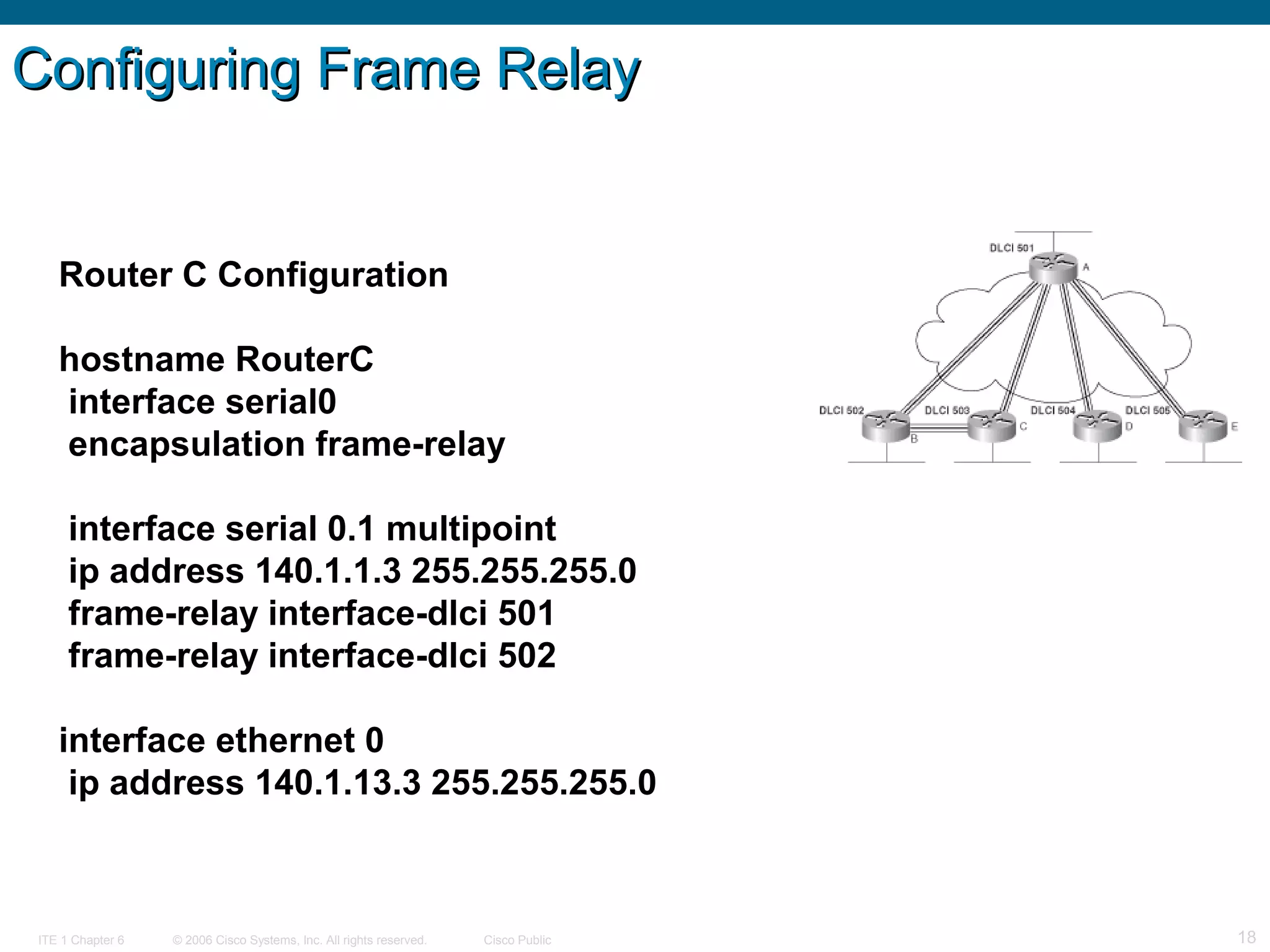
Router C Configuration
hostname RouterC
interface serial0
encapsulation frame-relay
interface serial 0.1 multipoint
ip address 140.1.1.3 255.255.255.0
frame-relay interface-dlci 501
frame-relay interface-dlci 502
interface ethernet 0
ip address 140.1.13.3 255.255.255.0
© 2006 Cisco Systems, Inc. All rights reserved. Cisco PublicITE 1 Chapter 6 19
Configuring Frame RelayConfiguring Frame Relay
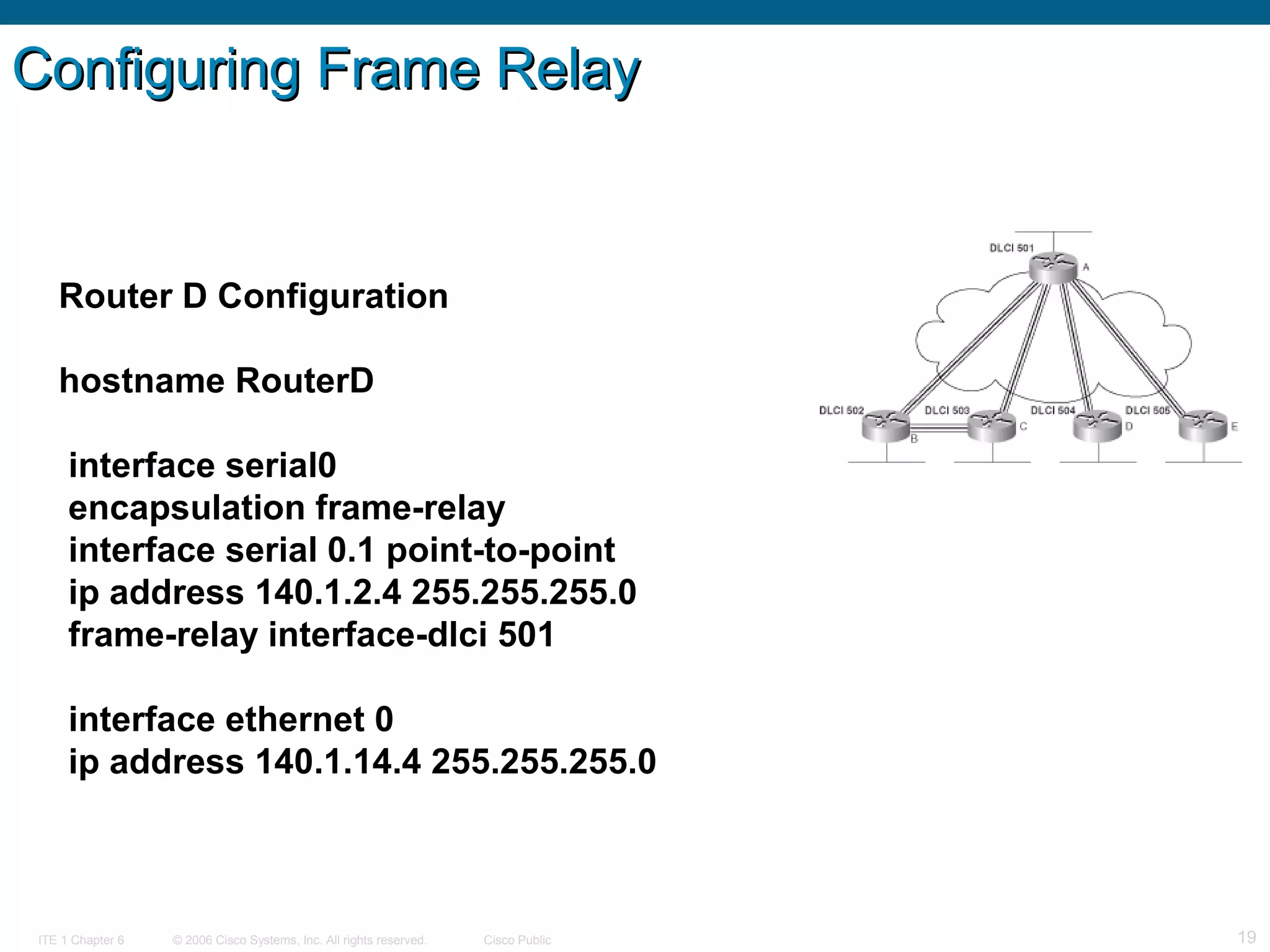
Router D Configuration
hostname RouterD
interface serial0
encapsulation frame-relay
interface serial 0.1 point-to-point
ip address 140.1.2.4 255.255.255.0
frame-relay interface-dlci 501
interface ethernet 0
ip address 140.1.14.4 255.255.255.0
© 2006 Cisco Systems, Inc. All rights reserved. Cisco PublicITE 1 Chapter 6 20
Configuring Frame RelayConfiguring Frame Relay
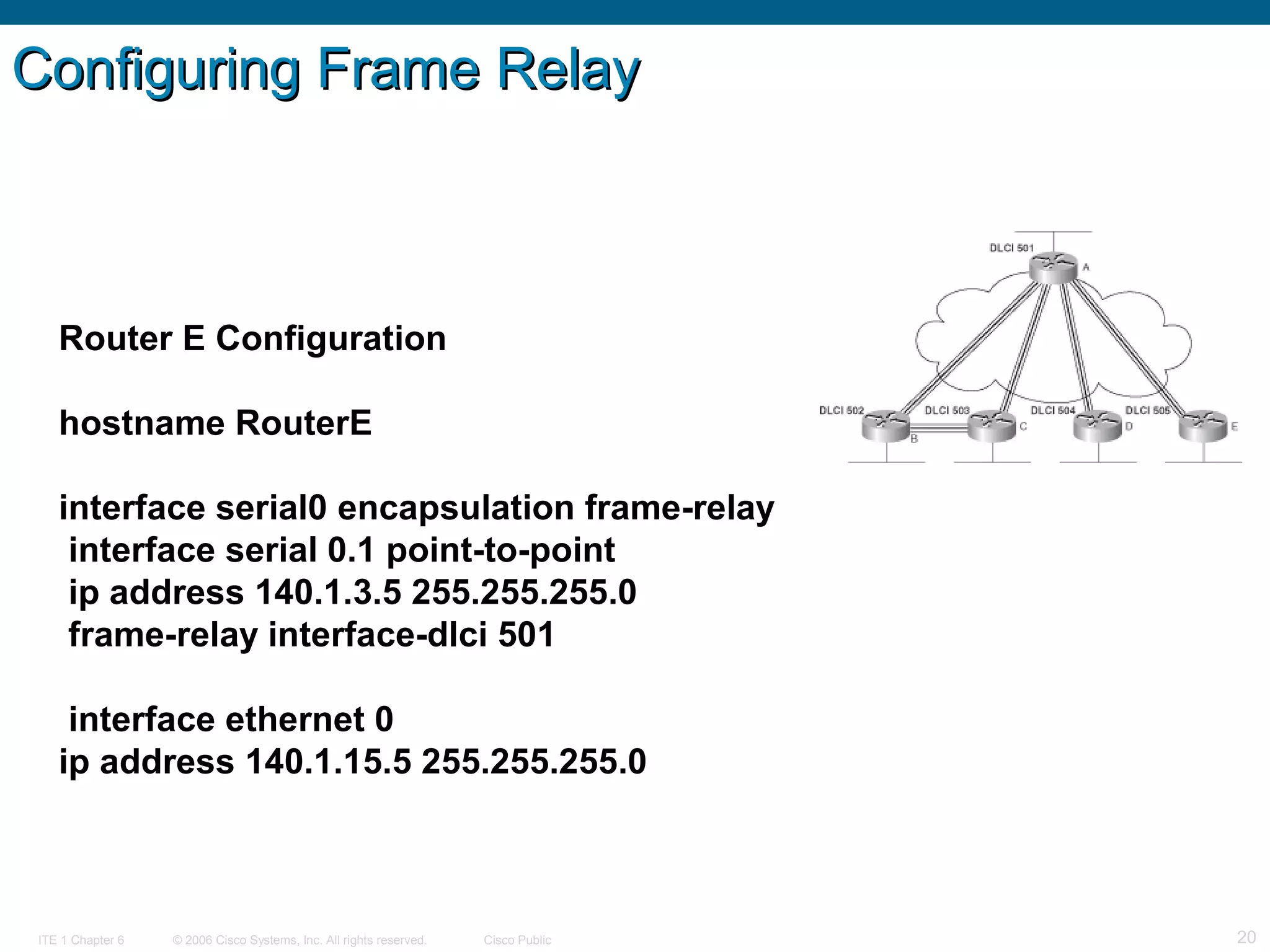
Router E Configuration
hostname RouterE
interface serial0 encapsulation frame-relay
interface serial 0.1 point-to-point
ip address 140.1.3.5 255.255.255.0
frame-relay interface-dlci 501
interface ethernet 0
ip address 140.1.15.5 255.255.255.0
© 2006 Cisco Systems, Inc. All rights reserved. Cisco PublicITE 1 Chapter 6 21
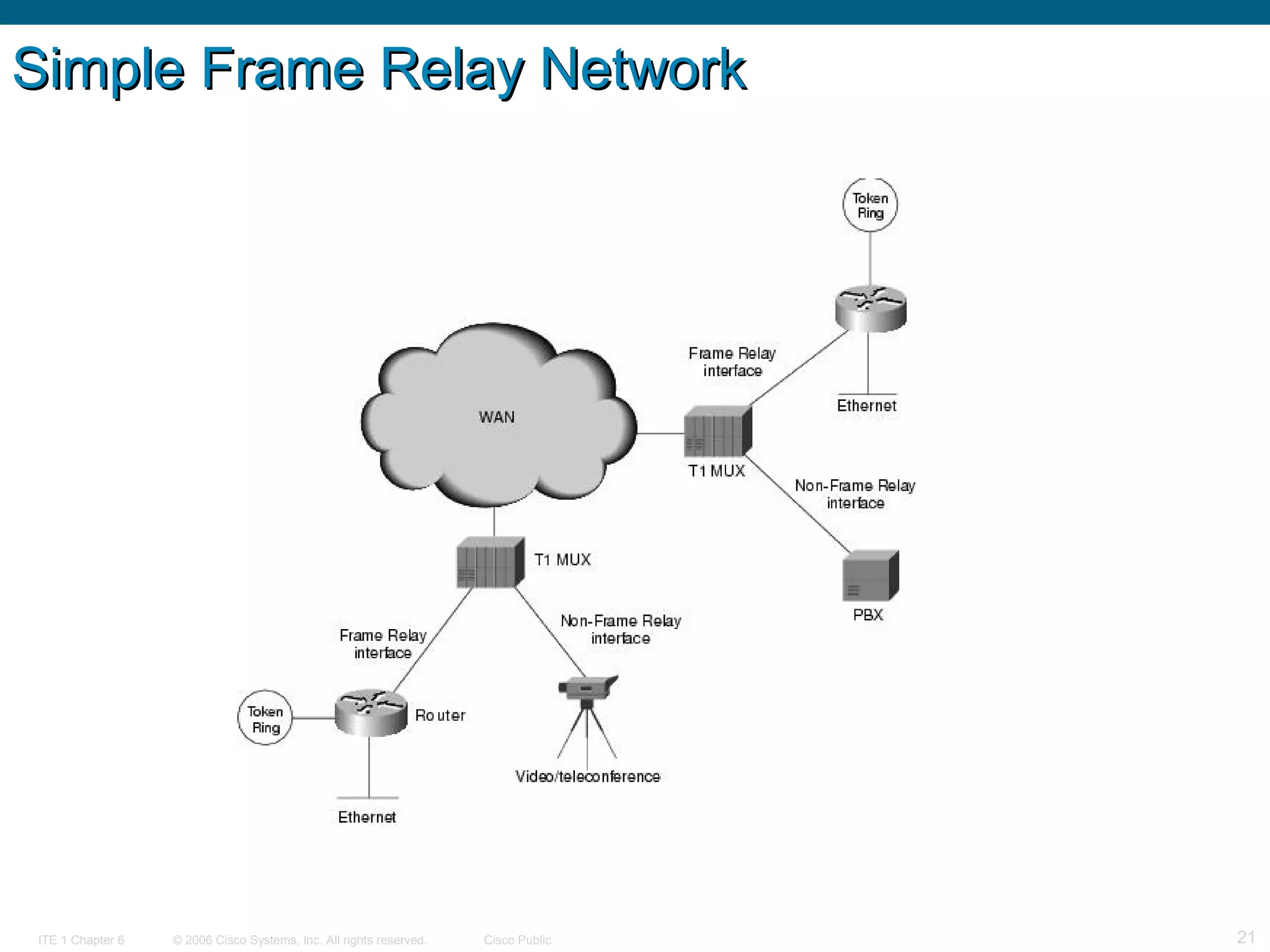
Simple Frame Relay NetworkSimple Frame Relay Network
© 2006 Cisco Systems, Inc. All rights reserved. Cisco PublicITE 1 Chapter 6 22

Frame Relay

  • 1.
    © 2006 CiscoSystems, Inc. All rights reserved. Cisco PublicITE I Chapter 6 1 Frame Relay cisco
  • 2.
    © 2006 CiscoSystems, Inc. All rights reserved. Cisco PublicITE 1 Chapter 6 2 Objectives  Describe the fundamental concepts of Frame Relay technology in terms of Enterprise WAN services including Frame Relay operation, Frame Relay implementation requirements, Frame Relay maps, and LMI operation.  Configure a basic Frame Relay PVC including configuring and troubleshooting Frame Relay on a router serial interface and configuring a static Frame Relay map.  Describe advanced concepts of Frame Relay technology in terms of Enterprise WAN services including Frame Relay sub- interfaces, Frame Relay bandwidth and flow control.  Configure an advanced Frame Relay PVC including solving reachability issues, configuring Frame Relay sub-interfaces, verifying and troubleshooting Frame Relay configuration.
  • 3.
    © 2006 CiscoSystems, Inc. All rights reserved. Cisco PublicITE 1 Chapter 6 3 Fundamental Concepts of Frame Relay Technology Frame Relay ?  Frame Relay is a packet-switched, connection-oriented, WAN service that operates at the data link layer of the OSI reference model  A high-performance WAN protocol that operates at the physical and data link layers of the OSI reference model.  Eric Scace, an engineer at Sprint International, invented Frame Relay as a simpler version of the X.25 protocol to use across Integrated Services Digital Network (ISDN) interfaces.  Frame Relay has become one of the most extensively used WAN protocols, because  It is inexpensive compared to dedicated lines.  Configuring user equipment in a Frame Relay network is very simple.
  • 4.
    © 2006 CiscoSystems, Inc. All rights reserved. Cisco PublicITE 1 Chapter 6 4 Fundamental Concepts of Frame Relay Technology  How Frame Relay is used to provide WAN services to the Enterprise
  • 5.
    © 2006 CiscoSystems, Inc. All rights reserved. Cisco PublicITE 1 Chapter 6 5 Fundamental Concepts of Frame Relay Technology  How Frame Relay uses virtual circuits to carry packets from one DTE to another
  • 6.
    © 2006 CiscoSystems, Inc. All rights reserved. Cisco PublicITE 1 Chapter 6 6 Fundamental Concepts of Frame Relay Technology  How Frame Relay uses virtual circuits to carry packets from one DTE to another SVCs, switched virtual circuits, are established dynamically by sending signaling messages to the network (CALL SETUP, DATA TRANSFER, IDLE, CALL TERMINATION). PVCs, permanent virtual circuits, are preconfigured by the carrier, and after they are set up, only operate in DATA TRANSFER and IDLE modes. Note that some publications refer to PVCs as private VCs.
  • 7.
    © 2006 CiscoSystems, Inc. All rights reserved. Cisco PublicITE 1 Chapter 6 7 Fundamental Concepts of Frame Relay Technology  Types of topologies that are used for implementing Frame Relay in different environments
  • 8.
    © 2006 CiscoSystems, Inc. All rights reserved. Cisco PublicITE 1 Chapter 6 8 Fundamental Concepts of Frame Relay Technology  Types of topologies that are used for implementing Frame Relay in different environments
  • 9.
    © 2006 CiscoSystems, Inc. All rights reserved. Cisco PublicITE 1 Chapter 6 9 Fundamental Concepts of Frame Relay Technology  How a router attached to a Frame Relay network uses LMI status messages and inverse ARP queries to map VCs to layer 3 network IP Addresses LMI is a keep alive mechanism that provides status information about Frame Relay connections between the router (DTE) and the Frame Relay switch (DCE). Three types of LMIs are supported by Cisco routers: Cisco - The original LMI extensions Ansi - Corresponding to the ANSI standard T1.617 Annex D q933a - Corresponding to the ITU standard Q933 Annex A
  • 10.
    © 2006 CiscoSystems, Inc. All rights reserved. Cisco PublicITE 1 Chapter 6 10 Configure a Basic Frame Relay PVC  Configure a basic Frame Relay PVC on a router serial interface
  • 11.
    © 2006 CiscoSystems, Inc. All rights reserved. Cisco PublicITE 1 Chapter 6 11 Configure a Basic Frame Relay PVC  Configure a static Frame Relay map
  • 12.
    © 2006 CiscoSystems, Inc. All rights reserved. Cisco PublicITE 1 Chapter 6 12 Advanced Concepts of Frame Relay Technology  Reachability issues associated with the Frame Relay NBMA topology
  • 13.
    © 2006 CiscoSystems, Inc. All rights reserved. Cisco PublicITE 1 Chapter 6 13 Advanced Concepts of Frame Relay Technology  How to implement bandwidth control in the Frame Relay technology
  • 14.
    © 2006 CiscoSystems, Inc. All rights reserved. Cisco PublicITE 1 Chapter 6 14 Advanced Concepts of Frame Relay Technology  How to implement flow control in Frame Relay technology
  • 15.
    © 2006 CiscoSystems, Inc. All rights reserved. Cisco PublicITE 1 Chapter 6 15 Configure an Advanced Frame Relay PVC  Steps to configure point-to-point subinterfaces on a physical interface
  • 16.
    © 2006 CiscoSystems, Inc. All rights reserved. Cisco PublicITE 1 Chapter 6 16 Configuring Frame RelayConfiguring Frame Relay hostname RouterA interface serial0 encapsulation frame-relay interface serial 0.1 multipoint ip address 140.1.1.1 255.255.255.0 frame-relay interface-dlci 502 frame-relay interface-dlci 503 interface serial 0.2 point-to-point ip address 140.1.2.1 255.255.255.0 frame-relay interface-dlci 504 interface serial 0.3 point-to-point ip address 140.1.3.1 255.255.255.0 frame-relay interface-dlci 505 interface ethernet 0 ip address 140.1.11.1 255.255.255.0
  • 17.
    © 2006 CiscoSystems, Inc. All rights reserved. Cisco PublicITE 1 Chapter 6 17 Configuring Frame RelayConfiguring Frame Relay Router B Configuration hostname RouterB interface serial0 encapsulation frame-relay interface serial 0.1 multipoint ip address 140.1.1.2 255.255.255.0 frame-relay interface-dlci 501 frame-relay interface-dlci 503 interface ethernet 0 ip address 140.1.12.2 255.255.255.0
  • 18.
    © 2006 CiscoSystems, Inc. All rights reserved. Cisco PublicITE 1 Chapter 6 18 Configuring Frame RelayConfiguring Frame Relay Router C Configuration hostname RouterC interface serial0 encapsulation frame-relay interface serial 0.1 multipoint ip address 140.1.1.3 255.255.255.0 frame-relay interface-dlci 501 frame-relay interface-dlci 502 interface ethernet 0 ip address 140.1.13.3 255.255.255.0
  • 19.
    © 2006 CiscoSystems, Inc. All rights reserved. Cisco PublicITE 1 Chapter 6 19 Configuring Frame RelayConfiguring Frame Relay Router D Configuration hostname RouterD interface serial0 encapsulation frame-relay interface serial 0.1 point-to-point ip address 140.1.2.4 255.255.255.0 frame-relay interface-dlci 501 interface ethernet 0 ip address 140.1.14.4 255.255.255.0
  • 20.
    © 2006 CiscoSystems, Inc. All rights reserved. Cisco PublicITE 1 Chapter 6 20 Configuring Frame RelayConfiguring Frame Relay Router E Configuration hostname RouterE interface serial0 encapsulation frame-relay interface serial 0.1 point-to-point ip address 140.1.3.5 255.255.255.0 frame-relay interface-dlci 501 interface ethernet 0 ip address 140.1.15.5 255.255.255.0
  • 21.
    © 2006 CiscoSystems, Inc. All rights reserved. Cisco PublicITE 1 Chapter 6 21 Simple Frame Relay NetworkSimple Frame Relay Network
  • 22.
    © 2006 CiscoSystems, Inc. All rights reserved. Cisco PublicITE 1 Chapter 6 22

Editor's Notes

  • #4 Graphic 3.1.1.1 (frame relay)
  • #5 Graphic 3.1.1.1 (frame relay)
  • #6 Graphic 3.1.2.1 Graphic 3.1.2.2
  • #7 Graphic 3.1.2.1 Graphic 3.1.2.2
  • #8 Graphic 3.1.4.1 Graphic 3.1.4.2
  • #9 Graphic 3.1.4.1 Graphic 3.1.4.2
  • #10 Graphic 3.1.5.4
  • #11 Graphic 3.2.1.1 & 3.2.1.2
  • #12 Graphic 3.2.2.1
  • #13 Graphic 3.3.1.1
  • #14 Graphic 3.3.2.1 & 3.3.2.2
  • #15 Graphic 3.3.3.1
  • #16 Graphic 3.4.1.2
  • #17 Graphic 3.4.1.2
  • #18 Graphic 3.4.1.2
  • #19 Graphic 3.4.1.2
  • #20 Graphic 3.4.1.2
  • #21 Graphic 3.4.1.2
  • #22 Graphic 3.4.1.2