
Switching in an
              Enterprise Network


              Introducing Routing and Switching in the Enterprise –
              Chapter 3


Version 4.0       © 2006 Cisco Systems, Inc. All rights reserved.   Cisco Public   1
Objectives
ď‚§   Compare the types of switches used in an enterprise
    network.
ď‚§   Explain how Spanning Tree Protocol prevents
    switching loops.
ď‚§   Describe and configure VLANs on a Cisco switch.
ď‚§   Describe and configure trunking and Inter-VLAN
    routing.
ď‚§   Maintain VLANs in an enterprise network.


    © 2006 Cisco Systems, Inc. All rights reserved.   Cisco Public   2
Compare the Types of Switches Used in an
  Enterprise Network
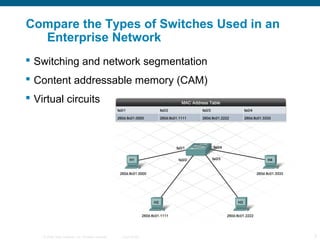
ď‚§ Switching and network segmentation
ď‚§ Content addressable memory (CAM)
ď‚§ Virtual circuits


    © 2006 Cisco Systems, Inc. All rights reserved.   Cisco Public   3
Compare the Types of Switches Used in an
  Enterprise Network
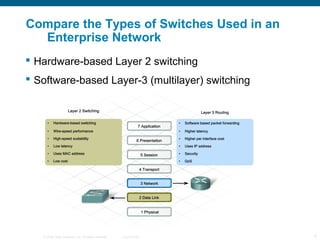
ď‚§ Hardware-based Layer 2 switching
ď‚§ Software-based Layer-3 (multilayer) switching


   © 2006 Cisco Systems, Inc. All rights reserved.   Cisco Public   4
Compare the Types of Switches Used in an
  Enterprise Network
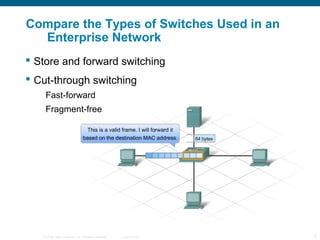
ď‚§ Store and forward switching
ď‚§ Cut-through switching
    Fast-forward
    Fragment-free


   © 2006 Cisco Systems, Inc. All rights reserved.   Cisco Public   5
Compare the Types of Switches Used in an
  Enterprise Network
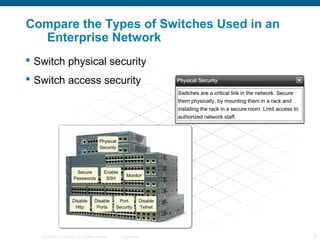
ď‚§ Switch physical security
ď‚§ Switch access security


   © 2006 Cisco Systems, Inc. All rights reserved.   Cisco Public   6
Explain How Spanning Tree Protocol Prevents
   Switching Loops
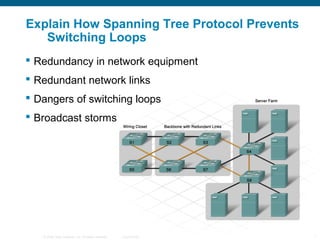
ď‚§ Redundancy in network equipment
ď‚§ Redundant network links
ď‚§ Dangers of switching loops
ď‚§ Broadcast storms


   © 2006 Cisco Systems, Inc. All rights reserved.   Cisco Public   7
Explain How Spanning Tree Protocol Prevents
   Switching Loops
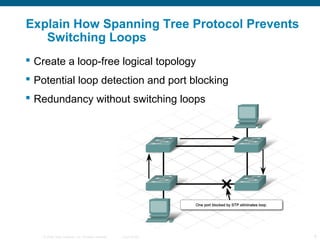
ď‚§ Create a loop-free logical topology
ď‚§ Potential loop detection and port blocking
ď‚§ Redundancy without switching loops


   © 2006 Cisco Systems, Inc. All rights reserved.   Cisco Public   8
Explain How Spanning Tree Protocol Prevents
   Switching Loops
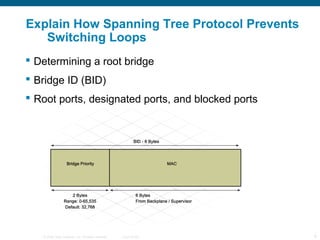
ď‚§ Determining a root bridge
ď‚§ Bridge ID (BID)
ď‚§ Root ports, designated ports, and blocked ports


   © 2006 Cisco Systems, Inc. All rights reserved.   Cisco Public   9
Explain How Spanning Tree Protocol Prevents
   Switching Loops
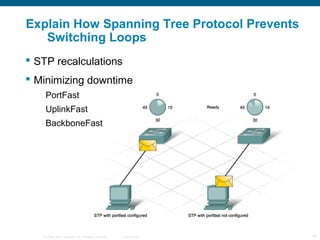
ď‚§ STP recalculations
ď‚§ Minimizing downtime
    PortFast
    UplinkFast
    BackboneFast


   © 2006 Cisco Systems, Inc. All rights reserved.   Cisco Public   10
Explain How Spanning Tree Protocol Prevents
Switching Loops

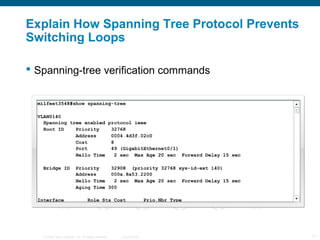
ď‚§ Spanning-tree verification commands


   © 2006 Cisco Systems, Inc. All rights reserved.   Cisco Public   11
Explain How Spanning Tree Protocol Prevents
   Switching Loops
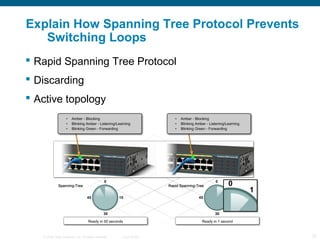
ď‚§ Rapid Spanning Tree Protocol
ď‚§ Discarding
ď‚§ Active topology


   © 2006 Cisco Systems, Inc. All rights reserved.   Cisco Public   12
Describe and Configure VLANs on a Cisco
   Switch
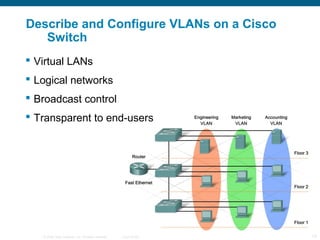
ď‚§ Virtual LANs
ď‚§ Logical networks
ď‚§ Broadcast control
ď‚§ Transparent to end-users


   © 2006 Cisco Systems, Inc. All rights reserved.   Cisco Public   13
Describe and Configure VLANs on a Cisco
Switch

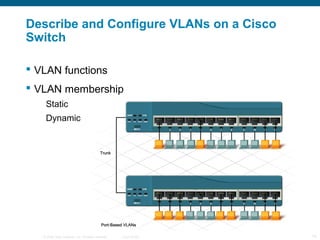
ď‚§ VLAN functions
ď‚§ VLAN membership
    Static
    Dynamic


   © 2006 Cisco Systems, Inc. All rights reserved.   Cisco Public   14
Describe and Configure VLANs on a Cisco
   Switch
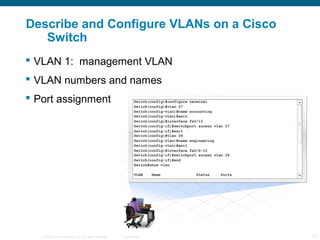
ď‚§ VLAN 1: management VLAN
ď‚§ VLAN numbers and names
ď‚§ Port assignment


   © 2006 Cisco Systems, Inc. All rights reserved.   Cisco Public   15
Describe and Configure VLANs on a Cisco
Switch
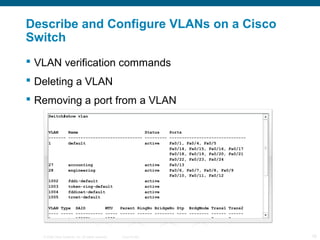
ď‚§ VLAN verification commands
ď‚§ Deleting a VLAN
ď‚§ Removing a port from a VLAN


   © 2006 Cisco Systems, Inc. All rights reserved.   Cisco Public   16
Describe and Configure VLANs on a Cisco
   Switch
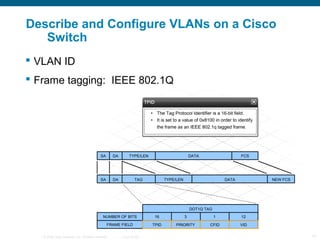
ď‚§ VLAN ID
ď‚§ Frame tagging: IEEE 802.1Q


   © 2006 Cisco Systems, Inc. All rights reserved.   Cisco Public   17
Describe and Configure Trunking and Inter-
   VLAN Routing
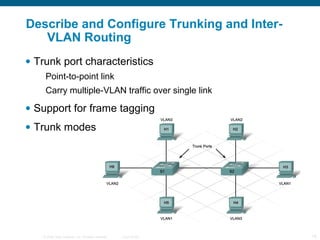
• Trunk port characteristics
    Point-to-point link
    Carry multiple-VLAN traffic over single link

• Support for frame tagging
• Trunk modes


   © 2006 Cisco Systems, Inc. All rights reserved.   Cisco Public   18
Describe and Configure Trunking and Inter-
   VLAN Routing
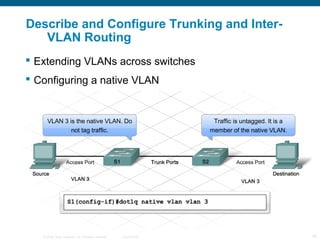
ď‚§ Extending VLANs across switches
ď‚§ Configuring a native VLAN


   © 2006 Cisco Systems, Inc. All rights reserved.   Cisco Public   19
Describe and Configure Trunking and Inter-
   VLAN Routing
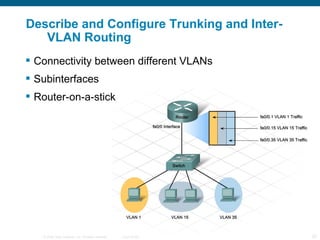
ď‚§ Connectivity between different VLANs
ď‚§ Subinterfaces
ď‚§ Router-on-a-stick


   © 2006 Cisco Systems, Inc. All rights reserved.   Cisco Public   20
Maintain VLAN Structure on an Enterprise
   Network
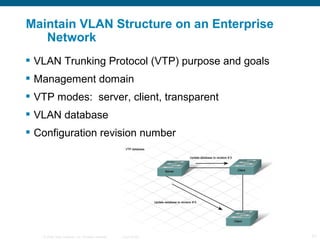
ď‚§ VLAN Trunking Protocol (VTP) purpose and goals
ď‚§ Management domain
ď‚§ VTP modes: server, client, transparent
ď‚§ VLAN database
ď‚§ Configuration revision number


   © 2006 Cisco Systems, Inc. All rights reserved.   Cisco Public   21
Maintain VLAN Structure on an Enterprise
Network

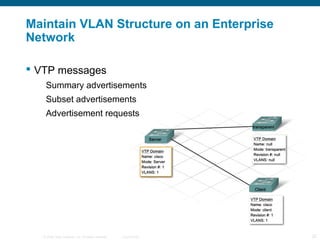
ď‚§ VTP messages
    Summary advertisements
    Subset advertisements
    Advertisement requests


   © 2006 Cisco Systems, Inc. All rights reserved.   Cisco Public   22
Maintain VLAN Structure on an Enterprise
   Network
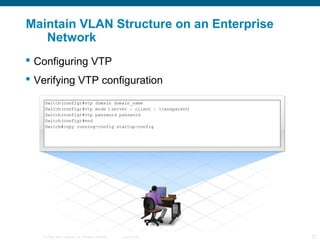
ď‚§ Configuring VTP
ď‚§ Verifying VTP configuration


   © 2006 Cisco Systems, Inc. All rights reserved.   Cisco Public   23
Maintain VLAN Structure on an Enterprise
   Network
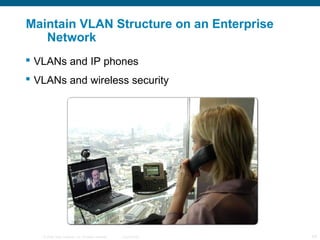
ď‚§ VLANs and IP phones
ď‚§ VLANs and wireless security


   © 2006 Cisco Systems, Inc. All rights reserved.   Cisco Public   24
Maintain VLAN Structure on an Enterprise
   Network
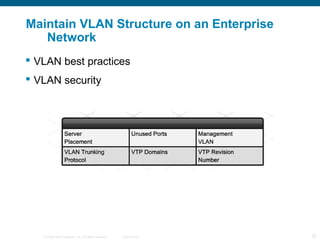
ď‚§ VLAN best practices
ď‚§ VLAN security


   © 2006 Cisco Systems, Inc. All rights reserved.   Cisco Public   25
Summary
ď‚§ Switches forward traffic using store and forward or cut-through
  techniques
ď‚§ Basic security features should be applied to switches
ď‚§ A VLAN is a way to group hosts on the same logical network even
  though they may be physically separated
ď‚§ Frame tagging allows a switch to identify the source VLAN of an
  Ethernet frame.
ď‚§ A Layer 3 device is needed to move traffic between different
  VLANs.
ď‚§ Subinterfaces allow router interfaces to support multiple VLANs.
ď‚§ VLAN Trunking Protocol provides centralized control, distribution
  and maintenance of VLANs.


     © 2006 Cisco Systems, Inc. All rights reserved.   Cisco Public   26
© 2006 Cisco Systems, Inc. All rights reserved.   Cisco Public   27

CCNA Discovery 3 - Chapter 3

  • 1.
    Switching in an Enterprise Network Introducing Routing and Switching in the Enterprise – Chapter 3 Version 4.0 © 2006 Cisco Systems, Inc. All rights reserved. Cisco Public 1
  • 2.
    Objectives  Compare the types of switches used in an enterprise network.  Explain how Spanning Tree Protocol prevents switching loops.  Describe and configure VLANs on a Cisco switch.  Describe and configure trunking and Inter-VLAN routing.  Maintain VLANs in an enterprise network. © 2006 Cisco Systems, Inc. All rights reserved. Cisco Public 2
  • 3.
    Compare the Typesof Switches Used in an Enterprise Network  Switching and network segmentation  Content addressable memory (CAM)  Virtual circuits © 2006 Cisco Systems, Inc. All rights reserved. Cisco Public 3
  • 4.
    Compare the Typesof Switches Used in an Enterprise Network  Hardware-based Layer 2 switching  Software-based Layer-3 (multilayer) switching © 2006 Cisco Systems, Inc. All rights reserved. Cisco Public 4
  • 5.
    Compare the Typesof Switches Used in an Enterprise Network  Store and forward switching  Cut-through switching Fast-forward Fragment-free © 2006 Cisco Systems, Inc. All rights reserved. Cisco Public 5
  • 6.
    Compare the Typesof Switches Used in an Enterprise Network  Switch physical security  Switch access security © 2006 Cisco Systems, Inc. All rights reserved. Cisco Public 6
  • 7.
    Explain How SpanningTree Protocol Prevents Switching Loops  Redundancy in network equipment  Redundant network links  Dangers of switching loops  Broadcast storms © 2006 Cisco Systems, Inc. All rights reserved. Cisco Public 7
  • 8.
    Explain How SpanningTree Protocol Prevents Switching Loops  Create a loop-free logical topology  Potential loop detection and port blocking  Redundancy without switching loops © 2006 Cisco Systems, Inc. All rights reserved. Cisco Public 8
  • 9.
    Explain How SpanningTree Protocol Prevents Switching Loops  Determining a root bridge  Bridge ID (BID)  Root ports, designated ports, and blocked ports © 2006 Cisco Systems, Inc. All rights reserved. Cisco Public 9
  • 10.
    Explain How SpanningTree Protocol Prevents Switching Loops  STP recalculations  Minimizing downtime PortFast UplinkFast BackboneFast © 2006 Cisco Systems, Inc. All rights reserved. Cisco Public 10
  • 11.
    Explain How SpanningTree Protocol Prevents Switching Loops  Spanning-tree verification commands © 2006 Cisco Systems, Inc. All rights reserved. Cisco Public 11
  • 12.
    Explain How SpanningTree Protocol Prevents Switching Loops  Rapid Spanning Tree Protocol  Discarding  Active topology © 2006 Cisco Systems, Inc. All rights reserved. Cisco Public 12
  • 13.
    Describe and ConfigureVLANs on a Cisco Switch  Virtual LANs  Logical networks  Broadcast control  Transparent to end-users © 2006 Cisco Systems, Inc. All rights reserved. Cisco Public 13
  • 14.
    Describe and ConfigureVLANs on a Cisco Switch  VLAN functions  VLAN membership Static Dynamic © 2006 Cisco Systems, Inc. All rights reserved. Cisco Public 14
  • 15.
    Describe and ConfigureVLANs on a Cisco Switch  VLAN 1: management VLAN  VLAN numbers and names  Port assignment © 2006 Cisco Systems, Inc. All rights reserved. Cisco Public 15
  • 16.
    Describe and ConfigureVLANs on a Cisco Switch  VLAN verification commands  Deleting a VLAN  Removing a port from a VLAN © 2006 Cisco Systems, Inc. All rights reserved. Cisco Public 16
  • 17.
    Describe and ConfigureVLANs on a Cisco Switch  VLAN ID  Frame tagging: IEEE 802.1Q © 2006 Cisco Systems, Inc. All rights reserved. Cisco Public 17
  • 18.
    Describe and ConfigureTrunking and Inter- VLAN Routing • Trunk port characteristics Point-to-point link Carry multiple-VLAN traffic over single link • Support for frame tagging • Trunk modes © 2006 Cisco Systems, Inc. All rights reserved. Cisco Public 18
  • 19.
    Describe and ConfigureTrunking and Inter- VLAN Routing  Extending VLANs across switches  Configuring a native VLAN © 2006 Cisco Systems, Inc. All rights reserved. Cisco Public 19
  • 20.
    Describe and ConfigureTrunking and Inter- VLAN Routing  Connectivity between different VLANs  Subinterfaces  Router-on-a-stick © 2006 Cisco Systems, Inc. All rights reserved. Cisco Public 20
  • 21.
    Maintain VLAN Structureon an Enterprise Network  VLAN Trunking Protocol (VTP) purpose and goals  Management domain  VTP modes: server, client, transparent  VLAN database  Configuration revision number © 2006 Cisco Systems, Inc. All rights reserved. Cisco Public 21
  • 22.
    Maintain VLAN Structureon an Enterprise Network  VTP messages Summary advertisements Subset advertisements Advertisement requests © 2006 Cisco Systems, Inc. All rights reserved. Cisco Public 22
  • 23.
    Maintain VLAN Structureon an Enterprise Network  Configuring VTP  Verifying VTP configuration © 2006 Cisco Systems, Inc. All rights reserved. Cisco Public 23
  • 24.
    Maintain VLAN Structureon an Enterprise Network  VLANs and IP phones  VLANs and wireless security © 2006 Cisco Systems, Inc. All rights reserved. Cisco Public 24
  • 25.
    Maintain VLAN Structureon an Enterprise Network  VLAN best practices  VLAN security © 2006 Cisco Systems, Inc. All rights reserved. Cisco Public 25
  • 26.
    Summary  Switches forwardtraffic using store and forward or cut-through techniques  Basic security features should be applied to switches  A VLAN is a way to group hosts on the same logical network even though they may be physically separated  Frame tagging allows a switch to identify the source VLAN of an Ethernet frame.  A Layer 3 device is needed to move traffic between different VLANs.  Subinterfaces allow router interfaces to support multiple VLANs.  VLAN Trunking Protocol provides centralized control, distribution and maintenance of VLANs. © 2006 Cisco Systems, Inc. All rights reserved. Cisco Public 26
  • 27.
    © 2006 CiscoSystems, Inc. All rights reserved. Cisco Public 27