TECHNICAL COMMUNICATION
By Ajit vijayee yadav
AGENDA
 Introduction
 What is Cloud Computing
 History
 Layers of Cloud Computing
 Types Of Cloud Computing
 Cloud Providers
 Advantage of Cloud Computing
 Disadvantage of Cloud Computing
 Future Trends
 Conclusions
 Reference
INTRODUCTION
The cloud is something that you have been using for a long
time now in the form of the Internet. Then, what is it that is
creating this buzz about cloud computing. So here are the
cloud computing features that make it the latest sensation
promising to shape the entire future of modern computing.
The cloud computing benefits are so immense that it is
looked upon as a utility model of computing, with which an
application can start small and grow to be enormous
overnight.
In 2008 Oracle CEO Larry Ellison said “The computer
industry is the only industry that is more fashion-driven
than women’s fashion.” to a group of Oracle analysts. So
let’s talk about what cloud computing is and tighten up our
definition and understanding of this implementation.
 Cloud Computing refers to both the applications
delivered as services over the Internet and the hardware
and systems software in Internet infrastructure (called a
platform).
 Hide the complexity infrastructure by providing very
simple graphical interface or API (Applications
Programming Interface).
 Provides on demand services, that are always on,
anywhere, anytime and any place.
 Pay for use and as needed, elastic.
 The hardware and software services are available to the
general public, enterprises, corporations and businesses
markets.
What is Cloud Computing?
HISTORY
 The concept was coined by John McCarthy in 1960.
 The term cloud came into commercial use in the
early 1990s generally refers to large ATM network.
 By the 21st century the real concept of “cloud
computing” has appeared most focus was on
SaaS.
 In 1999 , Saleaforce.com was established by Marc,
Parker and his fellows.
 IBM extended the concept in 2001.
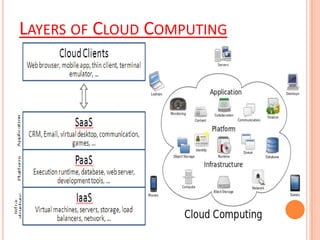
LAYERS OF CLOUD COMPUTING
CLOUD SOFTWARE AS A SERVICE (SAAS)
 Software services are applications or components that
can be used as an end application or used as part of a
custom solution
 Software Services include –
 Billing, Financials, Legal, Human Resources - Aria
Systems, OpSource
 Sales, CRM - Concur, Xero, Workday
 Desktop Productivity - DirectLaw, Advologix
 Content Management - Taleo, Workday
 Backup & Recovery - Xactly, LucidEra, StreetSmarts
 Document Management - Salesforce.com, NetSuite,
LiveOps
 Collaboration - Box.net, DropBox
 Social Networks - Ning, Zembly
CLOUD PLATFORM AS A SERVICE (PAAS)
 Platform services offer a ready built infrastructure and
application frameworks that can be used for building and
running applications.
 Platform Services include -
 General Purpose - provide development tools for
cloud‐capable applications or application fragments.
Vendors - Force.com, LongJump, Google App Engine, MS Azure
Services Platform
 Business Intelligence - provide business intelligence
capabilities as service and can be cloud‐based.
Vendors - Aster DB, Panaroma, Vertica
 Integration - provide integration and process
orchestration capabilities delivered as a service.
Vendors - Amazon SQS, HubSpan, Microsoft BizTalk Services
CLOUD INFRASTRUCTURE AS A SERVICE (IAAS)
 Infrastructure services provide building blocks that can be moulded
to run different application servers, packaged applications, etc.,
which can be used to host applications.
 Infrastructure Services include -
 Storage - Provide metered, on‐demand storage of structure or
un‐structured data delivered as a service.
Vendors - Amazon EBS & S3, MossoCloud Files, Nirvanix,
VaultscapeStorage
 Compute - provide metered, on‐demand execution of codes,
services or applications delivered as a service.
Vendors - Amazon EC2, MossoCloud Servers, AppNexus,
Terremark, GridLayer
 Services Management - provide a layer of management of the
infrastructure services
Vendors - IBM, RightScale, Scalr, CloudStatus, Kaavo
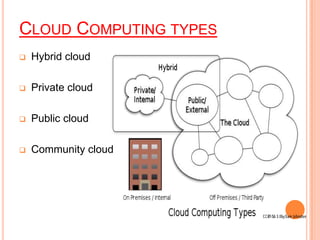
CLOUD COMPUTING TYPES
 Hybrid cloud
 Private cloud
 Public cloud
 Community cloud
CONTINUE….
 Private Cloud - The cloud infrastructure is operated
solely for an organization.
 Community Cloud - Several organizations have
similar requirements and seek to share the cloud
infrastructure.
 Public Cloud – Cloud computing through off-site
third-party provider
 Hybrid Cloud – Mix of Cloud models. Normally used
for archiving and backup functions
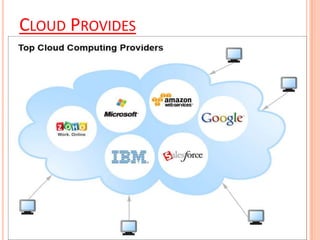
CLOUD PROVIDES
ADVANTAGES OF CLOUD COMPUTING
 Lower computer costs.
 Improved performance.
 Reduced software costs.
 Instant software updates.
 Improved document format compatibility.
 Unlimited storage capacity. ( pbytes !!!)
 Increased data reliability.
 Universal document access
 Easier group collaboration
 Device independence
DISADVANTAGES OF CLOUD COMPUTING
 Requires a constant Internet connection.
 Features might be limited.
THE FUTURE TRENDS
 Many of the activities loosely grouped together under cloud
computing have already been happening and centralized
computing activity is not a new phenomena.
 Grid Computing was the last research-led centralized
approach.
 However there are concerns that the mainstream adoption of
cloud computing could cause many problems for users.
 Whether these worries are grounded or not has yet to be
seen.
 Many new open source systems appearing that you can
install and run on your local cluster – should be able to run a
variety of applications on these systems.
CONCLUSION
 Cloud Computing is the fastest growing part of IT
 Tremendous benefits to customers of all sizes.
 Cloud services are simpler to acquire and scale up or down.
 Key opportunity for application and infrastructure vendors.
 Public clouds work great for some but not all applications.
 Private clouds offer many benefits for internal applications.
 Public and private clouds can be used in combination.
 Economic environment is accelerating adoption of cloud solutions
REFERENCE
 www.wikipedia.com
 www.amazon.com
 www.infoworld.com/article/08/04/07/15FE-cloud-
computing-reality_1.html
 www.salesforce.com
Thank you !!

Cloud computing

  • 1.
  • 2.
    AGENDA  Introduction  Whatis Cloud Computing  History  Layers of Cloud Computing  Types Of Cloud Computing  Cloud Providers  Advantage of Cloud Computing  Disadvantage of Cloud Computing  Future Trends  Conclusions  Reference
  • 3.
    INTRODUCTION The cloud issomething that you have been using for a long time now in the form of the Internet. Then, what is it that is creating this buzz about cloud computing. So here are the cloud computing features that make it the latest sensation promising to shape the entire future of modern computing. The cloud computing benefits are so immense that it is looked upon as a utility model of computing, with which an application can start small and grow to be enormous overnight. In 2008 Oracle CEO Larry Ellison said “The computer industry is the only industry that is more fashion-driven than women’s fashion.” to a group of Oracle analysts. So let’s talk about what cloud computing is and tighten up our definition and understanding of this implementation.
  • 4.
     Cloud Computingrefers to both the applications delivered as services over the Internet and the hardware and systems software in Internet infrastructure (called a platform).  Hide the complexity infrastructure by providing very simple graphical interface or API (Applications Programming Interface).  Provides on demand services, that are always on, anywhere, anytime and any place.  Pay for use and as needed, elastic.  The hardware and software services are available to the general public, enterprises, corporations and businesses markets. What is Cloud Computing?
  • 5.
    HISTORY  The conceptwas coined by John McCarthy in 1960.  The term cloud came into commercial use in the early 1990s generally refers to large ATM network.  By the 21st century the real concept of “cloud computing” has appeared most focus was on SaaS.  In 1999 , Saleaforce.com was established by Marc, Parker and his fellows.  IBM extended the concept in 2001.
  • 6.
    LAYERS OF CLOUDCOMPUTING
  • 7.
    CLOUD SOFTWARE ASA SERVICE (SAAS)  Software services are applications or components that can be used as an end application or used as part of a custom solution  Software Services include –  Billing, Financials, Legal, Human Resources - Aria Systems, OpSource  Sales, CRM - Concur, Xero, Workday  Desktop Productivity - DirectLaw, Advologix  Content Management - Taleo, Workday  Backup & Recovery - Xactly, LucidEra, StreetSmarts  Document Management - Salesforce.com, NetSuite, LiveOps  Collaboration - Box.net, DropBox  Social Networks - Ning, Zembly
  • 8.
    CLOUD PLATFORM ASA SERVICE (PAAS)  Platform services offer a ready built infrastructure and application frameworks that can be used for building and running applications.  Platform Services include -  General Purpose - provide development tools for cloud‐capable applications or application fragments. Vendors - Force.com, LongJump, Google App Engine, MS Azure Services Platform  Business Intelligence - provide business intelligence capabilities as service and can be cloud‐based. Vendors - Aster DB, Panaroma, Vertica  Integration - provide integration and process orchestration capabilities delivered as a service. Vendors - Amazon SQS, HubSpan, Microsoft BizTalk Services
  • 9.
    CLOUD INFRASTRUCTURE ASA SERVICE (IAAS)  Infrastructure services provide building blocks that can be moulded to run different application servers, packaged applications, etc., which can be used to host applications.  Infrastructure Services include -  Storage - Provide metered, on‐demand storage of structure or un‐structured data delivered as a service. Vendors - Amazon EBS & S3, MossoCloud Files, Nirvanix, VaultscapeStorage  Compute - provide metered, on‐demand execution of codes, services or applications delivered as a service. Vendors - Amazon EC2, MossoCloud Servers, AppNexus, Terremark, GridLayer  Services Management - provide a layer of management of the infrastructure services Vendors - IBM, RightScale, Scalr, CloudStatus, Kaavo
  • 10.
    CLOUD COMPUTING TYPES Hybrid cloud  Private cloud  Public cloud  Community cloud
  • 11.
    CONTINUE….  Private Cloud- The cloud infrastructure is operated solely for an organization.  Community Cloud - Several organizations have similar requirements and seek to share the cloud infrastructure.  Public Cloud – Cloud computing through off-site third-party provider  Hybrid Cloud – Mix of Cloud models. Normally used for archiving and backup functions
  • 12.
  • 13.
    ADVANTAGES OF CLOUDCOMPUTING  Lower computer costs.  Improved performance.  Reduced software costs.  Instant software updates.  Improved document format compatibility.  Unlimited storage capacity. ( pbytes !!!)  Increased data reliability.  Universal document access  Easier group collaboration  Device independence
  • 14.
    DISADVANTAGES OF CLOUDCOMPUTING  Requires a constant Internet connection.  Features might be limited.
  • 15.
    THE FUTURE TRENDS Many of the activities loosely grouped together under cloud computing have already been happening and centralized computing activity is not a new phenomena.  Grid Computing was the last research-led centralized approach.  However there are concerns that the mainstream adoption of cloud computing could cause many problems for users.  Whether these worries are grounded or not has yet to be seen.  Many new open source systems appearing that you can install and run on your local cluster – should be able to run a variety of applications on these systems.
  • 16.
    CONCLUSION  Cloud Computingis the fastest growing part of IT  Tremendous benefits to customers of all sizes.  Cloud services are simpler to acquire and scale up or down.  Key opportunity for application and infrastructure vendors.  Public clouds work great for some but not all applications.  Private clouds offer many benefits for internal applications.  Public and private clouds can be used in combination.  Economic environment is accelerating adoption of cloud solutions
  • 17.
    REFERENCE  www.wikipedia.com  www.amazon.com www.infoworld.com/article/08/04/07/15FE-cloud- computing-reality_1.html  www.salesforce.com
  • 18.