Fractures: General Considerations
G.S.Patnaik
MS(Orth), FAOI(USA),PhD
www.drgspatnaik.com
Description
 A disruption or break in the continuity of
the structure of bone
 Traumatic injuries account for the majority
of fractures
Description
 Described and classified according to:
Type
Communication or noncommunication
with external environment
Anatomic location
Description
 Described and classified according to:
Type
Communication or noncommunication
with external environment
Anatomic location
Description
 Described and classified according to:
Type
Communication or noncommunication
with external environment
Anatomic location
Description
 Described and classified according to:
Type
Communication or noncommunication
with external environment
Anatomic location
Types of Fractures
Fig. 61-4
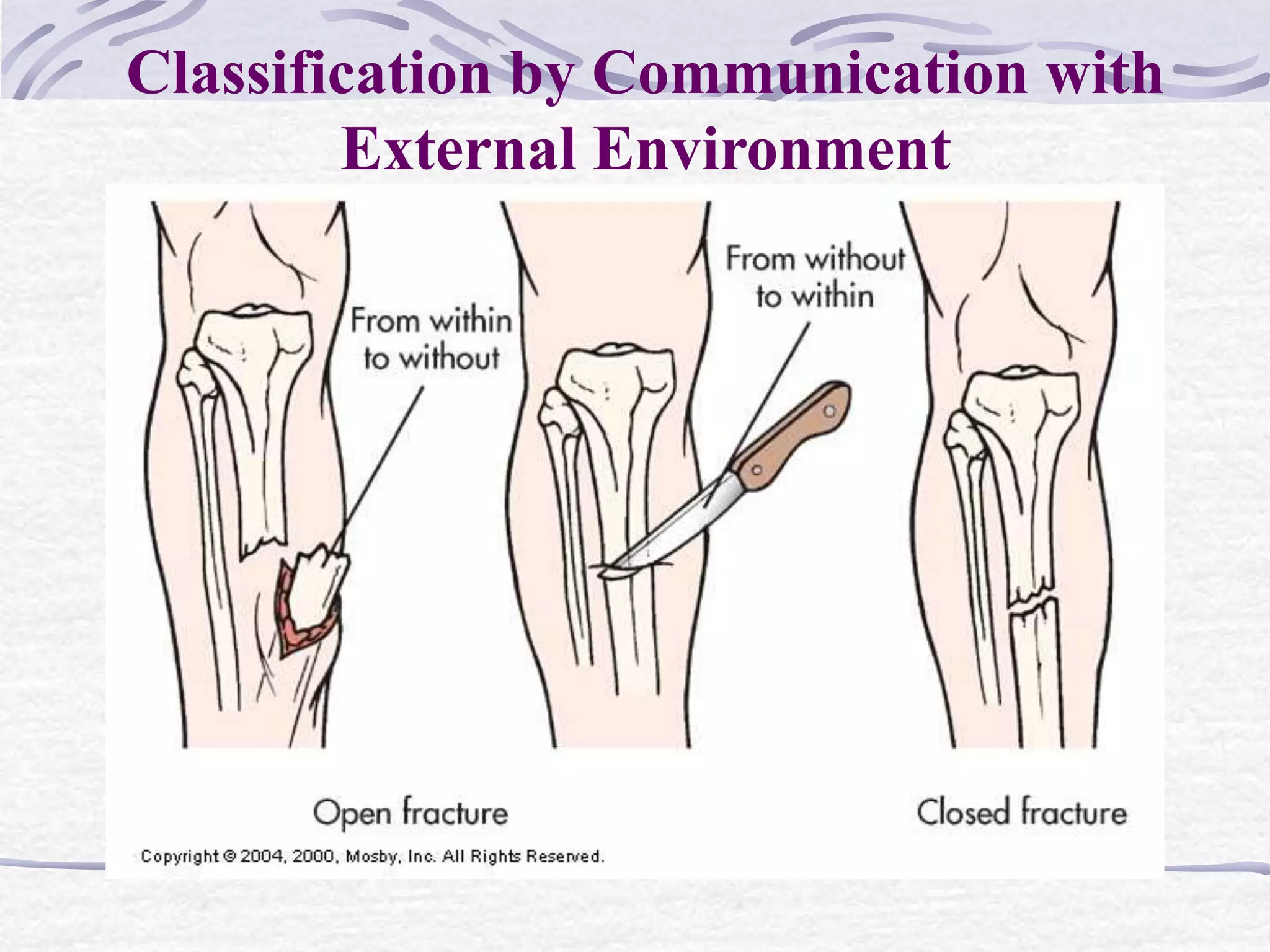
Classification by Communication with
External Environment
Classification by Fracture Location
Description
 Described and classified according to:
Appearance, position, and alignment of
the fragments
Classic names
Stable or unstable
Description
 Closed (also called simple)
 Open (also called compound)
Description
 Stable fractures
Occur when a piece of the periosteum is
intact across the fracture
External or internal fixation has rendered
the fragments stationary
Description
 Unstable fractures
Grossly displaced
Poor fixation
Clinical Manifestations
Immediate localized pain
 Function
Inability to bear weight or use affected
part
Guarding
May or may not see obvious bone
deformity
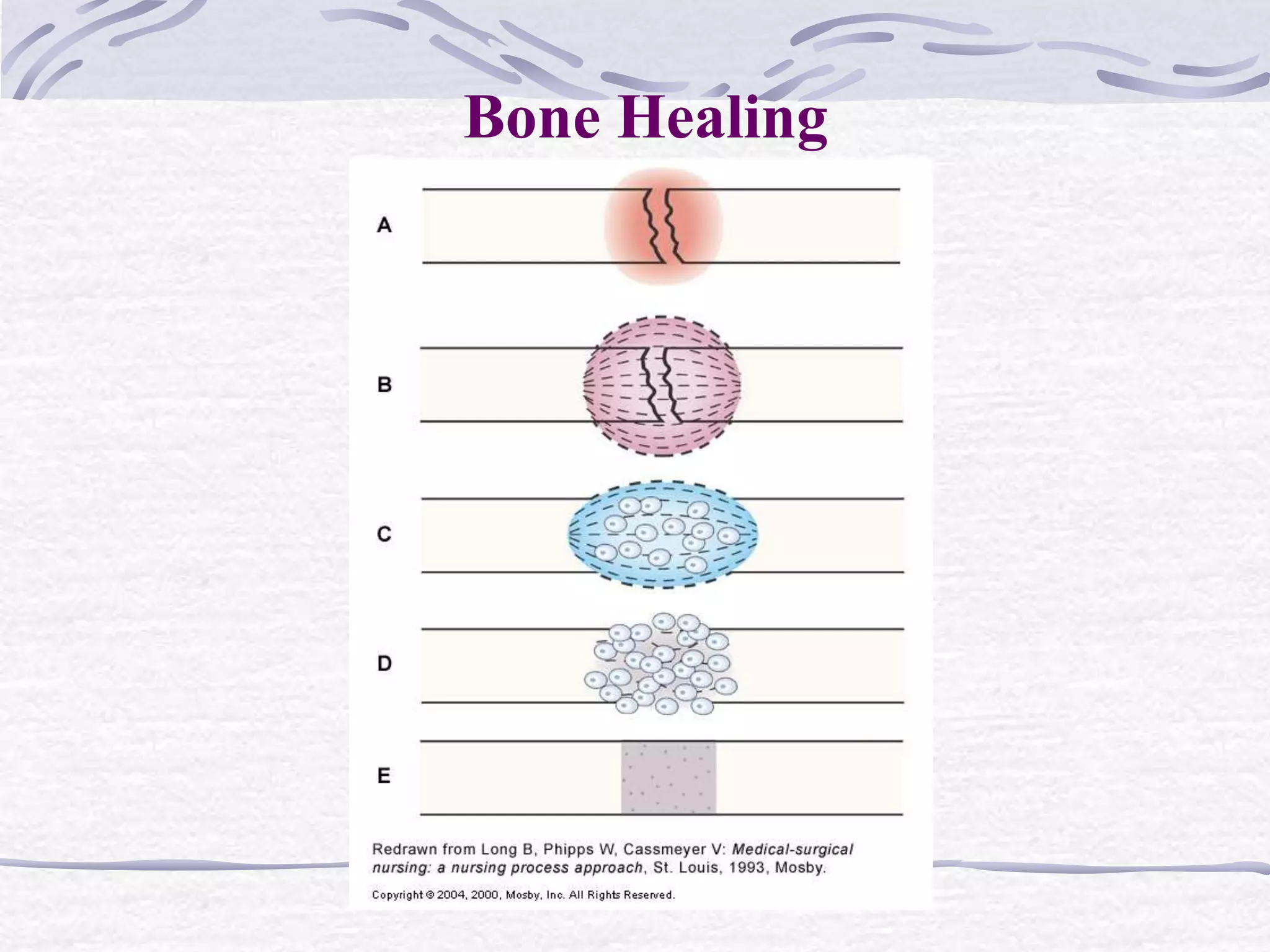
Fracture Healing
 Reparative process of self-healing (union)
occurs in the following stages:
1. Fracture hematoma (d/t bleeding, edema)
2. Granulation tissue → osteoid (3 – 14 days
post injury)
3. Callus formation (minerals deposited in osteoid)
Fracture Healing
 Reparative process of self-healing (union)
occurs in the following stages:
4. Ossification (3 wks – 6 mos)
5. Consolidation (distance between fragments
decreases → closes).
6. Remodeling (union completed; remodels to
original shape, strength)
Bone Healing
Collaborative Care
 Overall goals of treatment:
Anatomic realignment of bone fragments
(reduction)
Immobilization to maintain alignment
(fixation)
Restoration of normal function
Collaborative Care
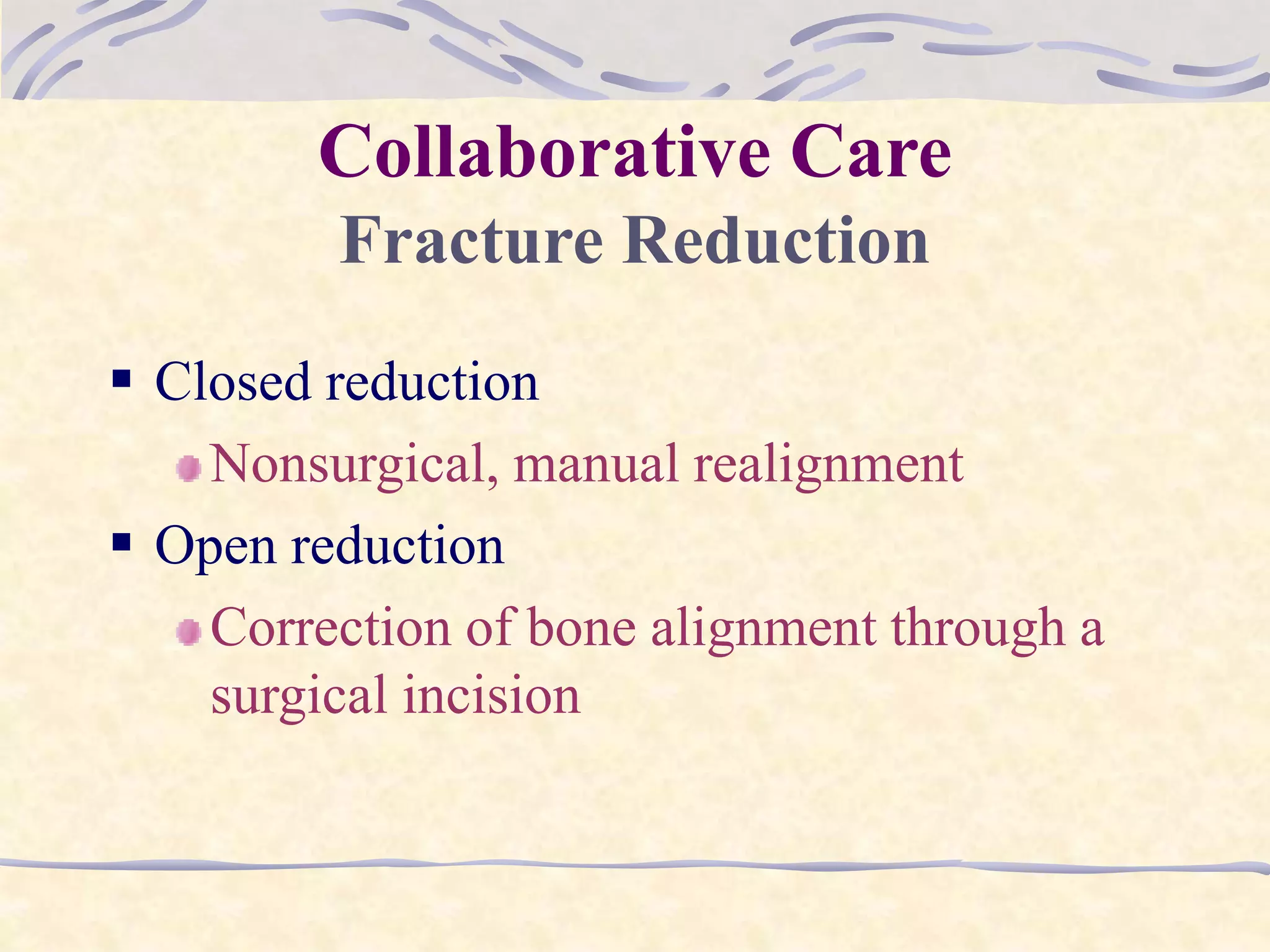
Fracture Reduction
 Closed reduction
Nonsurgical, manual realignment
 Open reduction
Correction of bone alignment through a
surgical incision
Collaborative Care
Fracture Reduction
 Traction (with simultaneous counter-traction)
Application of pulling force to attain
realignment
Skin traction (short-term: 48-72 hrs)
Skeletal traction (longer periods)
Collaborative Care
Fracture Immobilization
 Casts
Temporary circumferential immobilization
device
Common following closed reduction
Casts
Fig. 61-9
Collaborative Care
Fracture Immobilization
 External fixation
Metallic device composed of pins that are
inserted into the bone and attached to external
rods
Collaborative Care
Fracture Immobilization
 Internal fixation
Pins, plates, intramedullary rods, and screws
Surgically inserted at the time of realignment
Collaborative Care
Fracture Immobilization
 Traction
Application of a pulling force to an injured
part of the body while countertraction pulls in
the opposite direction
Collaborative Care
Fracture Immobilization
 Purpose of traction:
Prevent or reduce muscle spasm
Immobilization
Reduction
Treat a pathologic condition
Complications of Fractures
Infection
 Open fractures and soft tissue injuries have 
incidence
 Osteomyelitis can become chronic
Complications of Fractures
Infection
 Collaborative Care
Open fractures require aggressive surgical
debridement
Post-op IV antibiotics for 3 to 7 days
(prophylactic)
Complications of Fractures
Compartment Syndrome
 Condition in which elevated intracompartmental
pressure within a confined myofascial
compartment compromises the neurovascular
function of tissues within that space
 Causes capillary perfusion to be reduced below a
level necessary for tissue viability
Complications of Fractures
Compartment Syndrome
 Two basic etiologies create compartment
syndrome:
Decreased compartment size (dressings,
splints, casts)
Increased compartment content (bleeding,
edema)
Complications of Fractures
Compartment Syndrome
 Clinical Manifestations
Six Ps
1. Paresthesia (unrelieved by narcotics)
2. Pain (unrelieved by narcotics)
3. Pressure
Complications of Fractures
Compartment Syndrome
 Clinical Manifestations
Six Ps:
4. Pallor (loss of normal color, coolness)
5. Paralysis
6. Pulselessness (decreased/absent pulses)
Complications of Fractures
Compartment Syndrome
 Clinical Manifestations
Six Ps:
Patient may present with one or all of the
six Ps
Compare extemities
Complications of Fractures
Compartment Syndrome
 Clinical Manifestations
Absence of peripheral pulse = ominous late
sign
Myoglobinuria
Dark reddish-brown urine
Complications of Fractures
Compartment Syndrome
 Collaborative Care
Prompt, accurate diagnosis is critical
Early recognition is the key
Do not apply ice or elevate above heart level
Complications of Fractures
Compartment Syndrome
 Collaborative Care
Remove/loosen the bandage and bivalve the
cast
Reduce traction weight
Surgical decompression (fasciotomy)
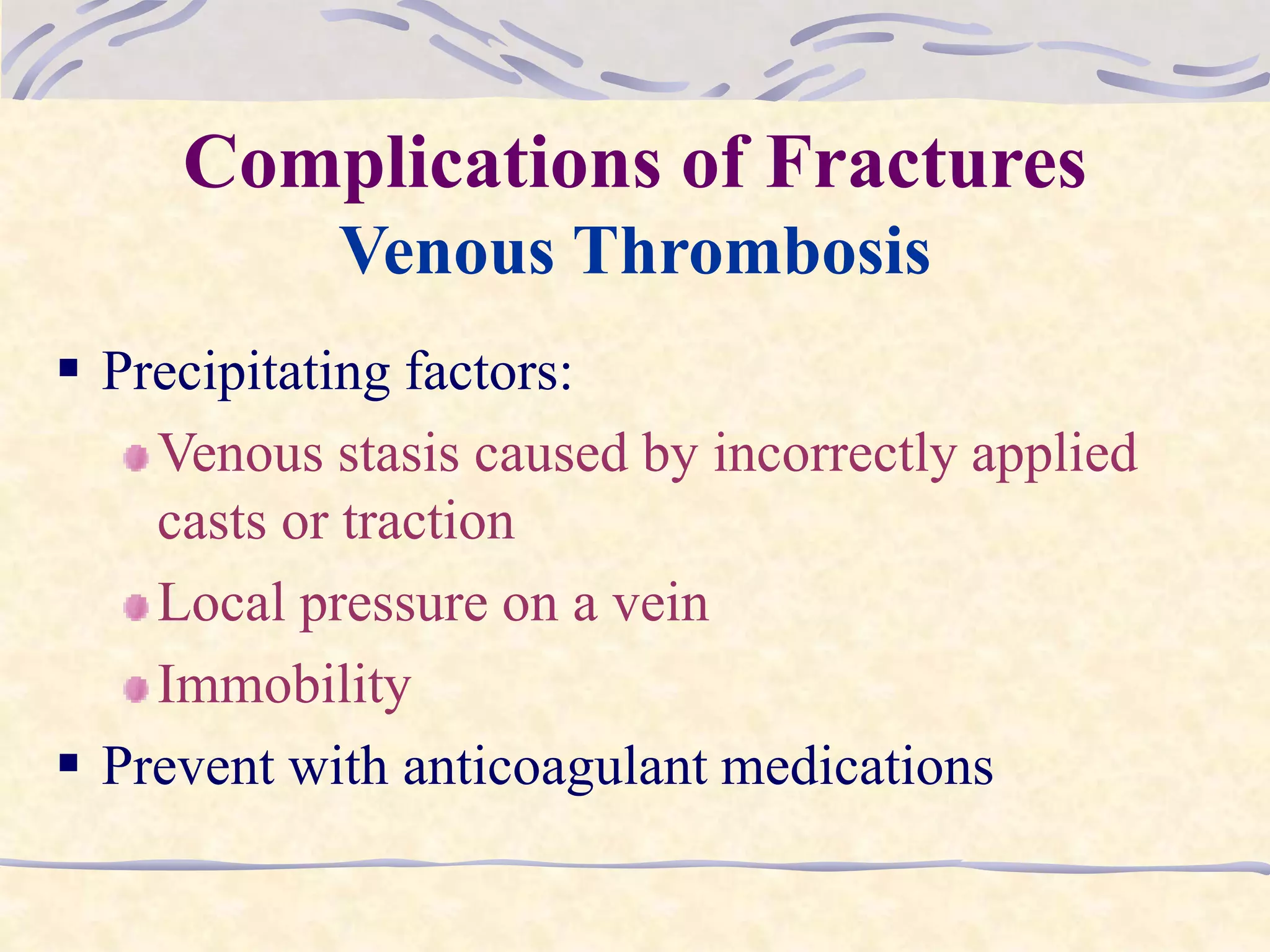
Complications of Fractures
Venous Thrombosis
 Veins of the lower extremities and pelvis are
highly susceptible to thrombus formation after
fracture, especially hip fracture
Complications of Fractures
Venous Thrombosis
 Precipitating factors:
Venous stasis caused by incorrectly applied
casts or traction
Local pressure on a vein
Immobility
 Prevent with anticoagulant medications
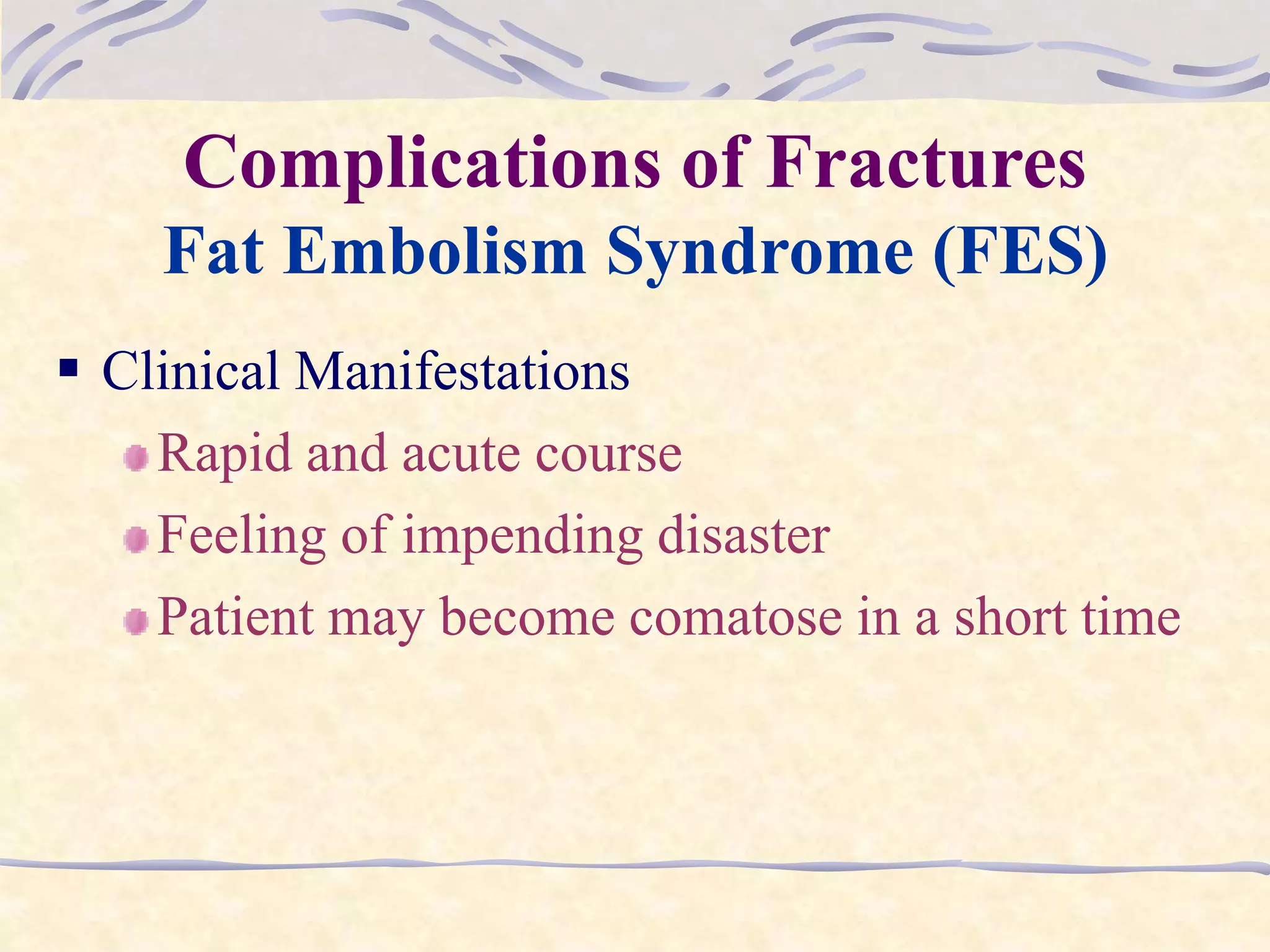
Complications of Fractures
Fat Embolism Syndrome (FES)
 Characterized by the presence of fat globules in
tissues and organs after a traumatic skeletal
injury
Complications of Fractures
Fat Embolism Syndrome (FES)
 Fractures that most often cause FES:
Long bones
Ribs
Tibia
Pelvis
Complications of Fractures
Fat Embolism Syndrome (FES)
 Clinical Manifestations
Usually occur 24-48 hours after injury
Interstitial pneumonitis
Produce symptoms of ARDS
Complications of Fractures
Fat Embolism Syndrome (FES)
 Clinical Manifestations
Symptoms of ARDS:
Chest pain
Tachypnea
Cyanosis
 PaO2
Complications of Fractures
Fat Embolism Syndrome (FES)
 Clinical Manifestations
Symptoms of ARDS:
Dyspnea
Apprehension
Tachycardia
Complications of Fractures
Fat Embolism Syndrome (FES)
 Clinical Manifestations
Rapid and acute course
Feeling of impending disaster
Patient may become comatose in a short time
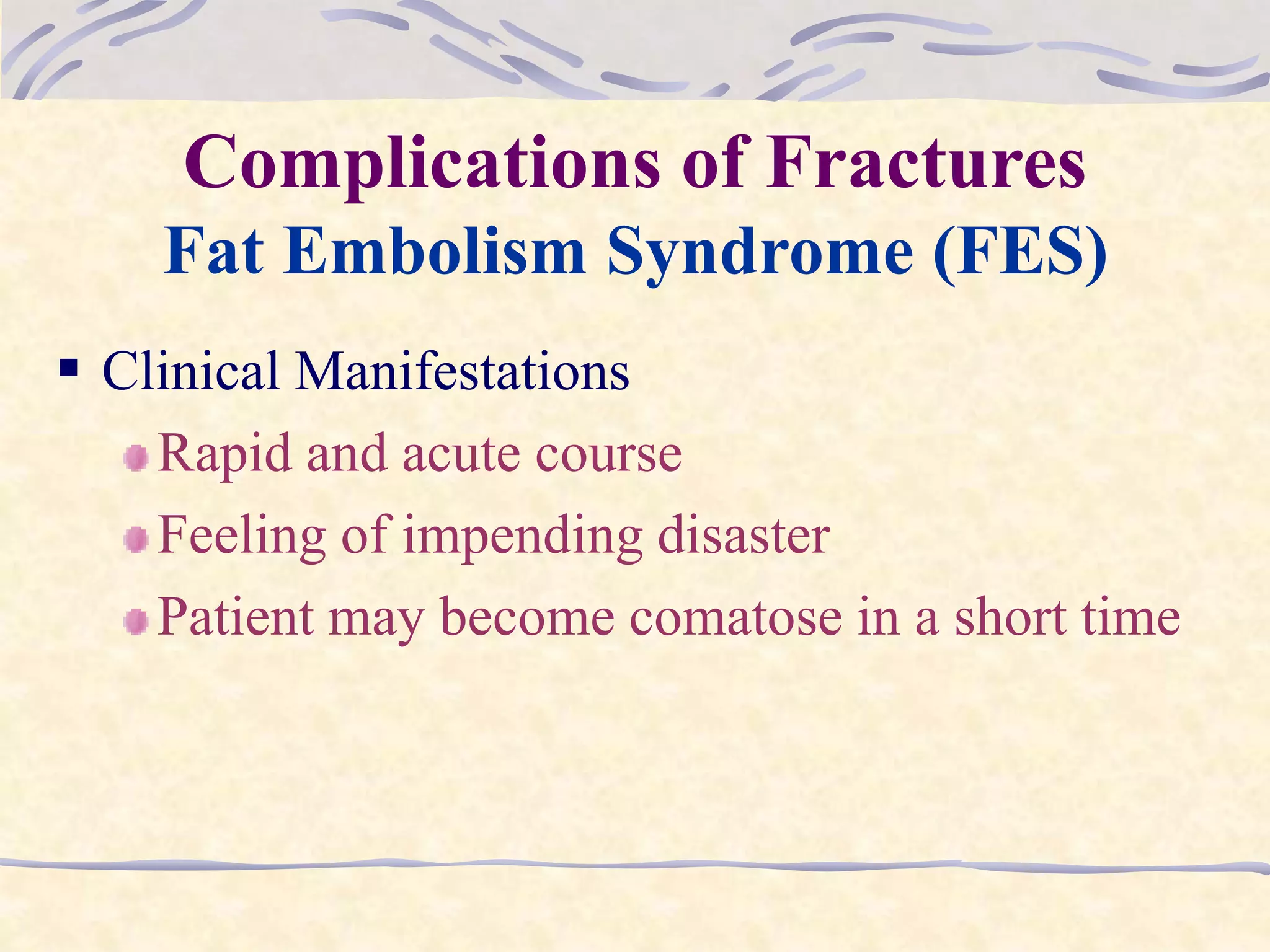
Complications of Fractures
Fat Embolism Syndrome (FES)
 Clinical Manifestations
Rapid and acute course
Feeling of impending disaster
Patient may become comatose in a short time
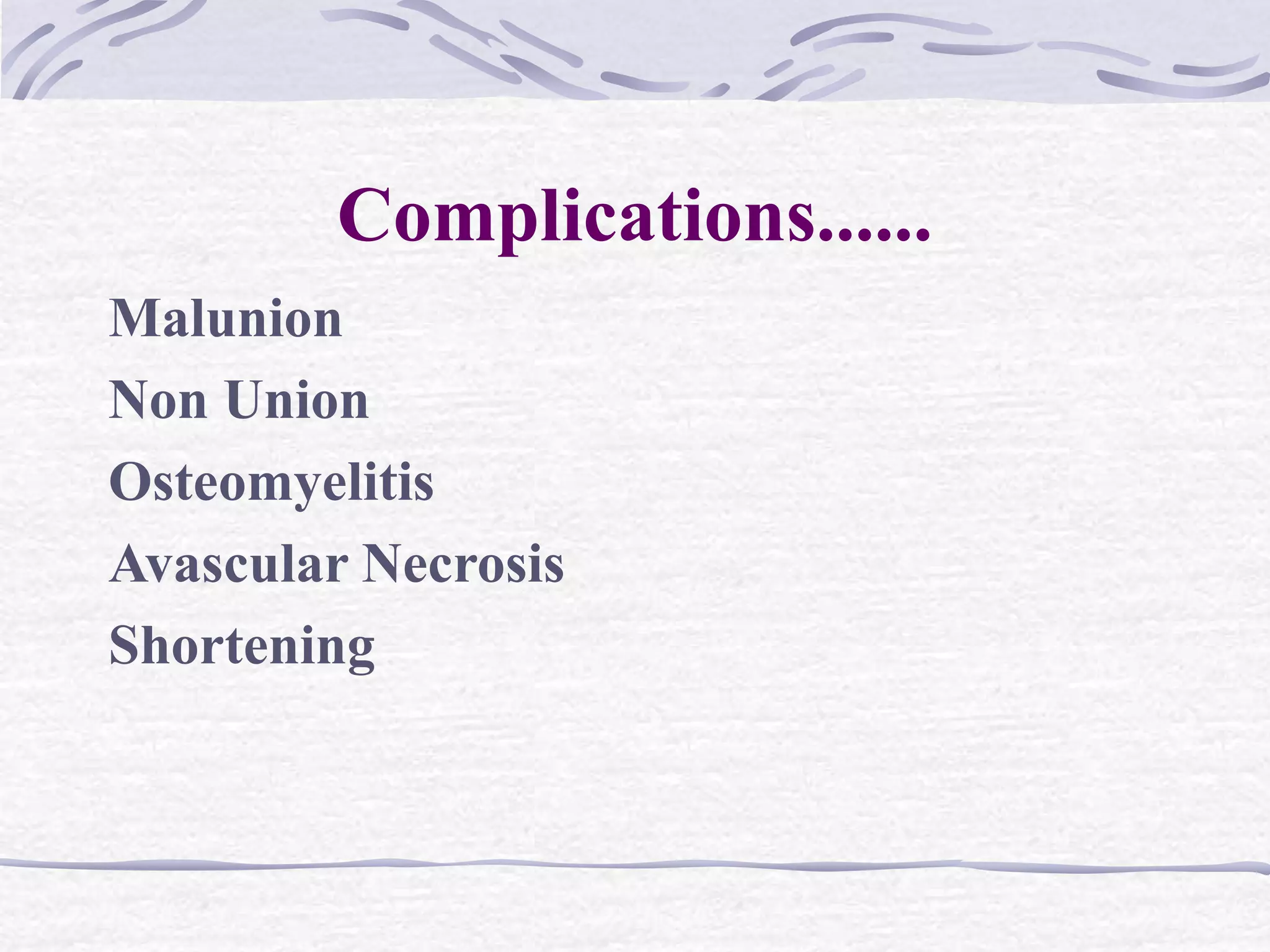
Complications......
Malunion
Non Union
Osteomyelitis
Avascular Necrosis
Shortening
THANKS

Fractures