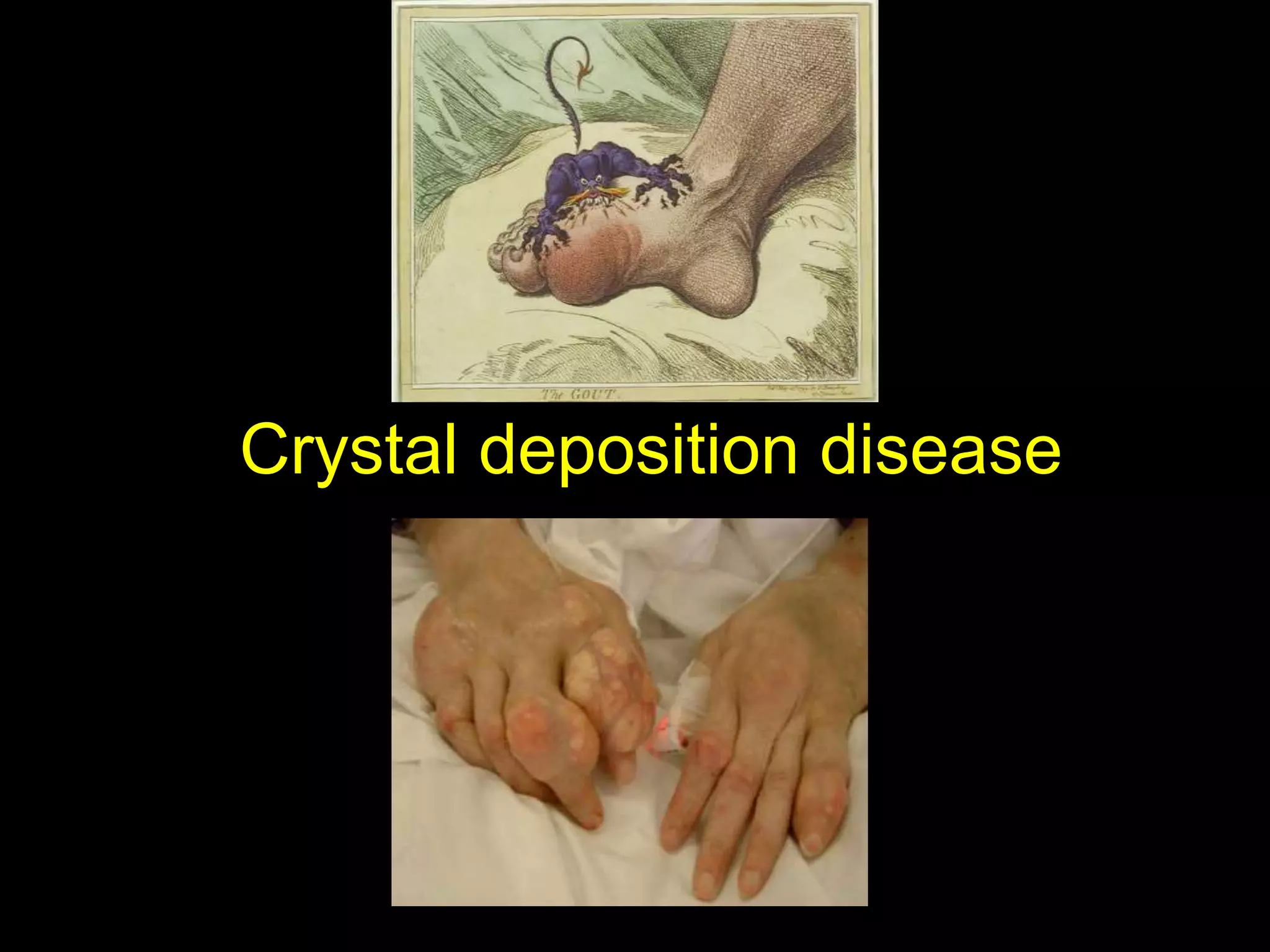
Crystal deposition disease
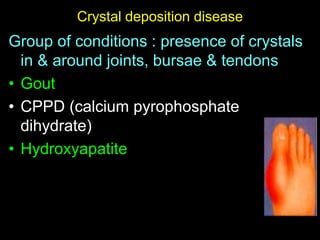
Group of conditions : presence of crystals
in & around joints, bursae & tendons
• Gout
• CPPD (calcium pyrophosphate
dihydrate)
• Hydroxyapatite
GOUT
Consequences : crystal deposition
• Remains inert and asymptomatic
• Induces acute inflammatory
reaction
• Slow destruction of the affected
tissue
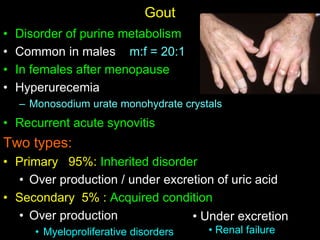
Gout
• Disorder of purine metabolism
• Common in males m:f = 20:1
• In females after menopause
• Hyperurecemia
– Monosodium urate monohydrate crystals
• Recurrent acute synovitis
Two types:
• Primary 95%: Inherited disorder
• Over production / under excretion of uric acid
• Secondary 5% : Acquired condition
• Over production
• Myeloproliferative disorders
• Under excretion
• Renal failure
Two types:
• Primary 95%: Inherited disorder
• Over production / under excretion of uric
acid
• Secondary 5% : Acquired condition
Over production Under Excretion (renal Failure)
• Myeloproliferative disorders
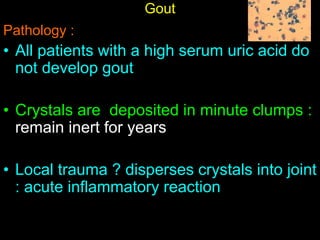
Gout
Pathology :
• All patients with a high serum uric acid do
not develop gout
• Crystals are deposited in minute clumps :
remain inert for years
• Local trauma ? disperses crystals into joint
: acute inflammatory reaction
Pathology .. Gout…
• Each crystal : phagocytosed or float free
in the joint
• Over years, urate deposits build up in
joints , periarticular tissue,tendon and
bursa :destroy articular cartilage and
periarticular bone
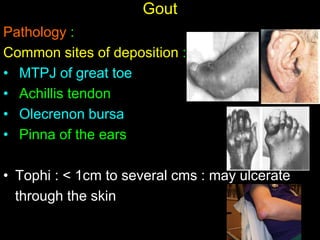
Pathology :
Common sites of deposition :
• MTPJ of great toe
• Achillis tendon
• Olecrenon bursa
• Pinna of the ears
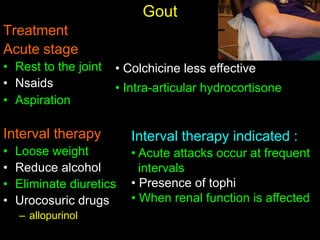
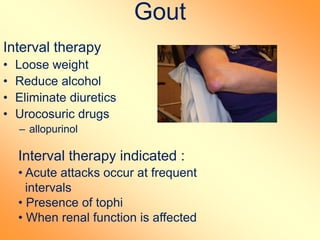
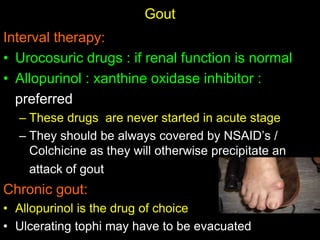
• Tophi : < 1cm to several cms : may ulcerate
through the skin
Gout
Gout
Clinical features :
• Men > 30 yrs of age
• Women after menopause
• Obese, hypertensive, alcohol friendly
• Patients on diuretics : (increases tubular re-absorption
of uric acid)
• Family history : positive
Gout
Acute gout :
• Sudden severe joint pain, ? precipitated by
• Minor trauma
• Surgery
• More in the night
• Lasts for 1-2 wks and completely resolves
• Minor illness
• Unaccustomed exercise
• Alcohol
Gout
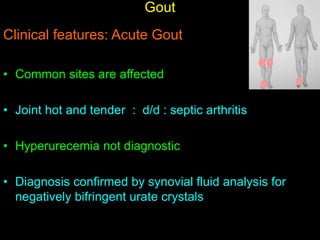
Clinical features: Acute Gout
• Common sites are affected
• Joint hot and tender : d/d : septic arthritis
• Hyperurecemia not diagnostic
• Diagnosis confirmed by synovial fluid analysis for
negatively bifringent urate crystals
Gout
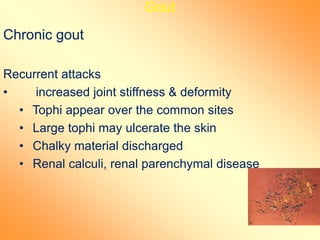
Chronic gout
Recurrent attacks
• increased joint stiffness & deformity
• Tophi appear over the common sites
• Large tophi may ulcerate the skin
• Chalky material discharged
• Renal calculi, renal parenchymal disease
Gout
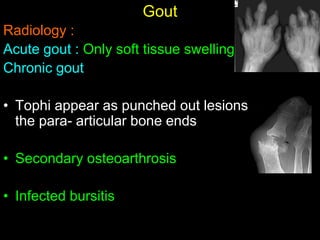
Radiology :
Acute gout : Only soft tissue swelling
Chronic gout
• Tophi appear as punched out lesions (cysts) in
the para- articular bone ends
• Secondary osteoarthrosis
• Infected bursitis
Gout
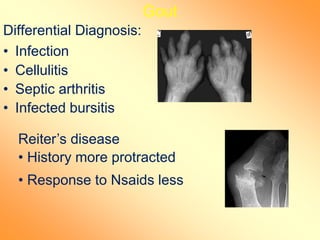
Differential Diagnosis:
• Infection
• Cellulitis
• Septic arthritis
• Infected bursitis
Reiter’s disease
• History more protracted
• Response to Nsaids less
Gout
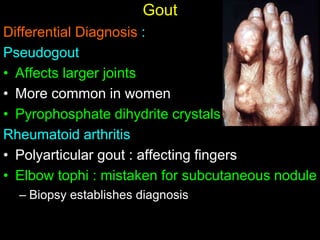
Differential Diagnosis :
Pseudogout
• Affects larger joints
• More common in women
• Pyrophosphate dihydrite crystalsdeposition
Rheumatoid arthritis
• Polyarticular gout : affecting fingers
• Elbow tophi : mistaken for subcutaneous nodule
– Biopsy establishes diagnosis
Gout
Treatment
Acute stage
• Rest to the joint
• Nsaids
• Aspiration
Interval therapy
• Loose weight
• Reduce alcohol
• Eliminate diuretics
• Urocosuric drugs
– allopurinol
Interval therapy indicated :
• Acute attacks occur at frequent
intervals
• Presence of tophi
• When renal function is affected
• Colchicine less effective
• Intra-articular hydrocortisone
Gout
Interval therapy
• Loose weight
• Reduce alcohol
• Eliminate diuretics
• Urocosuric drugs
– allopurinol
Interval therapy indicated :
• Acute attacks occur at frequent
intervals
• Presence of tophi
• When renal function is affected
Gout
Interval therapy:
• Urocosuric drugs : if renal function is normal
• Allopurinol : xanthine oxidase inhibitor :
preferred
– These drugs are never started in acute stage
– They should be always covered by NSAID’s /
Colchicine as they will otherwise precipitate an
attack of gout
Chronic gout:
• Allopurinol is the drug of choice
• Ulcerating tophi may have to be evacuated
Gout

Gout

  • 1.
  • 2.
    Crystal deposition disease Groupof conditions : presence of crystals in & around joints, bursae & tendons • Gout • CPPD (calcium pyrophosphate dihydrate) • Hydroxyapatite
  • 3.
    GOUT Consequences : crystaldeposition • Remains inert and asymptomatic • Induces acute inflammatory reaction • Slow destruction of the affected tissue
  • 4.
    Gout • Disorder ofpurine metabolism • Common in males m:f = 20:1 • In females after menopause • Hyperurecemia – Monosodium urate monohydrate crystals • Recurrent acute synovitis Two types: • Primary 95%: Inherited disorder • Over production / under excretion of uric acid • Secondary 5% : Acquired condition • Over production • Myeloproliferative disorders • Under excretion • Renal failure
  • 5.
    Two types: • Primary95%: Inherited disorder • Over production / under excretion of uric acid • Secondary 5% : Acquired condition Over production Under Excretion (renal Failure) • Myeloproliferative disorders
  • 6.
    Gout Pathology : • Allpatients with a high serum uric acid do not develop gout • Crystals are deposited in minute clumps : remain inert for years • Local trauma ? disperses crystals into joint : acute inflammatory reaction
  • 7.
    Pathology .. Gout… •Each crystal : phagocytosed or float free in the joint • Over years, urate deposits build up in joints , periarticular tissue,tendon and bursa :destroy articular cartilage and periarticular bone
  • 8.
    Pathology : Common sitesof deposition : • MTPJ of great toe • Achillis tendon • Olecrenon bursa • Pinna of the ears • Tophi : < 1cm to several cms : may ulcerate through the skin Gout
  • 9.
    Gout Clinical features : •Men > 30 yrs of age • Women after menopause • Obese, hypertensive, alcohol friendly • Patients on diuretics : (increases tubular re-absorption of uric acid) • Family history : positive
  • 10.
    Gout Acute gout : •Sudden severe joint pain, ? precipitated by • Minor trauma • Surgery • More in the night • Lasts for 1-2 wks and completely resolves • Minor illness • Unaccustomed exercise • Alcohol
  • 12.
    Gout Clinical features: AcuteGout • Common sites are affected • Joint hot and tender : d/d : septic arthritis • Hyperurecemia not diagnostic • Diagnosis confirmed by synovial fluid analysis for negatively bifringent urate crystals
  • 13.
    Gout Chronic gout Recurrent attacks •increased joint stiffness & deformity • Tophi appear over the common sites • Large tophi may ulcerate the skin • Chalky material discharged • Renal calculi, renal parenchymal disease
  • 14.
    Gout Radiology : Acute gout: Only soft tissue swelling Chronic gout • Tophi appear as punched out lesions (cysts) in the para- articular bone ends • Secondary osteoarthrosis • Infected bursitis
  • 15.
    Gout Differential Diagnosis: • Infection •Cellulitis • Septic arthritis • Infected bursitis Reiter’s disease • History more protracted • Response to Nsaids less
  • 16.
    Gout Differential Diagnosis : Pseudogout •Affects larger joints • More common in women • Pyrophosphate dihydrite crystalsdeposition Rheumatoid arthritis • Polyarticular gout : affecting fingers • Elbow tophi : mistaken for subcutaneous nodule – Biopsy establishes diagnosis
  • 17.
    Gout Treatment Acute stage • Restto the joint • Nsaids • Aspiration Interval therapy • Loose weight • Reduce alcohol • Eliminate diuretics • Urocosuric drugs – allopurinol Interval therapy indicated : • Acute attacks occur at frequent intervals • Presence of tophi • When renal function is affected • Colchicine less effective • Intra-articular hydrocortisone
  • 19.
    Gout Interval therapy • Looseweight • Reduce alcohol • Eliminate diuretics • Urocosuric drugs – allopurinol Interval therapy indicated : • Acute attacks occur at frequent intervals • Presence of tophi • When renal function is affected
  • 20.
    Gout Interval therapy: • Urocosuricdrugs : if renal function is normal • Allopurinol : xanthine oxidase inhibitor : preferred – These drugs are never started in acute stage – They should be always covered by NSAID’s / Colchicine as they will otherwise precipitate an attack of gout Chronic gout: • Allopurinol is the drug of choice • Ulcerating tophi may have to be evacuated