FRACTURE HEALING
DR.ABHINAV KESARKAR
JR1
DEPARTMENT OF ORTHOPEDICS
PDMMC, AMRAVATI
CELLS FOUND IN BONE
Osteoprogenitor cells
• Pluripotent mesenchymal stem
cells found in bone which
differentiate into osteoblasts
•Found throughout the bone and
also called as preosteoblasts
Osteoblasts
• derived from osteoprogenitor cells
• Secrete collagen and calcium salts
• Highly active cells depicted by increased
density rER on histology
• create bone tissue de novo and entrap themselves
in small spaces called lacunae.
• long processes from the cell lie in channels called as canaliculi
through which these cells communicate with other cells.
• osteoblast within a lacunae surrounded by bone matrix
and further differentiation is called as an osteocyte and is responsible
strength and integrity of the bone
Osteoclast
• derived from fusion of many
monocytes
•They are large phagocytic multi-
nucleated cells
• They break down bone after
senescence of or trauma to osteocyte,
normal bone remodelling
• cytoplasm is eosinophilic and has a
ruffled border
• present on the surface of bone being
reabsorbed and occasionally free in bone
• Are flattened epithelium in adult skeleton found on resting
surfaces.
• Plays active role in differentiation of progenitor cells
• Controls osteoclasts, mineral hemostasis and may secrete
collagenase.
• Lines – endosteal surface of marrow cavity
- periosteal surface
- vascular channels within osteons.
5
BONE LINING CELLS
THE BONE
• Bone is essentially a highly vascular, living, constantly
changing mineralized connective tissue which makes up
body’s skeleton.
• Other functions are:
- Bone provides protection for the vital organs of the
body( eg: heart and brain)
- The hematopoietic bone marrow is protected by the
surrounding bony tissue.
- Storage of calcium and phosphate
• Woven (Immature bone): Characterized by random
arrangement of cells and collagen ,associated with
periods of rapid bone formation, such as in initial stage of
fracture healing.
• Lamellar bone (Mature bone) : Characterized by an
orderly cellular distribution and properly oriented
collagen fibres . This constitutes organised bone both
cortical and cancellous
HAVERSIAN CANAL
• Haversian canal
Cells, nerves & vessels
• Volkmann’s
canal
Connects osteons
10
osteon
Haversian
canal
osteocyte
Volkmann’s
canal
THE PERIOSTEUM
Is a membrane that lines the outer surface of all bones
except at the joints of long bones.
• Is made up of :
• Outer FIBROUS layer : made up of white connective and
elastic tissue.
• Inner CAMBIUM layer : which has a looser composition, is
more vascular and contains cells with osteogenic
potency.
FUNCTION OF THE PERIOSTEUM
1. Anchors tendons and ligaments to bone.
2. Acts as a limiting membrane.
3. Participates in growth (appositional) and repair through
the activities of the osteoprogenitor cells .
4. Periosteum helps in fracture healing by forming
periosteal callus.
5. It also lessen the displacement of the # and helps in
reduction.
6. Allows passage of blood vessels, lymphatics and nerves
into and out of
the bone.
INDUCTION
• PRIMITIVE CELLS
STIMULATED TO BONE
FORMING CELLS
CONDUCTION
• REPARATIVE CELLS
PRODUCE CALLUS AND
BONE ON ALREADY
FORMED SCAFFOLD OF
COLLAGENOUS TISSUE
INTEGRATION
• DIRECT STRUCTURAL
AND FUNCTIONAL
CONNECTION BETWEEN
LIVING BONE AND LOAD
BEARING IMPLANT
1. Cutting Cones
2. Intramembranous Bone Formation
3. Endochondral Bone Formation
14
MECHANISM OF BONE FORMATION
CUTTING CONES
• Primarily a mechanism to remodel bone.
• Osteoclasts at the front of the cutting cone remove bone.
• Trailing osteoblasts lay down new bone.
Cutting cone
INTRAMEMBRANOUS BONE FORMATION
17
• Results in the formation of cranial bones of the skull
(frontal, perietal, occipital, and temporal bones) and the
clavicles.
• All bones formed this way are flat bones
• An ossification center appears in the fibrous connective
tissue membrane Bone matrix is secreted within the
fibrous membrane Woven bone and periosteum form
Bone collar of compact bone forms, and red marrow
appears
ENDOCHONDRAL BONE FORMATION
• Results in the formation of all of the rest of the bones
• Begins in the second month of development
• Uses hyaline cartilage “bones” as models for bone construction
• Requires breakdown of hyaline cartilage prior to ossification
• Formation begins at the primary ossification center
• The perichondrium covering the hyaline cartilage “bone”
infiltrated with blood vessels converting it to vascularized
periosteum.
• This change in nutrition causes the underlying mesenchymal
cells to specialize into osteoblasts
TYPES OF BONE HEALING
• A] PRIMARY BONE HEALING
• B] SECONDARY BONE HEALING
A] PRIMARY BONE HEALING
• Occurs when fractured bones are approximated properly and
stabilised by fixation.
• No callus is formed
• Heals by
contact healing
gap healing
PRIMARY BONE HEALING WITHOUT CALLUS
FORMATION
PRIMARY BONE HEALING
1. CONTACT HEALING: When there is direct contact
between the cortical bone ends, lamellar bone forms
directly across the fracture line , parallel to long axis of
the bone, by direct extension of osteons.
2. GAP HEALING: Osteoblasts differentiate and start
depositing osteoids on the exposed surfaces of
fragment ends, mostly without a preceding osteoclastic
resorption which is later converted into the lamellar
bone .
B] SECONDARY BONE HEALING
It is usual type consisting of formation of callus either of
cartilaginous or fibrous.
This callus is later replaced by lamellar bone. It is
comparable to healing of soft tissue by filling of gaps with
vascular granulation tissue.
STAGES OF FRACTURE HEALING
REACTIVE
• FRACTURE AND
INFLAMMATORY
RESPONSE
• HAEMATOMA
FORMATION
• GRANULATION
TISSUE
FORMATION
REPARATIVE
• CARTILAGE
CALLUS
FORMATION
• LAMELLAR
BONE
DEPOSITION
REMODELING
• BONE
REMODELING
TO ORIGINAL
CONTOUR
Fracture and
inflammatory
ressponse
•presence of blood cells within the tissues which are adjacent to the injury site. Soon after
fracture, the blood vessels constrict, stopping any further bleeding
Haematoma
formation
•the extravascular blood cells form a blood clot, known as a hematoma. All of the cells
within the blood clot degenerate and die.
•The fracture hematoma immobilizes & splints the fracture.
•The fracture haematoma provides a fibrin scaffold that facilitates migration of repair cells.
Granulation
tissue formation
•fibroblasts survive and replicate. They form a loose aggregate of cells, interspersed with
small blood vessels, known as granulation tissue which grows forward, outside and inside
the bone to bridge the fracture.
•They are stimulated by vasoactive mediators like serotonin and histamine.
REPARATIVE STAGE
Days after the # the periosteal cells proximal to the fracture gap and
fibroblasts develop into chondroblasts which form hyaline cartilage.
The periosteal cells distal to the fracture gap develop
into osteoblasts which form woven bone. These 2 tissues unite with
their counterparts and culminate into new mass of heterogenous
tissue called Fracture Callus restoring some of its original strength
, the mineralized matrix is penetrated by channels, each containing
a microvessel and numerous osteoblasts.
This new lamellar bone is in the form of trabecular bone which
restores bone’s original strength.
REMODELING PHASE
The remodeling process substitutes the trabecular bone
with compact bone. The trabecular bone is first resorbed
by osteoclasts, creating a shallow resorption pit known as a
"Howship's lacuna".
Then osteoblasts deposit compact bone within the
resorption pit.
Eventually, the fracture callus is remodelled
FRACTURE HEALING IN CANCELLOUS
BONE
•Cancellous bones are porous and have larger
Surface area per unit volume
• large surface area create many points of bone
contact rich in cells and blood supply.
• usually undisplaced and impacted cancellous
fractures heal without visisble callus formation
whereas undisplaced fractures heal by callus
• woven bone is formed along points of contact
thereby leading into bone regeneration by
osteoblastic activity
FRACTURE HEALING IN CHILDREN
• Compared with the relatively static mature bone of adult, the
changing structure and function both physiological and
biomechanical of immature bones make them susceptible to
different patterns of fracture.
• Fracture in children are more common and are more likely to
occur after seemingly insignificant trauma. Damage involving
specific growth regions such as the physis or epiphyseal
ossification center may lead to acute and chronic growth
disturbances.
HOW IS PAEDIATRIC BONE DIFFERENT ?
1. HIGHER COLLAGEN TO BONE RATIO
2. HIGH CELLULARITY AND POROSITY
3. TRANSITION AREAS IN BONE
4. THICKER PERIOSTEUM
5. PRESENCE OF GROWTH PLATE
6. MORE CANCELLOUS BONE
7. STRONG LIGAMENTS
THE GROWTH PLATE
John Hunter studied growing
chickens. He observed
bones grew at the ends and
thus demonstrated the
existence of the epiphyseal
plates. Hunter is considered
the “father of the growth
plate’’
ZONES OF GROWTH PLATE
Epiphyseal plate zone (from epiphysis
to diaphysis
Description
Zone of reserve Quiescent chondrocytes are found at
the epiphyseal end
Zone of proliferation Chondrocytes undergo rapid mitosis
under influence of growth hormone
Zone of maturation and hypertrophy Chondrocytes stop mitosis, and begin
to hypertrophy by accumulating
glycogen, lipids, and alkaline
phosphatase
Zone of calcification Chondrocytes undergo apoptosis.
Cartilagenous matrix begins to calcify.
Fractures usually occur through this
zone
Zone of ossification Osteoclasts and osteoblasts from the
diaphyseal side break down the
calcified cartilage and replace with
mineralized bone tissue.
FRACTURE REPAIR IN PEDIATRIC BONES
Fracture healing in children follow same pattern of adults but with
some peculiarities :
PERIOSTEUM:
• In the contrast to adults the periosteum strips away easily from the
underlying bone in children. Allowing fracture haematoma to dissect
along the diaphysis and metaphysis and this is evident in the
subsequent amount of new bone formation along the shaft.
• Dense attachment of the periosteum into the zone of ranvier limit
subperiosteal hematoma formation to the metaphysic and diaphysis.
• Paediatric bone very vascular, therefore inflammatory hyperaemic
response rapid and marked.
• Periosteum already producing bone as part of growth
• Rapid acceleration of this process, supplements endochondral
ossification from organising haematoma
• Produces rubbery bone around fracture within 10-14 days, then
difficult to manipulate
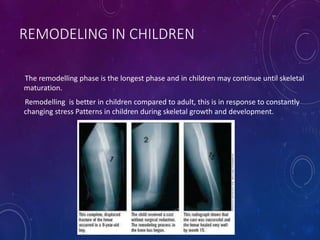
REMODELING IN CHILDREN
The remodelling phase is the longest phase and in children may continue until skeletal
maturation.
Remodelling is better in children compared to adult, this is in response to constantly
changing stress Patterns in children during skeletal growth and development.
VARIABLES INFLUENCING FRACTURE
HEALING
variables
1]INJURY VARIABLES OPEN FRACTURES
INJURY SEVERITY
INTRAARTICULAR FRACTURES
SEGMENTAL FRACTURES
VASCULAR INJURY
SOFT TISSUE INTERPOSITION
2]PATIENT VARIABLES DISEASE/DISORDER
AGE
NUTRITION
HORMONES
NICOTINE AND OTHER AGENTS
3]TISSUE VARIABLES TYPE OF BONE (CANCELLOUS OR CORTICAL)
BONE DISEASE
BONE NECROSIS
INFECTION
4] TREATMENT VARIABLES APPOSITION OF FRACTURE ENDS
MICROMOTION
FRACTURE STABILITY
• VITAMIN D INSUFFICIENCY (< 32ng/ml)
• VITAMIN D DEFICIENCY (<20ng/ml)
BASIS OF COLLAGEN AND MATRIX LAYDOWN AND OSTEOID FORMATION
IS PROTEIN ‘ THE BUILDING BLOCKS OF BODY TISSUE’
NUTRITIONAL CARE OF PATIENT UNDERGOING ORTHOPEDIC TREATMENT
SHOULD NOT BE UNDERESTIMATED.
This x-ray film obtained
from a patient with
corticosteroid-induced
osteoporosis showed
osteopenia and multiple
vertebral compression
fractures.
The hypertrophic fracture
pattern indicates motion at
the fracture site, despite
the fixation. The patient
was relatively asymptomatic
until a nail broke at the
nonunited fracture site (A).
Anteroposterior radiograph
showing complete healing
following compression
plating and bone grafting of
the nonunion
RECENT ADVANCES:
• GROWTH FACTOR THERAPY
Due to their ability to stimulate proliferation and differentiation of
mesenchymal and osteoprogenitor cells they have shown great promise for
their ability to promote fracture repair .
• APPLICATION OF PLATELET RICH PLASMA
Injecting platelet rich plasma at fracture site helps in fracture healing .
• TISSUE ENGINEERING, STEM CEELS AND GENE THERAPIES
In past decade tissue culture and stem cells have been implicated in
enhancing fracture healing and articular cartilage regeneration.
SUMMARY
• THE PROCESS OF FRACTURE HEALING IS MULTIFACTORIAL
AND DEPENDS UPON VARIABLES LIKE MECHANICAL
STABILITY,HORMONAL INFLUENCES,ELECTRICAL
ACTIVITY,METABOLISM,ETC.
• NECESSITY TO KNOW INTERDEPENDENCE OF THIS FACTORS
ON EACH OTHER AND HEALING PROCESS.
• WARRANTS MORE PENETRANCE OF TECHNOLOGICAL
ADVANCES FOR STUDY OF PHENOMENON OF FRACTURE
HEALING ON MOLECULAR LEVEL
THANK YOU

Fracture healing

  • 1.
  • 2.
    CELLS FOUND INBONE Osteoprogenitor cells • Pluripotent mesenchymal stem cells found in bone which differentiate into osteoblasts •Found throughout the bone and also called as preosteoblasts
  • 3.
    Osteoblasts • derived fromosteoprogenitor cells • Secrete collagen and calcium salts • Highly active cells depicted by increased density rER on histology • create bone tissue de novo and entrap themselves in small spaces called lacunae. • long processes from the cell lie in channels called as canaliculi through which these cells communicate with other cells. • osteoblast within a lacunae surrounded by bone matrix and further differentiation is called as an osteocyte and is responsible strength and integrity of the bone
  • 4.
    Osteoclast • derived fromfusion of many monocytes •They are large phagocytic multi- nucleated cells • They break down bone after senescence of or trauma to osteocyte, normal bone remodelling • cytoplasm is eosinophilic and has a ruffled border • present on the surface of bone being reabsorbed and occasionally free in bone
  • 5.
    • Are flattenedepithelium in adult skeleton found on resting surfaces. • Plays active role in differentiation of progenitor cells • Controls osteoclasts, mineral hemostasis and may secrete collagenase. • Lines – endosteal surface of marrow cavity - periosteal surface - vascular channels within osteons. 5 BONE LINING CELLS
  • 6.
    THE BONE • Boneis essentially a highly vascular, living, constantly changing mineralized connective tissue which makes up body’s skeleton. • Other functions are: - Bone provides protection for the vital organs of the body( eg: heart and brain) - The hematopoietic bone marrow is protected by the surrounding bony tissue. - Storage of calcium and phosphate
  • 8.
    • Woven (Immaturebone): Characterized by random arrangement of cells and collagen ,associated with periods of rapid bone formation, such as in initial stage of fracture healing. • Lamellar bone (Mature bone) : Characterized by an orderly cellular distribution and properly oriented collagen fibres . This constitutes organised bone both cortical and cancellous
  • 10.
    HAVERSIAN CANAL • Haversiancanal Cells, nerves & vessels • Volkmann’s canal Connects osteons 10 osteon Haversian canal osteocyte Volkmann’s canal
  • 11.
    THE PERIOSTEUM Is amembrane that lines the outer surface of all bones except at the joints of long bones. • Is made up of : • Outer FIBROUS layer : made up of white connective and elastic tissue. • Inner CAMBIUM layer : which has a looser composition, is more vascular and contains cells with osteogenic potency.
  • 12.
    FUNCTION OF THEPERIOSTEUM 1. Anchors tendons and ligaments to bone. 2. Acts as a limiting membrane. 3. Participates in growth (appositional) and repair through the activities of the osteoprogenitor cells . 4. Periosteum helps in fracture healing by forming periosteal callus. 5. It also lessen the displacement of the # and helps in reduction. 6. Allows passage of blood vessels, lymphatics and nerves into and out of the bone.
  • 13.
    INDUCTION • PRIMITIVE CELLS STIMULATEDTO BONE FORMING CELLS CONDUCTION • REPARATIVE CELLS PRODUCE CALLUS AND BONE ON ALREADY FORMED SCAFFOLD OF COLLAGENOUS TISSUE INTEGRATION • DIRECT STRUCTURAL AND FUNCTIONAL CONNECTION BETWEEN LIVING BONE AND LOAD BEARING IMPLANT
  • 14.
    1. Cutting Cones 2.Intramembranous Bone Formation 3. Endochondral Bone Formation 14 MECHANISM OF BONE FORMATION
  • 15.
  • 16.
    • Primarily amechanism to remodel bone. • Osteoclasts at the front of the cutting cone remove bone. • Trailing osteoblasts lay down new bone. Cutting cone
  • 17.
  • 18.
    • Results inthe formation of cranial bones of the skull (frontal, perietal, occipital, and temporal bones) and the clavicles. • All bones formed this way are flat bones • An ossification center appears in the fibrous connective tissue membrane Bone matrix is secreted within the fibrous membrane Woven bone and periosteum form Bone collar of compact bone forms, and red marrow appears
  • 19.
  • 20.
    • Results inthe formation of all of the rest of the bones • Begins in the second month of development • Uses hyaline cartilage “bones” as models for bone construction • Requires breakdown of hyaline cartilage prior to ossification • Formation begins at the primary ossification center • The perichondrium covering the hyaline cartilage “bone” infiltrated with blood vessels converting it to vascularized periosteum. • This change in nutrition causes the underlying mesenchymal cells to specialize into osteoblasts
  • 21.
    TYPES OF BONEHEALING • A] PRIMARY BONE HEALING • B] SECONDARY BONE HEALING
  • 22.
    A] PRIMARY BONEHEALING • Occurs when fractured bones are approximated properly and stabilised by fixation. • No callus is formed • Heals by contact healing gap healing
  • 23.
    PRIMARY BONE HEALINGWITHOUT CALLUS FORMATION
  • 24.
    PRIMARY BONE HEALING 1.CONTACT HEALING: When there is direct contact between the cortical bone ends, lamellar bone forms directly across the fracture line , parallel to long axis of the bone, by direct extension of osteons. 2. GAP HEALING: Osteoblasts differentiate and start depositing osteoids on the exposed surfaces of fragment ends, mostly without a preceding osteoclastic resorption which is later converted into the lamellar bone .
  • 25.
    B] SECONDARY BONEHEALING It is usual type consisting of formation of callus either of cartilaginous or fibrous. This callus is later replaced by lamellar bone. It is comparable to healing of soft tissue by filling of gaps with vascular granulation tissue.
  • 26.
    STAGES OF FRACTUREHEALING REACTIVE • FRACTURE AND INFLAMMATORY RESPONSE • HAEMATOMA FORMATION • GRANULATION TISSUE FORMATION REPARATIVE • CARTILAGE CALLUS FORMATION • LAMELLAR BONE DEPOSITION REMODELING • BONE REMODELING TO ORIGINAL CONTOUR
  • 27.
    Fracture and inflammatory ressponse •presence ofblood cells within the tissues which are adjacent to the injury site. Soon after fracture, the blood vessels constrict, stopping any further bleeding Haematoma formation •the extravascular blood cells form a blood clot, known as a hematoma. All of the cells within the blood clot degenerate and die. •The fracture hematoma immobilizes & splints the fracture. •The fracture haematoma provides a fibrin scaffold that facilitates migration of repair cells. Granulation tissue formation •fibroblasts survive and replicate. They form a loose aggregate of cells, interspersed with small blood vessels, known as granulation tissue which grows forward, outside and inside the bone to bridge the fracture. •They are stimulated by vasoactive mediators like serotonin and histamine.
  • 28.
    REPARATIVE STAGE Days afterthe # the periosteal cells proximal to the fracture gap and fibroblasts develop into chondroblasts which form hyaline cartilage. The periosteal cells distal to the fracture gap develop into osteoblasts which form woven bone. These 2 tissues unite with their counterparts and culminate into new mass of heterogenous tissue called Fracture Callus restoring some of its original strength , the mineralized matrix is penetrated by channels, each containing a microvessel and numerous osteoblasts. This new lamellar bone is in the form of trabecular bone which restores bone’s original strength.
  • 29.
    REMODELING PHASE The remodelingprocess substitutes the trabecular bone with compact bone. The trabecular bone is first resorbed by osteoclasts, creating a shallow resorption pit known as a "Howship's lacuna". Then osteoblasts deposit compact bone within the resorption pit. Eventually, the fracture callus is remodelled
  • 30.
    FRACTURE HEALING INCANCELLOUS BONE •Cancellous bones are porous and have larger Surface area per unit volume • large surface area create many points of bone contact rich in cells and blood supply. • usually undisplaced and impacted cancellous fractures heal without visisble callus formation whereas undisplaced fractures heal by callus • woven bone is formed along points of contact thereby leading into bone regeneration by osteoblastic activity
  • 31.
    FRACTURE HEALING INCHILDREN • Compared with the relatively static mature bone of adult, the changing structure and function both physiological and biomechanical of immature bones make them susceptible to different patterns of fracture. • Fracture in children are more common and are more likely to occur after seemingly insignificant trauma. Damage involving specific growth regions such as the physis or epiphyseal ossification center may lead to acute and chronic growth disturbances.
  • 32.
    HOW IS PAEDIATRICBONE DIFFERENT ? 1. HIGHER COLLAGEN TO BONE RATIO 2. HIGH CELLULARITY AND POROSITY 3. TRANSITION AREAS IN BONE 4. THICKER PERIOSTEUM 5. PRESENCE OF GROWTH PLATE 6. MORE CANCELLOUS BONE 7. STRONG LIGAMENTS
  • 33.
    THE GROWTH PLATE JohnHunter studied growing chickens. He observed bones grew at the ends and thus demonstrated the existence of the epiphyseal plates. Hunter is considered the “father of the growth plate’’
  • 35.
    ZONES OF GROWTHPLATE Epiphyseal plate zone (from epiphysis to diaphysis Description Zone of reserve Quiescent chondrocytes are found at the epiphyseal end Zone of proliferation Chondrocytes undergo rapid mitosis under influence of growth hormone Zone of maturation and hypertrophy Chondrocytes stop mitosis, and begin to hypertrophy by accumulating glycogen, lipids, and alkaline phosphatase Zone of calcification Chondrocytes undergo apoptosis. Cartilagenous matrix begins to calcify. Fractures usually occur through this zone Zone of ossification Osteoclasts and osteoblasts from the diaphyseal side break down the calcified cartilage and replace with mineralized bone tissue.
  • 36.
    FRACTURE REPAIR INPEDIATRIC BONES Fracture healing in children follow same pattern of adults but with some peculiarities : PERIOSTEUM: • In the contrast to adults the periosteum strips away easily from the underlying bone in children. Allowing fracture haematoma to dissect along the diaphysis and metaphysis and this is evident in the subsequent amount of new bone formation along the shaft. • Dense attachment of the periosteum into the zone of ranvier limit subperiosteal hematoma formation to the metaphysic and diaphysis.
  • 37.
    • Paediatric bonevery vascular, therefore inflammatory hyperaemic response rapid and marked. • Periosteum already producing bone as part of growth • Rapid acceleration of this process, supplements endochondral ossification from organising haematoma • Produces rubbery bone around fracture within 10-14 days, then difficult to manipulate
  • 38.
    REMODELING IN CHILDREN Theremodelling phase is the longest phase and in children may continue until skeletal maturation. Remodelling is better in children compared to adult, this is in response to constantly changing stress Patterns in children during skeletal growth and development.
  • 39.
    VARIABLES INFLUENCING FRACTURE HEALING variables 1]INJURYVARIABLES OPEN FRACTURES INJURY SEVERITY INTRAARTICULAR FRACTURES SEGMENTAL FRACTURES VASCULAR INJURY SOFT TISSUE INTERPOSITION 2]PATIENT VARIABLES DISEASE/DISORDER AGE NUTRITION HORMONES NICOTINE AND OTHER AGENTS 3]TISSUE VARIABLES TYPE OF BONE (CANCELLOUS OR CORTICAL) BONE DISEASE BONE NECROSIS INFECTION 4] TREATMENT VARIABLES APPOSITION OF FRACTURE ENDS MICROMOTION FRACTURE STABILITY
  • 43.
    • VITAMIN DINSUFFICIENCY (< 32ng/ml) • VITAMIN D DEFICIENCY (<20ng/ml) BASIS OF COLLAGEN AND MATRIX LAYDOWN AND OSTEOID FORMATION IS PROTEIN ‘ THE BUILDING BLOCKS OF BODY TISSUE’ NUTRITIONAL CARE OF PATIENT UNDERGOING ORTHOPEDIC TREATMENT SHOULD NOT BE UNDERESTIMATED.
  • 44.
    This x-ray filmobtained from a patient with corticosteroid-induced osteoporosis showed osteopenia and multiple vertebral compression fractures.
  • 45.
    The hypertrophic fracture patternindicates motion at the fracture site, despite the fixation. The patient was relatively asymptomatic until a nail broke at the nonunited fracture site (A). Anteroposterior radiograph showing complete healing following compression plating and bone grafting of the nonunion
  • 46.
    RECENT ADVANCES: • GROWTHFACTOR THERAPY Due to their ability to stimulate proliferation and differentiation of mesenchymal and osteoprogenitor cells they have shown great promise for their ability to promote fracture repair . • APPLICATION OF PLATELET RICH PLASMA Injecting platelet rich plasma at fracture site helps in fracture healing . • TISSUE ENGINEERING, STEM CEELS AND GENE THERAPIES In past decade tissue culture and stem cells have been implicated in enhancing fracture healing and articular cartilage regeneration.
  • 47.
    SUMMARY • THE PROCESSOF FRACTURE HEALING IS MULTIFACTORIAL AND DEPENDS UPON VARIABLES LIKE MECHANICAL STABILITY,HORMONAL INFLUENCES,ELECTRICAL ACTIVITY,METABOLISM,ETC. • NECESSITY TO KNOW INTERDEPENDENCE OF THIS FACTORS ON EACH OTHER AND HEALING PROCESS. • WARRANTS MORE PENETRANCE OF TECHNOLOGICAL ADVANCES FOR STUDY OF PHENOMENON OF FRACTURE HEALING ON MOLECULAR LEVEL
  • 48.