FRACTURE: AETIOLOGY,
CLASSIFICATIONS AND
COMPLICATIONS
DR FADAMIJO J S
NOH IGBOBI, LAGOS
OUTLINE
• INTRODUCTION
-Definition
-Statement of surgical importance
-Historical background
• RELEVANT ANATOMY
• AETIOLOGY
• TYPES OF FRACTURES
OUTLINE
• CLASSIFICATION OF FRACTURES
-General
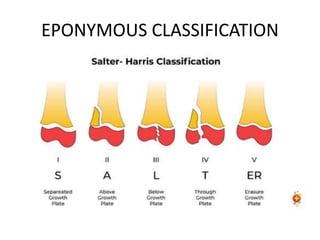
-Eponymous
• MANAGEMENT
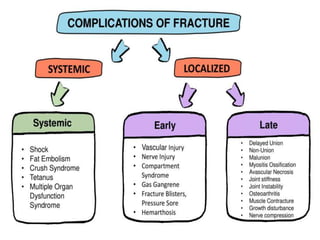
• COMPLICATIONS
• CONCLUSION
• REFERENCES
INTRODUCTION
DEFINITION
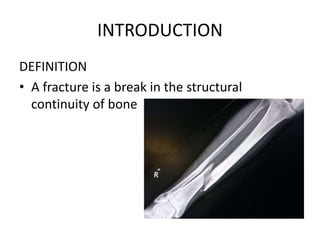
• A fracture is a break in the structural
continuity of bone
INTRODUCTION
STATEMENT OF SURGICAL IMPORTANCE
• Aetiology and classification of fractures helps
to determine the management and to avoid
complications
• It is therefore important as orthopaedic
surgeons to have this knowledge for better
outcome of patient care
INTRODUCTION
HISTORICAL BACKGROUND
• Ancient Egypt(1501BC)
– The Edwin Smith Papyrus classified injuries as:
– “An ailment which I will treat”
– “An ailment with which I will contend”
– “An ailment not to be treated”
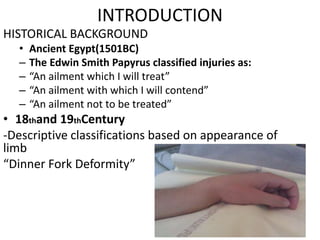
• 18thand 19thCentury
-Descriptive classifications based on appearance of
limb
“Dinner Fork Deformity”
INTRODUCTION
HISTORICAL BACKGROUND
• 20thCentury
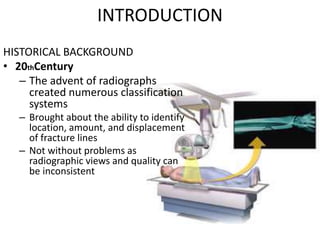
– The advent of radiographs
created numerous classification
systems
– Brought about the ability to identify
location, amount, and displacement
of fracture lines
– Not without problems as
radiographic views and quality can
be inconsistent
INTRODUCTION
HISTORICAL BACKGROUND
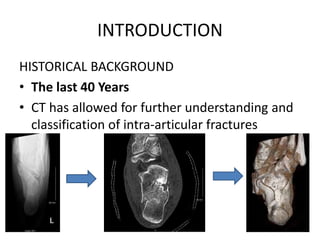
• The last 40 Years
• CT has allowed for further understanding and
classification of intra-articular fractures
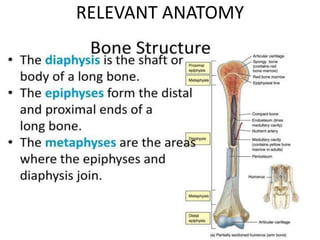
RELEVANT ANATOMY
AETIOLOGY
• Injury
-Direct
-Indirect
• Repetitive stress
• Abnormal weakening of the bone (a
pathological fracture)
AETIOLOGY
MECHANISM
• Twisting causes a spiral fracture.
• Compression causes a short oblique fracture.
• Bending results in a fracture with a triangular
‘butterfly’
fragment.
• Tension tends to break the bone transversely;
TYPES OF FRACTURES
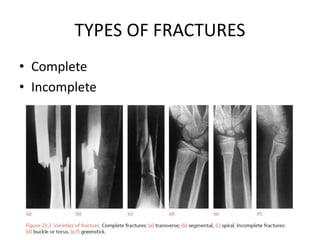
• Complete
• Incomplete
CLASSIFICATION OF FRACTURES
• What makes a good classification?
• Inter-observer Reliability
• Do different physicians agree on the classification
of a particular fracture?
• Intra-observer Reproducibility
• For a given fracture, does the same physician
classify it the same way at different times?
CLASSIFICATION OF FRACTURES
GENERAL
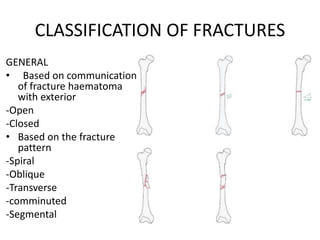
• Based on communication
of fracture haematoma
with exterior
-Open
-Closed
• Based on the fracture
pattern
-Spiral
-Oblique
-Transverse
-comminuted
-Segmental
GENERAL
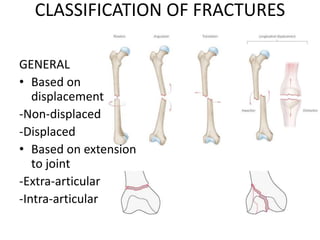
• Based on
displacement
-Non-displaced
-Displaced
• Based on extension
to joint
-Extra-articular
-Intra-articular
CLASSIFICATION OF FRACTURES
GENERAL- AO/OTA CLASSIFICATION
• Alphanumeric classification that can be
applied throughout the skeleton, based on
fracture location and morphology
• Created in the 1960’s and multiply updated to
include classifications of the pelvis and
acetabulum
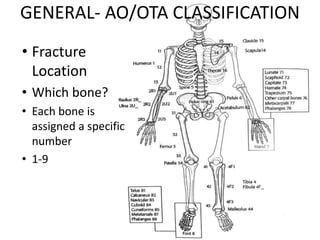
GENERAL- AO/OTA CLASSIFICATION
• Fracture
Location
• Which bone?
• Each bone is
assigned a specific
number
• 1-9
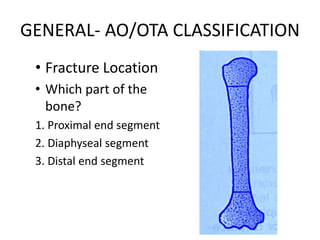
GENERAL- AO/OTA CLASSIFICATION
• Fracture Location
• Which part of the
bone?
1. Proximal end segment
2. Diaphyseal segment
3. Distal end segment
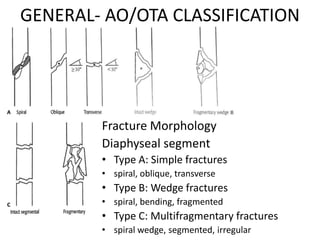
GENERAL- AO/OTA CLASSIFICATION
Fracture Morphology
Diaphyseal segment
• Type A: Simple fractures
• spiral, oblique, transverse
• Type B: Wedge fractures
• spiral, bending, fragmented
• Type C: Multifragmentary fractures
• spiral wedge, segmented, irregular
GENERAL- AO/OTA CLASSIFICATION
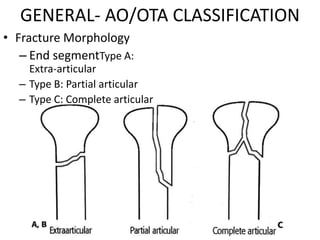
• Fracture Morphology
– End segmentType A:
Extra-articular
– Type B: Partial articular
– Type C: Complete articular
GENERAL- Soft Tissue-Based
Classifications
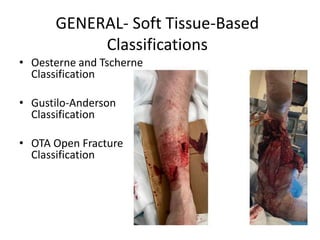
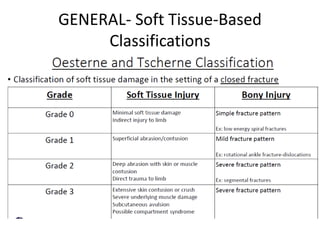
• Oesterne and Tscherne
Classification
• Gustilo-Anderson
Classification
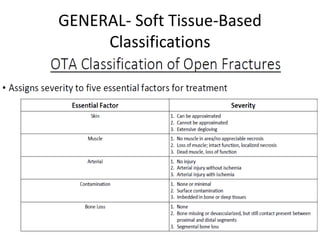
• OTA Open Fracture
Classification
GENERAL- Soft Tissue-Based
Classifications
GENERAL- Soft Tissue-Based
Classifications
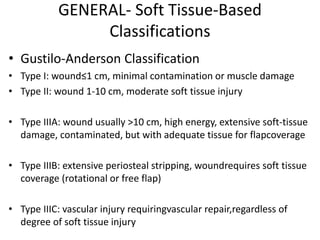
• Gustilo-Anderson Classification
• Type I: wound≤1 cm, minimal contamination or muscle damage
• Type II: wound 1-10 cm, moderate soft tissue injury
• Type IIIA: wound usually >10 cm, high energy, extensive soft-tissue
damage, contaminated, but with adequate tissue for flapcoverage
• Type IIIB: extensive periosteal stripping, woundrequires soft tissue
coverage (rotational or free flap)
• Type IIIC: vascular injury requiringvascular repair,regardless of
degree of soft tissue injury
GENERAL- Soft Tissue-Based
Classifications
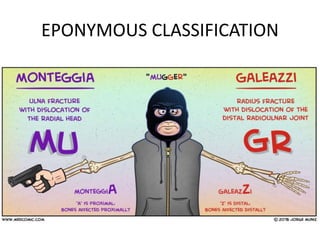
EPONYMOUS CLASSIFICATION
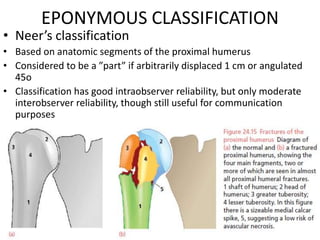
• Neer’s classification
• Based on anatomic segments of the proximal humerus
• Considered to be a ”part” if arbitrarily displaced 1 cm or angulated
45o
• Classification has good intraobserver reliability, but only moderate
interobserver reliability, though still useful for communication
purposes
EPONYMOUS CLASSIFICATION
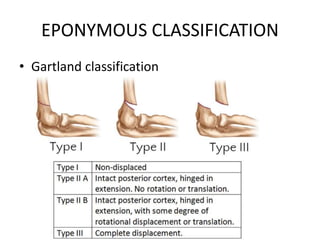
• Gartland classification
EPONYMOUS CLASSIFICATION
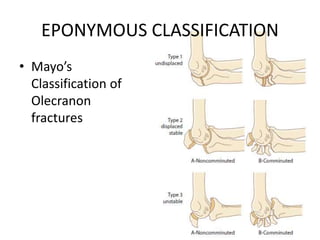
• Mayo’s
Classification of
Olecranon
fractures
EPONYMOUS CLASSIFICATION
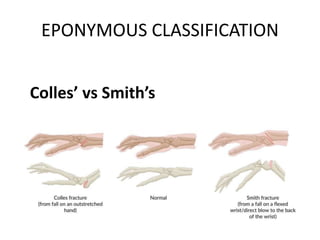
Colles’ vs Smith’s
EPONYMOUS CLASSIFICATION
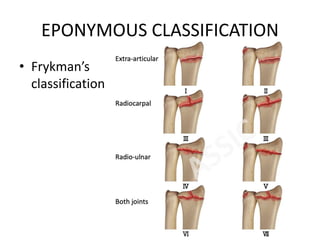
• Frykman’s
classification
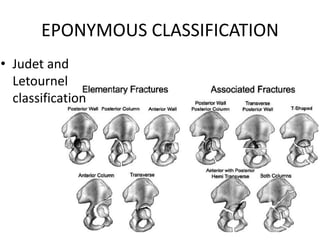
EPONYMOUS CLASSIFICATION
• Judet and
Letournel
classification
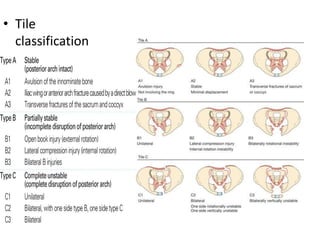
• Tile
classification
EPONYMOUS CLASSIFICATION
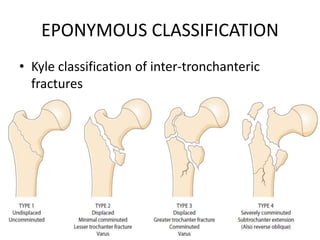
• Kyle classification of inter-tronchanteric
fractures
EPONYMOUS CLASSIFICATION
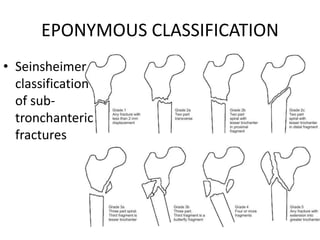
• Seinsheimer
classification
of sub-
tronchanteric
fractures
EPONYMOUS CLASSIFICATION
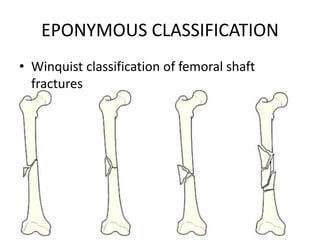
• Winquist classification of femoral shaft
fractures
EPONYMOUS CLASSIFICATION
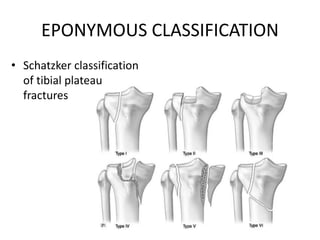
• Schatzker classification
of tibial plateau
fractures
EPONYMOUS CLASSIFICATION
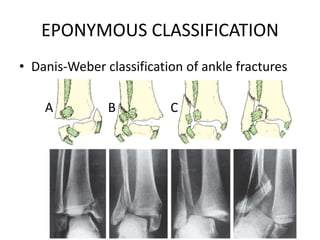
• Danis-Weber classification of ankle fractures
A B C
EPONYMOUS CLASSIFICATION
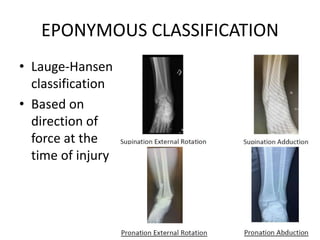
• Lauge-Hansen
classification
• Based on
direction of
force at the
time of injury
EPONYMOUS CLASSIFICATION
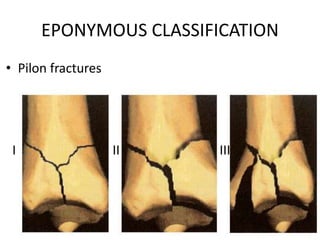
• Pilon fractures
I II III
EPONYMOUS CLASSIFICATION
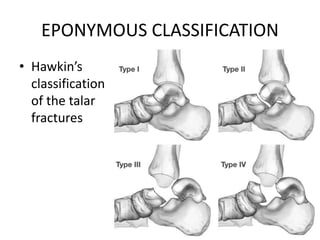
• Hawkin’s
classification
of the talar
fractures
EPONYMOUS CLASSIFICATION
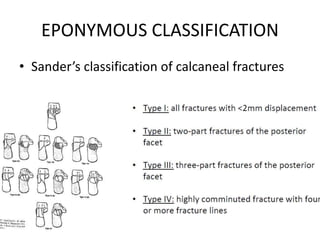
• Sander’s classification of calcaneal fractures
MANAGEMENT
• ATLS protocol
• Definitive care: depends on class and
aetiology
• Operative vs non-operative
CONCLUSION
• Classifications are essential for
communication, education, treatment
guidelines, and as a prognostic tool
REFERENCES
• Apley and Solomon’s System of Orthopaedics
and Trauma 10th ed
• Fracture and Dislocation Compendium—2018
A joint collaboration between the Orthopaedic
Trauma Association and the AO Foundation

FRACTURE- Aetiology, Classification and Complications.pptx