CHRONIC OSTEOMYELITIS
DR BIPUL BORTHAKUR
PROFESSOR
DEPTT OF
ORTHOPAEDICS,SMCH
INTRODUCTION
Chronic osteomyelitis is an infection of bone and marrow of more than six weeks
duration characterised by recurrent attacks of inflammation with discharging
sinuses and presence of infected dead bone(sequestra).
Causes: pyogenic bacteria, mycobacteria, or fungus but the term usually indicate
pyogenic infection.
ETIOLOGY
• Staph. aureus(most
common)
• Staph. epidermidis
• Strep. pyogenes
• Haemophilus influenzae
(between 6 mths. to 4 yrs.)
• Salmonella (in sickle cell
anemia)
• Pseudomonas (intravenous
drug users)
Predisposing
factors-
Inadequate
treatment of acute
osteomyelitis
An acute becomes
chronic due to one of the
following reasons:
1. Improper drainage of
the pus in acute
osteomyelitis
2. Formation of an
undrained non
collapsable cavity in
the bone
3. Presence of sequestra
4. Presence of foreign
bodies in case of
osteomyelitis following
open injuries
Compound fracture
Direct invasion
from adjacent soft
tissues, such as
from diabetic ulcers
Some special type
organisms-
mycobacteria,trepone
ma and some fungus
cause chronic
osteomyelitis
Around an infected
implant or prosthesis
PATHOGENESIS
Infection at the bone locus
creates an increase of
intramedullary pressure as a
result of inflammatory
exudate stripping the
periosteum; this leads to
vascular thrombosis, followed
by bone necrosis and the
Usually, necrosis of the
large segments of bone
leads to sequestrum
formation. These
sequestra with infected
material are surrounded
by sclerotic bone that is
relatively avascular.
The haversian canals are
blocked with scar tissue, and
the bone is surrounded by
thickened periosteum and
scarred muscle
Antibiotics cannot penetrate
these relatively avascular
tissues and are hence
ineffective in clearing the
New bone formation occurs at
the same time (involucrum)
around the dead bone
Multiple openings appear in
this involucrum, (cloacae)
through which exudates and
debris from the sequestrum
pass via the sinuses.
The periosteal reaction
acts to circumscribe
the sequestrum,
producing a thick sheet
of new bone or
involucrum.
Sequestrum:
It is a piece of dead bone
separated from healthy
bone. The area of dead
bone gets demarcated by
granulation tissue and
gradually separates and
forms a loose piece of
sequestrum.
Types of sequestrum-
1) corraliform- in pyogenic
infections
2) ivory sequestrum –
syphillis
3) feathery sequestrum- in
tuberculosis of long
bones
4) sand sequestrum – in
vertebral tuberculosis
5) black sequestrum – in
fungal infections
6) ring sequestrum – in pin
tract infections and
amputation stumps
CLINICAL FEATURES
Presentation-
Unlike acute
osteomyelitis, chronic
osteomyelitis causes
no acute
constitutional
symptoms
The presenting
features may be those
of a long-standing,
discharging sinus or
chronic bone pain that
persists despite
treatment.
Patients may also
present with acute
exacerbations and
usually have a
history of acute
osteomyelitis,
sometimes dating
back to childhood.
Some times it may
present with a
pathological
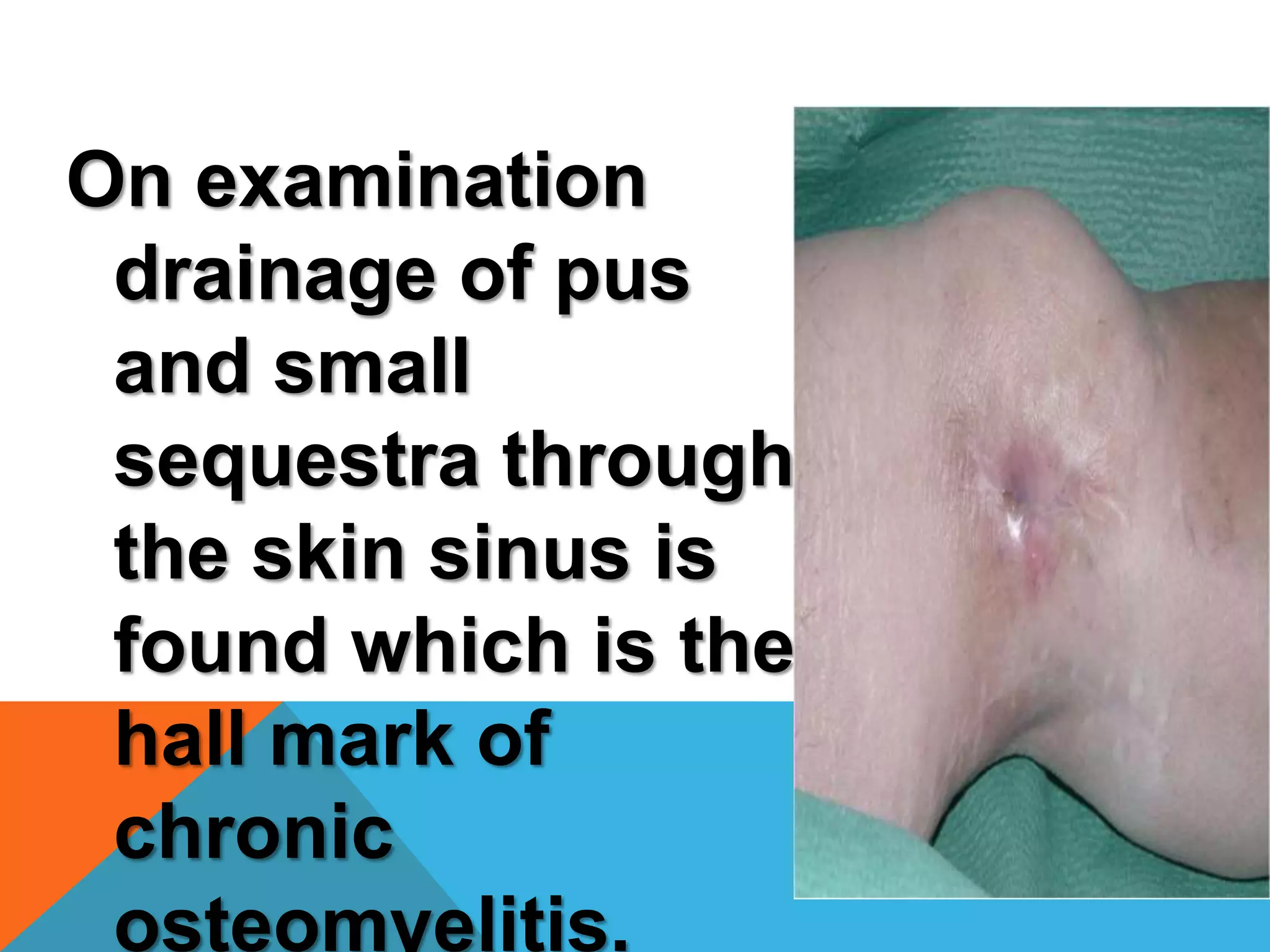
On examination
drainage of pus
and small
sequestra through
the skin sinus is
found which is the
hall mark of
chronic
osteomyelitis.
Granulation
tissue
protruding at
the sinus may
be found.
Sinus is often
adherent with
underlying
Patient may present
with deformity of the
limbs, muscle
contracture or limb
length discrepency.
DIAGNOSIS
Physical examinations
should focus on
integrity of skin and
soft tissue, assess
bone stability and
neurovascular status
Laboratory blood
studies are nonspecific
and gives no indication
of severity of infection.
ESR and CRP are
elevated in most
patients but WBC is
elevated only in 35%
DIAGNOSIS CONT..
X ray usually
shows bone
resorption with
thickening and
Sclerosis of the
surrounding
bone. A cavity
may appear as
an osteolytic
area.
DIAGNOSIS CONT..
Inside
cavity
sequestrum
is seen
denser than
normal
bone.
DIAGNOSIS CONT..
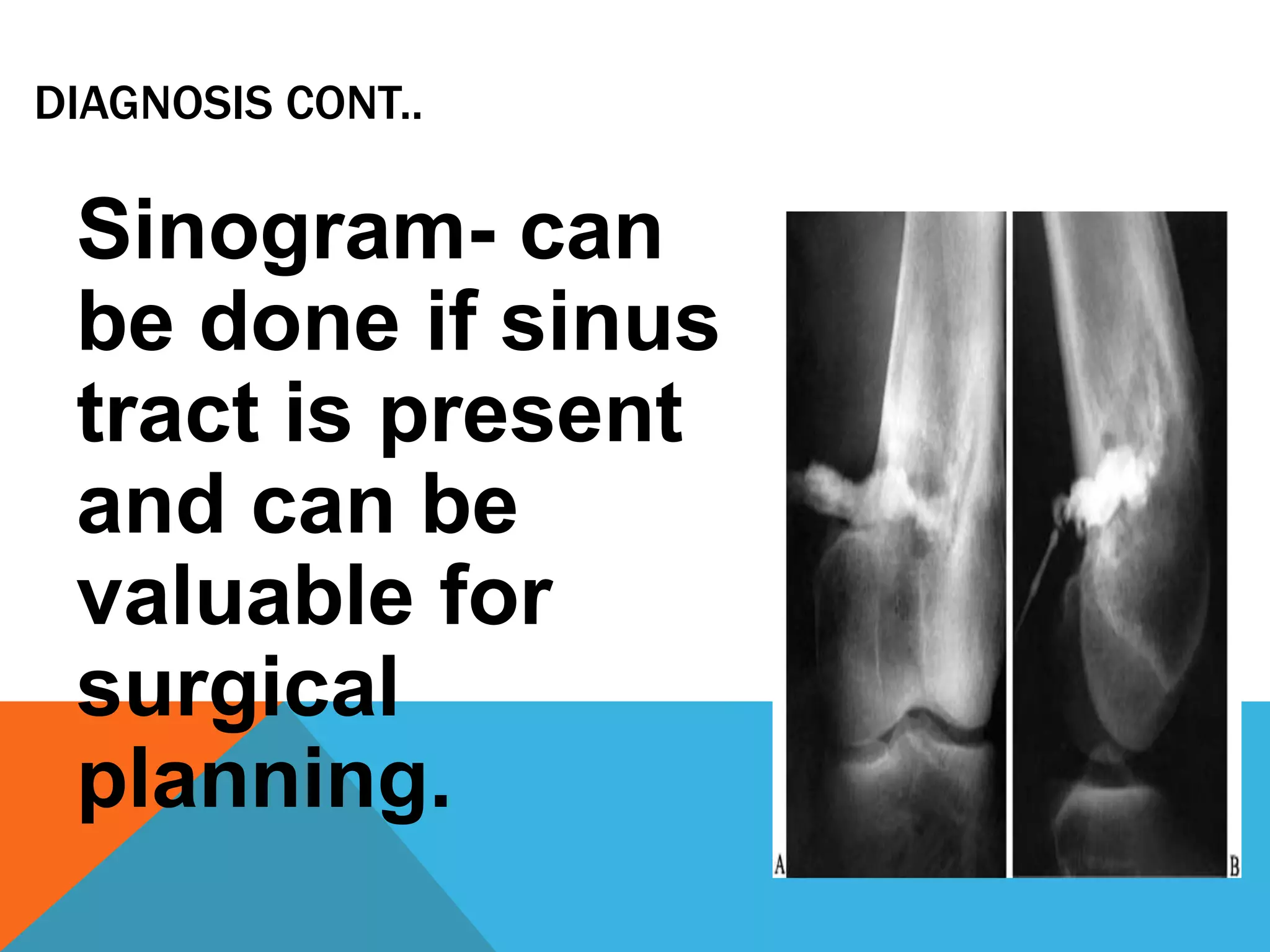
Sinogram- can
be done if sinus
tract is present
and can be
valuable for
surgical
planning.
DIAGNOSIS CONT..
C.T. Scan-
extremely
useful for
detection of
sequestra
and extent
of bony
involvemen
DIAGNOSIS CONT..
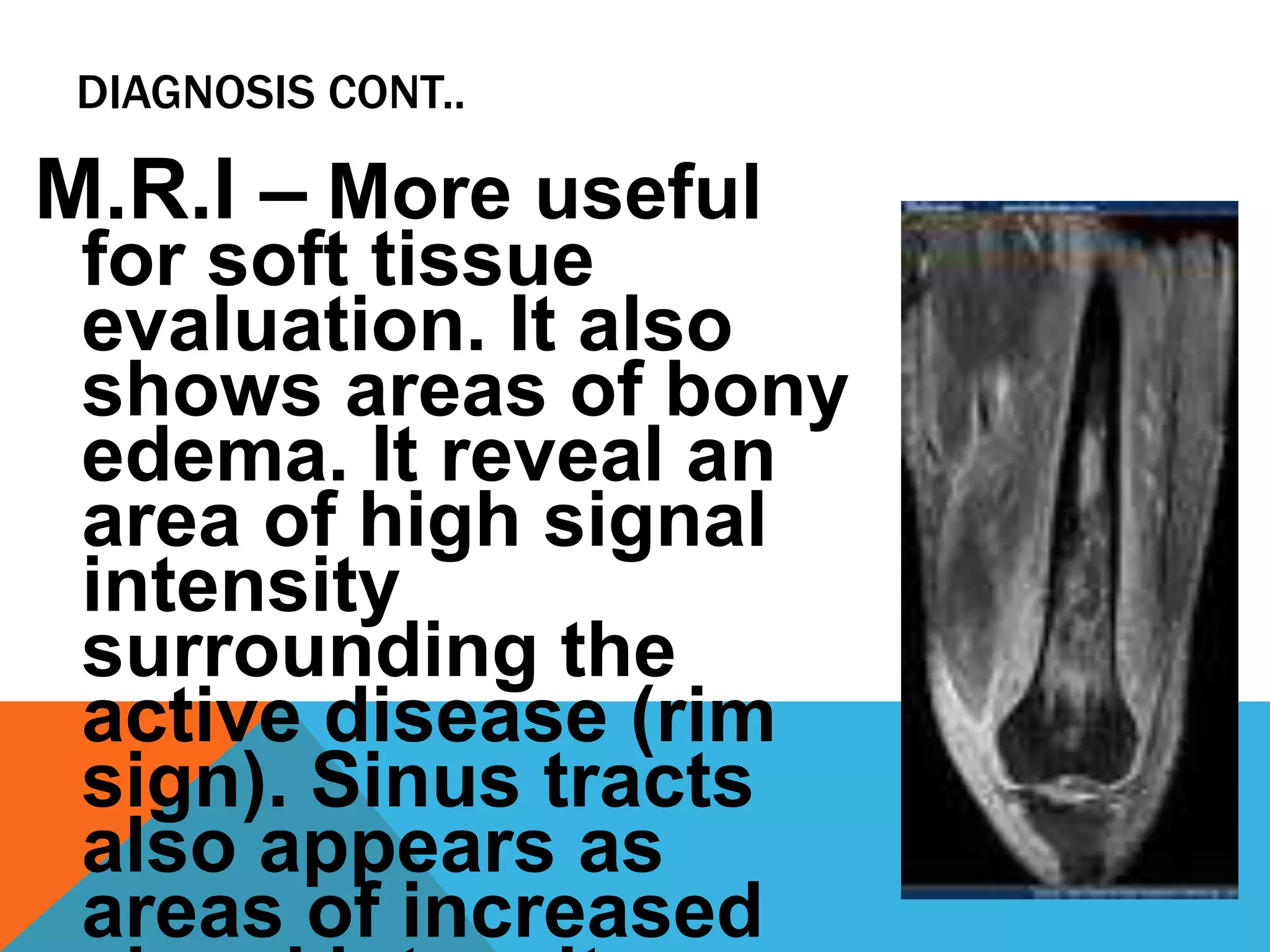
M.R.I – More useful
for soft tissue
evaluation. It also
shows areas of bony
edema. It reveal an
area of high signal
intensity
surrounding the
active disease (rim
sign). Sinus tracts
also appears as
areas of increased
DIAGNOSIS CONT..
Isotope bone
scanning –
technetium 99m bone
scans which shows
increased uptake in
areas of increased
blood flow or
osteoblastic activity
but tend to lack
specificity. It has a
Gallium scan – show
increased uptake in areas of
leukocyte or bacteria
accumulation. A normal
gallium scan virtually
excludes osteomyelitis and
can be useful as follow up
examination.
 Indium 111-labled leucocyte
scan- Specially useful to
differentiate chronic
osteomyelitis from reactive
bone disease or neuropathic
arthropathy.
 Biopsy with culture
sensitivity – It is the gold
standard for establishing
diagnosis.
DIFFERENTIAL DIAGNOSIS
Tubercular
osteomyelitis
Soft tissue infection
Ewing’s sarcoma
TREATMENT
Chronic osteomyelitis
generally cannot be
eradicated without
surgical treatment. The
goal of surgery is
eradication of infection by
achieving viable and
TREATMENT CONT.
Aims are –
1) adequate debridement
2) appropriate
reconstruction of bone and
soft tissue defect
3) appropriate antibiotic
therapy
SURGICAL TREATMENT
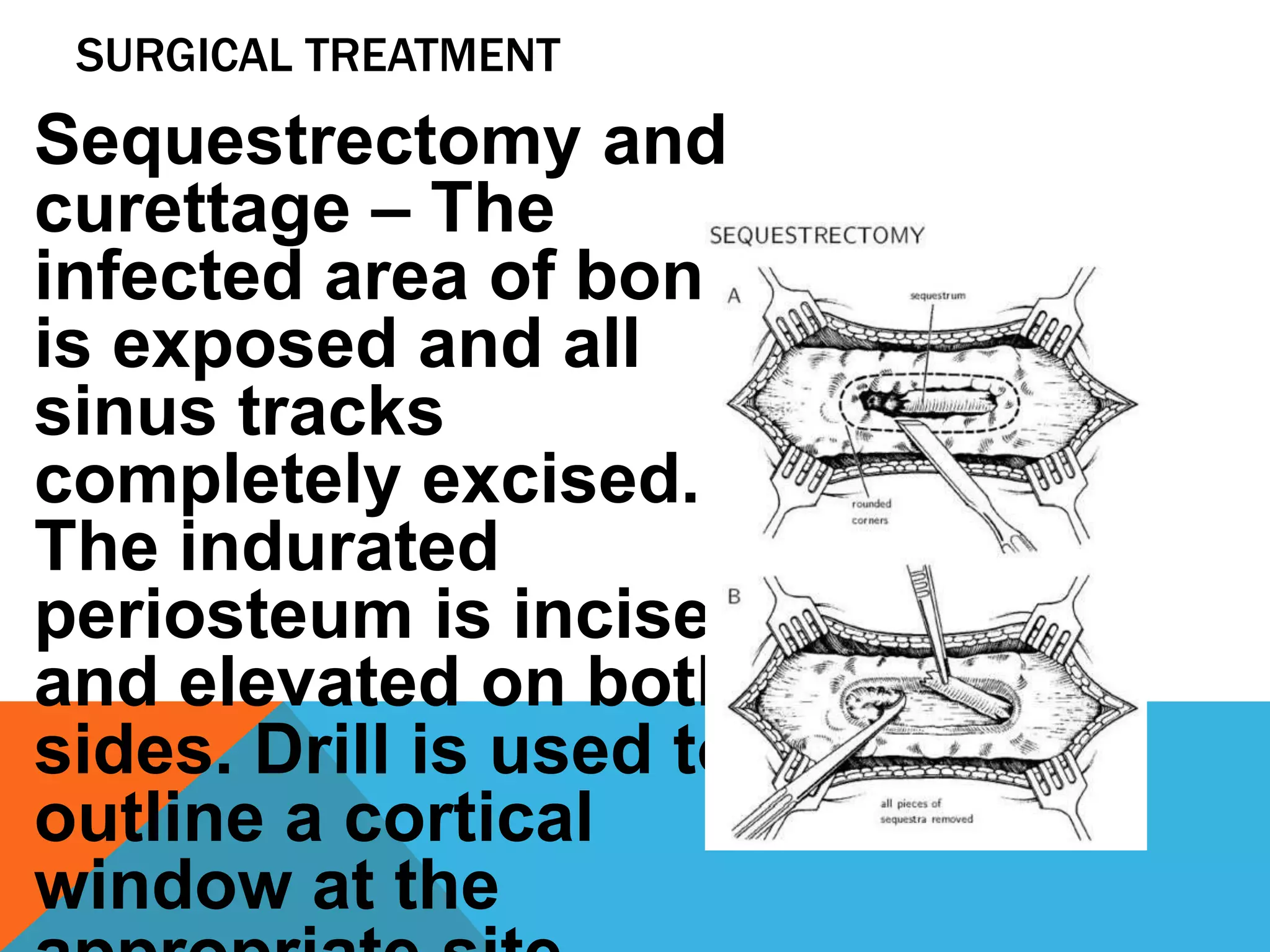
Sequestrectomy and
curettage – The
infected area of bone
is exposed and all
sinus tracks
completely excised.
The indurated
periosteum is incised
and elevated on both
sides. Drill is used to
outline a cortical
window at the
SURGICAL TREATMENT CONT
Remove all sequestra,
purulent material,
scarred and necrotic
tissue. If sclerotic
bone seals off a cavity
within medullary
canal, open it on both
directions to allow
blood vessels to grow
SURGICAL TREATMENT CONT
After removing
all suspicious
matter excise the
over hanging
edges of bone
and avoid leaving
are dead space.
SURGICAL TREATMENT CONT.
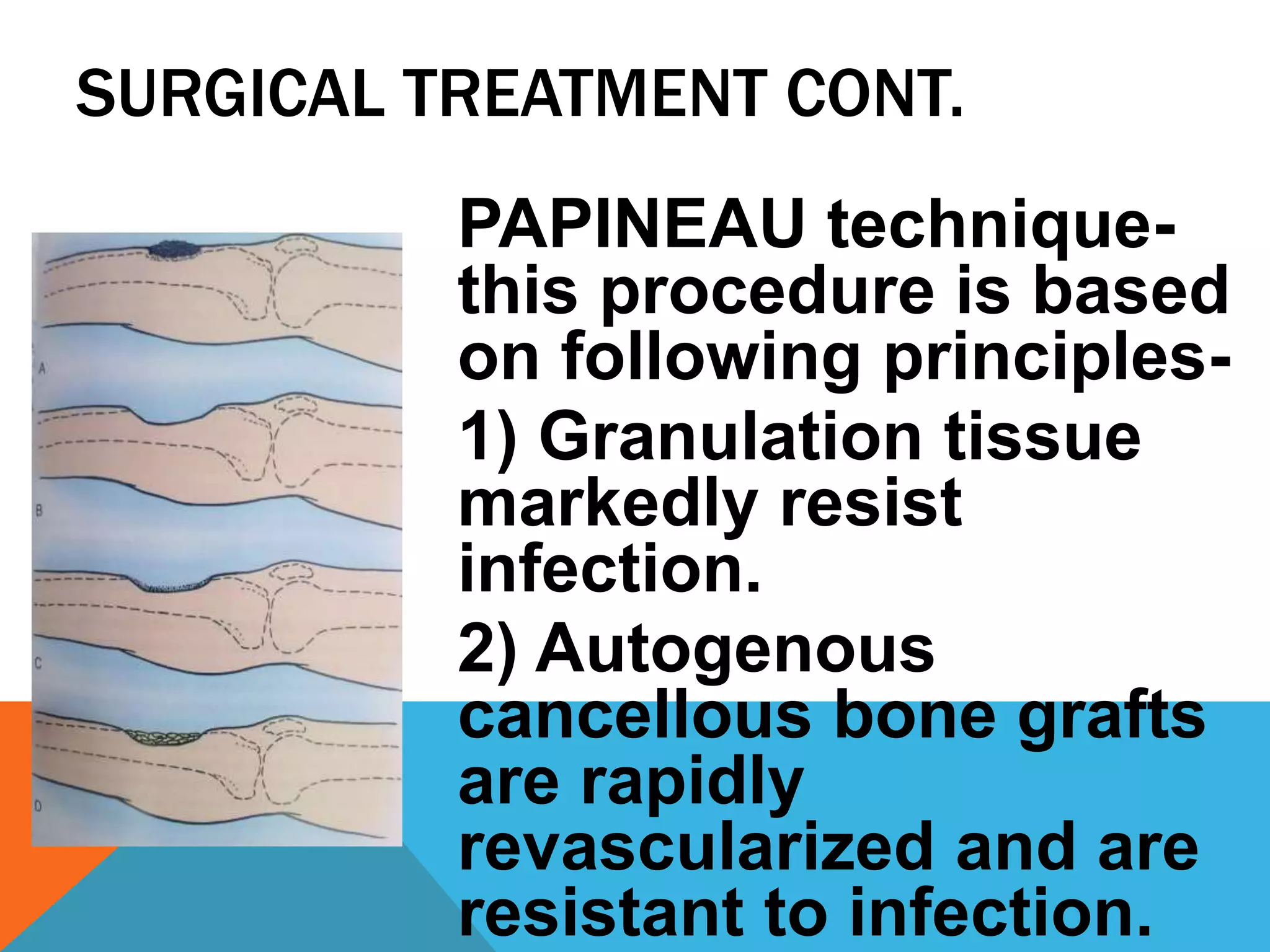
PAPINEAU technique-
this procedure is based
on following principles-
1) Granulation tissue
markedly resist
infection.
2) Autogenous
cancellous bone grafts
are rapidly
revascularized and are
resistant to infection.
SURGICAL TREATMENT CONT.
The operation is divided
into three stages-
a)excision of infected
tissue with or without
stabilization using an
external fixator or
intramedullary rod.
Dressing continued till
healthy appearing
granulation tissue is
SURGICAL TREATMENT CONT.
b)Cancellous bone
grafting in concentric
and overlapping layers
c)Wound coverage- in
some cases spontanous
epithelialization results,
otherwise skin grafts,
myocutaneous flaps or
muscle pedicle flaps can
be used.
SURGICAL TREATMENT CONT.
POLYMETHYLMETHAC
RYLATE(PMMA)
antibiotic bead chains-
the rationale for this
treatment is to deliver
high level of antibiotics
locally in
concentrations that
exceed the mic. The
antibiotic is leached
from beads into the
postoperative wound
hematoma and
secretion.
SURGICAL TREATMENT CONT.
Before the beads
are implanted the
infected and dead
tissue should be
debribed. the
beads are
implanted in the
bony defect.
SURGICAL TREATMENT CONT.
Aminoglycosides are
most commonly used,
but cephalosporins
and vancomycin also
used. Short term (10
days), long term (6
weeks), or permanent
implantation is
possible. The limb
should be
appropriately
SURGICAL TREATMENT CONT
Biodegradable Antibiotic
Delivery systems – Various
biodegradable antibiotic
delivery systems have been
evaluated. The main
advantage to these is that a
second procedure is not
required to remove the
implant.
SURGICAL TREATMENT CONT
Furthermore, some of these
biodegradable substrates
contain calcium, which can be
used in new bone formation. As
these beads resorb they are
slowly replaced by new bone
and soft tissue, and this process
may decrease the need for
further reconstructive or
coverage procedures.
SURGICAL TREATMENT CONT.
Soft Tissue Transfer – Soft
tissue transfers to fill dead
space left behind after
extensive debridement may
range from a localized muscle
flap on a vascular pedicle to
microvascular free tissue
transfer.
SURGICAL TREATMENT CONT.
The transfer of vascularised
muscle tissue improves the
local biological environment
by bringing in a blood
supply that is important in
the host’s defence
mechanisms, as well as for
antibiotic delivery and
osseous and soft tissue
SURGICAL TREATMENT CONT.
Most commonly a local muscle
flap is used in the treatment
of chronic osteomyelities of
the tibia. The gastrocnemius
muscle is used for defects
about the proximal third, and
soleus muscle is used for
defects at middle third.
SURGICAL TREATMENT CONT.
Ilizarov Technique – the
Ilizarov technique has been
helpful in the treatment of
chronic osteomyelitis and
infected non unions. This
technique allows radical
resection of the infected
bone.
SURGICAL TREATMENT CONT.
A corticotomy is performed
through normal bone proximal
and distal to the area of
disease. The bone is
transported until union is
achieved.
Disadvantages include the time
required to achieve a solid
union and the high incidence of
SURGICAL TREATMENT CONT.
Hyperbaric Oxygen Therapy –
Hyperbaric oxygen therapy
has not proved to be reliably
effective. The use of
hyperbaric oxygen can be
recommended only as an
adjuvant to more traditional
methods of treatment.
COMPLICATIONS
Pathological fracture
Deformity
Limb length discrepancy
Muscle fibrosis
Malignant changes(squmaous cell
carcinoma of sinus tract,
osteosarcoma)
Amyloidosis
PRIMARY SUBACUTE
OSTEOMYELITIS
Brodie abscess
Garres’ osteomyelitis
Salmonella
osteomyelitis
BRODIE ABSCESS
A Brodie abscess is a
localized form of
subacute
osteomyelitis that
occurs most often
in the long bones of
the lower
extremities of
young adults.
Before physeal
closure, the
In adults the
metaphyseal-
epiphyseal area is
involved.
Intermittent pain
of long duration is
the presenting
complaint, along
with local
tenderness over
the affected area.
On plain roentgenograms a
Brodie abscess generally
appears as a lytic lesion with a
rim of sclerotic bone but can
have a markedly varied
appearance
Careful evaluation of plain films is
mandatory because a Brodie
abscess can be easily mistaken
for a variety of neoplasm
The lesion is thought to be
caused by organisms of low
virulence. S. aureus is cultured
in 50% of patients, in 20%
culture is negative.
This condition often
requires an open biopsy
with curettage to make
the diagnosis. The
wound should be closed
loosely over a drain.
GARRE’S OSTEOMYELITIS
Sclerosing Osteomyelitis of Garre –
Sclerosing osteoyemilitis is a
chronic from of disease in which
the bone is thickened and
distended but abscesses and
sequestra are absent
The disease affects children and
young adults
Its cause is unknown, but it is
thought to be an infection caused
by a low-grade, possibly anaerobic
Patients report intermittent
pain of moderate intensity
and usually of long duration.
Swelling and tenderness over
the affected bone may be
found
Roentgenograms show an
expanded bone with
generalized sclerosis
The ESR usually is slightly
elevated
Biopsy shows only chronic,
low-grade, nonspecific
A secondary lesion at a distant
site can occur years after
onset. No treatment has been
predictably helpful, but
fenestration of the sclerotic
bone and antibiotics are
advisable
The condition must be
distinguished from osteoid
SALMONELLA OSTEOMYELITIS
Subacute type of
osteomyelitis usually
occurring in the ulna, ribs,
and vertebrae
Occurs some months or
years after attack of typhoid
or paratyphoid fever
Commonly associated with
sickle cell anaemia
Presents as an abscess
within the diaphysis of
bone
Blood widal tests may be
positive
Biopsy and culture
sensitivity done to
establish diagnosis.
Surgery is always required.
FUNGAL (MYCOTIC) INFECTION
Mycotic osteomyelitis is
the general term used to
describe a group of
diseases caused by
fungal infections of bone
There are two main
organisms- Actinomyces
and Maduramyces.
FUNGAL (MYCOTIC) INFECTION
Actinomycosis from cattle, occurs in
man in the soft tissues like mouth,
appendix, caecum and lung. Bone
affected secondarily, mandible most
commonly. The infection may spread
from lung to thoracic spine and from
caecum to pelvis. Multiple abscesses
result with the typical amorphous
yellow granules or sulphur granules
formed of fungal colonies.
FUNGAL (MYCOTIC) INFECTION CONT.
The affected bone has a
moth-eaten appearance. In
the spine the condition is
distinguished from
tuberculosis by sparing of
intervertebral discs and
absence of vertebral
collapse and kyphosis. The
heads of ribs and
transverse processes are
FUNGAL (MYCOTIC) INFECTION CONT.
Treatment is classically with the
penicillins, addition of
streptomycin or tetracycline
may be necessary. Antibiotic
should be continued for 6
month at least. Surgical
excision of the affected bone is
required for treatment of
MADURA FOOT:
~ first described by
Gill in 1832 from
madurai. The
organism usually
enter through a cut
in the foot, from
there they spread
through
subcutaneus tissue
and tendon sheaths.
Bones infected by
direct invasion
Patient may present
at early stage with
tender
~ as the condition
forms tumour like
mass it was called
mycetoma
~ Swelling
gradually spreads
and blister forms
which ultimately
involves the whole
foot. X ray shows
multiple bony
cavities or
progressive bone
destruction.
~ It later bursts
and forms
multiple
discharging
sinuses
~ pus contains
black granules
which are fungal
colonies from
which organism
can be isolated.
~ Treatment :
1.penicillin or
dapsone orally
may be
effective but
usually
unsatisfactory,
i.v.
amphotericin B
is advocated
which is fairly
toxic.
2. Localised
debridement
of
necrotic
tissue
3. amputation
may be
necessary in
extreme
cases.
TUBERCULOUS OSTEOMYELITIS
Tuberculous dactylitis
~ occurs in children and young
adults
~ infection starts in the shaft of the
phalanx and causes erosion and
gradual destruction of the bone
~ subperiosteal new bone
formation and thickening of bone
this phenomenon is peculiar to
the tuberculous infection in the
~The surrounding
soft tissue also swell
up and cold abscess
often forms and
bursts to form
chronic sinuses
~ the patient
presents with a
painful spindle
shaped swelling of
finger which is called
spinosa ventosa
SYPHILITIC OSTEOMYELITIS
Syphilitic affections of bone occur in
the inherited and acquired forms of
the disease and in the latter they are
more serious in the tertiary stage.
They differ from tuberculus
affections in that the shaft is more
frequently involved while the joints
escape
The causative organism is Treponema
pallidum
The tibia, femur and humerus and the
cranial bones are most common
sites of syphilitic osteomyelitis.
SYPHILITIC OSTEOMYELITIS CONT.
Manifestations –
1. Pain – this may vary from slight
dull ache to most excruciating
pains. There are no local
abnormalitis on clinical exam. and
a diagnosis of neuralgia is often
made.
2. Periostitis – frequently occurs and
affects multiple long bones.
3. The periosteal node – the
characteristic lesion is a localized
swelling of shaft which usually
involves a portion of the
circumference, and may surround
1. Diffuse osteoperiostitis – this
is a chronic inflammation
affecting the whole bone or
the greater portion of it inside
the periosteal envelope.
X-ray shows double outline
which is very characteristic. A
second sheath of compact
bone surrounds the original
compact layer but an
intervening space exists
which may be filled with
granulation tissue.
2. Syphilitic osteochondritis –
children with inherited
syphilis show an irregularity
of the epiphyseal line. This
irregularity is due to
transformation of cartilage
into bone. There is
thickening of epiphysis and
pain on passive movement.
3. Gummatous
Osteomyelitis - Gumma
can occur on surface of
the bone or within it. The
surface gumma
resembles an ordinary
periosteal nod except that
its speedily softens at its
centre. A gumma is in the
interior of long bone is a
serious condition as it is
mistaken for a malignant
4. Syphilitic dactylitis – the
importance of syphilis of the
phalanges lies in the fact that it
may be mistaken for
tuberculosis. But there is little
tendency to break down and
ulcerate as in tuberculosis. The
condition is usually painless.
Antibiotics are usually
ineffective. Pathological
fracture from break down of
gamma needs stabilization.
THANK YOU

Chronic osteomyelitis

  • 1.
    CHRONIC OSTEOMYELITIS DR BIPULBORTHAKUR PROFESSOR DEPTT OF ORTHOPAEDICS,SMCH
  • 2.
    INTRODUCTION Chronic osteomyelitis isan infection of bone and marrow of more than six weeks duration characterised by recurrent attacks of inflammation with discharging sinuses and presence of infected dead bone(sequestra). Causes: pyogenic bacteria, mycobacteria, or fungus but the term usually indicate pyogenic infection.
  • 3.
    ETIOLOGY • Staph. aureus(most common) •Staph. epidermidis • Strep. pyogenes • Haemophilus influenzae (between 6 mths. to 4 yrs.) • Salmonella (in sickle cell anemia) • Pseudomonas (intravenous drug users)
  • 4.
  • 5.
    An acute becomes chronicdue to one of the following reasons: 1. Improper drainage of the pus in acute osteomyelitis 2. Formation of an undrained non collapsable cavity in the bone
  • 6.
    3. Presence ofsequestra 4. Presence of foreign bodies in case of osteomyelitis following open injuries
  • 7.
    Compound fracture Direct invasion fromadjacent soft tissues, such as from diabetic ulcers
  • 8.
    Some special type organisms- mycobacteria,trepone maand some fungus cause chronic osteomyelitis Around an infected implant or prosthesis
  • 9.
    PATHOGENESIS Infection at thebone locus creates an increase of intramedullary pressure as a result of inflammatory exudate stripping the periosteum; this leads to vascular thrombosis, followed by bone necrosis and the
  • 10.
    Usually, necrosis ofthe large segments of bone leads to sequestrum formation. These sequestra with infected material are surrounded by sclerotic bone that is relatively avascular.
  • 11.
    The haversian canalsare blocked with scar tissue, and the bone is surrounded by thickened periosteum and scarred muscle Antibiotics cannot penetrate these relatively avascular tissues and are hence ineffective in clearing the
  • 12.
    New bone formationoccurs at the same time (involucrum) around the dead bone Multiple openings appear in this involucrum, (cloacae) through which exudates and debris from the sequestrum pass via the sinuses.
  • 13.
    The periosteal reaction actsto circumscribe the sequestrum, producing a thick sheet of new bone or involucrum.
  • 14.
    Sequestrum: It is apiece of dead bone separated from healthy bone. The area of dead bone gets demarcated by granulation tissue and gradually separates and forms a loose piece of sequestrum.
  • 15.
    Types of sequestrum- 1)corraliform- in pyogenic infections 2) ivory sequestrum – syphillis 3) feathery sequestrum- in tuberculosis of long bones
  • 16.
    4) sand sequestrum– in vertebral tuberculosis 5) black sequestrum – in fungal infections 6) ring sequestrum – in pin tract infections and amputation stumps
  • 17.
    CLINICAL FEATURES Presentation- Unlike acute osteomyelitis,chronic osteomyelitis causes no acute constitutional symptoms The presenting features may be those of a long-standing, discharging sinus or chronic bone pain that persists despite treatment.
  • 18.
    Patients may also presentwith acute exacerbations and usually have a history of acute osteomyelitis, sometimes dating back to childhood. Some times it may present with a pathological
  • 19.
    On examination drainage ofpus and small sequestra through the skin sinus is found which is the hall mark of chronic osteomyelitis.
  • 20.
    Granulation tissue protruding at the sinusmay be found. Sinus is often adherent with underlying
  • 21.
    Patient may present withdeformity of the limbs, muscle contracture or limb length discrepency.
  • 22.
    DIAGNOSIS Physical examinations should focuson integrity of skin and soft tissue, assess bone stability and neurovascular status
  • 23.
    Laboratory blood studies arenonspecific and gives no indication of severity of infection. ESR and CRP are elevated in most patients but WBC is elevated only in 35%
  • 24.
    DIAGNOSIS CONT.. X rayusually shows bone resorption with thickening and Sclerosis of the surrounding bone. A cavity may appear as an osteolytic area.
  • 25.
  • 26.
    DIAGNOSIS CONT.. Sinogram- can bedone if sinus tract is present and can be valuable for surgical planning.
  • 27.
    DIAGNOSIS CONT.. C.T. Scan- extremely usefulfor detection of sequestra and extent of bony involvemen
  • 28.
    DIAGNOSIS CONT.. M.R.I –More useful for soft tissue evaluation. It also shows areas of bony edema. It reveal an area of high signal intensity surrounding the active disease (rim sign). Sinus tracts also appears as areas of increased
  • 29.
    DIAGNOSIS CONT.. Isotope bone scanning– technetium 99m bone scans which shows increased uptake in areas of increased blood flow or osteoblastic activity but tend to lack specificity. It has a
  • 30.
    Gallium scan –show increased uptake in areas of leukocyte or bacteria accumulation. A normal gallium scan virtually excludes osteomyelitis and can be useful as follow up examination.
  • 31.
     Indium 111-labledleucocyte scan- Specially useful to differentiate chronic osteomyelitis from reactive bone disease or neuropathic arthropathy.  Biopsy with culture sensitivity – It is the gold standard for establishing diagnosis.
  • 32.
  • 33.
    TREATMENT Chronic osteomyelitis generally cannotbe eradicated without surgical treatment. The goal of surgery is eradication of infection by achieving viable and
  • 34.
    TREATMENT CONT. Aims are– 1) adequate debridement 2) appropriate reconstruction of bone and soft tissue defect 3) appropriate antibiotic therapy
  • 35.
    SURGICAL TREATMENT Sequestrectomy and curettage– The infected area of bone is exposed and all sinus tracks completely excised. The indurated periosteum is incised and elevated on both sides. Drill is used to outline a cortical window at the
  • 36.
    SURGICAL TREATMENT CONT Removeall sequestra, purulent material, scarred and necrotic tissue. If sclerotic bone seals off a cavity within medullary canal, open it on both directions to allow blood vessels to grow
  • 37.
    SURGICAL TREATMENT CONT Afterremoving all suspicious matter excise the over hanging edges of bone and avoid leaving are dead space.
  • 38.
    SURGICAL TREATMENT CONT. PAPINEAUtechnique- this procedure is based on following principles- 1) Granulation tissue markedly resist infection. 2) Autogenous cancellous bone grafts are rapidly revascularized and are resistant to infection.
  • 39.
    SURGICAL TREATMENT CONT. Theoperation is divided into three stages- a)excision of infected tissue with or without stabilization using an external fixator or intramedullary rod. Dressing continued till healthy appearing granulation tissue is
  • 40.
    SURGICAL TREATMENT CONT. b)Cancellousbone grafting in concentric and overlapping layers c)Wound coverage- in some cases spontanous epithelialization results, otherwise skin grafts, myocutaneous flaps or muscle pedicle flaps can be used.
  • 41.
    SURGICAL TREATMENT CONT. POLYMETHYLMETHAC RYLATE(PMMA) antibioticbead chains- the rationale for this treatment is to deliver high level of antibiotics locally in concentrations that exceed the mic. The antibiotic is leached from beads into the postoperative wound hematoma and secretion.
  • 42.
    SURGICAL TREATMENT CONT. Beforethe beads are implanted the infected and dead tissue should be debribed. the beads are implanted in the bony defect.
  • 43.
    SURGICAL TREATMENT CONT. Aminoglycosidesare most commonly used, but cephalosporins and vancomycin also used. Short term (10 days), long term (6 weeks), or permanent implantation is possible. The limb should be appropriately
  • 44.
    SURGICAL TREATMENT CONT BiodegradableAntibiotic Delivery systems – Various biodegradable antibiotic delivery systems have been evaluated. The main advantage to these is that a second procedure is not required to remove the implant.
  • 45.
    SURGICAL TREATMENT CONT Furthermore,some of these biodegradable substrates contain calcium, which can be used in new bone formation. As these beads resorb they are slowly replaced by new bone and soft tissue, and this process may decrease the need for further reconstructive or coverage procedures.
  • 46.
    SURGICAL TREATMENT CONT. SoftTissue Transfer – Soft tissue transfers to fill dead space left behind after extensive debridement may range from a localized muscle flap on a vascular pedicle to microvascular free tissue transfer.
  • 47.
    SURGICAL TREATMENT CONT. Thetransfer of vascularised muscle tissue improves the local biological environment by bringing in a blood supply that is important in the host’s defence mechanisms, as well as for antibiotic delivery and osseous and soft tissue
  • 48.
    SURGICAL TREATMENT CONT. Mostcommonly a local muscle flap is used in the treatment of chronic osteomyelities of the tibia. The gastrocnemius muscle is used for defects about the proximal third, and soleus muscle is used for defects at middle third.
  • 49.
    SURGICAL TREATMENT CONT. IlizarovTechnique – the Ilizarov technique has been helpful in the treatment of chronic osteomyelitis and infected non unions. This technique allows radical resection of the infected bone.
  • 51.
    SURGICAL TREATMENT CONT. Acorticotomy is performed through normal bone proximal and distal to the area of disease. The bone is transported until union is achieved. Disadvantages include the time required to achieve a solid union and the high incidence of
  • 52.
    SURGICAL TREATMENT CONT. HyperbaricOxygen Therapy – Hyperbaric oxygen therapy has not proved to be reliably effective. The use of hyperbaric oxygen can be recommended only as an adjuvant to more traditional methods of treatment.
  • 53.
    COMPLICATIONS Pathological fracture Deformity Limb lengthdiscrepancy Muscle fibrosis Malignant changes(squmaous cell carcinoma of sinus tract, osteosarcoma) Amyloidosis
  • 54.
    PRIMARY SUBACUTE OSTEOMYELITIS Brodie abscess Garres’osteomyelitis Salmonella osteomyelitis
  • 55.
    BRODIE ABSCESS A Brodieabscess is a localized form of subacute osteomyelitis that occurs most often in the long bones of the lower extremities of young adults. Before physeal closure, the
  • 56.
    In adults the metaphyseal- epiphysealarea is involved. Intermittent pain of long duration is the presenting complaint, along with local tenderness over the affected area.
  • 57.
    On plain roentgenogramsa Brodie abscess generally appears as a lytic lesion with a rim of sclerotic bone but can have a markedly varied appearance Careful evaluation of plain films is mandatory because a Brodie abscess can be easily mistaken for a variety of neoplasm The lesion is thought to be caused by organisms of low virulence. S. aureus is cultured in 50% of patients, in 20% culture is negative.
  • 58.
    This condition often requiresan open biopsy with curettage to make the diagnosis. The wound should be closed loosely over a drain.
  • 59.
    GARRE’S OSTEOMYELITIS Sclerosing Osteomyelitisof Garre – Sclerosing osteoyemilitis is a chronic from of disease in which the bone is thickened and distended but abscesses and sequestra are absent The disease affects children and young adults Its cause is unknown, but it is thought to be an infection caused by a low-grade, possibly anaerobic
  • 60.
    Patients report intermittent painof moderate intensity and usually of long duration. Swelling and tenderness over the affected bone may be found Roentgenograms show an expanded bone with generalized sclerosis The ESR usually is slightly elevated Biopsy shows only chronic, low-grade, nonspecific
  • 61.
    A secondary lesionat a distant site can occur years after onset. No treatment has been predictably helpful, but fenestration of the sclerotic bone and antibiotics are advisable The condition must be distinguished from osteoid
  • 63.
    SALMONELLA OSTEOMYELITIS Subacute typeof osteomyelitis usually occurring in the ulna, ribs, and vertebrae Occurs some months or years after attack of typhoid or paratyphoid fever Commonly associated with sickle cell anaemia
  • 64.
    Presents as anabscess within the diaphysis of bone Blood widal tests may be positive Biopsy and culture sensitivity done to establish diagnosis. Surgery is always required.
  • 65.
    FUNGAL (MYCOTIC) INFECTION Mycoticosteomyelitis is the general term used to describe a group of diseases caused by fungal infections of bone There are two main organisms- Actinomyces and Maduramyces.
  • 66.
    FUNGAL (MYCOTIC) INFECTION Actinomycosisfrom cattle, occurs in man in the soft tissues like mouth, appendix, caecum and lung. Bone affected secondarily, mandible most commonly. The infection may spread from lung to thoracic spine and from caecum to pelvis. Multiple abscesses result with the typical amorphous yellow granules or sulphur granules formed of fungal colonies.
  • 67.
    FUNGAL (MYCOTIC) INFECTIONCONT. The affected bone has a moth-eaten appearance. In the spine the condition is distinguished from tuberculosis by sparing of intervertebral discs and absence of vertebral collapse and kyphosis. The heads of ribs and transverse processes are
  • 68.
    FUNGAL (MYCOTIC) INFECTIONCONT. Treatment is classically with the penicillins, addition of streptomycin or tetracycline may be necessary. Antibiotic should be continued for 6 month at least. Surgical excision of the affected bone is required for treatment of
  • 69.
    MADURA FOOT: ~ firstdescribed by Gill in 1832 from madurai. The organism usually enter through a cut in the foot, from there they spread through subcutaneus tissue and tendon sheaths. Bones infected by direct invasion Patient may present at early stage with tender
  • 70.
    ~ as thecondition forms tumour like mass it was called mycetoma ~ Swelling gradually spreads and blister forms which ultimately involves the whole foot. X ray shows multiple bony cavities or progressive bone destruction.
  • 71.
    ~ It laterbursts and forms multiple discharging sinuses ~ pus contains black granules which are fungal colonies from which organism can be isolated.
  • 72.
    ~ Treatment : 1.penicillinor dapsone orally may be effective but usually unsatisfactory, i.v. amphotericin B is advocated which is fairly toxic.
  • 73.
  • 74.
    TUBERCULOUS OSTEOMYELITIS Tuberculous dactylitis ~occurs in children and young adults ~ infection starts in the shaft of the phalanx and causes erosion and gradual destruction of the bone ~ subperiosteal new bone formation and thickening of bone this phenomenon is peculiar to the tuberculous infection in the
  • 75.
    ~The surrounding soft tissuealso swell up and cold abscess often forms and bursts to form chronic sinuses ~ the patient presents with a painful spindle shaped swelling of finger which is called spinosa ventosa
  • 76.
    SYPHILITIC OSTEOMYELITIS Syphilitic affectionsof bone occur in the inherited and acquired forms of the disease and in the latter they are more serious in the tertiary stage. They differ from tuberculus affections in that the shaft is more frequently involved while the joints escape The causative organism is Treponema pallidum The tibia, femur and humerus and the cranial bones are most common sites of syphilitic osteomyelitis.
  • 77.
    SYPHILITIC OSTEOMYELITIS CONT. Manifestations– 1. Pain – this may vary from slight dull ache to most excruciating pains. There are no local abnormalitis on clinical exam. and a diagnosis of neuralgia is often made. 2. Periostitis – frequently occurs and affects multiple long bones. 3. The periosteal node – the characteristic lesion is a localized swelling of shaft which usually involves a portion of the circumference, and may surround
  • 78.
    1. Diffuse osteoperiostitis– this is a chronic inflammation affecting the whole bone or the greater portion of it inside the periosteal envelope. X-ray shows double outline which is very characteristic. A second sheath of compact bone surrounds the original compact layer but an intervening space exists which may be filled with granulation tissue.
  • 79.
    2. Syphilitic osteochondritis– children with inherited syphilis show an irregularity of the epiphyseal line. This irregularity is due to transformation of cartilage into bone. There is thickening of epiphysis and pain on passive movement.
  • 80.
    3. Gummatous Osteomyelitis -Gumma can occur on surface of the bone or within it. The surface gumma resembles an ordinary periosteal nod except that its speedily softens at its centre. A gumma is in the interior of long bone is a serious condition as it is mistaken for a malignant
  • 81.
    4. Syphilitic dactylitis– the importance of syphilis of the phalanges lies in the fact that it may be mistaken for tuberculosis. But there is little tendency to break down and ulcerate as in tuberculosis. The condition is usually painless. Antibiotics are usually ineffective. Pathological fracture from break down of gamma needs stabilization.
  • 82.