Four-Stroke EngineFour-Stroke Engine
BasicsBasics
Instructor:Instructor: Amar AhirAmar Ahir
Next
OrientationOrientation
 Throughout this lesson on four-Throughout this lesson on four-
stroke engines, learner will self-stroke engines, learner will self-
navigate through thisnavigate through this
PowerPoint presentationPowerPoint presentation
 Be sure to click on every linkBe sure to click on every link
 Learner will be quizzed at theLearner will be quizzed at the
end of the lessonend of the lesson
 Click on Next to move on, orClick on Next to move on, or
Back to go back.Back to go back.
NextBack
Orientation ContinuedOrientation Continued
 Material that will be covered:Material that will be covered:
 Four-stroke engine basicsFour-stroke engine basics
 Other engine typesOther engine types
 Basic components of a four-strokeBasic components of a four-stroke
engineengine
 The four-stroke cycleThe four-stroke cycle
NextBack
NextBack
The BasicsThe Basics
 A four-stroke engine:A four-stroke engine:
 Is an internal combustion engineIs an internal combustion engine
 Converts gasoline into motionConverts gasoline into motion
 Is the most common car engineIs the most common car engine
typetype
 Is relatively efficientIs relatively efficient
 Is relatively inexpensiveIs relatively inexpensive
NextBack
Other Engine TypesOther Engine Types
 Two-stroke enginesTwo-stroke engines
 Diesel enginesDiesel engines
 Rotary enginesRotary engines
 Turbine enginesTurbine engines
 Steam enginesSteam engines
NextBack
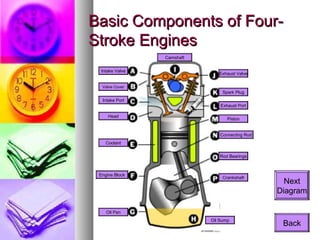
Basic Components of Four-Basic Components of Four-
Stroke EnginesStroke Engines
Intake Valve
Valve Cover
Intake Port
Head
Coolant
Engine Block
Oil Pan
Oil Sump
Crankshaft
Camshaft
Exhaust Valve
Spark Plug
Exhaust Port
Piston
Connecting Rod
Rod Bearings
Back
Next
Diagram
 A.A. Intake Valve-Intake Valve- opens at theopens at the
proper time to let in air and fuel.proper time to let in air and fuel.
Back
 B.B. Valve CoverValve Cover- Protects the- Protects the
valves and the valve springs.valves and the valve springs.
Keeps dirt out and lubricating oilKeeps dirt out and lubricating oil
in.in.
Back
 C.C. Intake PortIntake Port- the passageway- the passageway
in a cylinder head for the fuelin a cylinder head for the fuel
and air to pass through.and air to pass through.
Back
 D.D. HeadHead- a platform containing- a platform containing
most of the parts of themost of the parts of the
combustion chamber.combustion chamber.
Back
 E.E. CoolantCoolant- circulating water- circulating water
and antifreeze to keep theand antifreeze to keep the
temperature regulated.temperature regulated.
Back
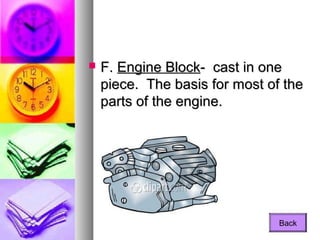
 F.F. Engine BlockEngine Block- cast in one- cast in one
piece. The basis for most of thepiece. The basis for most of the
parts of the engine.parts of the engine.
Back
 G.G. Oil PanOil Pan- where the oil is- where the oil is
collected and recirculated.collected and recirculated.
Back
 H.H. Oil SumpOil Sump- the collected oil- the collected oil
primarily for lubricating theprimarily for lubricating the
crankshaft and rod bearingcrankshaft and rod bearing
Back
 I.I. CamshaftCamshaft- a round shaft with- a round shaft with
lobes, that rotates to open andlobes, that rotates to open and
close the fuel and exhaustclose the fuel and exhaust
valves.valves.
Back
 J.J. Exhaust ValveExhaust Valve- open at the- open at the
proper time to release theproper time to release the
exhaustexhaust
Back
 K.K. Spark PlugSpark Plug- a device,- a device,
inserted into the combustioninserted into the combustion
chamber for firing an electricalchamber for firing an electrical
spark to ignite air-fuel mixturespark to ignite air-fuel mixture
Back
 L.L. Exhaust PortExhaust Port- the- the
passageway in a cylinder head,passageway in a cylinder head,
for the exhaust to pass throughfor the exhaust to pass through
Back
 M.M. PistonPiston- the part of the- the part of the
engine that moves up and downengine that moves up and down
in the cylinder converting thein the cylinder converting the
gasoline into motiongasoline into motion
Back
 N.N. Connecting RodConnecting Rod- links the- links the
piston to the crankshaft.piston to the crankshaft.
Back
 O.O. Rod BearingRod Bearing- used to reduce- used to reduce
friction to the rod and crankshaftfriction to the rod and crankshaft
Back
 P.P. CrankshaftCrankshaft- converts the up- converts the up
and down motion of the pistonand down motion of the piston
into a turning, or rotating motioninto a turning, or rotating motion
Back
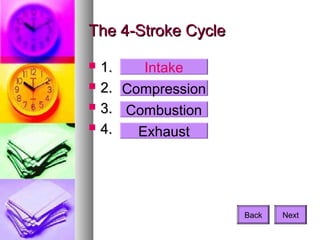
The 4-Stroke CycleThe 4-Stroke Cycle
 1.1.
 2.2.
 3.3.
 4.4.
Intake
Compression
Combustion
Exhaust
Back Next
 IntakeIntake-- process ofprocess of
filling the cylinderfilling the cylinder
with the proper air-with the proper air-
fuel mixturefuel mixture
through the intakethrough the intake
valve.valve.
Back
 CompressionCompression--
the process ofthe process of
compressing thecompressing the
air-fuel mixture inair-fuel mixture in
the cylinder tothe cylinder to
make it moremake it more
combustiblecombustible
Back
 CombustionCombustion-the-the
process of ignitingprocess of igniting
the compressedthe compressed
air-fuel mixture toair-fuel mixture to
create motion andcreate motion and
the over all powerthe over all power
of the engine.of the engine.
Back
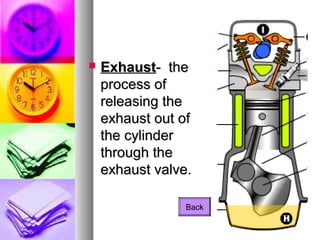
 ExhaustExhaust- the- the
process ofprocess of
releasing thereleasing the
exhaust out ofexhaust out of
the cylinderthe cylinder
through thethrough the
exhaust valve.exhaust valve.
Back
ApplicationApplication
 Now that you understand theNow that you understand the
basics of four-stroke engines,basics of four-stroke engines,
how can you use thishow can you use this
information in the real world?information in the real world?

Four stroke engine-basics

  • 1.
  • 2.
    OrientationOrientation  Throughout thislesson on four-Throughout this lesson on four- stroke engines, learner will self-stroke engines, learner will self- navigate through thisnavigate through this PowerPoint presentationPowerPoint presentation  Be sure to click on every linkBe sure to click on every link  Learner will be quizzed at theLearner will be quizzed at the end of the lessonend of the lesson  Click on Next to move on, orClick on Next to move on, or Back to go back.Back to go back. NextBack
  • 3.
    Orientation ContinuedOrientation Continued Material that will be covered:Material that will be covered:  Four-stroke engine basicsFour-stroke engine basics  Other engine typesOther engine types  Basic components of a four-strokeBasic components of a four-stroke engineengine  The four-stroke cycleThe four-stroke cycle NextBack
  • 4.
  • 5.
    The BasicsThe Basics A four-stroke engine:A four-stroke engine:  Is an internal combustion engineIs an internal combustion engine  Converts gasoline into motionConverts gasoline into motion  Is the most common car engineIs the most common car engine typetype  Is relatively efficientIs relatively efficient  Is relatively inexpensiveIs relatively inexpensive NextBack
  • 6.
    Other Engine TypesOtherEngine Types  Two-stroke enginesTwo-stroke engines  Diesel enginesDiesel engines  Rotary enginesRotary engines  Turbine enginesTurbine engines  Steam enginesSteam engines NextBack
  • 7.
    Basic Components ofFour-Basic Components of Four- Stroke EnginesStroke Engines Intake Valve Valve Cover Intake Port Head Coolant Engine Block Oil Pan Oil Sump Crankshaft Camshaft Exhaust Valve Spark Plug Exhaust Port Piston Connecting Rod Rod Bearings Back Next Diagram
  • 8.
     A.A. IntakeValve-Intake Valve- opens at theopens at the proper time to let in air and fuel.proper time to let in air and fuel. Back
  • 9.
     B.B. ValveCoverValve Cover- Protects the- Protects the valves and the valve springs.valves and the valve springs. Keeps dirt out and lubricating oilKeeps dirt out and lubricating oil in.in. Back
  • 10.
     C.C. IntakePortIntake Port- the passageway- the passageway in a cylinder head for the fuelin a cylinder head for the fuel and air to pass through.and air to pass through. Back
  • 11.
     D.D. HeadHead-a platform containing- a platform containing most of the parts of themost of the parts of the combustion chamber.combustion chamber. Back
  • 12.
     E.E. CoolantCoolant-circulating water- circulating water and antifreeze to keep theand antifreeze to keep the temperature regulated.temperature regulated. Back
  • 13.
     F.F. EngineBlockEngine Block- cast in one- cast in one piece. The basis for most of thepiece. The basis for most of the parts of the engine.parts of the engine. Back
  • 14.
     G.G. OilPanOil Pan- where the oil is- where the oil is collected and recirculated.collected and recirculated. Back
  • 15.
     H.H. OilSumpOil Sump- the collected oil- the collected oil primarily for lubricating theprimarily for lubricating the crankshaft and rod bearingcrankshaft and rod bearing Back
  • 16.
     I.I. CamshaftCamshaft-a round shaft with- a round shaft with lobes, that rotates to open andlobes, that rotates to open and close the fuel and exhaustclose the fuel and exhaust valves.valves. Back
  • 17.
     J.J. ExhaustValveExhaust Valve- open at the- open at the proper time to release theproper time to release the exhaustexhaust Back
  • 18.
     K.K. SparkPlugSpark Plug- a device,- a device, inserted into the combustioninserted into the combustion chamber for firing an electricalchamber for firing an electrical spark to ignite air-fuel mixturespark to ignite air-fuel mixture Back
  • 19.
     L.L. ExhaustPortExhaust Port- the- the passageway in a cylinder head,passageway in a cylinder head, for the exhaust to pass throughfor the exhaust to pass through Back
  • 20.
     M.M. PistonPiston-the part of the- the part of the engine that moves up and downengine that moves up and down in the cylinder converting thein the cylinder converting the gasoline into motiongasoline into motion Back
  • 21.
     N.N. ConnectingRodConnecting Rod- links the- links the piston to the crankshaft.piston to the crankshaft. Back
  • 22.
     O.O. RodBearingRod Bearing- used to reduce- used to reduce friction to the rod and crankshaftfriction to the rod and crankshaft Back
  • 23.
     P.P. CrankshaftCrankshaft-converts the up- converts the up and down motion of the pistonand down motion of the piston into a turning, or rotating motioninto a turning, or rotating motion Back
  • 24.
    The 4-Stroke CycleThe4-Stroke Cycle  1.1.  2.2.  3.3.  4.4. Intake Compression Combustion Exhaust Back Next
  • 25.
     IntakeIntake-- processofprocess of filling the cylinderfilling the cylinder with the proper air-with the proper air- fuel mixturefuel mixture through the intakethrough the intake valve.valve. Back
  • 26.
     CompressionCompression-- the processofthe process of compressing thecompressing the air-fuel mixture inair-fuel mixture in the cylinder tothe cylinder to make it moremake it more combustiblecombustible Back
  • 27.
     CombustionCombustion-the-the process ofignitingprocess of igniting the compressedthe compressed air-fuel mixture toair-fuel mixture to create motion andcreate motion and the over all powerthe over all power of the engine.of the engine. Back
  • 28.
     ExhaustExhaust- the-the process ofprocess of releasing thereleasing the exhaust out ofexhaust out of the cylinderthe cylinder through thethrough the exhaust valve.exhaust valve. Back
  • 29.
    ApplicationApplication  Now thatyou understand theNow that you understand the basics of four-stroke engines,basics of four-stroke engines, how can you use thishow can you use this information in the real world?information in the real world?