Get a sheet of
paper and title it,
“The Founding Fathers”
Write down the Learning Target for the day:
“I can recognize the contributions of the
Founding Fathers during the American
Revolution.”
On the same paper, you will copy the Quick
Check questions and write your answer.
YOU DO NOT NEED TO TAKE NOTES ON
THE SLIDES.
The Founding
Fathers
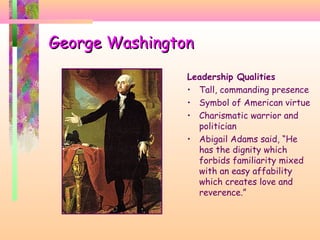
George WashingtonGeorge Washington
Leadership Qualities
• Tall, commanding presence
• Symbol of American virtue
• Charismatic warrior and
politician
• Abigail Adams said, “He
has the dignity which
forbids familiarity mixed
with an easy affability
which creates love and
reverence.”
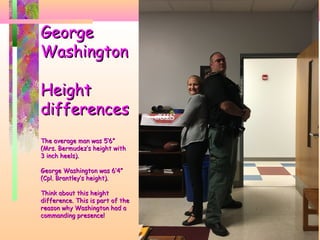
GeorgeGeorge
WashingtonWashington
HeightHeight
differencesdifferences
The average man was 5’6”The average man was 5’6”
(Mrs. Bermudez’s height with(Mrs. Bermudez’s height with
3 inch heels).3 inch heels).
George Washington was 6’4”George Washington was 6’4”
(Cpl. Brantley’s height).(Cpl. Brantley’s height).
Think about this heightThink about this height
difference. This is part of thedifference. This is part of the
reason why Washington had areason why Washington had a
commanding presence!commanding presence!
...continued
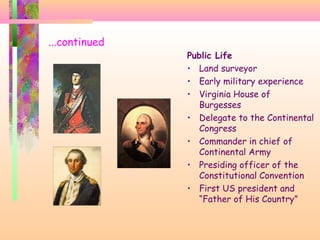
Public Life
• Land surveyor
• Early military experience
• Virginia House of
Burgesses
• Delegate to the Continental
Congress
• Commander in chief of
Continental Army
• Presiding officer of the
Constitutional Convention
• First US president and
“Father of His Country”
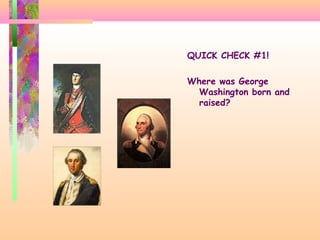
QUICK CHECK #1!
Where was George
Washington born and
raised?
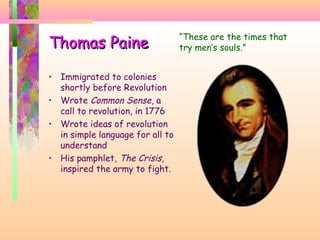
Thomas PaineThomas Paine
• Immigrated to colonies
shortly before Revolution
• Wrote Common Sense, a
call to revolution, in 1776
• Wrote ideas of revolution
in simple language for all to
understand
• His pamphlet, The Crisis,
inspired the army to fight.
“These are the times that
try men’s souls.”
QUICK CHECK #2!
Thomas Paine’s pamphlet,
The Crisis, served what
purpose?
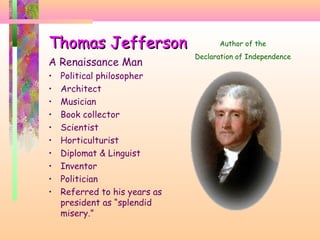
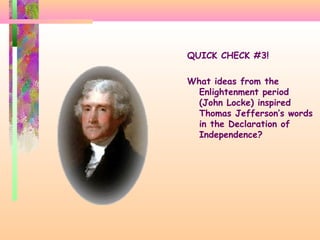
Thomas JeffersonThomas Jefferson
A Renaissance Man
• Political philosopher
• Architect
• Musician
• Book collector
• Scientist
• Horticulturist
• Diplomat & Linguist
• Inventor
• Politician
• Referred to his years as
president as “splendid
misery.”
Author of the
Declaration of Independence
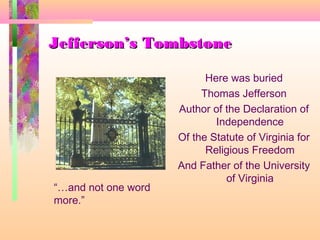
Jefferson’s TombstoneJefferson’s Tombstone
Here was buried
Thomas Jefferson
Author of the Declaration of
Independence
Of the Statute of Virginia for
Religious Freedom
And Father of the University
of Virginia
“…and not one word
more.”
QUICK CHECK #3!
What ideas from the
Enlightenment period
(John Locke) inspired
Thomas Jefferson’s words
in the Declaration of
Independence?
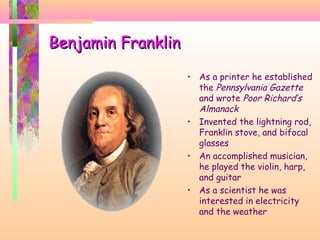
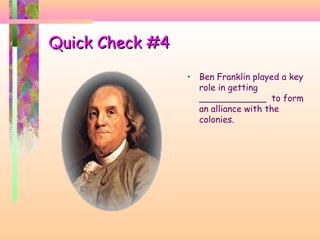
Benjamin FranklinBenjamin Franklin
• As a printer he established
the Pennsylvania Gazette
and wrote Poor Richard’s
Almanack
• Invented the lightning rod,
Franklin stove, and bifocal
glasses
• An accomplished musician,
he played the violin, harp,
and guitar
• As a scientist he was
interested in electricity
and the weather
…continued
• Franklin was essential to
the French forming an
alliance with the American
colonists in the Revolution.
• As a statesman and
diplomat he signed all four
important documents of
the Revolutionary era:
– Declaration of Independence
– Alliance with France
– Treaty of Paris
– US Constitution
Quick Check #4Quick Check #4
• Ben Franklin played a key
role in getting
____________ to form
an alliance with the
colonies.
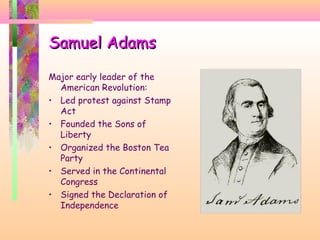
Samuel AdamsSamuel Adams
Major early leader of the
American Revolution:
• Led protest against Stamp
Act
• Founded the Sons of
Liberty
• Organized the Boston Tea
Party
• Served in the Continental
Congress
• Signed the Declaration of
Independence
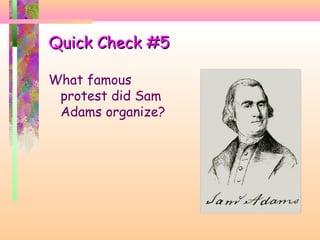
Quick Check #5Quick Check #5
What famous
protest did Sam
Adams organize?
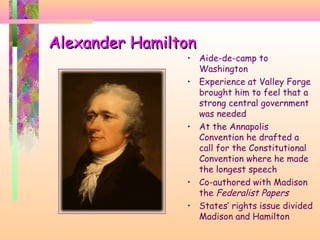
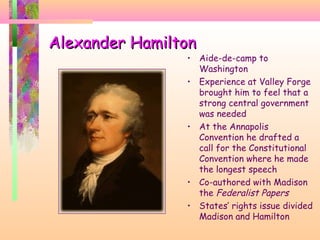
Alexander HamiltonAlexander Hamilton
• Aide-de-camp to
Washington
• Experience at Valley Forge
brought him to feel that a
strong central government
was needed
• At the Annapolis
Convention he drafted a
call for the Constitutional
Convention where he made
the longest speech
• Co-authored with Madison
the Federalist Papers
• States’ rights issue divided
Madison and Hamilton
…continued
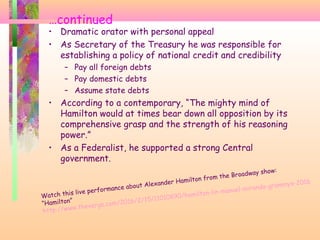
• Dramatic orator with personal appeal
• As Secretary of the Treasury he was responsible for
establishing a policy of national credit and credibility
– Pay all foreign debts
– Pay domestic debts
– Assume state debts
• According to a contemporary, “The mighty mind of
Hamilton would at times bear down all opposition by its
comprehensive grasp and the strength of his reasoning
power.”
• As a Federalist, he supported a strong Central
government.
Watch this live performance about Alexander Hamilton from the Broadway show:
“Hamilton”
http://www.theverge.com/2016/2/15/11010890/hamilton-lin-manuel-miranda-grammys-2016
Alexander HamiltonAlexander Hamilton
• Aide-de-camp to
Washington
• Experience at Valley Forge
brought him to feel that a
strong central government
was needed
• At the Annapolis
Convention he drafted a
call for the Constitutional
Convention where he made
the longest speech
• Co-authored with Madison
the Federalist Papers
• States’ rights issue divided
Madison and Hamilton
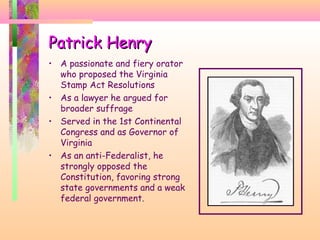
Patrick HenryPatrick Henry
• A passionate and fiery orator
who proposed the Virginia
Stamp Act Resolutions
• As a lawyer he argued for
broader suffrage
• Served in the 1st Continental
Congress and as Governor of
Virginia
• As an anti-Federalist, he
strongly opposed the
Constitution, favoring strong
state governments and a weak
federal government.
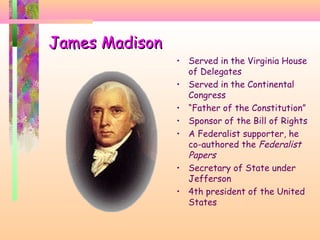
James MadisonJames Madison
• Served in the Virginia House
of Delegates
• Served in the Continental
Congress
• “Father of the Constitution”
• Sponsor of the Bill of Rights
• A Federalist supporter, he
co-authored the Federalist
Papers
• Secretary of State under
Jefferson
• 4th president of the United
States
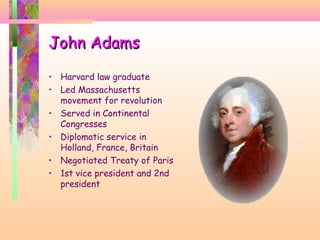
John AdamsJohn Adams
• Harvard law graduate
• Led Massachusetts
movement for revolution
• Served in Continental
Congresses
• Diplomatic service in
Holland, France, Britain
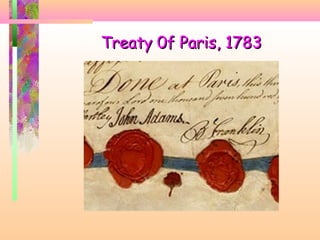
• Negotiated Treaty of Paris
• 1st vice president and 2nd
president
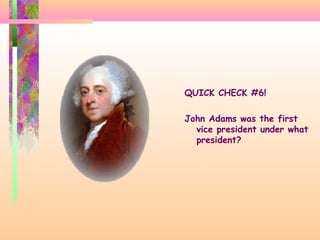
QUICK CHECK #6!
John Adams was the first
vice president under what
president?
Treaty 0f Paris, 1783Treaty 0f Paris, 1783
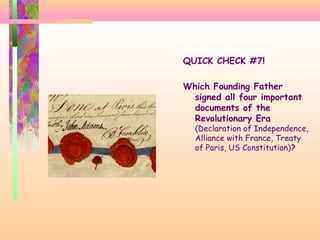
QUICK CHECK #7!
Which Founding Father
signed all four important
documents of the
Revolutionary Era
(Declaration of Independence,
Alliance with France, Treaty
of Paris, US Constitution)?
NOW THAT YOU’VE FINISHED THE
PRESENTATION…
You should have a paper titled, “The Founding Fathers”.
On that paper, the learning target should be written,
followed by 7 Quick Check questions and answers.
KEEP THIS PAPER
Now, go to join.quizizz.com and enter gamepin 435039.
Write down the score you got on the quiz on your
paper.
YOU’RE DONE!!
Turn in your paper with the Learning
Target, Quick Check questions,
and your Quizizz score to receive
points.

Founding Fathers

  • 1.
    Get a sheetof paper and title it, “The Founding Fathers” Write down the Learning Target for the day: “I can recognize the contributions of the Founding Fathers during the American Revolution.” On the same paper, you will copy the Quick Check questions and write your answer. YOU DO NOT NEED TO TAKE NOTES ON THE SLIDES.
  • 2.
  • 3.
    George WashingtonGeorge Washington LeadershipQualities • Tall, commanding presence • Symbol of American virtue • Charismatic warrior and politician • Abigail Adams said, “He has the dignity which forbids familiarity mixed with an easy affability which creates love and reverence.”
  • 4.
    GeorgeGeorge WashingtonWashington HeightHeight differencesdifferences The average manwas 5’6”The average man was 5’6” (Mrs. Bermudez’s height with(Mrs. Bermudez’s height with 3 inch heels).3 inch heels). George Washington was 6’4”George Washington was 6’4” (Cpl. Brantley’s height).(Cpl. Brantley’s height). Think about this heightThink about this height difference. This is part of thedifference. This is part of the reason why Washington had areason why Washington had a commanding presence!commanding presence!
  • 5.
    ...continued Public Life • Landsurveyor • Early military experience • Virginia House of Burgesses • Delegate to the Continental Congress • Commander in chief of Continental Army • Presiding officer of the Constitutional Convention • First US president and “Father of His Country”
  • 6.
    QUICK CHECK #1! Wherewas George Washington born and raised?
  • 7.
    Thomas PaineThomas Paine •Immigrated to colonies shortly before Revolution • Wrote Common Sense, a call to revolution, in 1776 • Wrote ideas of revolution in simple language for all to understand • His pamphlet, The Crisis, inspired the army to fight. “These are the times that try men’s souls.”
  • 8.
    QUICK CHECK #2! ThomasPaine’s pamphlet, The Crisis, served what purpose?
  • 9.
    Thomas JeffersonThomas Jefferson ARenaissance Man • Political philosopher • Architect • Musician • Book collector • Scientist • Horticulturist • Diplomat & Linguist • Inventor • Politician • Referred to his years as president as “splendid misery.” Author of the Declaration of Independence
  • 10.
    Jefferson’s TombstoneJefferson’s Tombstone Herewas buried Thomas Jefferson Author of the Declaration of Independence Of the Statute of Virginia for Religious Freedom And Father of the University of Virginia “…and not one word more.”
  • 11.
    QUICK CHECK #3! Whatideas from the Enlightenment period (John Locke) inspired Thomas Jefferson’s words in the Declaration of Independence?
  • 12.
    Benjamin FranklinBenjamin Franklin •As a printer he established the Pennsylvania Gazette and wrote Poor Richard’s Almanack • Invented the lightning rod, Franklin stove, and bifocal glasses • An accomplished musician, he played the violin, harp, and guitar • As a scientist he was interested in electricity and the weather
  • 13.
    …continued • Franklin wasessential to the French forming an alliance with the American colonists in the Revolution. • As a statesman and diplomat he signed all four important documents of the Revolutionary era: – Declaration of Independence – Alliance with France – Treaty of Paris – US Constitution
  • 14.
    Quick Check #4QuickCheck #4 • Ben Franklin played a key role in getting ____________ to form an alliance with the colonies.
  • 15.
    Samuel AdamsSamuel Adams Majorearly leader of the American Revolution: • Led protest against Stamp Act • Founded the Sons of Liberty • Organized the Boston Tea Party • Served in the Continental Congress • Signed the Declaration of Independence
  • 16.
    Quick Check #5QuickCheck #5 What famous protest did Sam Adams organize?
  • 17.
    Alexander HamiltonAlexander Hamilton •Aide-de-camp to Washington • Experience at Valley Forge brought him to feel that a strong central government was needed • At the Annapolis Convention he drafted a call for the Constitutional Convention where he made the longest speech • Co-authored with Madison the Federalist Papers • States’ rights issue divided Madison and Hamilton
  • 18.
    …continued • Dramatic oratorwith personal appeal • As Secretary of the Treasury he was responsible for establishing a policy of national credit and credibility – Pay all foreign debts – Pay domestic debts – Assume state debts • According to a contemporary, “The mighty mind of Hamilton would at times bear down all opposition by its comprehensive grasp and the strength of his reasoning power.” • As a Federalist, he supported a strong Central government. Watch this live performance about Alexander Hamilton from the Broadway show: “Hamilton” http://www.theverge.com/2016/2/15/11010890/hamilton-lin-manuel-miranda-grammys-2016
  • 19.
    Alexander HamiltonAlexander Hamilton •Aide-de-camp to Washington • Experience at Valley Forge brought him to feel that a strong central government was needed • At the Annapolis Convention he drafted a call for the Constitutional Convention where he made the longest speech • Co-authored with Madison the Federalist Papers • States’ rights issue divided Madison and Hamilton
  • 20.
    Patrick HenryPatrick Henry •A passionate and fiery orator who proposed the Virginia Stamp Act Resolutions • As a lawyer he argued for broader suffrage • Served in the 1st Continental Congress and as Governor of Virginia • As an anti-Federalist, he strongly opposed the Constitution, favoring strong state governments and a weak federal government.
  • 21.
    James MadisonJames Madison •Served in the Virginia House of Delegates • Served in the Continental Congress • “Father of the Constitution” • Sponsor of the Bill of Rights • A Federalist supporter, he co-authored the Federalist Papers • Secretary of State under Jefferson • 4th president of the United States
  • 22.
    John AdamsJohn Adams •Harvard law graduate • Led Massachusetts movement for revolution • Served in Continental Congresses • Diplomatic service in Holland, France, Britain • Negotiated Treaty of Paris • 1st vice president and 2nd president
  • 23.
    QUICK CHECK #6! JohnAdams was the first vice president under what president?
  • 24.
    Treaty 0f Paris,1783Treaty 0f Paris, 1783
  • 25.
    QUICK CHECK #7! WhichFounding Father signed all four important documents of the Revolutionary Era (Declaration of Independence, Alliance with France, Treaty of Paris, US Constitution)?
  • 26.
    NOW THAT YOU’VEFINISHED THE PRESENTATION… You should have a paper titled, “The Founding Fathers”. On that paper, the learning target should be written, followed by 7 Quick Check questions and answers. KEEP THIS PAPER Now, go to join.quizizz.com and enter gamepin 435039. Write down the score you got on the quiz on your paper.
  • 27.
    YOU’RE DONE!! Turn inyour paper with the Learning Target, Quick Check questions, and your Quizizz score to receive points.

Editor's Notes

  • #2 This lesson studies important people in the revolutionary period of American history. There are three main categories of revolutionaries; those who agitated for revolution, those who fought for revolution, and those who founded a new nation after victory. Many of these founders can be placed in more than one category. Some in only one. Ask students think about each category as they review the information about the founding fathers.
  • #3 This lesson studies important people in the revolutionary period of American history. There are three main categories of revolutionaries; those who agitated for revolution, those who fought for revolution, and those who founded a new nation after victory. Many of these founders can be placed in more than one category. Some in only one. Ask students think about each category as they review the information about the founding fathers.
  • #4 One of the objectives of this lesson on Founding Fathers is to look at the qualities of different leaders of the revolution. This slide uses primary source material to briefly describe Washington’s character. Ask students to study the portrait and make inferences about the artist’s depiction of Washington’s character.
  • #5 One of the objectives of this lesson on Founding Fathers is to look at the qualities of different leaders of the revolution. This slide uses primary source material to briefly describe Washington’s character. Ask students to study the portrait and make inferences about the artist’s depiction of Washington’s character.
  • #6 Another objective of the lesson is to study the background of the individuals who led the independence movement. On this slide students may see paintings of Washington during different periods of his life. The earliest picture is the one in the red vest, painted when he was in the Virginia Militia serving on the frontier in the French and Indian War.
  • #7 Another objective of the lesson is to study the background of the individuals who led the independence movement. On this slide students may see paintings of Washington during different periods of his life. The earliest picture is the one in the red vest, painted when he was in the Virginia Militia serving on the frontier in the French and Indian War.
  • #8 One of the earliest colonials to protest British policies, Paine wrote a pamphlet, Common Sense, calling colonists to revolt. It inspired many Americans to support revolution. Paine joined the army but soon quit. He was neither a part of the revolution itself nor of the settlement afterwards.
  • #9 Another objective of the lesson is to study the background of the individuals who led the independence movement. On this slide students may see paintings of Washington during different periods of his life. The earliest picture is the one in the red vest, painted when he was in the Virginia Militia serving on the frontier in the French and Indian War.
  • #10 Information on this slide can be compared with information about Washington. Both were Virginians who owned plantations and slaves. However, Washington was from the Tidewater and Jefferson from the Piedmont . The lands of Tidewater Virginia were flat and fertile and productive. The Piedmont was less fertile and hilly. Therefore, Tidewater planters tended to be wealthier than those in the Piedmont. As a political philosopher and writer, Jefferson was asked to write a declaration of independence. In it he set forth new ideas based on the philosophy of John Locke. Those ideas stressed that all people were born with natural rights to life, liberty, and property. Jefferson returned to home and served as Governor of Virginia during the Revolution. As governor, he was not actively engaged in the fight for independence. After the war he spent several years in Paris as US envoy to France.
  • #11 Jefferson wrote his own tombstone inscription. He added “and not one word more.” Ask students to look back at Jefferson’s accomplishments and list those he omitted.
  • #12 Another objective of the lesson is to study the background of the individuals who led the independence movement. On this slide students may see paintings of Washington during different periods of his life. The earliest picture is the one in the red vest, painted when he was in the Virginia Militia serving on the frontier in the French and Indian War.
  • #13 Students may compare the talents of Franklin and Jefferson. Both were writers, inventors, muscians, diplomats, and scientists.
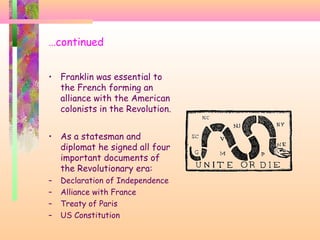
  • #14 The inset picture is from his newspaper and visually show what would happen if the colonies did not unite in their revolt against the British. Franklin signed the Declaration of Independence and negotiated the Treaty of Paris in 1783. He served as the US representative to France for several years and was a favorite of the French court and of the Parisian ladies. Franklin was the oldest delegate to the Constitutional Convention.
  • #15 Students may compare the talents of Franklin and Jefferson. Both were writers, inventors, muscians, diplomats, and scientists.
  • #16 Adams organized the early movement for revolution in Massachusetts. The Intolerable Acts were aimed specifically at the colony of Massachusetts and disrupted their economy as well as their colonial government. It was logical that the early movement for separation from the British Empire would begin there. After the early phase of the revolt in Massachusetts, Adams had no important role in the ongoing revolution and the settlement with the British.
  • #17 Adams organized the early movement for revolution in Massachusetts. The Intolerable Acts were aimed specifically at the colony of Massachusetts and disrupted their economy as well as their colonial government. It was logical that the early movement for separation from the British Empire would begin there. After the early phase of the revolt in Massachusetts, Adams had no important role in the ongoing revolution and the settlement with the British.
  • #18 Hamilton had key roles in the American Revolution, the Annapolis Convention, the Constitutional Convention, and served as the first Secretary of the Treasury. During the first years of the new nation he came to disagree with Jefferson on a number of issues; he was pro-British, Jefferson was pro-French; he was a “loose constructionist”, Jefferson was a “strict constructionist.” Aaron Burr, the Vice President of the US, killed Hamilton in a duel.
  • #19 Probably the greatest service Hamilton did for the new nation was to establish the credit of the United States by paying all debts, both domestic and foreign. The assumption of state debts strengthened the federal government. Hamilton believed that the US could not survive without a strong federal government.
  • #20 Hamilton had key roles in the American Revolution, the Annapolis Convention, the Constitutional Convention, and served as the first Secretary of the Treasury. During the first years of the new nation he came to disagree with Jefferson on a number of issues; he was pro-British, Jefferson was pro-French; he was a “loose constructionist”, Jefferson was a “strict constructionist.” Aaron Burr, the Vice President of the US, killed Hamilton in a duel.
  • #21 Henry was an early leader of the revolutionary movement in Virginia. He served in the 1st Continental Congress, but was not actively engaged in fighting for independence. In contrast to Hamilton, Henry favored a weak central government and states’ rights.
  • #22 Virginian Madison and New Yorker Hamilton wrote a series of essays called the Federalist Papers to explain the features of the new Constitution. Their explanations helped in the ratification process. Madison kept detailed notes of the Constitutional Convention, earning him the title of “Father of the Constitution” by historians.
  • #23 Adams, a lawyer from Massachusetts, led the movement for revolution in Boston. As a founding father, he negotiated the Treaty of Paris in 1783. In that treaty, Adams and other representatives of the US managed to get the British to cede all lands between the east coast and the Mississippi River to the new country. This agreement opened all the lands west of the Appalachains for settlement.
  • #24 Another objective of the lesson is to study the background of the individuals who led the independence movement. On this slide students may see paintings of Washington during different periods of his life. The earliest picture is the one in the red vest, painted when he was in the Virginia Militia serving on the frontier in the French and Indian War.
  • #25 This picture shows the representatives to the Treaty of Paris in 1783. Standing are the French and Spanish representatives. Seated are John Adams, Benjamin Franklin, and John Jay. The British sent a low-level diplomat who refused to have his picture painted with a bunch of ruffians. The artist shaded in the area where he would have been standing.
  • #26 Another objective of the lesson is to study the background of the individuals who led the independence movement. On this slide students may see paintings of Washington during different periods of his life. The earliest picture is the one in the red vest, painted when he was in the Virginia Militia serving on the frontier in the French and Indian War.
  • #27 Another objective of the lesson is to study the background of the individuals who led the independence movement. On this slide students may see paintings of Washington during different periods of his life. The earliest picture is the one in the red vest, painted when he was in the Virginia Militia serving on the frontier in the French and Indian War.
  • #28 Another objective of the lesson is to study the background of the individuals who led the independence movement. On this slide students may see paintings of Washington during different periods of his life. The earliest picture is the one in the red vest, painted when he was in the Virginia Militia serving on the frontier in the French and Indian War.