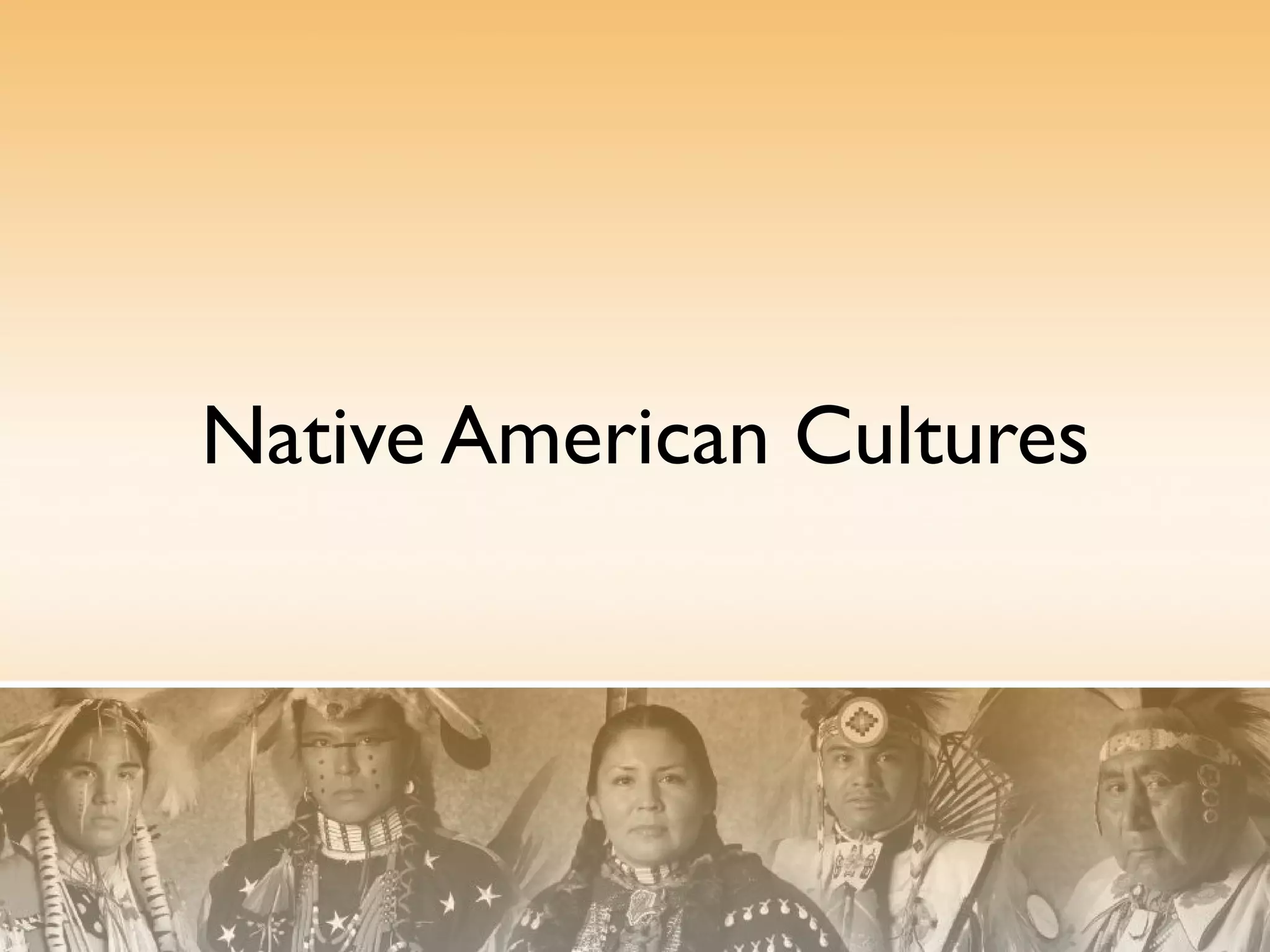
Native American Cultures
Why do we call them Native
Americans instead of Indians?
• Native American and American Natives are
synonyms.
• We use the term Native Americans instead of
Indians.
• When explorers from Europe came to North
America for the first time, they thought they were in
India, so they called the people there Indians.
• Because they were actually in the U.S., and not in
India we do not use the term Indians.
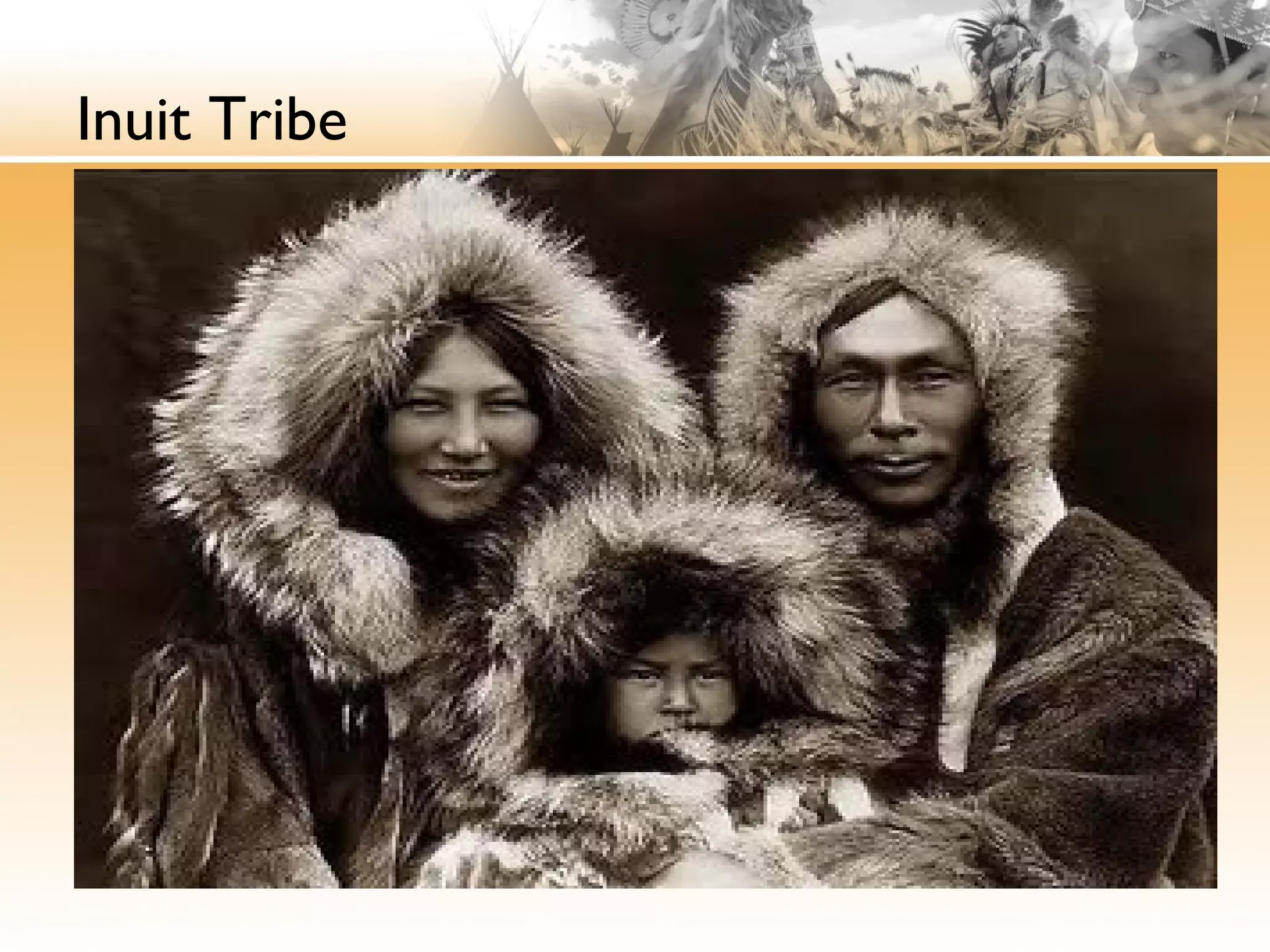
Inuit Tribe
Location
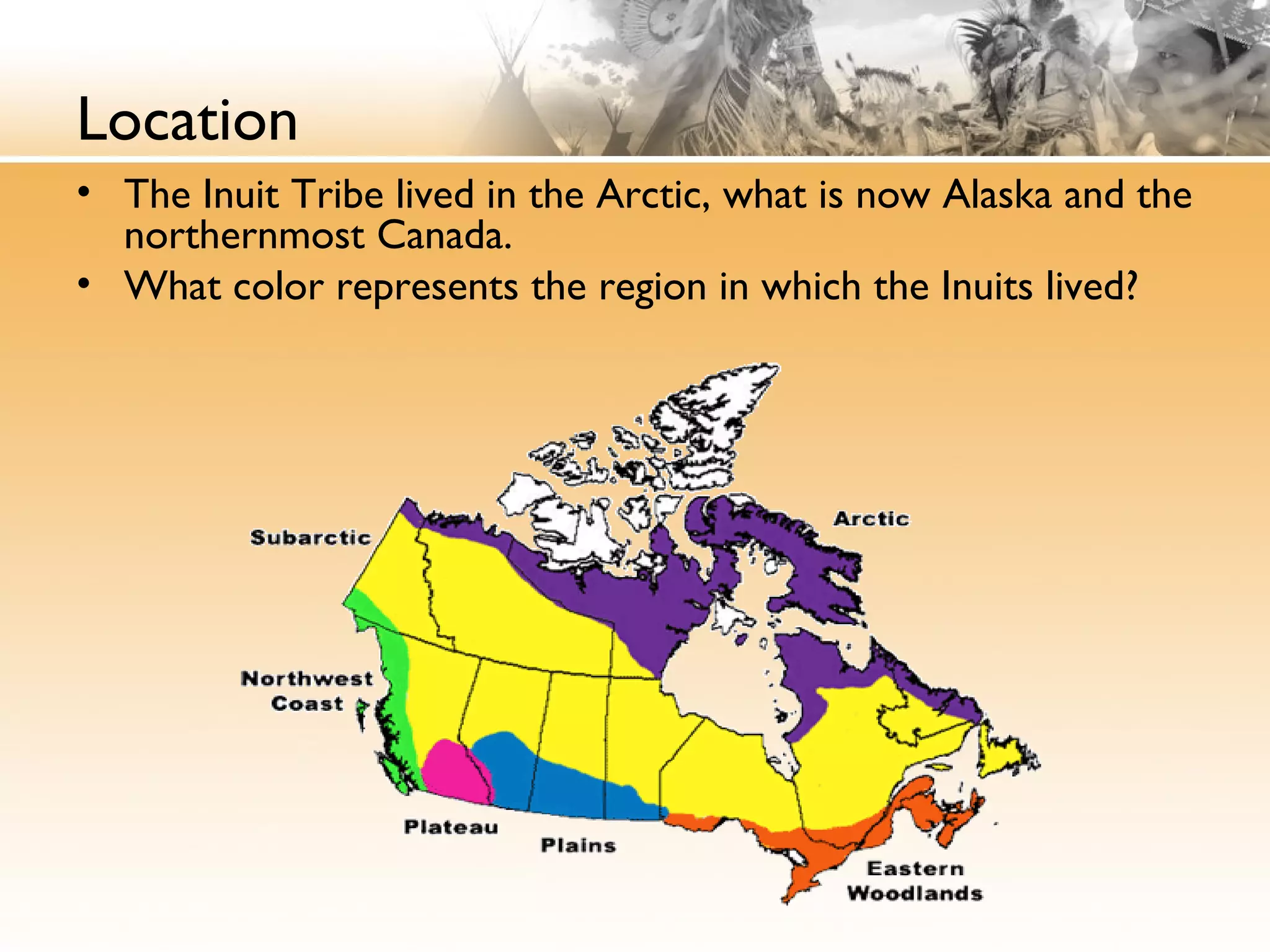
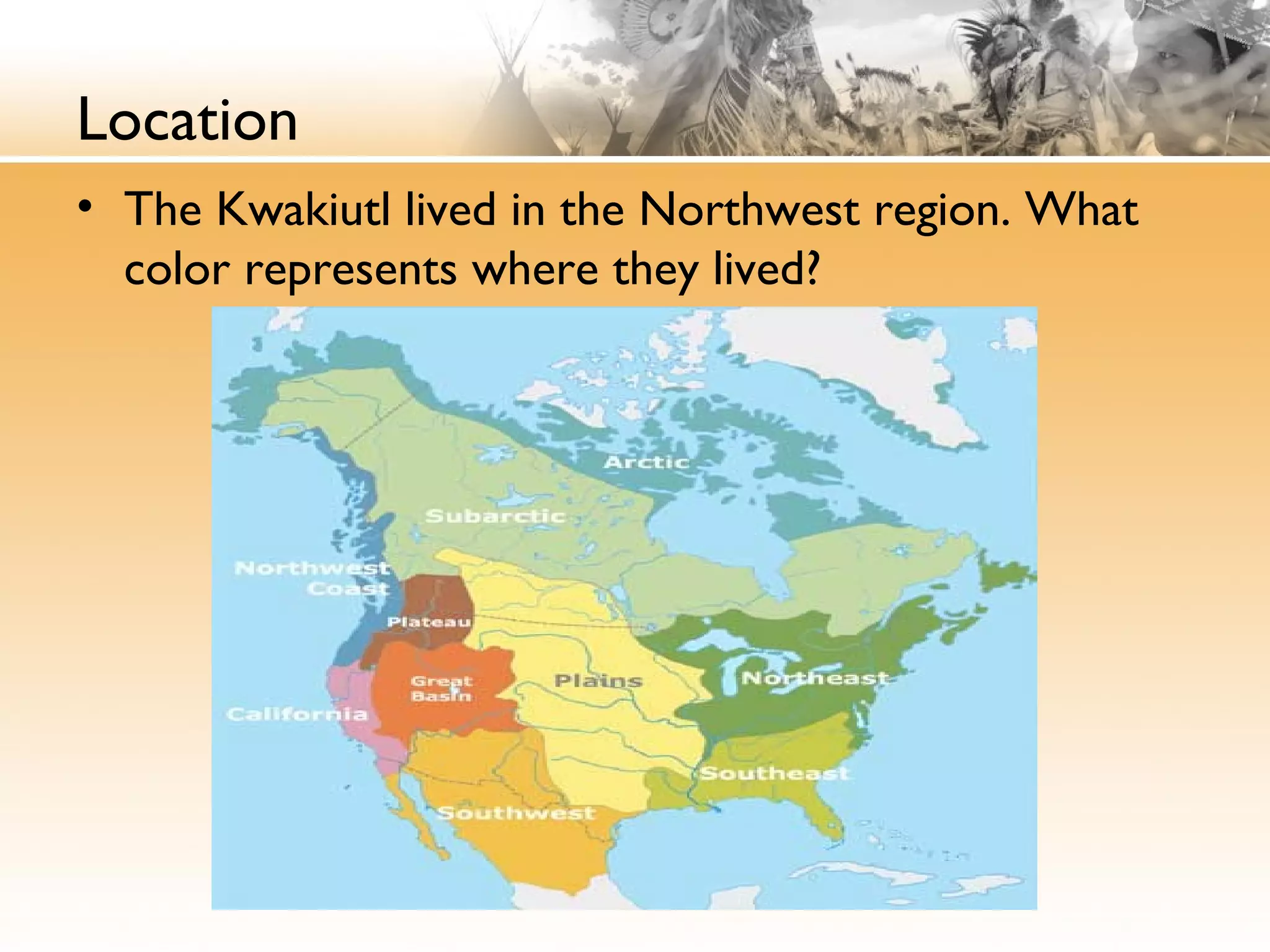
• The Inuit Tribe lived in the Arctic, what is now Alaska and the
northernmost Canada.
• What color represents the region in which the Inuits lived?
Way of Life
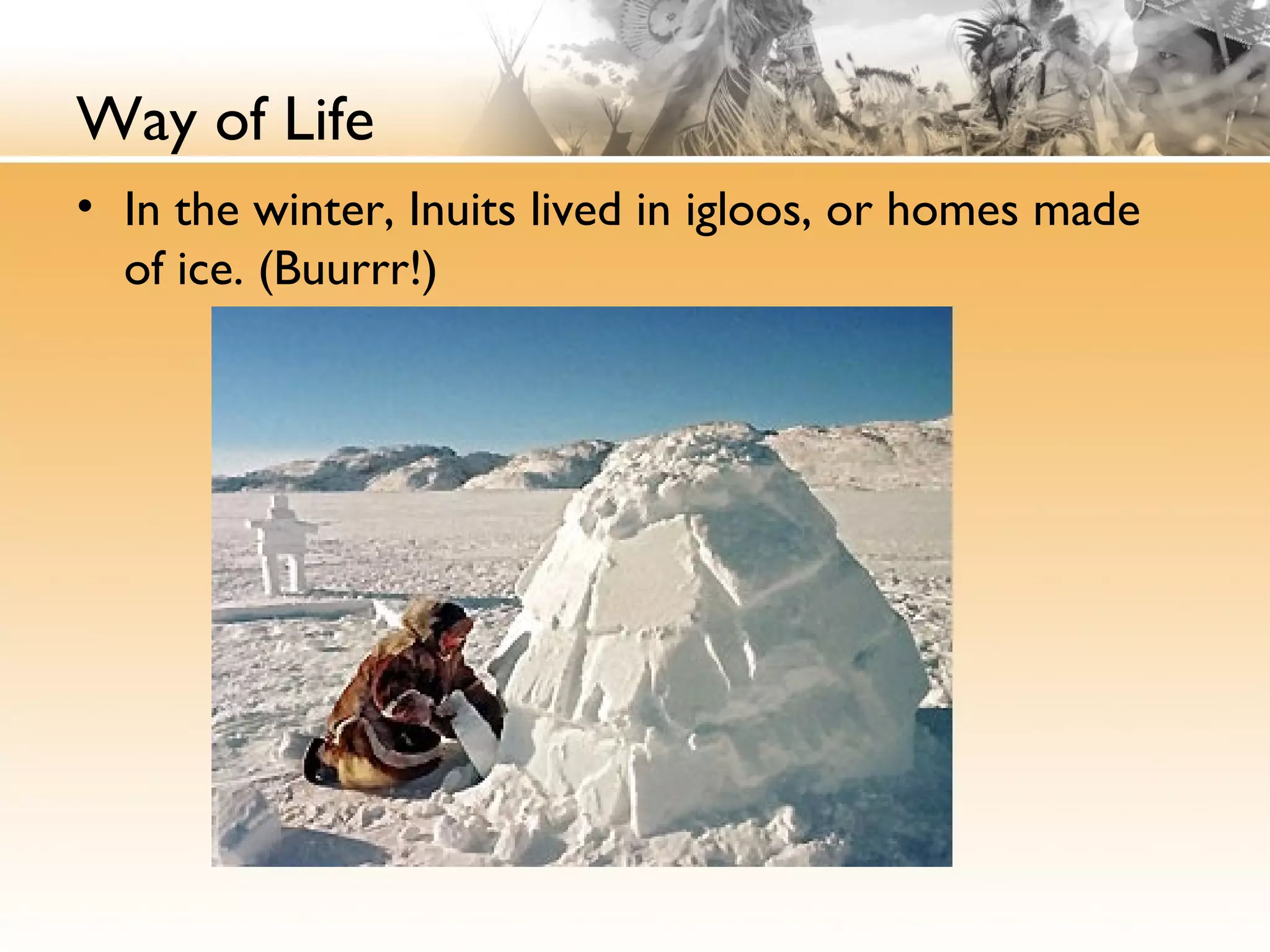
• In the winter, Inuits lived in igloos, or homes made
of ice. (Buurrr!)
Way of Life
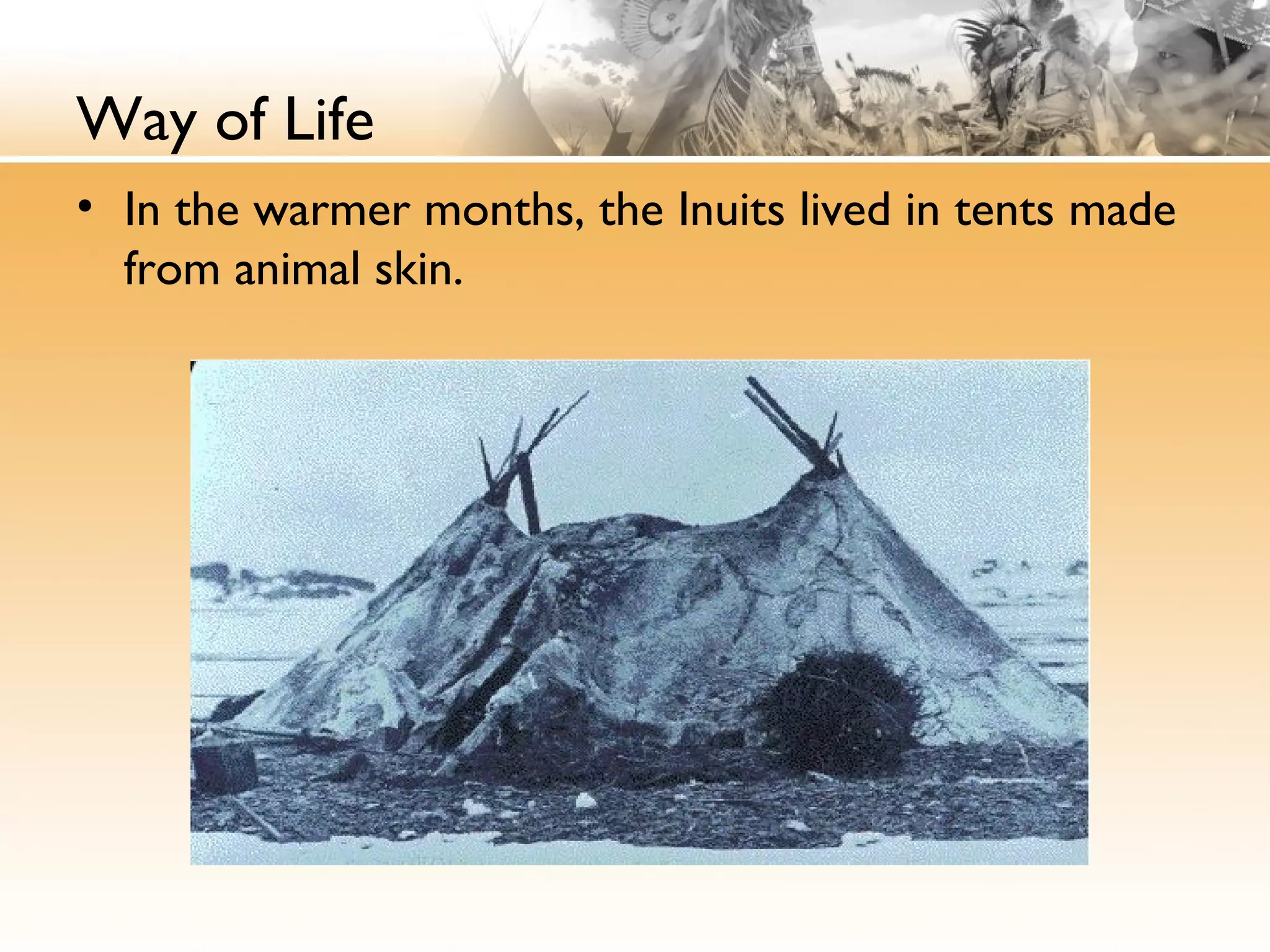
• In the warmer months, the Inuits lived in tents made
from animal skin.
Way of Life
“Foxes, caribou, and polar bears. Oh my!”
• Because it was extremely cold in the Arctic, few
plants could grow in this region.
• The Inuit hunted foxes, caribou, and polar bears.
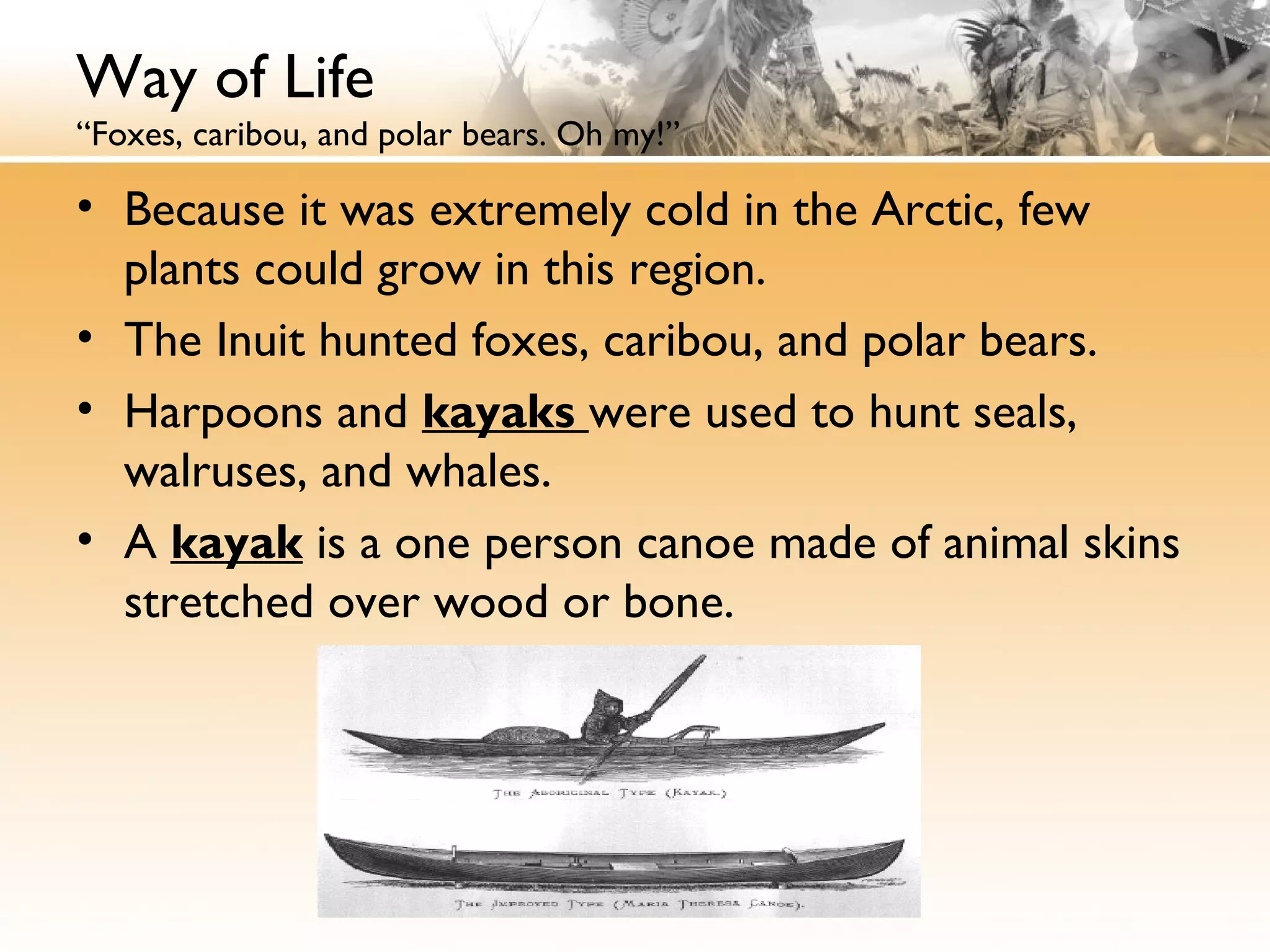
• Harpoons and kayaks were used to hunt seals,
walruses, and whales.
• A kayak is a one person canoe made of animal skins
stretched over wood or bone.
Way of Life
• Resources were
limited…they couldn’t
go to Target or Wal-
mart for things!
• Seals were caught for
their skins, to make
clothes and tents.
• Oil was used for light
and heat.
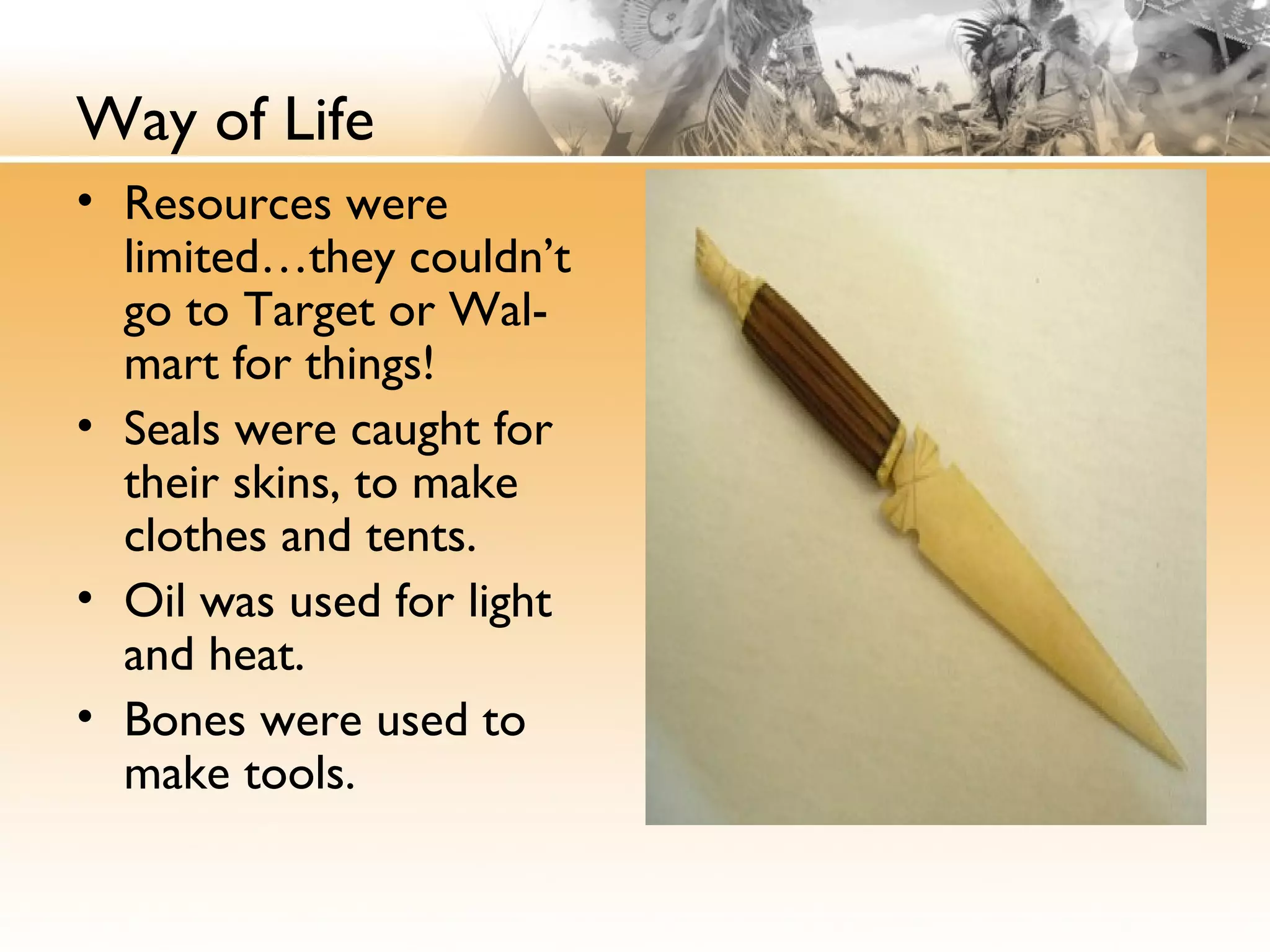
• Bones were used to
make tools.
Family
• Family was an important part of Inuit society.
• They lived in groups of 60 to 300 people, made up of
several families.
• The families made decisions, hunted, and traveled
together.
• Life was extremely difficult in the Arctic due to the
climate. Resources were limited, therefore, they had
to work together and share what they had in effort
to survive.
Q & A
• In what region did the Inuit live?
• What country and state can this region be found?
• What kind of homes did the Inuit build?
• What were their natural resources?
• What is a kayak?
• How did the climate of the Arctic affect the Inuit?
• Why do you think they had to share their food to
survive?
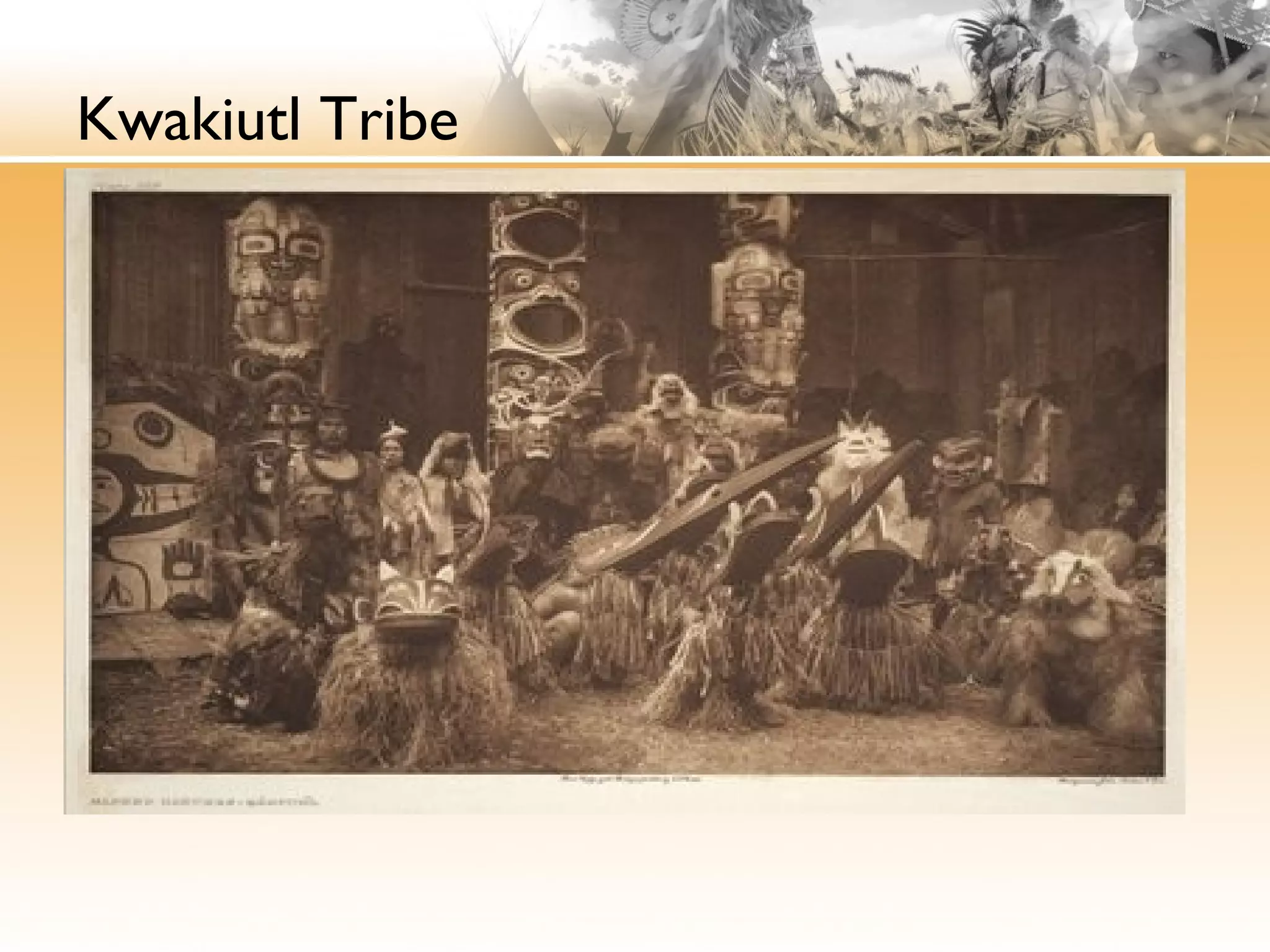
Kwakiutl Tribe
Location
• The Kwakiutl lived in the Northwest region. What
color represents where they lived?
Shelter
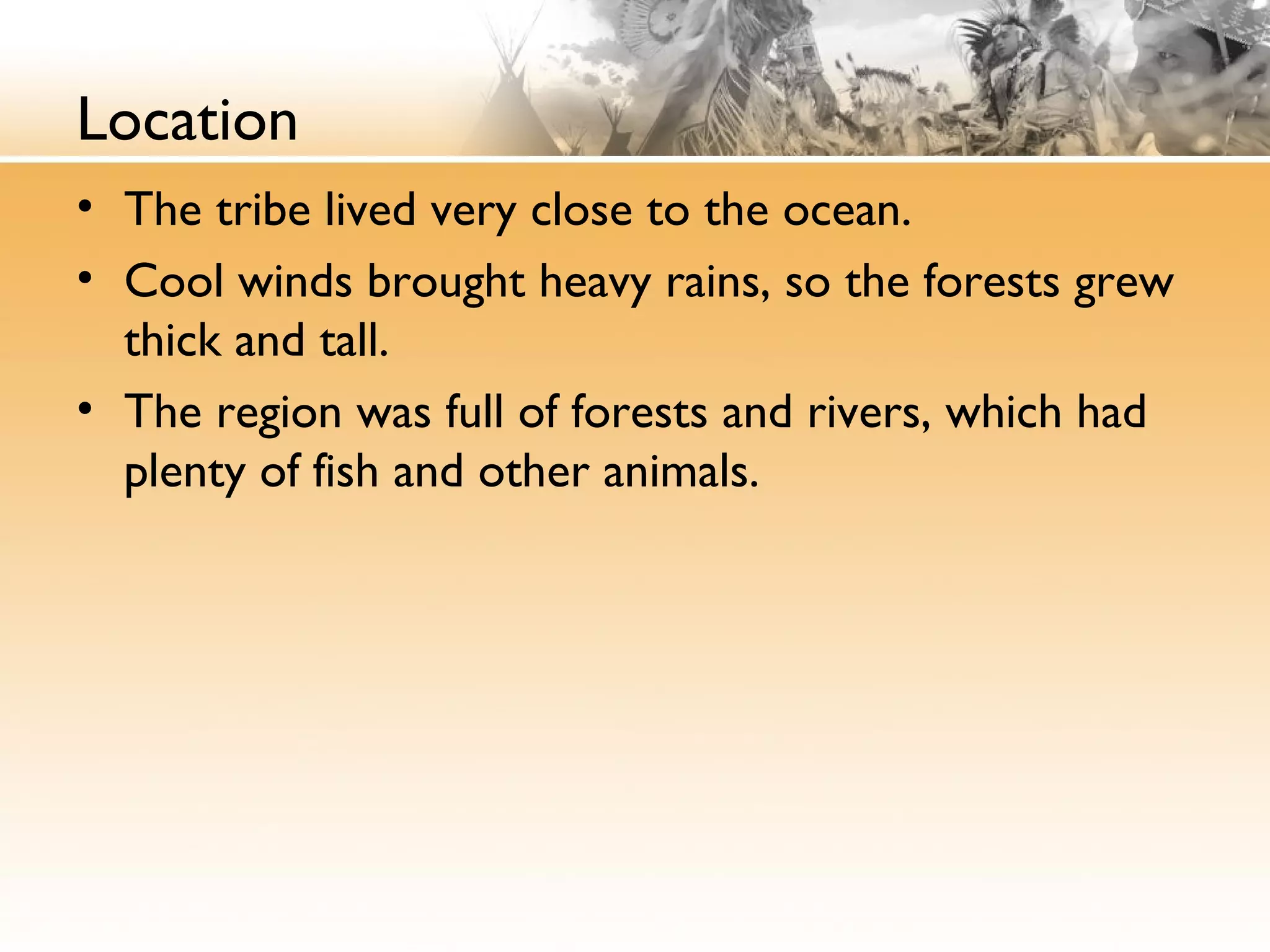
• The Kwakiutl lived in coastal villages of rectangular
cedar-plank houses with bark roofs. Usually these
houses were large (up to 100 feet long) and each
one housed several familes from the same clan (as
many as 50 people).
• The photo below shows the frame of a Kwakiutl
home.
Location
• The tribe lived very close to the ocean.
• Cool winds brought heavy rains, so the forests grew
thick and tall.
• The region was full of forests and rivers, which had
plenty of fish and other animals.
Way of Life
• Instead of farming, the Kwakiutl, met their needs by
fishing, hunting, and gathering plants and nuts.
• Salmon, a type of fish, was a common food eaten.
• Whales provided food and fat. The fat was melted
into oil to burn in lamps.
• Unlike neighboring tribes, the Kwakiutl did not hunt
whales, they only captured the whales that were
beached, or stranded on shore.
Q & A
• In what region did the Kwakiutl live?
• What was the climate like?
• How did the resources compare to that of the Inuit?
• Did this tribe hunt Whales? What did they use
whales for?
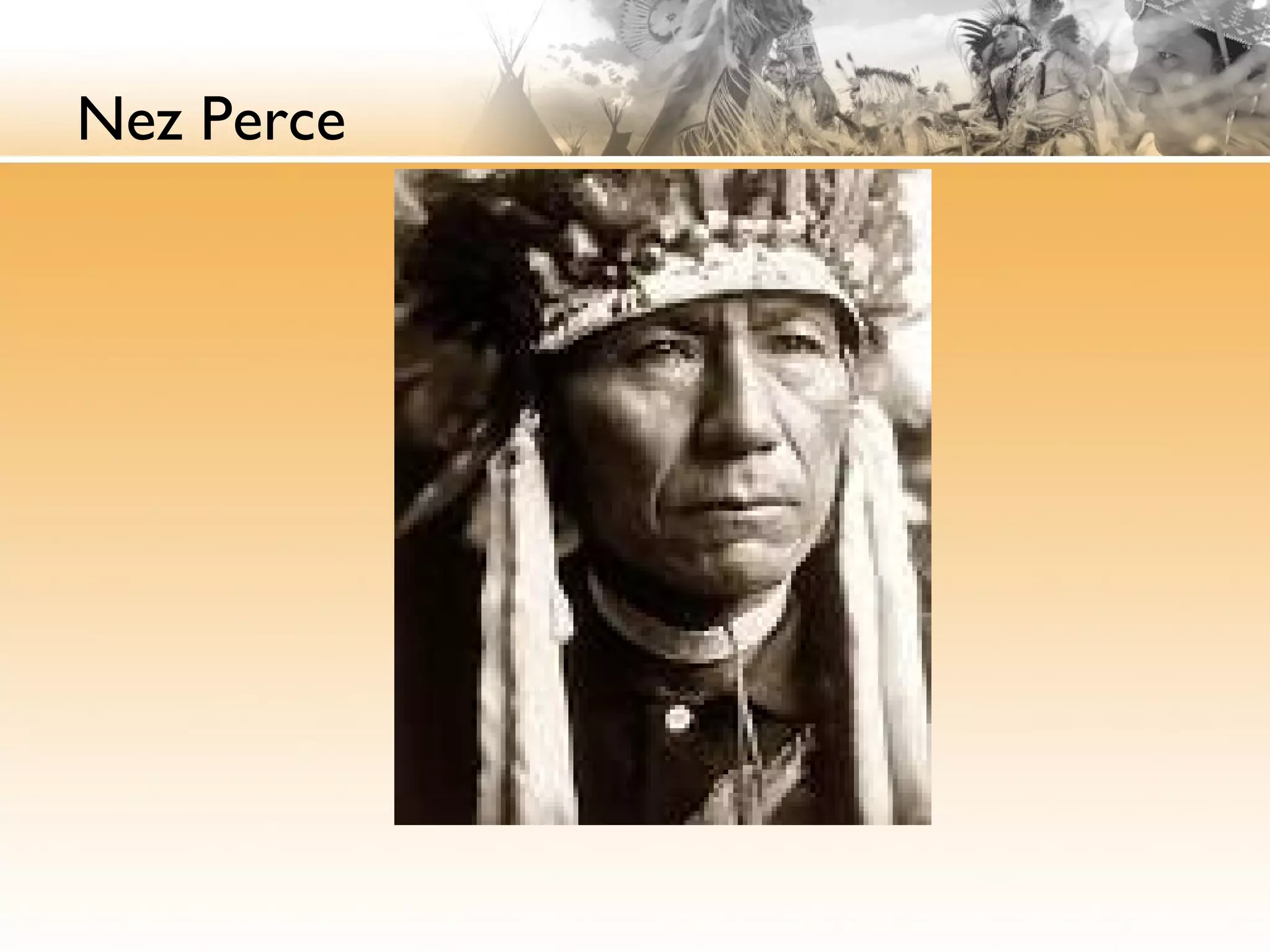
Nez Perce
Location
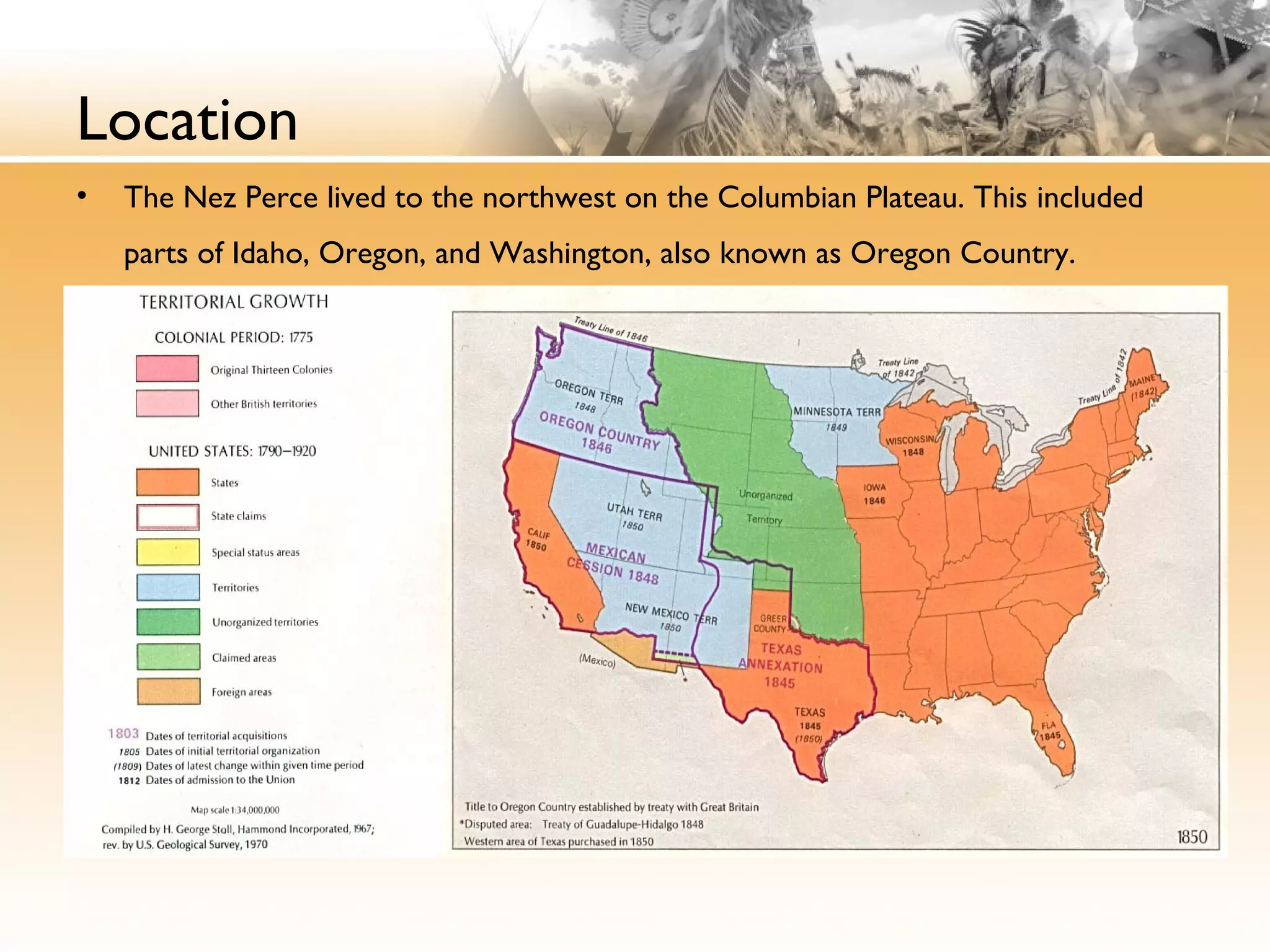
• The Nez Perce lived to the northwest on the Columbian Plateau. This included
parts of Idaho, Oregon, and Washington, also known as Oregon Country.
Climate and Resources
• The Nez Perce lived in an area with dry hills and
flatlands.
• Like the Kwakiutl, they caught a lot of salmon from
the rivers and streams that drained the high plateau.
• Long spears and nets were used to catch the fish.
Q & A
• Where did the Nez Perce reside or live?
• What is a plateau?
• What what was their major resource for food?
• What did they use to catch their food?
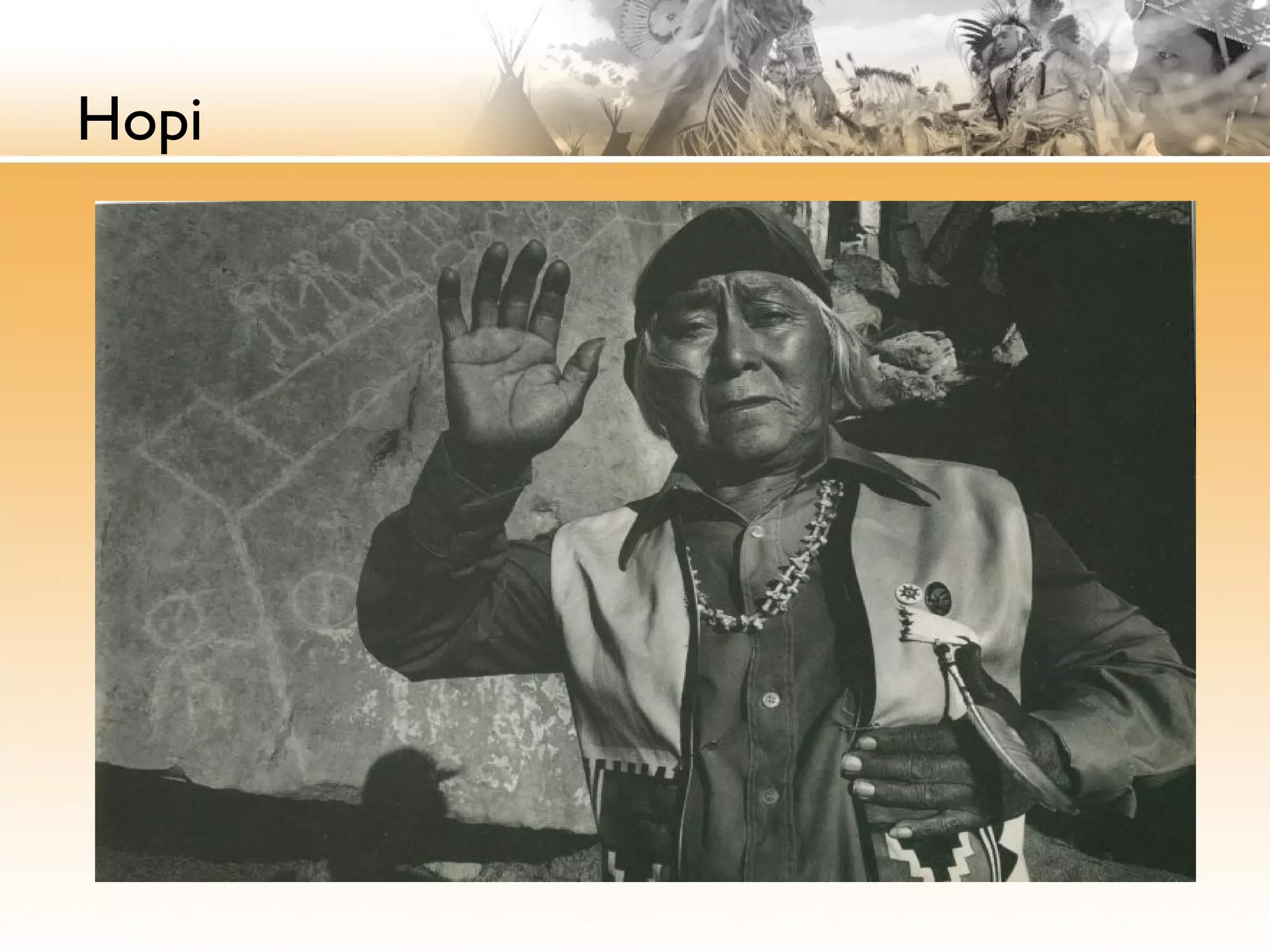
Hopi
Location
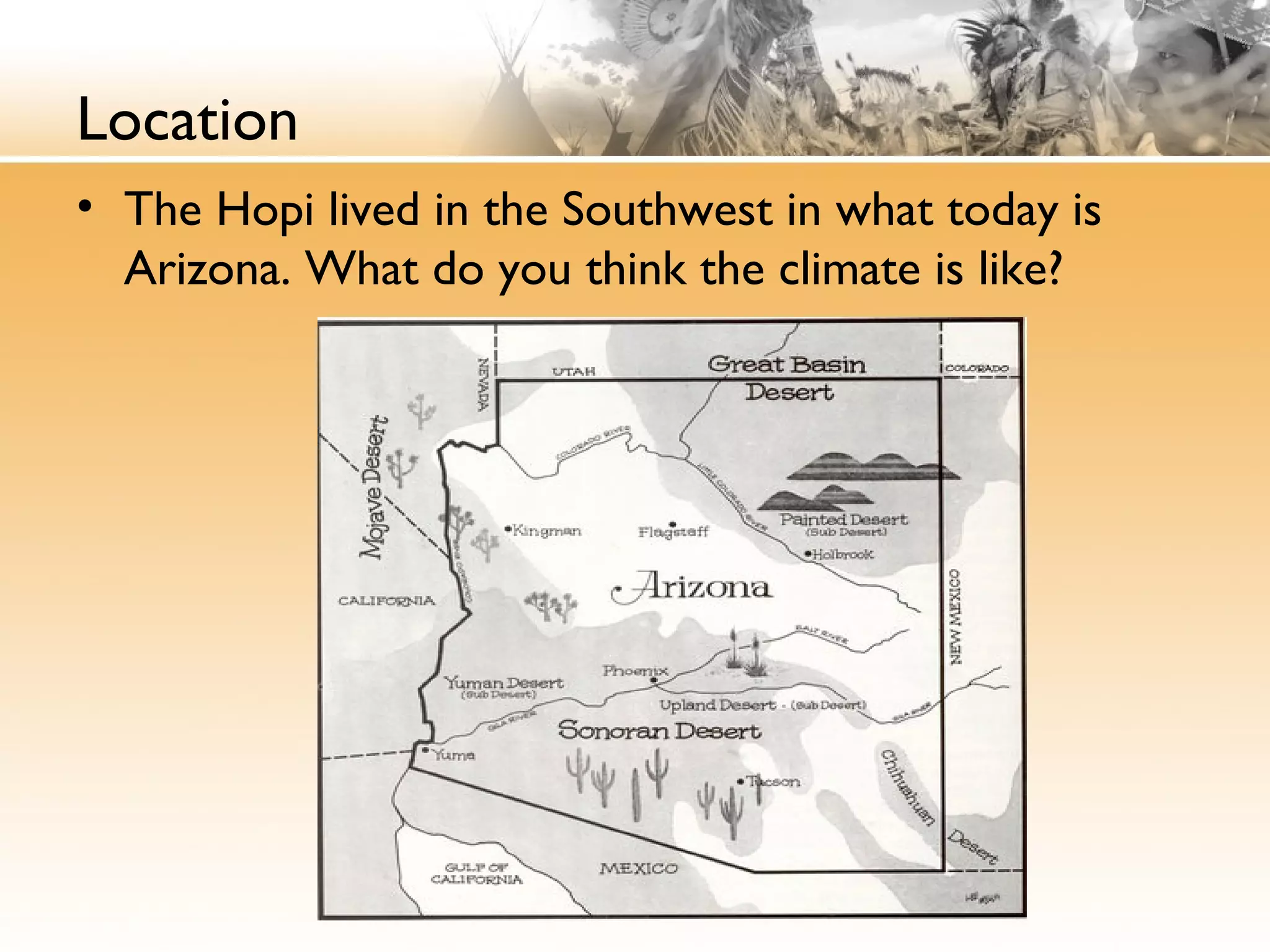
• The Hopi lived in the Southwest in what today is
Arizona. What do you think the climate is like?
Shelter
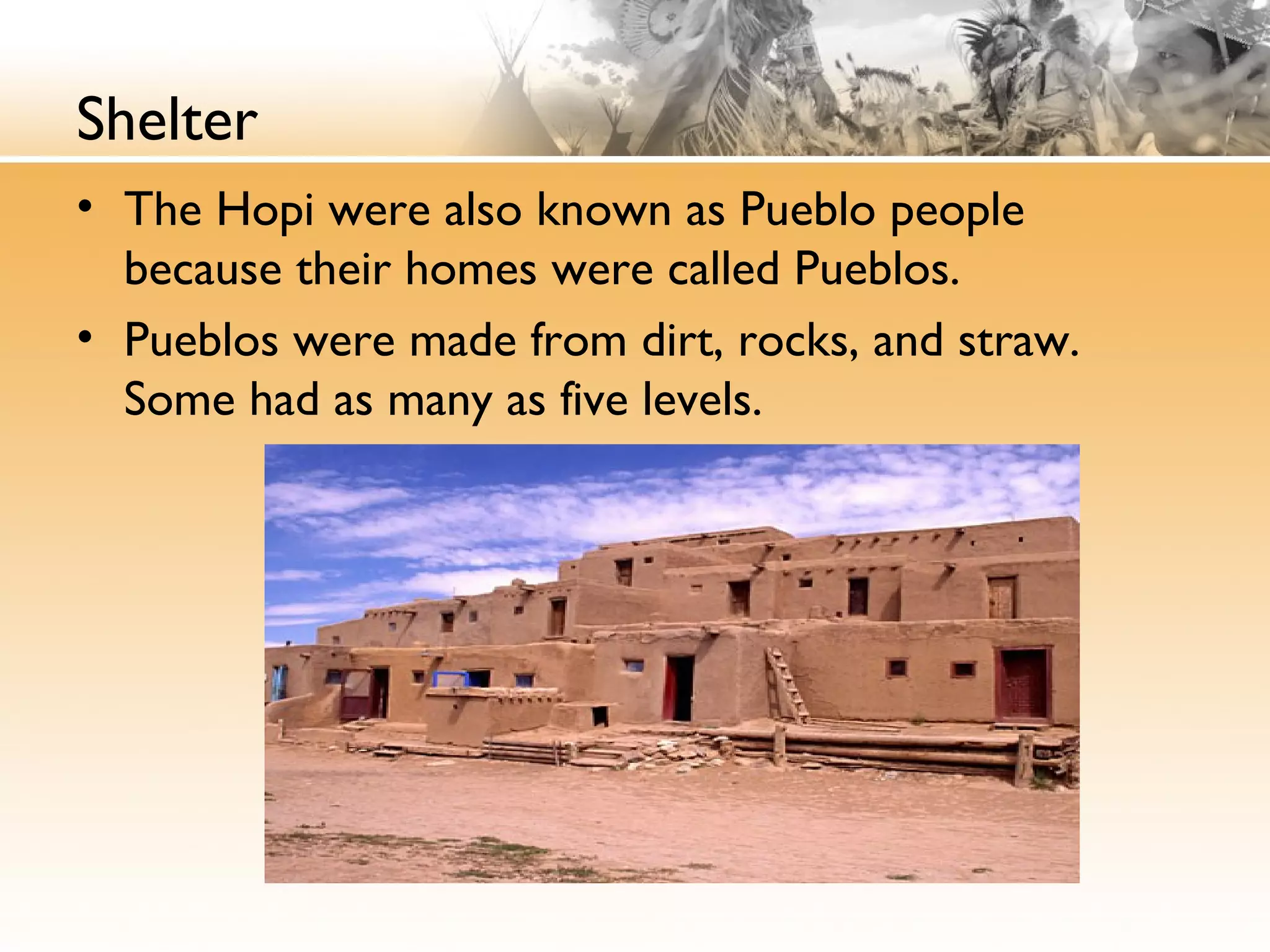
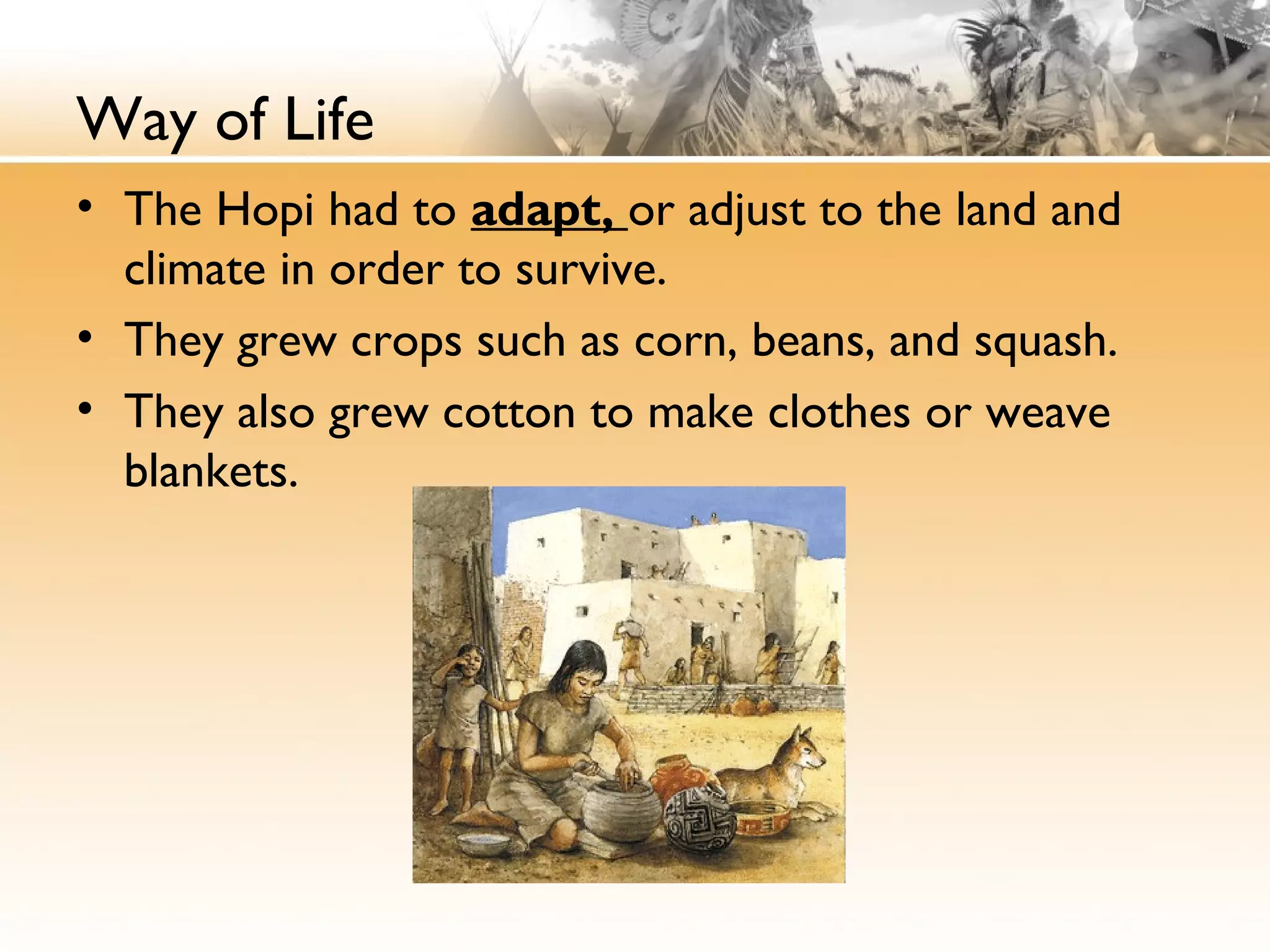
• The Hopi were also known as Pueblo people
because their homes were called Pueblos.
• Pueblos were made from dirt, rocks, and straw.
Some had as many as five levels.
Climate
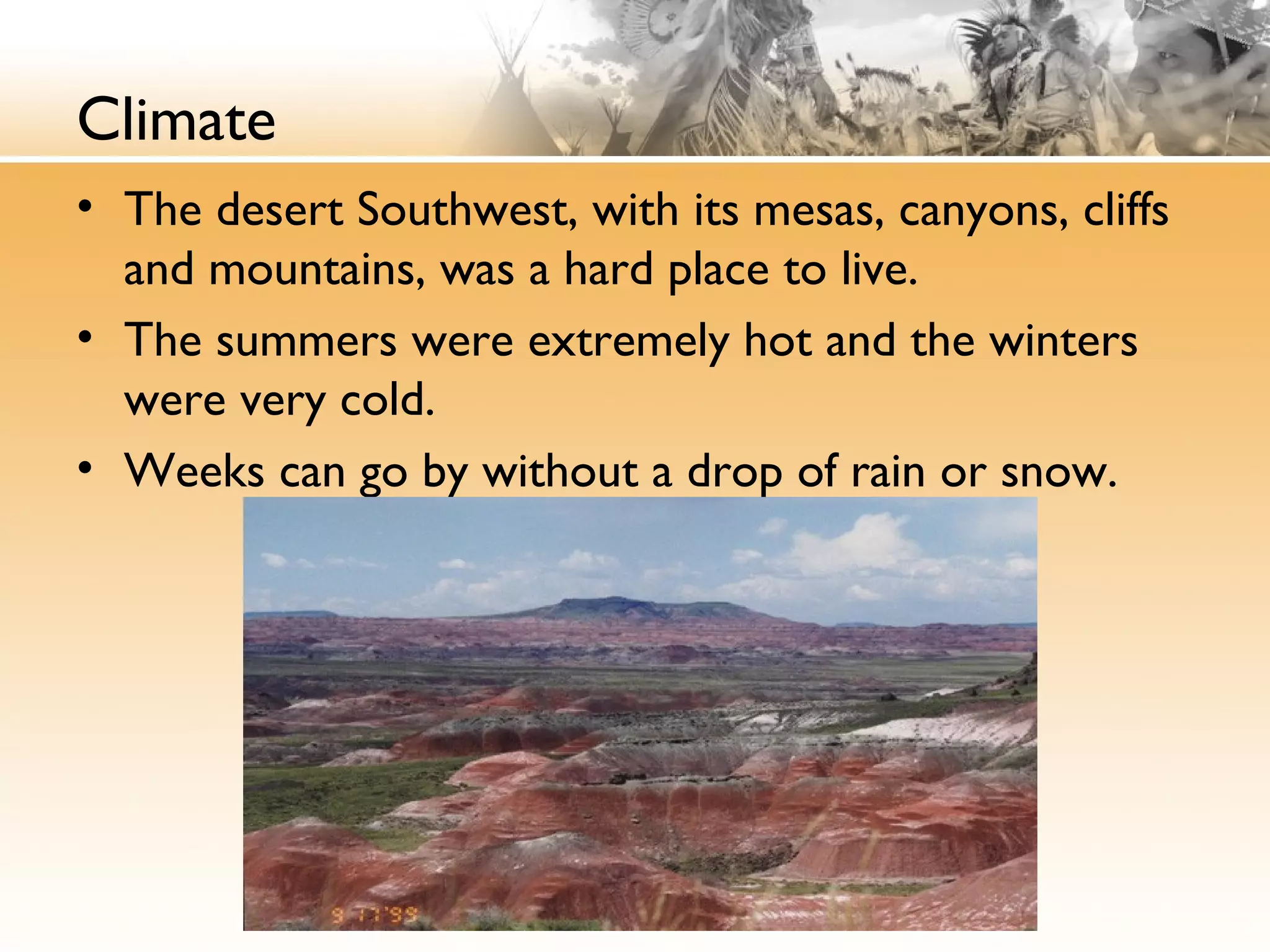
• The desert Southwest, with its mesas, canyons, cliffs
and mountains, was a hard place to live.
• The summers were extremely hot and the winters
were very cold.
• Weeks can go by without a drop of rain or snow.
Way of Life
• The Hopi had to adapt, or adjust to the land and
climate in order to survive.
• They grew crops such as corn, beans, and squash.
• They also grew cotton to make clothes or weave
blankets.
Q & A
• Where did the Hopi live? In what state and region?
• What was the climate like?
• What is a pueblo and how is one made?
• What kind of crops were the Hopi able to grow?
Pawnee
Location
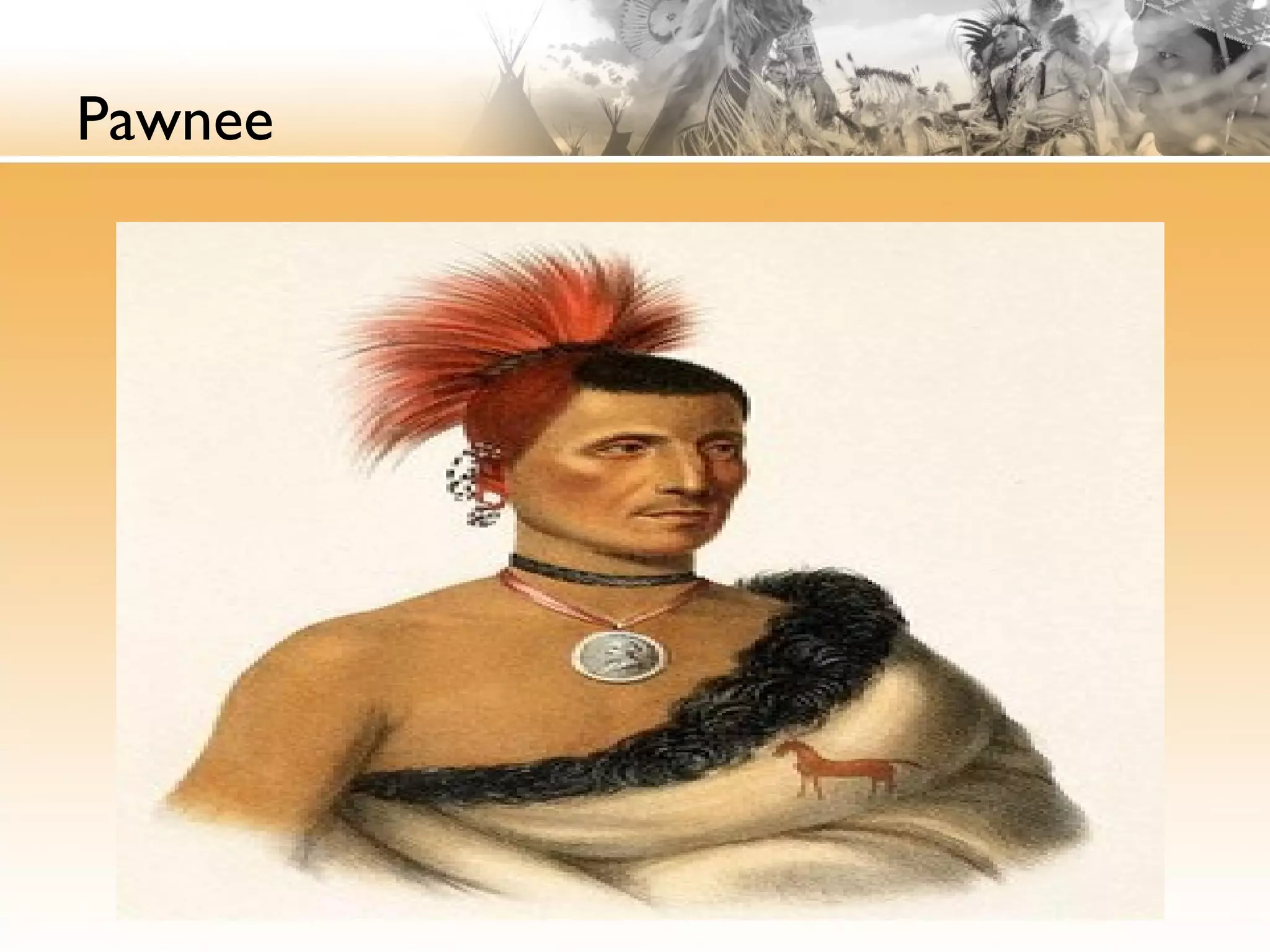
• The Pawnee Indians are original people of Nebraska
and Kansas.
• The Pawnee tribe was forced to move to a
reservation in Oklahoma during the 1800's, and most
Pawnee people are still living in Oklahoma today.
Pawnee Children
• Many Pawnee children like to go hunting and fishing
with their fathers.
• In the past, Pawnee kids had more chores and less
time to play in their daily lives.
• They did have dolls, toys, and games to play.
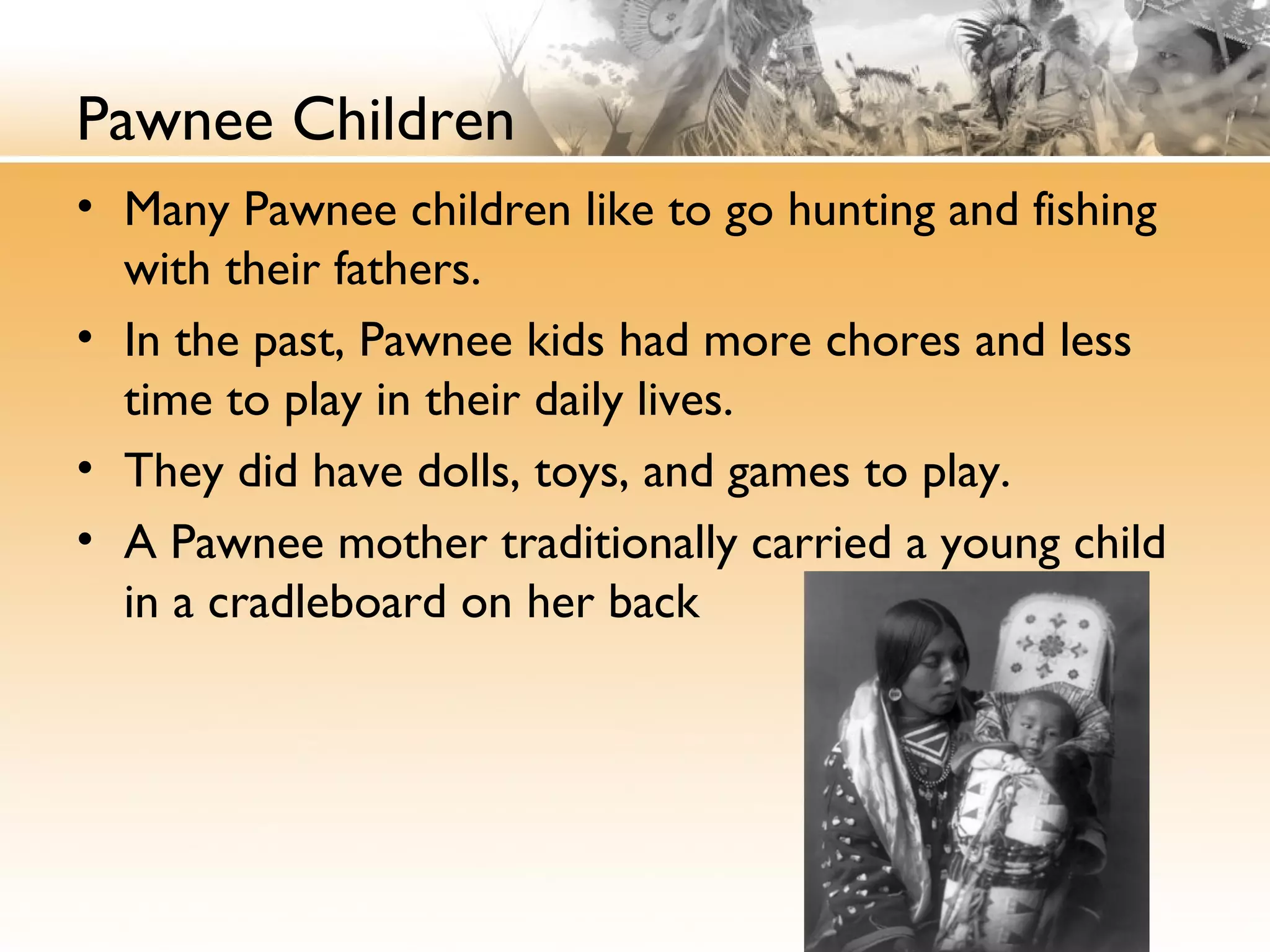
• A Pawnee mother traditionally carried a young child
in a cradleboard on her back
Way of Life
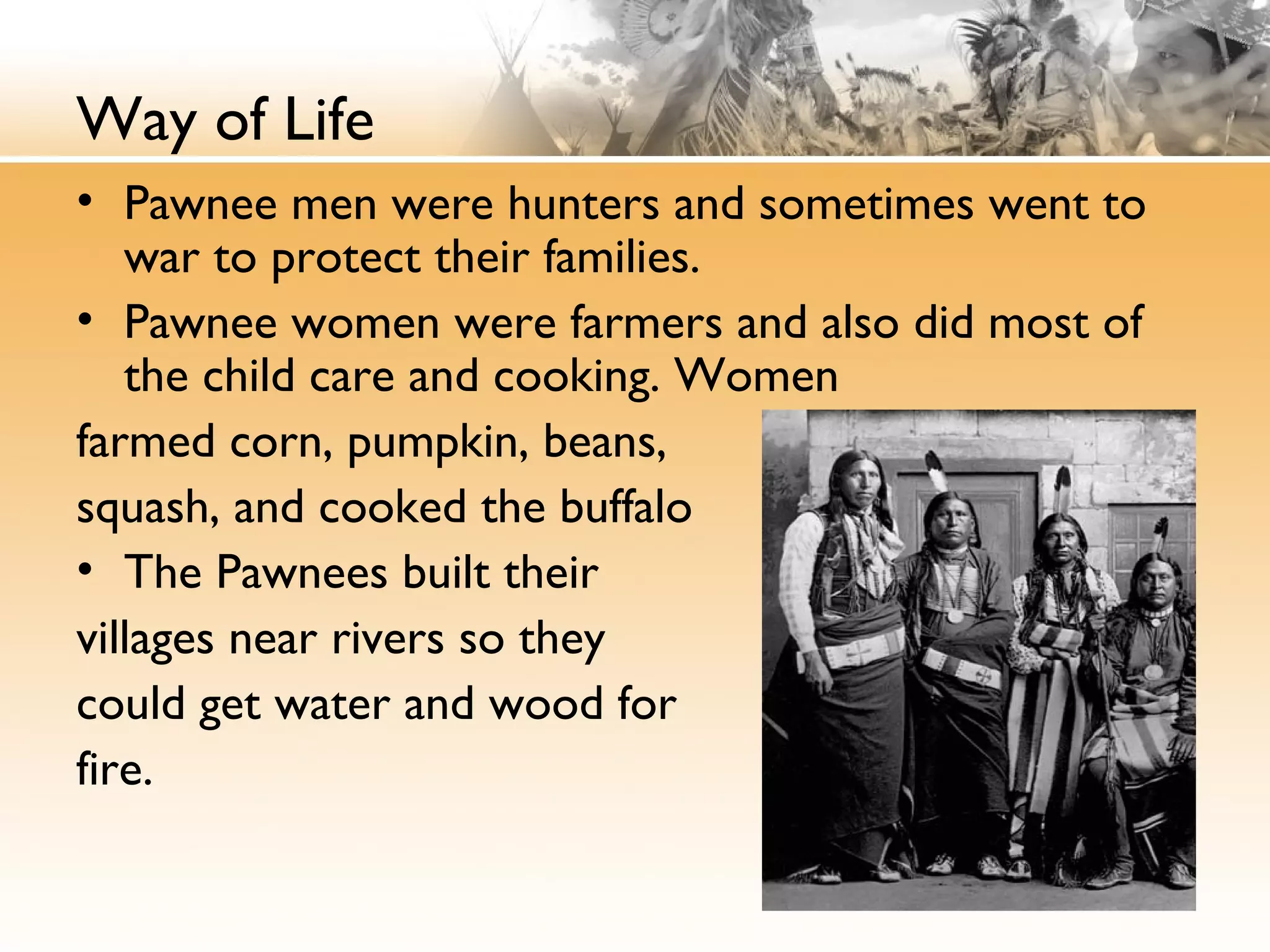
• Pawnee men were hunters and sometimes went to
war to protect their families.
• Pawnee women were farmers and also did most of
the child care and cooking. Women
farmed corn, pumpkin, beans,
squash, and cooked the buffalo
• The Pawnees built their
villages near rivers so they
could get water and wood for
fire. 
Way of Life- shelter
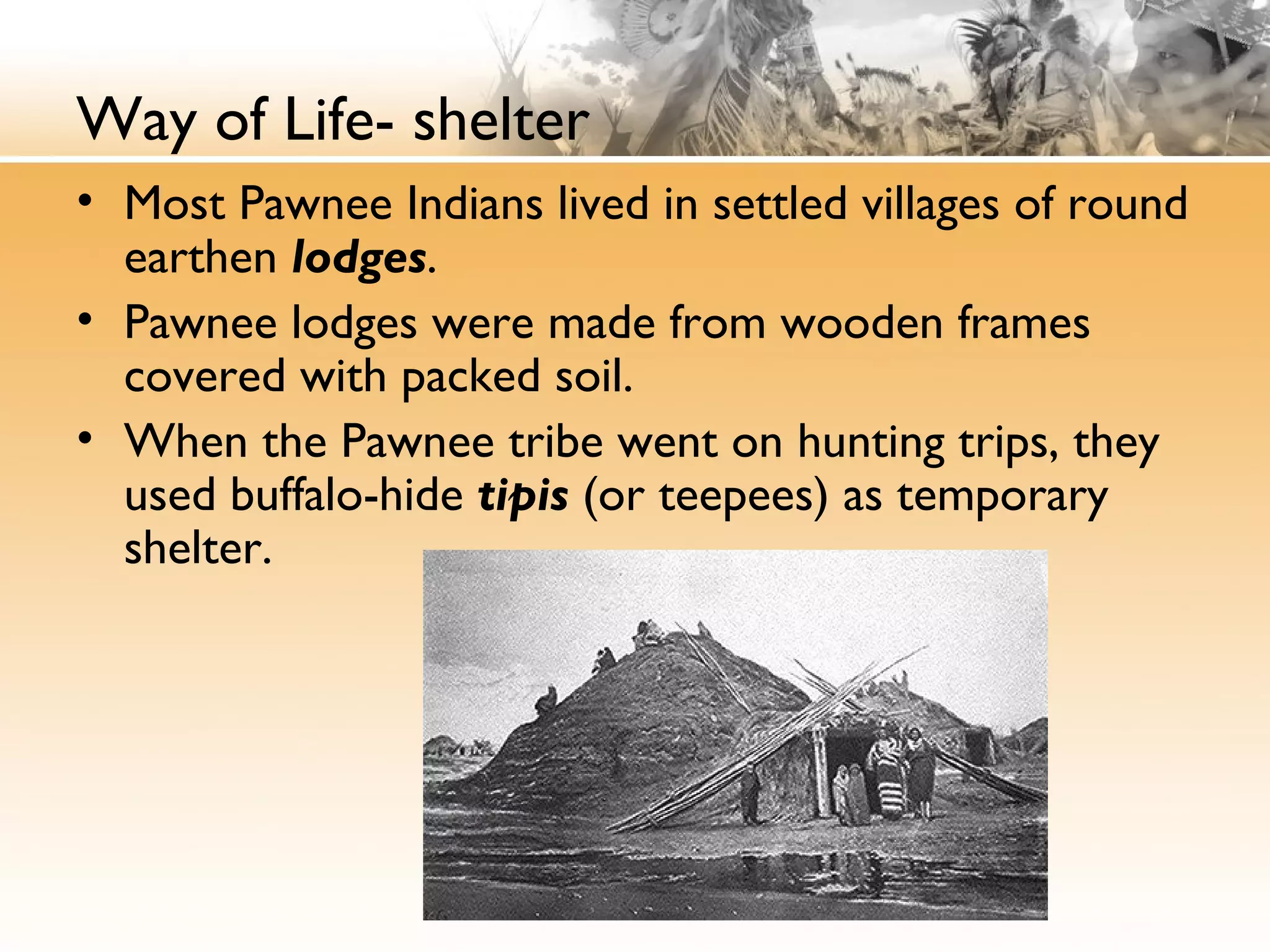
• Most Pawnee Indians lived in settled villages of round
earthen lodges.
• Pawnee lodges were made from wooden frames
covered with packed soil.
• When the Pawnee tribe went on hunting trips, they
used buffalo-hide tipis (or teepees) as temporary
shelter.
Way of Life- clothing
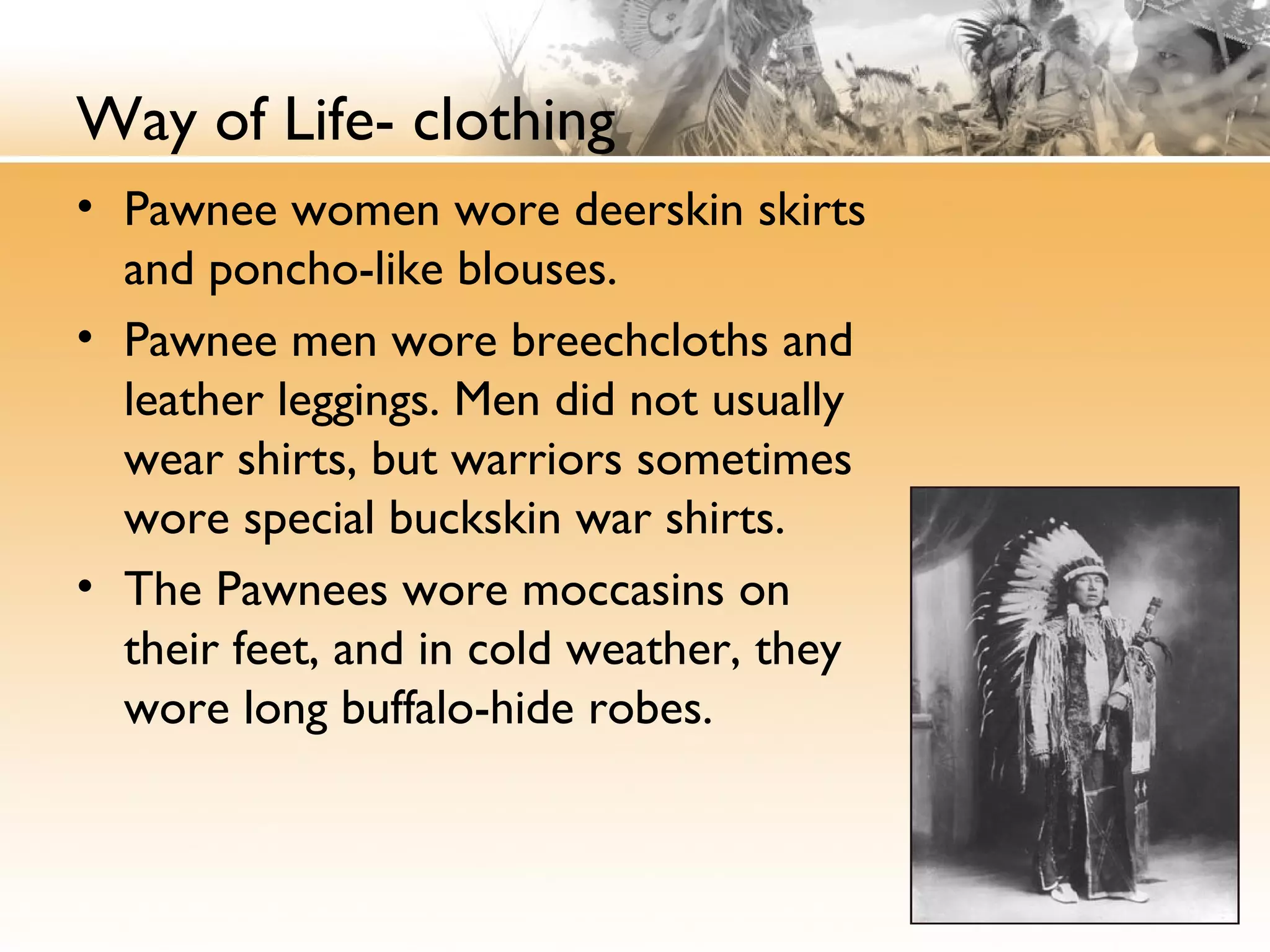
• Pawnee women wore deerskin skirts
and poncho-like blouses.
• Pawnee men wore breechcloths and
leather leggings. Men did not usually
wear shirts, but warriors sometimes
wore special buckskin war shirts.
• The Pawnees wore moccasins on
their feet, and in cold weather, they
wore long buffalo-hide robes.
Q & A
• The Pawnee Native Americans are natives of what
two states?
• What state do the Pawnee’s live in today?
• What is the baby carrier called that the Pawnee
mothers carried on their back?
• What were the jobs of the men and women?
• Where did they build their villages?
• Their houses were called _____________?
• Women wore what and men wore what? What did
they wear on their feet?
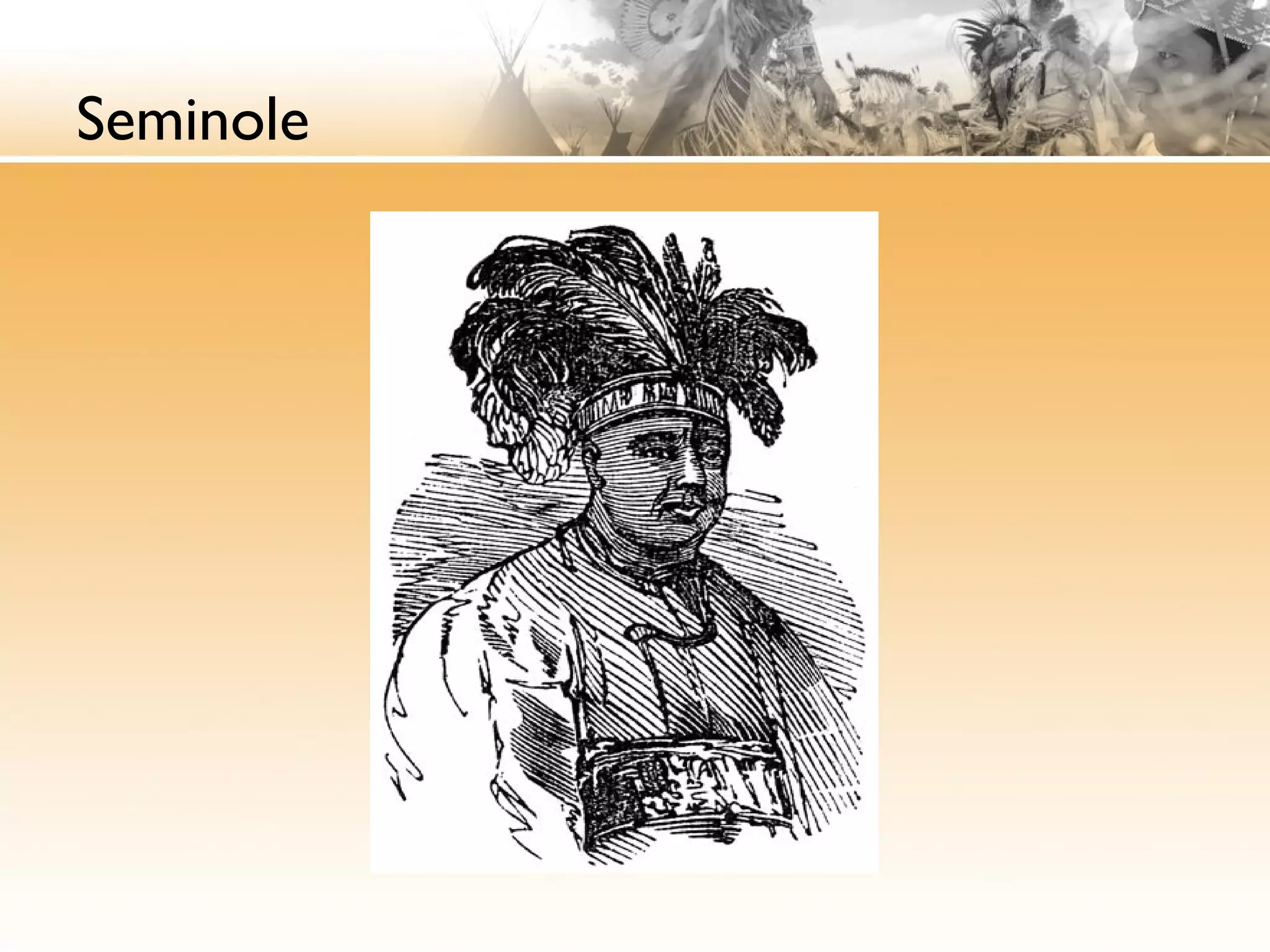
Seminole
Where they live
• The Seminoles lived in Florida.
• They started out in northern Florida, but when the
Americans attacked them, the Seminole tribe
retreated further south into the Everglades.
• Some Seminole people were forced to move to
Oklahoma in the 1800's.
• Other Seminole people still live in southern Florida
today.
Way of Life
• Seminole men were hunters and sometimes went to
war to protect their families.
• Seminole women were farmers and also did most of
the child care and cooking.
• Both genders took part in storytelling, artwork and
music, and traditional medicine.
• In the past, the chief was always a man, but today a
Seminole woman can participate in government too.
Shelter
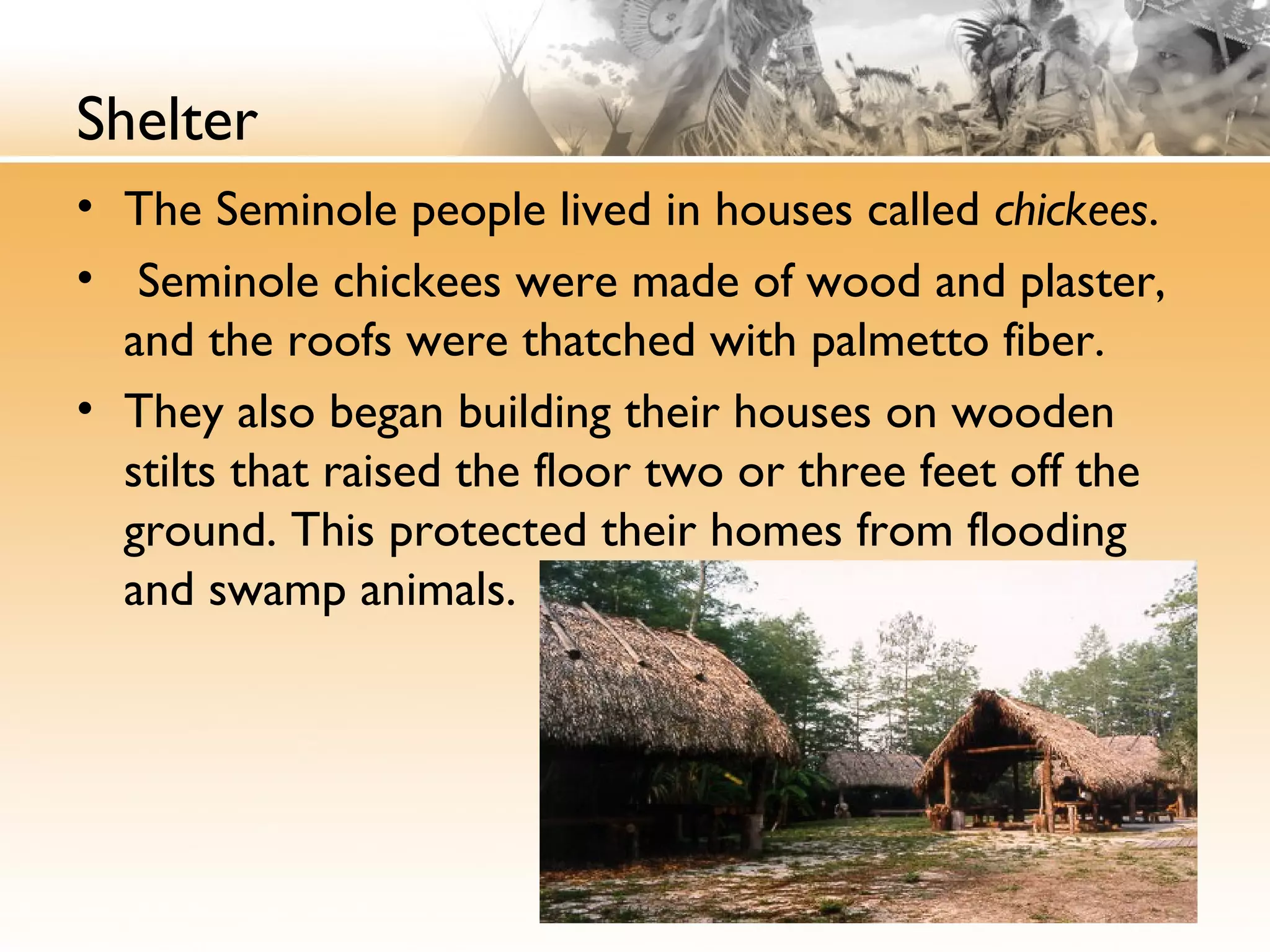
• The Seminole people lived in houses called chickees.
• Seminole chickees were made of wood and plaster,
and the roofs were thatched with palmetto fiber.
• They also began building their houses on wooden
stilts that raised the floor two or three feet off the
ground. This protected their homes from flooding
and swamp animals.
Clothing
• Seminole men wore breechcloths. Seminole women
wore wraparound skirts, usually woven from
palmetto. Shirts were not necessary in Seminole
culture.
• The Seminoles also wore moccasins on their feet.
• Seminole men usually shaved their heads except for
a single strip of hair- this became known as the
mohawk.
• The Seminoles wore elaborate tribal tattoos, but
rarely painted their faces.
Transportation
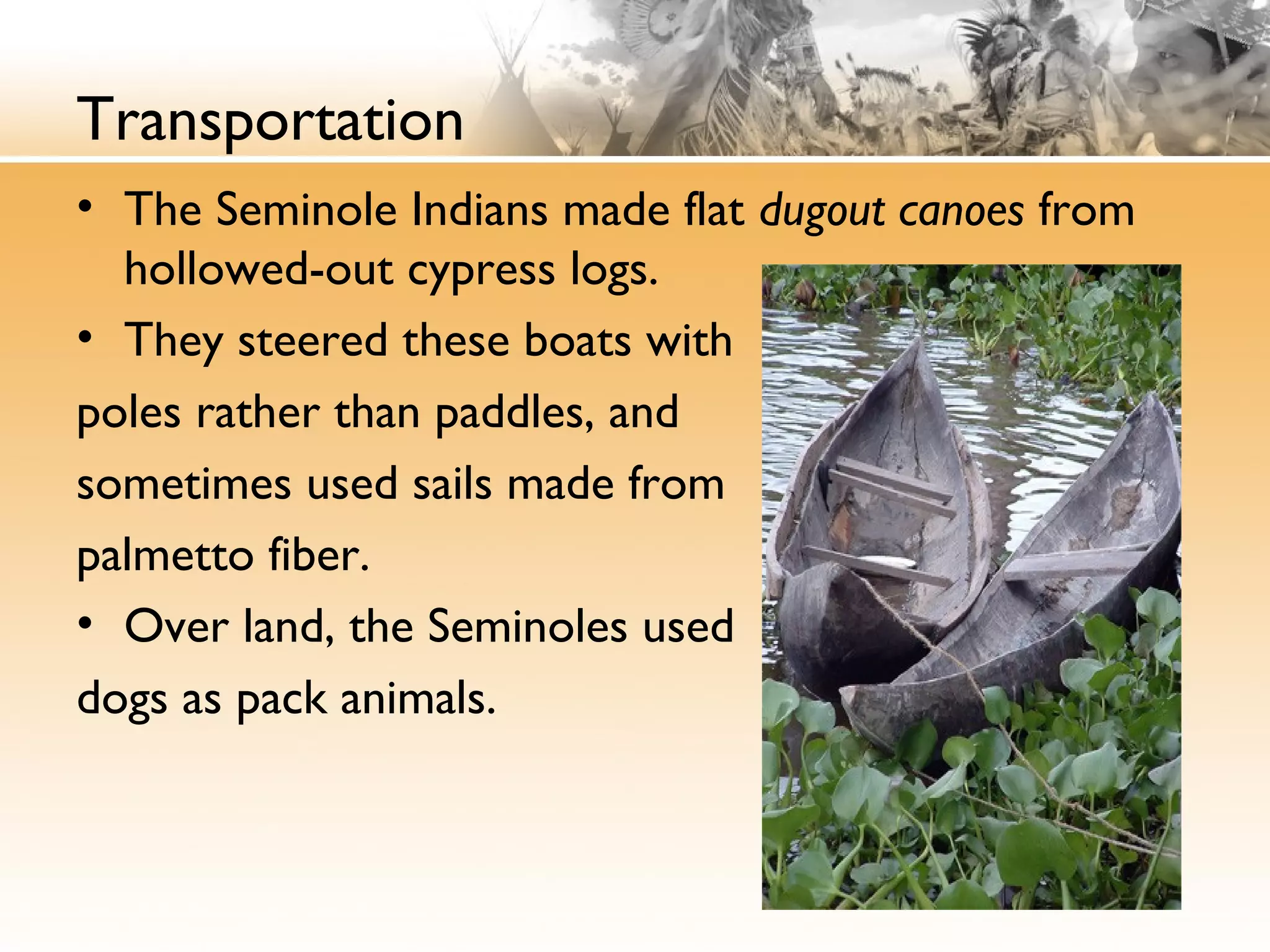
• The Seminole Indians made flat dugout canoes from
hollowed-out cypress logs.
• They steered these boats with
poles rather than paddles, and
sometimes used sails made from
palmetto fiber.
• Over land, the Seminoles used
dogs as pack animals.
Food
• The Seminoles were farming people.
• Seminole women harvested crops of corn, beans,
and squash.
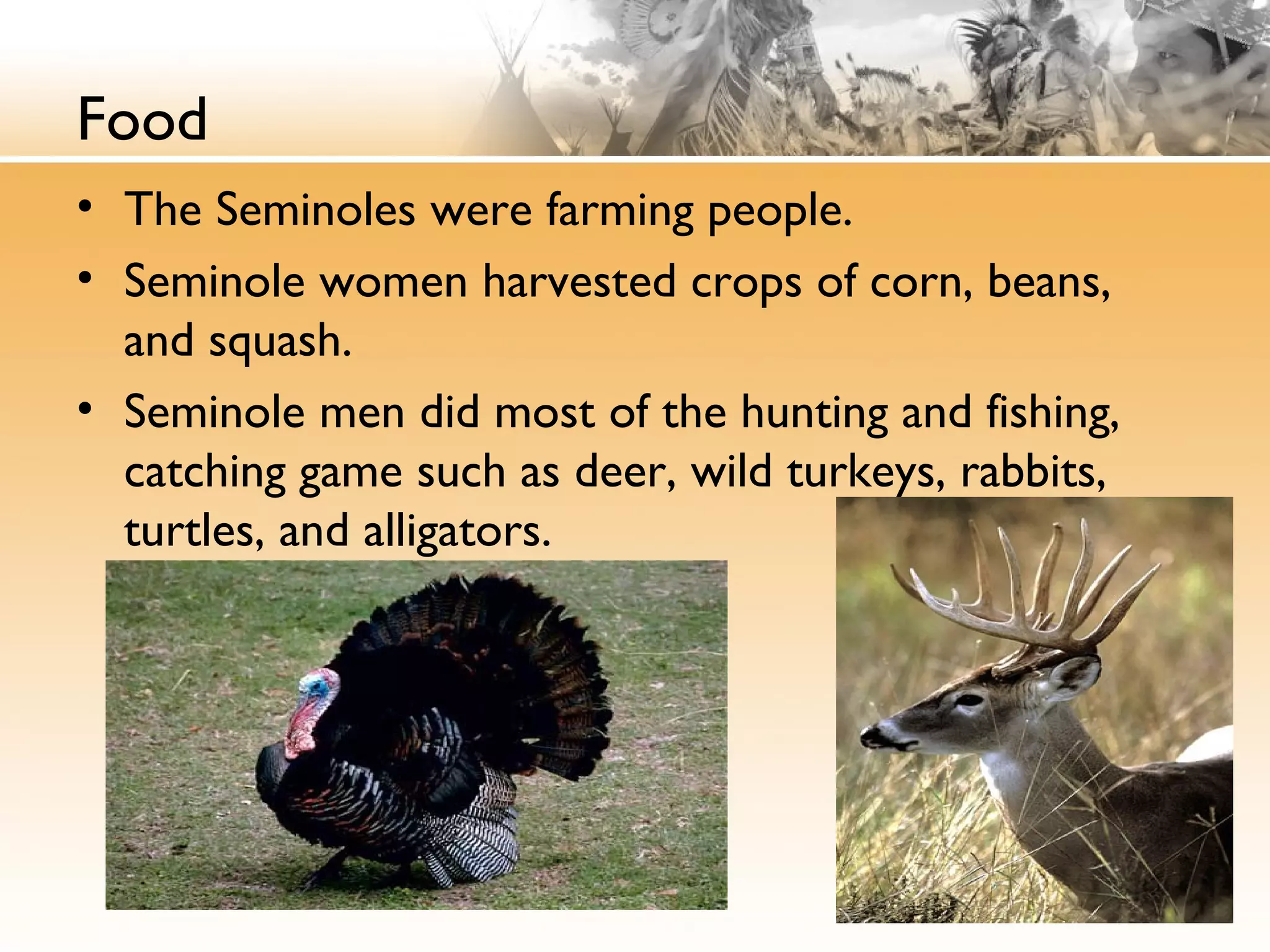
• Seminole men did most of the hunting and fishing,
catching game such as deer, wild turkeys, rabbits,
turtles, and alligators.
Weapons
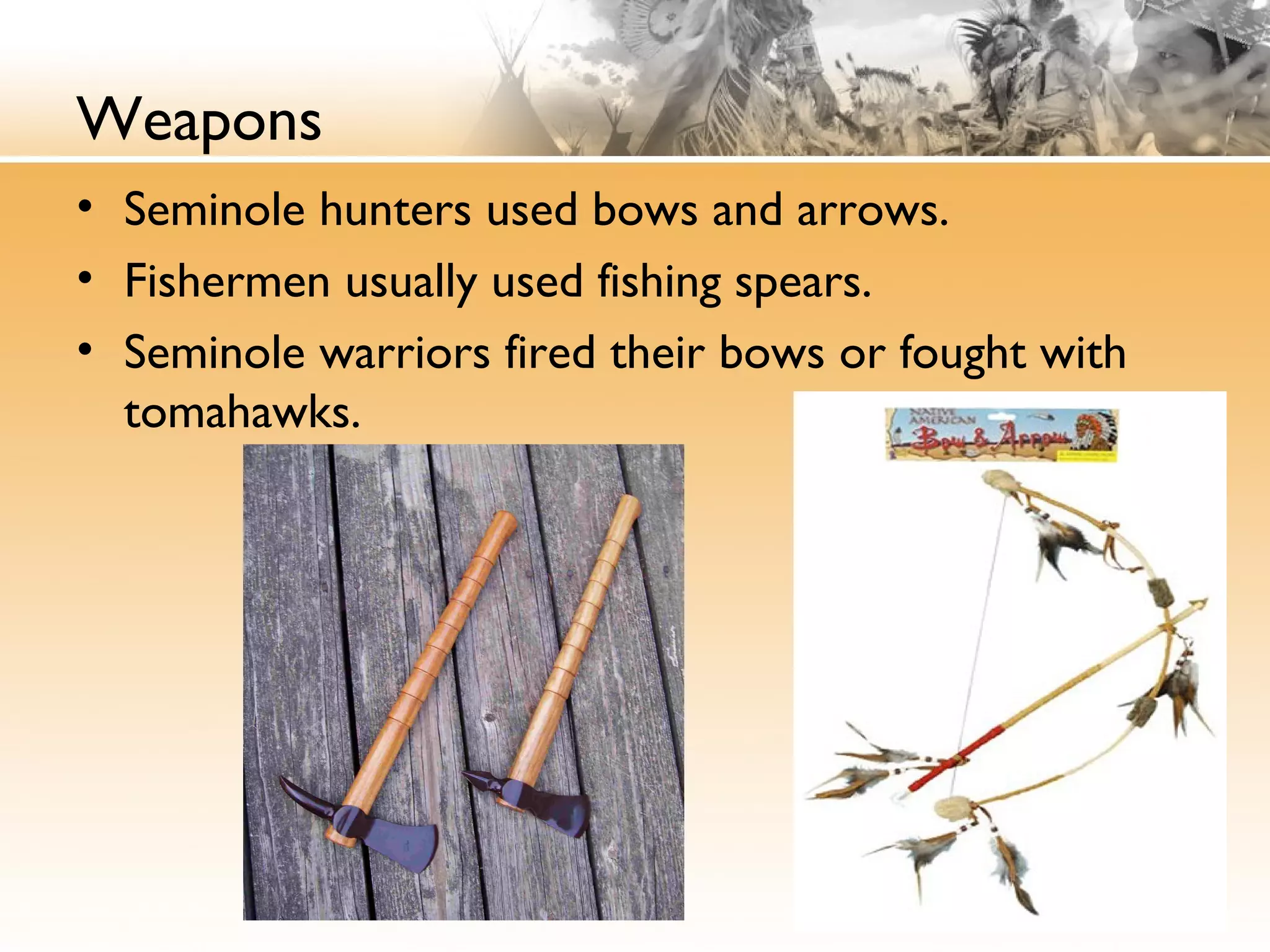
• Seminole hunters used bows and arrows.
• Fishermen usually used fishing spears.
• Seminole warriors fired their bows or fought with
tomahawks.
Q & A
• What state did the Seminoles live in?
• What were the jobs of the men and women?
• Was the chief usually a man or woman?
• What were the Seminole houses called and what
were they made out of?
• Instead of painting their faces, what did the Seminole
men do?
• What did they travel in the water in?
• They used __________ and __________ when
hunting.

Native Americans Powerpoint

  • 1.
  • 2.
    Why do wecall them Native Americans instead of Indians? • Native American and American Natives are synonyms. • We use the term Native Americans instead of Indians. • When explorers from Europe came to North America for the first time, they thought they were in India, so they called the people there Indians. • Because they were actually in the U.S., and not in India we do not use the term Indians.
  • 3.
  • 4.
    Location • The InuitTribe lived in the Arctic, what is now Alaska and the northernmost Canada. • What color represents the region in which the Inuits lived?
  • 5.
    Way of Life •In the winter, Inuits lived in igloos, or homes made of ice. (Buurrr!)
  • 6.
    Way of Life •In the warmer months, the Inuits lived in tents made from animal skin.
  • 7.
    Way of Life “Foxes,caribou, and polar bears. Oh my!” • Because it was extremely cold in the Arctic, few plants could grow in this region. • The Inuit hunted foxes, caribou, and polar bears. • Harpoons and kayaks were used to hunt seals, walruses, and whales. • A kayak is a one person canoe made of animal skins stretched over wood or bone.
  • 8.
    Way of Life •Resources were limited…they couldn’t go to Target or Wal- mart for things! • Seals were caught for their skins, to make clothes and tents. • Oil was used for light and heat. • Bones were used to make tools.
  • 9.
    Family • Family wasan important part of Inuit society. • They lived in groups of 60 to 300 people, made up of several families. • The families made decisions, hunted, and traveled together. • Life was extremely difficult in the Arctic due to the climate. Resources were limited, therefore, they had to work together and share what they had in effort to survive.
  • 10.
    Q & A •In what region did the Inuit live? • What country and state can this region be found? • What kind of homes did the Inuit build? • What were their natural resources? • What is a kayak? • How did the climate of the Arctic affect the Inuit? • Why do you think they had to share their food to survive?
  • 11.
  • 12.
    Location • The Kwakiutllived in the Northwest region. What color represents where they lived?
  • 13.
    Shelter • The Kwakiutllived in coastal villages of rectangular cedar-plank houses with bark roofs. Usually these houses were large (up to 100 feet long) and each one housed several familes from the same clan (as many as 50 people). • The photo below shows the frame of a Kwakiutl home.
  • 14.
    Location • The tribelived very close to the ocean. • Cool winds brought heavy rains, so the forests grew thick and tall. • The region was full of forests and rivers, which had plenty of fish and other animals.
  • 15.
    Way of Life •Instead of farming, the Kwakiutl, met their needs by fishing, hunting, and gathering plants and nuts. • Salmon, a type of fish, was a common food eaten. • Whales provided food and fat. The fat was melted into oil to burn in lamps. • Unlike neighboring tribes, the Kwakiutl did not hunt whales, they only captured the whales that were beached, or stranded on shore.
  • 16.
    Q & A •In what region did the Kwakiutl live? • What was the climate like? • How did the resources compare to that of the Inuit? • Did this tribe hunt Whales? What did they use whales for?
  • 17.
  • 18.
    Location • The NezPerce lived to the northwest on the Columbian Plateau. This included parts of Idaho, Oregon, and Washington, also known as Oregon Country.
  • 19.
    Climate and Resources •The Nez Perce lived in an area with dry hills and flatlands. • Like the Kwakiutl, they caught a lot of salmon from the rivers and streams that drained the high plateau. • Long spears and nets were used to catch the fish.
  • 20.
    Q & A •Where did the Nez Perce reside or live? • What is a plateau? • What what was their major resource for food? • What did they use to catch their food?
  • 21.
  • 22.
    Location • The Hopilived in the Southwest in what today is Arizona. What do you think the climate is like?
  • 23.
    Shelter • The Hopiwere also known as Pueblo people because their homes were called Pueblos. • Pueblos were made from dirt, rocks, and straw. Some had as many as five levels.
  • 24.
    Climate • The desertSouthwest, with its mesas, canyons, cliffs and mountains, was a hard place to live. • The summers were extremely hot and the winters were very cold. • Weeks can go by without a drop of rain or snow.
  • 25.
    Way of Life •The Hopi had to adapt, or adjust to the land and climate in order to survive. • They grew crops such as corn, beans, and squash. • They also grew cotton to make clothes or weave blankets.
  • 26.
    Q & A •Where did the Hopi live? In what state and region? • What was the climate like? • What is a pueblo and how is one made? • What kind of crops were the Hopi able to grow?
  • 27.
  • 28.
    Location • The PawneeIndians are original people of Nebraska and Kansas. • The Pawnee tribe was forced to move to a reservation in Oklahoma during the 1800's, and most Pawnee people are still living in Oklahoma today.
  • 29.
    Pawnee Children • ManyPawnee children like to go hunting and fishing with their fathers. • In the past, Pawnee kids had more chores and less time to play in their daily lives. • They did have dolls, toys, and games to play. • A Pawnee mother traditionally carried a young child in a cradleboard on her back
  • 30.
    Way of Life •Pawnee men were hunters and sometimes went to war to protect their families. • Pawnee women were farmers and also did most of the child care and cooking. Women farmed corn, pumpkin, beans, squash, and cooked the buffalo • The Pawnees built their villages near rivers so they could get water and wood for fire. 
  • 31.
    Way of Life-shelter • Most Pawnee Indians lived in settled villages of round earthen lodges. • Pawnee lodges were made from wooden frames covered with packed soil. • When the Pawnee tribe went on hunting trips, they used buffalo-hide tipis (or teepees) as temporary shelter.
  • 32.
    Way of Life-clothing • Pawnee women wore deerskin skirts and poncho-like blouses. • Pawnee men wore breechcloths and leather leggings. Men did not usually wear shirts, but warriors sometimes wore special buckskin war shirts. • The Pawnees wore moccasins on their feet, and in cold weather, they wore long buffalo-hide robes.
  • 33.
    Q & A •The Pawnee Native Americans are natives of what two states? • What state do the Pawnee’s live in today? • What is the baby carrier called that the Pawnee mothers carried on their back? • What were the jobs of the men and women? • Where did they build their villages? • Their houses were called _____________? • Women wore what and men wore what? What did they wear on their feet?
  • 34.
  • 35.
    Where they live •The Seminoles lived in Florida. • They started out in northern Florida, but when the Americans attacked them, the Seminole tribe retreated further south into the Everglades. • Some Seminole people were forced to move to Oklahoma in the 1800's. • Other Seminole people still live in southern Florida today.
  • 36.
    Way of Life •Seminole men were hunters and sometimes went to war to protect their families. • Seminole women were farmers and also did most of the child care and cooking. • Both genders took part in storytelling, artwork and music, and traditional medicine. • In the past, the chief was always a man, but today a Seminole woman can participate in government too.
  • 37.
    Shelter • The Seminolepeople lived in houses called chickees. • Seminole chickees were made of wood and plaster, and the roofs were thatched with palmetto fiber. • They also began building their houses on wooden stilts that raised the floor two or three feet off the ground. This protected their homes from flooding and swamp animals.
  • 38.
    Clothing • Seminole menwore breechcloths. Seminole women wore wraparound skirts, usually woven from palmetto. Shirts were not necessary in Seminole culture. • The Seminoles also wore moccasins on their feet. • Seminole men usually shaved their heads except for a single strip of hair- this became known as the mohawk. • The Seminoles wore elaborate tribal tattoos, but rarely painted their faces.
  • 39.
    Transportation • The SeminoleIndians made flat dugout canoes from hollowed-out cypress logs. • They steered these boats with poles rather than paddles, and sometimes used sails made from palmetto fiber. • Over land, the Seminoles used dogs as pack animals.
  • 40.
    Food • The Seminoleswere farming people. • Seminole women harvested crops of corn, beans, and squash. • Seminole men did most of the hunting and fishing, catching game such as deer, wild turkeys, rabbits, turtles, and alligators.
  • 41.
    Weapons • Seminole huntersused bows and arrows. • Fishermen usually used fishing spears. • Seminole warriors fired their bows or fought with tomahawks.
  • 42.
    Q & A •What state did the Seminoles live in? • What were the jobs of the men and women? • Was the chief usually a man or woman? • What were the Seminole houses called and what were they made out of? • Instead of painting their faces, what did the Seminole men do? • What did they travel in the water in? • They used __________ and __________ when hunting.