
Making Leaders Successful Every Day
November 5, 2010
Build Security Into Your Network’s
DNA: The Zero Trust Network
Architecture
by John Kindervag
for Security & Risk Professionals
© 2010, Forrester Research, Inc. All rights reserved. Unauthorized reproduction is strictly prohibited. Information is based on best available
resources. Opinions reflect judgment at the time and are subject to change. Forrester®, Technographics®, Forrester Wave, RoleView, TechRadar,
and Total Economic Impact are trademarks of Forrester Research, Inc. All other trademarks are the property of their respective companies. To
purchase reprints of this document, please email clientsupport@forrester.com. For additional information, go to www.forrester.com.
For Security & Risk Professionals
Executive Summary
This report is a deep dive into a potential way in which you could use the concepts of the Zero Trust
Model and conceivably implement them in a real-world environment. One of our goals with Zero Trust
is to optimize the security architectures and technologies for future flexibility. As we move toward a
data-centric world with shifting threats and perimeters, we look at new network designs that integrate
connectivity, transport, and security around potentially toxic data. We call this “designing from the
inside out.” If we begin to do all those things together we can have a much more strategic infrastructure.
If we look at everything from a data-centric perspective, we can design networks from the inside out and
make them more efficient, more elegant, simpler, and more cost-effective.
table of Contents
Forrester’s Zero Trust Network Security
Report Collection
Zero Trust Will Change The Way We Design
And Build Networks
Use Zero Trust To Rebuild The Secure Network
The Zero Trust Network Is Poised To Transform
Enterprise Networking
IT Professionals Will Upgrade The Network
Soon — You Need To Be By Their Side
recommendations
Today Is A Good Day To Take Action On Zero
Trust Networking
NOTES & RESOURCES
In developing this report, Forrester drew
from a wealth of analyst experience, insight,
and research through advisory and inquiry
discussions with end users, vendors, and
regulators across industry sectors.
Related Research Documents
“No More Chewy Centers: Introducing The Zero
Trust Model Of Information Security”
September 14, 2010
“Are Converged Infrastructures Good For IT?”
May 17, 2010
“TechRadar™ For Security & Risk Professionals:
Network Threat Mitigation, Q3 2009”
July 22, 2009
November 5, 2010
Build Security Into Your Network’s DNA: The Zero
Trust Network Architecture
by John Kindervag
with Stephanie Balaouras and Lindsey Coit
2
2
5
12
23
24
© 2010, Forrester Research, Inc. Reproduction ProhibitedNovember 5, 2010
Build Security Into Your Network’s DNA: The Zero Trust Network Architecture
For Security & Risk Professionals
2
Forrester’s Zero Trust network security report collection
This is the second in a collection of reports that describe the concept, architecture, and benefits
of Forrester’s Zero Trust Model of information security. There is a simple philosophy at the core
of Zero Trust: Security professionals must stop trusting packets as if they were people. Instead,
they must eliminate the idea of a trusted network (usually the internal network) and an untrusted
network (external networks). In Zero Trust, all network traffic is untrusted. Thus, security
professionals must verify and secure all resources, limit and strictly enforce access control, and
inspect and log all network traffic.
The Zero Trust network security report collection will consist of the following reports:
·	Concept. This report will introduce the necessity and essential concepts of the Zero Trust
Model of information security.
·	Architecture. This report will outline the key architectural components, capabilities, and
required technologies of the Zero Trust Model.
·	Case studies. In a series of case studies, Forrester will highlight security organizations that have
adopted or applied concepts of the Zero Trust Model in their environment. Included in the case
studies will be a discussion of best practices and benefits.
Zero Trust Will Change The Way we design and build Networks
Trust is the fundamental problem in information security today. By changing our trust model we can
change our networks and make them easier to build and maintain; we can even make them more
efficient, more compliant, and more cost-effective. There are several core concepts of Zero Trust: 1)
There are no longer a trusted and an untrusted interface on our security devices; 2) there are no longer
a trusted and an untrusted network; and 3) there are no longer trusted and untrusted users. Zero Trust
mandates that information security pros treat all network traffic as untrusted. Zero Trust doesn’t say
that employees are untrustworthy but that trust is a concept that information security pros should not
apply to packets, network traffic, and data. The malicious insider reality demands a new trust model.
By changing the trust model, we reduce the temptation for insiders to abuse or misuse the network,
and we improve our chances of discovering cybercrime before it can succeed.
You Must Design The Network Of The Future From The Inside Out
Networking professionals built legacy networks from the outside in. Historically, networkers have
been more concerned with infrastructure than with data, more with roads than with destinations.
Network professionals built yesterday’s networks at the edge, with the Internet connection, and then
built inward, without regard to the placement of resources or data. The networker would start at the
router and all the complex routing protocols and then move to building the switching infrastructure.
© 2010, Forrester Research, Inc. Reproduction Prohibited November 5, 2010
Build Security Into Your Network’s DNA: The Zero Trust Network Architecture
For Security & Risk Professionals
3
At the end of the network build, users were allowed to plug resources into that network with little
regard to potential security implications.
That process is untenable today. Cyberthreats have increased, while various laws and regulations
track security postures more closely than ever. Shifting traffic flows and threats are forcing changes
to the way we build and operate networks. We must build tomorrow’s networks securely from
inception. You can use the basic concepts of Zero Trust to redesign legacy networks into modern
networks so that they are compliant, secure, efficient, and cost-effective.
When Bugsy Siegel decided to build the city of Las Vegas and make it one of the world’s premier and
most successful tourist destinations, he built the town first and the road second. He didn’t build the
road first and then build Las Vegas. Unfortunately, networking professionals didn’t build yesterday’s
networks this way; they built the network pipe first and then invited everyone to build destinations
second. Today we need to build networks from the inside out: Start with the system resources and data
repositories that we need to protect as well as the places where we need to be compliant, then build a
network out from that. Let’s protect the data first and figure out how to do the road-building — the
networking — second. Building roads is easy. Security is hard.
The Traditional Hierarchical Network Is Antiquated And Not Secure
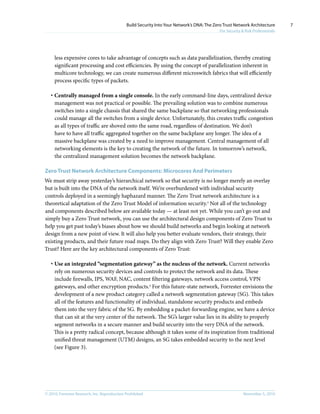
Network professionals designed the traditional hierarchical network from the outside in. If we look
closely at the traditional hierarchical network, we will quickly understand why new technology
and new ways of doing business (especially Web 2.0, social networks, and cloud computing) have
made it antiquated. Sometimes known as the “Three-Tiered Network Architecture,” this is the type
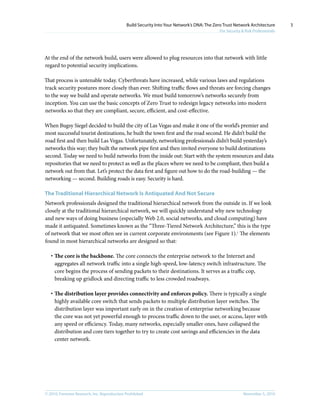
of network that we most often see in current corporate environments (see Figure 1).1
The elements
found in most hierarchical networks are designed so that:
·	The core is the backbone. The core connects the enterprise network to the Internet and
aggregates all network traffic into a single high-speed, low-latency switch infrastructure. The
core begins the process of sending packets to their destinations. It serves as a traffic cop,
breaking up gridlock and directing traffic to less crowded roadways.
·	The distribution layer provides connectivity and enforces policy. There is typically a single
highly available core switch that sends packets to multiple distribution layer switches. The
distribution layer was important early on in the creation of enterprise networking because
the core was not yet powerful enough to process traffic down to the user, or access, layer with
any speed or efficiency. Today, many networks, especially smaller ones, have collapsed the
distribution and core tiers together to try to create cost savings and efficiencies in the data
center network.
© 2010, Forrester Research, Inc. Reproduction ProhibitedNovember 5, 2010
Build Security Into Your Network’s DNA: The Zero Trust Network Architecture
For Security & Risk Professionals
4
·	The access layer connects users to the network. As the third tier of the traditional hierarchical
network, the access layer defines the outer boundary of the local area network (LAN). Often
called “closet” switches, each user device will connect directly to an access layer switch in order
to access approved network resources.
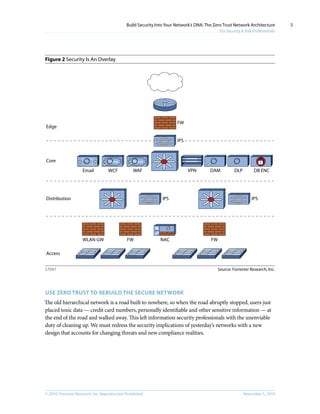
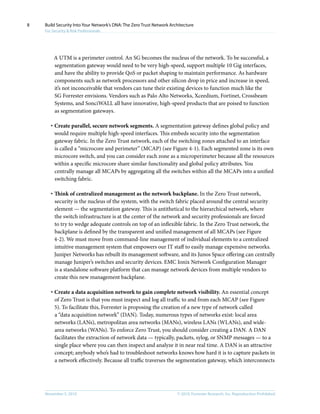
·	Security is an overlay in yesterday’s hierarchical network. There is no security layer in a three-
tiered network. Network professionals downgraded or dismissed most security requirements
during legacy network design. By the time they identified a security issue and brought in
security professionals, network professionals had already built the network; we then had to
bolt on security controls after the fact. Our networks, therefore, are overflowing with security
controls wedged awkwardly into this antiquated networking model (see Figure 2). They become
a management nightmare made even worse by the fact that we still have yet to fully resolve our
overarching security problems.
Figure 1 Building The Traditional Hierarchical Network
Source: Forrester Research, Inc.57047
Access
Edge
Core
Distribution
© 2010, Forrester Research, Inc. Reproduction Prohibited November 5, 2010
Build Security Into Your Network’s DNA: The Zero Trust Network Architecture
For Security & Risk Professionals
5
Figure 2 Security Is An Overlay
Use Zero Trust to ReBuild the Secure Network
The old hierarchical network is a road built to nowhere, so when the road abruptly stopped, users just
placed toxic data — credit card numbers, personally identifiable and other sensitive information — at
the end of the road and walked away. This left information security professionals with the unenviable
duty of cleaning up. We must redress the security implications of yesterday’s networks with a new
design that accounts for changing threats and new compliance realities.
Source: Forrester Research, Inc.57047
Access
Edge
Core
Distribution
VPN
FW
WLAN GW FW FW
IPS
IPS IPS
WAFWCFEmail DAM DLP DB ENC
NAC
© 2010, Forrester Research, Inc. Reproduction ProhibitedNovember 5, 2010
Build Security Into Your Network’s DNA: The Zero Trust Network Architecture
For Security & Risk Professionals
6
Zero Trust Network Architecture Characteristics: Segmented, Parallelized, And Centralized
The Zero Trust Model of information security can embolden network designers to do unique and
powerful things. It will engender infrastructure and security professionals to build security into
networks by default. Current designs merely overlay existing networks with more and more controls
in an attempt to create a semblance of a secure network. These efforts are generally unsuccessful
because our industry is unwilling to reinvent technology that aligns with tomorrow’s needs. To
rethink the network requires a willingness to set aside preconceived notions about what the network
should be and think about what the network could be. By taking network design down to the
trust level, we can create the Zero Trust network. Zero Trust will enable security throughout your
network by addressing three concepts that will empower secure networking in the future. We will
design tomorrow’s networks to be:
·	Easily managed and segmented for security and compliance. Legacy networks are flat, Layer
2 fabrics. These old networks just don’t function in a security-conscious environment. In the
future, we need to provide easy-to-manage, segmented networks. If you’re involved with almost
any compliance mandate right now, you know you need a segmented network. Compliance and
performance issues demand a segmented network, but hierarchical networks are difficult to
segment. This is because the focus on switch fabrics and high-speed backplanes doesn’t provide
a way to effectively break apart the backplane for segmentation purposes.
Some networkers advocate the use of virtual LANs (VLANs) for segmentation purposes, but
they are highly insecure. Think of VLANs as the yellow line on the road. Traffic is not supposed
to cross that yellow line, but there’s nothing preventing a vehicle from doing so. In the same
way, VLANs define a network traffic isolation policy, but they aren’t technologically capable of
preventing a malicious actor from moving between VLANs and gaining access to privileged
information.2
Therefore, new ways of segmenting networks must be created because all future
networks need to be segmented by default.
·	Built with multiple parallelized switching cores. The traditional switch fabric is the bottleneck
that keeps us from building inherently secure and efficient networks. A unified switch fabric
and massive backplane are, in fact, antithetical to multicore processing and parallelization.
Once we realize that the actual problem is the very switch fabric we’re so focused on, and once
we start to disabuse ourselves of the notion that the network is all about the backplane, we will
begin to think about networks in a completely different way. Having a several-hundred-gigabyte
backplane on a core switch is of little value today because all those packets are going to different
destinations, which reduces traffic efficiency.
Modern laptops have multicore processors. If we use laptops as an example of distributed
processing in which the OS provides centralized management, we can extrapolate that model
to the network. This will allow designers to break the core switch into multiple smaller and
© 2010, Forrester Research, Inc. Reproduction Prohibited November 5, 2010
Build Security Into Your Network’s DNA: The Zero Trust Network Architecture
For Security & Risk Professionals
7
less expensive cores to take advantage of concepts such as data parallelization, thereby creating
significant processing and cost efficiencies. By using the concept of parallelization inherent in
multicore technology, we can create numerous different microswitch fabrics that will efficiently
process specific types of packets.
·	Centrally managed from a single console. In the early command-line days, centralized device
management was not practical or possible. The prevailing solution was to combine numerous
switches into a single chassis that shared the same backplane so that networking professionals
could manage all the switches from a single device. Unfortunately, this creates traffic congestion
as all types of traffic are shoved onto the same road, regardless of destination. We don’t
have to have all traffic aggregated together on the same backplane any longer. The idea of a
massive backplane was created by a need to improve management. Central management of all
networking elements is the key to creating the network of the future. In tomorrow’s network,
the centralized management solution becomes the network backplane.
Zero Trust Network Architecture Components: Microcores And Perimeters
We must strip away yesterday’s hierarchical network so that security is no longer merely an overlay
but is built into the DNA of the network itself. We’re overburdened with individual security
controls deployed in a seemingly haphazard manner. The Zero Trust network architecture is a
theoretical adaptation of the Zero Trust Model of information security.3
Not all of the technology
and components described below are available today — at least not yet. While you can’t go out and
simply buy a Zero Trust network, you can use the architectural design components of Zero Trust to
help you get past today’s biases about how we should build networks and begin looking at network
design from a new point of view. It will also help you better evaluate vendors, their strategy, their
existing products, and their future road maps. Do they align with Zero Trust? Will they enable Zero
Trust? Here are the key architectural components of Zero Trust:
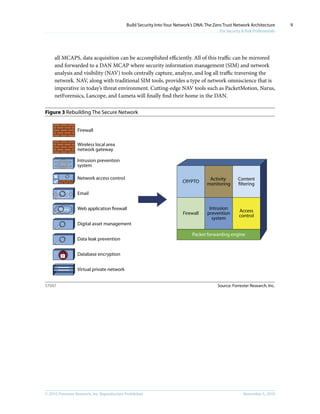
·	Use an integrated “segmentation gateway” as the nucleus of the network. Current networks
rely on numerous security devices and controls to protect the network and its data. These
include firewalls, IPS, WAF, NAC, content filtering gateways, network access control, VPN
gateways, and other encryption products.4
For this future-state network, Forrester envisions the
development of a new product category called a network segmentation gateway (SG). This takes
all of the features and functionality of individual, standalone security products and embeds
them into the very fabric of the SG. By embedding a packet-forwarding engine, we have a device
that can sit at the very center of the network. The SG’s larger value lies in its ability to properly
segment networks in a secure manner and build security into the very DNA of the network.
This is a pretty radical concept, because although it takes some of its inspiration from traditional
unified threat management (UTM) designs, an SG takes embedded security to the next level
(see Figure 3).
© 2010, Forrester Research, Inc. Reproduction ProhibitedNovember 5, 2010
Build Security Into Your Network’s DNA: The Zero Trust Network Architecture
For Security & Risk Professionals
8
A UTM is a perimeter control. An SG becomes the nucleus of the network. To be successful, a
segmentation gateway would need to be very high-speed, support multiple 10 Gig interfaces,
and have the ability to provide QoS or packet shaping to maintain performance. As hardware
components such as network processors and other silicon drop in price and increase in speed,
it’s not inconceivable that vendors can tune their existing devices to function much like the
SG Forrester envisions. Vendors such as Palo Alto Networks, Xceedium, Fortinet, Crossbeam
Systems, and SonciWALL all have innovative, high-speed products that are poised to function
as segmentation gateways.
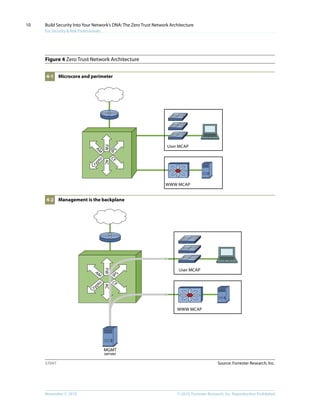
·	Create parallel, secure network segments. A segmentation gateway defines global policy and
would require multiple high-speed interfaces. This embeds security into the segmentation
gateway fabric. In the Zero Trust network, each of the switching zones attached to an interface
is called a “microcore and perimeter” (MCAP) (see Figure 4-1). Each segmented zone is its own
microcore switch, and you can consider each zone as a microperimeter because all the resources
within a specific microcore share similar functionality and global policy attributes. You
centrally manage all MCAPs by aggregating all the switches within all the MCAPs into a unified
switching fabric.
·	Think of centralized management as the network backplane. In the Zero Trust network,
security is the nucleus of the system, with the switch fabric placed around the central security
element — the segmentation gateway. This is antithetical to the hierarchical network, where
the switch infrastructure is at the center of the network and security professionals are forced
to try to wedge adequate controls on top of an inflexible fabric. In the Zero Trust network, the
backplane is defined by the transparent and unified management of all MCAPs (see Figure
4-2). We must move from command-line management of individual elements to a centralized
intuitive management system that empowers our IT staff to easily manage expensive networks.
Juniper Networks has rebuilt its management software, and its Junos Space offering can centrally
manage Juniper’s switches and security devices. EMC Ionix Network Configuration Manager
is a standalone software platform that can manage network devices from multiple vendors to
create this new management backplane.
·	Create a data acquisition network to gain complete network visibility. An essential concept
of Zero Trust is that you must inspect and log all traffic to and from each MCAP (see Figure
5). To facilitate this, Forrester is proposing the creation of a new type of network called
a “data acquisition network” (DAN). Today, numerous types of networks exist: local area
networks (LANs), metropolitan area networks (MANs), wireless LANs (WLANs), and wide-
area networks (WANs). To enforce Zero Trust, you should consider creating a DAN. A DAN
facilitates the extraction of network data — typically, packets, sylog, or SNMP messages — to a
single place where you can then inspect and analyze it in near real time. A DAN is an attractive
concept; anybody who’s had to troubleshoot networks knows how hard it is to capture packets in
a network effectively. Because all traffic traverses the segmentation gateway, which interconnects
© 2010, Forrester Research, Inc. Reproduction Prohibited November 5, 2010
Build Security Into Your Network’s DNA: The Zero Trust Network Architecture
For Security & Risk Professionals
9
all MCAPS, data acquisition can be accomplished efficiently. All of this traffic can be mirrored
and forwarded to a DAN MCAP where security information management (SIM) and network
analysis and visibility (NAV) tools centrally capture, analyze, and log all traffic traversing the
network. NAV, along with traditional SIM tools, provides a type of network omniscience that is
imperative in today’s threat environment. Cutting-edge NAV tools such as PacketMotion, Narus,
netForensics, Lancope, and Lumeta will finally find their home in the DAN.
Figure 3 Rebuilding The Secure Network
Source: Forrester Research, Inc.57047
CRYPTO
Activity
monitoring
Content
filtering
Firewall
Packet forwarding engine
Intrusion
prevention
system
Access
control
Firewall
Wireless local area
network gateway
Intrusion prevention
system
Virtual private network
Web application firewall
Email
Network access control
Digital asset management
Data leak prevention
Database encryption
© 2010, Forrester Research, Inc. Reproduction ProhibitedNovember 5, 2010
Build Security Into Your Network’s DNA: The Zero Trust Network Architecture
For Security & Risk Professionals
10
Figure 4 Zero Trust Network Architecture
Source: Forrester Research, Inc.57047
MGMT
server
FWAC
IPS
CF
AM
Crypto
WWW MCAP
User MCAP
FWAC
IPS
CF
AM
Crypto
WWW MCAP
User MCAP
Microcore and perimeter4-1
Management is the backplane4-2
© 2010, Forrester Research, Inc. Reproduction Prohibited November 5, 2010
Build Security Into Your Network’s DNA: The Zero Trust Network Architecture
For Security & Risk Professionals
11
Figure 5 All Traffic Is Inspected And Logged
Source: Forrester Research, Inc.57047
MGMT
server
FWAC
IPS
CF
AM
Crypto
SIM NAV
WWW MCAP
User MCAP
DAN MCAP
© 2010, Forrester Research, Inc. Reproduction ProhibitedNovember 5, 2010
Build Security Into Your Network’s DNA: The Zero Trust Network Architecture
For Security & Risk Professionals
12
The Zero Trust Network is poised to transform enterprise networking
Twenty-first-century networks don’t work like they should. Science fiction movies and TV shows
have embedded a vision of what the future should look like, but the networking industry hasn’t
kept pace. The processes for building, managing, maintaining, and securing a network are done in
a similar manner as they were in the 1990s. Why is that? What needs to be done to make things
more intuitive, more automatic, more point-and-click? The moving of packets from Point A to
Point B can’t be allowed to be rocket science because there are not enough rocket scientists. To
fulfill expectations of the future, networks need to be simpler and easier to manage. Networks must
become more intuitive and inherently secure.
Zero Trust is an opportunity to reinvent the network and create secure networking. Now is the time
to begin thinking about implementing Zero Trust. There are numerous benefits implicit in the Zero
Trust network, including the following:
·	It’s platform-agnostic. The Zero Trust network can support any type of resource. MCAPs
provide global policy and are designed to handle a specific type of traffic. You can place a Linux
server or Unix mainframe in the same MCAP as a Windows server as long as all those servers
are processing the same types of traffic. For example, if you deploy a Web-facing MCAP, any
Web server can be deployed within it. The segmentation gateway will control policy so that only
Web protocols such as HTTP or HTTPS can traverse the MCAPs interface (see Figure 6).
·	It will reduce the cost of compliance and other security assessments. You must segment
tomorrow’s network. Again using PCI compliance as an example, it’s clear that one of the most
effective ways of meeting PCI compliance requirements is to limit the scope of PCI via network
segmentation. This implicitly demands that you segment cardholder data (CHD) from the rest of
your network. Since you can create a dedicated MCAP just to hold CHD, you simplify compliance
and reduce the costs of assessments.5
A CHD MCAP will have its own set of switches and its own
perimeter built into the network, so when you perform your PCI assessment, the CHD MCAP will
be the only area of the network that the QSA will need to review.
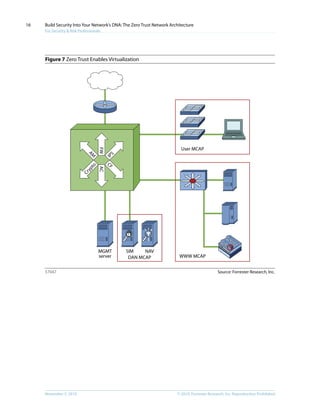
·	It enables secure virtualization. Today we must try to segment networks in order to make
them compliant with a myriad of burdensome regulations, yet virtualization and segmentation
are often at odds with each other. In an era of increased compliance obligations, it’s extremely
important that IT not deploy certain virtualized critical resources in the wrong part of the
network, where they might bring an organization out of compliance with a specific data security
regulation. Virtualization wants a huge Layer 2 network that makes the movement of virtual
machines (VMs) easy. Zero Trust enables virtualization because it creates specific Layer 2
MCAPs that are segmented from everything else (see Figure 7). It aggregates similar types of
VM hosts, and then it secures those VMs by default through segmentation gateway policies.
© 2010, Forrester Research, Inc. Reproduction Prohibited November 5, 2010
Build Security Into Your Network’s DNA: The Zero Trust Network Architecture
For Security & Risk Professionals
13
In the Zero Trust network, if an administrator tries to add a VM into an MCAP where it doesn’t
belong, that VM will not function. For example, if someone spins up a virtual instance of a
database server within a Web server MCAP, that database server will not receive any traffic since
the default policy for the interface attached to the Web MCAP only allows Web traffic to pass. In
this instance, our security risk is minimized because SQL traffic will not be allowed to traverse
the interface.
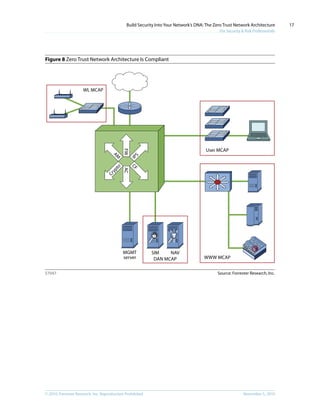
·	It will help you achieve compliance. PCI compliance, for example, mandates that wired and
wireless networks be separated by a firewall. The Zero Trust network is inherently compliant
because each MCAP is a separate microperimeter where a policy is enforced (see Figure 8). This
policy will often support a specific compliance requirement. In this case, the firewall embedded
in the fabric of the segmentation gateway ensures that wireless access points can’t be bridged
directly to a core network switch, which is a significant problem in many enterprise networks
and the issue that this specific PCI requirement was designed to address.
·	It will scale with your organization and new ways of doing business. The Zero Trust
network architecture is modular, and you can add MCAPs as needed. Additionally, you can
add resources within an MCAP just by adding switch capacity. This doesn’t add additional
management burden because management is the backplane in the Zero Trust network. Because
the focus is on management in Zero Trust, you can mingle large and small switches throughout
the network based on port-density needs (see Figure 9). This means that companies will no
longer need to overinvest in large switches just to get some semblance of device management.
Size the switch to the MCAP. This means that you can use less expensive switches in smaller
MCAPs, thus helping you reduce overall capital costs.
·	It’s the foundation for a secure multitenant environment. Cloud computing is all the rage.
But given the difficulty in securing a hierarchical network in an enterprise network, can we
really expect that a hierarchical network inside a cloud could even begin to be secure, given the
challenges of transport and multitenancy? The Zero Trust network fits, by default, into a cloud
or SaaS strategy. Zero Trust is natively segmented, which enables multitenancy more easily (see
Figure 10). Additionally, IT could deploy virtualized instances of the segmentation gateway
fabric on a single hardware cluster, with each virtual segmentation gateway (VSG) serving a
specific client in a multitenant cloud environment.
·	It allows you to balance workloads easily. You can substitute a load-balancing switch for a
traditional switch within a Web MCAP. Zero Trust will require a rethinking of centralized
network management solutions so that you can configure and control this load-balancing
just like any other switch. The load balancer then becomes part of this aggregated backplane.
This flexibility will force network management into the 21st century and enable device
interoperability and lower operational costs (see Figure 11).
© 2010, Forrester Research, Inc. Reproduction ProhibitedNovember 5, 2010
Build Security Into Your Network’s DNA: The Zero Trust Network Architecture
For Security & Risk Professionals
14
·	It’s extensible and offers choice. The individualized switch fabrics within an MCAP are modular.
You can stack switches to allow for traffic-driven expansion of any particular traffic segment. Also,
you’re not locked into the features and functions of the SG. You can still use best-of-breed controls
for the Zero Trust network. For example, you can augment the WAF capability of an SG by adding
a standalone WAF to an MCAP at the SG interface connection (see Figure 12).
·	It can augment your existing hierarchical networks. You can add a Zero Trust network to a
current network (see Figure 13). Again, compliance may play a role here. The modularity of
Zero Trust networking allows you to create a subset of your network and attach a smaller Zero
Trust network to your existing network to facilitate the creation of a segmented, compliant
subnetwork. For PCI, you could build a smaller PCI-compliant CHD Zero Trust network and
attach it directly to your existing network. For example, we might create a Zero Trust network
specifically as a cardholder network. Within our PCI compliance initiative, this might mean
we need to create a segmented wireless MCAP and a segmented cardholder data MCAP. With
Zero Trust networking concepts we can create a compliant and segmented network with
relative ease compared with the other ways we segment networks today. Once you build a Zero
Trust subnetwork, you will be able to extend it later on, and, over time, replace your existing
infrastructure in manageable chunks with a Zero Trust network.
© 2010, Forrester Research, Inc. Reproduction Prohibited November 5, 2010
Build Security Into Your Network’s DNA: The Zero Trust Network Architecture
For Security & Risk Professionals
15
Figure 6 Zero Trust Is Platform-Agnostic
Source: Forrester Research, Inc.57047
MGMT
server
FWAC
IPS
CF
AM
Crypto
SIM NAV
WWW MCAP
User MCAP
DAN MCAP
© 2010, Forrester Research, Inc. Reproduction ProhibitedNovember 5, 2010
Build Security Into Your Network’s DNA: The Zero Trust Network Architecture
For Security & Risk Professionals
16
Figure 7 Zero Trust Enables Virtualization
Source: Forrester Research, Inc.57047
MGMT
server
FWAC
IPS
CF
AM
Crypto
SIM
DAN MCAP
NAV
WWW MCAP
User MCAP
© 2010, Forrester Research, Inc. Reproduction Prohibited November 5, 2010
Build Security Into Your Network’s DNA: The Zero Trust Network Architecture
For Security & Risk Professionals
17
Figure 8 Zero Trust Network Architecture Is Compliant
Source: Forrester Research, Inc.57047
SIM
DAN MCAP
NAVMGMT
server
FWAC
IPS
CF
AM
Crypto
WL MCAP
WWW MCAP
User MCAP
© 2010, Forrester Research, Inc. Reproduction ProhibitedNovember 5, 2010
Build Security Into Your Network’s DNA: The Zero Trust Network Architecture
For Security & Risk Professionals
18
Figure 9 Zero Trust Network Architecture Is Scalable
Source: Forrester Research, Inc.57047
APPS
MCAP
DB
MCAP
MGMT
server
FWAC
IPS
CF
AM
Crypto
SIM NAV
WL MCAP
WWW MCAP
User MCAP
DAN MCAP
© 2010, Forrester Research, Inc. Reproduction Prohibited November 5, 2010
Build Security Into Your Network’s DNA: The Zero Trust Network Architecture
For Security & Risk Professionals
19
Figure 10 Zero Trust Network Architecture Is Segmented
Source: Forrester Research, Inc.57047
APPS
MCAP
CHD
MCAP
DB
MCAP
MGMT
server WWW MCAP
FWAC
IPS
CF
AM
Crypto
User MCAP
SIM NAV
WL MCAP
DAN MCAP
© 2010, Forrester Research, Inc. Reproduction ProhibitedNovember 5, 2010
Build Security Into Your Network’s DNA: The Zero Trust Network Architecture
For Security & Risk Professionals
20
Figure 11 Zero Trust Network Architecture Is Flexible
Source: Forrester Research, Inc.57047
SIM
DAN MCAP
NAV
APPS
MCAP
CHD
MCAP
DB
MCAP
MGMT
server WWW MCAP
FWAC
IPS
CF
AM
Crypto
User MCAP
WL MCAP
© 2010, Forrester Research, Inc. Reproduction Prohibited November 5, 2010
Build Security Into Your Network’s DNA: The Zero Trust Network Architecture
For Security & Risk Professionals
21
Figure 12 Zero Trust Network Architecture Is Extensible
Source: Forrester Research, Inc.57047
SIM
DAN MCAP
NAV
APPS
MCAP
CHD
MCAP
DB
MCAP
MGMT
server WWW MCAP
FWAC
IPS
CF
AM
Crypto
User MCAP
WL MCAP
WAF
© 2010, Forrester Research, Inc. Reproduction ProhibitedNovember 5, 2010
Build Security Into Your Network’s DNA: The Zero Trust Network Architecture
For Security & Risk Professionals
22
Figure 13 Augment Hierarchical Networks With Zero Trust
Source: Forrester Research, Inc.57047
SIM
DAN MCAP
NAV
CHD MCAP
MGMT
server
FWAC
IPS
CF
AM
Crypto
User MCAP
WL MCAP
WAF WWW
farm
DB farm
WAN
Server
farm
IPS
IPS
IPS
DAM
IPS
© 2010, Forrester Research, Inc. Reproduction Prohibited November 5, 2010
Build Security Into Your Network’s DNA: The Zero Trust Network Architecture
For Security & Risk Professionals
23
IT Professionals will upgrade the network soon — You need to be by their side
IT and networking professionals now find themselves at an inflection point, where technologies such
as unified communications, 10 GbE, and the bandwidth gluttony of Web 2.0 are converging to create
new challenges for an already overburdened network. IT professionals are struggling to determine
what to do to solve these unanticipated challenges. Networking has been a static pursuit for a long time.
We appear to on the cusp of a networking refresh cycle, however, with an opportunity to create a new
type of network: the Zero Trust network.6
Network refresh drivers include:
·	An immediate need to segment networks for compliance and performance purposes. An
increasing number of Forrester clients are talking to us about their struggles to segment
their networks. Many are now reviewing existing infrastructures with plans on segmentation
redesigns in the near future.
·	A demand to support an ever-increasing number of virtualized resources. Virtualization has
great benefits, but it comes with a price. It’s very easy to move VMs around the network, too
easy from a security perspective. The Zero Trust network secures VMs by default. It aggregates
resources so that we don’t have to worry about people deploying assets in places that they
shouldn’t be deployed.
·	A requirement to meet the 10 GB performance expectations of users and applications. New
technologies and user expectation are straining legacy networks. As soon as we start adding more
and more packets we must think about networking in a different way. Will our old networking
model work? Networking professionals designed it when we had 10 Mb networks — not 10 GB
networks. When Model T’s were the only car, we had a different kind of road than we do today.
New automotive technology meant rethinking how we built roads. As cars became faster and
faster, the need to create a new type of road — the autobahn and the interstate highway — became
readily apparent. New cars, new engines, and new tires redefined the way roads were built. The
same must happen in networking. Fast traffic requires new networks.
·	The adoption of bandwidth-intensive unified communications. As VoIP and IP
videoconferencing become more pervasive, they open up new avenues of attack and consume
extraordinary amounts of bandwidth.7
Many legacy networks can’t properly support the massive
demands of unified communications on their current networks. As a result, many networking
professionals are looking to replace infrastructure to support voice and video needs.
·	The adoption of converged infrastructures. As converged networks and infrastructures
begin to arrive in the data center, new challenges will arise for both infrastructure and security
professionals. Security is often overlooked in current discussions about converged networking. If
a converged network becomes a black box, how will we even get to its base elements to secure
it? Security must be built into the black box that is the converged network using an approach
like Zero Trust. Vendors can embed Zero Trust concepts into converged networks. By adding a
© 2010, Forrester Research, Inc. Reproduction ProhibitedNovember 5, 2010
Build Security Into Your Network’s DNA: The Zero Trust Network Architecture
For Security & Risk Professionals
24
segmentation gateway to a converged networking device, vendors will be able to alleviate many
of the concerns security professionals have with the converged networking concept, open up new
market opportunities, and attract security-conscious customers. In fact, a Zero Trust-enabled
converged networking solution would be especially appropriate for remote office and SMB use.8
It’s critical that information security professionals partner with their counterparts in IT and
networking infrastructure to design a network that incorporates key concepts, characteristics, and
architectural components of Zero Trust. If we miss this opportunity today, we may have to wait
another five to 10 years for another network architectural refresh of this magnitude, continuing
meanwhile to cobble together a plethora of security controls in the hope that it makes us a bit more
secure.
R e c o m m endati o ns
Today is a good day to take action on zero Trust Networking
The empowered enterprise technologies, including Social Computing, Web 2.0, mobile, video, and
cloud, have radically changed the traditional concept of the perimeter. The Zero Trust network
makes difficult concepts such as deperimeterization actionable. This architecture provides a long-
term road map to a flexible, scalable, and extensible network that builds in security by default. To
get started with Zero Trust today, Forrester recommends that you:
·	Change how you think about trust. This is also a recommendation from our first report in
this collection, but it bears repeating. You must challenge and break down the existing trust
paradigm. You must no longer accept and espouse“Trust but verify.”
·	Break away from the three-tiered hierarchical networking model. If you were designing
the network from the ground up and you didn’t know about this three-tiered model, would
you design your network that way? Look for greenfield subnetworks or lab environments
where you can start testing and incrementally implementing Zero Trust architectural ideas.
·	Set up recurring meetings with your counterparts in networking. Begin to socialize the
Zero Trust networking concept to your networking peers. Start a cross-functional Zero Trust
working group to brainstorm and whiteboard both immediate and long-term uses of Zero
Trust network architecture.
·	Grill your network and security vendors about Zero Trust. Change doesn’t happen in a
vacuum, and vendors must be incentivized by customer demand in order to build innovative
new products that subscribe to the tenets of Zero Trust. Push your vendors so that they can
provide feedback to product management and begin developing new products based on
the Zero Trust Model.
© 2010, Forrester Research, Inc. Reproduction Prohibited November 5, 2010
Build Security Into Your Network’s DNA: The Zero Trust Network Architecture
For Security & Risk Professionals
25
·	Include Zero Trust architectural requirements in every networking or security RFP. In
a highly competitive market economy, sourcing and vendor management efforts can drive
product developments. Demonstrate to your vendors that you are an educated client who
cares deeply about your data and your overall security, and you will be amazed at how
responsive the vendor community will become to this new model.
Endnotes
1	
A detailed study of traditional network design principles can be found at “Internetworking Design Basics.”
Source: Cisco Systems (http://www.cisco.com/en/US/docs/internetworking/design/guide/nd2002.html).
2	
For an understanding of automated VLAN attacks, read “VoIP Hopping: A Method of Testing VoIP security
or Voice VLANs.” Source: Jason Ostrom and John Kindervag, “VoIP Hopping: A Method of Testing VoIP
security or Voice VLANs,” Symantec, September 9, 2007 (http://www.symantec.com/connect/articles/voip-
hopping-method-testing-voip-security-or-voice-vlans).
3	
For details about the Zero Trust Model, see the September 14, 2010, “No More Chewy Centers: Introducing
The Zero Trust Model Of Information Security” report.
4	
There are numerous controls that can be used to protect networks and assets. Forrester has taken an in-
depth look at the current and future state of network threat mitigation technologies. See the July 22, 2009,
“TechRadar™ For Security & Risk Professionals: Network Threat Mitigation, Q3 2009” report.
5	
For a detailed discussion of network segmentation, see the July 17, 2009, “PCI X-Ray: Network
Segmentation” report.
6	
Forrester believes that networkers are at a crossroads, where they are assessing the future of their current
network designs and may be looking at potential redesigns. For more information, see the January 8, 2010,
“Assessing Your IT Infrastructure Architecture” report.
7	
Tools such as UCSniff are available to demonstrate attacks on unified communications systems. Source:
UCSniff (http://ucsniff.sourceforge.net/).
8	
IT pros have most of the basic ingredients to cook up their own cloud-like infrastructure — but there’s no
recipe, and many ingredients just don’t combine well. Complicating the story are the traditional infrastructure
silos around servers, networks, and storage that must work together in a new, truly integrated way. Vendors
like Cisco, Dell, EMC, HP, and IBM know you need packaged solutions that just work, but until recently they
left too much of the burden on their customers. Recent integrated solutions take a big step toward delivering
complete virtual infrastructures in a box, but to effectively use them, you must assess your own virtualization
maturity, start small with development and test workloads, and consider whether you really need to run it
yourself. See the May 17, 2010, “Are Converged Infrastructures Good For IT?” report.
Forrester Research, Inc. (Nasdaq: FORR)
is an independent research company
that provides pragmatic and forward-
thinking advice to global leaders in
business and technology. Forrester
works with professionals in 19 key roles
at major companies providing
proprietary research, customer insight,
consulting, events, and peer-to-peer
executive programs. For more than 27
years, Forrester has been making IT,
marketing, and technology industry
leaders successful every day. For more
information, visit www.forrester.com.
Headquarters
Forrester Research, Inc.
400 Technology Square
Cambridge, MA 02139 USA
Tel: +1 617.613.6000
Fax: +1 617.613.5000
Email: forrester@forrester.com
Nasdaq symbol: FORR
www.forrester.com
M a k i n g L e a d e r s S u c c e s s f u l E v e r y D a y
57047
For information on hard-copy or electronic reprints, please contact Client Support
at +1 866.367.7378, +1 617.613.5730, or clientsupport@forrester.com.
We offer quantity discounts and special pricing for academic and nonprofit institutions.
For a complete list of worldwide locations
visit www.forrester.com/about.
Research and Sales Offices
Forrester has research centers and sales offices in more than 27 cities
internationally, including Amsterdam; Cambridge, Mass.; Dallas; Dubai;
Foster City, Calif.; Frankfurt; London; Madrid; Sydney; Tel Aviv; and Toronto.

Forrester zero trust_dna

  • 1.
    Making Leaders SuccessfulEvery Day November 5, 2010 Build Security Into Your Network’s DNA: The Zero Trust Network Architecture by John Kindervag for Security & Risk Professionals
  • 2.
    © 2010, ForresterResearch, Inc. All rights reserved. Unauthorized reproduction is strictly prohibited. Information is based on best available resources. Opinions reflect judgment at the time and are subject to change. Forrester®, Technographics®, Forrester Wave, RoleView, TechRadar, and Total Economic Impact are trademarks of Forrester Research, Inc. All other trademarks are the property of their respective companies. To purchase reprints of this document, please email clientsupport@forrester.com. For additional information, go to www.forrester.com. For Security & Risk Professionals Executive Summary This report is a deep dive into a potential way in which you could use the concepts of the Zero Trust Model and conceivably implement them in a real-world environment. One of our goals with Zero Trust is to optimize the security architectures and technologies for future flexibility. As we move toward a data-centric world with shifting threats and perimeters, we look at new network designs that integrate connectivity, transport, and security around potentially toxic data. We call this “designing from the inside out.” If we begin to do all those things together we can have a much more strategic infrastructure. If we look at everything from a data-centric perspective, we can design networks from the inside out and make them more efficient, more elegant, simpler, and more cost-effective. table of Contents Forrester’s Zero Trust Network Security Report Collection Zero Trust Will Change The Way We Design And Build Networks Use Zero Trust To Rebuild The Secure Network The Zero Trust Network Is Poised To Transform Enterprise Networking IT Professionals Will Upgrade The Network Soon — You Need To Be By Their Side recommendations Today Is A Good Day To Take Action On Zero Trust Networking NOTES & RESOURCES In developing this report, Forrester drew from a wealth of analyst experience, insight, and research through advisory and inquiry discussions with end users, vendors, and regulators across industry sectors. Related Research Documents “No More Chewy Centers: Introducing The Zero Trust Model Of Information Security” September 14, 2010 “Are Converged Infrastructures Good For IT?” May 17, 2010 “TechRadar™ For Security & Risk Professionals: Network Threat Mitigation, Q3 2009” July 22, 2009 November 5, 2010 Build Security Into Your Network’s DNA: The Zero Trust Network Architecture by John Kindervag with Stephanie Balaouras and Lindsey Coit 2 2 5 12 23 24
  • 3.
    © 2010, ForresterResearch, Inc. Reproduction ProhibitedNovember 5, 2010 Build Security Into Your Network’s DNA: The Zero Trust Network Architecture For Security & Risk Professionals 2 Forrester’s Zero Trust network security report collection This is the second in a collection of reports that describe the concept, architecture, and benefits of Forrester’s Zero Trust Model of information security. There is a simple philosophy at the core of Zero Trust: Security professionals must stop trusting packets as if they were people. Instead, they must eliminate the idea of a trusted network (usually the internal network) and an untrusted network (external networks). In Zero Trust, all network traffic is untrusted. Thus, security professionals must verify and secure all resources, limit and strictly enforce access control, and inspect and log all network traffic. The Zero Trust network security report collection will consist of the following reports: · Concept. This report will introduce the necessity and essential concepts of the Zero Trust Model of information security. · Architecture. This report will outline the key architectural components, capabilities, and required technologies of the Zero Trust Model. · Case studies. In a series of case studies, Forrester will highlight security organizations that have adopted or applied concepts of the Zero Trust Model in their environment. Included in the case studies will be a discussion of best practices and benefits. Zero Trust Will Change The Way we design and build Networks Trust is the fundamental problem in information security today. By changing our trust model we can change our networks and make them easier to build and maintain; we can even make them more efficient, more compliant, and more cost-effective. There are several core concepts of Zero Trust: 1) There are no longer a trusted and an untrusted interface on our security devices; 2) there are no longer a trusted and an untrusted network; and 3) there are no longer trusted and untrusted users. Zero Trust mandates that information security pros treat all network traffic as untrusted. Zero Trust doesn’t say that employees are untrustworthy but that trust is a concept that information security pros should not apply to packets, network traffic, and data. The malicious insider reality demands a new trust model. By changing the trust model, we reduce the temptation for insiders to abuse or misuse the network, and we improve our chances of discovering cybercrime before it can succeed. You Must Design The Network Of The Future From The Inside Out Networking professionals built legacy networks from the outside in. Historically, networkers have been more concerned with infrastructure than with data, more with roads than with destinations. Network professionals built yesterday’s networks at the edge, with the Internet connection, and then built inward, without regard to the placement of resources or data. The networker would start at the router and all the complex routing protocols and then move to building the switching infrastructure.
  • 4.
    © 2010, ForresterResearch, Inc. Reproduction Prohibited November 5, 2010 Build Security Into Your Network’s DNA: The Zero Trust Network Architecture For Security & Risk Professionals 3 At the end of the network build, users were allowed to plug resources into that network with little regard to potential security implications. That process is untenable today. Cyberthreats have increased, while various laws and regulations track security postures more closely than ever. Shifting traffic flows and threats are forcing changes to the way we build and operate networks. We must build tomorrow’s networks securely from inception. You can use the basic concepts of Zero Trust to redesign legacy networks into modern networks so that they are compliant, secure, efficient, and cost-effective. When Bugsy Siegel decided to build the city of Las Vegas and make it one of the world’s premier and most successful tourist destinations, he built the town first and the road second. He didn’t build the road first and then build Las Vegas. Unfortunately, networking professionals didn’t build yesterday’s networks this way; they built the network pipe first and then invited everyone to build destinations second. Today we need to build networks from the inside out: Start with the system resources and data repositories that we need to protect as well as the places where we need to be compliant, then build a network out from that. Let’s protect the data first and figure out how to do the road-building — the networking — second. Building roads is easy. Security is hard. The Traditional Hierarchical Network Is Antiquated And Not Secure Network professionals designed the traditional hierarchical network from the outside in. If we look closely at the traditional hierarchical network, we will quickly understand why new technology and new ways of doing business (especially Web 2.0, social networks, and cloud computing) have made it antiquated. Sometimes known as the “Three-Tiered Network Architecture,” this is the type of network that we most often see in current corporate environments (see Figure 1).1 The elements found in most hierarchical networks are designed so that: · The core is the backbone. The core connects the enterprise network to the Internet and aggregates all network traffic into a single high-speed, low-latency switch infrastructure. The core begins the process of sending packets to their destinations. It serves as a traffic cop, breaking up gridlock and directing traffic to less crowded roadways. · The distribution layer provides connectivity and enforces policy. There is typically a single highly available core switch that sends packets to multiple distribution layer switches. The distribution layer was important early on in the creation of enterprise networking because the core was not yet powerful enough to process traffic down to the user, or access, layer with any speed or efficiency. Today, many networks, especially smaller ones, have collapsed the distribution and core tiers together to try to create cost savings and efficiencies in the data center network.
  • 5.
    © 2010, ForresterResearch, Inc. Reproduction ProhibitedNovember 5, 2010 Build Security Into Your Network’s DNA: The Zero Trust Network Architecture For Security & Risk Professionals 4 · The access layer connects users to the network. As the third tier of the traditional hierarchical network, the access layer defines the outer boundary of the local area network (LAN). Often called “closet” switches, each user device will connect directly to an access layer switch in order to access approved network resources. · Security is an overlay in yesterday’s hierarchical network. There is no security layer in a three- tiered network. Network professionals downgraded or dismissed most security requirements during legacy network design. By the time they identified a security issue and brought in security professionals, network professionals had already built the network; we then had to bolt on security controls after the fact. Our networks, therefore, are overflowing with security controls wedged awkwardly into this antiquated networking model (see Figure 2). They become a management nightmare made even worse by the fact that we still have yet to fully resolve our overarching security problems. Figure 1 Building The Traditional Hierarchical Network Source: Forrester Research, Inc.57047 Access Edge Core Distribution
  • 6.
    © 2010, ForresterResearch, Inc. Reproduction Prohibited November 5, 2010 Build Security Into Your Network’s DNA: The Zero Trust Network Architecture For Security & Risk Professionals 5 Figure 2 Security Is An Overlay Use Zero Trust to ReBuild the Secure Network The old hierarchical network is a road built to nowhere, so when the road abruptly stopped, users just placed toxic data — credit card numbers, personally identifiable and other sensitive information — at the end of the road and walked away. This left information security professionals with the unenviable duty of cleaning up. We must redress the security implications of yesterday’s networks with a new design that accounts for changing threats and new compliance realities. Source: Forrester Research, Inc.57047 Access Edge Core Distribution VPN FW WLAN GW FW FW IPS IPS IPS WAFWCFEmail DAM DLP DB ENC NAC
  • 7.
    © 2010, ForresterResearch, Inc. Reproduction ProhibitedNovember 5, 2010 Build Security Into Your Network’s DNA: The Zero Trust Network Architecture For Security & Risk Professionals 6 Zero Trust Network Architecture Characteristics: Segmented, Parallelized, And Centralized The Zero Trust Model of information security can embolden network designers to do unique and powerful things. It will engender infrastructure and security professionals to build security into networks by default. Current designs merely overlay existing networks with more and more controls in an attempt to create a semblance of a secure network. These efforts are generally unsuccessful because our industry is unwilling to reinvent technology that aligns with tomorrow’s needs. To rethink the network requires a willingness to set aside preconceived notions about what the network should be and think about what the network could be. By taking network design down to the trust level, we can create the Zero Trust network. Zero Trust will enable security throughout your network by addressing three concepts that will empower secure networking in the future. We will design tomorrow’s networks to be: · Easily managed and segmented for security and compliance. Legacy networks are flat, Layer 2 fabrics. These old networks just don’t function in a security-conscious environment. In the future, we need to provide easy-to-manage, segmented networks. If you’re involved with almost any compliance mandate right now, you know you need a segmented network. Compliance and performance issues demand a segmented network, but hierarchical networks are difficult to segment. This is because the focus on switch fabrics and high-speed backplanes doesn’t provide a way to effectively break apart the backplane for segmentation purposes. Some networkers advocate the use of virtual LANs (VLANs) for segmentation purposes, but they are highly insecure. Think of VLANs as the yellow line on the road. Traffic is not supposed to cross that yellow line, but there’s nothing preventing a vehicle from doing so. In the same way, VLANs define a network traffic isolation policy, but they aren’t technologically capable of preventing a malicious actor from moving between VLANs and gaining access to privileged information.2 Therefore, new ways of segmenting networks must be created because all future networks need to be segmented by default. · Built with multiple parallelized switching cores. The traditional switch fabric is the bottleneck that keeps us from building inherently secure and efficient networks. A unified switch fabric and massive backplane are, in fact, antithetical to multicore processing and parallelization. Once we realize that the actual problem is the very switch fabric we’re so focused on, and once we start to disabuse ourselves of the notion that the network is all about the backplane, we will begin to think about networks in a completely different way. Having a several-hundred-gigabyte backplane on a core switch is of little value today because all those packets are going to different destinations, which reduces traffic efficiency. Modern laptops have multicore processors. If we use laptops as an example of distributed processing in which the OS provides centralized management, we can extrapolate that model to the network. This will allow designers to break the core switch into multiple smaller and
  • 8.
    © 2010, ForresterResearch, Inc. Reproduction Prohibited November 5, 2010 Build Security Into Your Network’s DNA: The Zero Trust Network Architecture For Security & Risk Professionals 7 less expensive cores to take advantage of concepts such as data parallelization, thereby creating significant processing and cost efficiencies. By using the concept of parallelization inherent in multicore technology, we can create numerous different microswitch fabrics that will efficiently process specific types of packets. · Centrally managed from a single console. In the early command-line days, centralized device management was not practical or possible. The prevailing solution was to combine numerous switches into a single chassis that shared the same backplane so that networking professionals could manage all the switches from a single device. Unfortunately, this creates traffic congestion as all types of traffic are shoved onto the same road, regardless of destination. We don’t have to have all traffic aggregated together on the same backplane any longer. The idea of a massive backplane was created by a need to improve management. Central management of all networking elements is the key to creating the network of the future. In tomorrow’s network, the centralized management solution becomes the network backplane. Zero Trust Network Architecture Components: Microcores And Perimeters We must strip away yesterday’s hierarchical network so that security is no longer merely an overlay but is built into the DNA of the network itself. We’re overburdened with individual security controls deployed in a seemingly haphazard manner. The Zero Trust network architecture is a theoretical adaptation of the Zero Trust Model of information security.3 Not all of the technology and components described below are available today — at least not yet. While you can’t go out and simply buy a Zero Trust network, you can use the architectural design components of Zero Trust to help you get past today’s biases about how we should build networks and begin looking at network design from a new point of view. It will also help you better evaluate vendors, their strategy, their existing products, and their future road maps. Do they align with Zero Trust? Will they enable Zero Trust? Here are the key architectural components of Zero Trust: · Use an integrated “segmentation gateway” as the nucleus of the network. Current networks rely on numerous security devices and controls to protect the network and its data. These include firewalls, IPS, WAF, NAC, content filtering gateways, network access control, VPN gateways, and other encryption products.4 For this future-state network, Forrester envisions the development of a new product category called a network segmentation gateway (SG). This takes all of the features and functionality of individual, standalone security products and embeds them into the very fabric of the SG. By embedding a packet-forwarding engine, we have a device that can sit at the very center of the network. The SG’s larger value lies in its ability to properly segment networks in a secure manner and build security into the very DNA of the network. This is a pretty radical concept, because although it takes some of its inspiration from traditional unified threat management (UTM) designs, an SG takes embedded security to the next level (see Figure 3).
  • 9.
    © 2010, ForresterResearch, Inc. Reproduction ProhibitedNovember 5, 2010 Build Security Into Your Network’s DNA: The Zero Trust Network Architecture For Security & Risk Professionals 8 A UTM is a perimeter control. An SG becomes the nucleus of the network. To be successful, a segmentation gateway would need to be very high-speed, support multiple 10 Gig interfaces, and have the ability to provide QoS or packet shaping to maintain performance. As hardware components such as network processors and other silicon drop in price and increase in speed, it’s not inconceivable that vendors can tune their existing devices to function much like the SG Forrester envisions. Vendors such as Palo Alto Networks, Xceedium, Fortinet, Crossbeam Systems, and SonciWALL all have innovative, high-speed products that are poised to function as segmentation gateways. · Create parallel, secure network segments. A segmentation gateway defines global policy and would require multiple high-speed interfaces. This embeds security into the segmentation gateway fabric. In the Zero Trust network, each of the switching zones attached to an interface is called a “microcore and perimeter” (MCAP) (see Figure 4-1). Each segmented zone is its own microcore switch, and you can consider each zone as a microperimeter because all the resources within a specific microcore share similar functionality and global policy attributes. You centrally manage all MCAPs by aggregating all the switches within all the MCAPs into a unified switching fabric. · Think of centralized management as the network backplane. In the Zero Trust network, security is the nucleus of the system, with the switch fabric placed around the central security element — the segmentation gateway. This is antithetical to the hierarchical network, where the switch infrastructure is at the center of the network and security professionals are forced to try to wedge adequate controls on top of an inflexible fabric. In the Zero Trust network, the backplane is defined by the transparent and unified management of all MCAPs (see Figure 4-2). We must move from command-line management of individual elements to a centralized intuitive management system that empowers our IT staff to easily manage expensive networks. Juniper Networks has rebuilt its management software, and its Junos Space offering can centrally manage Juniper’s switches and security devices. EMC Ionix Network Configuration Manager is a standalone software platform that can manage network devices from multiple vendors to create this new management backplane. · Create a data acquisition network to gain complete network visibility. An essential concept of Zero Trust is that you must inspect and log all traffic to and from each MCAP (see Figure 5). To facilitate this, Forrester is proposing the creation of a new type of network called a “data acquisition network” (DAN). Today, numerous types of networks exist: local area networks (LANs), metropolitan area networks (MANs), wireless LANs (WLANs), and wide- area networks (WANs). To enforce Zero Trust, you should consider creating a DAN. A DAN facilitates the extraction of network data — typically, packets, sylog, or SNMP messages — to a single place where you can then inspect and analyze it in near real time. A DAN is an attractive concept; anybody who’s had to troubleshoot networks knows how hard it is to capture packets in a network effectively. Because all traffic traverses the segmentation gateway, which interconnects
  • 10.
    © 2010, ForresterResearch, Inc. Reproduction Prohibited November 5, 2010 Build Security Into Your Network’s DNA: The Zero Trust Network Architecture For Security & Risk Professionals 9 all MCAPS, data acquisition can be accomplished efficiently. All of this traffic can be mirrored and forwarded to a DAN MCAP where security information management (SIM) and network analysis and visibility (NAV) tools centrally capture, analyze, and log all traffic traversing the network. NAV, along with traditional SIM tools, provides a type of network omniscience that is imperative in today’s threat environment. Cutting-edge NAV tools such as PacketMotion, Narus, netForensics, Lancope, and Lumeta will finally find their home in the DAN. Figure 3 Rebuilding The Secure Network Source: Forrester Research, Inc.57047 CRYPTO Activity monitoring Content filtering Firewall Packet forwarding engine Intrusion prevention system Access control Firewall Wireless local area network gateway Intrusion prevention system Virtual private network Web application firewall Email Network access control Digital asset management Data leak prevention Database encryption
  • 11.
    © 2010, ForresterResearch, Inc. Reproduction ProhibitedNovember 5, 2010 Build Security Into Your Network’s DNA: The Zero Trust Network Architecture For Security & Risk Professionals 10 Figure 4 Zero Trust Network Architecture Source: Forrester Research, Inc.57047 MGMT server FWAC IPS CF AM Crypto WWW MCAP User MCAP FWAC IPS CF AM Crypto WWW MCAP User MCAP Microcore and perimeter4-1 Management is the backplane4-2
  • 12.
    © 2010, ForresterResearch, Inc. Reproduction Prohibited November 5, 2010 Build Security Into Your Network’s DNA: The Zero Trust Network Architecture For Security & Risk Professionals 11 Figure 5 All Traffic Is Inspected And Logged Source: Forrester Research, Inc.57047 MGMT server FWAC IPS CF AM Crypto SIM NAV WWW MCAP User MCAP DAN MCAP
  • 13.
    © 2010, ForresterResearch, Inc. Reproduction ProhibitedNovember 5, 2010 Build Security Into Your Network’s DNA: The Zero Trust Network Architecture For Security & Risk Professionals 12 The Zero Trust Network is poised to transform enterprise networking Twenty-first-century networks don’t work like they should. Science fiction movies and TV shows have embedded a vision of what the future should look like, but the networking industry hasn’t kept pace. The processes for building, managing, maintaining, and securing a network are done in a similar manner as they were in the 1990s. Why is that? What needs to be done to make things more intuitive, more automatic, more point-and-click? The moving of packets from Point A to Point B can’t be allowed to be rocket science because there are not enough rocket scientists. To fulfill expectations of the future, networks need to be simpler and easier to manage. Networks must become more intuitive and inherently secure. Zero Trust is an opportunity to reinvent the network and create secure networking. Now is the time to begin thinking about implementing Zero Trust. There are numerous benefits implicit in the Zero Trust network, including the following: · It’s platform-agnostic. The Zero Trust network can support any type of resource. MCAPs provide global policy and are designed to handle a specific type of traffic. You can place a Linux server or Unix mainframe in the same MCAP as a Windows server as long as all those servers are processing the same types of traffic. For example, if you deploy a Web-facing MCAP, any Web server can be deployed within it. The segmentation gateway will control policy so that only Web protocols such as HTTP or HTTPS can traverse the MCAPs interface (see Figure 6). · It will reduce the cost of compliance and other security assessments. You must segment tomorrow’s network. Again using PCI compliance as an example, it’s clear that one of the most effective ways of meeting PCI compliance requirements is to limit the scope of PCI via network segmentation. This implicitly demands that you segment cardholder data (CHD) from the rest of your network. Since you can create a dedicated MCAP just to hold CHD, you simplify compliance and reduce the costs of assessments.5 A CHD MCAP will have its own set of switches and its own perimeter built into the network, so when you perform your PCI assessment, the CHD MCAP will be the only area of the network that the QSA will need to review. · It enables secure virtualization. Today we must try to segment networks in order to make them compliant with a myriad of burdensome regulations, yet virtualization and segmentation are often at odds with each other. In an era of increased compliance obligations, it’s extremely important that IT not deploy certain virtualized critical resources in the wrong part of the network, where they might bring an organization out of compliance with a specific data security regulation. Virtualization wants a huge Layer 2 network that makes the movement of virtual machines (VMs) easy. Zero Trust enables virtualization because it creates specific Layer 2 MCAPs that are segmented from everything else (see Figure 7). It aggregates similar types of VM hosts, and then it secures those VMs by default through segmentation gateway policies.
  • 14.
    © 2010, ForresterResearch, Inc. Reproduction Prohibited November 5, 2010 Build Security Into Your Network’s DNA: The Zero Trust Network Architecture For Security & Risk Professionals 13 In the Zero Trust network, if an administrator tries to add a VM into an MCAP where it doesn’t belong, that VM will not function. For example, if someone spins up a virtual instance of a database server within a Web server MCAP, that database server will not receive any traffic since the default policy for the interface attached to the Web MCAP only allows Web traffic to pass. In this instance, our security risk is minimized because SQL traffic will not be allowed to traverse the interface. · It will help you achieve compliance. PCI compliance, for example, mandates that wired and wireless networks be separated by a firewall. The Zero Trust network is inherently compliant because each MCAP is a separate microperimeter where a policy is enforced (see Figure 8). This policy will often support a specific compliance requirement. In this case, the firewall embedded in the fabric of the segmentation gateway ensures that wireless access points can’t be bridged directly to a core network switch, which is a significant problem in many enterprise networks and the issue that this specific PCI requirement was designed to address. · It will scale with your organization and new ways of doing business. The Zero Trust network architecture is modular, and you can add MCAPs as needed. Additionally, you can add resources within an MCAP just by adding switch capacity. This doesn’t add additional management burden because management is the backplane in the Zero Trust network. Because the focus is on management in Zero Trust, you can mingle large and small switches throughout the network based on port-density needs (see Figure 9). This means that companies will no longer need to overinvest in large switches just to get some semblance of device management. Size the switch to the MCAP. This means that you can use less expensive switches in smaller MCAPs, thus helping you reduce overall capital costs. · It’s the foundation for a secure multitenant environment. Cloud computing is all the rage. But given the difficulty in securing a hierarchical network in an enterprise network, can we really expect that a hierarchical network inside a cloud could even begin to be secure, given the challenges of transport and multitenancy? The Zero Trust network fits, by default, into a cloud or SaaS strategy. Zero Trust is natively segmented, which enables multitenancy more easily (see Figure 10). Additionally, IT could deploy virtualized instances of the segmentation gateway fabric on a single hardware cluster, with each virtual segmentation gateway (VSG) serving a specific client in a multitenant cloud environment. · It allows you to balance workloads easily. You can substitute a load-balancing switch for a traditional switch within a Web MCAP. Zero Trust will require a rethinking of centralized network management solutions so that you can configure and control this load-balancing just like any other switch. The load balancer then becomes part of this aggregated backplane. This flexibility will force network management into the 21st century and enable device interoperability and lower operational costs (see Figure 11).
  • 15.
    © 2010, ForresterResearch, Inc. Reproduction ProhibitedNovember 5, 2010 Build Security Into Your Network’s DNA: The Zero Trust Network Architecture For Security & Risk Professionals 14 · It’s extensible and offers choice. The individualized switch fabrics within an MCAP are modular. You can stack switches to allow for traffic-driven expansion of any particular traffic segment. Also, you’re not locked into the features and functions of the SG. You can still use best-of-breed controls for the Zero Trust network. For example, you can augment the WAF capability of an SG by adding a standalone WAF to an MCAP at the SG interface connection (see Figure 12). · It can augment your existing hierarchical networks. You can add a Zero Trust network to a current network (see Figure 13). Again, compliance may play a role here. The modularity of Zero Trust networking allows you to create a subset of your network and attach a smaller Zero Trust network to your existing network to facilitate the creation of a segmented, compliant subnetwork. For PCI, you could build a smaller PCI-compliant CHD Zero Trust network and attach it directly to your existing network. For example, we might create a Zero Trust network specifically as a cardholder network. Within our PCI compliance initiative, this might mean we need to create a segmented wireless MCAP and a segmented cardholder data MCAP. With Zero Trust networking concepts we can create a compliant and segmented network with relative ease compared with the other ways we segment networks today. Once you build a Zero Trust subnetwork, you will be able to extend it later on, and, over time, replace your existing infrastructure in manageable chunks with a Zero Trust network.
  • 16.
    © 2010, ForresterResearch, Inc. Reproduction Prohibited November 5, 2010 Build Security Into Your Network’s DNA: The Zero Trust Network Architecture For Security & Risk Professionals 15 Figure 6 Zero Trust Is Platform-Agnostic Source: Forrester Research, Inc.57047 MGMT server FWAC IPS CF AM Crypto SIM NAV WWW MCAP User MCAP DAN MCAP
  • 17.
    © 2010, ForresterResearch, Inc. Reproduction ProhibitedNovember 5, 2010 Build Security Into Your Network’s DNA: The Zero Trust Network Architecture For Security & Risk Professionals 16 Figure 7 Zero Trust Enables Virtualization Source: Forrester Research, Inc.57047 MGMT server FWAC IPS CF AM Crypto SIM DAN MCAP NAV WWW MCAP User MCAP
  • 18.
    © 2010, ForresterResearch, Inc. Reproduction Prohibited November 5, 2010 Build Security Into Your Network’s DNA: The Zero Trust Network Architecture For Security & Risk Professionals 17 Figure 8 Zero Trust Network Architecture Is Compliant Source: Forrester Research, Inc.57047 SIM DAN MCAP NAVMGMT server FWAC IPS CF AM Crypto WL MCAP WWW MCAP User MCAP
  • 19.
    © 2010, ForresterResearch, Inc. Reproduction ProhibitedNovember 5, 2010 Build Security Into Your Network’s DNA: The Zero Trust Network Architecture For Security & Risk Professionals 18 Figure 9 Zero Trust Network Architecture Is Scalable Source: Forrester Research, Inc.57047 APPS MCAP DB MCAP MGMT server FWAC IPS CF AM Crypto SIM NAV WL MCAP WWW MCAP User MCAP DAN MCAP
  • 20.
    © 2010, ForresterResearch, Inc. Reproduction Prohibited November 5, 2010 Build Security Into Your Network’s DNA: The Zero Trust Network Architecture For Security & Risk Professionals 19 Figure 10 Zero Trust Network Architecture Is Segmented Source: Forrester Research, Inc.57047 APPS MCAP CHD MCAP DB MCAP MGMT server WWW MCAP FWAC IPS CF AM Crypto User MCAP SIM NAV WL MCAP DAN MCAP
  • 21.
    © 2010, ForresterResearch, Inc. Reproduction ProhibitedNovember 5, 2010 Build Security Into Your Network’s DNA: The Zero Trust Network Architecture For Security & Risk Professionals 20 Figure 11 Zero Trust Network Architecture Is Flexible Source: Forrester Research, Inc.57047 SIM DAN MCAP NAV APPS MCAP CHD MCAP DB MCAP MGMT server WWW MCAP FWAC IPS CF AM Crypto User MCAP WL MCAP
  • 22.
    © 2010, ForresterResearch, Inc. Reproduction Prohibited November 5, 2010 Build Security Into Your Network’s DNA: The Zero Trust Network Architecture For Security & Risk Professionals 21 Figure 12 Zero Trust Network Architecture Is Extensible Source: Forrester Research, Inc.57047 SIM DAN MCAP NAV APPS MCAP CHD MCAP DB MCAP MGMT server WWW MCAP FWAC IPS CF AM Crypto User MCAP WL MCAP WAF
  • 23.
    © 2010, ForresterResearch, Inc. Reproduction ProhibitedNovember 5, 2010 Build Security Into Your Network’s DNA: The Zero Trust Network Architecture For Security & Risk Professionals 22 Figure 13 Augment Hierarchical Networks With Zero Trust Source: Forrester Research, Inc.57047 SIM DAN MCAP NAV CHD MCAP MGMT server FWAC IPS CF AM Crypto User MCAP WL MCAP WAF WWW farm DB farm WAN Server farm IPS IPS IPS DAM IPS
  • 24.
    © 2010, ForresterResearch, Inc. Reproduction Prohibited November 5, 2010 Build Security Into Your Network’s DNA: The Zero Trust Network Architecture For Security & Risk Professionals 23 IT Professionals will upgrade the network soon — You need to be by their side IT and networking professionals now find themselves at an inflection point, where technologies such as unified communications, 10 GbE, and the bandwidth gluttony of Web 2.0 are converging to create new challenges for an already overburdened network. IT professionals are struggling to determine what to do to solve these unanticipated challenges. Networking has been a static pursuit for a long time. We appear to on the cusp of a networking refresh cycle, however, with an opportunity to create a new type of network: the Zero Trust network.6 Network refresh drivers include: · An immediate need to segment networks for compliance and performance purposes. An increasing number of Forrester clients are talking to us about their struggles to segment their networks. Many are now reviewing existing infrastructures with plans on segmentation redesigns in the near future. · A demand to support an ever-increasing number of virtualized resources. Virtualization has great benefits, but it comes with a price. It’s very easy to move VMs around the network, too easy from a security perspective. The Zero Trust network secures VMs by default. It aggregates resources so that we don’t have to worry about people deploying assets in places that they shouldn’t be deployed. · A requirement to meet the 10 GB performance expectations of users and applications. New technologies and user expectation are straining legacy networks. As soon as we start adding more and more packets we must think about networking in a different way. Will our old networking model work? Networking professionals designed it when we had 10 Mb networks — not 10 GB networks. When Model T’s were the only car, we had a different kind of road than we do today. New automotive technology meant rethinking how we built roads. As cars became faster and faster, the need to create a new type of road — the autobahn and the interstate highway — became readily apparent. New cars, new engines, and new tires redefined the way roads were built. The same must happen in networking. Fast traffic requires new networks. · The adoption of bandwidth-intensive unified communications. As VoIP and IP videoconferencing become more pervasive, they open up new avenues of attack and consume extraordinary amounts of bandwidth.7 Many legacy networks can’t properly support the massive demands of unified communications on their current networks. As a result, many networking professionals are looking to replace infrastructure to support voice and video needs. · The adoption of converged infrastructures. As converged networks and infrastructures begin to arrive in the data center, new challenges will arise for both infrastructure and security professionals. Security is often overlooked in current discussions about converged networking. If a converged network becomes a black box, how will we even get to its base elements to secure it? Security must be built into the black box that is the converged network using an approach like Zero Trust. Vendors can embed Zero Trust concepts into converged networks. By adding a
  • 25.
    © 2010, ForresterResearch, Inc. Reproduction ProhibitedNovember 5, 2010 Build Security Into Your Network’s DNA: The Zero Trust Network Architecture For Security & Risk Professionals 24 segmentation gateway to a converged networking device, vendors will be able to alleviate many of the concerns security professionals have with the converged networking concept, open up new market opportunities, and attract security-conscious customers. In fact, a Zero Trust-enabled converged networking solution would be especially appropriate for remote office and SMB use.8 It’s critical that information security professionals partner with their counterparts in IT and networking infrastructure to design a network that incorporates key concepts, characteristics, and architectural components of Zero Trust. If we miss this opportunity today, we may have to wait another five to 10 years for another network architectural refresh of this magnitude, continuing meanwhile to cobble together a plethora of security controls in the hope that it makes us a bit more secure. R e c o m m endati o ns Today is a good day to take action on zero Trust Networking The empowered enterprise technologies, including Social Computing, Web 2.0, mobile, video, and cloud, have radically changed the traditional concept of the perimeter. The Zero Trust network makes difficult concepts such as deperimeterization actionable. This architecture provides a long- term road map to a flexible, scalable, and extensible network that builds in security by default. To get started with Zero Trust today, Forrester recommends that you: · Change how you think about trust. This is also a recommendation from our first report in this collection, but it bears repeating. You must challenge and break down the existing trust paradigm. You must no longer accept and espouse“Trust but verify.” · Break away from the three-tiered hierarchical networking model. If you were designing the network from the ground up and you didn’t know about this three-tiered model, would you design your network that way? Look for greenfield subnetworks or lab environments where you can start testing and incrementally implementing Zero Trust architectural ideas. · Set up recurring meetings with your counterparts in networking. Begin to socialize the Zero Trust networking concept to your networking peers. Start a cross-functional Zero Trust working group to brainstorm and whiteboard both immediate and long-term uses of Zero Trust network architecture. · Grill your network and security vendors about Zero Trust. Change doesn’t happen in a vacuum, and vendors must be incentivized by customer demand in order to build innovative new products that subscribe to the tenets of Zero Trust. Push your vendors so that they can provide feedback to product management and begin developing new products based on the Zero Trust Model.
  • 26.
    © 2010, ForresterResearch, Inc. Reproduction Prohibited November 5, 2010 Build Security Into Your Network’s DNA: The Zero Trust Network Architecture For Security & Risk Professionals 25 · Include Zero Trust architectural requirements in every networking or security RFP. In a highly competitive market economy, sourcing and vendor management efforts can drive product developments. Demonstrate to your vendors that you are an educated client who cares deeply about your data and your overall security, and you will be amazed at how responsive the vendor community will become to this new model. Endnotes 1 A detailed study of traditional network design principles can be found at “Internetworking Design Basics.” Source: Cisco Systems (http://www.cisco.com/en/US/docs/internetworking/design/guide/nd2002.html). 2 For an understanding of automated VLAN attacks, read “VoIP Hopping: A Method of Testing VoIP security or Voice VLANs.” Source: Jason Ostrom and John Kindervag, “VoIP Hopping: A Method of Testing VoIP security or Voice VLANs,” Symantec, September 9, 2007 (http://www.symantec.com/connect/articles/voip- hopping-method-testing-voip-security-or-voice-vlans). 3 For details about the Zero Trust Model, see the September 14, 2010, “No More Chewy Centers: Introducing The Zero Trust Model Of Information Security” report. 4 There are numerous controls that can be used to protect networks and assets. Forrester has taken an in- depth look at the current and future state of network threat mitigation technologies. See the July 22, 2009, “TechRadar™ For Security & Risk Professionals: Network Threat Mitigation, Q3 2009” report. 5 For a detailed discussion of network segmentation, see the July 17, 2009, “PCI X-Ray: Network Segmentation” report. 6 Forrester believes that networkers are at a crossroads, where they are assessing the future of their current network designs and may be looking at potential redesigns. For more information, see the January 8, 2010, “Assessing Your IT Infrastructure Architecture” report. 7 Tools such as UCSniff are available to demonstrate attacks on unified communications systems. Source: UCSniff (http://ucsniff.sourceforge.net/). 8 IT pros have most of the basic ingredients to cook up their own cloud-like infrastructure — but there’s no recipe, and many ingredients just don’t combine well. Complicating the story are the traditional infrastructure silos around servers, networks, and storage that must work together in a new, truly integrated way. Vendors like Cisco, Dell, EMC, HP, and IBM know you need packaged solutions that just work, but until recently they left too much of the burden on their customers. Recent integrated solutions take a big step toward delivering complete virtual infrastructures in a box, but to effectively use them, you must assess your own virtualization maturity, start small with development and test workloads, and consider whether you really need to run it yourself. See the May 17, 2010, “Are Converged Infrastructures Good For IT?” report.
  • 27.
    Forrester Research, Inc.(Nasdaq: FORR) is an independent research company that provides pragmatic and forward- thinking advice to global leaders in business and technology. Forrester works with professionals in 19 key roles at major companies providing proprietary research, customer insight, consulting, events, and peer-to-peer executive programs. For more than 27 years, Forrester has been making IT, marketing, and technology industry leaders successful every day. For more information, visit www.forrester.com. Headquarters Forrester Research, Inc. 400 Technology Square Cambridge, MA 02139 USA Tel: +1 617.613.6000 Fax: +1 617.613.5000 Email: forrester@forrester.com Nasdaq symbol: FORR www.forrester.com M a k i n g L e a d e r s S u c c e s s f u l E v e r y D a y 57047 For information on hard-copy or electronic reprints, please contact Client Support at +1 866.367.7378, +1 617.613.5730, or clientsupport@forrester.com. We offer quantity discounts and special pricing for academic and nonprofit institutions. For a complete list of worldwide locations visit www.forrester.com/about. Research and Sales Offices Forrester has research centers and sales offices in more than 27 cities internationally, including Amsterdam; Cambridge, Mass.; Dallas; Dubai; Foster City, Calif.; Frankfurt; London; Madrid; Sydney; Tel Aviv; and Toronto.