Zero Trust NetworksEvan Gilman Doug Barth
download
https://ebookbell.com/product/zero-trust-networks-evan-gilman-
doug-barth-11646510
Explore and download more ebooks at ebookbell.com
2.
Here are somerecommended products that we believe you will be
interested in. You can click the link to download.
Zero Trust Networks With Vmware Nsx Build Highly Secure Network
Architectures For Your Data Centers Sreejith Keeriyattil
https://ebookbell.com/product/zero-trust-networks-with-vmware-nsx-
build-highly-secure-network-architectures-for-your-data-centers-
sreejith-keeriyattil-52556404
Zero Trust Networks Building Secure Systems In Untrusted Networks 2nd
Edition 2nd Edition Razi Rais
https://ebookbell.com/product/zero-trust-networks-building-secure-
systems-in-untrusted-networks-2nd-edition-2nd-edition-razi-
rais-56773494
Zero Trust Networks 2nd Edition First Early Release 2nd 20221004 First
Early Release Razi Rais
https://ebookbell.com/product/zero-trust-networks-2nd-edition-first-
early-release-2nd-20221004-first-early-release-razi-rais-46461642
Zero Trust Networks Building Secure Systems In Untrusted Networks
Barth
https://ebookbell.com/product/zero-trust-networks-building-secure-
systems-in-untrusted-networks-barth-7116342
3.
Zero Trust Networks2 Converted Razi Rais Christina Morillo
https://ebookbell.com/product/zero-trust-networks-2-converted-razi-
rais-christina-morillo-55930960
Zero Trust Networks 2 Converted Razi Rais
https://ebookbell.com/product/zero-trust-networks-2-converted-razi-
rais-55991424
Zero Trust Security Demystified Expert Insights Proven Strategies And
Real World Implementations For Digital Defense Your Roadmap To A
Resilient Network And Unparalleled Data Protection Knowings
https://ebookbell.com/product/zero-trust-security-demystified-expert-
insights-proven-strategies-and-real-world-implementations-for-digital-
defense-your-roadmap-to-a-resilient-network-and-unparalleled-data-
protection-knowings-55332720
Zero Trust And Thirdparty Risk Reduce The Blast Radius Gregory C
Rasner
https://ebookbell.com/product/zero-trust-and-thirdparty-risk-reduce-
the-blast-radius-gregory-c-rasner-51977780
Zero Trust Security An Enterprise Guide 1st Edition Jason Garbis
https://ebookbell.com/product/zero-trust-security-an-enterprise-
guide-1st-edition-jason-garbis-53658766
5.
Evan Gilman &Doug Barth
Zero Trust
Networks
BUILDING SECURE SYSTEMS IN UNTRUSTED NETWORKS
7.
Evan Gilman andDoug Barth
Zero Trust Networks
Building Secure Systems in Untrusted Networks
Boston Farnham Sebastopol Tokyo
Beijing Boston Farnham Sebastopol Tokyo
Beijing
Preface
Thank you forchoosing to read Zero Trust Networks! Building trusted systems in hos‐
tile networks has been a passion of ours for many years. In building and designing
such systems, we have found frustration in the pace of progress toward solving some
of the more fundamental security problems plaguing our industry. We’d very much
like to see the industry move more aggressively toward building the types of systems
which strive to solve these problems.
To that end, we are proposing that the world take a new stance toward building and
maintaining secure computer networks. Rather than being something which is lay‐
ered on top, considered only after some value has been built, security must be funda‐
mentally infused with the operation of the system itself. It must be ever-present,
enabling operation rather than restricting it. As such, this book sets forth a collection
of design patterns and considerations which, when heeded, can produce systems that
are resilient to the vast majority of modern-day attack vectors.
This collection, when taken as a whole, is known as the zero trust model. In this
model, nothing is taken for granted, and every single access request—whether it be
made by a client in a coffee shop or a server in the datacenter—is rigorously checked
and proven to be authorized. Adopting this model practically eliminates lateral move‐
ment, VPN headaches, and centralized firewall management overhead. It is a very dif‐
ferent model indeed; one that we believe represents the future of network and
infrastructure security design.
Security is a complicated and ever-changing field of engineering. Working on it
requires a deep understanding of many layers of a system and how bugs or weak‐
nesses in those layers can allow an attacker to subvert access controls and protections.
While this makes defending a system challenging, it’s also a lot of fun to learn about!
We hope you’ll enjoy learning about it as much as we have!
ix
16.
Who Should ReadThis Book
Have you found the overhead of centralized firewalls to be restrictive? Perhaps you’ve
even found their operation to be ineffective? Have you struggled with VPN head‐
aches, TLS configuration across a myriad of applications and languages, or compli‐
ance and auditing hardships? These problems represent just a small subset of those
addressed by the zero trust model. If you find yourself thinking that there just has to
be a better way, then you’re in luck—this book is for you.
Network engineers, security engineers, CTOs, and everyone in between can benefit
from zero trust learnings. Even without a specialized skillset, many of the principles
included within can be clearly understood, helping leaders make decisions that get
them closer to realizing the zero trust model, improving their overall security posture
incrementally.
Additionally, readers with experience using configuration management systems will
see the opportunity of using those same ideas to build a more secure and operable
networked system—one in which resources are secure by default. They will be inter‐
ested in how automation systems can enable a new network design that is able to
apply fine-grained security controls more easily.
Finally, this book also explores mature zero trust design, enabling those who have
already incorporated the basic philosophies to further the robustness of their security
systems.
Why We Wrote This Book
We started speaking about our approach to system and network design at industry
conferences in 2014. At the time, we were using configuration management systems
to rigorously define the system state, applying changes programmatically as a reac‐
tion to topological changes. As a result of leveraging automation tools for this pur‐
pose, we naturally found ourselves programmatically calculating the network
enforcement details instead of managing such configuration by hand. We found that
using automation to capture the system design in this way was enabling us to deploy
and manage security features, including access control and encryption, much more
easily than in systems past. Even better, doing so allowed us to place much less trust
in the network than other systems might normally do, which is a key security consid‐
eration when operating in and across public clouds.
Around that same time, Google’s first BeyondCorp paper was published, describing
how they were rethinking system and network design to remove trust from the net‐
work. We saw a lot of philosophical similarities in how Google was approaching their
network security, and how we approached similar problems in our own systems. It
was clear that reducing trust in the network was not only our own design preference/
x | Preface
17.
opinion, but thegeneral direction the industry was headed. With the realizations
gained from comparing the BeyondCorp paper to our own efforts, we started sharing
broader understandings of this architecture and philosophy at various conferences.
Attendees were engaged and interested in what we were doing, but the question we
frequently heard was “Where can I learn more about how to do this in my own sys‐
tem?” Unfortunately, the answer was typically “Well, there’s not a whole lot…come
see me afterward.” The lack of publicly available information and guidance became a
glaring gap—one we wanted to correct. This book aims to fill that gap.
While writing this book, we spoke to individuals from dozens of companies to under‐
stand their perspective on network security designs. We found that many of those
companies were themselves reducing the trust of their internal networks. While each
organization took a slightly different approach in their own system, it was clear that
they all were working under the same threat model and were as a result building solu‐
tions that shared many properties.
Our goal with this book isn’t to present one or two particular solutions to building
these types of systems, but rather to define a system model that places no trust in its
communication network. Therefore, this book won’t be focused on using specific
software or implementations, but rather it will explore the concepts and philosophies
that are used to build a zero trust network. We hope you will find it useful to have a
clear mental model for how to construct this type of system when building your own
system, or even better, reusable solutions for the problems described herein.
Zero Trust Networks Today
The zero trust model was originally conceived by Forrester’s John Kindervag in 2010.
He worked for many years to set forth architectural models and guidance for building
zero trust networks and has advised many large companies on how to evolve their
security posture in order to attain zero trust guarantees. John was, and still is, an
important figure in the field. His work in the area greatly informed our understand‐
ing of the state of the union, and we thank him for popularizing zero trust during its
formative years.
Today’s zero trust networks are largely built using off-the-shelf software components
with custom software and glue to integrate the components in novel ways. As such,
when reading this text, please be aware that deploying this type of system isn’t as easy
as installing and configuring some ready-made hardware or software...yet.
It could be said that the lack of easily deployable components that work well together
is an opportunity. A suite of open source tools could help drive adoption of zero trust
networks.
Preface | xi
18.
Navigating This Book
Thisbook is organized as follows:
• Chapters 1 and 2 discuss the fundamental concepts at play in a zero trust
network.
• Chapters 3 and 4 explore the new concepts typically seen in mature zero trust
networks: network agents and trust engines.
• Chapters 5–8 detail how trust is established among the actors in a network. Most
of this content is focused on existing technology that could be useful even in a
traditional network security model.
• Chapter 9 brings all this content together to discuss how you could begin build‐
ing your own zero trust network and includes two case studies.
• Chapter 10 looks at the zero trust model from an adversarial view. It explores
potential weaknesses, discussing which are well mitigated, and which are not.
Conventions Used in This Book
The following typographical conventions are used in this book:
Italic
Indicates new terms, URLs, email addresses, filenames, and file extensions.
Constant width
Used for program listings, as well as within paragraphs to refer to program ele‐
ments such as variable or function names, databases, data types, environment
variables, statements, and keywords.
Constant width bold
Shows commands or other text that should be typed literally by the user.
Constant width italic
Shows text that should be replaced with user-supplied values or by values deter‐
mined by context.
This element signifies a tip or suggestion.
xii | Preface
19.
This element signifiesa general note.
This element indicates a warning or caution.
O’Reilly Safari
Safari (formerly Safari Books Online) is a membership-based
training and reference platform for enterprise, government,
educators, and individuals.
Members have access to thousands of books, training videos, Learning Paths, interac‐
tive tutorials, and curated playlists from over 250 publishers, including O’Reilly
Media, Harvard Business Review, Prentice Hall Professional, Addison-Wesley Profes‐
sional, Microsoft Press, Sams, Que, Peachpit Press, Adobe, Focal Press, Cisco Press,
John Wiley & Sons, Syngress, Morgan Kaufmann, IBM Redbooks, Packt, Adobe
Press, FT Press, Apress, Manning, New Riders, McGraw-Hill, Jones & Bartlett, and
Course Technology, among others.
For more information, please visit http://oreilly.com/safari.
How to Contact Us
Please address comments and questions concerning this book to the publisher:
O’Reilly Media, Inc.
1005 Gravenstein Highway North
Sebastopol, CA 95472
800-998-9938 (in the United States or Canada)
707-829-0515 (international or local)
707-829-0104 (fax)
We have a web page for this book, where we list errata, examples, and any additional
information. You can access this page at http://bit.ly/zeroTrustNetworks.
To comment or ask technical questions about this book, send email to bookques‐
tions@oreilly.com.
Preface | xiii
20.
For more informationabout our books, courses, conferences, and news, see our web‐
site at http://www.oreilly.com.
Find us on Facebook: http://facebook.com/oreilly
Follow us on Twitter: http://twitter.com/oreillymedia
Watch us on YouTube: http://www.youtube.com/oreillymedia
Acknowledgments
We would like to thank our editor, Courtney Allen, for her help and guidance during
the writing process. Thanks also to Virginia Wilson, Nan Barber, and Maureen
Spencer for their help during the review.
We had the opportunity to meet with many people during the writing of this content,
and we appreciate their willingness to speak with us and provide intros to other folks
working in this space. Thanks to Rory Ward, Junaid Islam, Stephen Woodrow, John
Kindervag, Arup Chakrabarti, Julia Evans, Ed Bellis, Andrew Dunham, Bryan Berg,
Richo Healey, Cedric Staub, Jesse Endahl, Andrew Miklas, Peter Smith, Dimitri Stilia‐
dis, Jason Chan, and David Cheney.
A special thanks to Betsy Beyer for writing the Google BeyondCorp case study
included in the book. We really appreciate your willingness to work on getting that
content included. Thanks!
Thanks to our technical reviewers, Ryan Huber, Kevin Babcock, and Pat Cable. We
found your comments invaluable and appreciate the time you took to read through
the initial drafts.
Doug would like to thank his wife, Erin, and daughters, Persephone and Daphne, for
being so very understanding of the time it took to write this book.
Evan thanks his partner, Kristen, for all of her support through the writing of this
book. He would also like to thank Kareem Ali and Kenrick Thomas—without them,
none of this would have been possible.
xiv | Preface
21.
CHAPTER 1
Zero TrustFundamentals
In a time where network surveillance is ubiquitous, we find ourselves having a hard
time knowing who to trust. Can we trust that our internet traffic will be safe from
eavesdropping? Certainly not! What about that provider you leased your fiber from?
Or that contracted technician who was in your datacenter yesterday working on the
cabling?
Whistleblowers like Edward Snowden and Mark Klein have revealed the tenacity of
government-backed spy rings. The world was shocked at the revelation that they had
managed to get inside the datacenters of large organizations. But why? Isn’t it exactly
what you would do in their position? Especially if you knew that traffic there would
not be encrypted?
The assumption that systems and traffic within a datacenter can be trusted is flawed.
Modern networks and usage patterns no longer echo those that made perimeter
defense make sense many years ago. As a result, moving freely within a “secure” infra‐
structure is frequently trivial once a single host or link there has been compromised.
Zero trust aims to solve the inherent problems in placing our trust in the network.
Instead, it is possible to secure network communication and access so effectively that
physical security of the transport layer can be reasonably disregarded. It goes without
saying that this is a lofty goal. The good news is that we’ve got pretty good crypto
these days, and given the right automation systems, this vision is actually attainable.
What Is a Zero Trust Network?
A zero trust network is built upon five fundamental assertions:
• The network is always assumed to be hostile.
• External and internal threats exist on the network at all times.
1
22.
• Network localityis not sufficient for deciding trust in a network.
• Every device, user, and network flow is authenticated and authorized.
• Policies must be dynamic and calculated from as many sources of data as
possible.
Traditional network security architecture breaks different networks (or pieces of a
single network) into zones, contained by one or more firewalls. Each zone is granted
some level of trust, which determines the network resources it is permitted to reach.
This model provides very strong defense-in-depth. For example, resources deemed
more risky, such as web servers that face the public internet, are placed in an exclu‐
sion zone (often termed a “DMZ”), where traffic can be tightly monitored and con‐
trolled. Such an approach gives rise to an architecture that is similar to some you
might have seen before, such as the one shown in Figure 1-1.
Figure 1-1. Traditional network security architecture
The zero trust model turns this diagram inside out. Placing stopgaps in the network
is a solid step forward from the designs of yesteryear, but it is significantly lacking in
the modern cyberattack landscape. There are many disadvantages:
• Lack of intra-zone traffic inspection
• Lack of flexibility in host placement (both physical and logical)
• Single points of failure
2 | Chapter 1: Zero Trust Fundamentals
23.
It should benoted that, should network locality requirements be removed, the need
for VPNs is also removed. A VPN (or virtual private network) allows a user to
authenticate in order to receive an IP address on a remote network. The traffic is then
tunneled from the device to the remote network, where it is decapsulated and routed.
It’s the greatest backdoor that no one ever suspected.
If we instead declare that network location has no value, VPN is suddenly rendered
obsolete, along with several other modern network constructs. Of course, this man‐
date necessitates pushing enforcement as far toward the network edge as possible, but
at the same time relieves the core from such responsibility. Additionally, stateful fire‐
walls exist in all major operating systems, and advances in switching and routing have
opened an opportunity to install advanced capabilities at the edge. All of these gains
come together to form one conclusion: the time is right for a paradigm shift.
By leveraging distributed policy enforcement and applying zero trust principles, we
can produce a design similar to the one shown in Figure 1-2.
Figure 1-2. Zero trust architecture
Introducing the Zero Trust Control Plane
The supporting system is known as the control plane, while most everything else is
referred to as the data plane, which the control plane coordinates and configures.
What Is a Zero Trust Network? | 3
24.
Requests for accessto protected resources are first made through the control plane,
where both the device and user must be authenticated and authorized. Fine-grained
policy can be applied at this layer, perhaps based on role in the organization, time of
day, or type of device. Access to more secure resources can additionally mandate
stronger authentication.
Once the control plane has decided that the request will be allowed, it dynamically
configures the data plane to accept traffic from that client (and that client only). In
addition, it can coordinate the details of an encrypted tunnel between the requestor
and the resource. This can include temporary one-time-use credentials, keys, and
ephemeral port numbers.
While some compromises can be made on the strength of these measures, the basic
idea is that an authoritative source, or trusted third party, is granted the ability to
authenticate, authorize, and coordinate access in real time, based on a variety of
inputs.
Evolution of the Perimeter Model
The traditional architecture described in this book is often referred to as the perime‐
ter model, after the castle-wall approach used in physical security. This approach pro‐
tects sensitive items by building lines of defenses that an intruder must penetrate
before gaining access. Unfortunately, this approach is fundamentally flawed in the
context of computer networks and no longer suffices. In order to fully understand the
failure, it is useful to recall how the current model was arrived at.
Managing the Global IP Address Space
The journey that led to the perimeter model began with address assignment. Net‐
works were being connected at an ever-increasing rate during the days of the early
internet. If it wasn’t being connected to the internet (remember the internet wasn’t
ubiquitous at the time), it was being connected to another business unit, another
company, or perhaps a research network. Of course, IP addresses must be unique in
any given IP network, and if the network operators were unlucky enough to have
overlapping ranges, they would have a lot of work to do in changing them all. If the
network you are connecting to happens to be the internet, then your addresses must
be globally unique. So clearly some coordination is required here.
The Internet Assigned Numbers Authority (IANA), formally established in 1998, is
the body that today provides that coordination. Prior to the establishment of the
IANA, this responsibility was handled by Jon Postel, who created the internet map
shown in Figure 1-3. He was the authoritative source for IP address ownership
records, and if you wanted to guarantee that your IP addresses were globally unique,
you would register with him. At this time, everybody was encouraged to register for
4 | Chapter 1: Zero Trust Fundamentals
25.
IP address space,even if the network being registered was not going to be connected
to the internet. The assumption was that even if a network was not connected now, it
would probably be connected to another network at some point.
Figure 1-3. A map of the early internet created by Jon Postel, dated February 1982
Evolution of the Perimeter Model | 5
26.
Birth of PrivateIP Address Space
As IP adoption grew through the late 1980s and early 1990s, frivolous use of address
space became a serious concern. Numerous cases of truly isolated networks with large
IP address space requirements began to emerge. Networks connecting ATMs and
arrival/departure displays at large airports were touted as prime examples. These net‐
works were considered truly isolated for various reasons. Some devices might be iso‐
lated to meet security or privacy requirements (e.g., networks meant for ATMs).
Some might be isolated because the scope of their function was so limited that having
broader network access was seen as exceedingly unlikely (e.g., airport arrival and
departure displays). RFC 1597, Address Allocation for Private Internets, was intro‐
duced to address this wasted public address space issue.
In March of 1994, RFC 1597 announced that three IP network ranges had been
reserved with IANA for general use in private networks: 10.0.0.0/8, 172.16.0.0/12, and
192.168.0.0/16. This had the effect of slowing address depletion by ensuring that the
address space of large private networks never grew beyond those allocations. It also
enabled network operators to use non-globally unique addresses where and when
they saw fit. It had another interesting effect, which lingers with us today: networks
using private addresses were more secure, because they were fundamentally incapable
of joining other networks, particularly the internet.
At the time, very few organizations (relatively speaking) had an internet connection
or presence, and as such, internal networks were frequently numbered with the
reserved ranges. Additionally, security measures were weak to nonexistent because
these networks were typically confined by the walls of a single organization.
Private Networks Connect to Public Networks
The number of interesting things on the internet grew fairly quickly, and soon most
organizations wanted at least some sort of presence. Email was one of the earliest
examples of this. People wanted to be able to send and receive email, but that meant
they needed a publicly accessible mail server, which of course meant that they needed
to connect to the internet somehow.
With established private networks, it was often the case that this mail server would be
the only server with an internet connection. It would have one network interface fac‐
ing the internet, and one facing the internal network. With that, systems and people
on the internal private network got the ability to send and receive internet email via
their connected mail server.
It was quickly realized that these servers had opened up a physical internet path into
their otherwise secure and private network. If one was compromised, an attacker
might be able to work their way into the private network, since hosts there can
communicate with it. This realization prompted strict scrutiny of these hosts and
6 | Chapter 1: Zero Trust Fundamentals
27.
their network connections.Network operators placed firewalls on both sides of them
to restrict communication and thwart potential attackers attempting to access inter‐
nal systems from the internet, as shown in Figure 1-4. With this step, the perimeter
model was born. The internal network became the “secure” network, and the tightly
controlled pocket that the external hosts laid in became the DMZ, or the demilitarized
zone.
Figure 1-4. Both internet and private resources can access hosts in the DMZ; private
resources, however, cannot reach beyond the DMZ, and thus do not gain direct internet
access
Birth of NAT
The number of internet resources desired to be accessed from internal networks was
growing rapidly, and it quickly became easier to grant general internet access to inter‐
nal resources than it was to maintain intermediary hosts for every application
desired. NAT, or network address translation, solved that problem nicely.
RFC 1631, The IP Network Address Translator, defines a standard for a network device
that is capable of performing IP address translation at organizational boundaries. By
maintaining a table that maps public IPs and ports to private ones, it enabled devices
on private networks to access arbitrary internet resources. This lightweight mapping
Evolution of the Perimeter Model | 7
28.
is application-agnostic, whichmeant that network operators no longer needed to sup‐
port internet connectivity for particular applications; they needed only to support
internet connectivity in general.
These NAT devices had an interesting property: because the IP mapping was many-
to-one, it was not possible for incoming connections from the internet to access
internal private IPs without specifically configuring the NAT to handle this special
case. In this way, the devices exhibited the same properties as a stateful firewall.
Actual firewalls began integrating NAT features almost instantaneously, and the two
became a single function, largely indistinguishable. Supporting both network com‐
patibility and tight security controls meant that eventually you could find one of these
devices at practically every organizational boundary, as shown in Figure 1-5.
Figure 1-5. Typical (and simplified) perimeter firewall design
The Contemporary Perimeter Model
With a firewall/NAT device between the internal network and the internet, the secu‐
rity zones are clearly forming. There is the internal “secure” zone, the DMZ (demilita‐
rized zone), and the untrusted zone (aka the internet). If at some point in the future,
this organization needed to interconnect with another, a device would be placed on
8 | Chapter 1: Zero Trust Fundamentals
29.
that boundary ina similar manner. The neighboring organization is likely to become
a new security zone, with particular rules about what kind of traffic can go from one
to the other, just like the DMZ or the secure zone.
Looking back, the progression can be seen. We went from offline/private networks
with just one or two hosts with internet access to highly interconnected networks
with security devices around the perimeter. It is not hard to understand: network
operators can’t afford to sacrifice the perfect security of their offline network because
they had to open doors up for various business purposes. Tight security controls at
each door minimized the risk.
Evolution of the Threat Landscape
Even before the public internet, communicating with a remote computer system was
highly desirable. This was commonly done over the public telephone system. Users
and computer systems could dial in and, by encoding data into audible tones, gain
connectivity to the remote machine. These dial-in interfaces were the most common
attack vector of the day, since gaining physical access was much more difficult.
Once organizations had internet-connected hosts, attacks shifted from occurring over
the telephone network to being launched over the internet. This triggered a change in
most attack dynamics. Incoming calls to dial-in interfaces tied up a phone line, and
were a notable occurrence when compared to a TCP connection coming from the
internet. It was much easier to have a covert presence on an IP network than it was on
a system that needed to be dialed into. Exploitation and brute force attempts could be
carried out over long periods of time without raising too much suspicion...though an
additional and more impactful capability rose from this shift: malicious code could
then listen for internet traffic.
By the late 1990s, the world’s first (software) Trojan horses had begun to make their
rounds. Typically, a user would be tricked into installing the malware, which would
then open a port and wait for incoming connections. The attacker could then connect
to the open port and remotely control the target machine.
It wasn’t long after that people realized it would be a good idea to protect those
internet-facing hosts. Hardware firewalls were the best way to do it (most operating
systems had no concept of a host-based firewall at the time). They provided policy
enforcement, ensuring that only whitelisted “safe” traffic was allowed in from the
internet. If an administrator inadvertently installed something that exposed an open
port (like a Trojan horse), the firewall would physically block connections to that port
until explicitly configured to allow it. Likewise, traffic to the internet-facing servers
from inside the network could be controlled, ensuring that internal users could speak
to them, but not vice versa. This helped prevent movement into the internal network
by a potentially compromised DMZ host.
Evolution of the Threat Landscape | 9
30.
DMZ hosts wereof course a prime target (due to their connectivity), though such
tight controls on both inbound and outbound traffic made it hard to reach an inter‐
nal network through a DMZ. An attacker would first have to compromise the firewal‐
led server, then abuse the application in such a way that it could be used for covert
communication (they need to get data out of that network, after all). Dial-in inter‐
faces remained the lowest hanging fruit if one was determined to gain access to an
internal network.
This is where things took an interesting turn. NAT was introduced to grant internet
access to clients on internal networks. Due in some part to NAT mechanics and in
some part to real security concerns, there was still tight control on inbound traffic,
though internal resources wishing to consume external resources might freely do so.
There’s an important distinction to be made when considering a network with NAT’d
internet access against a network without it: the former has relaxed (if any) outbound
network policy.
This significantly transformed the network security model. Hosts on the “trusted”
internal networks could then communicate directly with untrusted internet hosts,
and the untrusted host was suddenly in a position to abuse the client attempting to
speak with it. Even worse, malicious code could then send messages to internet hosts
from within the internal network. Today, we know this as phoning home.
Phoning home is a critical component of most modern attacks. It allows data to be
exfiltrated from otherwise-protected networks; but more importantly, since TCP is
bidirectional, it allows data to be injected as well.
A typical attack involves several steps, as shown in Figure 1-6. First, the attacker will
compromise a single computer on the internal network by exploiting the user’s
browser when they visit a particular page, by sending them an email with an attach‐
ment that exploits some local software, for example. The exploit carries a very small
payload, just enough code to make a connection out to a remote internet host and
execute the code it receives in the response. This payload is sometimes referred to as
a dialer.
The dialer downloads and installs the real malware, which more often than not will
attempt to make an additional connection to a remote internet host controlled by the
attacker. The attacker will use this connection to send commands to the malware,
exfiltrate sensitive data, or even to obtain an interactive session. This “patient zero”
can act as a stepping stone, giving the attacker a host on the internal network from
which to launch additional attacks.
10 | Chapter 1: Zero Trust Fundamentals
31.
Figure 1-6. Clientinitiates all attack-related connections, easily traversing perimeter
firewalls with relaxed outbound security
Outbound Security
Outbound network security is a very effective mitigation measure
against dialer-based attacks, as the phone home can be detected
and/or blocked. Oftentimes, however, the phone home is disguised
as regular web traffic, possibly even to networks that are seemingly
benign or “normal.” Outbound security tight enough to stop these
attacks will oftentimes cripple web usability for users. This is a
more realistic prospect for back-office systems.
The ability to launch attacks from hosts within an internal network is a very powerful
one. These hosts almost certainly have permission to talk to other hosts in the same
security zone (lateral movement) and might even have access to talk to hosts in zones
more secure than their own. To this effect, by first compromising a low-security zone
on the internal network, an attacker can move through the network, eventually gain‐
ing access to the high-security zones.
Evolution of the Threat Landscape | 11
32.
Taking a stepback for a moment, it can be seen that this pattern very effectively
undermines the perimeter security model. The critical flaw enabling attack progres‐
sion is subtle, yet clear: security policies are defined by network zones, enforced only
at zone boundaries, using nothing more than the source and destination details.
Perimeter Shortcomings
Even though the perimeter security model still stands as the most prevalent model by
far, it is increasingly obvious that the way we rely on it is flawed. Complex (and suc‐
cessful) attacks against networks with perfectly good perimeter security occur every
day. An attacker drops a remote access tool (or RAT) into your network through one
of a myriad of methods, gains remote access, and begins moving laterally. Perimeter
firewalls have become the functional equivalent of building a wall around a city to
keep out the spies.
The problem comes when architecting security zones into the network itself. Imagine
the following scenario: you run a small ecommerce company. You have some employ‐
ees, some internal systems (payroll, inventory, etc.), and some servers to power your
website. It is natural to begin classifying the kind of access these groups might need:
employees need access to internal systems, web servers need access to database
servers, database servers don’t need internet access but employees do, and so on. Tra‐
ditional network security would codify these groups as zones and then define which
zone can access what, as shown in Figure 1-7. Of course, you need to actually enforce
these policies; and since they are defined on a zone-by-zone basis, it makes sense to
enforce them wherever one zone can route traffic into another.
As you might imagine, there are always exceptions to these generalized rules... they
are, in fact, colloquially known as firewall exceptions. These exceptions are typically as
tightly scoped as possible. For instance, your web developer might want SSH access to
the production web servers, or your HR representative might need access to the HR
software’s database in order to perform audits. In these cases, an acceptable approach
is to configure a firewall exception permitting traffic from that individual’s IP address
to the particular server(s) in question.
Now let’s imagine that your archnemesis has hired a team of hackers. They want to
have a peek at your inventory and sales numbers. The hackers send emails to all the
employee email addresses they can find on the internet, masquerading as a discount
code for a restaurant near the office. Sure enough, one of them clicks the link, allow‐
ing the attackers to install malware. The malware phones home and provides the
attackers with a session on the now-compromised employee’s machine. Luckily, it’s
only an intern, and the level of access they gain is limited.
12 | Chapter 1: Zero Trust Fundamentals
33.
Figure 1-7. Corporatenetwork interacting with the production network
They begin searching the network and find that the company is using file sharing
software on its network. Out of all the employee computers on the network, none of
them have the latest version and are vulnerable to an attack that was recently publi‐
cized. One by one, the hackers begin searching for a computer with elevated access
(this process of course can be more targeted if the attacker has advanced knowledge).
Eventually they come across your web developer’s machine. A keylogger they install
there recovers the credentials to log into the web server. They SSH to the server using
the credentials they gathered; and using the sudo rights of the web developer, they
read the database password from disk and connect to the database. They dump the
contents of the database, download it, and delete all the log files. If you’re lucky, you
might actually discover that this breach occurred. They accomplished their mission,
as shown in Figure 1-8.
Wait, what? As you can see, many failures at many levels led to this breach, and while
you might think that this is a particularly contrived case, successful attacks just like
this one are staggeringly common. The most surprising part however goes unnoticed
all too often: what happened to all that network security? Firewalls were meticulously
Perimeter Shortcomings | 13
34.
placed, policies andexceptions were tightly scoped and very limited, everything was
done right from a network security perspective. So what gives?
Figure 1-8. Attacker movement into corporate network, and subsequently production
into network
Example Attack Progression
1. Employees targeted via phishing email
2. Corporate machine compromised, shell shoveled
3. Lateral movement through corporate network
4. Privileged workstation located
5. Local privilege escalation on workstation—keylogger installed
6. Developer password stolen
7. Compromised prod app host from privileged workstation
8. Developer password used to elevate privileges on prod app
host
9. Database credentials stolen from app
10. Database contents exfiltrated via compromised app host
14 | Chapter 1: Zero Trust Fundamentals
35.
When carefully examined,it is overwhelmingly obvious that this network security
model is not enough. Bypassing perimeter security is trivial with malware that
phones home, and firewalls between zones consider nothing more than source and
destination when making enforcement decisions. While perimeters can still provide
some value in network security, their role as the primary mechanism by which a net‐
work’s security stance is defined needs to be reconsidered.
The first step of course is to search for existing solutions. Sure, the perimeter model is
the accepted approach to securing a network, but that doesn’t mean we haven’t
learned better elsewhere. What is the worst possible scenario network security-wise?
It turns out that there is actually a level of absoluteness to this question, and the crux
of it lies in trust.
Where the Trust Lies
When considering options beyond the perimeter model, one must have a firm under‐
standing of what is trusted and what isn’t. The level of trust defines a lower limit on
the robustness of the security protocols required. Unfortunately, it is rare for robust‐
ness to exceed what is required, so it is wise to trust as little as possible. Once trust is
built into a system, it can be very hard to remove.
A zero trust network is just as it sounds. It is a network that is completely untrusted.
Lucky for us, we interact with such a network very frequently: the internet.
The internet has taught us some valuable security lessons. Certainly an operator will
secure an internet-facing server much differently than it secures its locally accessible
counterpart. Why is that? And if the pains associated with such rigor were cured (or
even just lessened), would the security sacrifice still be worth it?
The zero trust model dictates that all hosts be treated as if they’re internet-facing. The
networks they reside in must be considered compromised and hostile. Only with this
consideration can you begin to build secure communication. With most operators
having built or maintained internet-facing systems in the past, we have at least some
idea of how to secure IP in a way that is difficult to intercept or tamper with (and, of
course, how to secure those hosts). Automation enables us to extend this level of
security to all of the systems in our infrastructure.
Automation as an Enabler
Zero trust networks do not require new protocols or libraries. They do, however, use
existing technologies in novel ways. Automation systems are what allow a zero trust
network to be built and operated.
Interactions between the control plane and the data plane are the most critical points
requiring automation. If policy enforcement cannot be dynamically updated, zero
Where the Trust Lies | 15
36.
trust will beunattainable; therefore it is critical that this process be automatic and
rapid.
There are many ways that this automation can be realized. Purpose-built systems are
most ideal, though more mundane systems like traditional configuration manage‐
ment can fit here as well. Widespread adoption of configuration management repre‐
sents an important stepping stone for a zero trust network, as these systems often
maintain device inventories and are capable of automating network enforcement con‐
figuration in the data plane.
Due to the fact that modern configuration management systems can both maintain a
device inventory and automate the data plane configuration, they are well positioned
to be a first step toward a mature zero trust network.
Perimeter Versus Zero Trust
The perimeter and zero trust models are fundamentally different from each other.
The perimeter model attempts to build a wall between trusted and untrusted resour‐
ces (i.e., local network and the internet). On the other hand, the zero trust model
basically throws the towel in, and accepts the reality that the “bad guys” are every‐
where. Rather than build walls to protect the soft bodies inside, it turns the entire
population into a militia.
The current approaches to perimeter networks assign some level of trust to the pro‐
tected networks. This notion violates the zero trust model and leads to some bad
behavior. Operators tend to let their guard down a bit when the network is “trusted”
(they are human). Rarely are hosts that share a trust zone protected from themselves.
Sharing a trust zone, after all, seems to imply that they are equally trusted. Over time,
we have come to learn that this assumption is false, and it is not only necessary to
protect your hosts from the outside, but it is also necessary to protect them from each
other.
Since the zero trust model assumes the network is fully compromised, you must also
assume that an attacker can communicate using any arbitrary IP address. Thus, pro‐
tecting resources by using IP addresses or physical location as an identifier is not
enough. All hosts, even those which share “trust zones,” must provide proper identifi‐
cation. Attackers are not limited to active attacks though. They can still perform pas‐
sive attacks in which they sniff your traffic for sensitive information. In this case,
even host identification is not enough—strong encryption is also required.
There are three key components in a zero trust network: user/application authentica‐
tion, device authentication, and trust. The first component has some duality in it due
to the fact that not all actions are taken by users. So in the case of automated action
(inside the datacenter, for instance), we look at qualities of the application in the same
way that we would normally look at qualities of the user.
16 | Chapter 1: Zero Trust Fundamentals
37.
Authenticating and authorizingthe device is just as important as doing so for the
user/application. This is a feature rarely seen in services and resources protected by
perimeter networks. It is often deployed using VPN or NAC technology, especially in
more mature networks, but finding it between endpoints (as opposed to network
intermediaries) is uncommon.
NAC as a Perimeter Technology
NAC, or Network Access Control, represents a set of technologies
designed to strongly authenticate devices in order to gain access to
a sensitive network. These technologies, which include protocols
like 802.1X and the Trusted Network Connect (TNC) family, focus
on admittance to a network rather than admittance to a service and
as such are independent to the zero trust model. An approach more
consistent with the zero trust model would involve similar checks
as close to the service being accessed as possible (something which
TNC can address—more on this in Chapter 5). While NAC can still
be employed in a zero trust network, it does not fulfill the zero
trust device authentication requirement due to its distance from
the remote endpoint.
Finally, a “trust score” is computed, and the application, device, and score are bonded
to form an agent. Policy is then applied against the agent in order to authorize the
request. The richness of information contained within the agent allows very flexible
yet fine-grained access control, which can adapt to varying conditions by including
the score component in your policies.
If the request is authorized, the control plane signals the data plane to accept the
incoming request. This action can configure encryption details as well. Encryption
can be applied at the device level, application level, or both. At least one is required
for confidentiality.
With these authentication/authorization components, and the aide of the control
plane in coordinating encrypted channels, we can assert that every single flow on the
network is authenticated and expected. Hosts and network devices drop traffic that
has not had all of these components applied to it, ensuring sensitive data can never
leak out. Additionally, by logging each of the control plane events and actions, net‐
work traffic can be easily audited on a flow-by-flow or request-by-request basis.
Perimeter networks can be found which have similar capability, though these capabil‐
ities are enforced at the perimeter only. VPN famously attempts to provide these
qualities in order to secure access to an internal network, but the security ends as
soon as your traffic reaches a VPN concentrator. It is apparent that operators know
what internet-strength security is supposed to look like; they just fail to implement
those strong measures throughout.
Perimeter Versus Zero Trust | 17
38.
If one canimagine a network that applies these measures homogeneously, some brief
thought experiment can shed a lot of light on this new paradigm. Identity can be pro‐
ven cryptographically, meaning it no longer matters what IP address any given con‐
nection is originating from (technically, you can still associate risk with it—more on
that later). With automation removing the technical barriers, VPN is essentially obso‐
leted. “Private” networks no longer mean anything special: the hosts there are just as
hardened as the ones on the internet. Thinking critically about NAT and private
address space, perhaps zero trust makes it more obvious that the security arguments
for it are null and void.
Ultimately, the perimeter model flaw is lack of universal protection and enforcement.
Secure cells with soft bodies inside. What we’re really looking for is hard bodies, bod‐
ies that know how to check IDs and speak in a way they can’t be overheard. Having
hard bodies doesn’t necessarily preclude you from also maintaining the security cells.
In very sensitive installations, this would still be encouraged. It does, however, raise
the security bar high enough that it wouldn’t be unreasonable to lessen or remove
those cells. Combined with the fact that the majority of the zero trust function can be
done with transparency to the end user, the model almost seems to violate the secu‐
rity/convenience trade-off: stronger security, more convenience. Perhaps the conve‐
nience problem (or lack thereof) has been pushed onto the operators.
Applied in the Cloud
There are many challenges in deploying infrastructure into the cloud, one of the
larger being security. Zero trust is a perfect fit for cloud deployments for an obvious
reason: you can’t trust the network in a public cloud! The ability to authenticate and
secure communication without relying on IP addresses or the security of the network
connecting them means that compute resources can be nearly commoditized.
Since zero trust advocates that every packet be encrypted, even within the same data‐
center, operators need not worry about which packets traverse the internet and which
don’t. This advantage is often understated. Cognitive load associated with when,
where, and how to encrypt traffic can be quite large, particularly for developers who
may not fully understand the underlying system. By eliminating special cases, we can
also eliminate the human error associated with them.
Some might argue that intra-datacenter encryption is overkill, even with the reduc‐
tion in cognitive load. History has proven otherwise. At large cloud providers like
AWS, a single “region” consists of many datacenters, with fiber links between them.
To the end user, this subtlety is often obfuscated. The NSA was targeting precisely
links like these in 2013, and internet-backbone links even earlier in rooms like the
one shown in Figure 1-9.
18 | Chapter 1: Zero Trust Fundamentals
39.
Figure 1-9. Room641A—NSA interception facility inside an AT&T datacenter in San
Francisco
There are additionally risks in the network implementation of the provider itself. It is
not impossible to think that a vulnerability might exist in which neighbors can see
your traffic. A more likely case is network operators inspecting traffic while trouble‐
shooting. Perhaps the operator is honest, but how about the person who stole his/her
laptop a few hours later with your captures on the disk? The unfortunate reality is
that we can no longer assume that our traffic is protected from snooping or modifica‐
tion while in the datacenter.
Summary
This chapter explored the high-level concepts that have led us toward the zero trust
model. The zero trust model does away with the perimeter model, which attempts to
ensure that bad actors stay out of the trusted internal network. Instead, the zero trust
system recognizes that this approach is doomed to failure, and as a result, starts with
the assumption that malicious actors are within the internal network and builds up
security mechanisms to guard against this threat.
Summary | 19
40.
To better understandwhy the perimeter model is failing us, we reviewed how the
perimeter model came into being. Back at the internet’s beginning, the network was
fully routable. As the system evolved, some users identified areas of the network that
didn’t have a credible reason to be routable on the internet, and thus the concept of a
private network was born. Over time, this idea took hold, and organizations modeled
their security around protecting the trusted private network. Unfortunately, these pri‐
vate networks aren’t nearly as isolated as the original private networks were. The end
result is a very porous perimeter, which is frequently breached in regular security
incidents.
With the shared understanding of perimeter networks, we are able to contrast that
design against the zero trust design. The zero trust model carefully manages trust in
the system. These types of networks lean on automation to realistically manage the
security control systems that allow us to create a more dynamic and hardened system.
We introduced some key concepts like the authentication of users, devices, and appli‐
cations, and the authorization of the combination of those components. We will dis‐
cuss these concepts in greater detail throughout the rest of this book.
Finally, we talked about how the move to public cloud environments and the perva‐
siveness of internet connectivity have fundamentally changed the threat landscape.
“Internal” networks are now increasingly shared and sufficiently abstracted away in
such a way that end users don’t have as clear an understanding of when their data is
transiting more vulnerable long-distance network links. The end result of this change
is that data security is more important than ever when constructing new systems.
The next chapter will discuss the high-level concepts that need to be understood in
order to build systems that can safely manage trust.
20 | Chapter 1: Zero Trust Fundamentals
41.
CHAPTER 2
Managing Trust
Trustmanagement is perhaps the most important component of a zero trust network.
We are all familiar with trust to some degree—you probably trust members of your
family, but not a stranger on the street, and certainly not a stranger who looks threat‐
ening or menacing. Why is that?
For starters, you actually know your family members. You know what they look like,
where they live; perhaps you’ve even known them your whole life. There is no ques‐
tion of who they are, and you are more likely to trust them with important matters
than others.
A stranger, on the other hand, is someone completely unknown. You might see their
face, and be able to tell some basic things about them, but you don’t know where they
live, and you don’t know their history. They might appear perfectly cromulent, but
you likely wouldn’t rely on one for important matters. Watch your stuff for you while
you run to the bathroom? Sure. Make a quick run to the ATM for you? Definitely not.
At the end, you are simply taking in all the information you can tell about the situa‐
tion, a person, and all you may know about them, and deciding how trustworthy they
are. The ATM errand requires a very high level of trust, where watching your stuff
needs much less, but not zero.
You may not even trust yourself completely, but you can definitely trust that actions
taken by you were taken by you. In this way, trust in a zero trust network always orig‐
inates with the operator. Trust in a zero trust network seems contradictory, though it
is important to understand that when you have no inherent trust, you must source it
from somewhere and manage it carefully.
There’s a small wrinkle though: the operator won’t always be available to authorize
and grant trust! Plus, the operator just doesn’t scale :). Luckily, we know how to solve
that problem—we delegate trust as shown in Figure 2-1.
21
42.
Figure 2-1. Anoperator declares trust in a particular system, which can in turn trust
another, forming a trust chain
Trust delegation is important because it allows us to build automated systems that can
grow to large scale and to operate in a secure and trusted way with minimal human
intervention. The trusted operator must assign some level of trust to a system, ena‐
bling it to take actions on behalf of the operator. A simple example of this is auto-
scaling. You want your servers to provision themselves as needed, but how do you
know a new server is one of yours and not some other random server? The operator
must delegate the responsibility to a provisioning system, granting it the ability to
assign trust to, and create, new hosts. In this way, we can say that we trust the new
server is indeed our own, because the provisioning system has validated that it has
taken the action to create it, and the provisioning system can prove that the operator
has granted it the ability to do so. This flow of trust back to the operator is often
referred to as a trust chain, and the operator can be referred to as a trust anchor.
22 | Chapter 2: Managing Trust
43.
Threat Models
Defining threatmodels is an important first step when designing a security architec‐
ture. A threat model enumerates the potential attackers, their capabilities and resour‐
ces, and their intended targets. Threat models will normally define which attackers
are in scope, rationally choosing to mitigate attacks from weaker adversaries before
moving onto more difficult adversaries.
A well-defined threat model can be a useful tool to focus security mitigation efforts.
When building security systems, like most engineering exercises, there is a tendency
to focus on the fancier aspects of the engineering problem to the detriment of the
more boring but still important parts. This tendency is especially worrisome in a
security system, since the weakest link in the system is where attackers will quickly
focus their attention. Therefore, the threat model serves as a mechanism for focusing
our attention on a single threat and fully mitigating their attacks.
Threat models can also be useful when prioritizing security initiatives. Fighting state-
level actors is pointless if a system’s security measures are insufficient to defend
against a simple brute force attack on a user’s poor password. As such, it is important
to start first with simpler personas when building a threat model.
Common Threat Models
There are many different techniques for threat modeling in the security field. Here
are some of the more popular ones:
• STRIDE
• DREAD
• PASTA
• Trike
• VAST
The varying threat modeling techniques provide different frameworks for exploring
the threat space. Each of them is after the same goal: to enumerate threats to the sys‐
tem and further enumerate the mitigating systems and processes for those threats.
Different threat models approach the problem from different angles. Some modeling
systems might focus on the assets that an attacker would be targeting. Others might
look at each software component in isolation and enumerate all the attacks that could
be applied to that system. Finally, some models might look at the system as a whole
from the attacker’s perspective: as an attacker, how might I approach penetrating this
system. Each of these approaches has pros and cons. For a well-diversified mitigating
strategy, a blend of the three approaches is ideal.
Threat Models | 23
44.
If we wereto look at the attacker-based threat modeling methodology, we are able to
categorize attackers into a list of increasing capabilities (ordered from least to most
threatening):
1. Opportunistic attackers
So-called script kiddies, who are unsophisticated attackers taking advantage of
well-known vulnerabilities with no predetermined target.
2. Targeted attackers
Attackers who craft specialized attacks against a particular target. Spear phishing
and corporate espionage might fall under this bucket.
3. Insider threats
A credentialed but everyday user of a system. Contractors and unprivileged
employees generally fall into this bucket.
4. Trusted insider
A highly trusted administrator of a system.
5. State-level actor
Attackers backed by foreign or domestic governments and assumed to have vast
resources and positioning capabilities to attack a target.
Categorizing threats like this is a useful exercise to focus discussion around a particu‐
lar level to mitigate against. We will discuss which level zero trust targets in the next
section.
Zero Trust’s Threat Model
In RFC 3552, the Internet Threat Model is described. Zero trust networks generally
follow the Internet Threat Model to plan their security stance. While reading the
entire RFC is recommended, here is a relevant excerpt:
The Internet environment has a fairly well understood threat model. In general, we
assume that the end-systems engaging in a protocol exchange have not themselves
been compromised. Protecting against an attack when one of the end-systems has been
compromised is extraordinarily difficult. It is, however, possible to design protocols
which minimize the extent of the damage done under these circumstances.
By contrast, we assume that the attacker has nearly complete control of the communi‐
cations channel over which the end-systems communicate. This means that the
attacker can read any PDU (Protocol Data Unit) on the network and undetectably
remove, change, or inject forged packets onto the wire. This includes being able to gen‐
erate packets that appear to be from a trusted machine. Thus, even if the end-system
with which you wish to communicate is itself secure, the Internet environment pro‐
vides no assurance that packets which claim to be from that system in fact are.
Zero trust networks, as a result of their control over endpoints in the network,
expand upon the Internet Threat Model to consider compromises at the endpoints.
24 | Chapter 2: Managing Trust
45.
The response tothese threats is generally to first harden the systems proactively
against compromised peers, and then facilitate detection of those compromises.
Detection is aided by scanning of devices and behavioral analysis of the activity from
each device. Additionally, mitigation of endpoint compromise is achieved by frequent
upgrades to software on devices, frequent and automated credential rotation, and in
some cases frequent rotation of the devices themselves.
An attacker with unlimited resources is essentially impossible to defend against, and
zero trust networks recognize that. The goal of a zero trust network isn’t to defend
against all adversaries, but rather the types of adversaries that are commonly seen in a
hostile network.
From our earlier discussion of attacker capabilities, a zero trust network is generally
attempting to mitigate attacks up to and including attacks originating from a “trusted
insider” level of access. Most organizations do not experience attacks that exceed this
level of sophistication. Developing mitigations against these attackers will defend
against the vast majority of compromises and would be a dramatic improvement for
the industry’s security stance.
Zero trust networks generally do not try to mitigate all state-level actors, though they
do attempt to mitigate those attempting to compromise their systems remotely. State-
level actors are assumed to have vast amounts of money, so many attacks that would
be infeasible for lesser organizations are available to them. Additionally, local govern‐
ments have physical and legal access to many of the systems that organizations
depend upon for securing their networks.
Defending against these localized threats is exceedingly expensive, requiring dedica‐
ted physical hardware, and most zero trust networks consider the more extreme
forms of attacks (say a vulnerability being inserted into a hypervisor which copies
memory pages out of a VM) out of scope in their threat models. We should be clear
that while security best practices are still very much encouraged, the zero trust model
only requires the safety of information used to authenticate and authorize actions,
such as on-disk credentials. Further requirements on endpoints, say full disk encryp‐
tion, can be applied via additional policy.
Strong Authentication
Knowing how much to trust someone is useless without being able to associate a real-
life person with that identity you know to trust. Humans have many senses to deter‐
mine if the person in front of them is who they think they are. Turns out,
combinations of senses are hard to fool.
Computer systems, however, are not so lucky. It’s more like talking to someone on the
phone. You can listen to their voice, read their caller ID, ask them questions...but you
can’t see them. Thus we are left with a challenge: how can one be reasonably assured
Strong Authentication | 25
46.
that the person(or system) on the other end of the line is in fact who they say they
are?
Typically, operators examine the IP address of the remote system and ask for a pass‐
word. Unfortunately, these methods alone are insufficient for a zero trust network,
where attackers can communicate from any IP they please and insert themselves
between yourself and trusted remote host. Therefore, it is very important to employ
strong authentication on every flow in a zero trust network.
The most widely accepted method to accomplish this is a standard named X.509,
which most engineers are familiar with. It defines a certificate standard that allows
identity to be verified through a chain of trust. It’s popularly deployed as the primary
mechanism for authenticating TLS (formerly SSL) connections.
SSL is Anonymous
The most widely consumed TLS configuration validates that the
client is speaking to a trusted resource, but not that the resource is
speaking to a trusted client. This poses an obvious problem for zero
trust networks.
TLS additionally supports mutual authentication, in which the
resource also validates the client. This is an important step in
securing private resources; otherwise, the client device will go
unauthenticated. More on zero trust TLS configuration in “Mutu‐
ally Authenticated TLS” on page 155.
Certificates utilize two cryptographic keys: a public key and a private key. The public
key is distributed, and the private key is held as a secret. The public key can encrypt
data that the private key can decrypt, and vice versa, as shown in Figure 2-2. This
allows one to prove they are in the presence of the private key by correctly decrypting
a piece of data that was encrypted by the well-known (and verifiable) public key. In
this way, identity can be validated without ever exposing the secret.
Certificate-based authentication lets us be certain that the person on the other end of
the line has the private key, and also lets us be certain that someone listening in can’t
steal the key and reuse it in the future. It does, however, still rely on a secret, some‐
thing that can be stolen. Not necessarily by listening in, but perhaps by a malware
infection or physical theft.
So while we can validate that credentials are legitimate, we might not trust that they
have been kept a secret. For this reason, it is desirable to use multiple secrets, stored
in different places, which in combination grant access. With this approach, a poten‐
tial attacker must steal multiple components.
26 | Chapter 2: Managing Trust
47.
Figure 2-2. Bobcan use Alice’s well-known public key to encrypt a message that only
Alice is able to decrypt
While having multiple components goes a long way in preventing unauthorized
access, it is still conceivable that all these components can be stolen. Therefore, it is
critical that all authentication credentials be time-boxed. Setting an expiration on cre‐
dentials helps to minimize the blast radius of leaked or stolen keys and gives the oper‐
ator an opportunity to reassert trust. The act of changing, or renewing, keys/
passwords is known as credential rotation.
Credential rotation is essential for validating that no secrets have been stolen, and
revoking them when required. Systems utilizing keys/passwords that are hard or
impossible to rotate should be avoided at all cost, and when building new systems this
fact should be taken into account early on in the design process. The rotation fre‐
quency of a particular credential is often inversely proportional to the cost of
rotation.
Examples of Secrets Expensive to Rotate
• Certificates requiring external coordination
• Hand-configured service accounts
• Database passwords requiring downtime to reset
• A site-specific salt that cannot be changed without invalidating
all stored hashes
Strong Authentication | 27
48.
Authenticating Trust
We spokea little bit about certificates and public key cryptography. However, certifi‐
cates alone don’t solve the authentication issue. For instance, you can be assured that
a remote entity is in possession of a private key by making an assertion using its pub‐
lic key. But how do you obtain the public key to begin with? Sure, public keys don’t
need to be secret, but you must still have a way to know that you have the right public
key. Public key infrastructure, or PKI, defines a set of roles and responsibilities that are
used to securely distribute and validate public keys in untrusted networks.
The goal of a PKI is to allow unprivileged participants to validate the authenticity of
their peers through an existing trust relationship with a mutual third party. A PKI
leverages what is known as a registration authority (RA) in order to bind an identity
to a public key. This binding is embedded in the certificate, which is cryptographi‐
cally signed by the trusted third party. The signed certificate can then be presented in
order to “prove” identity, so long as the recipient trusts the same third party.
There are many types of PKI providers. The most popular two are certificate authori‐
ties (CAs) and webs of trust (WoTs). The former relies on a signature chain that is
ultimately rooted in the mutually trusted party. The latter allows systems to assert val‐
idity of their peers, forming a web of endorsements rather than a chain. Trust is then
asserted by traversing the web until a trusted certificate is found. While this approach
is in relatively wide use with Pretty Good Privacy (PGP) encryption, this book will
focus on PKIs that employ a CA, the popularity of which overshadows the WoT
provider.
What Is a Certificate Authority?
Certificate authorities act as the trust anchor of a certificate chain. They sign and
publish public keys and their bound identities, allowing unprivileged entities to assert
the validity of the binding through the signature.
CA certificates are used to represent the identity of the CA itself, and it is the private
key of the CA certificate that is used to sign client certificates. The CA certificate is
well known, and is used by the authenticating entity to validate the signature of the
presented client certificate. It is here that the trusted third-party relationship exists,
issuing and asserting the validity of digital certificates on behalf of the clients.
The trusted third-party position is very privileged. The CA must be protected at all
costs, since its subversion would be catastrophic. Digital certificate standards like
X.509 allow for chaining of certificates, which enables the root CA to be kept offline.
This is considered standard practice in CA-based PKI security. We’ll talk more about
X.509 security in Chapter 5.
28 | Chapter 2: Managing Trust
49.
Importance of PKIin Zero Trust
All zero trust networks rely on PKI to prove identity throughout the network. As
such, it acts as the bedrock of identity authentication for the majority of operations.
Entities that might be authenticated with a digital certificate include:
• Devices
• Users
• Applications
Binding Keys to Entites
PKI can bind an identity to a public key, but what about a private
key to the entity it is meant to identify? After all, it is the private
key which we are really authenticating. It is important to keep the
private key as close to the entity it was meant to represent as possi‐
ble. The method by which this is done varies by the type of entity.
For instance, a user might store a private key on a smart card in
their pocket, where a device might store a private key in an on-
board security chip. We’ll discuss which methods best fit which
entities in Chapters 5, 6, and 7.
Given the sheer number of certificates that a zero trust network will issue, it is impor‐
tant to recognize the need for automation. If humans are required in order to process
certificate signing requests, the procedure will be applied sparingly, weakening the
overall system. That being said, certificates deemed highly sensitive will likely wish to
retain a human-based approval process.
Private Versus Public PKI
PKI is perhaps most popularly deployed as a public trust system, backing X.509 cer‐
tificates in use on the public internet. In this mode, the trusted third party is publicly
trusted, allowing clients to authenticate resources that belong to other organizations.
While public PKI is trusted by the internet at large, it is not recommended for use in
a zero trust network.
Some might wonder why this is. After all, public PKI has some defensible strengths.
Factors like existing utilities/tooling, peer-reviewed security practices, and the
promise of a better time to market are all attractive. There are, however, several draw‐
backs to public PKI that work against it. The first is cost.
The public PKI system relies on publicly trusted authorities to validate digital certifi‐
cates. These authorities are businesses of their own, and usually charge a fee for sign‐
ing certificates. Since a zero trust network has many certificates, the signing costs
Authenticating Trust | 29
50.
associated with publicauthorities can be prohibitive, especially when considering
rotation policies.
Another significant drawback to public PKI is the fact that it’s hard to fully trust the
public authorities. There are lots of publicly trusted CAs, operating in many coun‐
tries. In a zero trust network leveraging public PKI, any one of these CAs can cut cer‐
tificates that your network trusts. Do you trust the laws and the governments
associated with all of those CAs too? Probably not. While there are some mitigation
methods here, like certificate pinning or installing trust in a single public CA, it
remains challenging to retain trust in a disjoint organization.
Finally, flexibility and programmability can suffer when leveraging public CAs. Pub‐
lic CAs are generally interested in retaining the public’s trust, so they do employ good
security measures. This might include policies about how certificates are formed, and
what information can be placed where. This can adversely affect zero trust authenti‐
cation in that it is often desirable to store site-specific metadata in the certificate, like
a role or a user ID. Additionally, not all public CAs provide programmable interfaces,
making automation a challenge.
Public PKI Strictly Better Than None
While the drawbacks associated with public PKI are significant, and the authors heav‐
ily discourage its use within a zero trust network, it remains superior to no PKI at all.
A well-automated PKI is the first step, and work will be required in this area no mat‐
ter which PKI approach you choose. The good news is that if you choose to leverage
public PKI initially, there is a clear path to switch to private PKI once the risk
becomes too great. It begs the question, however, if it is even worth the effort, since
automation of those resources will still be required.
Least Privilege
The principle of least privilege is the idea that an entity should be granted only the
privileges it needs to get its work done. By granting only the permissions that are
always required, as opposed to sometimes desired, the potential for abuse or misuse
by a user or application is greatly reduced.
In the case of an application, that usually means running it under a service account,
in a container or jail, etc. In the case of a human, it commonly manifests itself as poli‐
cies like “only engineers are allowed access to the source code.” Devices must also be
considered in this regard, though they often assume the same policies as the user or
application they were originally assigned to.
30 | Chapter 2: Managing Trust
51.
Privacy as LeastPrivilege
The application of encryption in the name of privacy is an often-
overlooked application of least privilege. Who really needs access to
the packet payload?
Another effect of this principle is that if you do need elevated access, that you retain
those access privileges for only as long as you need them. It is important to under‐
stand what actions require which privileges so that they may be granted only when
appropriate. This goes one step beyond simple access control reviews.
This means that human users should spend most of their time executing actions
using a nonprivileged user account. When elevated privileges are needed, the user
needs to execute those actions under a separate account with higher privileges.
On a single machine, elevating one’s privileges is usually accomplished by taking an
action that requires the user to authenticate themselves. For example, on a Unix sys‐
tem, invoking a command using the sudo command will prompt the user to enter
their password before running that command as a different role. In GUI environ‐
ments, a dialog box might appear requiring the user’s password before performing the
risky operation. By requiring interaction with the user, the potential for malicious
software to take action on behalf of the user is (potentially) mitigated.
In a zero trust network, users should similarly operate in a reduced privilege mode on
the network most of the time, only elevating their permissions when needed to per‐
form some sensitive operation. For example, an authenticated user might freely access
the company’s directory or interact with project planning software. Accessing a criti‐
cal production system, however, should require additional confirmation that the user
or the user’s system is not compromised. For relatively low-risk actions, this privilege
elevation could be as simple as reprompting for the user’s password, requesting a sec‐
ond factor token, or sending a push notification to the user’s phone. For high-risk
access, one might choose to require active confirmation from a peer via an out-of-
band request.
Human-Driven Authentication
For particularly sensitive operations, an operator may rely on the
coordination of multiple humans, requiring a number of people to
be actively engaged in order to authenticate a particular action.
Forcing authentication actions into the real world is a good way to
ensure a compromised system can’t interfere with them. Be careful,
however—these methods are expensive and will become ineffective
if employed too frequently.
Least Privilege | 31
52.
Like users, applicationsshould also be configured to have the fewest privileges neces‐
sary to operate on the network. Sadly, applications deployed in a corporate setting are
often given fairly wide access on the network. Either due to the difficulty of defining
policies to rein in applications, or the assumption that compromised users are the
more likely target, it’s now become commonplace for the first step in setting up a
machine to be disabling the application security frameworks that are meant to secure
the infrastructure.
Beyond the traditional consideration of privilege for users and applications, zero trust
networks also consider the privilege of the device on the network. It is the combina‐
tion of user or application and the device being used that determines the privilege
level granted. By joining the privilege of a user to the device being used to access a
resource, zero trust networks are able to mitigate the effects of lost or compromised
credentials. Chapter 3 will explore how this marriage of devices and users works in
practice.
Privilege in a zero trust network is more dynamic than in traditional networks. Tradi‐
tional networks eventually converge on policies that stay relatively static. If new use
cases appear that require greater privilege, either the requestor must lobby for a
change in policy; or, perhaps more frequently, they ask someone with greater privi‐
lege (a sysadmin, for example) to perform the operation for them. This static defini‐
tion of policy presents two problems. First, in more permissive organizations,
privilege will grow over time, lessening the benefit of least privilege. Second, in both
permissive and restrictive organizations, admins are given greater access, which has
resulted in malicious actors purposefully targeting sysadmins for phishing attacks.
A zero trust network, by contrast, will use many attributes of activity on the network
to determine a riskiness factor for the access being requested currently. These
attributes could be temporal (access outside of the normal window activity for that
user is more suspicious), geographical (access from a different location than the user
was last seen), or even behavioral (access to resources the user does not normally
access). By considering all the details of an access attempt, the determination of
whether the action is authorized or not can be more granular than a simple binary
answer. For example, access to a database by a given user from their normal location
during typical working hours would be granted, but access from a new location at
different working hours might require the user to authenticate using an additional
factor.
The ability to actively adjust access based on the riskiness of activity on a network is
one of the several features that make zero trust networks more secure. By dynamically
adjusting policies and access, these networks are able to respond autonomously to
known and unknown attacks by malicious actors.
32 | Chapter 2: Managing Trust
53.
Variable Trust
Managing trustis perhaps the most difficult aspect of running a secure network.
Choosing which privileges people and devices are allowed on the network is time
consuming, constantly changing, and directly affects the security posture the network
presents. Given the importance of trust management, it’s surprising how under-
deployed network trust management systems are today.
Defining trust policies is typically left as a manual effort for security engineers. Cloud
systems might have managed policies, but those policies provide only basic isolation
(e.g., super user, admin, regular user) which advanced users typically outgrow. Per‐
haps in part due to the difficulty of defining and maintaining them, requests to
change existing policies can be met with resistance. Determining the impact of a pol‐
icy change can be difficult, so prudence pushes the administrators toward the status
quo, which can frustrate end users and overwhelm system administrators with
change requests.
Policy assignment is also typically a manual effort. Users are granted policies based on
their responsibilities in the organization. This role-based policy system tends to pro‐
duce large pools of trust in the administrators of the network, weakening the overall
security posture of the network. These pools of trust have created a market for hack‐
ers to “hunt sys admins”, seeking out and compromising system administrators. Per‐
haps the gold standard for a secure network is one without highly privileged system
administrators.
These pools of trust underscore the fundamental issue with how trust is managed in
traditional networks: policies are not nearly dynamic enough to respond to the
threats being leveled against the network. Mature organizations will have some sort of
auditing process in place for activity on their network, but audits can be done too
infrequently, and are frankly so tedious that doing them well is difficult for humans.
How much damage could a rogue sysadmin do on a network before an audit discov‐
ered their behavior and mitigated it? A more fruitful path might be to rethink the
actor/trust relationship, recognizing that trust in a network is ever evolving and based
on the previous and current actions of an actor within the network.
This model of trust, considering all the actions of an actor and determining their
trustworthiness, is not novel. Credit agencies have been performing this service for
many years. Instead of requiring organizations like retailers, financial institutions, or
even an employer to independently define and determine one’s trustworthiness, a
credit agency can use actions in the real world to score and gauge the trustworthiness
of an individual. The consuming organizations can then use their credit score to
decide how much trust to grant that person. In the case of a mortgage application, an
individual with a higher credit score will receive a better interest rate, which mitigates
the risk to the lender. In the case of an employer, one’s credit score might be used as a
Variable Trust | 33
54.
signal for ahiring decision. On a case-by-case basis, these factors can feel arbitrary
and opaque, but they serve a useful purpose; providing a mechanism for defending a
system against arbitrary threats by defining policy based not only on specifics, but
also on an ever-changing and evolving score.
A zero trust network utilizes this insight to define trust within the network, as shown
in Figure 2-3. Instead of defining binary policy decisions assigned to specific actors in
the network, a zero trust network will continuously monitor the actions of an actor
on the network to update their trust score. This score can then be used to define pol‐
icy in the network based on the severity of breach of that trust (Figure 2-4). A user
viewing their calendar from an untrusted network might require a relatively low trust
score. However, if that same user attempted to change system settings, they would
require a much higher score and would be denied or flagged for immediate review.
Even in this simple example, one can see the benefit of a score: we can make fine-
grained determinations on the checks and balances needed to ensure trust is main‐
tained.
Figure 2-3. Using a trust score allows fewer policies to provide the same amount of access
34 | Chapter 2: Managing Trust
This ebook isfor the use of anyone anywhere in the United States
and most other parts of the world at no cost and with almost no
restrictions whatsoever. You may copy it, give it away or re-use it
under the terms of the Project Gutenberg License included with this
ebook or online at www.gutenberg.org. If you are not located in the
United States, you will have to check the laws of the country where
you are located before using this eBook.
Title: Bentley's Miscellany, Volume I
Author: Various
Editor: Charles Dickens
Publisher: Richard Bentley
Release date: January 4, 2014 [eBook #44578]
Language: English
Credits: Produced by Paul Marshall, Jason Isbell and the Online
Distributed Proofreading Team at http://www.pgdp.net
*** START OF THE PROJECT GUTENBERG EBOOK BENTLEY'S
MISCELLANY, VOLUME I ***
EDITOR'S ADDRESS
ON THECOMPLETION OF THE
FIRST VOLUME.
At the end of a theatrical season it is customary for the manager
to step forward, and, in as few words as may be, to say how very
much obliged he feels for all past favours, and how very ready he is
to incur fresh obligations.
With a degree of candour which few managers would display, we
cheerfully confess that we have been fairly inundated with orders
during our six months' campaign; but so liberal are we,
notwithstanding, that we place many of the very first authors of the
day on our free list, and invite them to write for our establishment
just as much paper as they think proper.
We have produced a great variety of novelties, some of which we
humbly hope may become stock pieces, and all of which we may
venture to say have been must successful; and, although we are not
subject to the control of a licenser, we have eschewed everything
political, personal, or ill-natured, with perhaps as much care as we
could possibly have shown, even had we been under the watchful
eye of the Lord Chamberlain himself.
We shall open our Second Volume, ladies and gentlemen, on the
first day of July, One thousand eight hundred and thirty-seven, when
we shall have the pleasure of submitting a great variety of entirely
new pieces for your judgment and approval. The company will be
numerous, first-rate, and complete. The scenery will continue to be
supplied by the creative pencil of Mr. George Cruikshank; the whole
64.
of the extensiveand beautiful machinery will be, as heretofore,
under the immediate superintendence of Mr. Samuel Bentley, of
Dorset-street, Fleet-street; and Mr. Richard Bentley, of New
Burlington-street, has kindly consented to preside over the Treasury
department, where he has already conducted himself with
uncommon ability.
The stage management will again be confided, ladies and
gentlemen, to the humble individual with the short name, who has
now the honour to address you, and who hopes, for very many
years to come, to appear before you in the same capacity. Permit
him to add in sober seriousness, that it has been the constant and
unremitting endeavour of himself and the proprietor to render this
undertaking worthy of your patronage. That they have not
altogether failed in their attempt, its splendid success sufficiently
demonstrates; that they have no intention of relaxing in their efforts,
its future Volumes we trust will abundantly testify.
"BOZ."
London,
June, 1837.
65.
CONTENTS OF
THE FIRSTVOLUME.
——————
Page
Songs of the Month — January, by "Father Prout;" 1
February, by Dr. Maginn; 105
March, by Samuel Lover; 325
April,by W. H. Ainsworth; 429
May and June, by J. A. Wade; 533
Prologue, by Dr. Maginn 2
Opening Chaunt 6
Recollections of the late George Colman, by Theodore
Hook
7
The "Monstre" Balloon 17
Handy Andy, by Samuel Lover
20,
169, 373
Legend of Manor Hall, by the Author of "Headlong Hall" 29
Terence O'Shaughnessy, by the Author of "Stories of
Waterloo"
33
The Sabine Farmer's Serenade, by Father Prout 46
Public Life of Mr. Tulrumble, by Boz 49
The Hot Wells of Clifton, by Father Prout 63
The Marine Ghost, by the Author of "Rattlin the Reefer" 65
Old Age and Youth, by T. Haynes Bayly 79
An Evening of Visits, by the Author of "The Pilot" 80
Who are you?—Metastasio, Fontenelle, and Samuel Lover 88
66.
Metropolitan Men ofScience 89
Kyan's Patent—the Nine Muses and the Dry-rot 93
The Original of "Not a Drum was heard," by Father Prout 96
A Gossip with some old English Poets, by C. Ollier 98
The Rising Periodical; Mr. Verdant's Account of the last
aërial ascent, by T. Haynes Bayly
101
An Italian Anecdote, by the Author of "Hajji Baba" 103
Oliver Twist, or the Parish Boy's Progress, by Boz
105,
218,
326, 430
Richie Barter 116
Plunder Creek, by the Author of "Tales of an Antiquary" 121
The Spectre 131
Authors and Actors, a dramatic sketch 132
A Gossip with Lady Mary Wortley Montagu, by Hamilton
Reynolds
138
A Lament over the Bannister 151
Theatrical Advertisement Extraordinary 152
The Abbess and Duchess, by T. Haynes Bayly 153
Edward Saville, by C. Whitehead 155
A Fragment of Romance 165
Lines on John Bannister, by Sir George Rose 168
Lines to a Lyric and Artist 177
Biographical Sketch of Richardson, by W. Jerdan 178
Paddy Blake's Echo, by J. A. Wade 186
Recollections of Childhood, by the author of "Headlong
Hall"
187
Epigrams
190,
409,
493, 508
540,
564,
67.
583, 590
Family Stories,by Thomas Ingoldsby: No. I. Spectre of
Tappington
191
No. II. Legend of
Hamilton Tighe
266
No. III. Grey Dolphin 341
No. IV. The Squire's
Story
529
No. V. The Execution,
a Sporting Anecdote
561
The Wide-awake Club 208
A Remnant of the Time of Izaak Walton 230
The "Original" Dragon, by C. J. Davids 231
A Passage in the Life of Beaumarchais, by George Hogarth 233
Mars and Venus, by C. F. Le Gros 247
An Evening Meditation 250
The Devil and Johnny Dixon, by the Author of "Stories of
Waterloo"
251
A Merry Christmas, by T. Haynes Bayly 260
Nights at Sea, by the Old Sailor: No. I. The Captain's
Cabin
269
No. II. The White Squall 474
No. III. The Chase and the
Forecastle Yarn
621
Remains of Hajji Baba, by the Author of "Zohrab"
280,
364, 487
The Portrait Gallery, by the Author of "The Bee Hive" 286, 442
The Sorrows of Life 290
Stray Chapters, by Boz: No. I. The Pantomime of Life 291
No. II. Particulars concerning a
Lion
515
Memoirs of Samuel Foote 298
68.
The Two Butlersof Kilkenny 306
The Little Bit of Tape, by Richard Johns 313
Hippothanasia, or the last of Tails, a lamentable Tale, by
W. Jerdan
319
The Grand Cham of Tartary, by C. J. Davids 339
The Dumb Waiter 340
Friar Laurence and Juliet, by T. Haynes Bayly 354
Unpublished Letters of Addison 356
Sonnet to a Fog, by Egerton Webbe 371
Biography of Aunt Jemima, by F. H. Rankin 382
Scenes in the Life of a Gambler, by Captain Medwin 387
Les Poissons d'Avril; a Gastronomical Chaunt, by Father
Prout
397
The Anatomy of Courage, by Prince Puckler Muskau 398
Song of the Cover 402
The Cobbler of Dort 403
Hero and Leander, by T. Chapman 410
The Admirable Crichton 416
Memoirs of Sheridan 419
Summer Night's Reverie, by J. A. Wade 428
Peter Plumbago's Correspondence 448
The Blue Wonder 450
The Youth's Vade Mecum, by C. Whitehead 461
A Visit to the Madrigal Society 465
Love and Poverty 469
Reflections in a Horse-pond 470
Inscription for a Cemetery 473
The Useful Young Man, by W. Collier 485
A London Fog 492
Shakspeare Papers, by Dr. Maginn: No. I. Sir John
Falstaff
494
69.
No. II. Jaques550
Steam Trip to Hamburgh 509
Legend of Bohis Head 519
Bob Burns and Beranger; Sam Lover and Ovidius Naso; by
"Father Prout"
525
Periodical Literature of the North American Indians 534
An Epitaph 540
Darby the Swift, by J. A. Wade 541
The Romance of a Day, by "The Bashful Irishman" 565
The Man with the Tuft, by T. Haynes Bayly 576
The Minister's Fate; from "Recollections of H. T." 577
Love in the City, by the Author of "Stories of Waterloo" 584
Mrs. Jennings 591
Hints for an Historical Play, by Thomas Ingoldsby 597
John Pooledoune, the Victim of Improvements, by W.
Jerdan
599
The Legend of Mount Pilate, by G. Dance 608
Glorvina, the Maid of Meath, by J. Sheridan Knowles 614
Ode upon the Birth-day of the Princess Victoria, by J. A.
Wade
620
70.
ILLUSTRATIONS.
Portrait of GeorgeColman Frontispiece
Handy Andy, No. I. by S. Lover Page 20
Procession at the Inauguration of Mr. Tulrumble
as Mayor of Mudfog, by George
Cruikshank
49
Who are you? by S. Lover 88
Oliver Twist, by George Cruikshank 105
Handy Andy, No. II. by S. Lover 169
Spectre of Tappington, by Buss 191
Oliver Twist, No. II. by George Cruikshank 218
Portrait of Samuel Foote, by Sir Joshua Reynolds 298
The Little Bit of Tape, by Phiz 313
Oliver Twist, No. III. by George Cruikshank 326
Portrait of Richard Brinsley Sheridan, by Ozias
Humphreys
419
Oliver Twist, No. IV. by George Cruikshank 430
Nights at Sea, by George Cruikshank 474
The Romance of a Day, by George Cruikshank 565
Nights at Sea, by George Cruikshank 621
BENTLEY'S MISCELLANY.
72.
OUR SONG OFTHE MONTH.
No. I. January, 1837.
The Bottle of St. Januarius.
I.
In the land of the citron and myrtle, we're told
That the blood of a MARTYR is kept in a phial,
Which, though all the year round, it lie torpid and cold,
Yet grasp but the crystal, 'twill warm the first trial ...
Be it fiction or truth, with your favourite FACT,
O, profound Lazzaroni! I seek not to quarrel;
But indulge an old priest who would simply extract
From your legend, a lay—from your martyr, a moral.
II.
Lo! with icicled beard Januarius comes!
And the blood in his veins is all frozen and gelid,
And he beareth a bottle; but TORPOR benumbs
Every limb of the saint:—Would ye wish to dispel it?
With the hand of good-fellowship grasp the hoar sage—
Soon his joints will relax and his pulse will beat quicker;
Grasp the bottle he brings—'twill grow warm. I'll engage,
Till the frost of each heart lies dissolved in the LIQUOR!
Probatum est. P. Prout.
Water-grass-hill, Kal. Januarii.
73.
PROLOGUE.
For us, andour Miscellany,
Here stooping to your clemency,
We beg your hearing patiently.
Shakspeare, with a difference.
"Doctor," said a young gentleman to Dean Swift, "I intend to set
up for a wit."
"Then," said the Doctor, "I advise you to sit down again."
The anecdote is unratified by a name, for the young gentleman
continues to the present day to be anonymous, as he will, in all
probability, continue to future time; and as for Dean Swift, his name,
being merely that of a wit by profession, goes for nothing. We
apprehend that the tale is not much better than what is to be read in
the pages of Joe Miller.
But, supposing it true,—and the joke is quite bad enough to be
authentic,—we must put in our plea that it is not to apply to us. The
fact is absolutely undeniable that we originally advertised ourselves
or rather our work as, the "Wits' Miscellany,"—thereby indicating,
beyond all doubt, that we of the Miscellany were Wits. It is our firm
hope that the public, which is in general a most tender-hearted
individual, will not give us a rebuff similar to that which the
unnamed young gentleman experienced at the hands, or the tongue,
of the implacable Dean of St. Patrick.
It has been frequently remarked,—and indeed we have more
than fifty times experienced the fact ourselves,—that of all the
stupid dinner-parties, by far the stupidest is that at which the
cleverest men in all the world do congregate. A single lion is a
pleasant show: he wags his tail in proper order; his teeth are
displayed in due course; his hide is systematically admired, and his
74.
mane fitly appreciated.If he roars, good!—if he aggravates his voice
to the note of a sucking-dove, better! All look on in the appropriate
mood of delight, as Theseus and Hippolita, enraptured at the
dramatic performance of Snug the Joiner. But when there comes a
menagerie of lions, the case is altered. Too much familiarity, as the
lawyers say in their peculiar jargon, begets contempt. We recollect,
many years ago, when some ingenious artist in Paris proposed to
make Brussels lace or blonde by machinery at the rate of a sou per
ell, to have congratulated a lady of our acquaintance on this
important saving in the main expenditure of the fair sex. "You will
have," said we, "a cap which now costs four hundred francs for less
than fifty. Think of that!"
"Think of that!" said the countess, casting upon us the darkest
expression of indignation that her glowing eyes [and what eyes they
were!—but no matter] could let loose,—"think of that, indeed! Do
you think that I should ever wear such rags as are to be bought for
fifty francs?"
There was no arguing the matter: it was useless to say that the
fifty-franc article, if the plan had succeeded, (which, however, it did
not,) would have been precisely and in every thread the same as
that set down at five hundred. The crowd of fine things generated
by cheapness, in general, was quite enough to dim the finery of any
portion of them in particular.
We are much afraid that we run somewhat loose of our original
design in these rambling remarks. But it is always easy to come back
to the starting-post. Abandoning metaphor and figure of all kinds,
we were endeavouring to express our conviction, drawn from
experience, that a company of professed wits might be justly
suspected to be a dull concern. Every man is on the alert to guard
against surprise.
Through all the seven courses laid down,
Each jester looks sour on his brother;
The wit dreads the punster's renown,
75.
The buffoon triesthe mimic to smother:
He who shines in the sharp repartee
Envies him who can yarn a droll story;
And the jolly bass voice in a glee
Will think your adagio but snory.
This is, we admit at once, and in anticipation of the reader's
already expressed opinion, a very poor imitation of the opening song
of the Beggar's Opera.
If this melancholy fact of the stupidity of congregated wits be
admitted to be true, the question comes irresistibly, thrown in our
faces in the very language of the street, "Who are you? Have not
you advertised yourselves as wits, and can you escape from the soft-
headed impeachment?" We reply nothing; we stand mute. It will be
our time this day twelvemonths to offer to the pensive public a
satisfactory replication to that somewhat personal interrogatory. Yet
—
Having in our minds, and the interior sensoria of our consciences,
some portion of modesty yet lingering behind—how small that
portion may be is best known to those who have campaigned for a
few years upon the press, and thence learned the diffident mildness
which naturally adheres to the pursuit of enlightening the public
mind, and advancing the march of general intellect;—possessed, we
say, of that quantity of retiring bashfulness, it is undeniable that, like
one of the Passions in Collins's Ode,—we forget which, but we fear it
is Fear,—we, after showing forth in the best public instructors as the
Wits' Miscellany,
Back recoiled,
Scared at the sound ourselves had made.
To this resolution we were also led by the fact, that such a title
would altogether exclude from our pages contributions of great merit
—which, although exhibiting comic faculty, would also deal with the
shadows of human life, and sound the deep wells of the heart.
76.
We agreed thatthe work should not be called "The Wits'" any
longer. We massacred the title as ruthlessly as ever were massacred
its namesakes in Holland: and, agreeing to an emendatio, we now
sail under the title of our worthy publisher, which happens to be the
same as that of him who is by all viri clarissimi adopted as criticorum
longè doctissimus, Ricardus Bentleius; or, to drop Latin lore—Richard
Bentley.
Here then, ladies and gentlemen, we introduce to your special
and particular notice
BENTLEY'S MISCELLANY.
What may be in the Miscellany it is your business to find out.
Here lie the goods, warehoused, bonded, ticketed, and labelled, at
your service. You have only, with the Genius in the Arabian Nights'
Entertainments, to cry, "Fish, fish, do your duty;" and if they are
under-cooked or over-cooked, if the seasoning is too high or the fire
too low, if they be burnt on one side and raw on the other,—why,
gentle readers, it is your business to complain. All we have to say
here, is, that we have made our haul in the best fishing-grounds,
and, if we were ambitious of pun-making, we might add, that we
had well baited our hooks—caught some choice souls—flung our
lines into right places—and so forth, as might easily he expanded by
the students of Mr. Commissioner Dubois's art of punning made
easy.
What we propose is simply this:—We do not envy the fame or
glory of other monthly publications. Let them all have their room.
We do not desire to jostle them in their course to fame or profit,
even if it was in our power to do so. One may revel in the
unmastered fun and the soul-touching feeling of Wilson, the humour
of Hamilton, the dry jocularity and the ornamented poetry of Moir,
the pathos of Warren, the tender sentiment of Caroline Bowles, the
eloquence of Croly, and the Tory brilliancy of half a hundred
contributors zealous in the cause of Conservatism. Another may
shake our sides with the drolleries of Gilbert Gurney and his fellows,
77.
poured forth fromthe inexhaustible reservoir of the wit of our
contributor Theodore Hook,—captivate or agitate us by the
Hibernian Tales of Mrs. Hall,—or rouse the gentlest emotions by the
fascinating prose or delicious verse of our fairest of collaborateuses
Miss Landon. In a third we must admire the polyglot facetiæ of our
own Father Prout, and the delicate appreciation of the classical and
elegant which pervades the writings of the Greek-thoughted
Chapman; while its rough drollery, its bold bearing, its mirth, its
learning, its courage, and its caricatures, (when, confined to the
harmless and the mirth-provoking, they abstain from invading the
sanctuary of private life,) are all deserving of the highest applause,
though we should be somewhat sorry to stand in the way of
receiving the consequences which they occasionally entail.
Elsewhere, what can be better than Marryat, Peter Simple, Jacob
Faithful, Midshipman Easy, or whatever other title pleases his ear; A
Smollett of the sea revived, equal to the Doctor in wit, and
somewhat purged of his grossness. In short, to all our periodical
contemporaries we wish every happiness and success; and for those
among their contributors whose writings tend to amuse or instruct,—
and many among them there are to whom such praise may be justly
applied,—we feel the highest honour and respect. We wish that we
could catch them all, to illuminate our pages, without any desire
whatever that their rays should be withdrawn from those in which
they are at present shining.
Our path is single and distinct. In the first place, we have nothing
to do with politics. We are so far Conservatives as to wish that all
things which are good and honourable for our native country should
be preserved with jealous hand. We are so far Reformers as to
desire that every weed which defaces our conservatory should be
unsparingly plucked up and cast away. But is it a matter of absolute
necessity that people's political opinions should be perpetually
obtruded upon public notice? Is there not something more in the
world to be talked about than Whig and Tory? We do not quarrel
with those who find or make it their vocation to show us annually, or
quarterly, or hebdomadally, or diurnally, how we are incontestably
78.
saved or ruined;they have chosen their line of walk, and a pleasant
one no doubt it is; but, for our softer feet may it not be permitted to
pick out a smoother and a greener promenade,—a path of springy
turf and odorous sward, in which no rough pebble will lacerate the
ancle, no briery thorn penetrate the wandering sole?
Truce, however, to prefacing. We well know that speechmaking
never yet won an election, because something more tangible than
speechifying is requisite. So it is with books; and, indeed, so is it
with every thing else in the world. We must be judged by our works.
We have only one petition to make, which is put in with all due
humility,—it is this—that we are not to be pre-judged by this our first
attempt. Nothing is more probable than that many of our readers,
and they fair-going people too, will think this number a matter not at
all to be commended; and we, with perfect modesty, suggest, on the
other side, the propriety of their suspending their opinion as to our
demerits until they see the next. And then——And then! Well!—what
then? Why, we do not know: and, as it is generally ruled, that, when
a man cannot speak, he is bound to sing, we knock ourselves down
for a song.
79.
Our Opening Chaunt.
I.
Comeround and hear, my public dear,
Come hear, and judge it gently,—
The prose so terse, and flowing verse,
Of us, the wits of Bentley.
II.
We offer not intricate plot
To muse upon intently;
No tragic word, no bloody sword,
Shall stain the page of Bentley.
III.
The tender song which all day long
Resounds so sentimént'ly,
Through wood and grove all full of love,
Will find no place in Bentley.
IV.
Nor yet the speech which fain would teach
All nations eloquéntly;—
'Tis quite too grand for us the bland
And modest men of Bentley.
V.
For science deep no line we keep,
We speak it reveréntly;—
From sign to sign the sun may shine,
Untelescoped by Bentley.
VI.
80.
Tory and Whig,in accents big,
May wrangle violéntly:
Their party rage shan't stain the page—
The neutral page of Bentley.
VII.
The scribe whose pen is mangling men
And women pestiléntly,
May take elsewhere his wicked ware,—
He finds no mart in Bentley.
VIII.
It pains us not to mark the spot
Where Dan may find his rént lie;
The Glasgow chiel may shout for Peel,
We know them not in Bentley.
IX.
Those who admire a merry lyre,—
Those who would hear attent'ly
A tale of wit, or flashing hit,—
Are ask'd to come to Bentley.
X.
Our hunt will be for grace and glee,
Where thickest may the scent lie;
At slashing pace begins the chase—
Now for the burst of Bentley.
81.
GEORGE COLMAN.
That alife of this eminent and much regretted man will be
written by some competent author, there can be little doubt. That he
himself extended his "Random Records" no further than two
volumes, containing the history and anecdotes of the early part of
his career, is greatly to be lamented. What is here collected is merely
worthy of being called "Recollections," and does not assume to itself
the character of a piece of biography.
Mr. Colman was the grandson of Francis Colman, Esq. British
Resident at the Court of Tuscany at Pisa, who married a sister of the
Countess of Bath. George Colman the elder, father of him of whom
we write, was born about the year 1733, at Florence, and was
placed at an early age at Westminster School, where he very soon
distinguished himself by the rapidity of his attainments. In 1748 he
went to Christchurch College, Oxford, where he took his Master's
degree; and shortly became the friend and associate of Churchill,
Bonnell Thornton, Lloyd, and the other principal wits and writers of
the day.
Lord Bath was greatly struck by his merit and accomplishments,
and induced him to adopt the law as his profession. He accordingly
entered at Lincoln's Inn, and was eventually called to the bar. It
appears—as it happened afterwards to his son—that the drier
pursuits of his vocation were neglected or abandoned in favour of
literature and the drama. His first poetical performance was a copy
of verses addressed to his cousin, Lord Pulteney. But it was not till
1760 that he produced any dramatic work: in that year he brought
out "Polly Honeycombe," which met with considerable success.
It is remarkable that, previous to that season, no new comedy
had been produced at either theatre for nine years; and equally
remarkable that the year 1761 should have brought before the
82.
public "The JealousWife," by Colman, "The way to Keep Him," by
Murphy, and "The Married Libertine," by Macklin.
In the following year Lord Bath died, and left Mr. Colman a very
comfortable annuity, but less in value than he had anticipated. In
1767, General Pulteney, Lord Bath's successor, died, and left him a
second annuity, which secured him in independence for life. And
here it may be proper to notice a subject which George Colman the
younger has touched before in his "Random Records," in which he
corrects a hasty and incautious error of the late Margravine of
Anspach, committed by her, in her "Memoirs." Speaking of George
Colman the elder, she says,
"He was a natural son of Lord Bath, Sir James Pulteney;
and his father, perceiving in the son a passion for plays, asked
him fairly if he never intended to turn his thoughts to politics,
as it was his desire to see him a minister, which, with his
natural endowments, and the expense and pains he had
bestowed on his education, he had reason to imagine, with
his interest, he might become. His father desired to know if
he would give up the Muses for diplomacy, and plays for
politics; as, in that case, he meant to give him his whole
fortune. Colman thanked Lord Bath for his kind
communication, but candidly said, that he preferred Thalia
and Melpomene to ambition of any kind, for the height of his
wishes was to become, at some future time, the manager of
a theatre. Lord Bath left him fifteen hundred pounds a-year,
instead of all his immense wealth."
Mr. Colman, after exposing the strange mistake of calling the Sir
William Pulteney, James, goes on to state, that, being the son of his
wife's sister, Lord Bath, on the death of Francis Colman (his brother-
in-law), which occurred when the elder George was but one year
old, took him entirely under his protection, and placed him
progressively at Westminster, Oxford, and Lincoln's Inn. In
corroboration of the else unquestioned truth of this statement, he
refers to the posthumous pamphlets of his highly-gifted parent, and
83.
justly takes creditfor saving him from imputed illegitimacy, by
explaining that his grandmother was exempt from the conjugal
frailty of Venus, and his grandfather from the fate of Vulcan.
George Colman the elder suffered severely from the effects of a
paralytic affection, which, in the year 1790, produced mental
derangement; and, after living in seclusion for four years, he died on
the 14th of April 1794, having been during his life a joint proprietor
of Covent Garden Theatre, and sole proprietor of the little theatre in
the Haymarket.
George Colman the younger became, at Westminster, the
schoolfellow and associate of the present Archbishop of York, the
Marquess of Anglesea, the late Earl of Buckinghamshire, Doctor
Robert Willis, Mr. Reynolds, his brother dramatist, the present Earl
Somers, and many other persons, who have since, like himself,
become distinguished members of society.
The account which Mr. Colman gives of his introduction by his
father to Johnson, Goldsmith, and Foote, when a child, is so highly
graphic, and so strongly characteristic of the man, that we give an
abridgement of it here:
"On the day of my introduction," says Colman, "Dr. Johnson was
asked to dinner at my father's house in Soho-square, and the erudite
savage came a full hour before his time. My father, having dressed
himself hastily, took me with him into the drawing-room.
"On our entrance, we found Johnson sitting in a fauteuil of rose-
coloured satin. He was dressed in a rusty suit of brown, cloth dittos,
with black worsted stockings; his old yellow wig was of formidable
dimensions; and the learned head which sustained it rolled about in
a seemingly paralytic motion; but, in the performance of its orbit, it
inclined chiefly to one shoulder.
"He deigned not to rise on our entrance; and we stood before
him while he and my father talked. There was soon a pause in the
colloquy; and my father, making his advantage of it, took me by the
hand, and said,—'Dr. Johnson, this is a little Colman.' The doctor
84.
bestowed a slightungracious glance upon me, and, continuing the
rotary motion of his head, renewed the previous conversation. Again
there was a pause;—again the anxious father, who had failed in his
first effort, seized the opportunity for pushing his progeny, with
—'This is my son, Dr. Johnson.' The great man's contempt for me
was now roused to wrath; and, knitting his brows, he exclaimed in a
voice of thunder, 'I see him, sir!' He then fell back in his rose-
coloured satin fauteuil, as if giving himself up to meditation;
implying that he would not be further plagued, either with an old
fool or a young one.
"After this rude rebuff from the doctor, I had the additional
felicity to be placed next to him at dinner: he was silent over his
meal; but I observed that he was, as Shylock says of Lancelot
Gobbo, 'a huge feeder;' and during the display of his voracity, (which
was worthy of Bolt Court,) the perspiration fell in copious drops from
his visage upon the table-cloth."
"Oliver Goldsmith, several years before my luckless presentation
to Johnson, proved how 'doctors differ.' I was only five years old
when Goldsmith took me on his knee, while he was drinking coffee,
one evening, with my father, and began to play with me; which
amiable act I returned with the ingratitude of a peevish brat, by
giving him a very smart slap in the face; it must have been a tingler,
for it left the marks of my little spiteful paw upon his cheek. This
infantile outrage was followed by summary justice; and I was locked
up by my indignant father in an adjoining room, to undergo solitary
imprisonment in the dark. Here I began to howl and scream most
abominably; which was no bad step towards liberation, since those
who were not inclined to pity me might be likely to set me free, for
the purpose of abating a nuisance.
"At length a generous friend appeared to extricate me from
jeopardy, and that generous friend was no other than the man I had
so wantonly molested by assault and battery; it was the tender-
hearted doctor himself, with a lighted candle in his hand, and a smile
upon his countenance, which was still partially red from the effects
85.
Welcome to ourwebsite – the perfect destination for book lovers and
knowledge seekers. We believe that every book holds a new world,
offering opportunities for learning, discovery, and personal growth.
That’s why we are dedicated to bringing you a diverse collection of
books, ranging from classic literature and specialized publications to
self-development guides and children's books.
More than just a book-buying platform, we strive to be a bridge
connecting you with timeless cultural and intellectual values. With an
elegant, user-friendly interface and a smart search system, you can
quickly find the books that best suit your interests. Additionally,
our special promotions and home delivery services help you save time
and fully enjoy the joy of reading.
Join us on a journey of knowledge exploration, passion nurturing, and
personal growth every day!
ebookbell.com

![978-1-491-96219-0
[LSI]
Zero Trust Networks
by Evan Gilman and Doug Barth
Copyright © 2017 Evan Gilman, Doug Barth. All rights reserved.
Printed in the United States of America.
Published by O’Reilly Media, Inc., 1005 Gravenstein Highway North, Sebastopol, CA 95472.
O’Reilly books may be purchased for educational, business, or sales promotional use. Online editions are
also available for most titles (http://oreilly.com/safari). For more information, contact our corporate/insti‐
tutional sales department: 800-998-9938 or corporate@oreilly.com.
Editors: Courtney Allen and Virginia Wilson
Production Editor: Kristen Brown
Copyeditor: Amanda Kersey
Proofreader: Jasmine Kwityn
Indexer: Wendy Catalano
Interior Designer: David Futato
Cover Designer: Karen Montgomery
Illustrator: Rebecca Demarest
July 2017: First Edition
Revision History for the First Edition
2017-06-15: First Release
See http://oreilly.com/catalog/errata.csp?isbn=9781491962190 for release details.
The O’Reilly logo is a registered trademark of O’Reilly Media, Inc. Zero Trust Networks, the cover image,
and related trade dress are trademarks of O’Reilly Media, Inc.
While the publisher and the authors have used good faith efforts to ensure that the information and
instructions contained in this work are accurate, the publisher and the authors disclaim all responsibility
for errors or omissions, including without limitation responsibility for damages resulting from the use of
or reliance on this work. Use of the information and instructions contained in this work is at your own
risk. If any code samples or other technology this work contains or describes is subject to open source
licenses or the intellectual property rights of others, it is your responsibility to ensure that your use
thereof complies with such licenses and/or rights.](https://image.slidesharecdn.com/5823255-250531021939-656acc6f/85/Zero-Trust-Networks-Evan-Gilman-Doug-Barth-8-320.jpg)



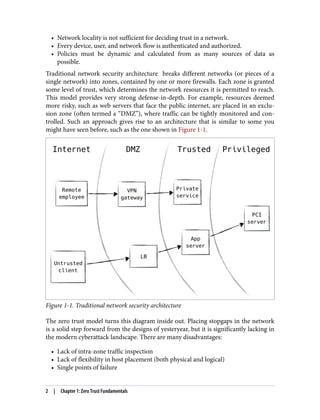
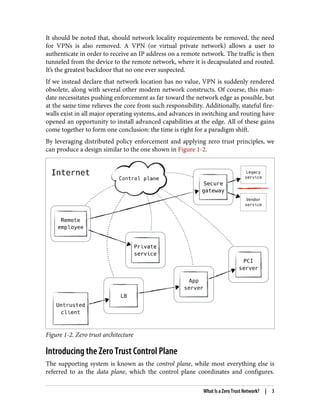
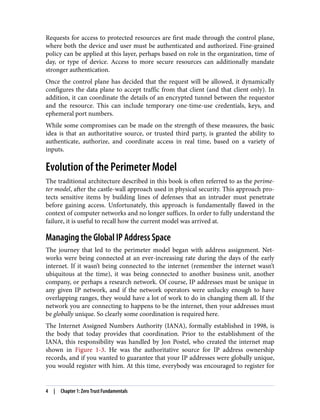
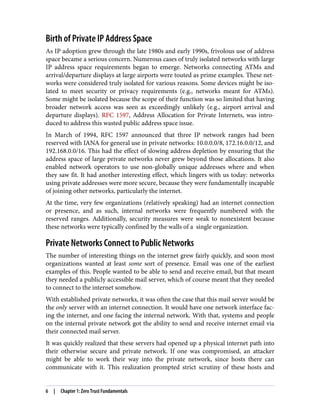
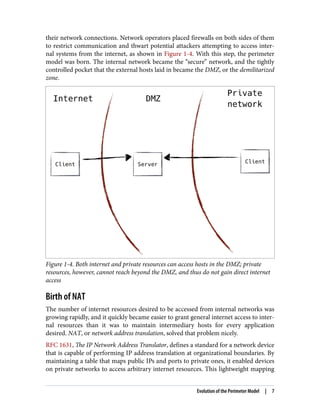
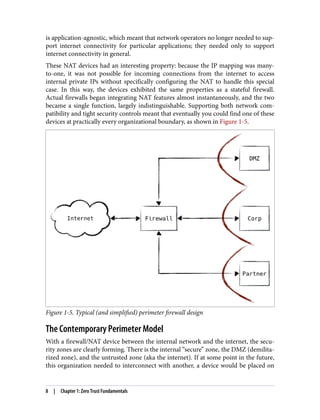
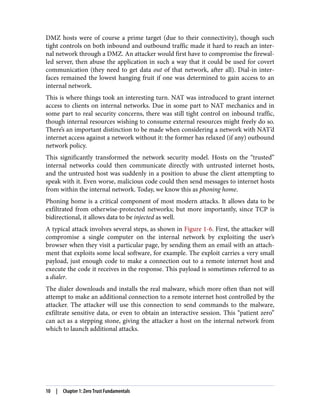
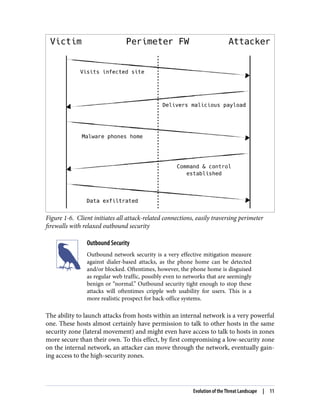
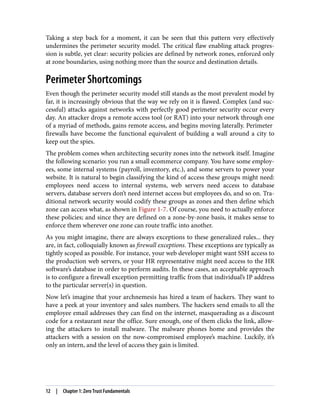
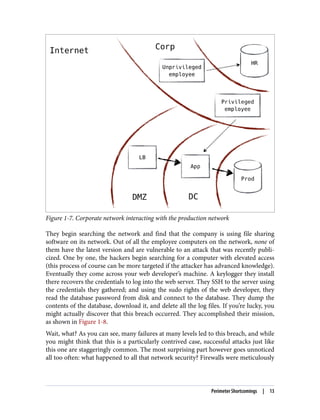
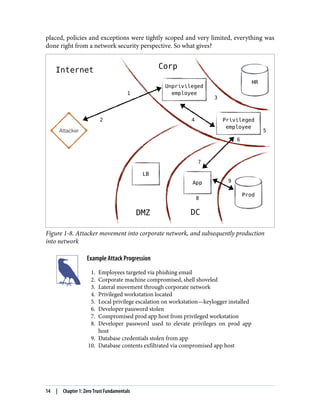
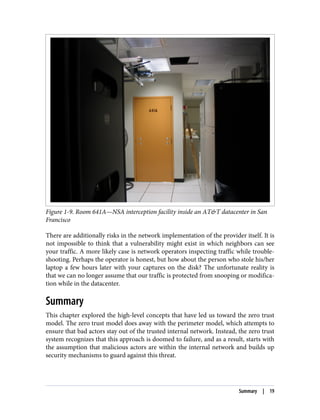
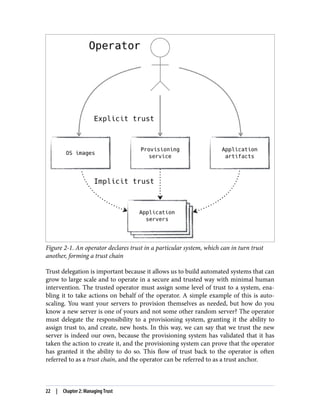
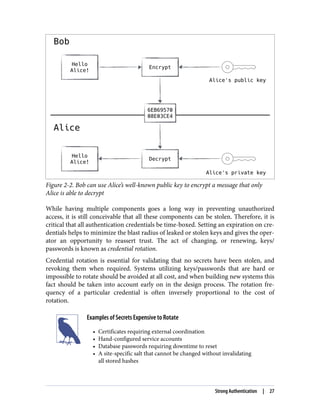
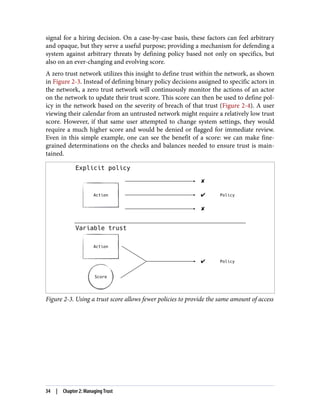





![This ebook is for the use of anyone anywhere in the United States
and most other parts of the world at no cost and with almost no
restrictions whatsoever. You may copy it, give it away or re-use it
under the terms of the Project Gutenberg License included with this
ebook or online at www.gutenberg.org. If you are not located in the
United States, you will have to check the laws of the country where
you are located before using this eBook.
Title: Bentley's Miscellany, Volume I
Author: Various
Editor: Charles Dickens
Publisher: Richard Bentley
Release date: January 4, 2014 [eBook #44578]
Language: English
Credits: Produced by Paul Marshall, Jason Isbell and the Online
Distributed Proofreading Team at http://www.pgdp.net
*** START OF THE PROJECT GUTENBERG EBOOK BENTLEY'S
MISCELLANY, VOLUME I ***](https://image.slidesharecdn.com/5823255-250531021939-656acc6f/85/Zero-Trust-Networks-Evan-Gilman-Doug-Barth-60-320.jpg)













![mane fitly appreciated. If he roars, good!—if he aggravates his voice
to the note of a sucking-dove, better! All look on in the appropriate
mood of delight, as Theseus and Hippolita, enraptured at the
dramatic performance of Snug the Joiner. But when there comes a
menagerie of lions, the case is altered. Too much familiarity, as the
lawyers say in their peculiar jargon, begets contempt. We recollect,
many years ago, when some ingenious artist in Paris proposed to
make Brussels lace or blonde by machinery at the rate of a sou per
ell, to have congratulated a lady of our acquaintance on this
important saving in the main expenditure of the fair sex. "You will
have," said we, "a cap which now costs four hundred francs for less
than fifty. Think of that!"
"Think of that!" said the countess, casting upon us the darkest
expression of indignation that her glowing eyes [and what eyes they
were!—but no matter] could let loose,—"think of that, indeed! Do
you think that I should ever wear such rags as are to be bought for
fifty francs?"
There was no arguing the matter: it was useless to say that the
fifty-franc article, if the plan had succeeded, (which, however, it did
not,) would have been precisely and in every thread the same as
that set down at five hundred. The crowd of fine things generated
by cheapness, in general, was quite enough to dim the finery of any
portion of them in particular.
We are much afraid that we run somewhat loose of our original
design in these rambling remarks. But it is always easy to come back
to the starting-post. Abandoning metaphor and figure of all kinds,
we were endeavouring to express our conviction, drawn from
experience, that a company of professed wits might be justly
suspected to be a dull concern. Every man is on the alert to guard
against surprise.
Through all the seven courses laid down,
Each jester looks sour on his brother;
The wit dreads the punster's renown,](https://image.slidesharecdn.com/5823255-250531021939-656acc6f/85/Zero-Trust-Networks-Evan-Gilman-Doug-Barth-74-320.jpg)