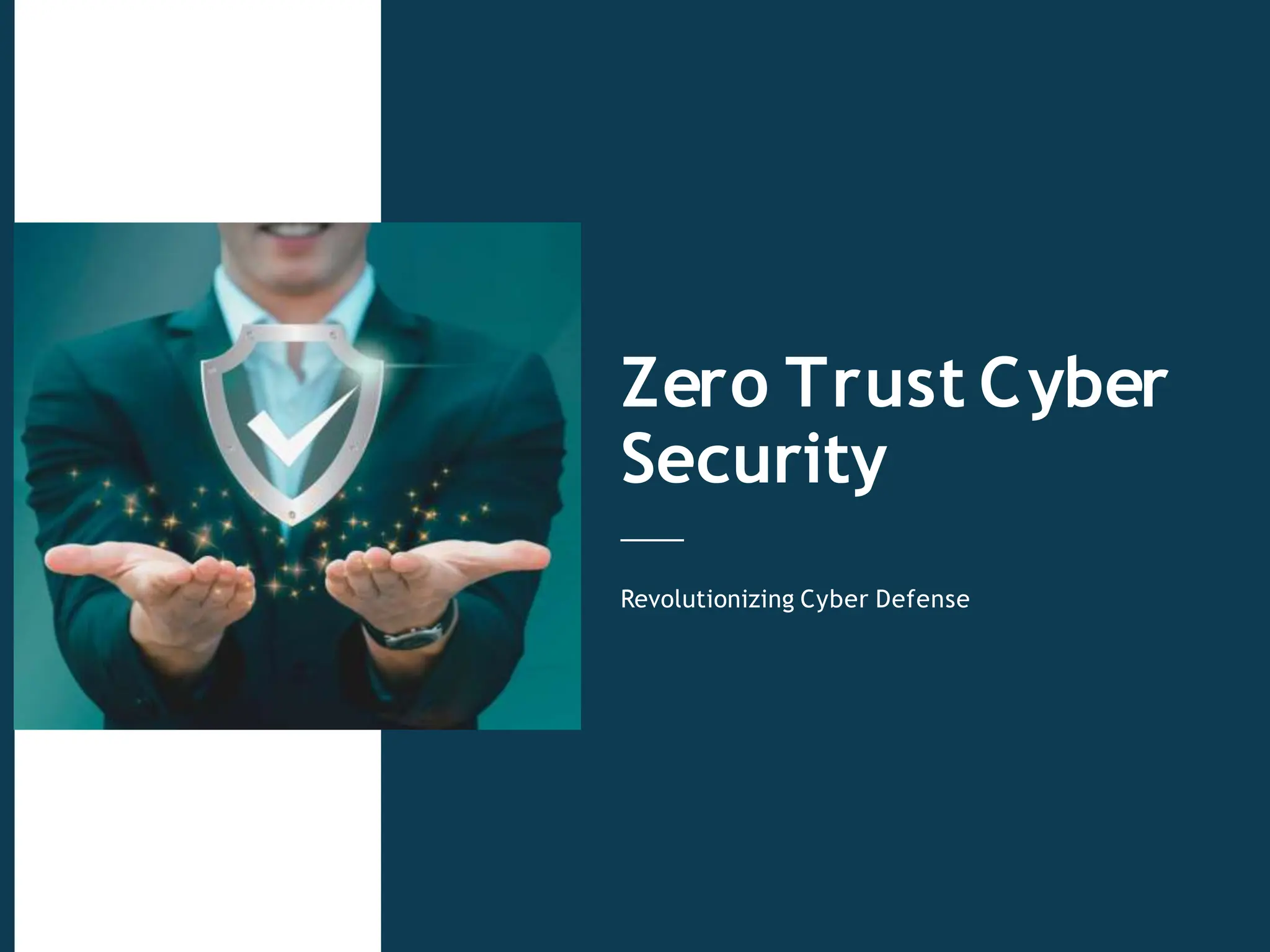
Zero Trust Cyber
Security
Revolutionizing Cyber Defense
What is
Zero Trust?
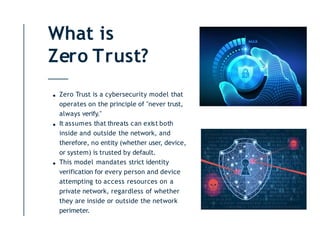
Zero Trust is a cybersecurity model that
operates on the principle of "never trust,
always verify."
It assumes that threats can exist both
inside and outside the network, and
therefore, no entity (whether user, device,
or system) is trusted by default.
This model mandates strict identity
verification for every person and device
attempting to access resources on a
private network, regardless of whether
they are inside or outside the network
perimeter.
Why Zero Trust is Crucial in
Modern Cybersecurity
Evolving Threat Landscape:
Cyber threats are becoming more sophisticated and frequent, exploiting weaknesses in traditional
perimeter-based security models.
Increased Insider Threats:
Zero Trust mitigates risks from insider threats by requiring verification for every access request,
regardless of origin.
Enhanced Data Protection:
Implements strict access controls, reducing the risk of data breaches by ensuring only authorized
users and devices access sensitive resources.
Regulatory Compliance:
Facilitates adherence to data protection regulations like GDPR and HIPAA by enforcing granular
access controls and maintaining detailed audit logs.
Regulatory Compliance:
Facilitates adherence to data protection regulations like GDPR and HIPAA by enforcing granular
access controls and maintaining detailed audit logs.
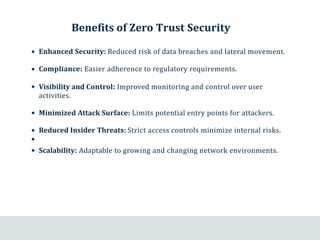
Benefits of Zero Trust Security
Enhanced Security: Reduced risk of data breaches and lateral movement.
Compliance: Easier adherence to regulatory requirements.
Visibility and Control: Improved monitoring and control over user
activities.
Minimized Attack Surface: Limits potential entry points for attackers.
Reduced Insider Threats: Strict access controls minimize internal risks.
Scalability: Adaptable to growing and changing network environments.
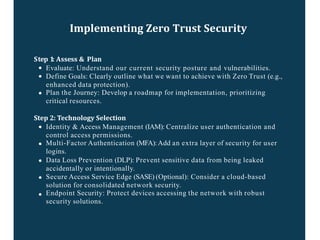
Implementing Zero Trust Security
Step 1
: Assess & Plan
Evaluate: Understand our current security posture and vulnerabilities.
Define Goals: Clearly outline what we want to achieve with Zero Trust (e.g.,
enhanced data protection).
Plan the Journey: Develop a roadmap for implementation, prioritizing
critical resources.
Step 2: Technology Selection
Identity & Access Management (IAM): Centralize user authentication and
control access permissions.
Multi-Factor Authentication (MFA):Add an extra layer of security for user
logins.
Data Loss Prevention (DLP): Prevent sensitive data from being leaked
accidentally or intentionally.
Secure Access Service Edge (SASE) (Optional): Consider a cloud-based
solution for consolidated network security.
Endpoint Security: Protect devices accessing the network with robust
security solutions.
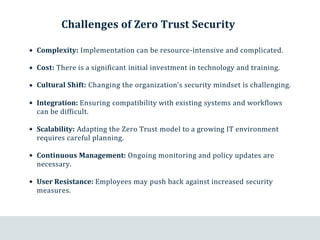
Challenges of Zero Trust Security
Complexity: Implementation can be resource-intensive and complicated.
Cost: There is a significant initial investment in technology and training.
Cultural Shift: Changing the organization’s security mindset is challenging.
Integration: Ensuring compatibility with existing systems and workflows
can be difficult.
Scalability: Adapting the Zero Trust model to a growing IT environment
requires careful planning.
Continuous Management: Ongoing monitoring and policy updates are
necessary.
User Resistance: Employees may push back against increased security
measures.
C
O
N
T
A
C
T
Website
Phone
Address
www.lumiversesolutions.com
9371099207
Gangapur Road, Nasik

Zero Trust Cyber Security | Zero Trust Security Solutions

  • 1.
  • 2.
    What is Zero Trust? ZeroTrust is a cybersecurity model that operates on the principle of "never trust, always verify." It assumes that threats can exist both inside and outside the network, and therefore, no entity (whether user, device, or system) is trusted by default. This model mandates strict identity verification for every person and device attempting to access resources on a private network, regardless of whether they are inside or outside the network perimeter.
  • 3.
    Why Zero Trustis Crucial in Modern Cybersecurity Evolving Threat Landscape: Cyber threats are becoming more sophisticated and frequent, exploiting weaknesses in traditional perimeter-based security models. Increased Insider Threats: Zero Trust mitigates risks from insider threats by requiring verification for every access request, regardless of origin. Enhanced Data Protection: Implements strict access controls, reducing the risk of data breaches by ensuring only authorized users and devices access sensitive resources. Regulatory Compliance: Facilitates adherence to data protection regulations like GDPR and HIPAA by enforcing granular access controls and maintaining detailed audit logs. Regulatory Compliance: Facilitates adherence to data protection regulations like GDPR and HIPAA by enforcing granular access controls and maintaining detailed audit logs.
  • 4.
    Benefits of ZeroTrust Security Enhanced Security: Reduced risk of data breaches and lateral movement. Compliance: Easier adherence to regulatory requirements. Visibility and Control: Improved monitoring and control over user activities. Minimized Attack Surface: Limits potential entry points for attackers. Reduced Insider Threats: Strict access controls minimize internal risks. Scalability: Adaptable to growing and changing network environments.
  • 5.
    Implementing Zero TrustSecurity Step 1 : Assess & Plan Evaluate: Understand our current security posture and vulnerabilities. Define Goals: Clearly outline what we want to achieve with Zero Trust (e.g., enhanced data protection). Plan the Journey: Develop a roadmap for implementation, prioritizing critical resources. Step 2: Technology Selection Identity & Access Management (IAM): Centralize user authentication and control access permissions. Multi-Factor Authentication (MFA):Add an extra layer of security for user logins. Data Loss Prevention (DLP): Prevent sensitive data from being leaked accidentally or intentionally. Secure Access Service Edge (SASE) (Optional): Consider a cloud-based solution for consolidated network security. Endpoint Security: Protect devices accessing the network with robust security solutions.
  • 6.
    Challenges of ZeroTrust Security Complexity: Implementation can be resource-intensive and complicated. Cost: There is a significant initial investment in technology and training. Cultural Shift: Changing the organization’s security mindset is challenging. Integration: Ensuring compatibility with existing systems and workflows can be difficult. Scalability: Adapting the Zero Trust model to a growing IT environment requires careful planning. Continuous Management: Ongoing monitoring and policy updates are necessary. User Resistance: Employees may push back against increased security measures.
  • 7.