M
A
T
E
R
I
A
L
S
&
A
S
S
E
M
B
L
I
E
S
I
V
Stud wall/ Dry
wall
Nirzari Desai...................................................................U19013
Dhwani Doshi................................................................U19201
Mayan Vora.....................................................................U19152
Kushang Barot..............................................................U19035
ANANT NATIONAL UNIVERSITY SEMESTER 6
LIST OF TOPICS
What is a stud wall?
Why do we build a stud wall?
The basic structure of the stud
wall
Types of stud walls
Materials for construction
Stage wise sequence of
construction or Erection process
on site.
Dimensions, detailing & boards
P
R
E
S
E
N
T
A
T
I
O
N
O
U
T
L
I
N
E
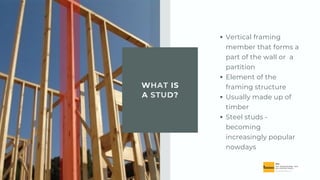
WHAT IS
A STUD?
Vertical framing
member that forms a
part of the wall or a
partition
Element of the
framing structure
Usually made up of
timber
Steel studs -
becoming
increasingly popular
nowdays
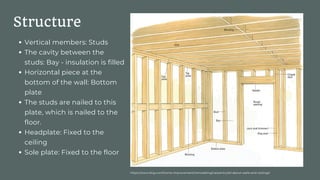
Vertical members: Studs
The cavity between the
studs: Bay - insulation is filled
Horizontal piece at the
bottom of the wall: Bottom
plate
The studs are nailed to this
plate, which is nailed to the
floor.
Headplate: Fixed to the
ceiling
Sole plate: Fixed to the floor
Structure
https://www.bhg.com/home-improvement/remodeling/carpentry/all-about-walls-and-ceilings/
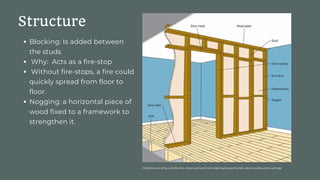
Blocking: Is added between
the studs
Why: Acts as a fire-stop
Without fire-stops, a fire could
quickly spread from floor to
floor.
Nogging: a horizontal piece of
wood fixed to a framework to
strengthen it.
Structure
https://www.bhg.com/home-improvement/remodeling/carpentry/all-about-walls-and-ceilings/
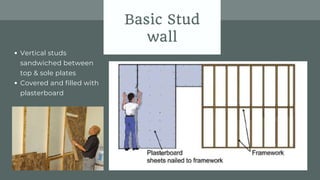
Basic Stud
wall
Vertical studs
sandwiched between
top & sole plates
Covered and filled with
plasterboard
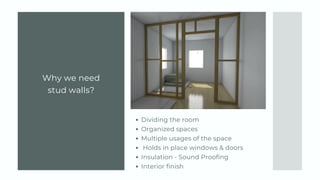
Why we need
stud walls?
Dividing the room
Organized spaces
Multiple usages of the space
Holds in place windows & doors
Insulation - Sound Proofing
Interior finish
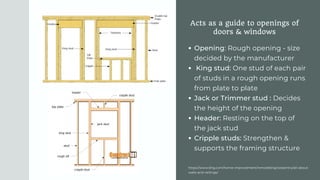
Opening: Rough opening - size
decided by the manufacturer
King stud: One stud of each pair
of studs in a rough opening runs
from plate to plate
Jack or Trimmer stud : Decides
the height of the opening
Header: Resting on the top of
the jack stud
Cripple studs: Strengthen &
supports the framing structure
Acts as a guide to openings of
doors & windows
https://www.bhg.com/home-improvement/remodeling/carpentry/all-about-
walls-and-ceilings/
Durable - care should be
taken while installing
them - dry - shrinking &
expanding
Easy to cut - Flexible -
more options for
creativity
Heavier in weight
Not prone to moisture
Can easily rot
Wood Studs
Durable than wood: Not affected
by fire, termites, rot, splitting.
Perfectly straight - Difficult to cut
Steel studs are lighter to carry and
store than wood because they are
hollow - Lightweight
Works well in bathrooms, & other
water prone areas - not affected
by the moisture
Easily rusted
Steel Studs
MATERIALS FOR
CONSTRUCTION
Wooden studs are usually made
of spruce, Douglas fir/ sawn
timber.
Types of wood used in Indian
context:
Standard sizes- 914*450 mm /
914*610 mm
Height- 2450 / 3048 mm
Width- 914 to 1220 mm could be
610 mm as well depending on the
area
Materials used for studs:
Pine, Chill, Meranti,Teak
Metals studs are made up of
steel.
It is lightweight and durable.
Sheet materials, such as
plywood and drywall or
plasterboard, are fastened to
the stud frame after
construction.
When sealed offers good
sound and fire resistance to
partition.
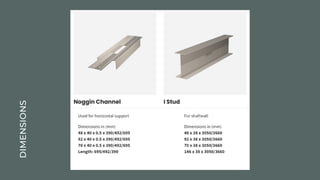
DIMENSIONS
DIMENSIONS
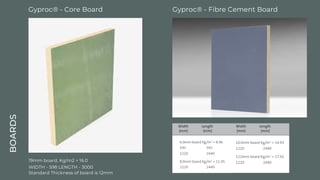
Gyproc® - Core Board
19mm board, Kg/m2 = 16.0
WIDTH - 598 LENGTH - 3000
Gyproc® - Fibre Cement Board
BOARDS
Standard Thickness of board is 12mm
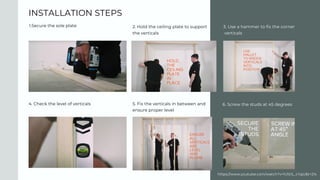
INSTALLATION STEPS
1.Secure the sole plate 3. Use a hammer to fix the corner
verticals
4. Check the level of verticals
2. Hold the ceiling plate to support
the verticals
5. Fix the verticals in between and
ensure proper level
6. Screw the studs at 45 degrees
https://www.youtube.com/watch?v=hJlz1L_cYgU&t=21s
7. Secure the ceiling plates
8. Add horizontal noggins between the studs according
to board measurements
9. Secure noggings with screws 10. Screw boards on noggings
https://www.youtube.com/watch?v=hJlz1L_cYgU&t=21s
Stud -Metal Wall System
Cutting V - Shape in floor
track
Bending
Limitation of bending
the partition
Curve Partition Detail
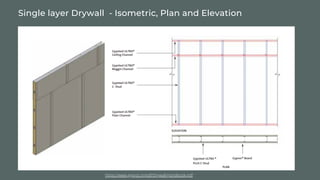
Single layer Drywall - Isometric, Plan and Elevation
https://www.gyproc.in/pdf/Drywall-Handbook.pdf
DETAILING
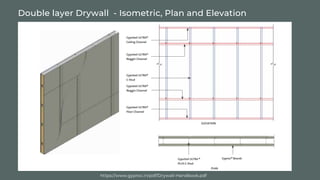
Double layer Drywall - Isometric, Plan and Elevation
https://www.gyproc.in/pdf/Drywall-Handbook.pdf
Why we need Double
Layer Dry wall ?
Sound Insulation;
through the air
cavity created
between two sides
plasterboards
Impact Resistance
Sound Absorption
DETAILING

MATERIALS STUD WALL .pdf

  • 1.
    M A T E R I A L S & A S S E M B L I E S I V Stud wall/ Dry wall NirzariDesai...................................................................U19013 Dhwani Doshi................................................................U19201 Mayan Vora.....................................................................U19152 Kushang Barot..............................................................U19035 ANANT NATIONAL UNIVERSITY SEMESTER 6
  • 2.
    LIST OF TOPICS Whatis a stud wall? Why do we build a stud wall? The basic structure of the stud wall Types of stud walls Materials for construction Stage wise sequence of construction or Erection process on site. Dimensions, detailing & boards P R E S E N T A T I O N O U T L I N E
  • 3.
    WHAT IS A STUD? Verticalframing member that forms a part of the wall or a partition Element of the framing structure Usually made up of timber Steel studs - becoming increasingly popular nowdays
  • 4.
    Vertical members: Studs Thecavity between the studs: Bay - insulation is filled Horizontal piece at the bottom of the wall: Bottom plate The studs are nailed to this plate, which is nailed to the floor. Headplate: Fixed to the ceiling Sole plate: Fixed to the floor Structure https://www.bhg.com/home-improvement/remodeling/carpentry/all-about-walls-and-ceilings/
  • 5.
    Blocking: Is addedbetween the studs Why: Acts as a fire-stop Without fire-stops, a fire could quickly spread from floor to floor. Nogging: a horizontal piece of wood fixed to a framework to strengthen it. Structure https://www.bhg.com/home-improvement/remodeling/carpentry/all-about-walls-and-ceilings/
  • 6.
    Basic Stud wall Vertical studs sandwichedbetween top & sole plates Covered and filled with plasterboard
  • 7.
    Why we need studwalls? Dividing the room Organized spaces Multiple usages of the space Holds in place windows & doors Insulation - Sound Proofing Interior finish
  • 8.
    Opening: Rough opening- size decided by the manufacturer King stud: One stud of each pair of studs in a rough opening runs from plate to plate Jack or Trimmer stud : Decides the height of the opening Header: Resting on the top of the jack stud Cripple studs: Strengthen & supports the framing structure Acts as a guide to openings of doors & windows https://www.bhg.com/home-improvement/remodeling/carpentry/all-about- walls-and-ceilings/
  • 9.
    Durable - careshould be taken while installing them - dry - shrinking & expanding Easy to cut - Flexible - more options for creativity Heavier in weight Not prone to moisture Can easily rot Wood Studs Durable than wood: Not affected by fire, termites, rot, splitting. Perfectly straight - Difficult to cut Steel studs are lighter to carry and store than wood because they are hollow - Lightweight Works well in bathrooms, & other water prone areas - not affected by the moisture Easily rusted Steel Studs
  • 10.
    MATERIALS FOR CONSTRUCTION Wooden studsare usually made of spruce, Douglas fir/ sawn timber. Types of wood used in Indian context: Standard sizes- 914*450 mm / 914*610 mm Height- 2450 / 3048 mm Width- 914 to 1220 mm could be 610 mm as well depending on the area Materials used for studs: Pine, Chill, Meranti,Teak
  • 11.
    Metals studs aremade up of steel. It is lightweight and durable. Sheet materials, such as plywood and drywall or plasterboard, are fastened to the stud frame after construction. When sealed offers good sound and fire resistance to partition.
  • 12.
  • 13.
  • 14.
    Gyproc® - CoreBoard 19mm board, Kg/m2 = 16.0 WIDTH - 598 LENGTH - 3000 Gyproc® - Fibre Cement Board BOARDS Standard Thickness of board is 12mm
  • 15.
    INSTALLATION STEPS 1.Secure thesole plate 3. Use a hammer to fix the corner verticals 4. Check the level of verticals 2. Hold the ceiling plate to support the verticals 5. Fix the verticals in between and ensure proper level 6. Screw the studs at 45 degrees https://www.youtube.com/watch?v=hJlz1L_cYgU&t=21s
  • 16.
    7. Secure theceiling plates 8. Add horizontal noggins between the studs according to board measurements 9. Secure noggings with screws 10. Screw boards on noggings https://www.youtube.com/watch?v=hJlz1L_cYgU&t=21s
  • 17.
  • 19.
    Cutting V -Shape in floor track Bending Limitation of bending the partition Curve Partition Detail
  • 20.
    Single layer Drywall- Isometric, Plan and Elevation https://www.gyproc.in/pdf/Drywall-Handbook.pdf
  • 21.
  • 22.
    Double layer Drywall- Isometric, Plan and Elevation https://www.gyproc.in/pdf/Drywall-Handbook.pdf
  • 23.
    Why we needDouble Layer Dry wall ? Sound Insulation; through the air cavity created between two sides plasterboards Impact Resistance Sound Absorption
  • 24.