CONSTRUCTION
QUALITY AND CONTROL
MANAGEMENT
Prepared By:-
Makwana Ajay
136250306028
REQUIREMENTS OF
GOOD FORMWORK
A good formwork should satisfy the
following requirements
1. Easy removal
2. Economy
3. Strength
4. Rigidity
5. Less leakage
6. smooth surface
7. Light weight
8. Quality
9. supports
1. Easy removal
The design of formwork should be
such that it can be removed easily with
least amount of hammering.
The removal of formwork should
cause least injury to the surface or
edges of the concrete.
2. Economy
As the formwork does not contribute
anything to the stability of the
finished structure, it should
therefore, be made economical by
reducing the cost through proper
design and construction.
3. Strength
The formwork should be strong
enough to withstand all loads coming
on it, such as dead load of
concrete. and live load during its
pouring. compaction and curing.
The loads on formwork should be
estimated carefully. The over-estimation
of loads result in expensive formwork
and the under estimation of loads
results in the failure of formwork.
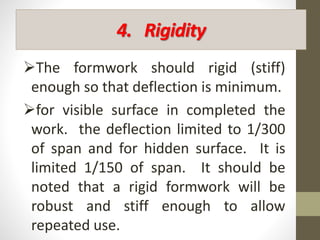
4. Rigidity
The formwork should rigid (stiff)
enough so that deflection is minimum.
for visible surface in completed the
work. the deflection limited to 1/300
of span and for hidden surface. It is
limited 1/150 of span. It should be
noted that a rigid formwork will be
robust and stiff enough to allow
repeated use.
5. Less leakage
The formwork should be so arranged
that there is minimum of leakage
through the joints. This is achieved
providing tight joints between
adjacent sections of the formwork.
6. smooth surface
The surface of the formwork should
be smooth, and it should afford easy
stripping This is achieved by applying
crude oil or soft soap solution to the
inside surface of formwork.
Formwok

Formwok

  • 1.
  • 2.
  • 3.
    A good formworkshould satisfy the following requirements 1. Easy removal 2. Economy 3. Strength 4. Rigidity 5. Less leakage 6. smooth surface 7. Light weight 8. Quality 9. supports
  • 4.
    1. Easy removal Thedesign of formwork should be such that it can be removed easily with least amount of hammering. The removal of formwork should cause least injury to the surface or edges of the concrete.
  • 5.
    2. Economy As theformwork does not contribute anything to the stability of the finished structure, it should therefore, be made economical by reducing the cost through proper design and construction.
  • 6.
    3. Strength The formworkshould be strong enough to withstand all loads coming on it, such as dead load of concrete. and live load during its pouring. compaction and curing.
  • 7.
    The loads onformwork should be estimated carefully. The over-estimation of loads result in expensive formwork and the under estimation of loads results in the failure of formwork.
  • 8.
    4. Rigidity The formworkshould rigid (stiff) enough so that deflection is minimum. for visible surface in completed the work. the deflection limited to 1/300 of span and for hidden surface. It is limited 1/150 of span. It should be noted that a rigid formwork will be robust and stiff enough to allow repeated use.
  • 9.
    5. Less leakage Theformwork should be so arranged that there is minimum of leakage through the joints. This is achieved providing tight joints between adjacent sections of the formwork.
  • 10.
    6. smooth surface Thesurface of the formwork should be smooth, and it should afford easy stripping This is achieved by applying crude oil or soft soap solution to the inside surface of formwork.