FORMULATION AND EVALUTION OF 
SUSTAINED RELEASE MATRIX TABLETS 
OF GLICLAZIDE 
Santhosh Kotagiri 
SCOPS 
Department of Pharmaceutics 1
Contents; 
Introduction 
Aim & Objective 
List of materials and Equipment 
Drug and Excipient profiles 
Methods used 
Results and Discussion 
Summary 
Department of Pharmaceutics 2
Sustained release drug: 
sustained release as “Any dosage form that provide medication over an 
extended time” and 
controlled release as “Any dosage form which is able to provide some actual 
therapeutic control 
Advantages of SR Drugs: 
 Improved patient convenience and compliance due to less frequent drug 
administration. 
 Reduction in fluctuation in steady-state levels and therefore better control 
of disease condition and reduced intensity of local or systemic side effects. 
 Increased safety margin of high potency drugs due to better control of 
plasma levels. 
 Maximum utilization of drug enabling reduction in total amount of dose 
administered. 
 Reduction in health care costs through improved therapy, shorter 
treatment period, less frequency of dosing and reduction in personnel time 
to dispense, administer and monitor patients 
Department of Pharmaceutics 3
Disadvantages of SR Drugs: 
 Decreased systemic availability in comparison to immediate release 
conventional dosage forms; this may be due to incomplete release, 
increased first-pass metabolism, increased instability, insufficient residence 
time for complete release, site-specific absorption, pH-depent solubility, 
etc. 
 Poor in vitro-in vivo correlation. 
 Possibility of dose dumping due to food, physiologic or formulation 
variables or chewing or grinding of oral formulations by the patient and 
thus, increased risk of toxicity 
 Retrieval of drug is difficult in case of toxicity, poisoning or hypersensitivity 
reactions. 
 Higher cost of formulation 
Department of Pharmaceutics 4
Diabetes mellitus: 
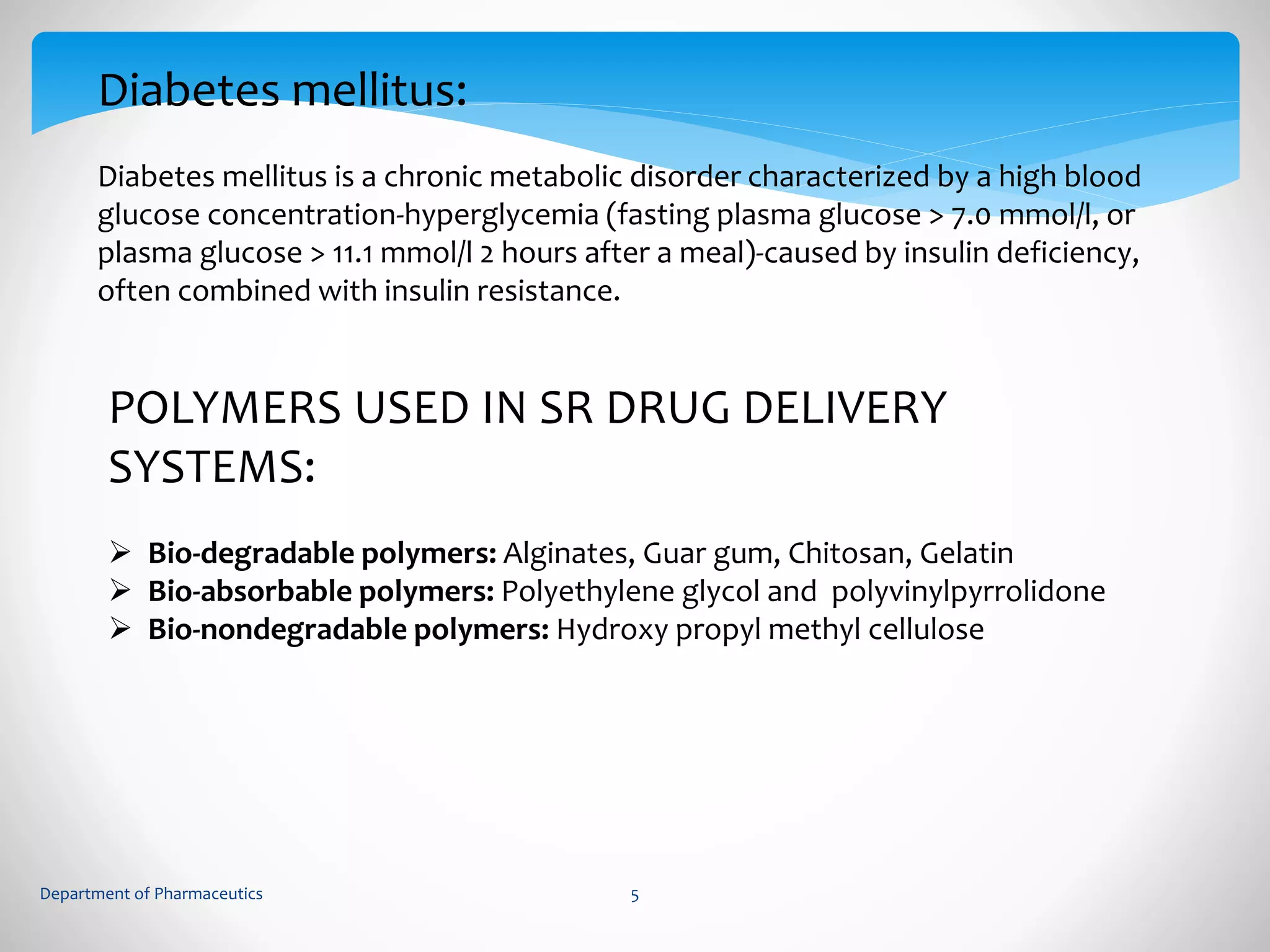
Diabetes mellitus is a chronic metabolic disorder characterized by a high blood 
glucose concentration-hyperglycemia (fasting plasma glucose > 7.0 mmol/l, or 
plasma glucose > 11.1 mmol/l 2 hours after a meal)-caused by insulin deficiency, 
often combined with insulin resistance. 
POLYMERS USED IN SR DRUG DELIVERY 
SYSTEMS: 
 Bio-degradable polymers: Alginates, Guar gum, Chitosan, Gelatin 
 Bio-absorbable polymers: Polyethylene glycol and polyvinylpyrrolidone 
 Bio-nondegradable polymers: Hydroxy propyl methyl cellulose 
Department of Pharmaceutics 5
AIM & OBJECTIVE: 
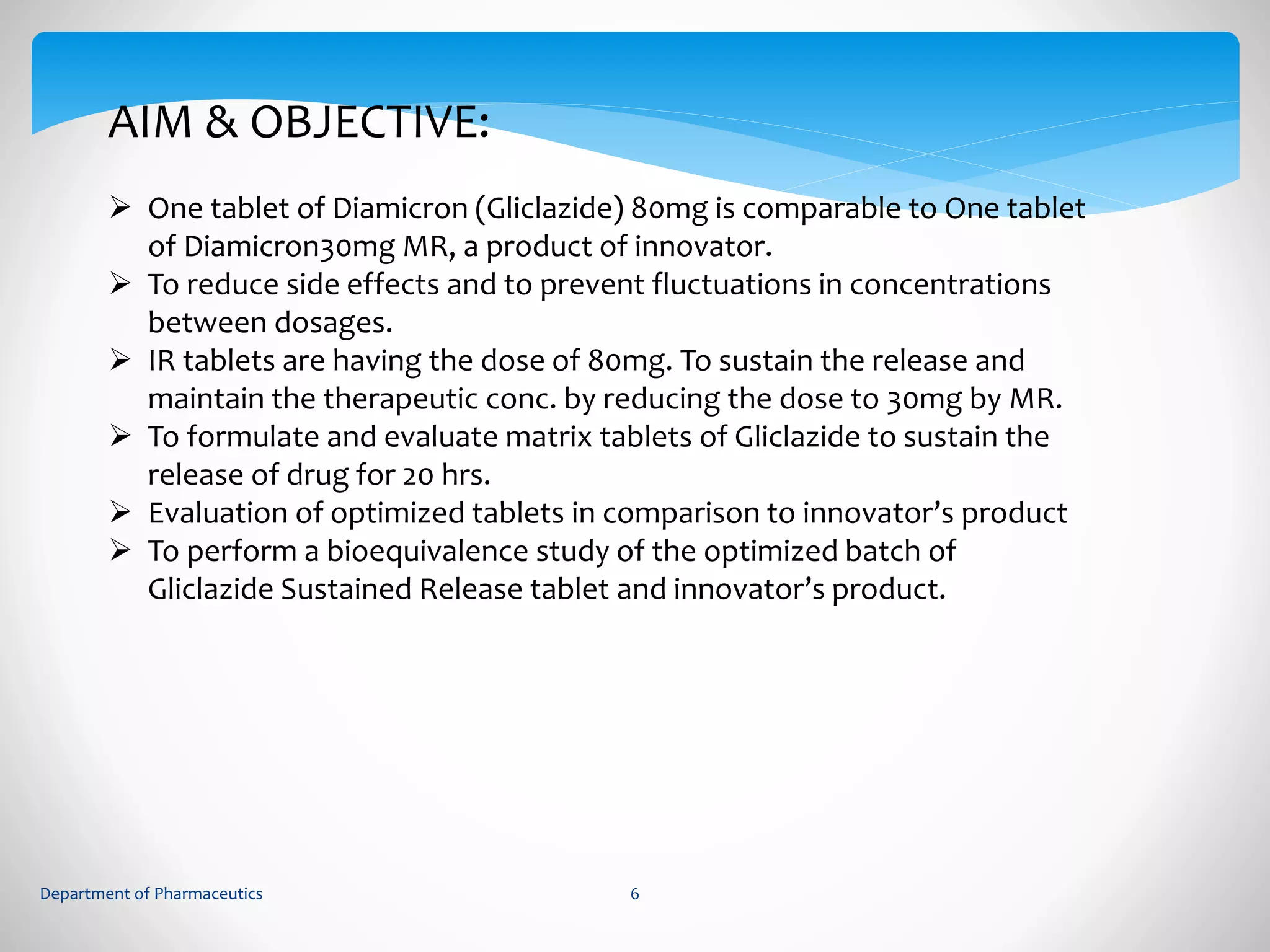
 One tablet of Diamicron (Gliclazide) 80mg is comparable to One tablet 
of Diamicron30mg MR, a product of innovator. 
 To reduce side effects and to prevent fluctuations in concentrations 
between dosages. 
 IR tablets are having the dose of 80mg. To sustain the release and 
maintain the therapeutic conc. by reducing the dose to 30mg by MR. 
 To formulate and evaluate matrix tablets of Gliclazide to sustain the 
release of drug for 20 hrs. 
 Evaluation of optimized tablets in comparison to innovator’s product 
 To perform a bioequivalence study of the optimized batch of 
Gliclazide Sustained Release tablet and innovator’s product. 
Department of Pharmaceutics 6
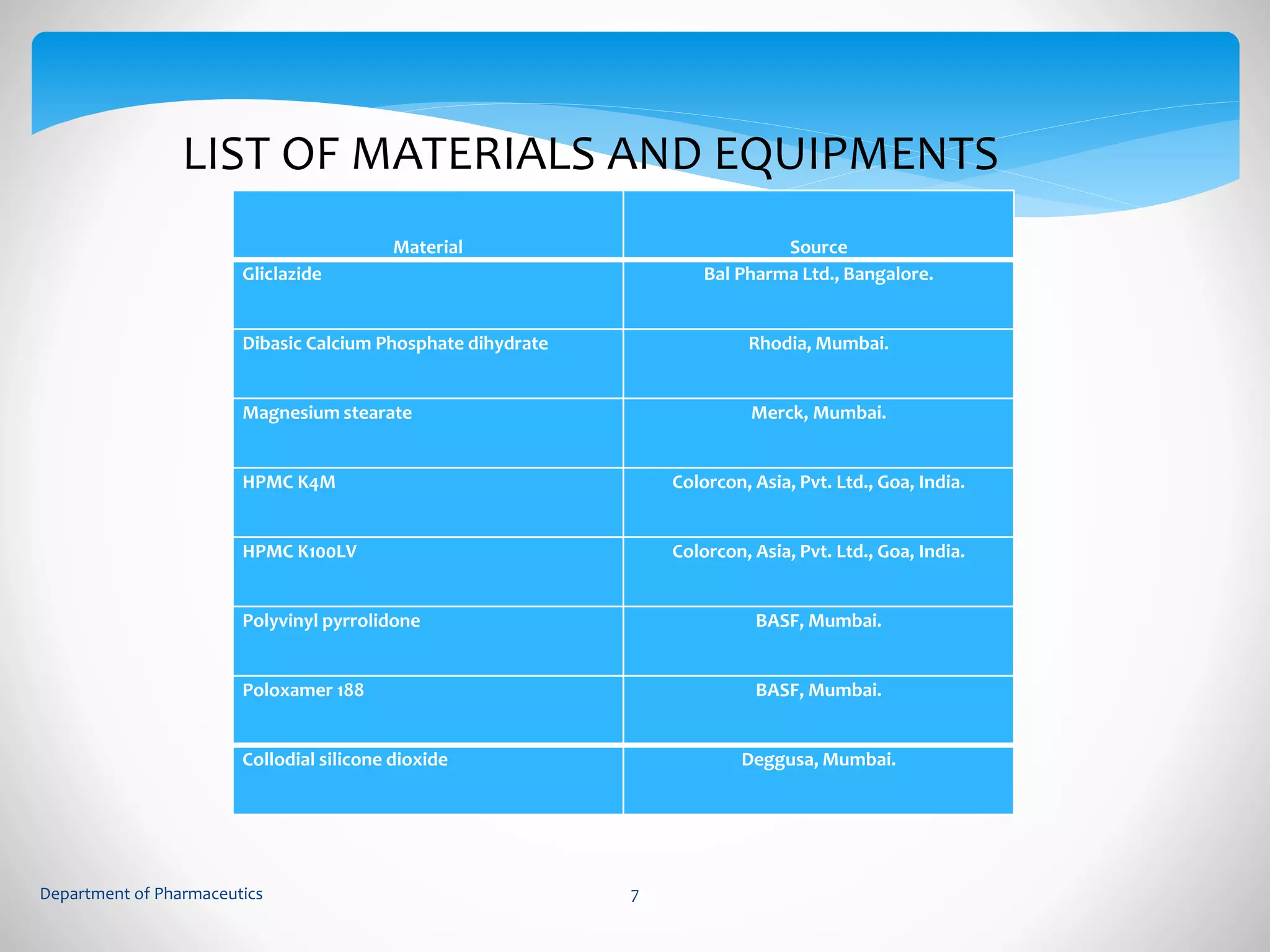
LIST OF MATERIALS AND EQUIPMENTS 
Material Source 
Gliclazide Bal Pharma Ltd., Bangalore. 
Dibasic Calcium Phosphate dihydrate Rhodia, Mumbai. 
Magnesium stearate Merck, Mumbai. 
HPMC K4M Colorcon, Asia, Pvt. Ltd., Goa, India. 
HPMC K100LV Colorcon, Asia, Pvt. Ltd., Goa, India. 
Polyvinyl pyrrolidone BASF, Mumbai. 
Poloxamer 188 BASF, Mumbai. 
Collodial silicone dioxide Deggusa, Mumbai. 
Department of Pharmaceutics 7
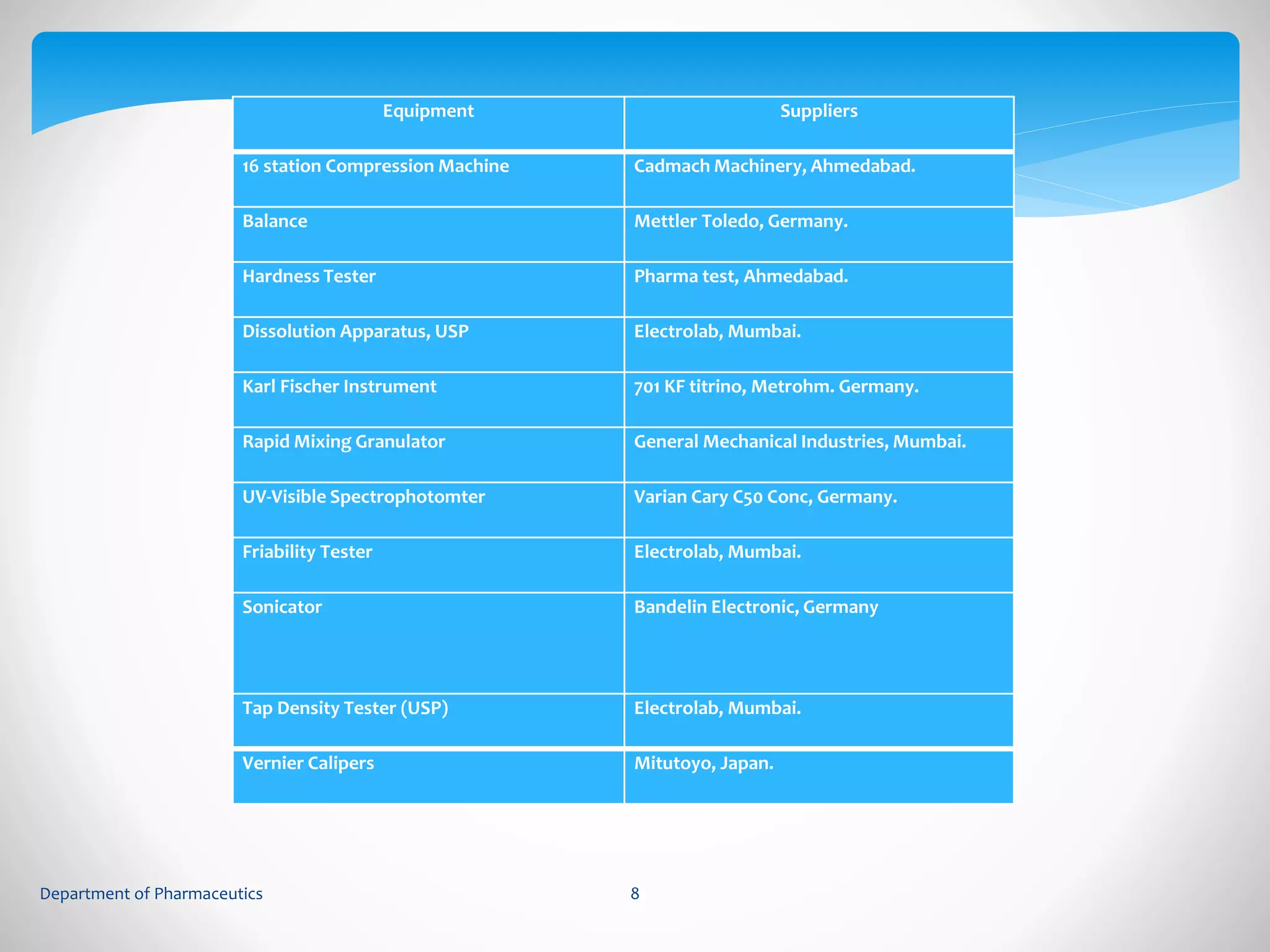
Equipment Suppliers 
16 station Compression Machine Cadmach Machinery, Ahmedabad. 
Balance Mettler Toledo, Germany. 
Hardness Tester Pharma test, Ahmedabad. 
Dissolution Apparatus, USP Electrolab, Mumbai. 
Karl Fischer Instrument 701 KF titrino, Metrohm. Germany. 
Rapid Mixing Granulator General Mechanical Industries, Mumbai. 
UV-Visible Spectrophotomter Varian Cary C50 Conc, Germany. 
Friability Tester Electrolab, Mumbai. 
Sonicator Bandelin Electronic, Germany 
Tap Density Tester (USP) Electrolab, Mumbai. 
Vernier Calipers Mitutoyo, Japan. 
Department of Pharmaceutics 8
DRUG PROFILE 
 Synonym : Gliclazidum 
 Chemical name : N-[[(Hexahydrocyclopenta[c]pyrrol-2(1H)-yl) amino] carbonyl]-4- 
methylbenzenesulfonamide. 
 Empirical formula : C15H21N3O3S 
 Molecular weight: 323.4g/mol. 
 Melting point : 163oC to 165°C 
 Half-life: 6 to 14 h 
 Bioavailability: About 79 to 100% 
 Dissociation Constant: pKa 6.6 
Chemical Structure 
Mechanism of action: 
primary effect is to potentiate glucose-stimulated insulin release from 
functioning pancreatic islet β-cells. 
Department of Pharmaceutics 9
EXCIPENTS 
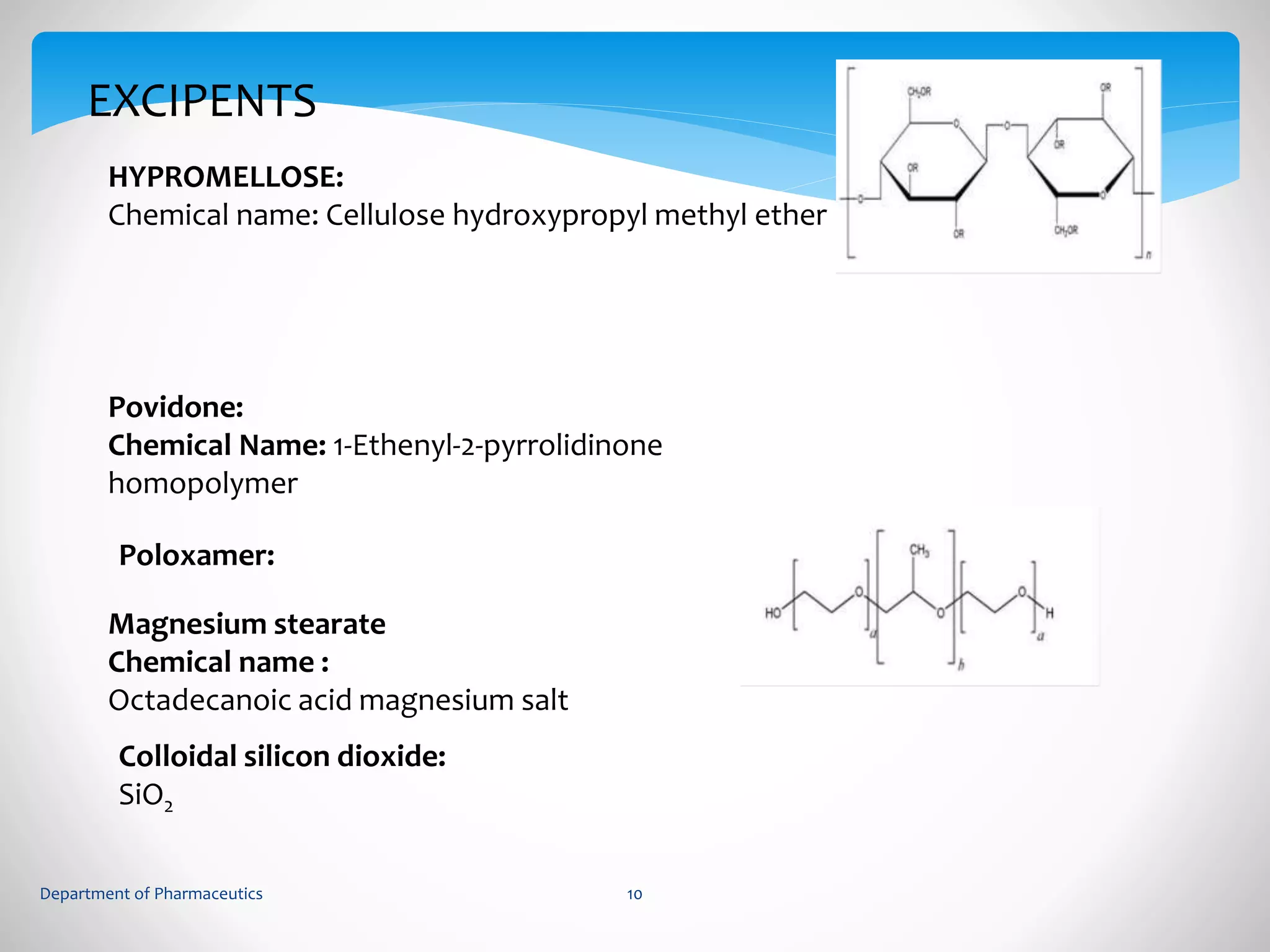
HYPROMELLOSE: 
Chemical name: Cellulose hydroxypropyl methyl ether 
Povidone: 
Chemical Name: 1-Ethenyl-2-pyrrolidinone 
homopolymer 
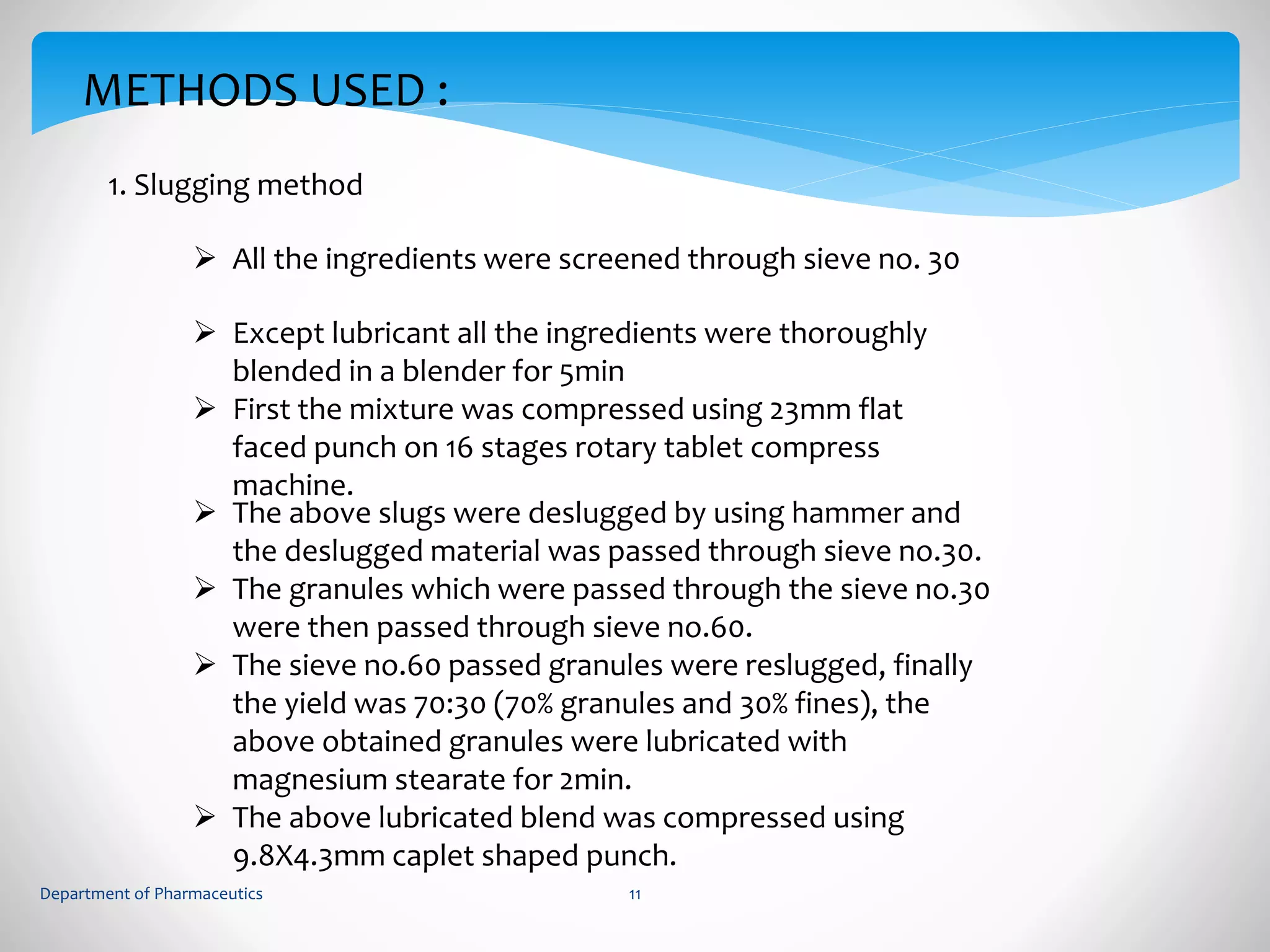
Poloxamer: 
Magnesium stearate 
Chemical name : 
Octadecanoic acid magnesium salt 
Colloidal silicon dioxide: 
SiO2 
Department of Pharmaceutics 10
METHODS USED : 
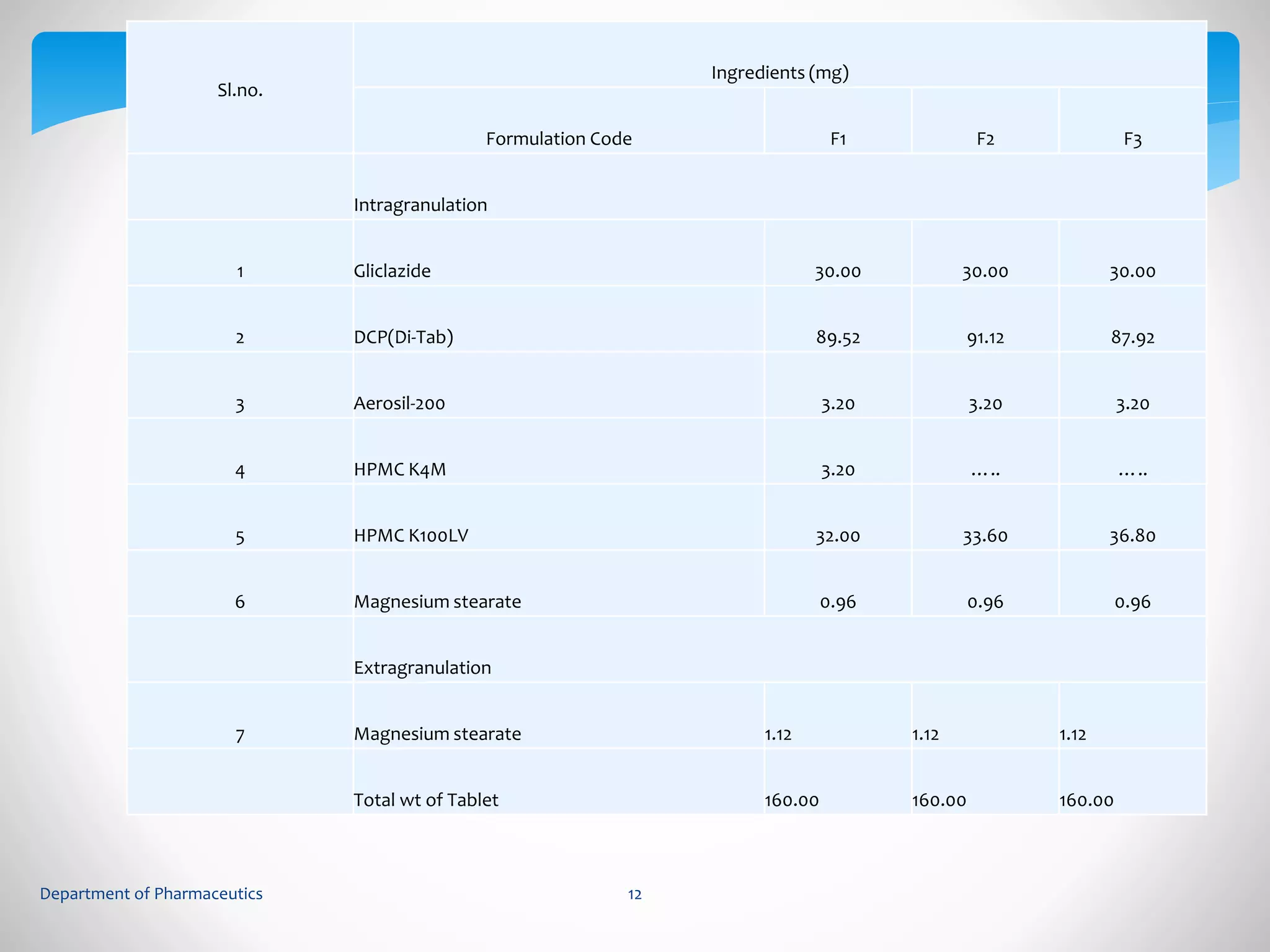
1. Slugging method 
 All the ingredients were screened through sieve no. 30 
 Except lubricant all the ingredients were thoroughly 
blended in a blender for 5min 
 First the mixture was compressed using 23mm flat 
faced punch on 16 stages rotary tablet compress 
machine. 
 The above slugs were deslugged by using hammer and 
the deslugged material was passed through sieve no.30. 
 The granules which were passed through the sieve no.30 
were then passed through sieve no.60. 
 The sieve no.60 passed granules were reslugged, finally 
the yield was 70:30 (70% granules and 30% fines), the 
above obtained granules were lubricated with 
magnesium stearate for 2min. 
 The above lubricated blend was compressed using 
9.8X4.3mm caplet shaped punch. 
Department of Pharmaceutics 11
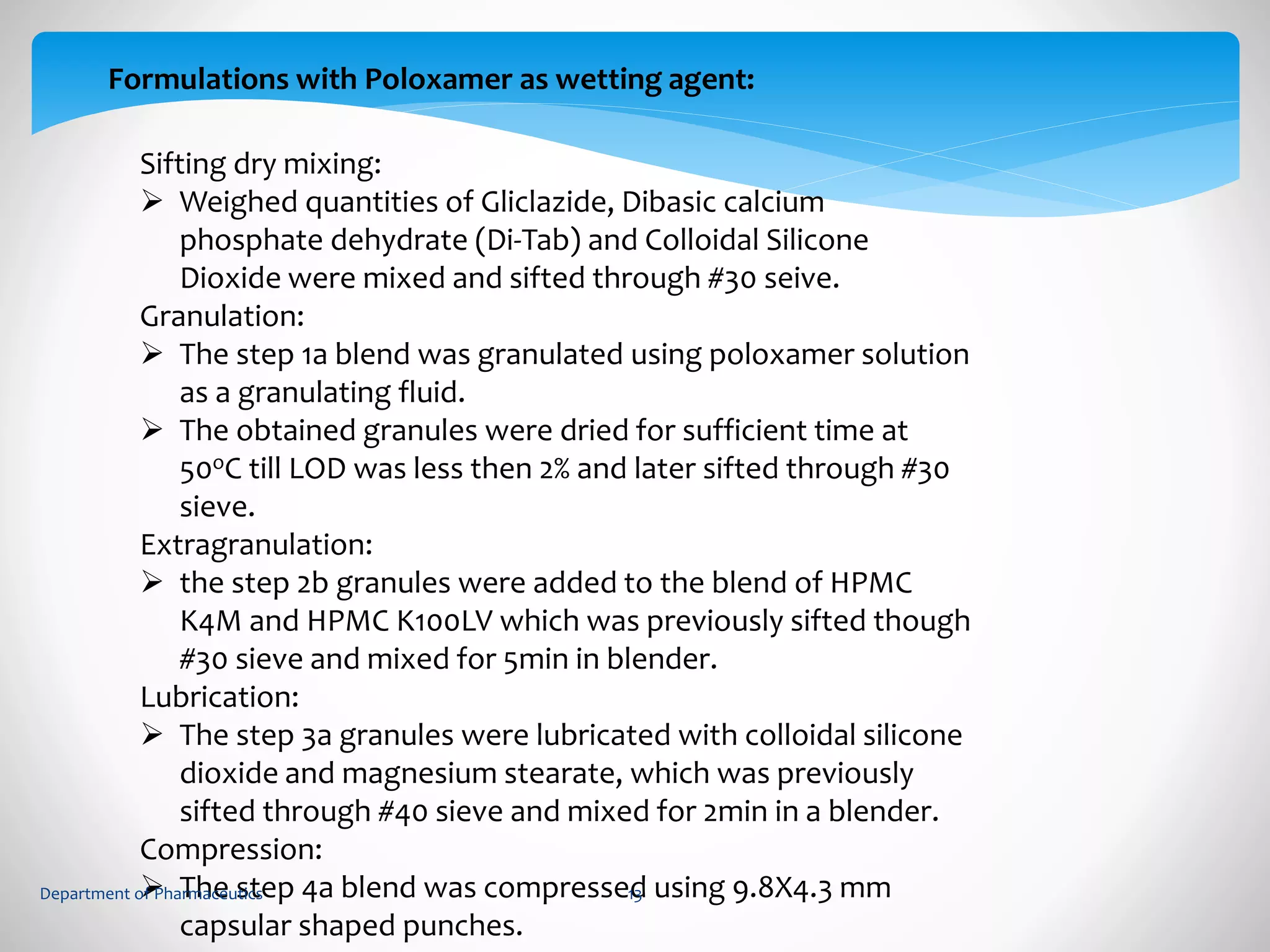
Sl.no. 
Ingredients (mg) 
Formulation Code F1 F2 F3 
Intragranulation 
1 Gliclazide 30.00 30.00 30.00 
2 DCP(Di-Tab) 89.52 91.12 87.92 
3 Aerosil-200 3.20 3.20 3.20 
4 HPMC K4M 3.20 ….. ….. 
5 HPMC K100LV 32.00 33.60 36.80 
6 Magnesium stearate 0.96 0.96 0.96 
Extragranulation 
7 Magnesium stearate 1.12 1.12 1.12 
Total wt of Tablet 160.00 160.00 160.00 
Department of Pharmaceutics 12
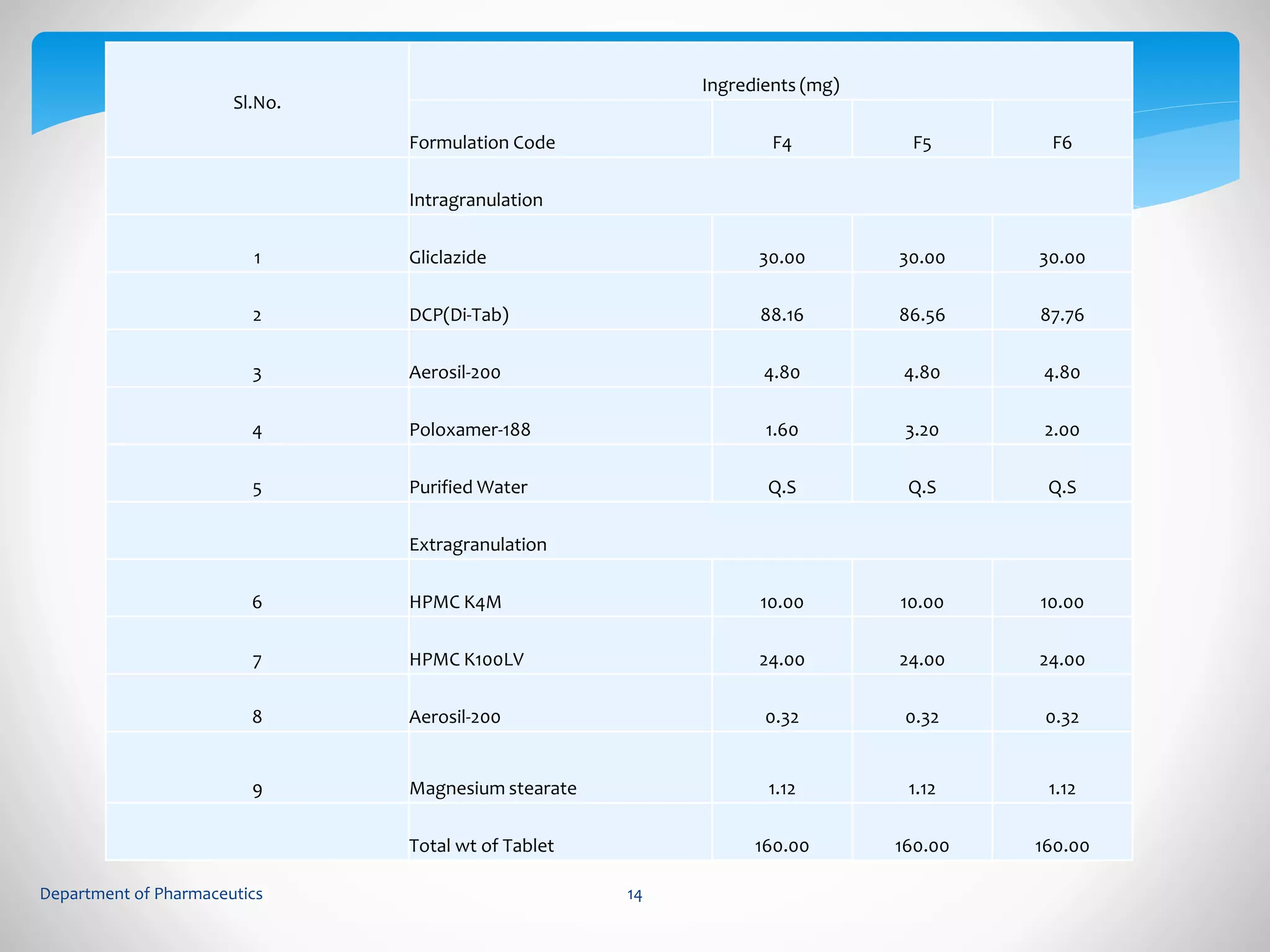
Formulations with Poloxamer as wetting agent: 
Sifting dry mixing: 
 Weighed quantities of Gliclazide, Dibasic calcium 
phosphate dehydrate (Di-Tab) and Colloidal Silicone 
Dioxide were mixed and sifted through #30 seive. 
Granulation: 
 The step 1a blend was granulated using poloxamer solution 
as a granulating fluid. 
 The obtained granules were dried for sufficient time at 
50oC till LOD was less then 2% and later sifted through #30 
sieve. 
Extragranulation: 
 the step 2b granules were added to the blend of HPMC 
K4M and HPMC K100LV which was previously sifted though 
#30 sieve and mixed for 5min in blender. 
Lubrication: 
 The step 3a granules were lubricated with colloidal silicone 
dioxide and magnesium stearate, which was previously 
sifted through #40 sieve and mixed for 2min in a blender. 
Compression: 
 The step 4a blend was compressed using 9.8X4.3 mm 
Department of Pharmaceutics 13 
capsular shaped punches.
Sl.No. 
Ingredients (mg) 
Formulation Code F4 F5 F6 
Intragranulation 
1 Gliclazide 30.00 30.00 30.00 
2 DCP(Di-Tab) 88.16 86.56 87.76 
3 Aerosil-200 4.80 4.80 4.80 
4 Poloxamer-188 1.60 3.20 2.00 
5 PurifiedWater Q.S Q.S Q.S 
Extragranulation 
6 HPMC K4M 10.00 10.00 10.00 
7 HPMC K100LV 24.00 24.00 24.00 
8 Aerosil-200 0.32 0.32 0.32 
9 Magnesium stearate 1.12 1.12 1.12 
Total wt of Tablet 160.00 160.00 160.00 
Department of Pharmaceutics 14
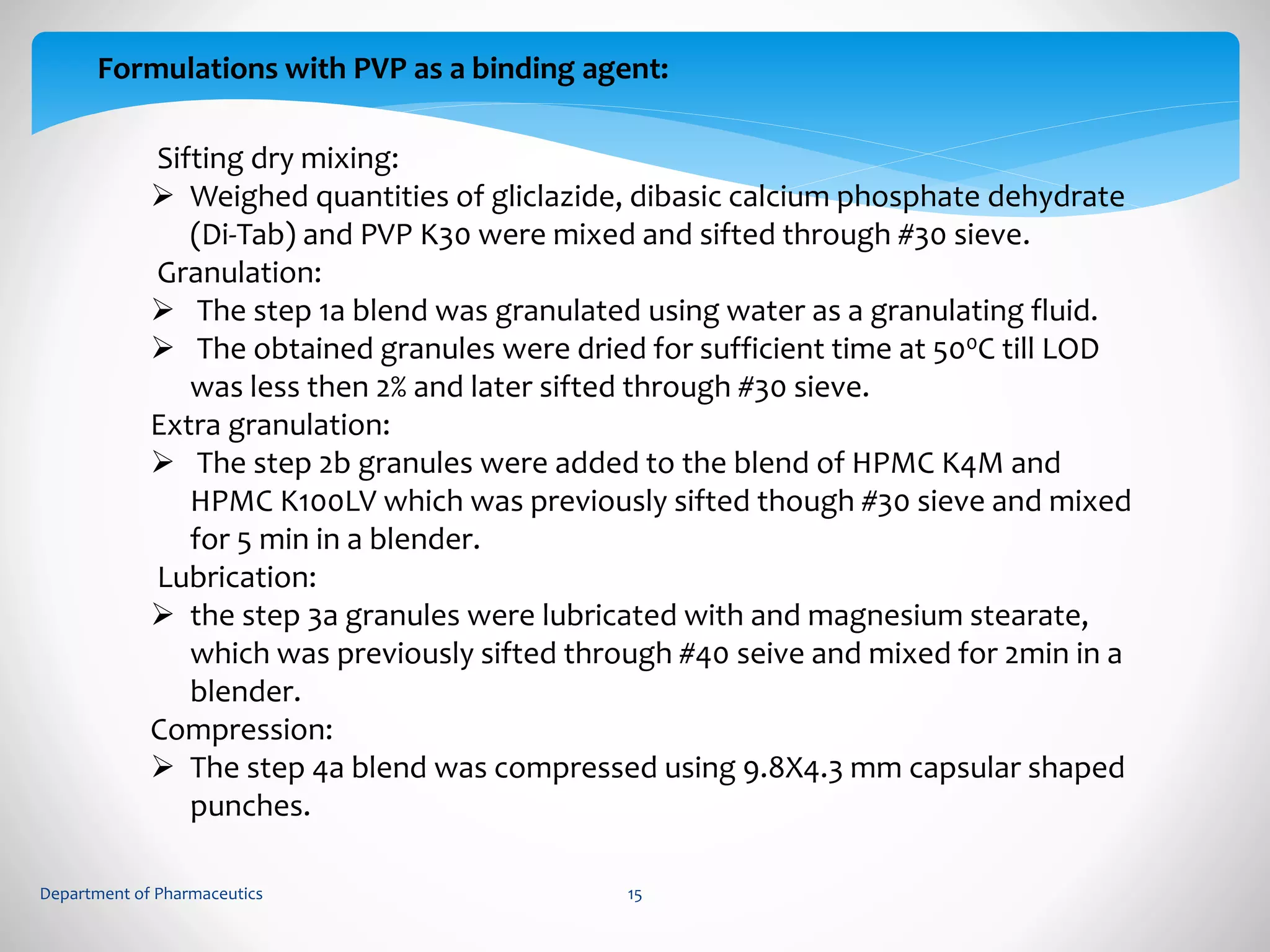
Formulations with PVP as a binding agent: 
Sifting dry mixing: 
 Weighed quantities of gliclazide, dibasic calcium phosphate dehydrate 
(Di-Tab) and PVP K30 were mixed and sifted through #30 sieve. 
Granulation: 
 The step 1a blend was granulated using water as a granulating fluid. 
 The obtained granules were dried for sufficient time at 500C till LOD 
was less then 2% and later sifted through #30 sieve. 
Extra granulation: 
 The step 2b granules were added to the blend of HPMC K4M and 
HPMC K100LV which was previously sifted though #30 sieve and mixed 
for 5 min in a blender. 
Lubrication: 
 the step 3a granules were lubricated with and magnesium stearate, 
which was previously sifted through #40 seive and mixed for 2min in a 
blender. 
Compression: 
 The step 4a blend was compressed using 9.8X4.3 mm capsular shaped 
punches. 
Department of Pharmaceutics 15
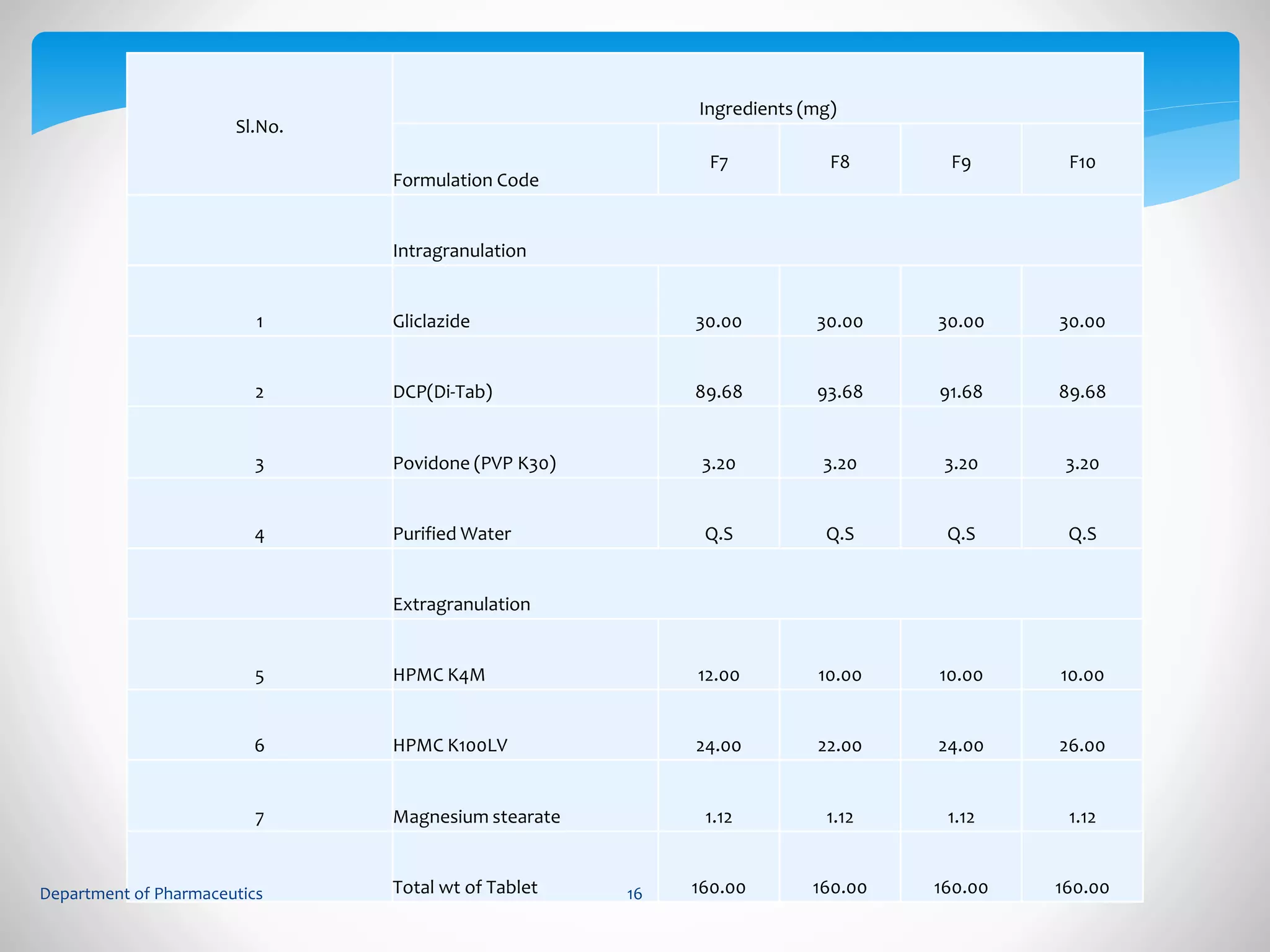
Sl.No. 
Ingredients (mg) 
Formulation Code 
F7 F8 F9 F10 
Intragranulation 
1 Gliclazide 30.00 30.00 30.00 30.00 
2 DCP(Di-Tab) 89.68 93.68 91.68 89.68 
3 Povidone (PVP K30) 3.20 3.20 3.20 3.20 
4 PurifiedWater Q.S Q.S Q.S Q.S 
Extragranulation 
5 HPMC K4M 12.00 10.00 10.00 10.00 
6 HPMC K100LV 24.00 22.00 24.00 26.00 
7 Magnesium stearate 1.12 1.12 1.12 1.12 
Department of Pharmaceutics Total wt of Tablet 16 160.00 160.00 160.00 160.00
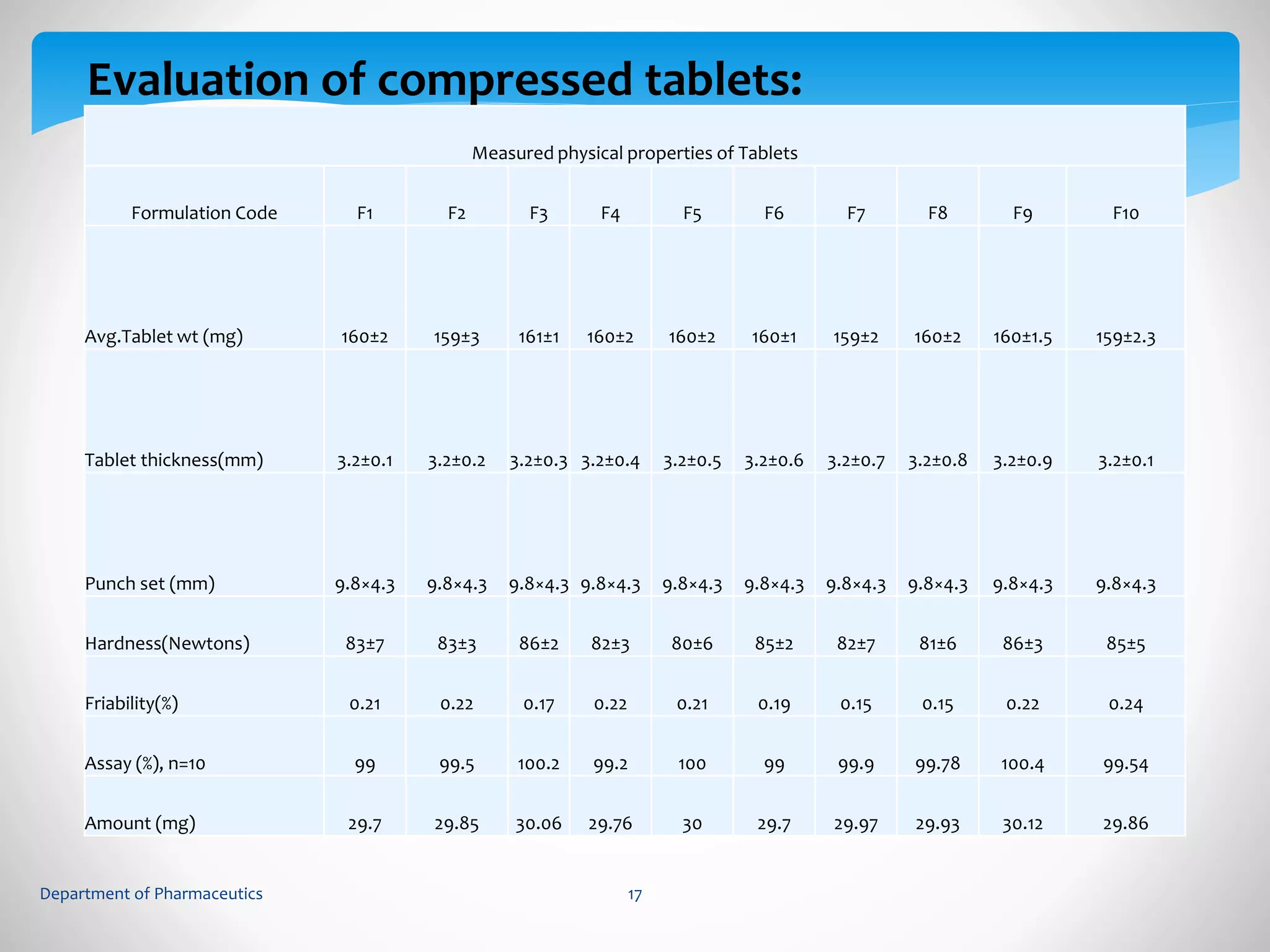
Evaluation of compressed tablets: 
Measured physical properties of Tablets 
Formulation Code F1 F2 F3 F4 F5 F6 F7 F8 F9 F10 
Avg.Tablet wt (mg) 160±2 159±3 161±1 160±2 160±2 160±1 159±2 160±2 160±1.5 159±2.3 
Tablet thickness(mm) 3.2±0.1 3.2±0.2 3.2±0.3 3.2±0.4 3.2±0.5 3.2±0.6 3.2±0.7 3.2±0.8 3.2±0.9 3.2±0.1 
Punch set (mm) 9.8×4.3 9.8×4.3 9.8×4.3 9.8×4.3 9.8×4.3 9.8×4.3 9.8×4.3 9.8×4.3 9.8×4.3 9.8×4.3 
Hardness(Newtons) 83±7 83±3 86±2 82±3 80±6 85±2 82±7 81±6 86±3 85±5 
Friability(%) 0.21 0.22 0.17 0.22 0.21 0.19 0.15 0.15 0.22 0.24 
Assay (%), n=10 99 99.5 100.2 99.2 100 99 99.9 99.78 100.4 99.54 
Amount (mg) 29.7 29.85 30.06 29.76 30 29.7 29.97 29.93 30.12 29.86 
Department of Pharmaceutics 17
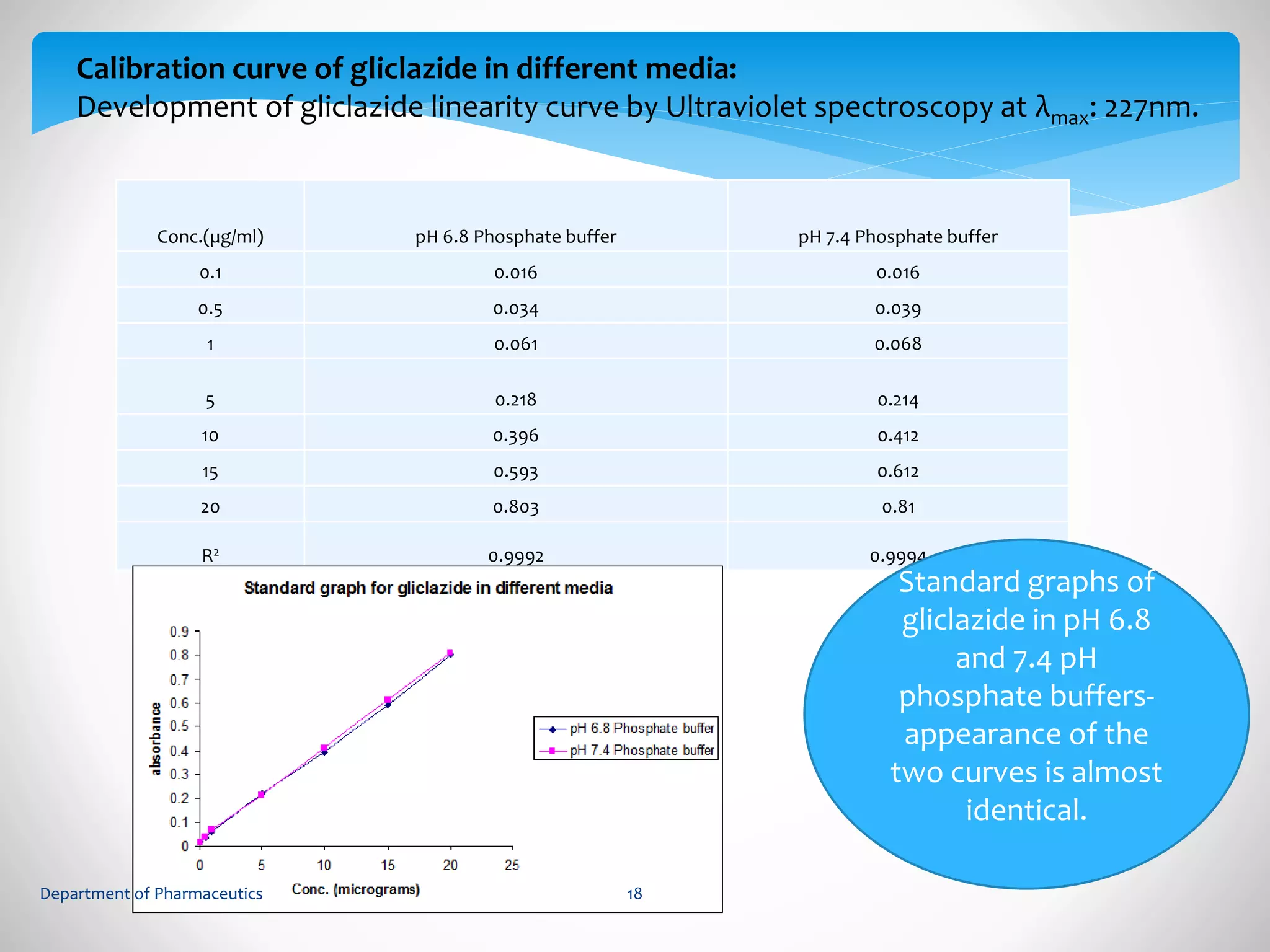
Calibration curve of gliclazide in different media: 
Development of gliclazide linearity curve by Ultraviolet spectroscopy at λmax: 227nm. 
Conc.(μg/ml) pH 6.8 Phosphate buffer pH 7.4 Phosphate buffer 
0.1 0.016 0.016 
0.5 0.034 0.039 
1 0.061 0.068 
5 0.218 0.214 
10 0.396 0.412 
15 0.593 0.612 
20 0.803 0.81 
R2 0.9992 0.9994 
Standard graphs of 
gliclazide in pH 6.8 
and 7.4 pH 
phosphate buffers-appearance 
of the 
two curves is almost 
identical. 
Department of Pharmaceutics 18
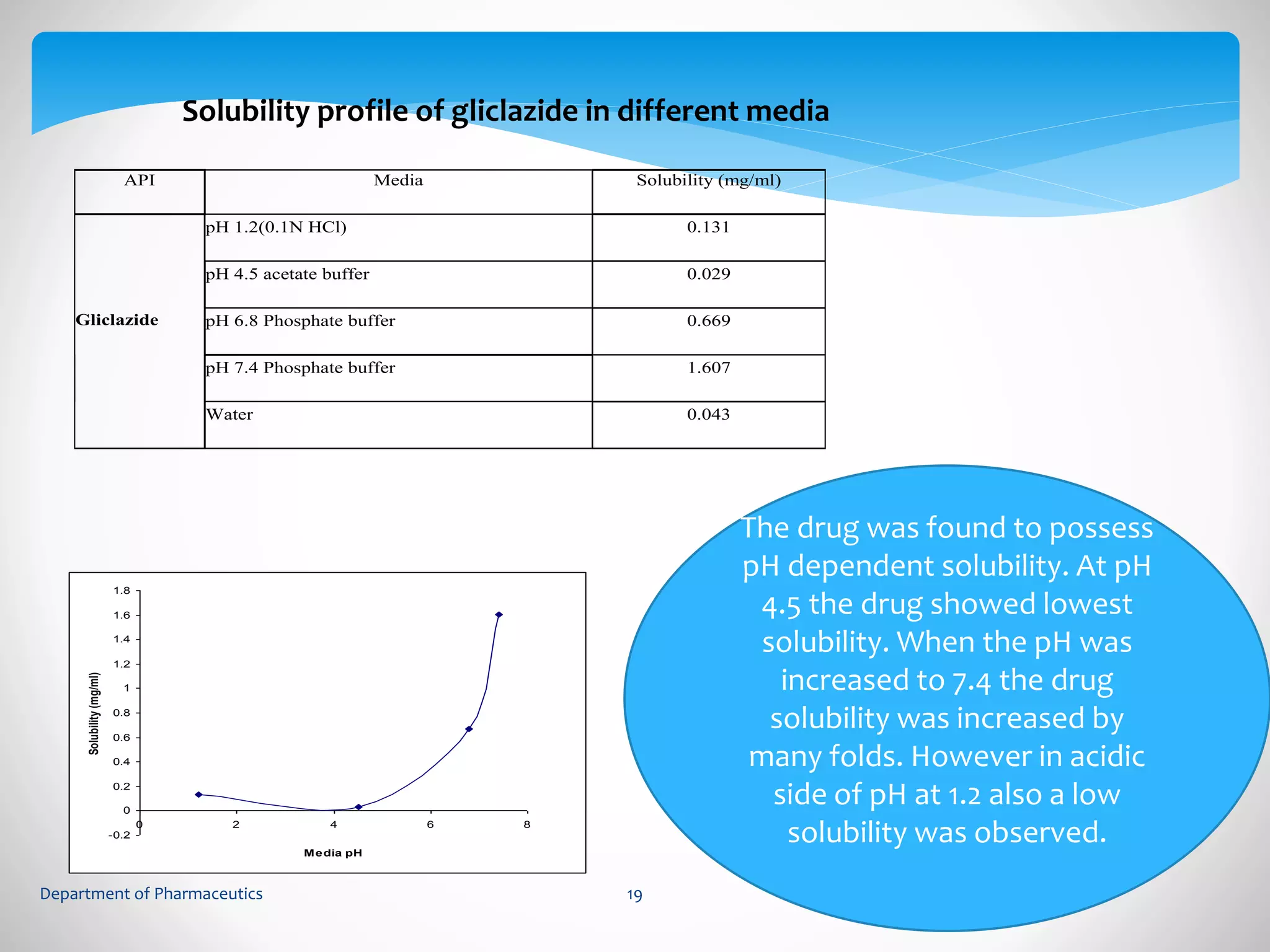
Solubility profile of gliclazide in different media 
API Media Solubility (mg/ml) 
Gliclazide 
pH 1.2(0.1N HCl) 0.131 
pH 4.5 acetate buffer 0.029 
pH 6.8 Phosphate buffer 0.669 
pH 7.4 Phosphate buffer 1.607 
Water 0.043 
1.8 
1.6 
1.4 
1.2 
1 
0.8 
0.6 
0.4 
0.2 
0 
-0.2 
0 2 4 6 8 
Media pH 
Solubility (mg/ml) 
The drug was found to possess 
pH dependent solubility. At pH 
4.5 the drug showed lowest 
solubility. When the pH was 
increased to 7.4 the drug 
solubility was increased by 
many folds. However in acidic 
side of pH at 1.2 also a low 
solubility was observed. 
Department of Pharmaceutics 19
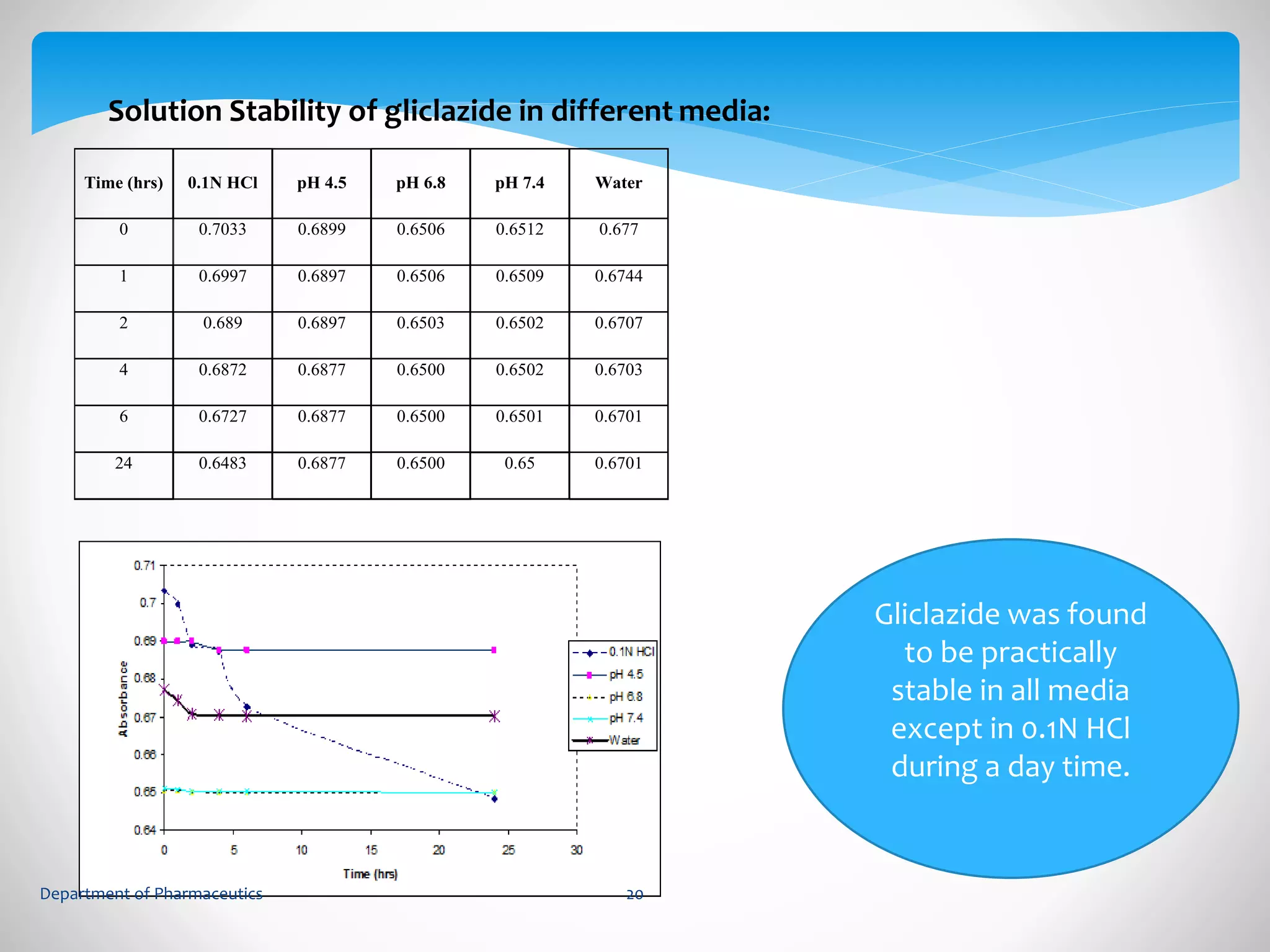
Solution Stability of gliclazide in different media: 
Time (hrs) 0.1N HCl pH 4.5 pH 6.8 pH 7.4 Water 
0 0.7033 0.6899 0.6506 0.6512 0.677 
1 0.6997 0.6897 0.6506 0.6509 0.6744 
2 0.689 0.6897 0.6503 0.6502 0.6707 
4 0.6872 0.6877 0.6500 0.6502 0.6703 
6 0.6727 0.6877 0.6500 0.6501 0.6701 
24 0.6483 0.6877 0.6500 0.65 0.6701 
Gliclazide was found 
to be practically 
stable in all media 
except in 0.1N HCl 
during a day time. 
Department of Pharmaceutics 20
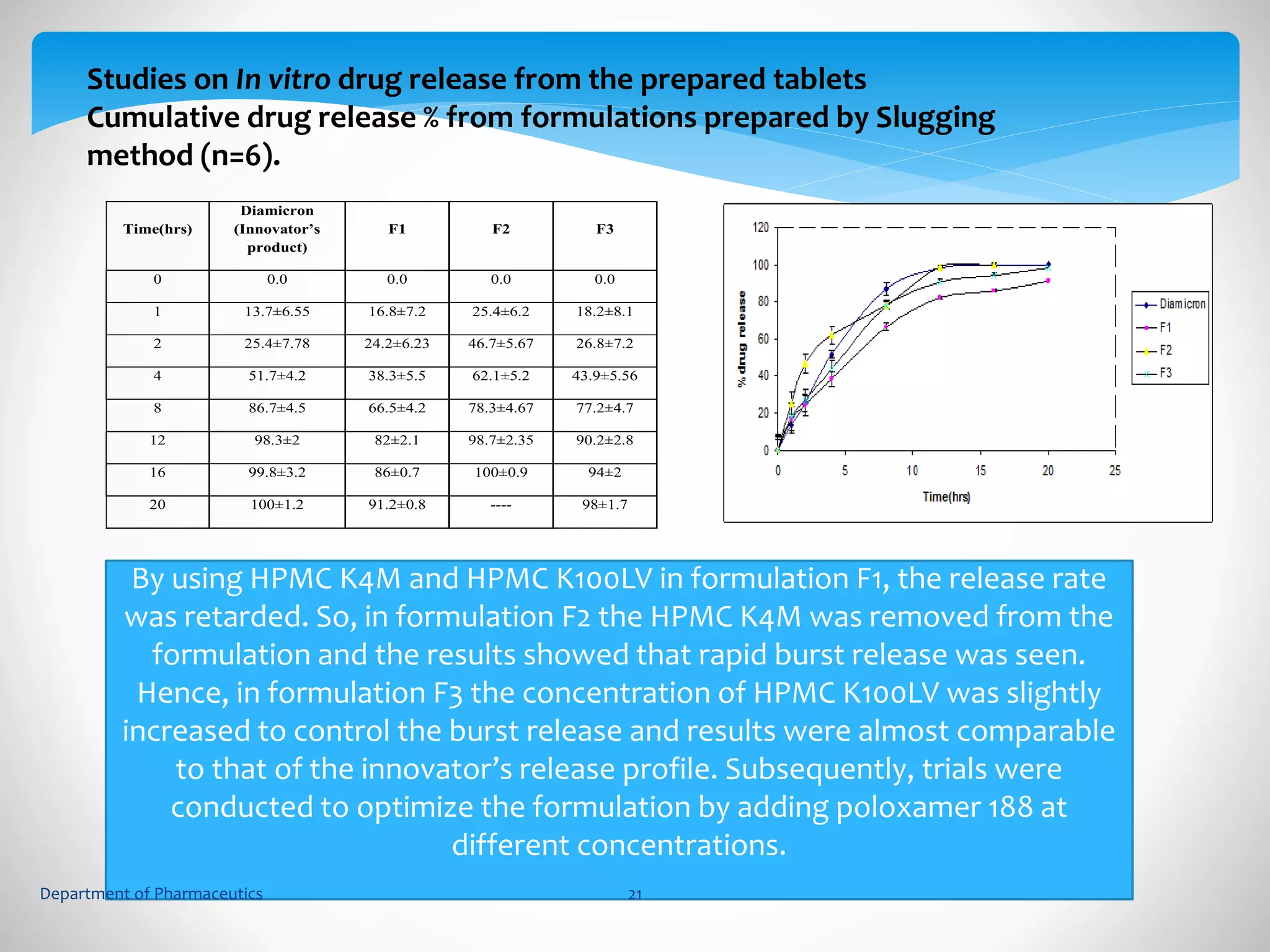
Studies on In vitro drug release from the prepared tablets 
Cumulative drug release % from formulations prepared by Slugging 
method (n=6). 
Time(hrs) 
Diamicron 
(Innovator’s 
product) 
F1 F2 F3 
0 0.0 0.0 0.0 0.0 
1 13.7±6.55 16.8±7.2 25.4±6.2 18.2±8.1 
2 25.4±7.78 24.2±6.23 46.7±5.67 26.8±7.2 
4 51.7±4.2 38.3±5.5 62.1±5.2 43.9±5.56 
8 86.7±4.5 66.5±4.2 78.3±4.67 77.2±4.7 
12 98.3±2 82±2.1 98.7±2.35 90.2±2.8 
16 99.8±3.2 86±0.7 100±0.9 94±2 
20 100±1.2 91.2±0.8 ---- 98±1.7 
By using HPMC K4M and HPMC K100LV in formulation F1, the release rate 
was retarded. So, in formulation F2 the HPMC K4M was removed from the 
formulation and the results showed that rapid burst release was seen. 
Hence, in formulation F3 the concentration of HPMC K100LV was slightly 
increased to control the burst release and results were almost comparable 
to that of the innovator’s release profile. Subsequently, trials were 
conducted to optimize the formulation by adding poloxamer 188 at 
different concentrations. 
Department of Pharmaceutics 21
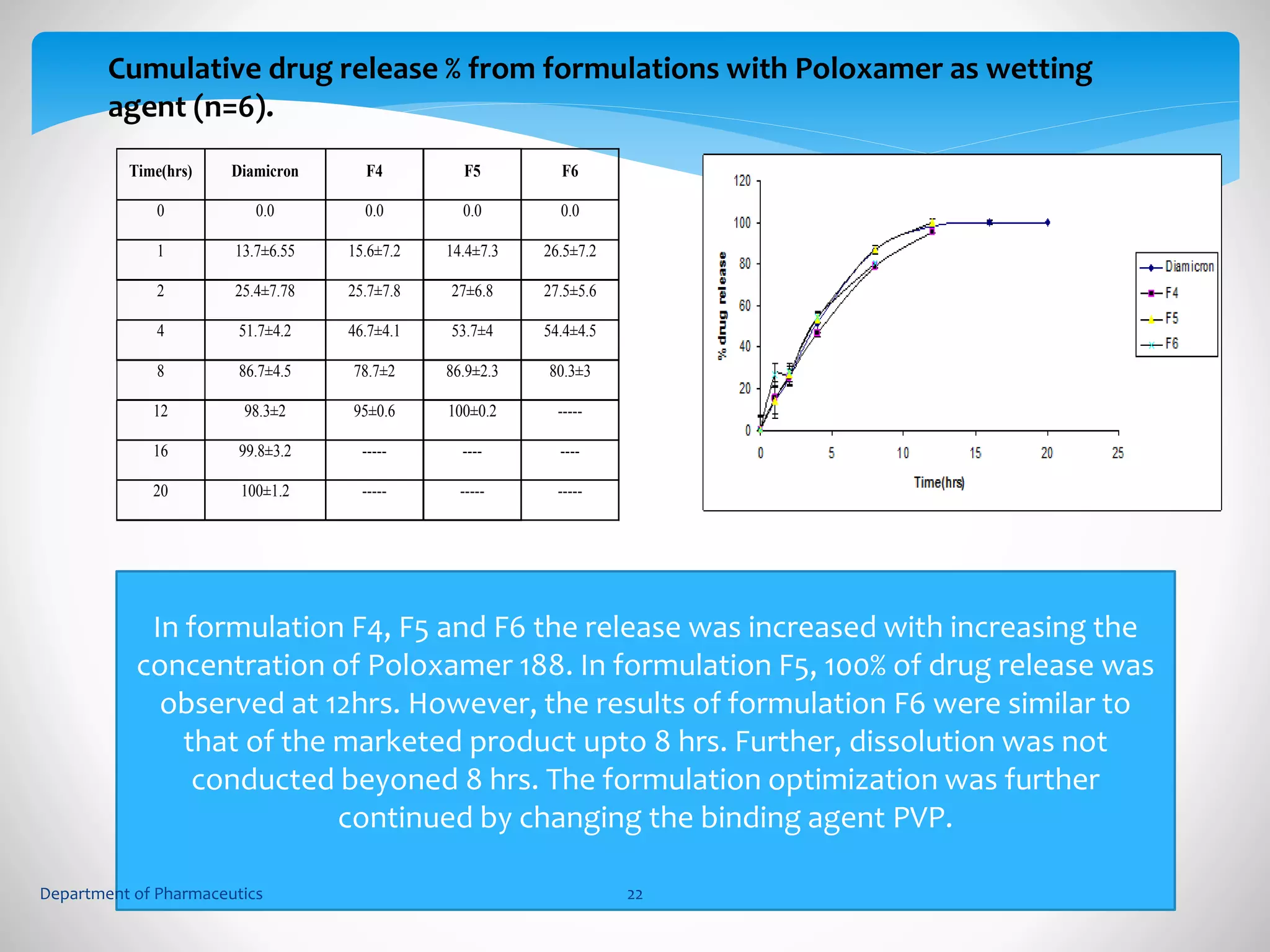
Cumulative drug release % from formulations with Poloxamer as wetting 
agent (n=6). 
Time(hrs) Diamicron F4 F5 F6 
0 0.0 0.0 0.0 0.0 
1 13.7±6.55 15.6±7.2 14.4±7.3 26.5±7.2 
2 25.4±7.78 25.7±7.8 27±6.8 27.5±5.6 
4 51.7±4.2 46.7±4.1 53.7±4 54.4±4.5 
8 86.7±4.5 78.7±2 86.9±2.3 80.3±3 
12 98.3±2 95±0.6 100±0.2 ----- 
16 99.8±3.2 ----- ---- ---- 
20 100±1.2 ----- ----- ----- 
In formulation F4, F5 and F6 the release was increased with increasing the 
concentration of Poloxamer 188. In formulation F5, 100% of drug release was 
observed at 12hrs. However, the results of formulation F6 were similar to 
that of the marketed product upto 8 hrs. Further, dissolution was not 
conducted beyoned 8 hrs. The formulation optimization was further 
continued by changing the binding agent PVP. 
Department of Pharmaceutics 22
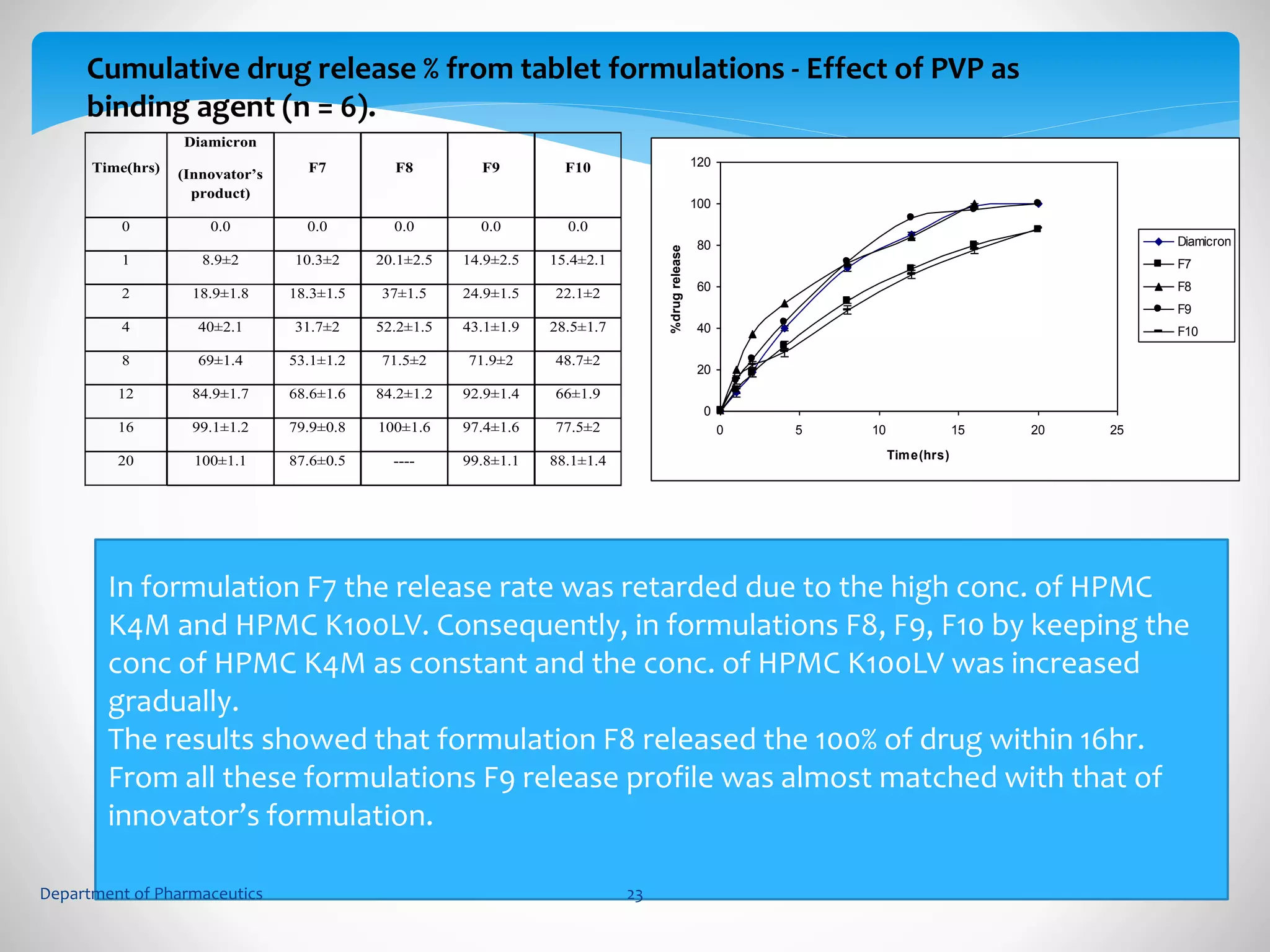
Cumulative drug release % from tablet formulations - Effect of PVP as 
binding agent (n = 6). 
Time(hrs) 
Diamicron 
(Innovator’s 
product) 
F7 F8 F9 F10 
0 0.0 0.0 0.0 0.0 0.0 
1 8.9±2 10.3±2 20.1±2.5 14.9±2.5 15.4±2.1 
2 18.9±1.8 18.3±1.5 37±1.5 24.9±1.5 22.1±2 
4 40±2.1 31.7±2 52.2±1.5 43.1±1.9 28.5±1.7 
8 69±1.4 53.1±1.2 71.5±2 71.9±2 48.7±2 
12 84.9±1.7 68.6±1.6 84.2±1.2 92.9±1.4 66±1.9 
16 99.1±1.2 79.9±0.8 100±1.6 97.4±1.6 77.5±2 
20 100±1.1 87.6±0.5 ---- 99.8±1.1 88.1±1.4 
120 
100 
80 
60 
40 
20 
0 
0 5 10 15 20 25 
Time(hrs) 
%drug release 
Diamicron 
F7 
F8 
F9 
F10 
In formulation F7 the release rate was retarded due to the high conc. of HPMC 
K4M and HPMC K100LV. Consequently, in formulations F8, F9, F10 by keeping the 
conc of HPMC K4M as constant and the conc. of HPMC K100LV was increased 
gradually. 
The results showed that formulation F8 released the 100% of drug within 16hr. 
From all these formulations F9 release profile was almost matched with that of 
innovator’s formulation. 
Department of Pharmaceutics 23
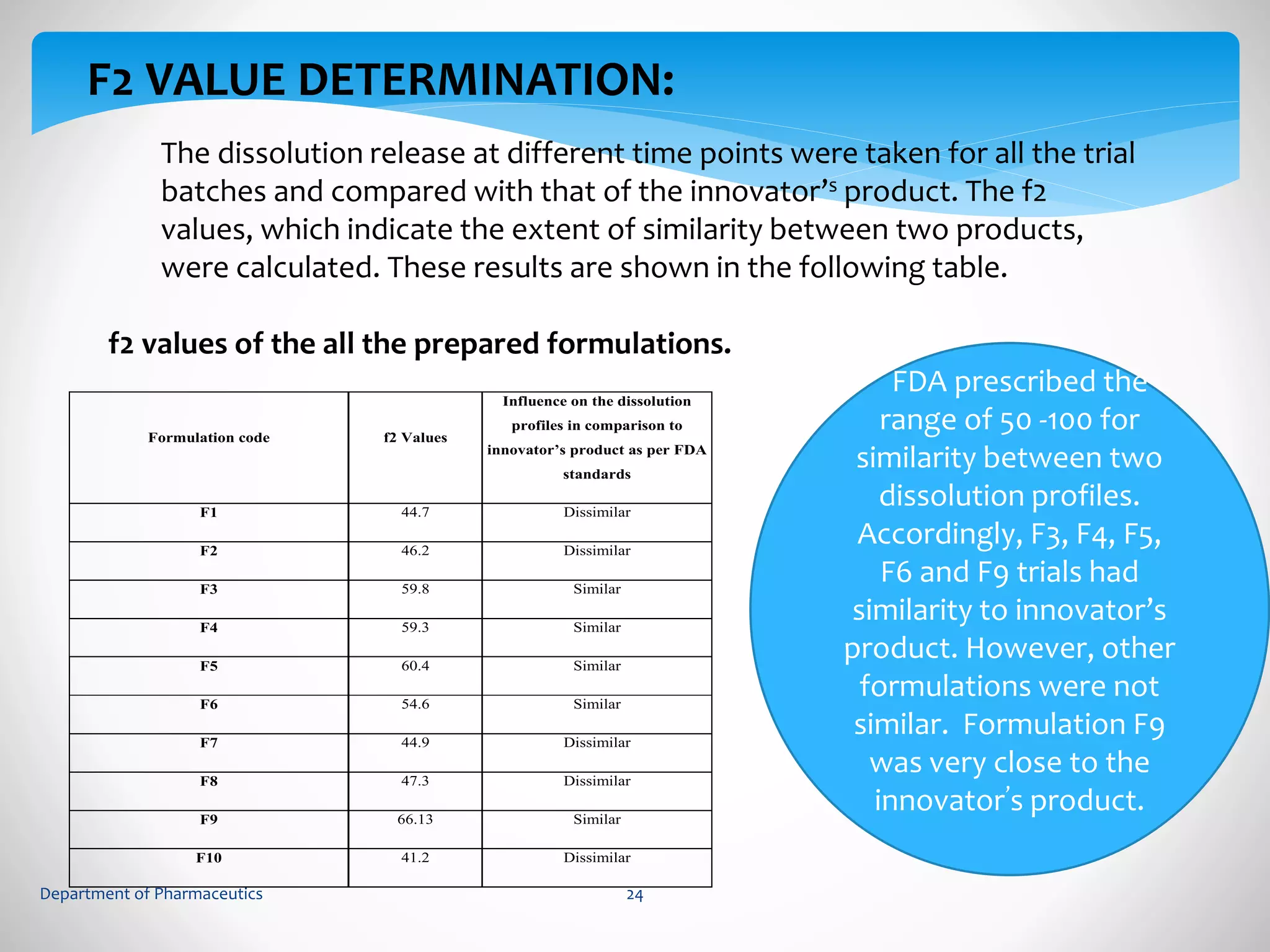
F2 VALUE DETERMINATION: 
The dissolution release at different time points were taken for all the trial 
batches and compared with that of the innovator’s product. The f2 
values, which indicate the extent of similarity between two products, 
were calculated. These results are shown in the following table. 
f2 values of the all the prepared formulations. 
Formulation code f2 Values 
Influence on the dissolution 
profiles in comparison to 
innovator’s product as per FDA 
standards 
F1 44.7 Dissimilar 
F2 46.2 Dissimilar 
F3 59.8 Similar 
F4 59.3 Similar 
F5 60.4 Similar 
F6 54.6 Similar 
F7 44.9 Dissimilar 
F8 47.3 Dissimilar 
F9 66.13 Similar 
F10 41.2 Dissimilar 
FDA prescribed the 
range of 50 -100 for 
similarity between two 
dissolution profiles. 
Accordingly, F3, F4, F5, 
F6 and F9 trials had 
similarity to innovator’s 
product. However, other 
formulations were not 
similar. Formulation F9 
was very close to the 
innovator’s product. 
Department of Pharmaceutics 24
SUMMARY AND CONCLUSIONS: 
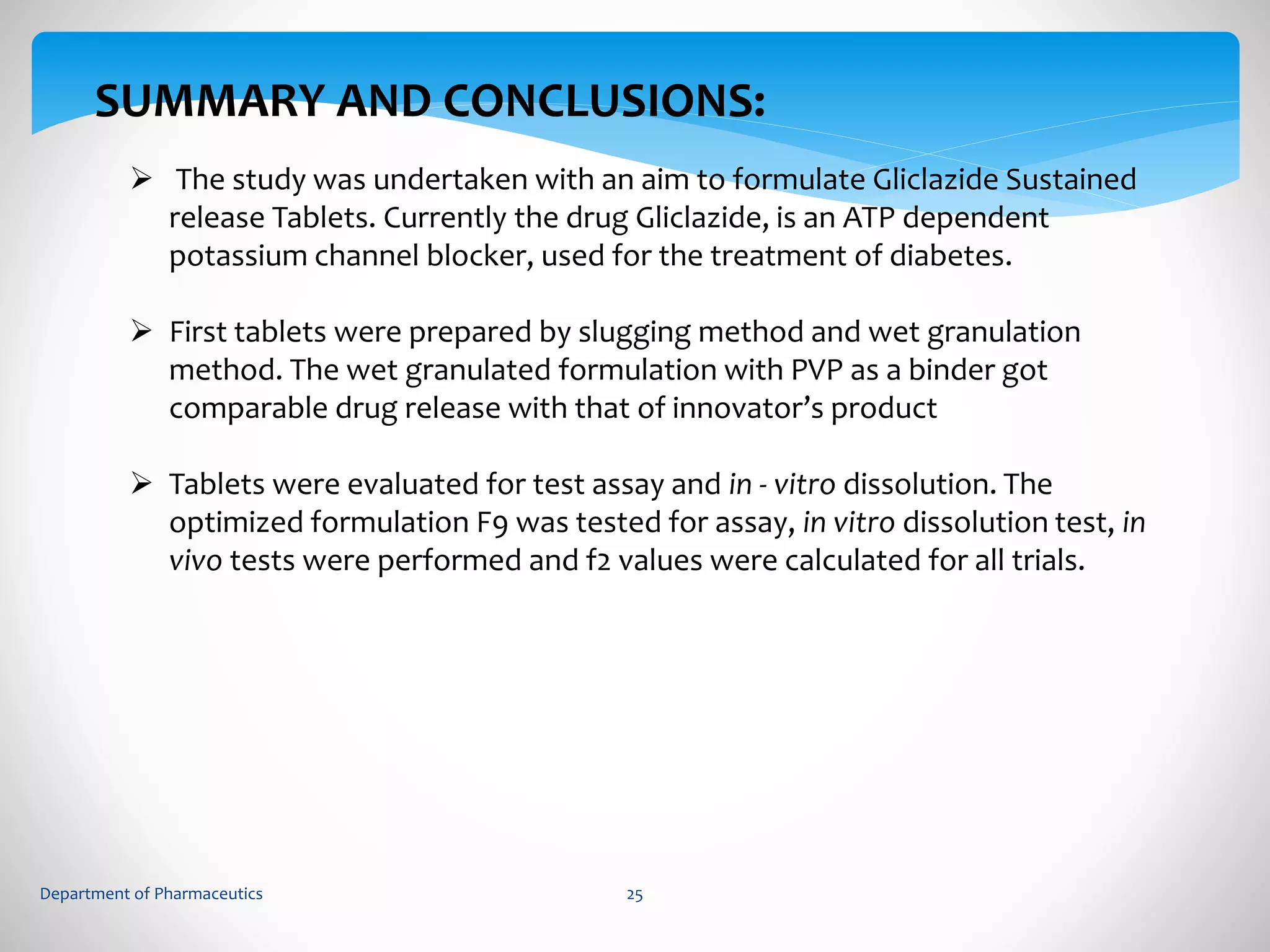
 The study was undertaken with an aim to formulate Gliclazide Sustained 
release Tablets. Currently the drug Gliclazide, is an ATP dependent 
potassium channel blocker, used for the treatment of diabetes. 
 First tablets were prepared by slugging method and wet granulation 
method. The wet granulated formulation with PVP as a binder got 
comparable drug release with that of innovator’s product 
 Tablets were evaluated for test assay and in - vitro dissolution. The 
optimized formulation F9 was tested for assay, in vitro dissolution test, in 
vivo tests were performed and f2 values were calculated for all trials. 
Department of Pharmaceutics 25
 Dissolution profile of formulation F9 matched with that of innovator’s 
product and f2 value, similarity factor was found as 66.13 and therefore 
to that of innovator’s product 
 The F9 formulation was subjected to three months stability study by 
keeping at 40ºC/ 75% RH. After this treatment also, no difference in the 
formulation was found in comparison to innovator’s product. 
 In vivo bioequivalent studies were done. In vivo studies revealed that the 
formulation F9 and innovator’s Diamicron were having similar 
pharmacokinetics parameters. Finally, in this study bioequivalent product 
Sustained Release Tablets were developed. 
Department of Pharmaceutics 26
Department of Pharmaceutics 27

Formulation and evalution of sustained release matrix tablets

  • 1.
    FORMULATION AND EVALUTIONOF SUSTAINED RELEASE MATRIX TABLETS OF GLICLAZIDE Santhosh Kotagiri SCOPS Department of Pharmaceutics 1
  • 2.
    Contents; Introduction Aim& Objective List of materials and Equipment Drug and Excipient profiles Methods used Results and Discussion Summary Department of Pharmaceutics 2
  • 3.
    Sustained release drug: sustained release as “Any dosage form that provide medication over an extended time” and controlled release as “Any dosage form which is able to provide some actual therapeutic control Advantages of SR Drugs:  Improved patient convenience and compliance due to less frequent drug administration.  Reduction in fluctuation in steady-state levels and therefore better control of disease condition and reduced intensity of local or systemic side effects.  Increased safety margin of high potency drugs due to better control of plasma levels.  Maximum utilization of drug enabling reduction in total amount of dose administered.  Reduction in health care costs through improved therapy, shorter treatment period, less frequency of dosing and reduction in personnel time to dispense, administer and monitor patients Department of Pharmaceutics 3
  • 4.
    Disadvantages of SRDrugs:  Decreased systemic availability in comparison to immediate release conventional dosage forms; this may be due to incomplete release, increased first-pass metabolism, increased instability, insufficient residence time for complete release, site-specific absorption, pH-depent solubility, etc.  Poor in vitro-in vivo correlation.  Possibility of dose dumping due to food, physiologic or formulation variables or chewing or grinding of oral formulations by the patient and thus, increased risk of toxicity  Retrieval of drug is difficult in case of toxicity, poisoning or hypersensitivity reactions.  Higher cost of formulation Department of Pharmaceutics 4
  • 5.
    Diabetes mellitus: Diabetesmellitus is a chronic metabolic disorder characterized by a high blood glucose concentration-hyperglycemia (fasting plasma glucose > 7.0 mmol/l, or plasma glucose > 11.1 mmol/l 2 hours after a meal)-caused by insulin deficiency, often combined with insulin resistance. POLYMERS USED IN SR DRUG DELIVERY SYSTEMS:  Bio-degradable polymers: Alginates, Guar gum, Chitosan, Gelatin  Bio-absorbable polymers: Polyethylene glycol and polyvinylpyrrolidone  Bio-nondegradable polymers: Hydroxy propyl methyl cellulose Department of Pharmaceutics 5
  • 6.
    AIM & OBJECTIVE:  One tablet of Diamicron (Gliclazide) 80mg is comparable to One tablet of Diamicron30mg MR, a product of innovator.  To reduce side effects and to prevent fluctuations in concentrations between dosages.  IR tablets are having the dose of 80mg. To sustain the release and maintain the therapeutic conc. by reducing the dose to 30mg by MR.  To formulate and evaluate matrix tablets of Gliclazide to sustain the release of drug for 20 hrs.  Evaluation of optimized tablets in comparison to innovator’s product  To perform a bioequivalence study of the optimized batch of Gliclazide Sustained Release tablet and innovator’s product. Department of Pharmaceutics 6
  • 7.
    LIST OF MATERIALSAND EQUIPMENTS Material Source Gliclazide Bal Pharma Ltd., Bangalore. Dibasic Calcium Phosphate dihydrate Rhodia, Mumbai. Magnesium stearate Merck, Mumbai. HPMC K4M Colorcon, Asia, Pvt. Ltd., Goa, India. HPMC K100LV Colorcon, Asia, Pvt. Ltd., Goa, India. Polyvinyl pyrrolidone BASF, Mumbai. Poloxamer 188 BASF, Mumbai. Collodial silicone dioxide Deggusa, Mumbai. Department of Pharmaceutics 7
  • 8.
    Equipment Suppliers 16station Compression Machine Cadmach Machinery, Ahmedabad. Balance Mettler Toledo, Germany. Hardness Tester Pharma test, Ahmedabad. Dissolution Apparatus, USP Electrolab, Mumbai. Karl Fischer Instrument 701 KF titrino, Metrohm. Germany. Rapid Mixing Granulator General Mechanical Industries, Mumbai. UV-Visible Spectrophotomter Varian Cary C50 Conc, Germany. Friability Tester Electrolab, Mumbai. Sonicator Bandelin Electronic, Germany Tap Density Tester (USP) Electrolab, Mumbai. Vernier Calipers Mitutoyo, Japan. Department of Pharmaceutics 8
  • 9.
    DRUG PROFILE Synonym : Gliclazidum  Chemical name : N-[[(Hexahydrocyclopenta[c]pyrrol-2(1H)-yl) amino] carbonyl]-4- methylbenzenesulfonamide.  Empirical formula : C15H21N3O3S  Molecular weight: 323.4g/mol.  Melting point : 163oC to 165°C  Half-life: 6 to 14 h  Bioavailability: About 79 to 100%  Dissociation Constant: pKa 6.6 Chemical Structure Mechanism of action: primary effect is to potentiate glucose-stimulated insulin release from functioning pancreatic islet β-cells. Department of Pharmaceutics 9
  • 10.
    EXCIPENTS HYPROMELLOSE: Chemicalname: Cellulose hydroxypropyl methyl ether Povidone: Chemical Name: 1-Ethenyl-2-pyrrolidinone homopolymer Poloxamer: Magnesium stearate Chemical name : Octadecanoic acid magnesium salt Colloidal silicon dioxide: SiO2 Department of Pharmaceutics 10
  • 11.
    METHODS USED : 1. Slugging method  All the ingredients were screened through sieve no. 30  Except lubricant all the ingredients were thoroughly blended in a blender for 5min  First the mixture was compressed using 23mm flat faced punch on 16 stages rotary tablet compress machine.  The above slugs were deslugged by using hammer and the deslugged material was passed through sieve no.30.  The granules which were passed through the sieve no.30 were then passed through sieve no.60.  The sieve no.60 passed granules were reslugged, finally the yield was 70:30 (70% granules and 30% fines), the above obtained granules were lubricated with magnesium stearate for 2min.  The above lubricated blend was compressed using 9.8X4.3mm caplet shaped punch. Department of Pharmaceutics 11
  • 12.
    Sl.no. Ingredients (mg) Formulation Code F1 F2 F3 Intragranulation 1 Gliclazide 30.00 30.00 30.00 2 DCP(Di-Tab) 89.52 91.12 87.92 3 Aerosil-200 3.20 3.20 3.20 4 HPMC K4M 3.20 ….. ….. 5 HPMC K100LV 32.00 33.60 36.80 6 Magnesium stearate 0.96 0.96 0.96 Extragranulation 7 Magnesium stearate 1.12 1.12 1.12 Total wt of Tablet 160.00 160.00 160.00 Department of Pharmaceutics 12
  • 13.
    Formulations with Poloxameras wetting agent: Sifting dry mixing:  Weighed quantities of Gliclazide, Dibasic calcium phosphate dehydrate (Di-Tab) and Colloidal Silicone Dioxide were mixed and sifted through #30 seive. Granulation:  The step 1a blend was granulated using poloxamer solution as a granulating fluid.  The obtained granules were dried for sufficient time at 50oC till LOD was less then 2% and later sifted through #30 sieve. Extragranulation:  the step 2b granules were added to the blend of HPMC K4M and HPMC K100LV which was previously sifted though #30 sieve and mixed for 5min in blender. Lubrication:  The step 3a granules were lubricated with colloidal silicone dioxide and magnesium stearate, which was previously sifted through #40 sieve and mixed for 2min in a blender. Compression:  The step 4a blend was compressed using 9.8X4.3 mm Department of Pharmaceutics 13 capsular shaped punches.
  • 14.
    Sl.No. Ingredients (mg) Formulation Code F4 F5 F6 Intragranulation 1 Gliclazide 30.00 30.00 30.00 2 DCP(Di-Tab) 88.16 86.56 87.76 3 Aerosil-200 4.80 4.80 4.80 4 Poloxamer-188 1.60 3.20 2.00 5 PurifiedWater Q.S Q.S Q.S Extragranulation 6 HPMC K4M 10.00 10.00 10.00 7 HPMC K100LV 24.00 24.00 24.00 8 Aerosil-200 0.32 0.32 0.32 9 Magnesium stearate 1.12 1.12 1.12 Total wt of Tablet 160.00 160.00 160.00 Department of Pharmaceutics 14
  • 15.
    Formulations with PVPas a binding agent: Sifting dry mixing:  Weighed quantities of gliclazide, dibasic calcium phosphate dehydrate (Di-Tab) and PVP K30 were mixed and sifted through #30 sieve. Granulation:  The step 1a blend was granulated using water as a granulating fluid.  The obtained granules were dried for sufficient time at 500C till LOD was less then 2% and later sifted through #30 sieve. Extra granulation:  The step 2b granules were added to the blend of HPMC K4M and HPMC K100LV which was previously sifted though #30 sieve and mixed for 5 min in a blender. Lubrication:  the step 3a granules were lubricated with and magnesium stearate, which was previously sifted through #40 seive and mixed for 2min in a blender. Compression:  The step 4a blend was compressed using 9.8X4.3 mm capsular shaped punches. Department of Pharmaceutics 15
  • 16.
    Sl.No. Ingredients (mg) Formulation Code F7 F8 F9 F10 Intragranulation 1 Gliclazide 30.00 30.00 30.00 30.00 2 DCP(Di-Tab) 89.68 93.68 91.68 89.68 3 Povidone (PVP K30) 3.20 3.20 3.20 3.20 4 PurifiedWater Q.S Q.S Q.S Q.S Extragranulation 5 HPMC K4M 12.00 10.00 10.00 10.00 6 HPMC K100LV 24.00 22.00 24.00 26.00 7 Magnesium stearate 1.12 1.12 1.12 1.12 Department of Pharmaceutics Total wt of Tablet 16 160.00 160.00 160.00 160.00
  • 17.
    Evaluation of compressedtablets: Measured physical properties of Tablets Formulation Code F1 F2 F3 F4 F5 F6 F7 F8 F9 F10 Avg.Tablet wt (mg) 160±2 159±3 161±1 160±2 160±2 160±1 159±2 160±2 160±1.5 159±2.3 Tablet thickness(mm) 3.2±0.1 3.2±0.2 3.2±0.3 3.2±0.4 3.2±0.5 3.2±0.6 3.2±0.7 3.2±0.8 3.2±0.9 3.2±0.1 Punch set (mm) 9.8×4.3 9.8×4.3 9.8×4.3 9.8×4.3 9.8×4.3 9.8×4.3 9.8×4.3 9.8×4.3 9.8×4.3 9.8×4.3 Hardness(Newtons) 83±7 83±3 86±2 82±3 80±6 85±2 82±7 81±6 86±3 85±5 Friability(%) 0.21 0.22 0.17 0.22 0.21 0.19 0.15 0.15 0.22 0.24 Assay (%), n=10 99 99.5 100.2 99.2 100 99 99.9 99.78 100.4 99.54 Amount (mg) 29.7 29.85 30.06 29.76 30 29.7 29.97 29.93 30.12 29.86 Department of Pharmaceutics 17
  • 18.
    Calibration curve ofgliclazide in different media: Development of gliclazide linearity curve by Ultraviolet spectroscopy at λmax: 227nm. Conc.(μg/ml) pH 6.8 Phosphate buffer pH 7.4 Phosphate buffer 0.1 0.016 0.016 0.5 0.034 0.039 1 0.061 0.068 5 0.218 0.214 10 0.396 0.412 15 0.593 0.612 20 0.803 0.81 R2 0.9992 0.9994 Standard graphs of gliclazide in pH 6.8 and 7.4 pH phosphate buffers-appearance of the two curves is almost identical. Department of Pharmaceutics 18
  • 19.
    Solubility profile ofgliclazide in different media API Media Solubility (mg/ml) Gliclazide pH 1.2(0.1N HCl) 0.131 pH 4.5 acetate buffer 0.029 pH 6.8 Phosphate buffer 0.669 pH 7.4 Phosphate buffer 1.607 Water 0.043 1.8 1.6 1.4 1.2 1 0.8 0.6 0.4 0.2 0 -0.2 0 2 4 6 8 Media pH Solubility (mg/ml) The drug was found to possess pH dependent solubility. At pH 4.5 the drug showed lowest solubility. When the pH was increased to 7.4 the drug solubility was increased by many folds. However in acidic side of pH at 1.2 also a low solubility was observed. Department of Pharmaceutics 19
  • 20.
    Solution Stability ofgliclazide in different media: Time (hrs) 0.1N HCl pH 4.5 pH 6.8 pH 7.4 Water 0 0.7033 0.6899 0.6506 0.6512 0.677 1 0.6997 0.6897 0.6506 0.6509 0.6744 2 0.689 0.6897 0.6503 0.6502 0.6707 4 0.6872 0.6877 0.6500 0.6502 0.6703 6 0.6727 0.6877 0.6500 0.6501 0.6701 24 0.6483 0.6877 0.6500 0.65 0.6701 Gliclazide was found to be practically stable in all media except in 0.1N HCl during a day time. Department of Pharmaceutics 20
  • 21.
    Studies on Invitro drug release from the prepared tablets Cumulative drug release % from formulations prepared by Slugging method (n=6). Time(hrs) Diamicron (Innovator’s product) F1 F2 F3 0 0.0 0.0 0.0 0.0 1 13.7±6.55 16.8±7.2 25.4±6.2 18.2±8.1 2 25.4±7.78 24.2±6.23 46.7±5.67 26.8±7.2 4 51.7±4.2 38.3±5.5 62.1±5.2 43.9±5.56 8 86.7±4.5 66.5±4.2 78.3±4.67 77.2±4.7 12 98.3±2 82±2.1 98.7±2.35 90.2±2.8 16 99.8±3.2 86±0.7 100±0.9 94±2 20 100±1.2 91.2±0.8 ---- 98±1.7 By using HPMC K4M and HPMC K100LV in formulation F1, the release rate was retarded. So, in formulation F2 the HPMC K4M was removed from the formulation and the results showed that rapid burst release was seen. Hence, in formulation F3 the concentration of HPMC K100LV was slightly increased to control the burst release and results were almost comparable to that of the innovator’s release profile. Subsequently, trials were conducted to optimize the formulation by adding poloxamer 188 at different concentrations. Department of Pharmaceutics 21
  • 22.
    Cumulative drug release% from formulations with Poloxamer as wetting agent (n=6). Time(hrs) Diamicron F4 F5 F6 0 0.0 0.0 0.0 0.0 1 13.7±6.55 15.6±7.2 14.4±7.3 26.5±7.2 2 25.4±7.78 25.7±7.8 27±6.8 27.5±5.6 4 51.7±4.2 46.7±4.1 53.7±4 54.4±4.5 8 86.7±4.5 78.7±2 86.9±2.3 80.3±3 12 98.3±2 95±0.6 100±0.2 ----- 16 99.8±3.2 ----- ---- ---- 20 100±1.2 ----- ----- ----- In formulation F4, F5 and F6 the release was increased with increasing the concentration of Poloxamer 188. In formulation F5, 100% of drug release was observed at 12hrs. However, the results of formulation F6 were similar to that of the marketed product upto 8 hrs. Further, dissolution was not conducted beyoned 8 hrs. The formulation optimization was further continued by changing the binding agent PVP. Department of Pharmaceutics 22
  • 23.
    Cumulative drug release% from tablet formulations - Effect of PVP as binding agent (n = 6). Time(hrs) Diamicron (Innovator’s product) F7 F8 F9 F10 0 0.0 0.0 0.0 0.0 0.0 1 8.9±2 10.3±2 20.1±2.5 14.9±2.5 15.4±2.1 2 18.9±1.8 18.3±1.5 37±1.5 24.9±1.5 22.1±2 4 40±2.1 31.7±2 52.2±1.5 43.1±1.9 28.5±1.7 8 69±1.4 53.1±1.2 71.5±2 71.9±2 48.7±2 12 84.9±1.7 68.6±1.6 84.2±1.2 92.9±1.4 66±1.9 16 99.1±1.2 79.9±0.8 100±1.6 97.4±1.6 77.5±2 20 100±1.1 87.6±0.5 ---- 99.8±1.1 88.1±1.4 120 100 80 60 40 20 0 0 5 10 15 20 25 Time(hrs) %drug release Diamicron F7 F8 F9 F10 In formulation F7 the release rate was retarded due to the high conc. of HPMC K4M and HPMC K100LV. Consequently, in formulations F8, F9, F10 by keeping the conc of HPMC K4M as constant and the conc. of HPMC K100LV was increased gradually. The results showed that formulation F8 released the 100% of drug within 16hr. From all these formulations F9 release profile was almost matched with that of innovator’s formulation. Department of Pharmaceutics 23
  • 24.
    F2 VALUE DETERMINATION: The dissolution release at different time points were taken for all the trial batches and compared with that of the innovator’s product. The f2 values, which indicate the extent of similarity between two products, were calculated. These results are shown in the following table. f2 values of the all the prepared formulations. Formulation code f2 Values Influence on the dissolution profiles in comparison to innovator’s product as per FDA standards F1 44.7 Dissimilar F2 46.2 Dissimilar F3 59.8 Similar F4 59.3 Similar F5 60.4 Similar F6 54.6 Similar F7 44.9 Dissimilar F8 47.3 Dissimilar F9 66.13 Similar F10 41.2 Dissimilar FDA prescribed the range of 50 -100 for similarity between two dissolution profiles. Accordingly, F3, F4, F5, F6 and F9 trials had similarity to innovator’s product. However, other formulations were not similar. Formulation F9 was very close to the innovator’s product. Department of Pharmaceutics 24
  • 25.
    SUMMARY AND CONCLUSIONS:  The study was undertaken with an aim to formulate Gliclazide Sustained release Tablets. Currently the drug Gliclazide, is an ATP dependent potassium channel blocker, used for the treatment of diabetes.  First tablets were prepared by slugging method and wet granulation method. The wet granulated formulation with PVP as a binder got comparable drug release with that of innovator’s product  Tablets were evaluated for test assay and in - vitro dissolution. The optimized formulation F9 was tested for assay, in vitro dissolution test, in vivo tests were performed and f2 values were calculated for all trials. Department of Pharmaceutics 25
  • 26.
     Dissolution profileof formulation F9 matched with that of innovator’s product and f2 value, similarity factor was found as 66.13 and therefore to that of innovator’s product  The F9 formulation was subjected to three months stability study by keeping at 40ºC/ 75% RH. After this treatment also, no difference in the formulation was found in comparison to innovator’s product.  In vivo bioequivalent studies were done. In vivo studies revealed that the formulation F9 and innovator’s Diamicron were having similar pharmacokinetics parameters. Finally, in this study bioequivalent product Sustained Release Tablets were developed. Department of Pharmaceutics 26
  • 27.