BUS 221_Lecture notes.pptx,BUS 221_Lecture notes.pptx
1.
BUS 221: FUNDAMENTALSOF BUSINESS RESEARCH METHODS
By Hawa Petro Tundui (PhD) – Lead Lecturer
hpetro@mzumbe.ac.tz
0754825860
2.
LEARNING OUTCOMES
• Tobe able to formulate business research topics
• Develop and formulate business research
proposals.
• Undertake research activities by using
appropriate techniques
• Analyze data using computer software, prepare
research reports and disseminate the information
to stakeholders
3.
REQUIRED READINGS
• Kothari,C. R. (2004). “Research Methodology;
Methods and Techniques”, 2nd
edition, New Delhi
Age Internal (P) Ltd, New Delhi
• Malhorta, N. K. (2007). Marketing Research: An
Applied Orientation (6th
ed.) Pearson’s Prentice Hall,
New Delhi.
4.
Today’s Plan
• Whatis a Business Research?
• Importance of a Business Research
• Factors for Conducting Business Research
• Types of Research
• Formulating Research topic, Problem statement and
Research Objectives
• Discussion questions
5.
What is Research?
•Research does help researchers to increase
understanding of the world by:
- creating or discovering new knowledge
- verifying/refining existing knowledge
- or, adding new knowledge to existing
knowledge.
• The important first step in research is to question
something that you have always taken for granted
6.
Business Research
• Researchis the process of finding solutions to
a problem after a thorough study and analysis
of the situational factors
• Business research is defined as the
systematic and objective process of
generating information for aid in making
business decisions
• Systematic and Objectivity are very important
features of Business Research
7.
Business Research(cont’d)
•Systematic andObjectivity are its
distinguishing features of Business Research,
which is important tool for managers and
decision-makers in corporate and non-
corporate organizations
•The term ‘systematic inquiry’ refers to
research as being ‘systematic’ as distinct from
a process of ‘chance’ or ‘fortuitous’ discovery.
8.
Business Research(cont’d)
•The termsystematic can also be related
to the scientific method, the idea being
that research is the process of inquiry
conducted in the best, or at least, the
most appropriate way.
•However, the concept of systematic
inquiry is wide enough to encompass
different approaches to conducting
research and does not restrict the scope
of research to a particular methodological
paradigm.
9.
The role ofBusiness Research
• Research provides the needed information
– To identify business opportunities
– To Identify and Monitor Challenges
– To Monitor Performance
• Business research helps to solve uncertainty,
• Business Research helps improving the
quality of decision-making to ensure its
continuity and efficiency.
11
Factors Influencing BusinessResearch
Decisions
• Type and Nature of Information Sought
– Operational vs. Strategic decisions
• Timing
• Availability of Resources (Financial)
• Cost-benefit Analysis
12.
12
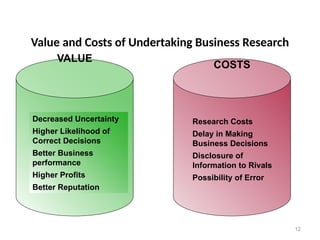
Value and Costsof Undertaking Business Research
VALUE
Decreased Uncertainty
Higher Likelihood of
Correct Decisions
Better Business
performance
Higher Profits
Better Reputation
COSTS
Research Costs
Delay in Making
Business Decisions
Disclosure of
Information to Rivals
Possibility of Error
Basic Research
• Isto generate a body of knowledge
• Attempts to expand the limits of knowledge.
• Not directly involved in the solution to a pragmatic
problem
• The findings of such research contribute to the
building of knowledge in the various functional
areas of business.
15.
Applied Research
• Isto solve a current problem faced by the manager
in the work setting, demanding a timely solution.
• Conducted when a decision must be made about a
specific real-life problem
• ………………….
16.
DISCUSSION QUESTIONS
• Byusing a practical examples, differentiate
between:
– Basic Research and Applied Research
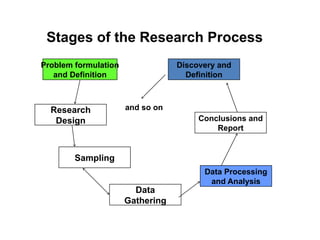
Stages of theResearch Process
Problem formulation
and Definition
Research
Design
Sampling
Data
Gathering
Data Processing
and Analysis
Conclusions and
Report
Discovery and
Definition
and so on
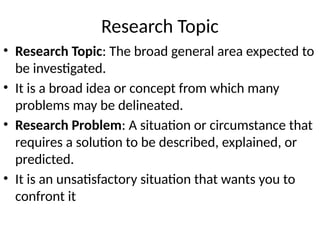
Research Topic
• ResearchTopic: The broad general area expected to
be investigated.
• It is a broad idea or concept from which many
problems may be delineated.
• Research Problem: A situation or circumstance that
requires a solution to be described, explained, or
predicted.
• It is an unsatisfactory situation that wants you to
confront it
21.
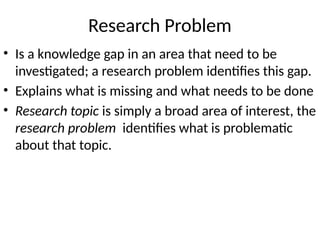
Research Problem
• Isa knowledge gap in an area that need to be
investigated; a research problem identifies this gap.
• Explains what is missing and what needs to be done
• Research topic is simply a broad area of interest, the
research problem identifies what is problematic
about that topic.
22.
Steps in formulatingresearch topics
1. Identifying the attributes of a good research topic
2. Generating ideas that help you select a suitable
topic
3. Turning ideas into clear research questions and
objectives
23.
1. Attributes ofa good research topic
• Capability: is it feasible?
–Are you interested in a topic?
–Can you complete the research in the time
available?
–Will the research still be current when you finish?
–Do you have sufficient financial and other
resources?
–Will you be able to gain access to data?
24.
1. Attributes……
• Appropriateness:is it worthwhile?
• Will the proposed research provide new
insights into the topic?
• Does the research topic match your career
goals?
25.
2. How togenerate research Ideas
Rational thinking technique:
• Looking at past projects/research reports
• Discussion with other people (friends, lecturers)
• Searching through literature (articles, books)
• Scanning the media (current issues)
26.
2. How togenerate Research ideas
Creative thinking technique:
• Keeping a notebook of ideas
• Exploring personal preferences using past
research reports
• Brainstorming
27.
Looking at pastresearch titles
• Research Reports and Theses;
• Scan university’s list of past research titles
• Scanning actual research reports.
28.
Discussion with otherpeople
• Colleagues, friends, university Lecturers,
Practitioners and Professional groups
29.
Searching the literature
•As part of your discussions, relevant literature may also be
suggested.
• Types of literature that are of particular use for generating
research ideas:
• Articles in academic and professional journals;
• Research Reports; books
30.
Scanning the media
•Keeping up to date with items in the news can
be a very rich source of ideas
– TVs
– News Papers
– Radios
31.
Keeping a notebookof ideas
• One of the more creative techniques that we all
use is to keep a notebook of ideas.
• All this involves is simply noting down any
interesting research ideas as you think of them
and, of equal importance, what sparked off your
thought.
• You can then pursue the idea using more rational
thinking technique later.
32.
Brainstorming
• Define yourproblem –the sorts of ideas you are interested in – as
precisely as possible.
• Ask for suggestions, relating to the problem
• Record all suggestions, observing the following rules:
– No suggestion should be criticized or evaluated in any
way before all ideas have been considered;
– All suggestions, however wild, should be recorded and
considered
– As many suggestions as possible should be recorded.
• Review all the suggestions and explore what is meant by each.
• Analyze the list of suggestions and decide which appeal to you most
as research ideas and why.
33.
3. Refining researchideas
• Using the Delphi Technique
– Sharing your topics with interested people in
the area (supervisors)
• Conducting a preliminary study
(exploratory research)
– Conducting interviews, reading relevant
literature
34.
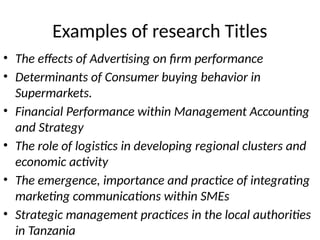
Examples of researchTitles
• The effects of Advertising on firm performance
• Determinants of Consumer buying behavior in
Supermarkets.
• Financial Performance within Management Accounting
and Strategy
• The role of logistics in developing regional clusters and
economic activity
• The emergence, importance and practice of integrating
marketing communications within SMEs
• Strategic management practices in the local authorities
in Tanzania
35.
Home Work
• ReadChapter 1 in Kothari
• Select three previous reports in your professional
and read them
• Formulate three research titles that are interesting
to you
STATEMENT OF THEPROBLEM
• It is a statement that clarifies in a few sentences the
problem to be investigated
• It is a statement which explains what needs to be
done by the proposed study
• It is based on previous studies; showing what has
been done and what is missing
38.
Statement of theProblem
• Statement of a research problem is important
because:-
• It enables the researcher to clarify the problem
and possible factors that contribute to it.
• It facilitates making decisions concerning the
focus and scope of the research.
39.
Statement of theProblem
• A persuasive problem statement consists of three
parts:
– the ideal situation (what is known),
– the reality (current situation – what is missing), and
– Why you need to do a research.
• Well constructed problem statements will convince
your audience that the problem is real and worth
having you to investigate.
40.
Statement of theProblem
• What you need is to:
– place the ideal scenario next to the situation as it
exists,
– emphasize the consequences of ignoring or
addressing the problem
– Connect ideal statement and the reality by using a
term such as "but," "however,“ "Unfortunately," or "in
spite of
• Examples:
41.
Example of statementof the problem (1)
PART A (IDEAL SITUATION)
• According to the XY university mission statement,
the university seeks to provide students with a safe,
healthy learning environment. Dormitories are one
important aspect of that learning environment,
since 55% of XY students live in campus dorms and
most of these students spend a significant amount
of time working in their dorm rooms.
42.
Problem statement…..
• PartB. (reality – current situation)
• However, Students living in dorms A B C, and D
currently do not have air conditioning units, and
during the hot seasons, it is common for room
temperatures to exceed 40 degree C. Many students
report that they are unable to do homework in their
dorm rooms. Others report problems sleeping
because of the humidity and temperature. The
rooms are not only unhealthy, but they inhibit
student productivity and academic achievement.
43.
Problem statement…..
• PartC. (What needs to be done)
• In response to this problem, our study proposes to
investigate several options for making the dorms more
hospitable. We plan to carry out an all inclusive
participatory investigation into options for purchasing air
conditioners (university-funded; student-subsidized) and
different types of air conditioning systems. We will also
consider less expensive ways to mitigate some or all of
the problems noted above (such as creating climate-
controlled dorm lounges and equipping them with better
study areas and computing space).
44.
Example 2…..
• Inorder to accomplish their missions, public
universities need motivated workforces. There are
however frequent and severe disciplinary actions,
absenteeism as well as various forms of unrests in
public universities which affect the accomplishment of
the set missions. Our preliminary investigation reveals
that both non-management and management staff are
not adequately motivated. Without effective
motivational packages and procedures the said vices
are likely to continue and retard the achievement of
the universities missions. Need arises to examine the
public universities motivation systems and procedures
hence this proposed research
45.
Research Objectives
• Theresearch objectives must be stated at the
very beginning of the study, since they will guide
the researcher during the process of formulating
research questions and hypothesis.
• They will enable the reader or consumer of the
work to judge whether the researcher had
achieved these objectives or not.
46.
Research Objectives
• Generalobjective (Goal): states what researchers expect
to achieve by the study in general terms.
• Specific objectives: smaller, logically connected parts of
general objective. They are the specific aspects of the
topic that we want to study within the framework of our
study
• Specific objectives should systematically address the
various aspects of the problem and the key factors that
are assumed to influence or cause the problem.
47.
Why research objectives?
•To Focus the study (narrowing it down to
essentials);
• To Avoid the collection of data which are not
strictly necessary for understanding and solving the
problem we have identified; and
• To Organize the study in clearly defined parts or
phases.
• Properly formulated, specific objectives will
facilitate the development of our research
methodology and will help to orient the collection,
analysis, interpretation and utilization of data
48.
Research Objectives:
Makesure that research objectives:
• Cover the different aspects of the problem and its
contributing factors in a coherent way and in a logical
sequence;
• Are clearly phrased in operational terms, specifying exactly
what you are going to do, where, and for what purpose;
• Are realistic considering local conditions; and
• Use action verbs that are specific enough to be evaluated.
• Examples of action verbs are: to determine, to compare, to
verify, to calculate, to describe, and to establish.
• Avoid the use of vague non-action verbs such as: to
appreciate, to understand, or to study.
49.
Examples of Objectives
•Main Objective
– Assessment of the factors that affect customer loyalty
in banks
• Specific Objectives:
– To identify services offered to customers.
– To identify the strategies used to retain customers.
– To identify the factors that affect customer’s loyalty
– To examine relationship between the factors with
customer loyalty.
50.
Research Questions
• Itis a direct rewording of the research objectives,
phrased interrogatively rather than declaratively
• Questions that are simple and direct invite an
answer and help to focus attention on the kinds of
data needed to provide that answer.
51.
Research Questions Examples…
•What services are offered to customers?
• What strategies are used to retain customers?
• What factors do affect customer’s loyalty at CRDB
Bank?
• Is there a significant relatioship btween identified
factors with customer loyalty?
DISCUSSION QUESTIONS
• Formulatea research topic that is interesting to you
• Formulate a research problem statement
• Formulate Research Objectives
• Formulate Research Questions
Editor's Notes
#5 For example:
Why people think Maths (QMS) is difficuult? Or Economics?
#6 Literally, research (re-search) -“search again”
Business research must be objective
Detached and impersonal rather than biased
#9 that guides managers to make informed decisions to successfully deal with problems.
that is, when decision-makers face two or more courses of action and seek to select the best possible alternative under the circumstances.
#14 E.g. Is executive success correlated with high need for achievement?
How does motivation affect employee performance?
#15 A firm wants to produce and market a new product but first wants to ascertain if there is a potential consumer demand for this product in markets A, B & C
A multinational firm wants to establish a production facility in another country after determining its technical and economic feasibility