2
Disclaimer:
Medicine and respiratory therapy are continuously changing
practices. The author and publisher have reviewed all information
in this report with resources believed to be reliable and accurate
and have made every effort to provide information that is up to
date with the best practices at the time of publication. Despite our
best efforts we cannot disregard the possibility of human error
and continual changes in best practices the author, publisher, and
any other party involved in the production of this work can
warrant that the information contained herein is complete or fully
accurate. The author, publisher, and all other parties involved in
this work disclaim all responsibility from any errors contained
within this work and from the results from the use of this
information. Readers are encouraged to check all information in
this publication with institutional guidelines, other sources, and up
to date information. Respiratory Therapy Zone is not affiliated with
the NBRC®
, AARC®
, or any other group at the time of this
publication.
Copyright ã Respiratory Therapy Zone
3
Table of Contents
Introduction ……………………………………………………………..…………………………………...……..4
Formulas ……………………………………………………………..………………………………..………...……..5
Calculations ……………………………………………………………..………………………………....………..11
Practice Questions ………………………………………….………………………………….…….……..73
TMC Practice Questions …………………………………….……………………..………..….……..80
Conclusion …………………………………………………………..…..……..…………………………...……..85
References …………………………………………………….….……..………..………………………...……..86
Copyright ã Respiratory Therapy Zone
4
Are you ready to learn about the Respiratory Therapy Formulas,
Calculations, and Equations? I sure hope so because that is what
this guide is all about.
Inside of this book, we’ve created an all-in-one stop that you can
use as a reference for each and every formula that you’ll see as a
Respiratory Therapy Student.
Some are hard. Some are easy.
But the good news is, I have faith that you can master them all if
you set your mind to it. Practice (and lots of repetitions) makes
perfect. So the more time you spend going through these
formulas, the more likely it is that you’ll actually learn and
memorize this information.
And as you’ll see, we’ve even included some practice questions
that can provide additional help as well.
So if you’re ready, let’s go ahead and dive right in. J
Copyright ã Respiratory Therapy Zone
Note: In general, the formulas and calculations may vary from
publication to publication. With that said, we’ve attempted to
provide the ones that will be most helpful for the Respiratory
Therapy Board Exams.
Introduction
5
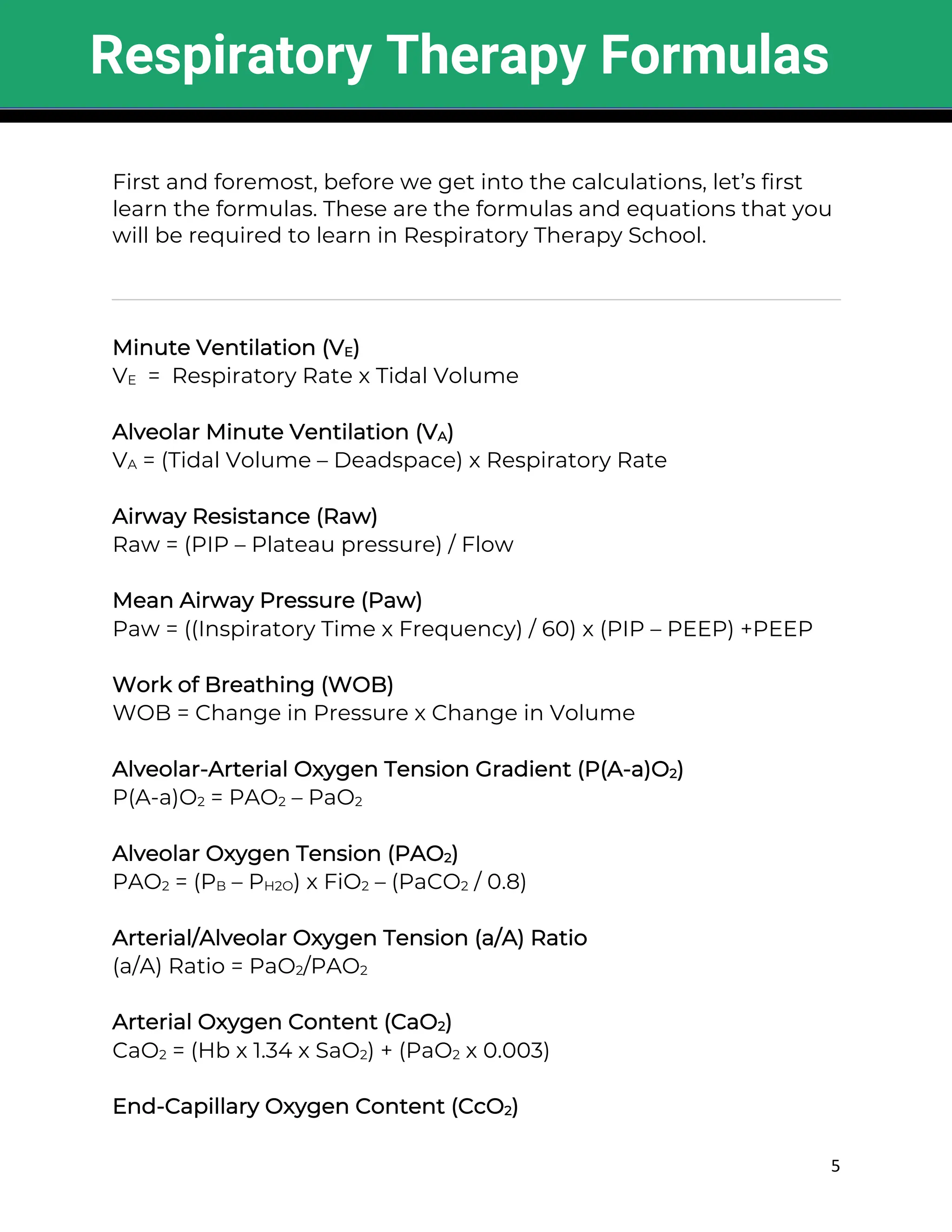
First and foremost, before we get into the calculations, let’s first
learn the formulas. These are the formulas and equations that you
will be required to learn in Respiratory Therapy School.
Minute Ventilation (VE)
VE = Respiratory Rate x Tidal Volume
Alveolar Minute Ventilation (VA)
VA = (Tidal Volume – Deadspace) x Respiratory Rate
Airway Resistance (Raw)
Raw = (PIP – Plateau pressure) / Flow
Mean Airway Pressure (Paw)
Paw = ((Inspiratory Time x Frequency) / 60) x (PIP – PEEP) +PEEP
Work of Breathing (WOB)
WOB = Change in Pressure x Change in Volume
Alveolar-Arterial Oxygen Tension Gradient (P(A-a)O2)
P(A-a)O2 = PAO2 – PaO2
Alveolar Oxygen Tension (PAO2)
PAO2 = (PB – PH2O) x FiO2 – (PaCO2 / 0.8)
Arterial/Alveolar Oxygen Tension (a/A) Ratio
(a/A) Ratio = PaO2/PAO2
Arterial Oxygen Content (CaO2)
CaO2 = (Hb x 1.34 x SaO2) + (PaO2 x 0.003)
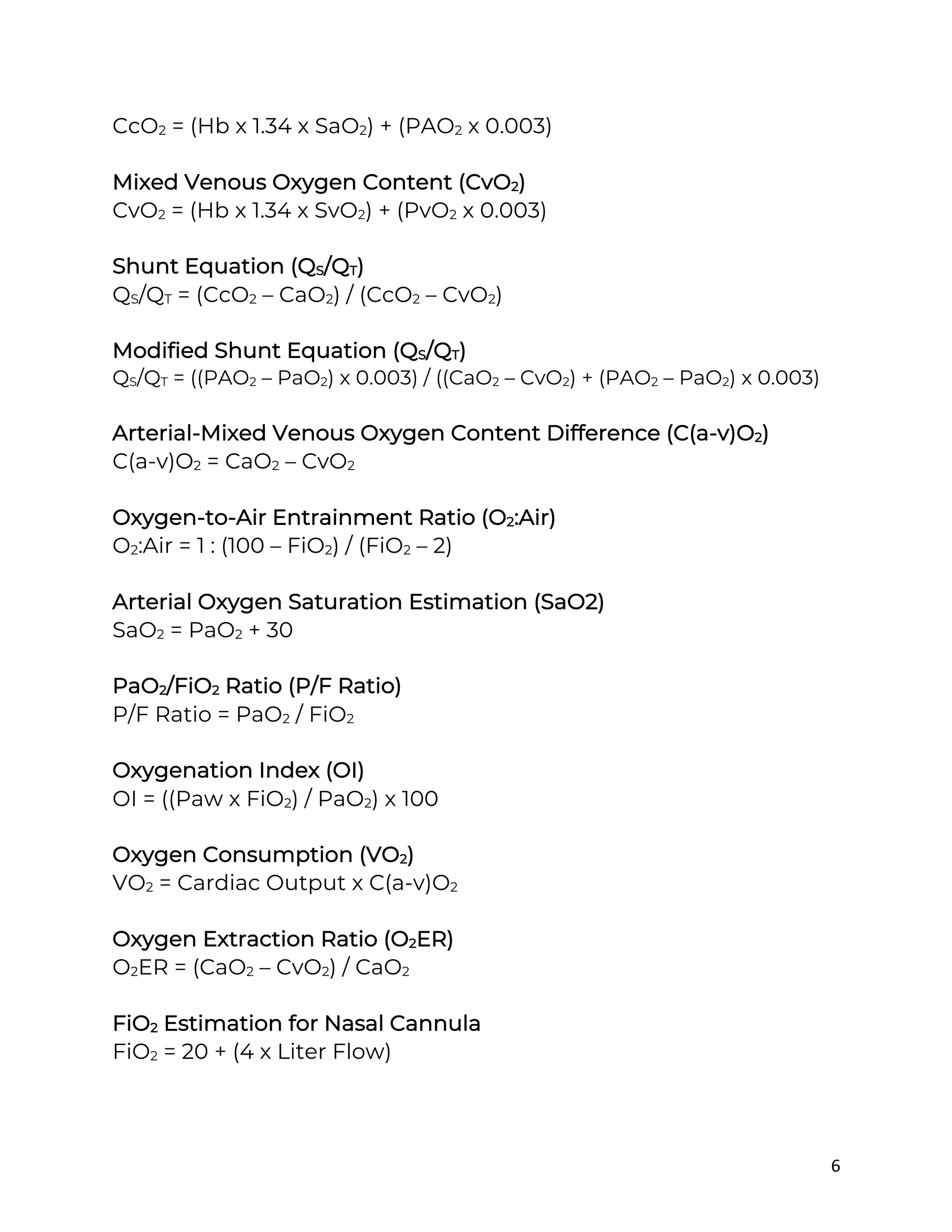
End-Capillary Oxygen Content (CcO2)
Respiratory Therapy Formulas
6
CcO2 = (Hb x 1.34 x SaO2) + (PAO2 x 0.003)
Mixed Venous Oxygen Content (CvO2)
CvO2 = (Hb x 1.34 x SvO2) + (PvO2 x 0.003)
Shunt Equation (QS/QT)
QS/QT = (CcO2 – CaO2) / (CcO2 – CvO2)
Modified Shunt Equation (QS/QT)
QS/QT = ((PAO2 – PaO2) x 0.003) / ((CaO2 – CvO2) + (PAO2 – PaO2) x 0.003)
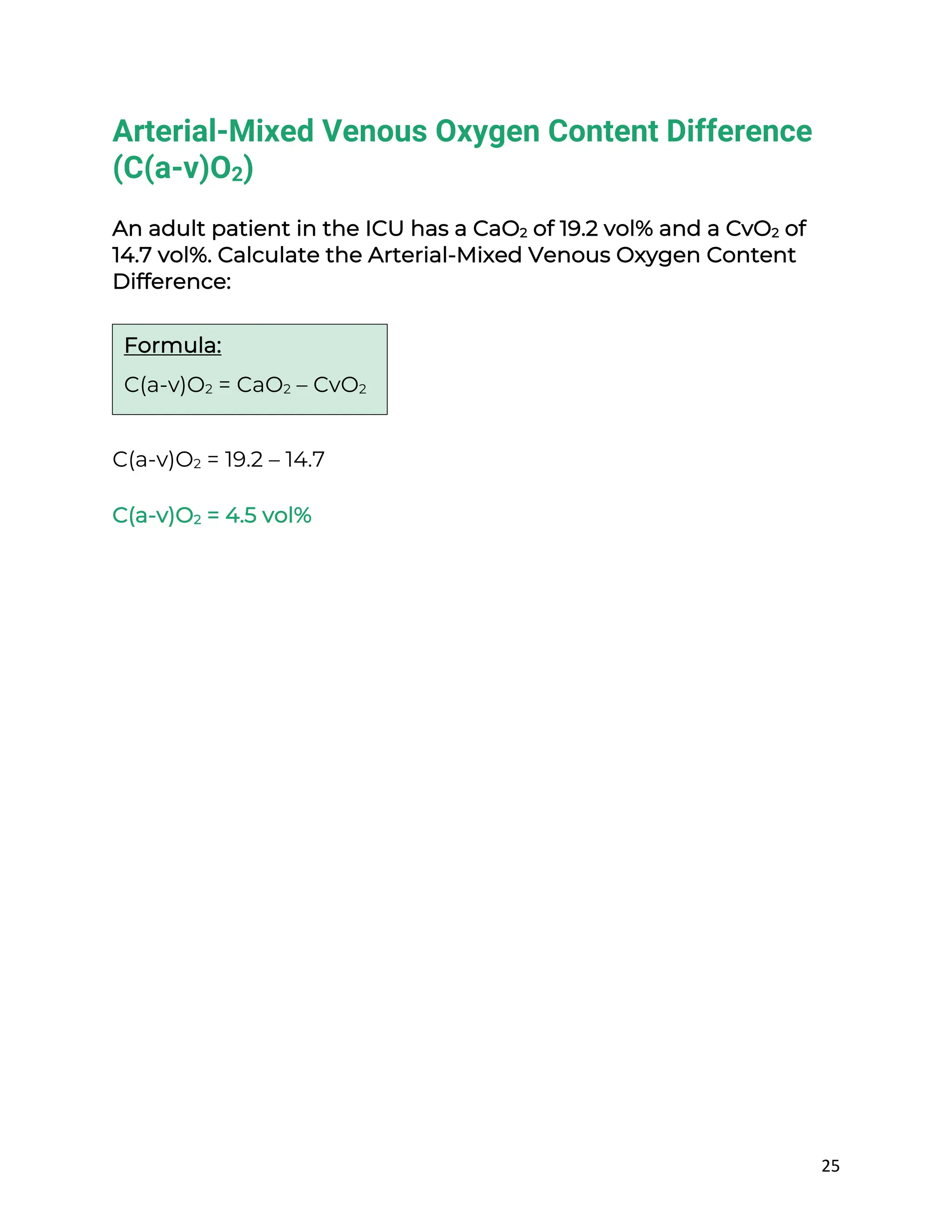
Arterial-Mixed Venous Oxygen Content Difference (C(a-v)O2)
C(a-v)O2 = CaO2 – CvO2
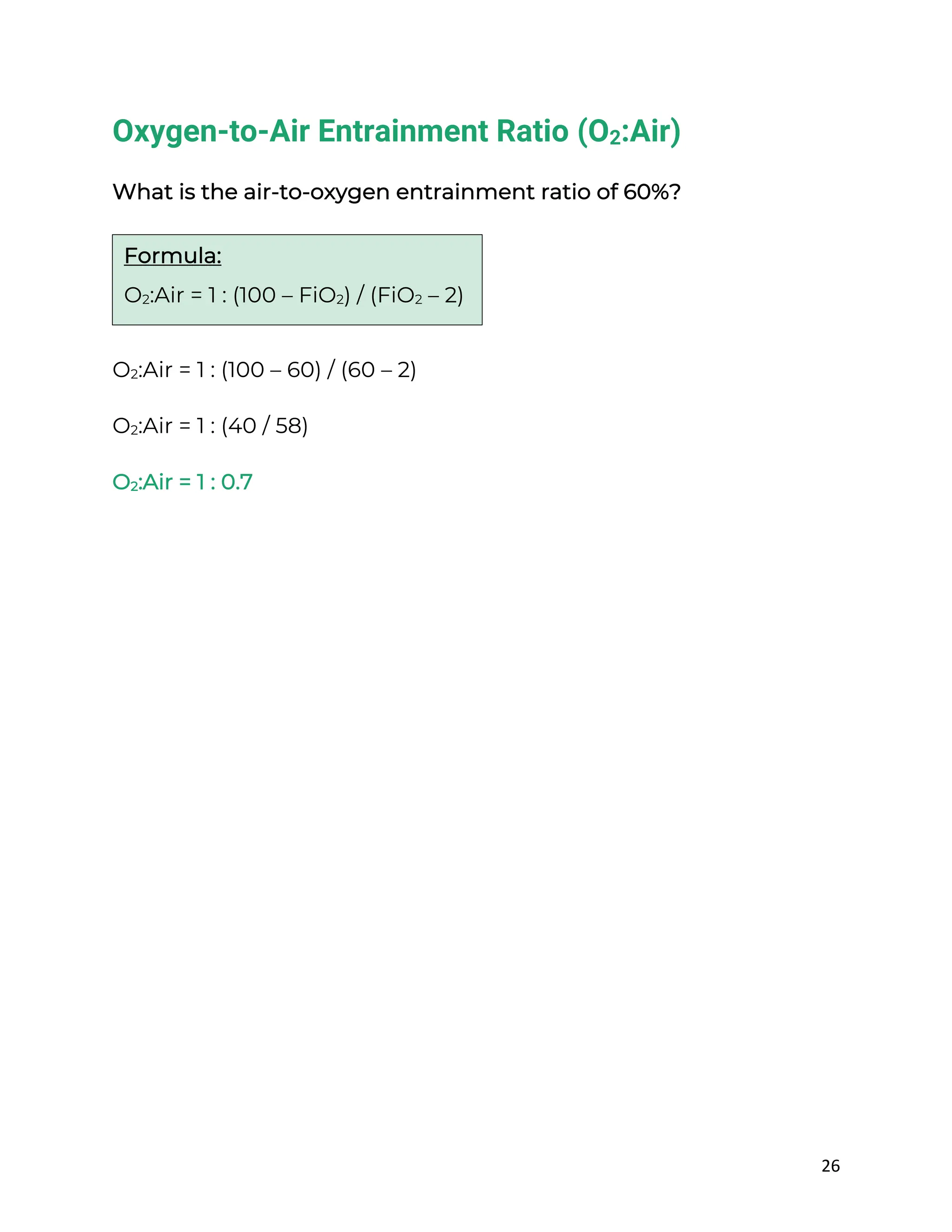
Oxygen-to-Air Entrainment Ratio (O2:Air)
O2:Air = 1 : (100 – FiO2) / (FiO2 – 2)
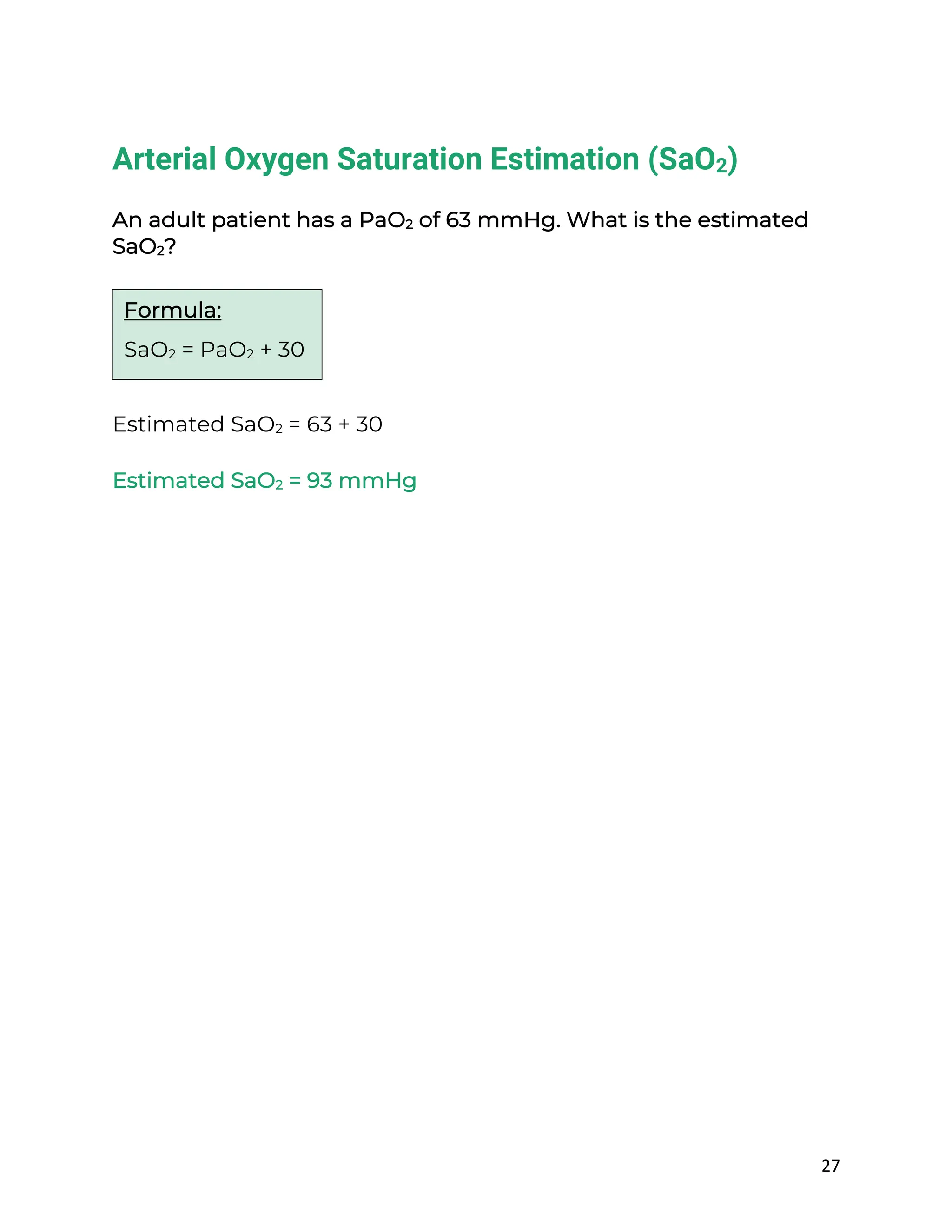
Arterial Oxygen Saturation Estimation (SaO2)
SaO2 = PaO2 + 30
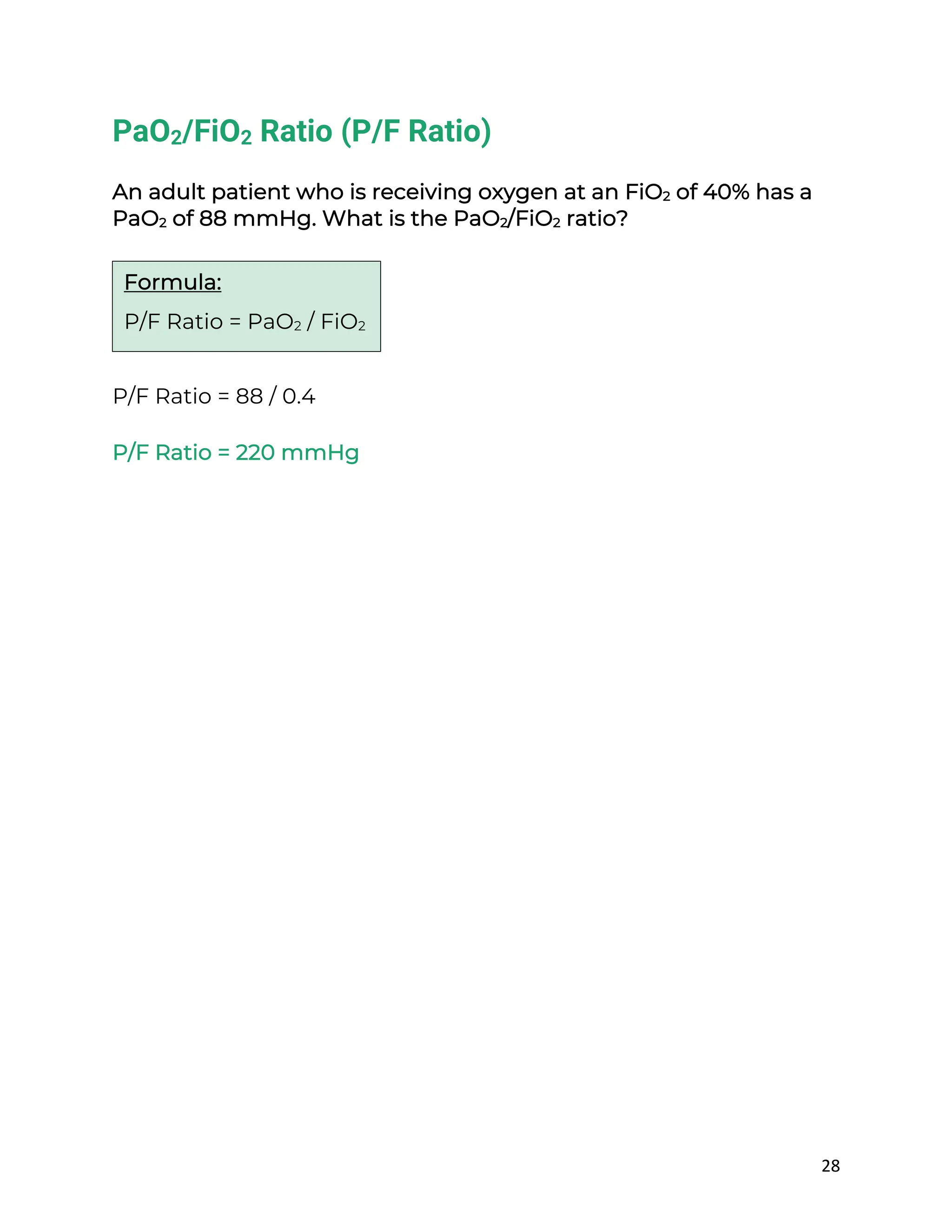
PaO2/FiO2 Ratio (P/F Ratio)
P/F Ratio = PaO2 / FiO2
Oxygenation Index (OI)
OI = ((Paw x FiO2) / PaO2) x 100
Oxygen Consumption (VO2)
VO2 = Cardiac Output x C(a-v)O2
Oxygen Extraction Ratio (O2ER)
O2ER = (CaO2 – CvO2) / CaO2
FiO2 Estimation for Nasal Cannula
FiO2 = 20 + (4 x Liter Flow)
7
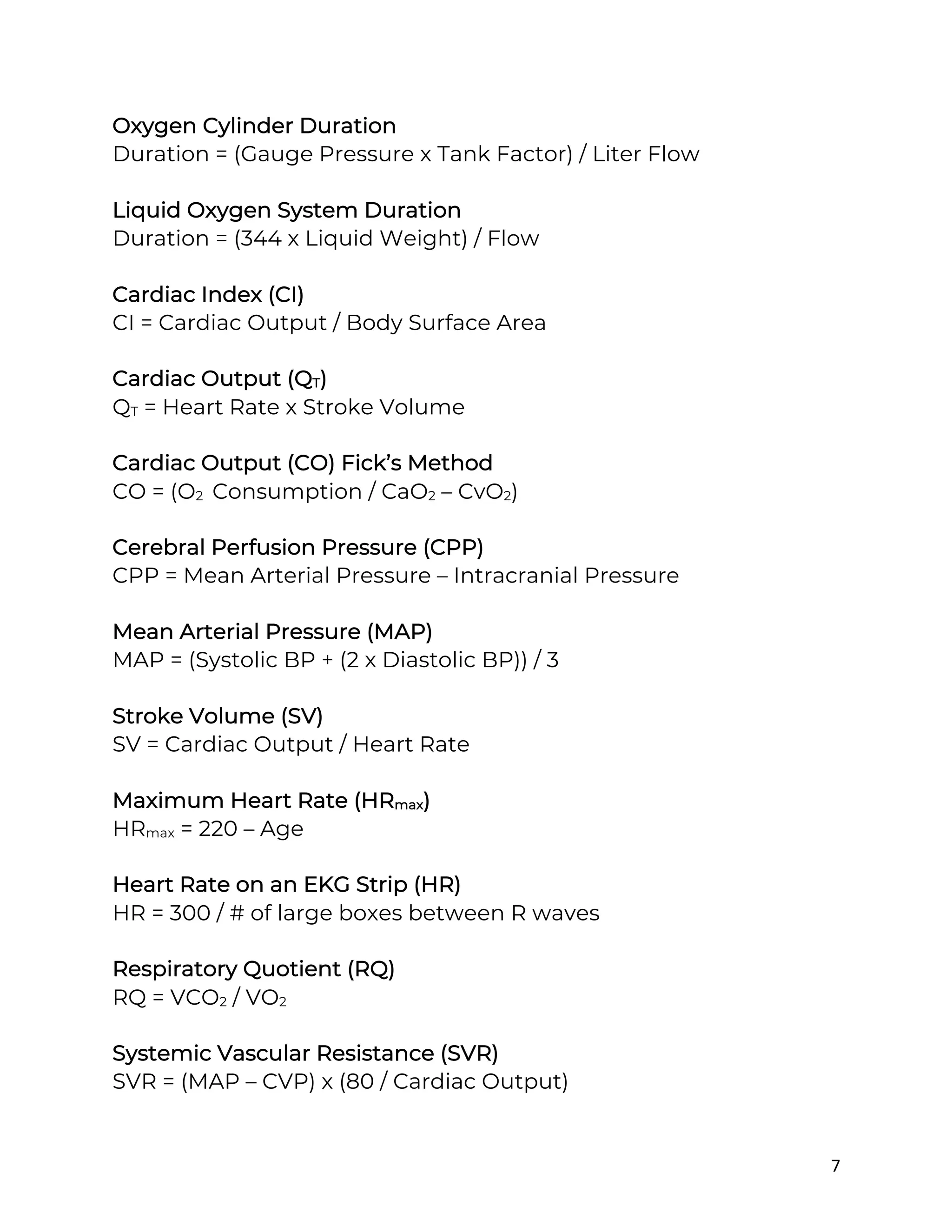
Oxygen Cylinder Duration
Duration = (Gauge Pressure x Tank Factor) / Liter Flow
Liquid Oxygen System Duration
Duration = (344 x Liquid Weight) / Flow
Cardiac Index (CI)
CI = Cardiac Output / Body Surface Area
Cardiac Output (QT)
QT = Heart Rate x Stroke Volume
Cardiac Output (CO) Fick’s Method
CO = (O2 Consumption / CaO2 – CvO2)
Cerebral Perfusion Pressure (CPP)
CPP = Mean Arterial Pressure – Intracranial Pressure
Mean Arterial Pressure (MAP)
MAP = (Systolic BP + (2 x Diastolic BP)) / 3
Stroke Volume (SV)
SV = Cardiac Output / Heart Rate
Maximum Heart Rate (HRmax)
HRmax = 220 – Age
Heart Rate on an EKG Strip (HR)
HR = 300 / # of large boxes between R waves
Respiratory Quotient (RQ)
RQ = VCO2 / VO2
Systemic Vascular Resistance (SVR)
SVR = (MAP – CVP) x (80 / Cardiac Output)
8
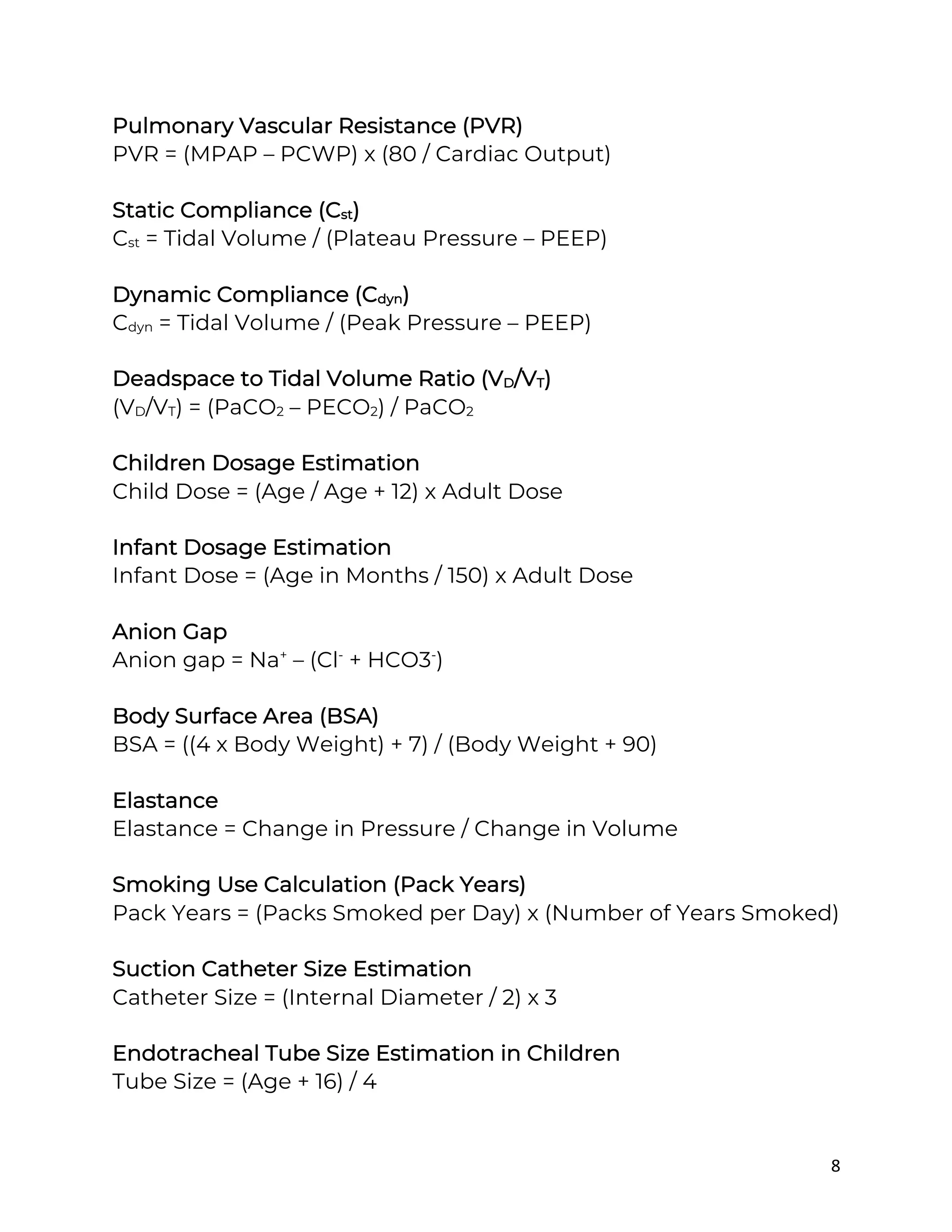
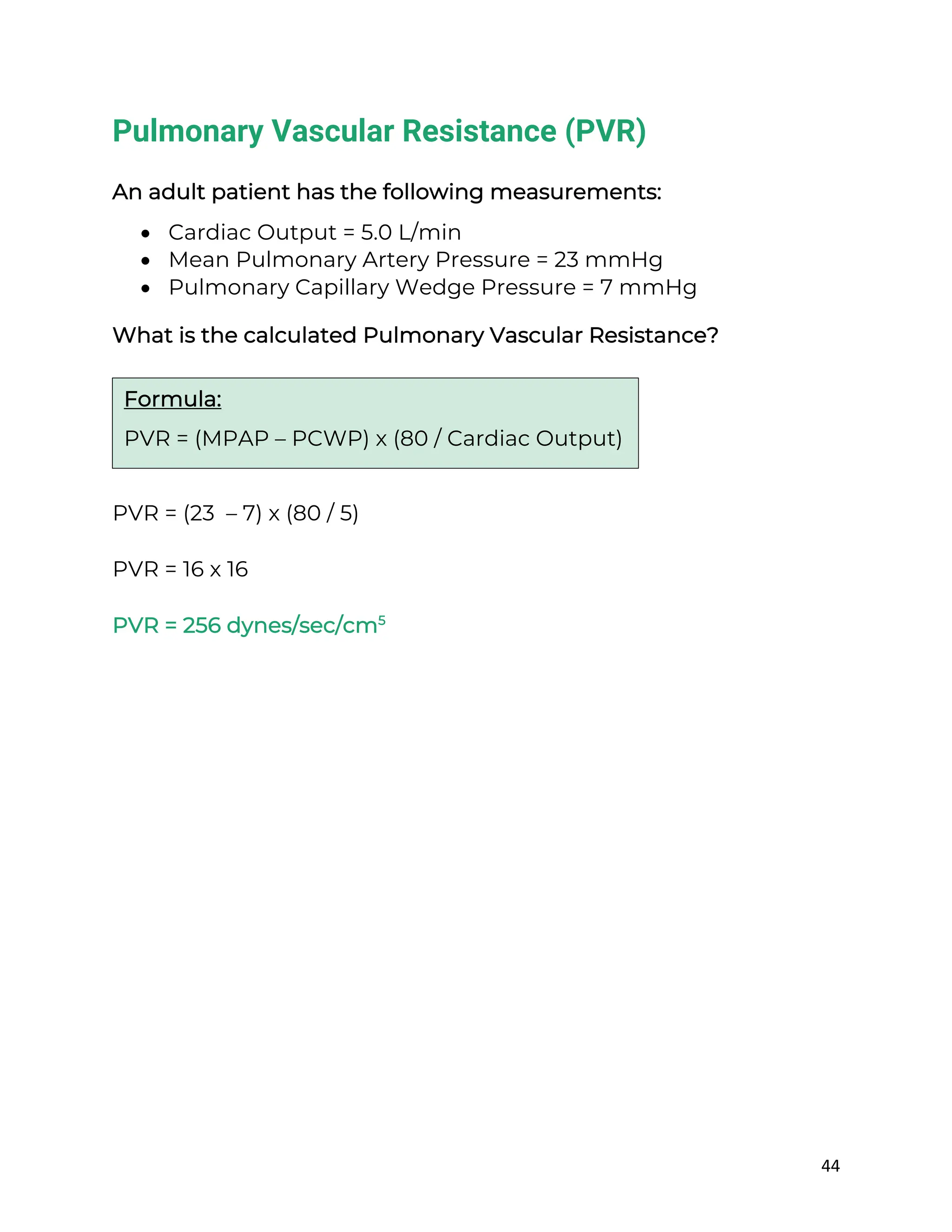
Pulmonary Vascular Resistance (PVR)
PVR = (MPAP – PCWP) x (80 / Cardiac Output)
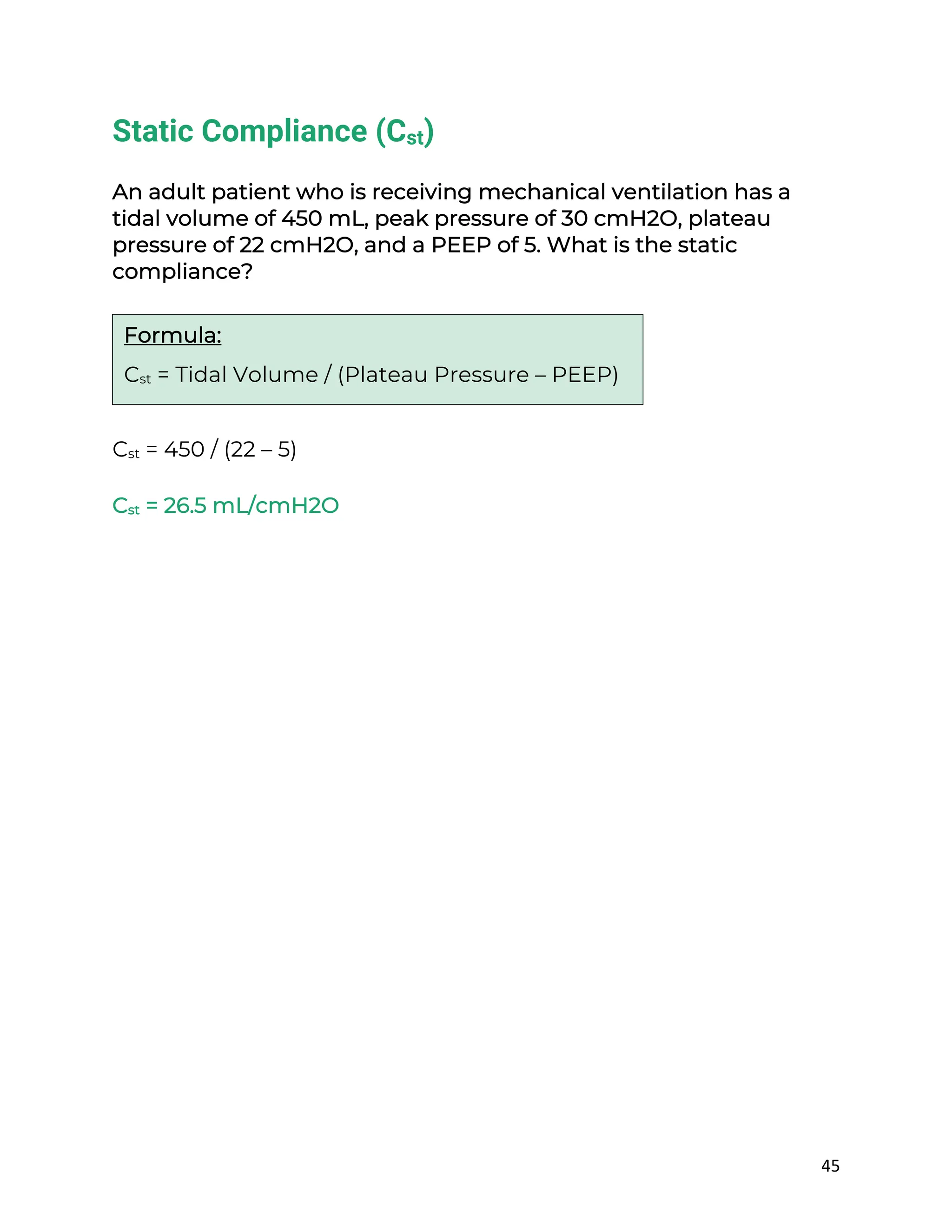
Static Compliance (Cst)
Cst = Tidal Volume / (Plateau Pressure – PEEP)
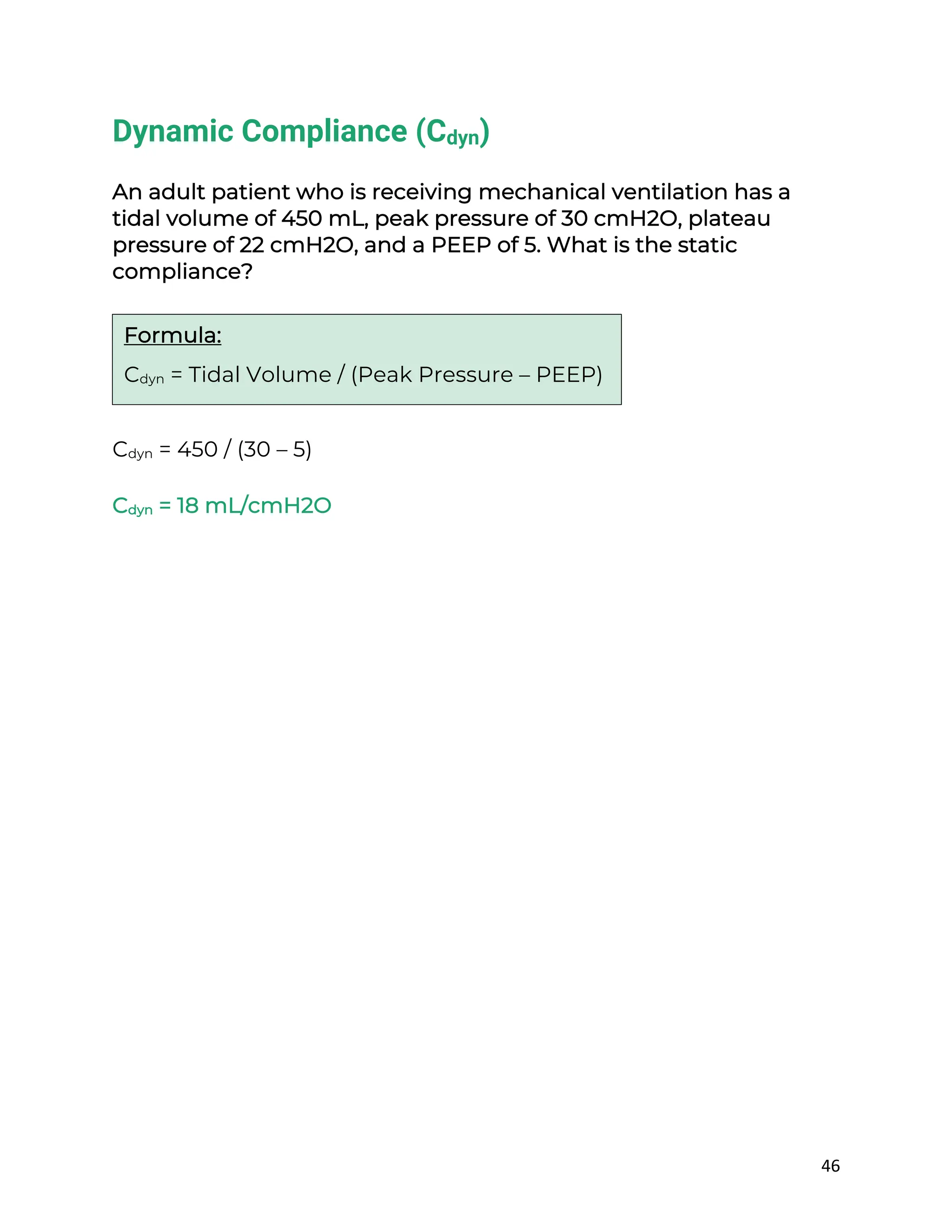
Dynamic Compliance (Cdyn)
Cdyn = Tidal Volume / (Peak Pressure – PEEP)
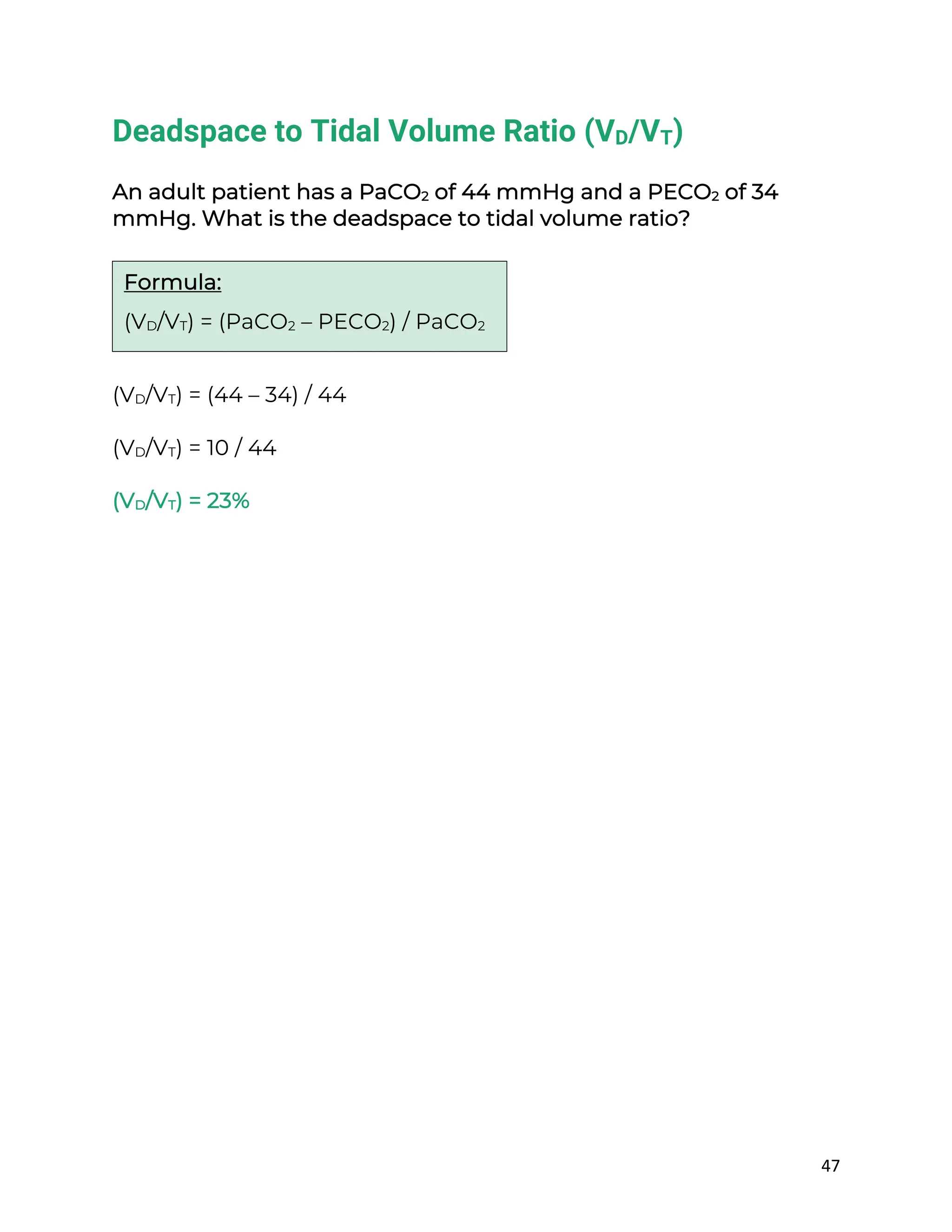
Deadspace to Tidal Volume Ratio (VD/VT)
(VD/VT) = (PaCO2 – PECO2) / PaCO2
Children Dosage Estimation
Child Dose = (Age / Age + 12) x Adult Dose
Infant Dosage Estimation
Infant Dose = (Age in Months / 150) x Adult Dose
Anion Gap
Anion gap = Na+
– (Cl-
+ HCO3-
)
Body Surface Area (BSA)
BSA = ((4 x Body Weight) + 7) / (Body Weight + 90)
Elastance
Elastance = Change in Pressure / Change in Volume
Smoking Use Calculation (Pack Years)
Pack Years = (Packs Smoked per Day) x (Number of Years Smoked)
Suction Catheter Size Estimation
Catheter Size = (Internal Diameter / 2) x 3
Endotracheal Tube Size Estimation in Children
Tube Size = (Age + 16) / 4
9
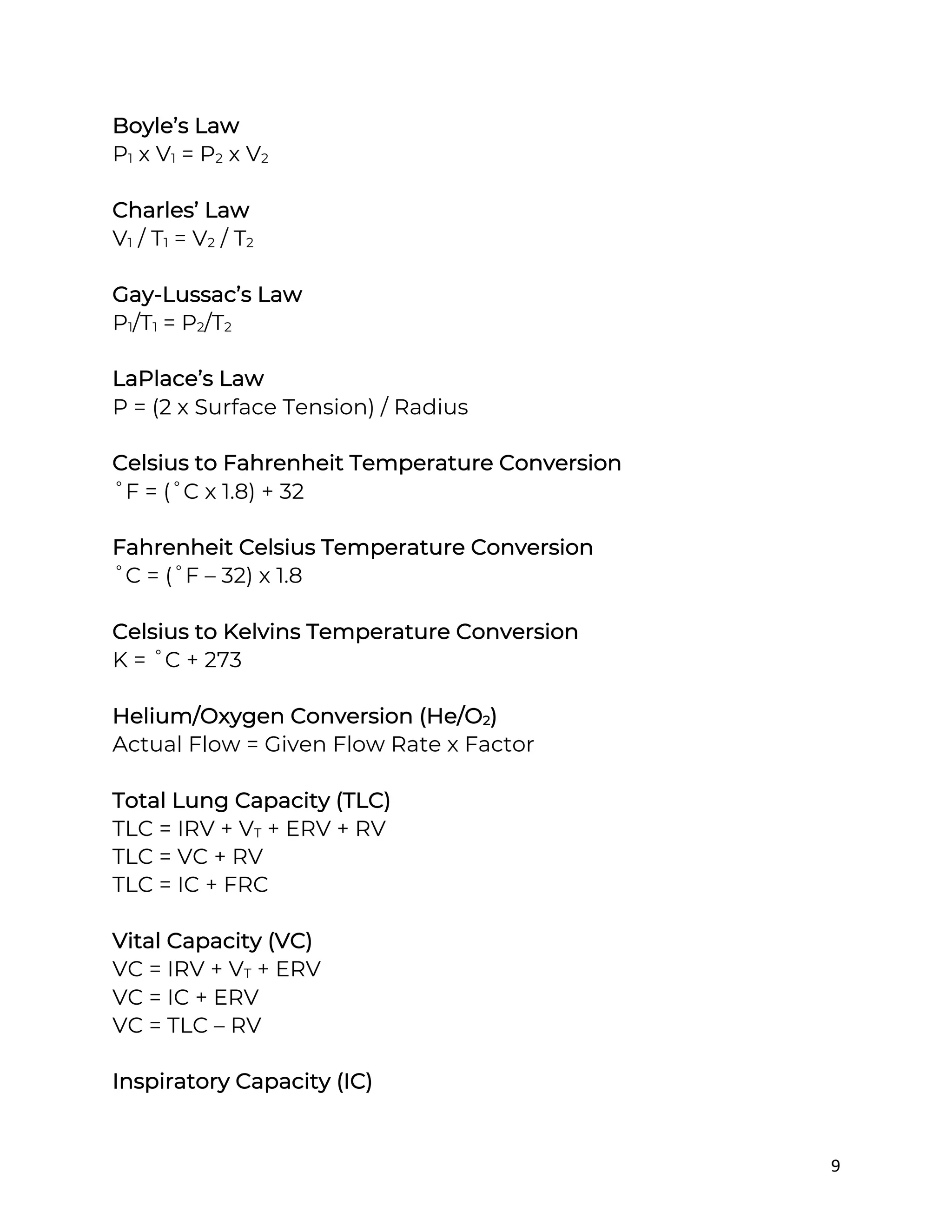
Boyle’s Law
P1 x V1 = P2 x V2
Charles’ Law
V1 / T1 = V2 / T2
Gay-Lussac’s Law
P1/T1 = P2/T2
LaPlace’s Law
P = (2 x Surface Tension) / Radius
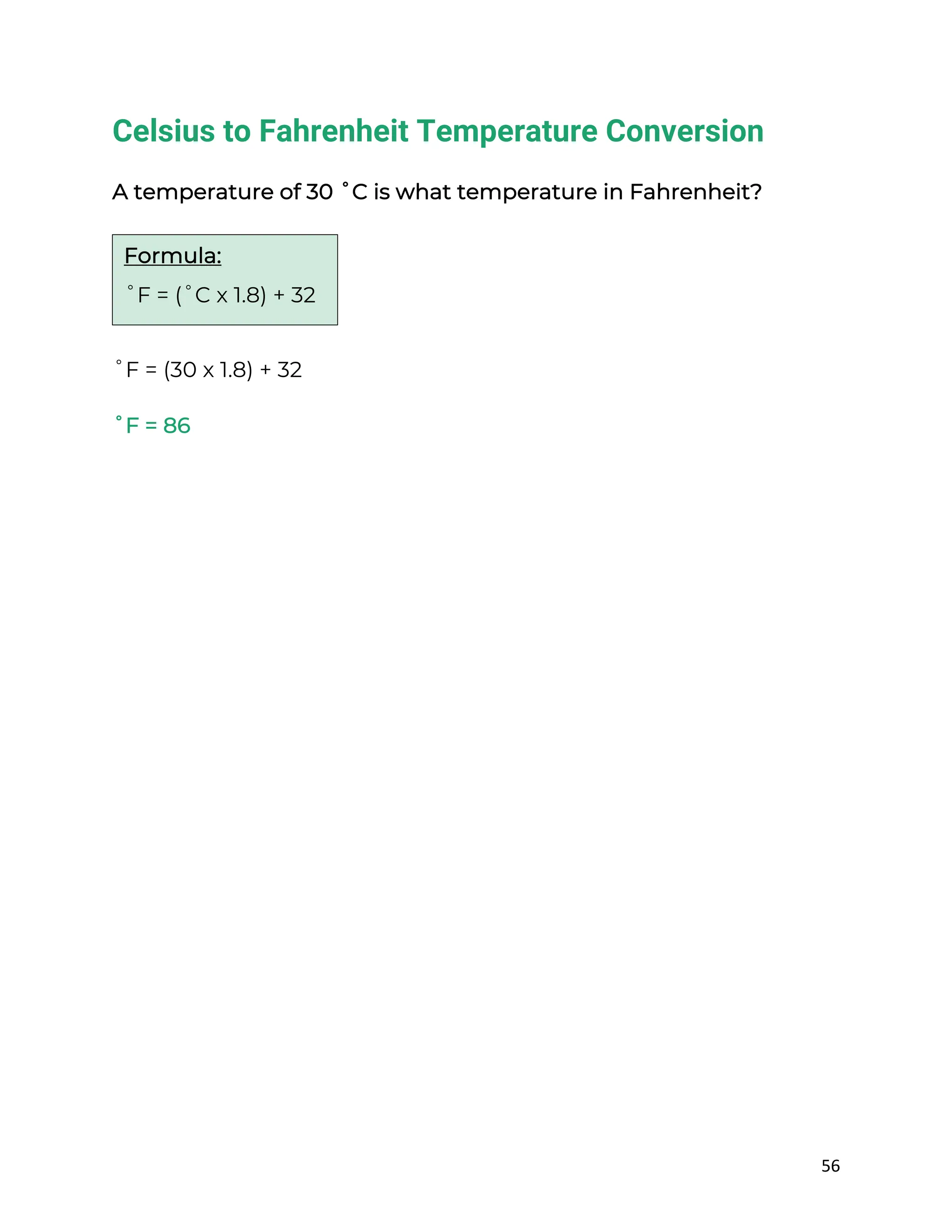
Celsius to Fahrenheit Temperature Conversion
˚F = (˚C x 1.8) + 32
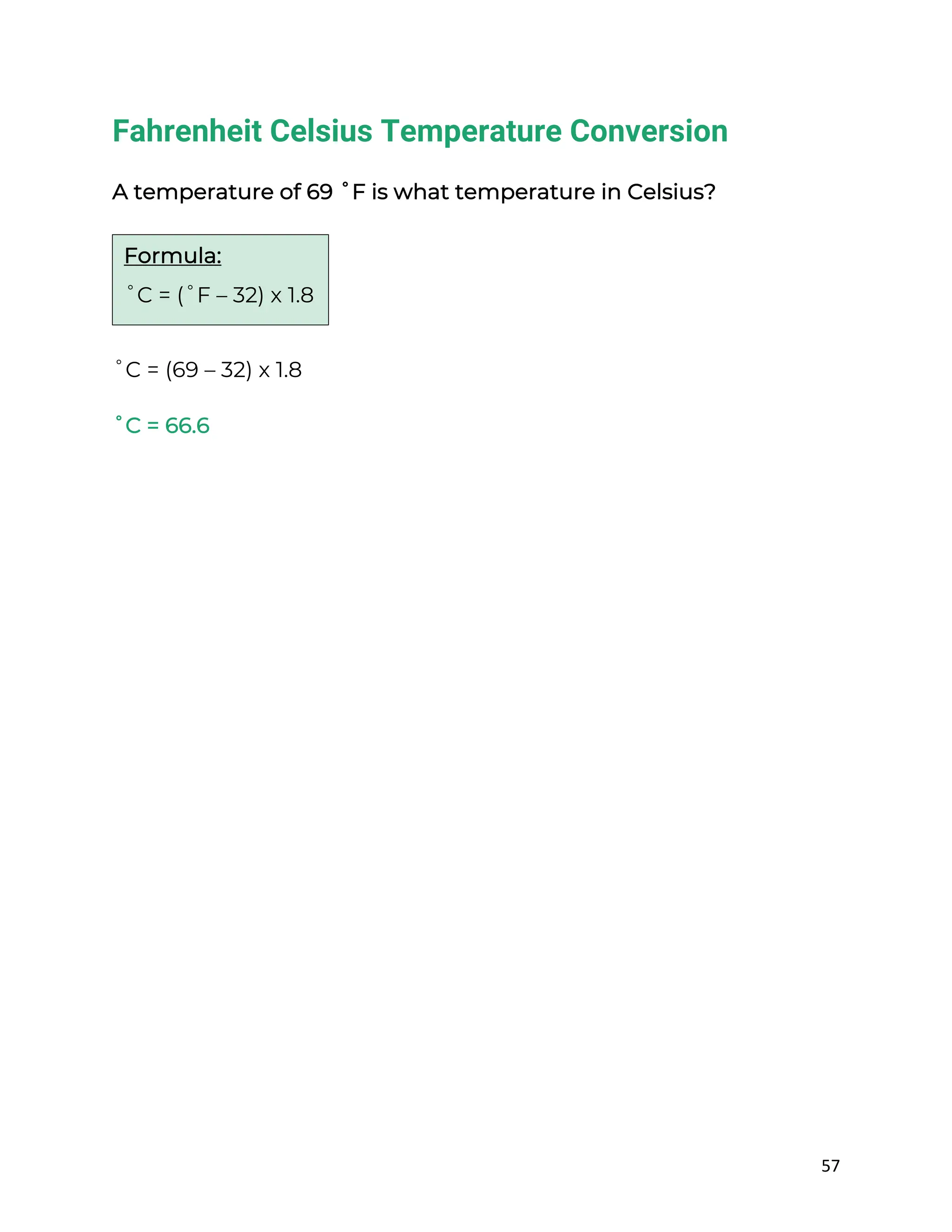
Fahrenheit Celsius Temperature Conversion
˚C = (˚F – 32) x 1.8
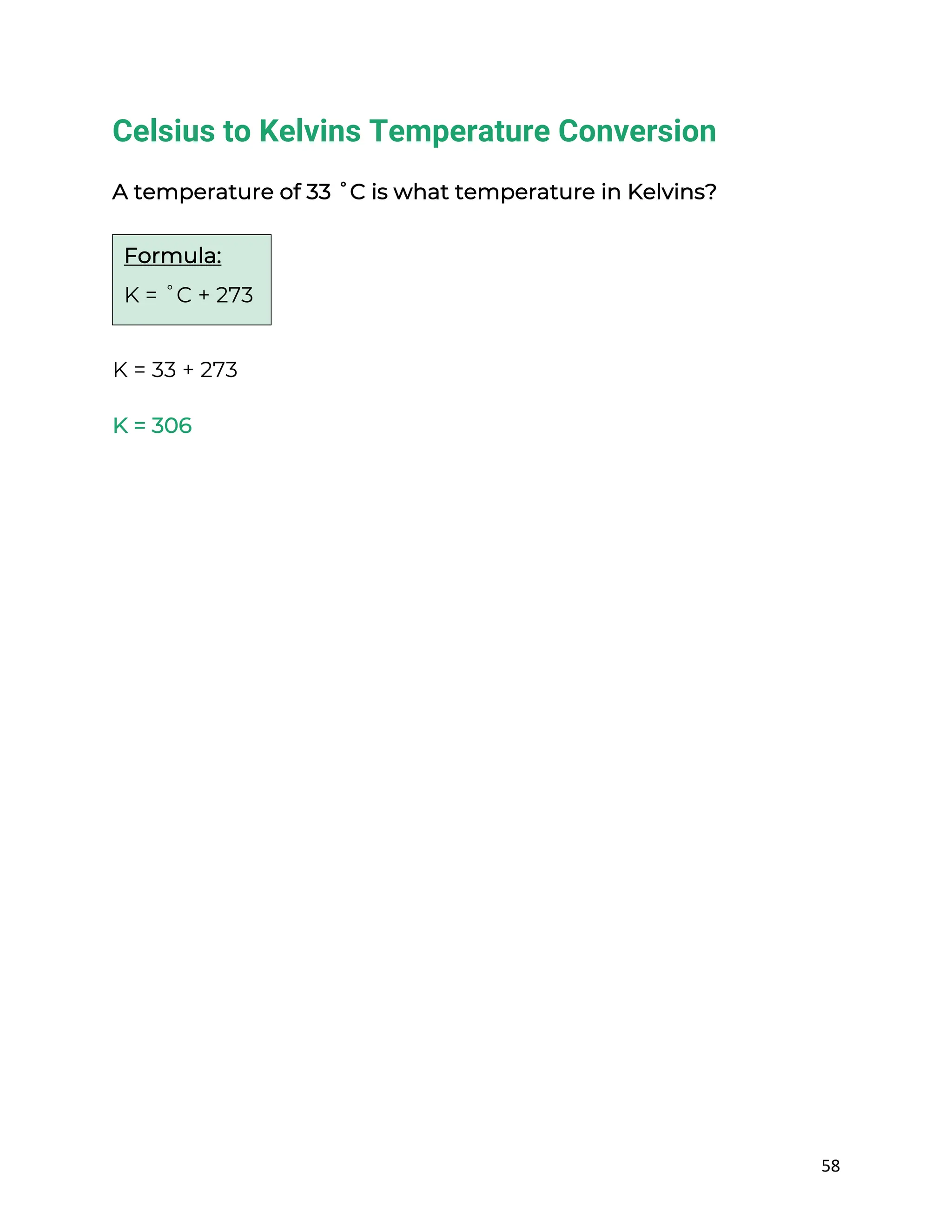
Celsius to Kelvins Temperature Conversion
K = ˚C + 273
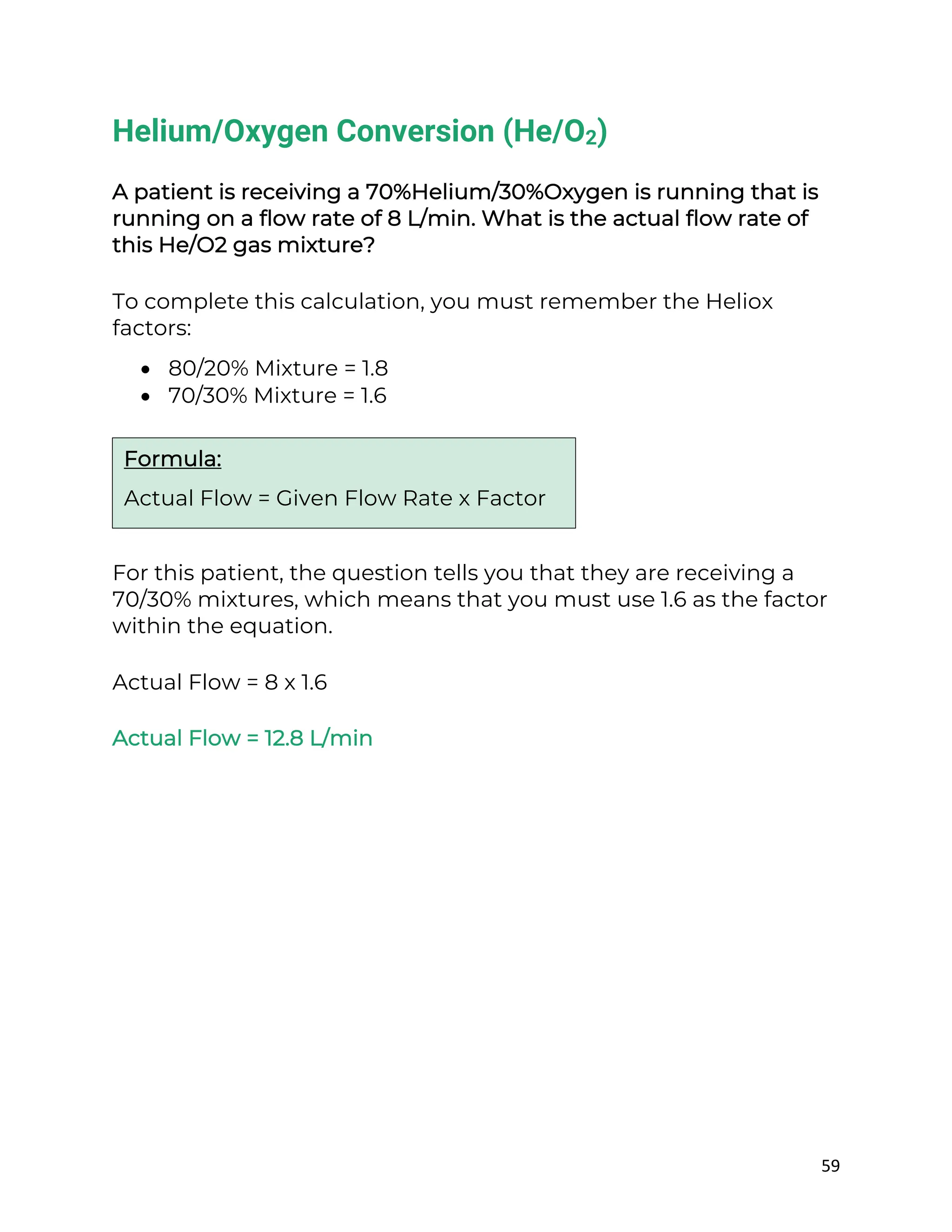
Helium/Oxygen Conversion (He/O2)
Actual Flow = Given Flow Rate x Factor
Total Lung Capacity (TLC)
TLC = IRV + VT + ERV + RV
TLC = VC + RV
TLC = IC + FRC
Vital Capacity (VC)
VC = IRV + VT + ERV
VC = IC + ERV
VC = TLC – RV
Inspiratory Capacity (IC)
10
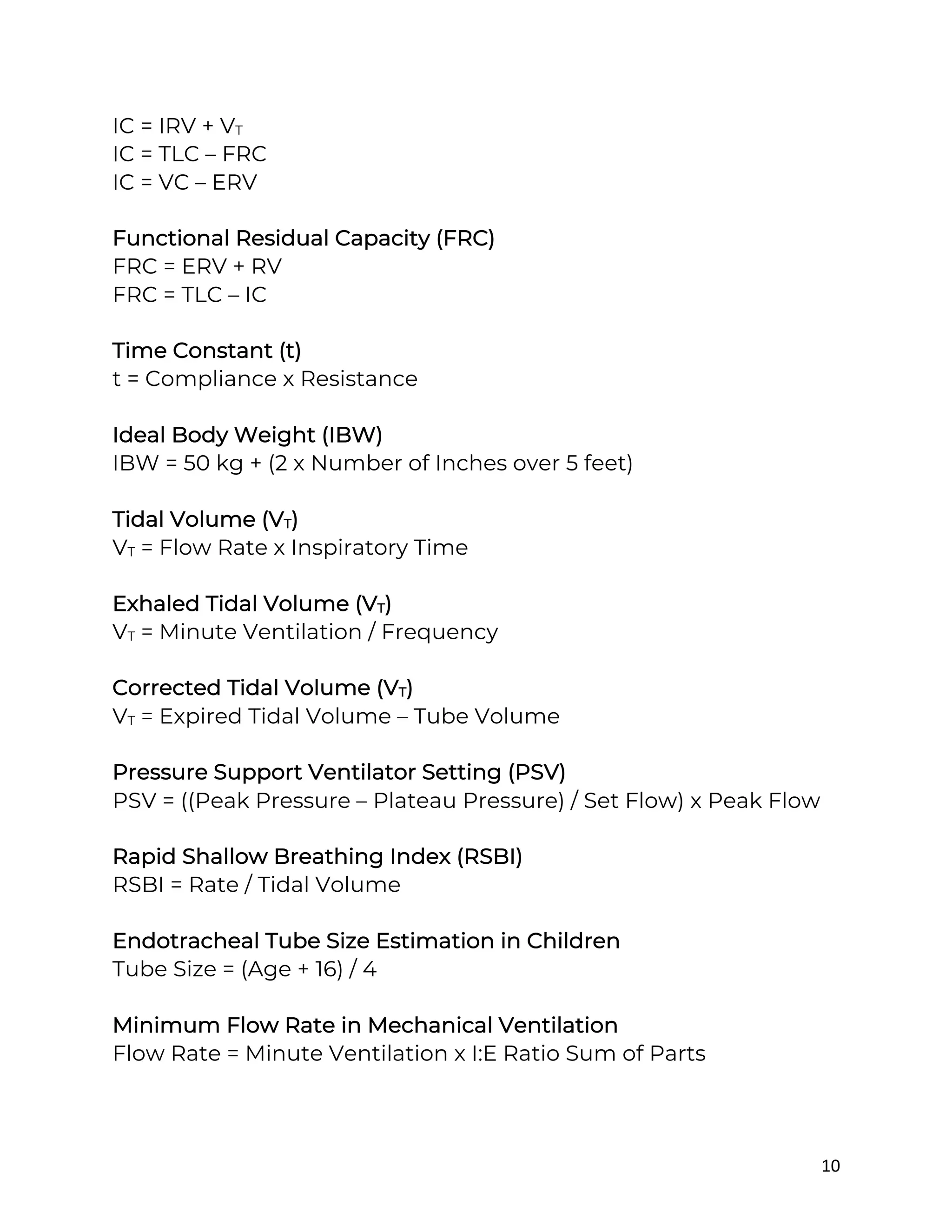
IC = IRV + VT
IC = TLC – FRC
IC = VC – ERV
Functional Residual Capacity (FRC)
FRC = ERV + RV
FRC = TLC – IC
Time Constant (t)
t = Compliance x Resistance
Ideal Body Weight (IBW)
IBW = 50 kg + (2 x Number of Inches over 5 feet)
Tidal Volume (VT)
VT = Flow Rate x Inspiratory Time
Exhaled Tidal Volume (VT)
VT = Minute Ventilation / Frequency
Corrected Tidal Volume (VT)
VT = Expired Tidal Volume – Tube Volume
Pressure Support Ventilator Setting (PSV)
PSV = ((Peak Pressure – Plateau Pressure) / Set Flow) x Peak Flow
Rapid Shallow Breathing Index (RSBI)
RSBI = Rate / Tidal Volume
Endotracheal Tube Size Estimation in Children
Tube Size = (Age + 16) / 4
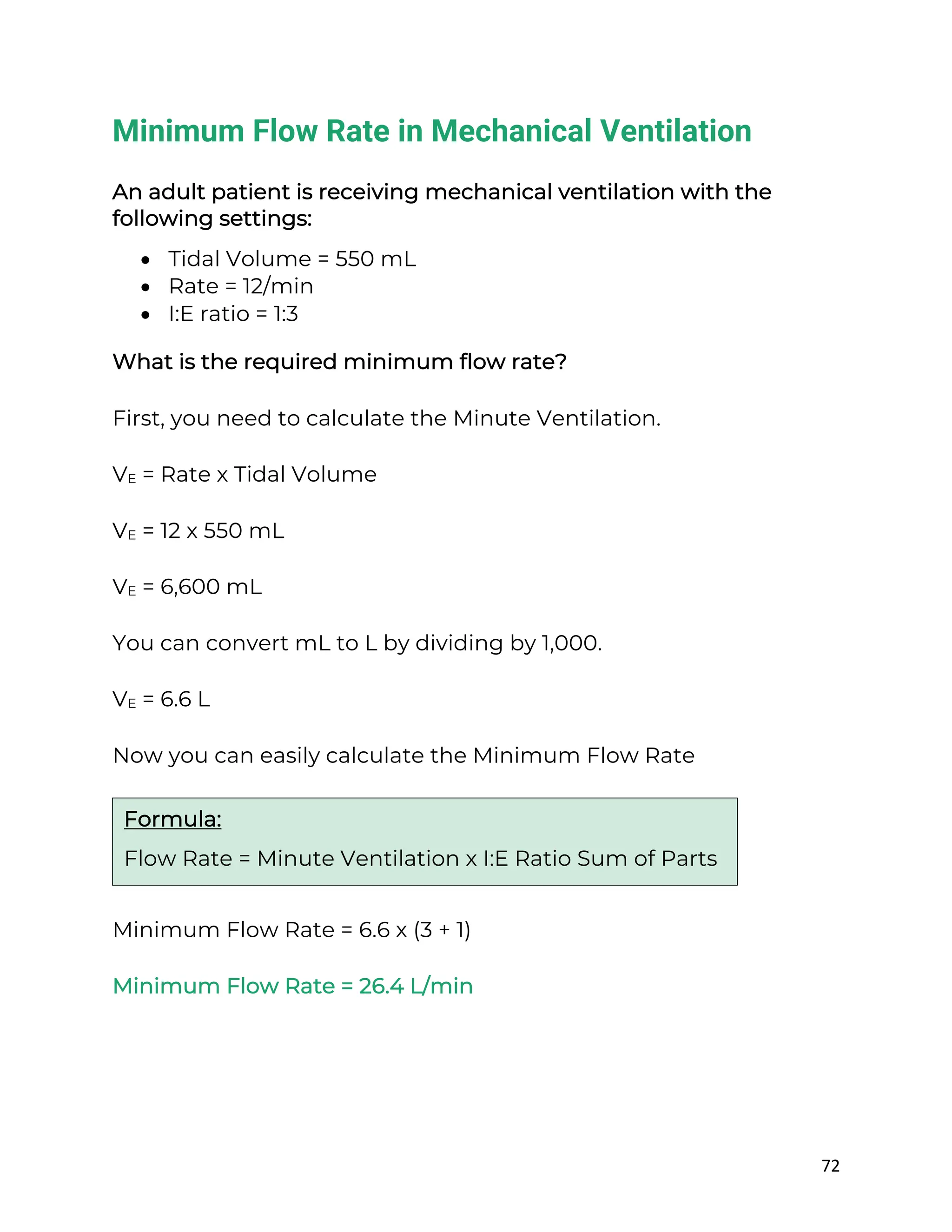
Minimum Flow Rate in Mechanical Ventilation
Flow Rate = Minute Ventilation x I:E Ratio Sum of Parts
11
Now that you know the formulas, that means it’s time for us to put
them to use. In this section, we’re going to walk you through an
example problem for each of the equations that you need to know
as a Respiratory Therapy Student.
For these practice problems, as long as you know the formula, the
math is very simple. All you have to do is just plug the numbers in.
So if you’re ready, let’s go ahead and get started. J
Respiratory Calculations
12
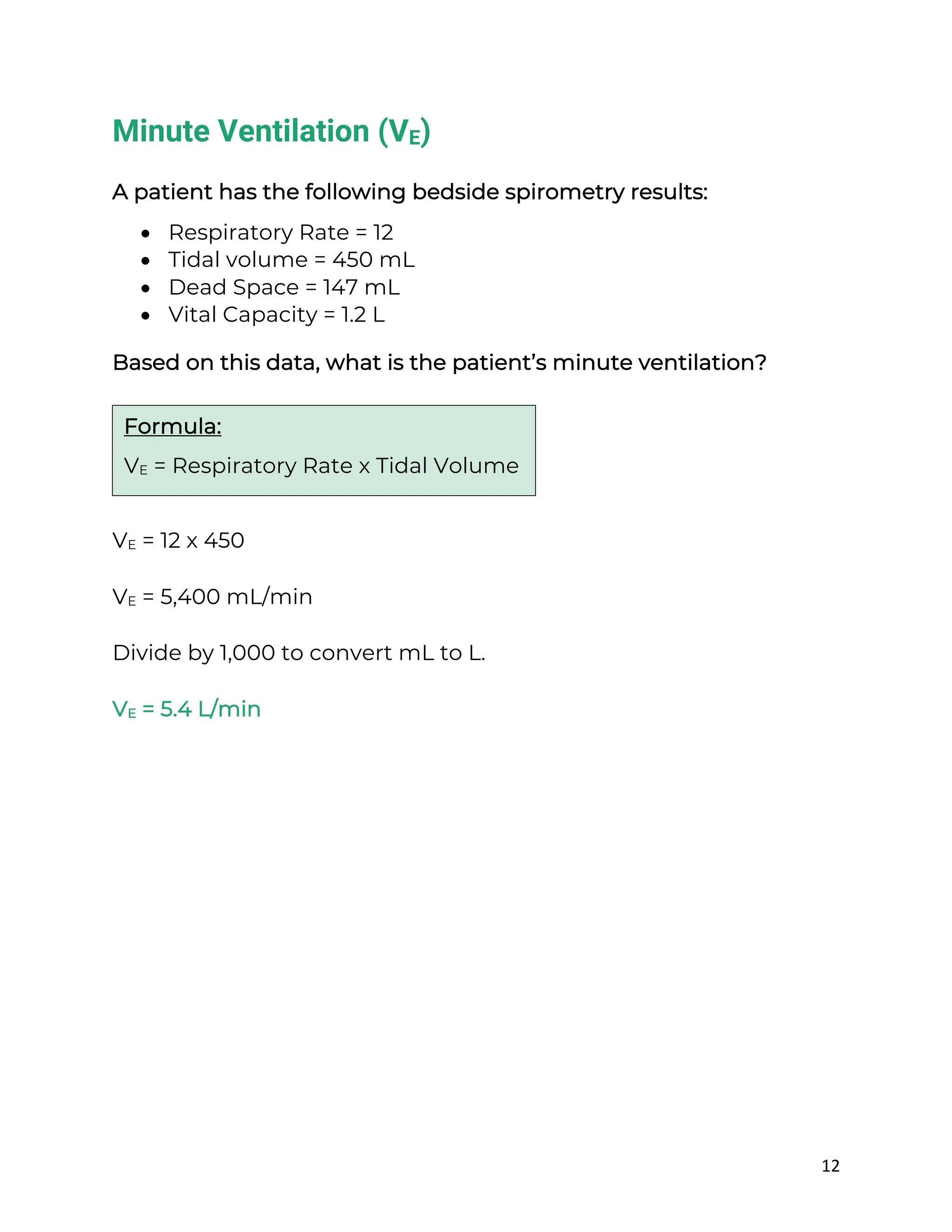
Minute Ventilation (VE)
A patient has the following bedside spirometry results:
• Respiratory Rate = 12
• Tidal volume = 450 mL
• Dead Space = 147 mL
• Vital Capacity = 1.2 L
Based on this data, what is the patient’s minute ventilation?
VE = 12 x 450
VE = 5,400 mL/min
Divide by 1,000 to convert mL to L.
VE = 5.4 L/min
Formula:
VE = Respiratory Rate x Tidal Volume
13
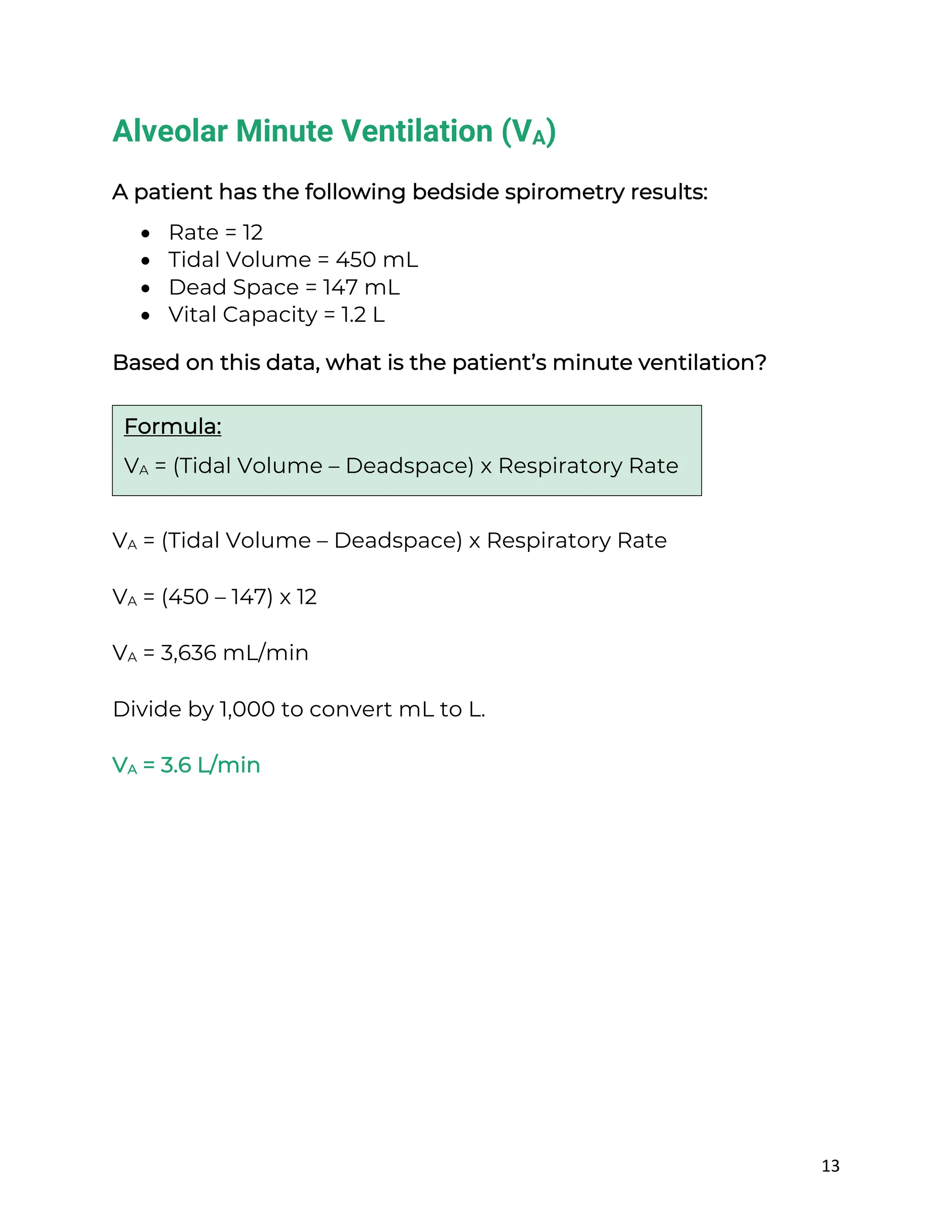
Alveolar Minute Ventilation (VA)
A patient has the following bedside spirometry results:
• Rate = 12
• Tidal Volume = 450 mL
• Dead Space = 147 mL
• Vital Capacity = 1.2 L
Based on this data, what is the patient’s minute ventilation?
VA = (Tidal Volume – Deadspace) x Respiratory Rate
VA = (450 – 147) x 12
VA = 3,636 mL/min
Divide by 1,000 to convert mL to L.
VA = 3.6 L/min
Formula:
VA = (Tidal Volume – Deadspace) x Respiratory Rate
14
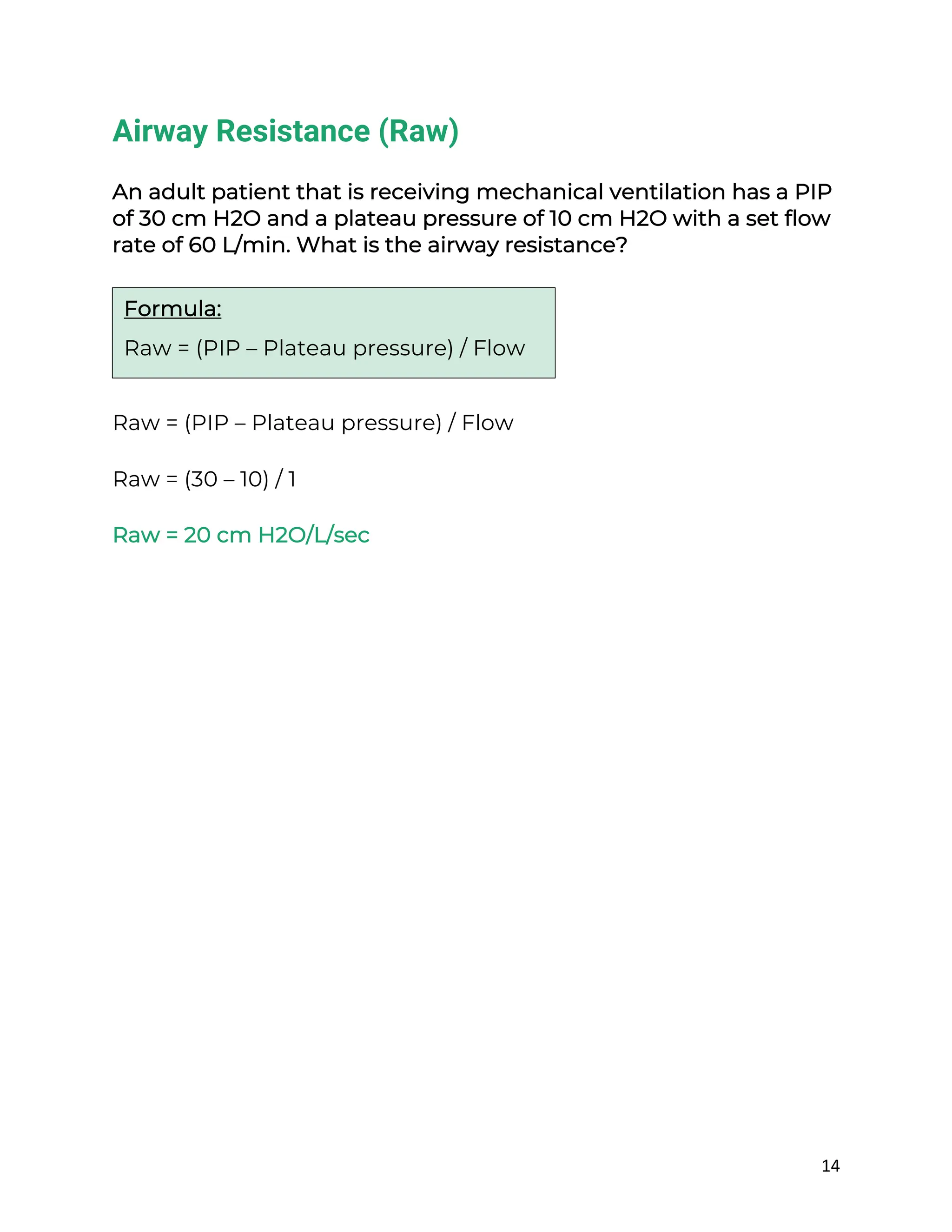
Airway Resistance (Raw)
An adult patient that is receiving mechanical ventilation has a PIP
of 30 cm H2O and a plateau pressure of 10 cm H2O with a set flow
rate of 60 L/min. What is the airway resistance?
Raw = (PIP – Plateau pressure) / Flow
Raw = (30 – 10) / 1
Raw = 20 cm H2O/L/sec
Formula:
Raw = (PIP – Plateau pressure) / Flow
15
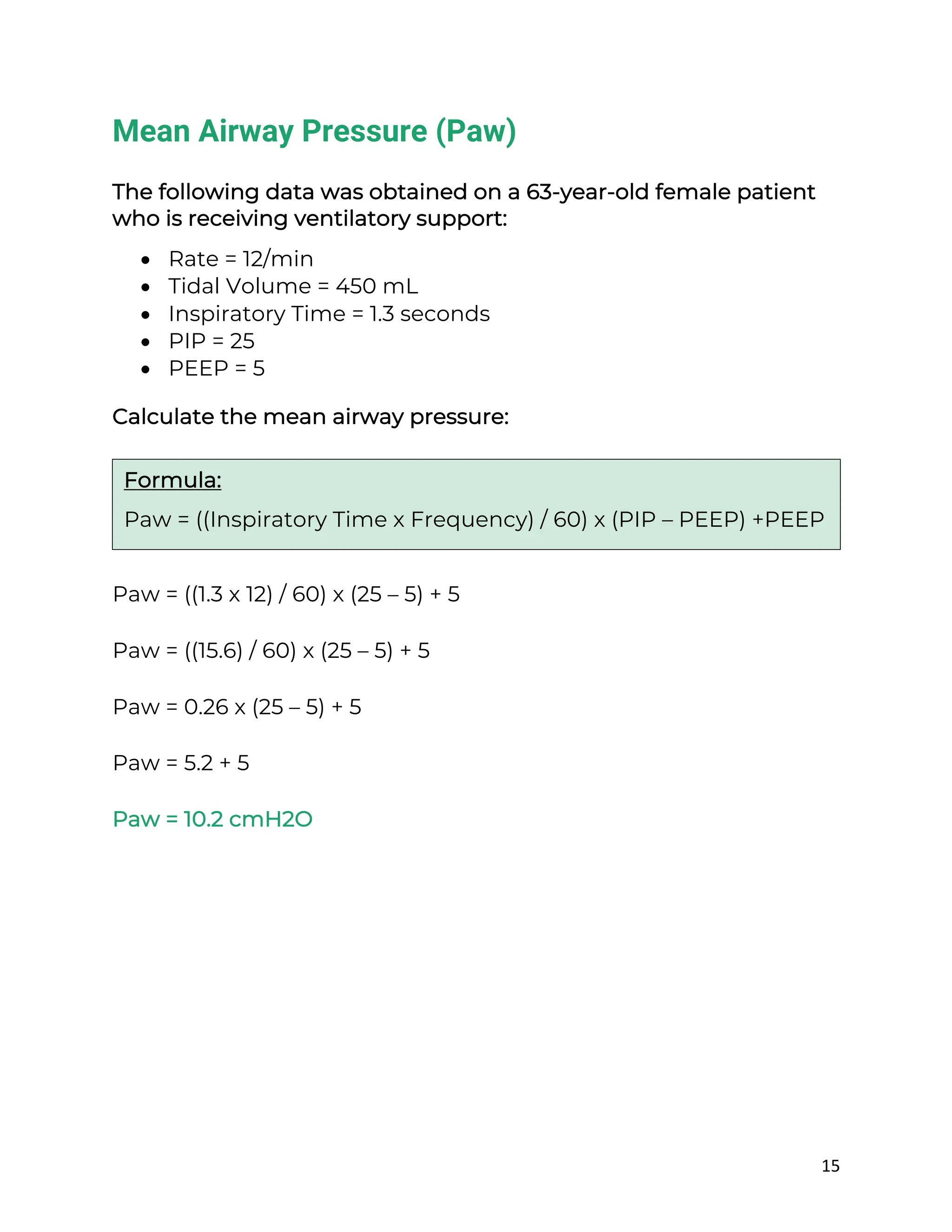
Mean Airway Pressure (Paw)
The following data was obtained on a 63-year-old female patient
who is receiving ventilatory support:
• Rate = 12/min
• Tidal Volume = 450 mL
• Inspiratory Time = 1.3 seconds
• PIP = 25
• PEEP = 5
Calculate the mean airway pressure:
Paw = ((1.3 x 12) / 60) x (25 – 5) + 5
Paw = ((15.6) / 60) x (25 – 5) + 5
Paw = 0.26 x (25 – 5) + 5
Paw = 5.2 + 5
Paw = 10.2 cmH2O
Formula:
Paw = ((Inspiratory Time x Frequency) / 60) x (PIP – PEEP) +PEEP
16
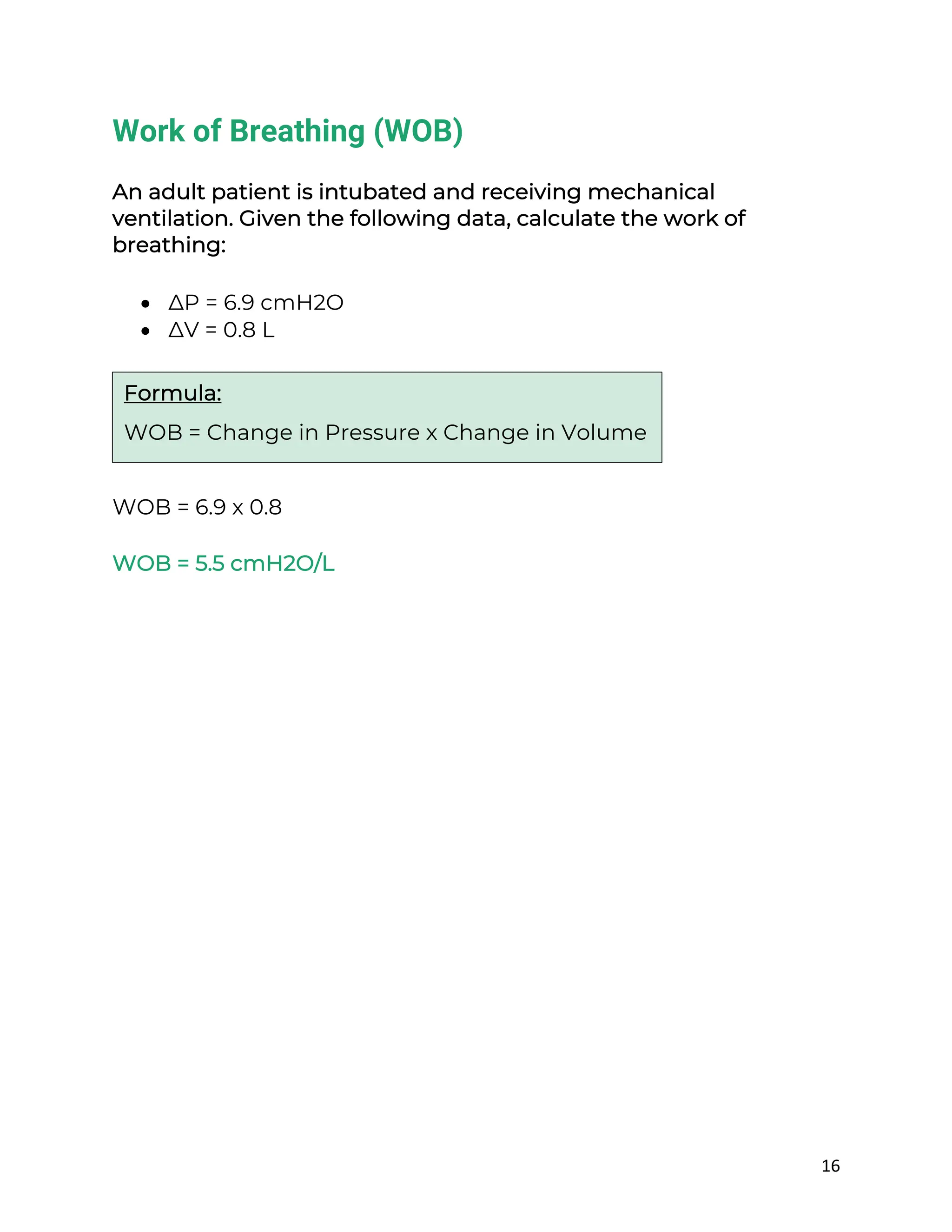
Work of Breathing (WOB)
An adult patient is intubated and receiving mechanical
ventilation. Given the following data, calculate the work of
breathing:
• ∆P = 6.9 cmH2O
• ∆V = 0.8 L
WOB = 6.9 x 0.8
WOB = 5.5 cmH2O/L
Formula:
WOB = Change in Pressure x Change in Volume
17
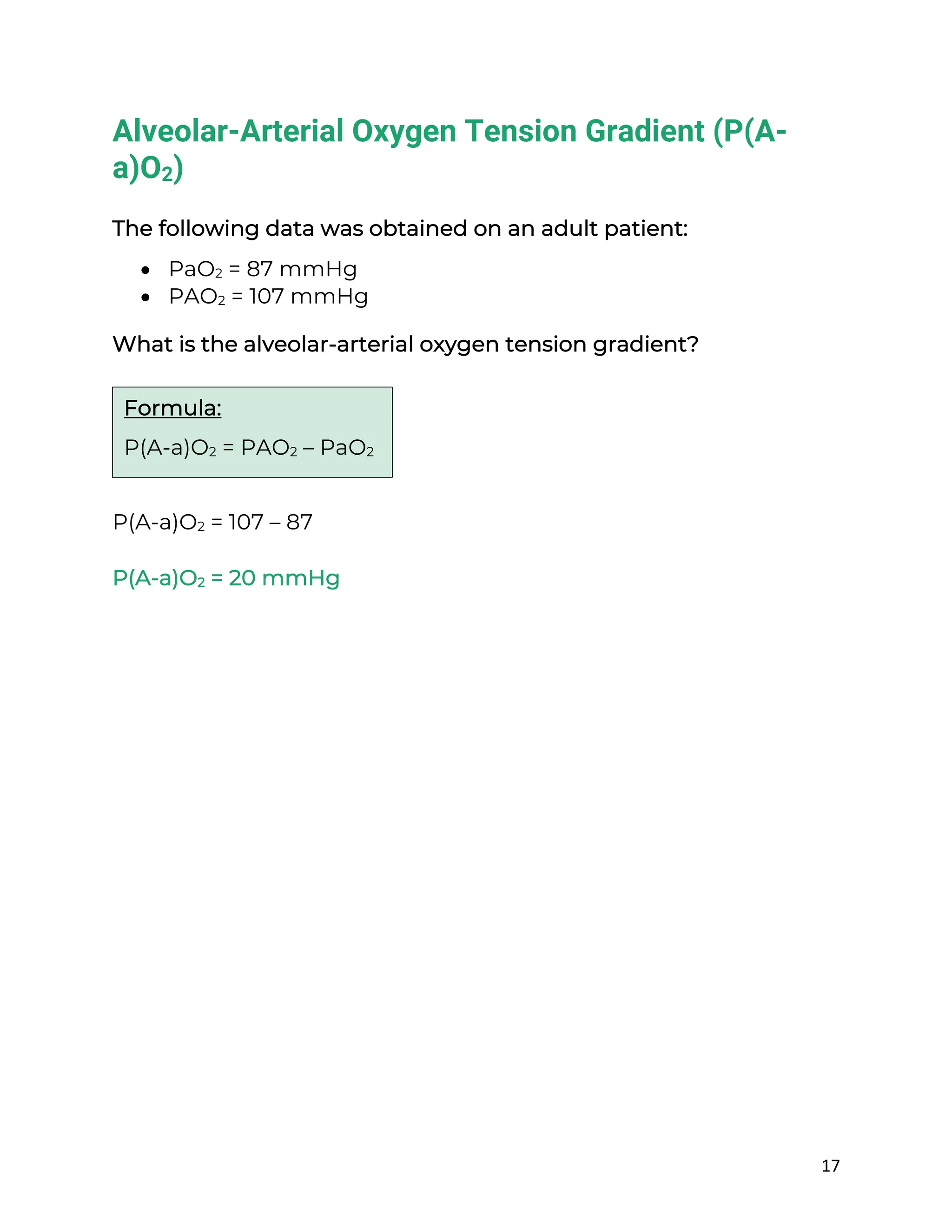
Alveolar-Arterial Oxygen Tension Gradient (P(A-
a)O2)
The following data was obtained on an adult patient:
• PaO2 = 87 mmHg
• PAO2 = 107 mmHg
What is the alveolar-arterial oxygen tension gradient?
P(A-a)O2 = 107 – 87
P(A-a)O2 = 20 mmHg
Formula:
P(A-a)O2 = PAO2 – PaO2
18
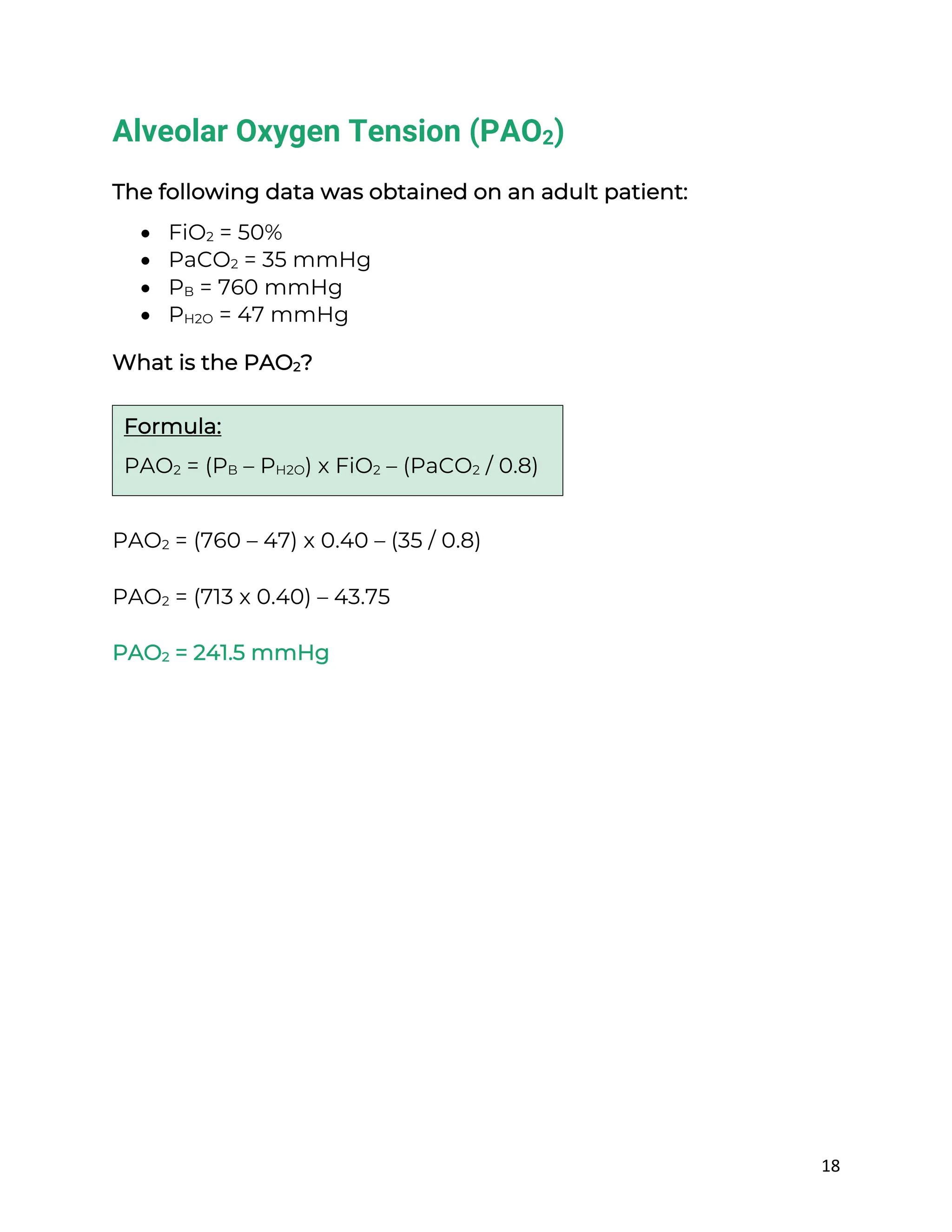
Alveolar Oxygen Tension (PAO2)
The following data was obtained on an adult patient:
• FiO2 = 50%
• PaCO2 = 35 mmHg
• PB = 760 mmHg
• PH2O = 47 mmHg
What is the PAO2?
PAO2 = (760 – 47) x 0.40 – (35 / 0.8)
PAO2 = (713 x 0.40) – 43.75
PAO2 = 241.5 mmHg
Formula:
PAO2 = (PB – PH2O) x FiO2 – (PaCO2 / 0.8)
19
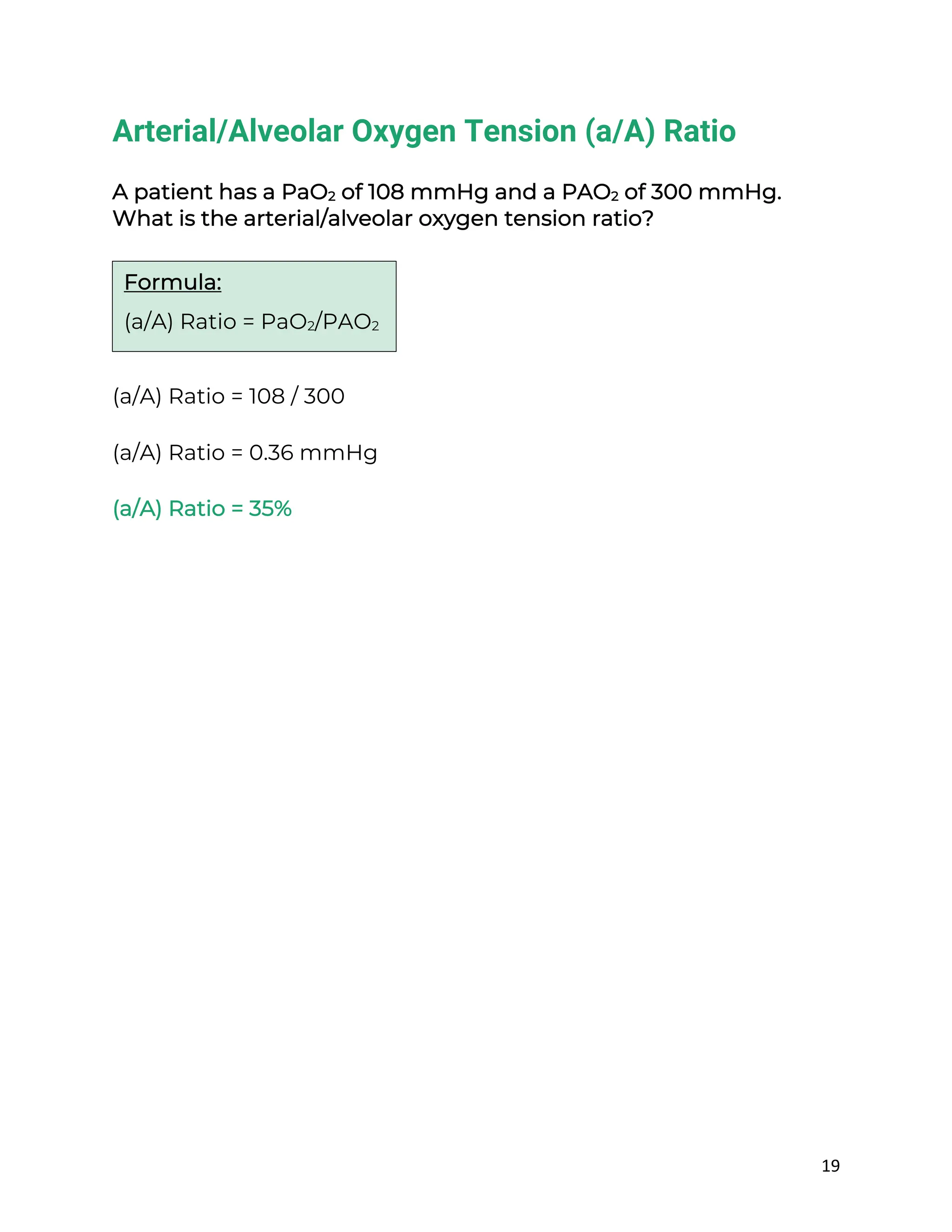
Arterial/Alveolar Oxygen Tension (a/A) Ratio
A patient has a PaO2 of 108 mmHg and a PAO2 of 300 mmHg.
What is the arterial/alveolar oxygen tension ratio?
(a/A) Ratio = 108 / 300
(a/A) Ratio = 0.36 mmHg
(a/A) Ratio = 35%
Formula:
(a/A) Ratio = PaO2/PAO2
20
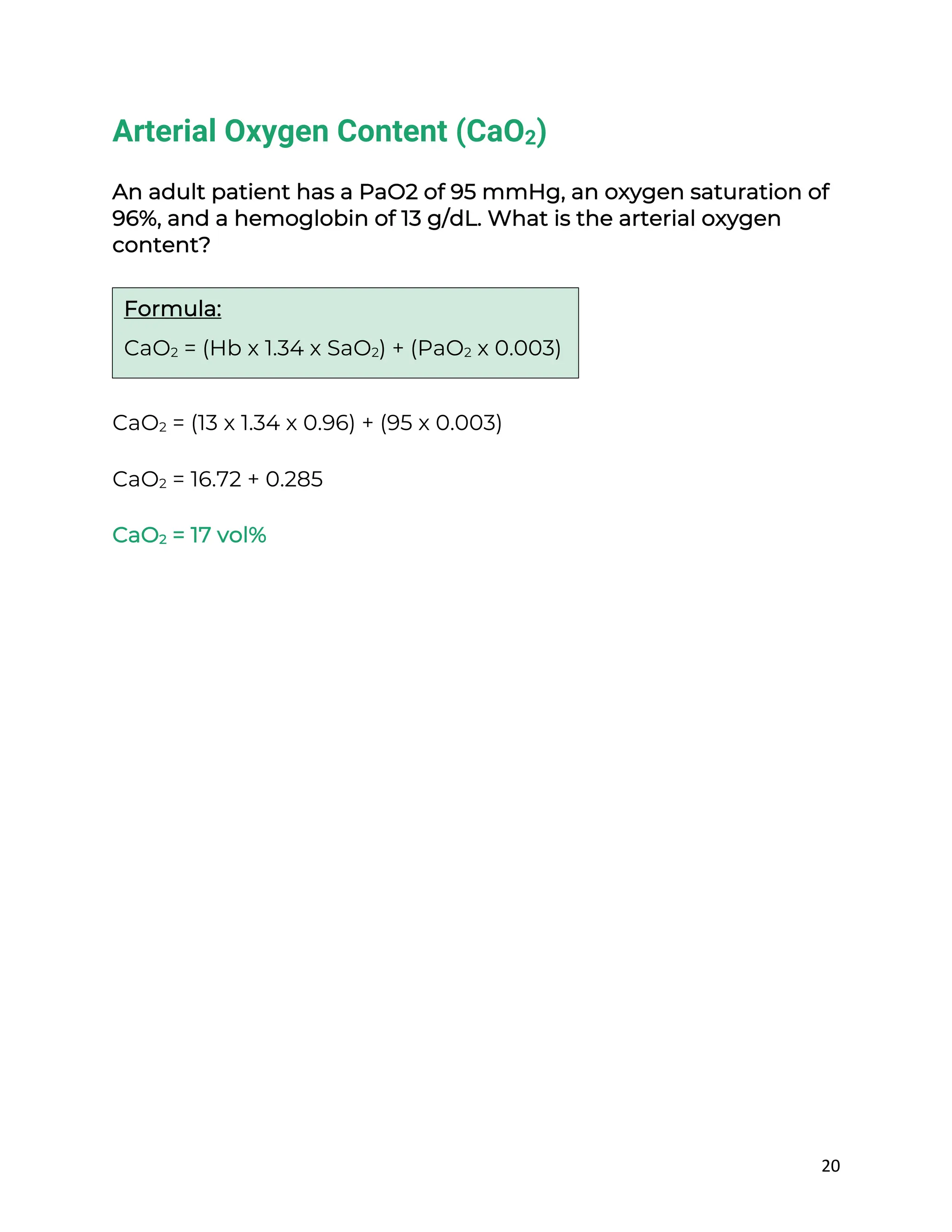
Arterial Oxygen Content (CaO2)
An adult patient has a PaO2 of 95 mmHg, an oxygen saturation of
96%, and a hemoglobin of 13 g/dL. What is the arterial oxygen
content?
CaO2 = (13 x 1.34 x 0.96) + (95 x 0.003)
CaO2 = 16.72 + 0.285
CaO2 = 17 vol%
Formula:
CaO2 = (Hb x 1.34 x SaO2) + (PaO2 x 0.003)
21
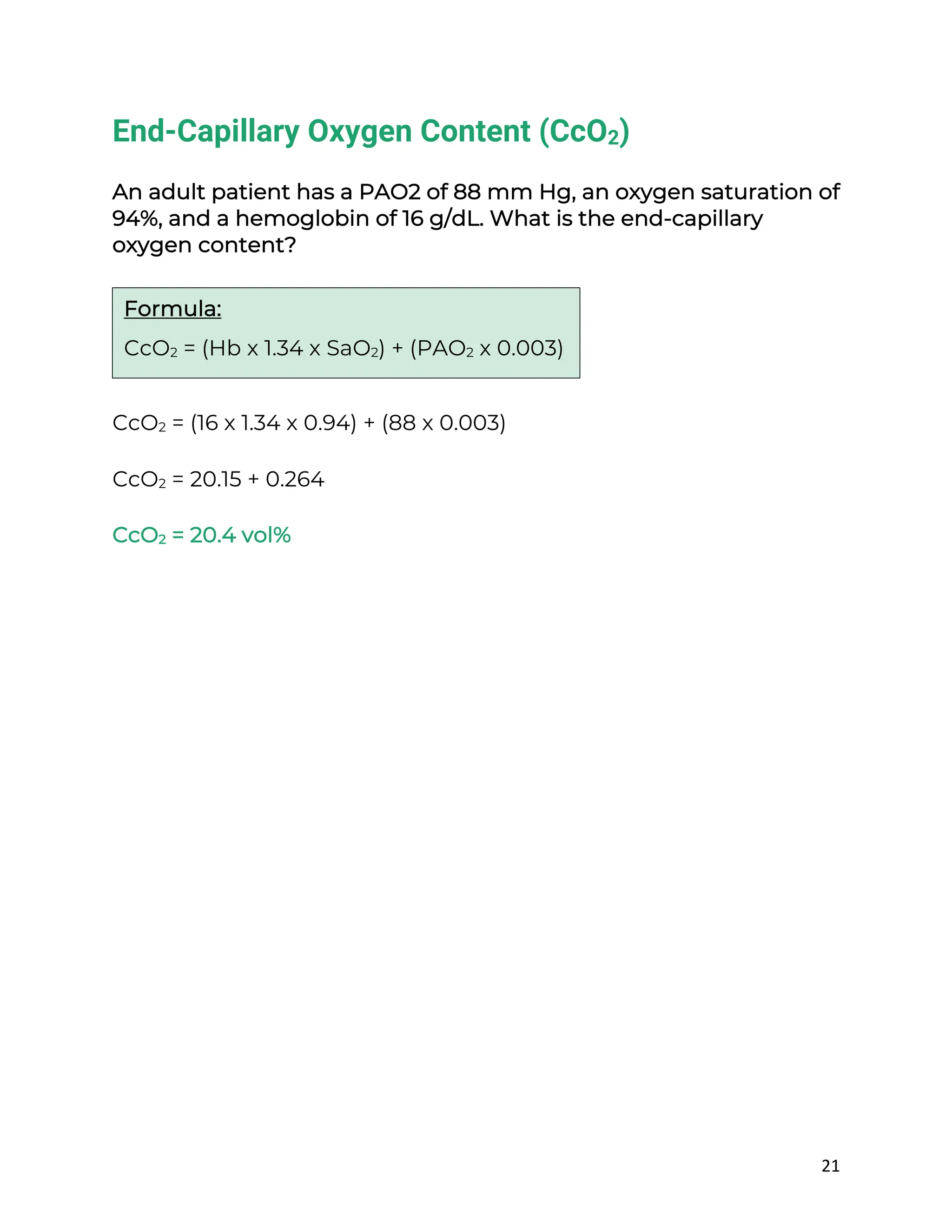
End-Capillary Oxygen Content (CcO2)
An adult patient has a PAO2 of 88 mm Hg, an oxygen saturation of
94%, and a hemoglobin of 16 g/dL. What is the end-capillary
oxygen content?
CcO2 = (16 x 1.34 x 0.94) + (88 x 0.003)
CcO2 = 20.15 + 0.264
CcO2 = 20.4 vol%
Formula:
CcO2 = (Hb x 1.34 x SaO2) + (PAO2 x 0.003)
22
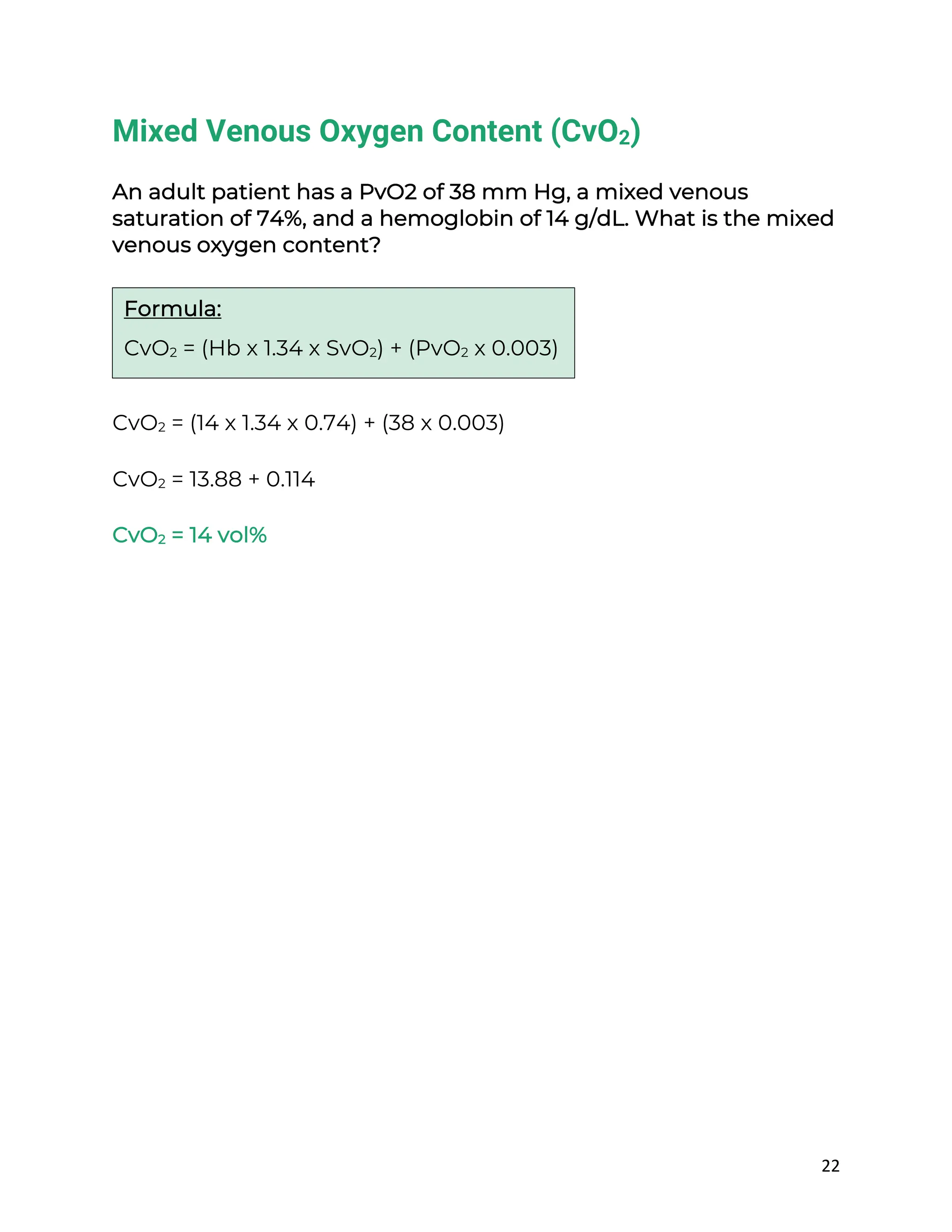
Mixed Venous Oxygen Content (CvO2)
An adult patient has a PvO2 of 38 mm Hg, a mixed venous
saturation of 74%, and a hemoglobin of 14 g/dL. What is the mixed
venous oxygen content?
CvO2 = (14 x 1.34 x 0.74) + (38 x 0.003)
CvO2 = 13.88 + 0.114
CvO2 = 14 vol%
Formula:
CvO2 = (Hb x 1.34 x SvO2) + (PvO2 x 0.003)
23
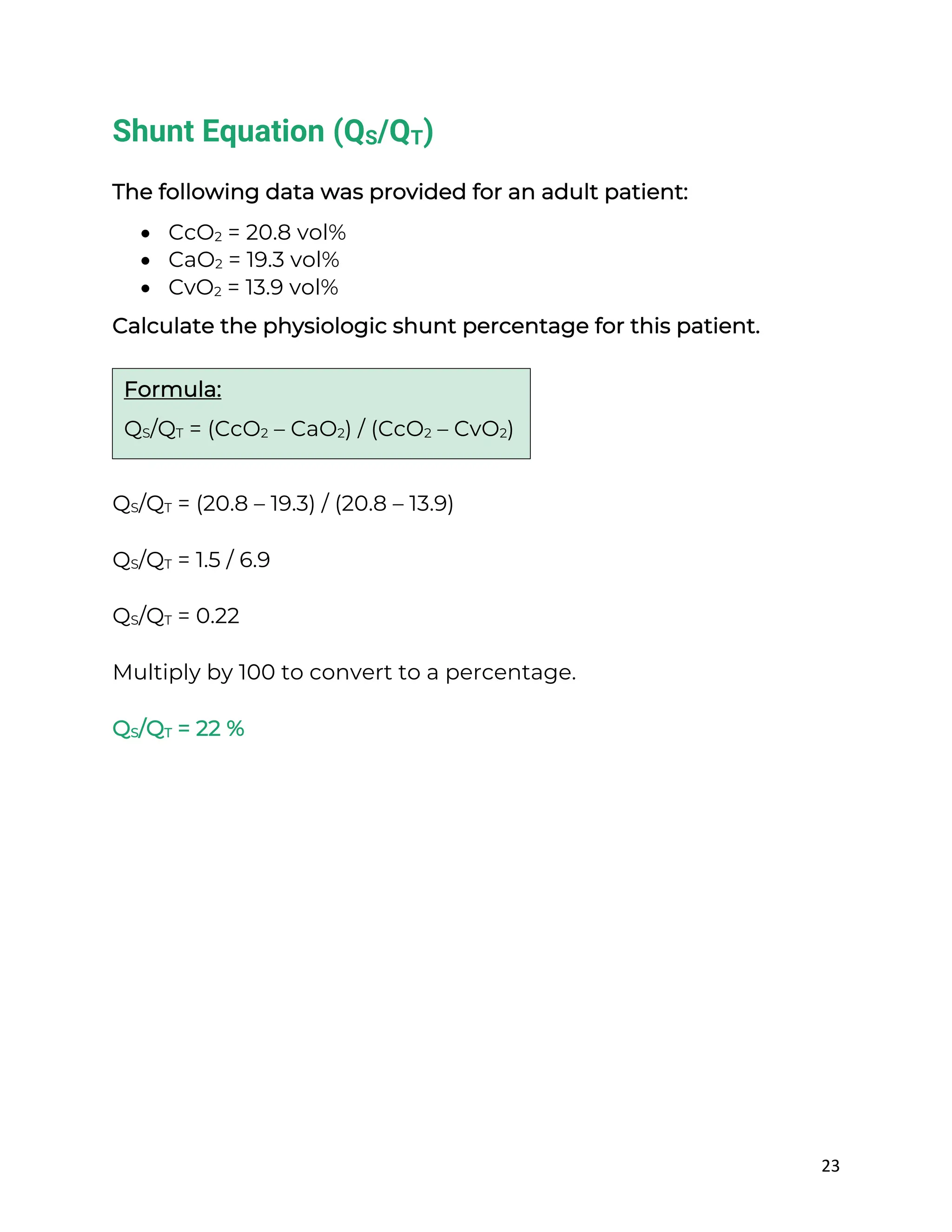
Shunt Equation (QS/QT)
The following data was provided for an adult patient:
• CcO2 = 20.8 vol%
• CaO2 = 19.3 vol%
• CvO2 = 13.9 vol%
Calculate the physiologic shunt percentage for this patient.
QS/QT = (20.8 – 19.3) / (20.8 – 13.9)
QS/QT = 1.5 / 6.9
QS/QT = 0.22
Multiply by 100 to convert to a percentage.
QS/QT = 22 %
Formula:
QS/QT = (CcO2 – CaO2) / (CcO2 – CvO2)
24
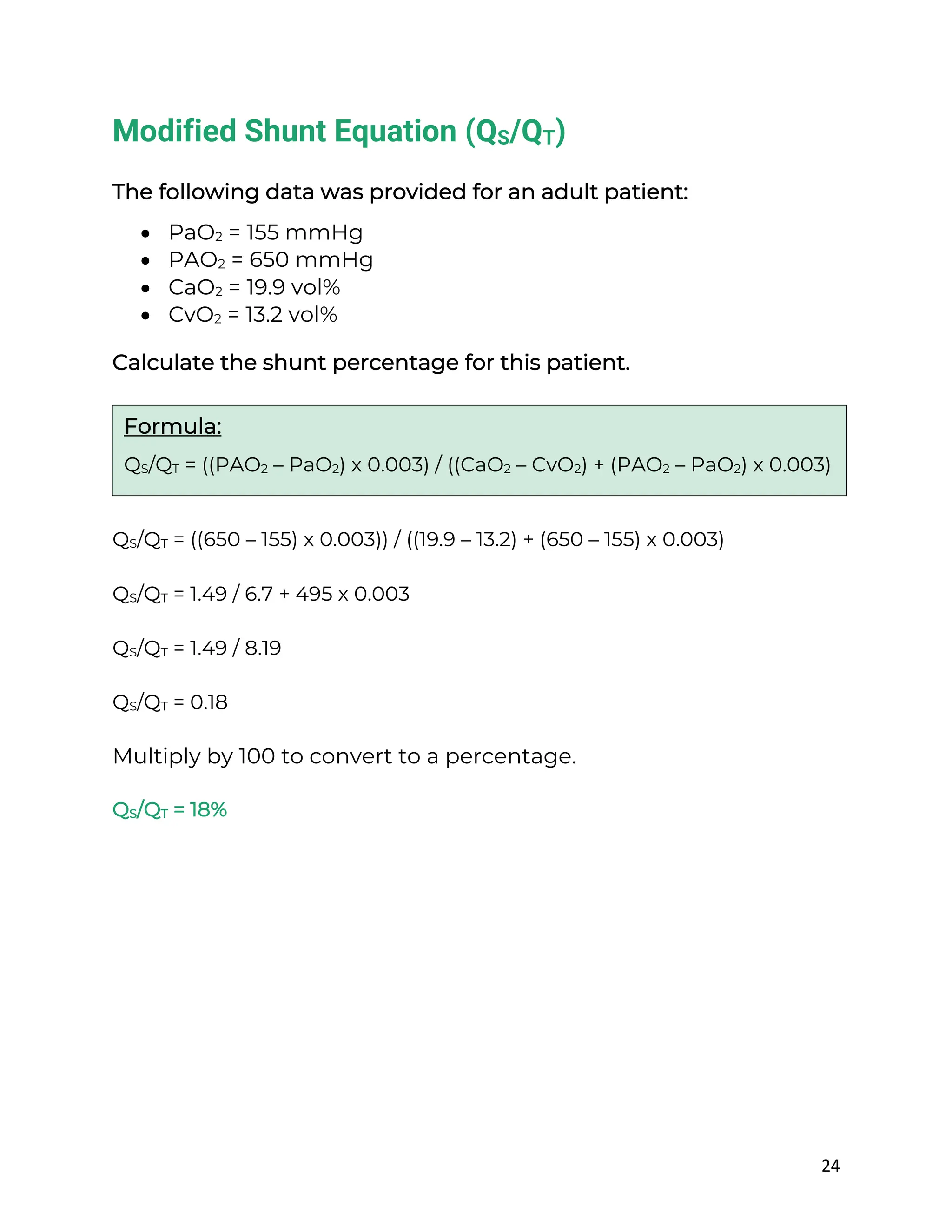
Modified Shunt Equation (QS/QT)
The following data was provided for an adult patient:
• PaO2 = 155 mmHg
• PAO2 = 650 mmHg
• CaO2 = 19.9 vol%
• CvO2 = 13.2 vol%
Calculate the shunt percentage for this patient.
QS/QT = ((650 – 155) x 0.003)) / ((19.9 – 13.2) + (650 – 155) x 0.003)
QS/QT = 1.49 / 6.7 + 495 x 0.003
QS/QT = 1.49 / 8.19
QS/QT = 0.18
Multiply by 100 to convert to a percentage.
QS/QT = 18%
Formula:
QS/QT = ((PAO2 – PaO2) x 0.003) / ((CaO2 – CvO2) + (PAO2 – PaO2) x 0.003)
25
Arterial-Mixed Venous Oxygen Content Difference
(C(a-v)O2)
An adult patient in the ICU has a CaO2 of 19.2 vol% and a CvO2 of
14.7 vol%. Calculate the Arterial-Mixed Venous Oxygen Content
Difference:
C(a-v)O2 = 19.2 – 14.7
C(a-v)O2 = 4.5 vol%
Formula:
C(a-v)O2 = CaO2 – CvO2
26
Oxygen-to-Air Entrainment Ratio (O2:Air)
What is the air-to-oxygen entrainment ratio of 60%?
O2:Air = 1 : (100 – 60) / (60 – 2)
O2:Air = 1 : (40 / 58)
O2:Air = 1 : 0.7
Formula:
O2:Air = 1 : (100 – FiO2) / (FiO2 – 2)
27
Arterial Oxygen Saturation Estimation (SaO2)
An adult patient has a PaO2 of 63 mmHg. What is the estimated
SaO2?
Estimated SaO2 = 63 + 30
Estimated SaO2 = 93 mmHg
Formula:
SaO2 = PaO2 + 30
28
PaO2/FiO2 Ratio (P/F Ratio)
An adult patient who is receiving oxygen at an FiO2 of 40% has a
PaO2 of 88 mmHg. What is the PaO2/FiO2 ratio?
P/F Ratio = 88 / 0.4
P/F Ratio = 220 mmHg
Formula:
P/F Ratio = PaO2 / FiO2
29
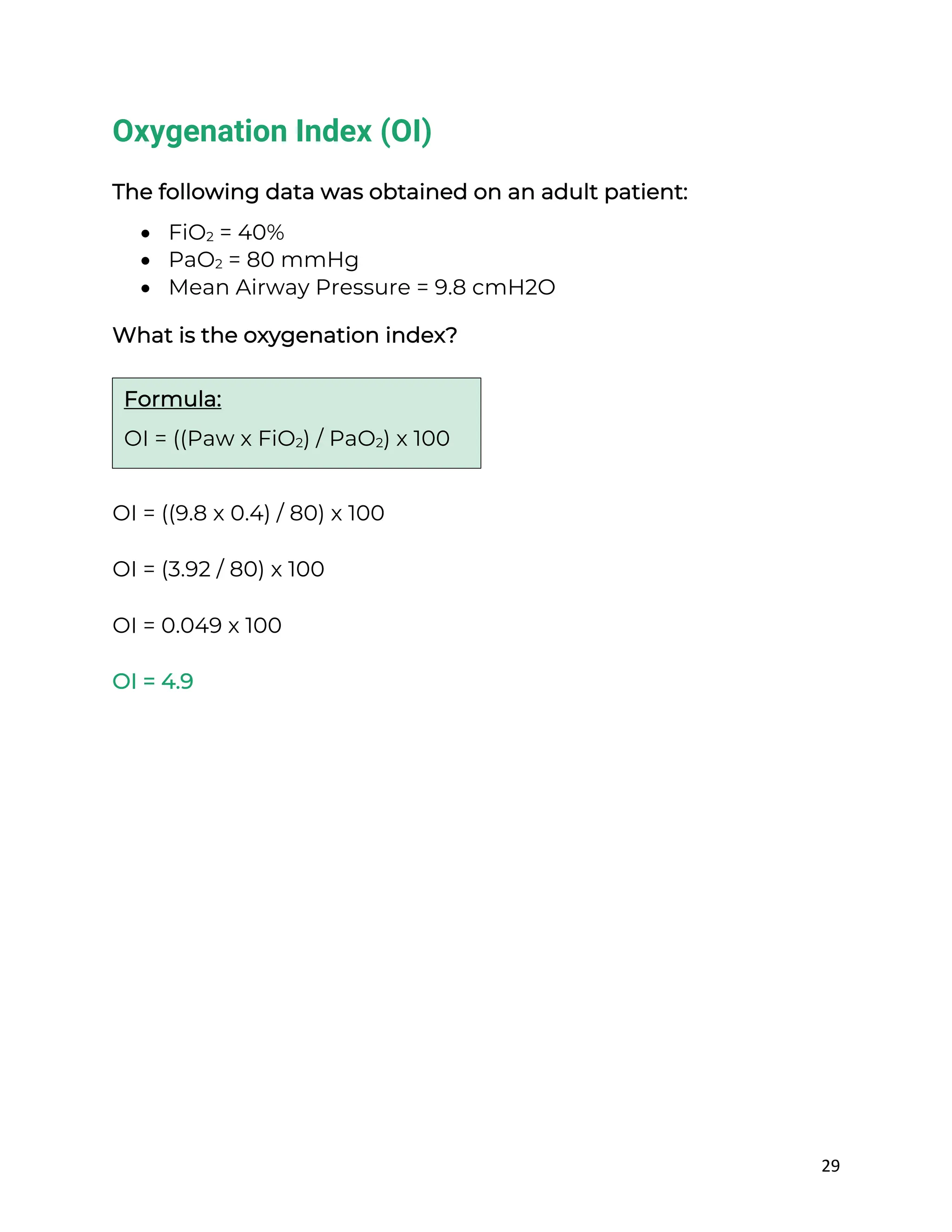
Oxygenation Index (OI)
The following data was obtained on an adult patient:
• FiO2 = 40%
• PaO2 = 80 mmHg
• Mean Airway Pressure = 9.8 cmH2O
What is the oxygenation index?
OI = ((9.8 x 0.4) / 80) x 100
OI = (3.92 / 80) x 100
OI = 0.049 x 100
OI = 4.9
Formula:
OI = ((Paw x FiO2) / PaO2) x 100
30
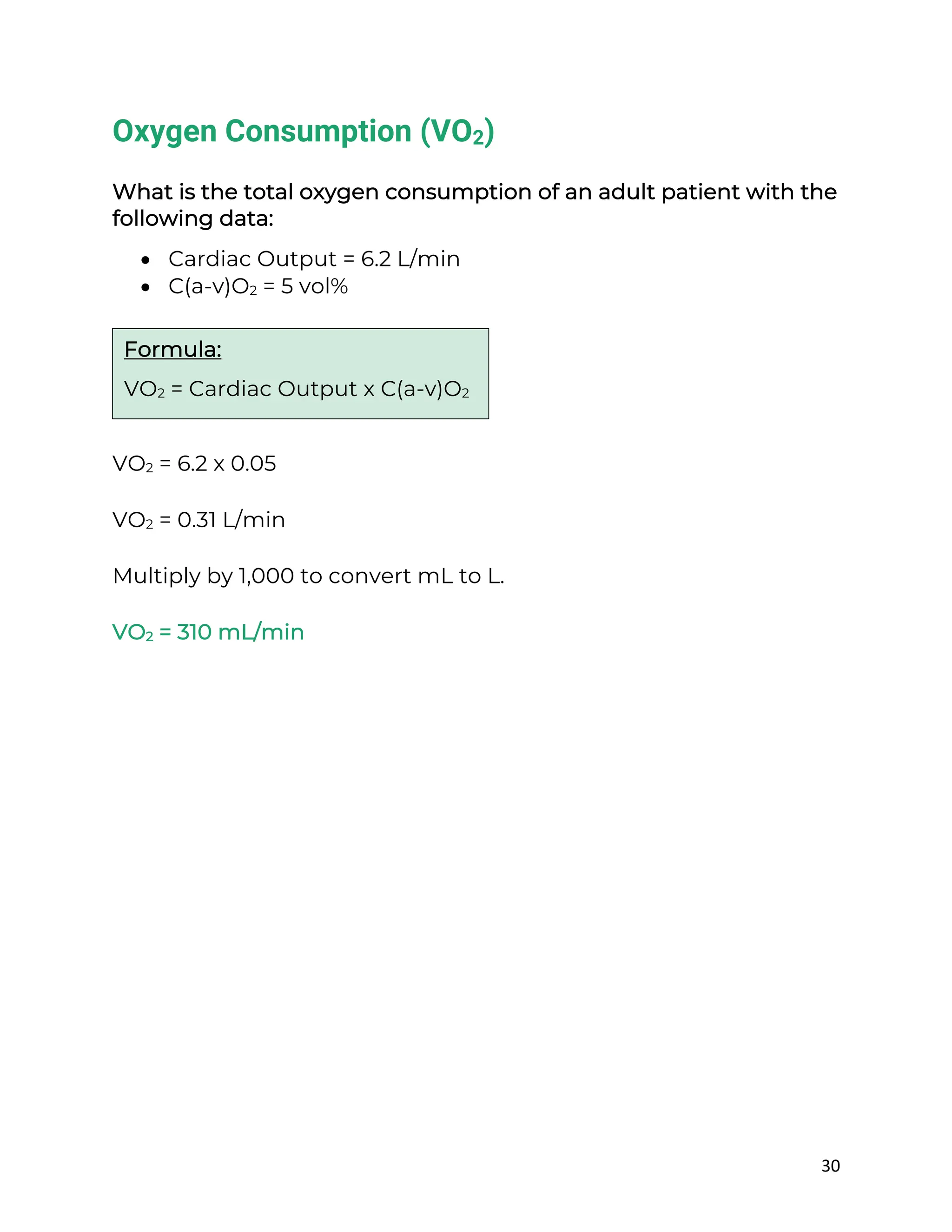
Oxygen Consumption (VO2)
What is the total oxygen consumption of an adult patient with the
following data:
• Cardiac Output = 6.2 L/min
• C(a-v)O2 = 5 vol%
VO2 = 6.2 x 0.05
VO2 = 0.31 L/min
Multiply by 1,000 to convert mL to L.
VO2 = 310 mL/min
Formula:
VO2 = Cardiac Output x C(a-v)O2
31
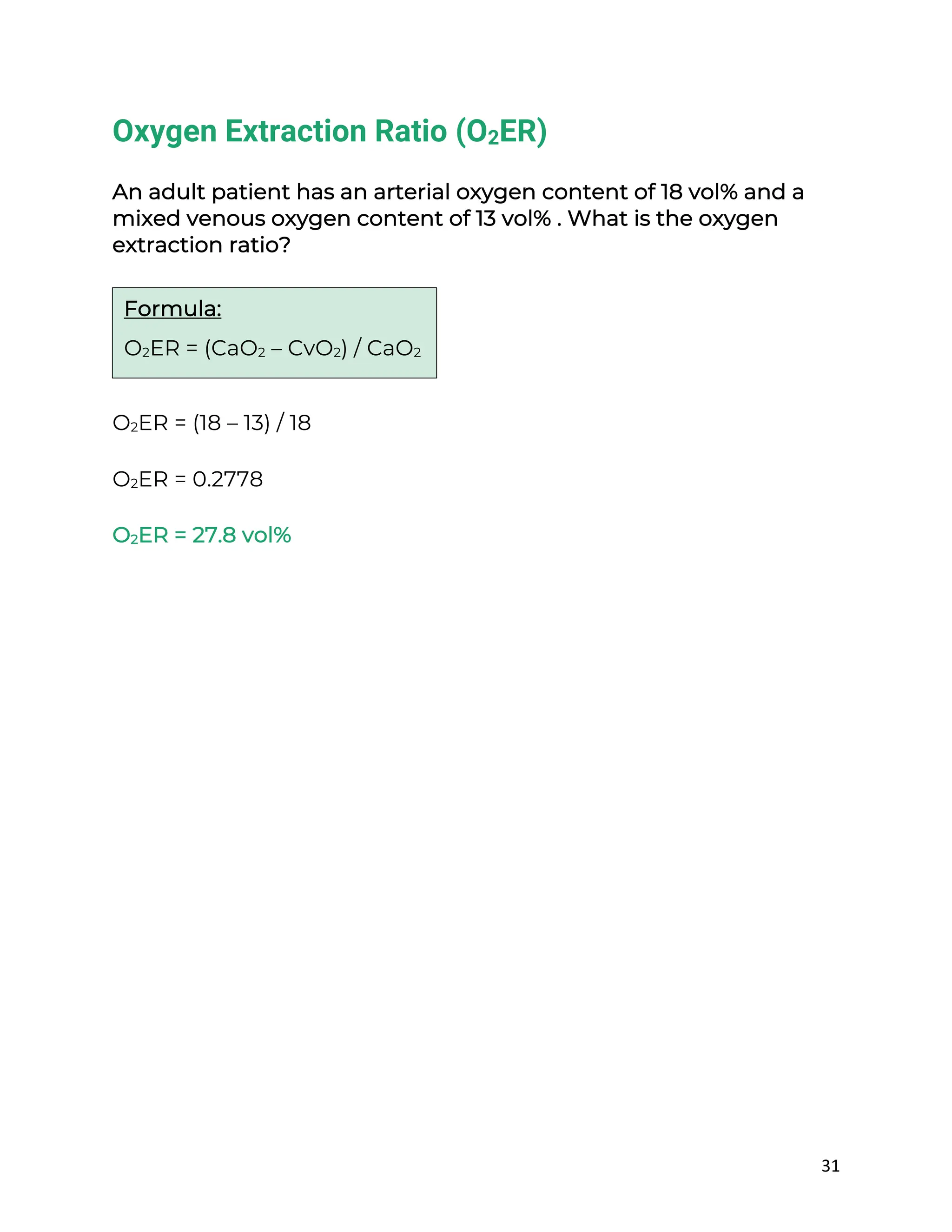
Oxygen Extraction Ratio (O2ER)
An adult patient has an arterial oxygen content of 18 vol% and a
mixed venous oxygen content of 13 vol% . What is the oxygen
extraction ratio?
O2ER = (18 – 13) / 18
O2ER = 0.2778
O2ER = 27.8 vol%
Formula:
O2ER = (CaO2 – CvO2) / CaO2
32
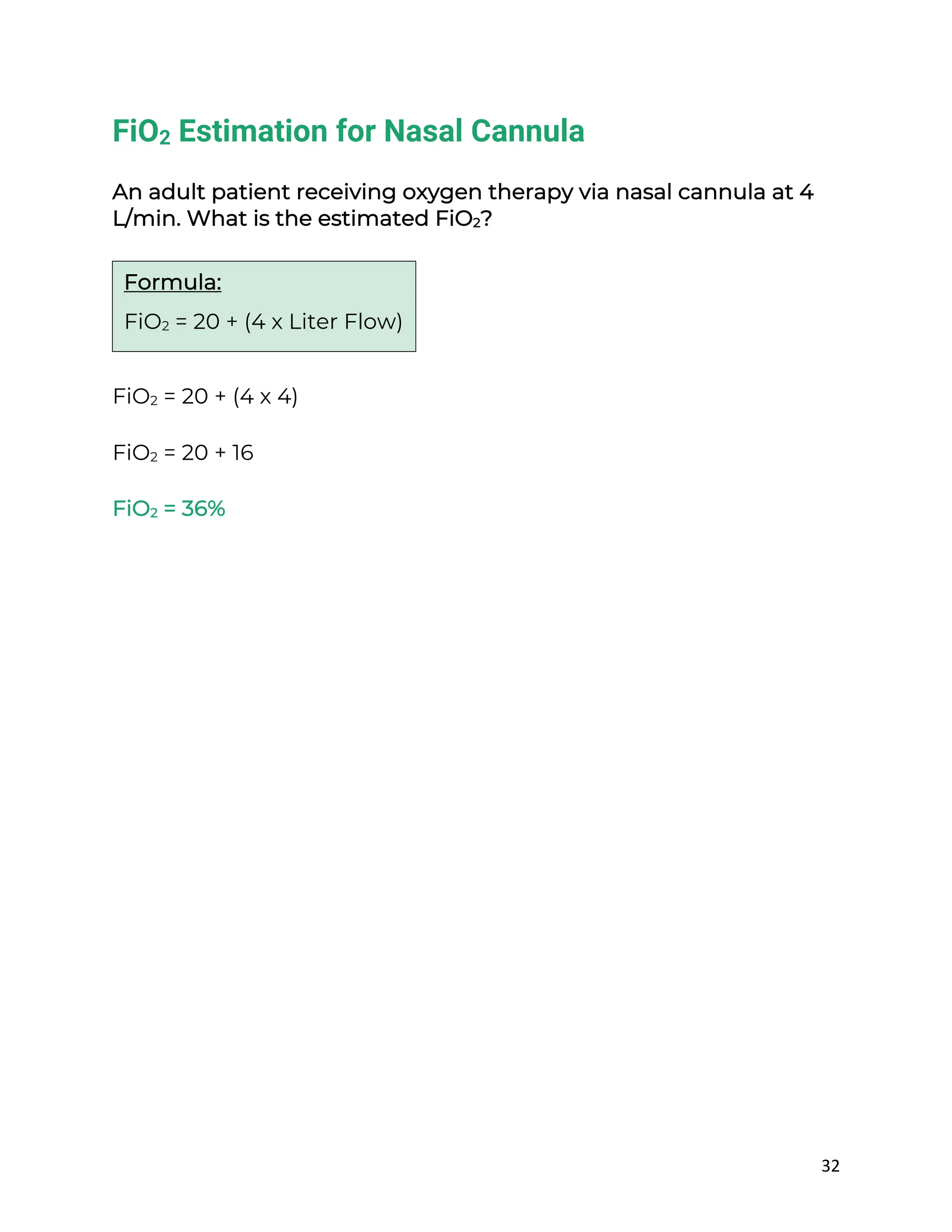
FiO2 Estimation for Nasal Cannula
An adult patient receiving oxygen therapy via nasal cannula at 4
L/min. What is the estimated FiO2?
FiO2 = 20 + (4 x 4)
FiO2 = 20 + 16
FiO2 = 36%
Formula:
FiO2 = 20 + (4 x Liter Flow)
33
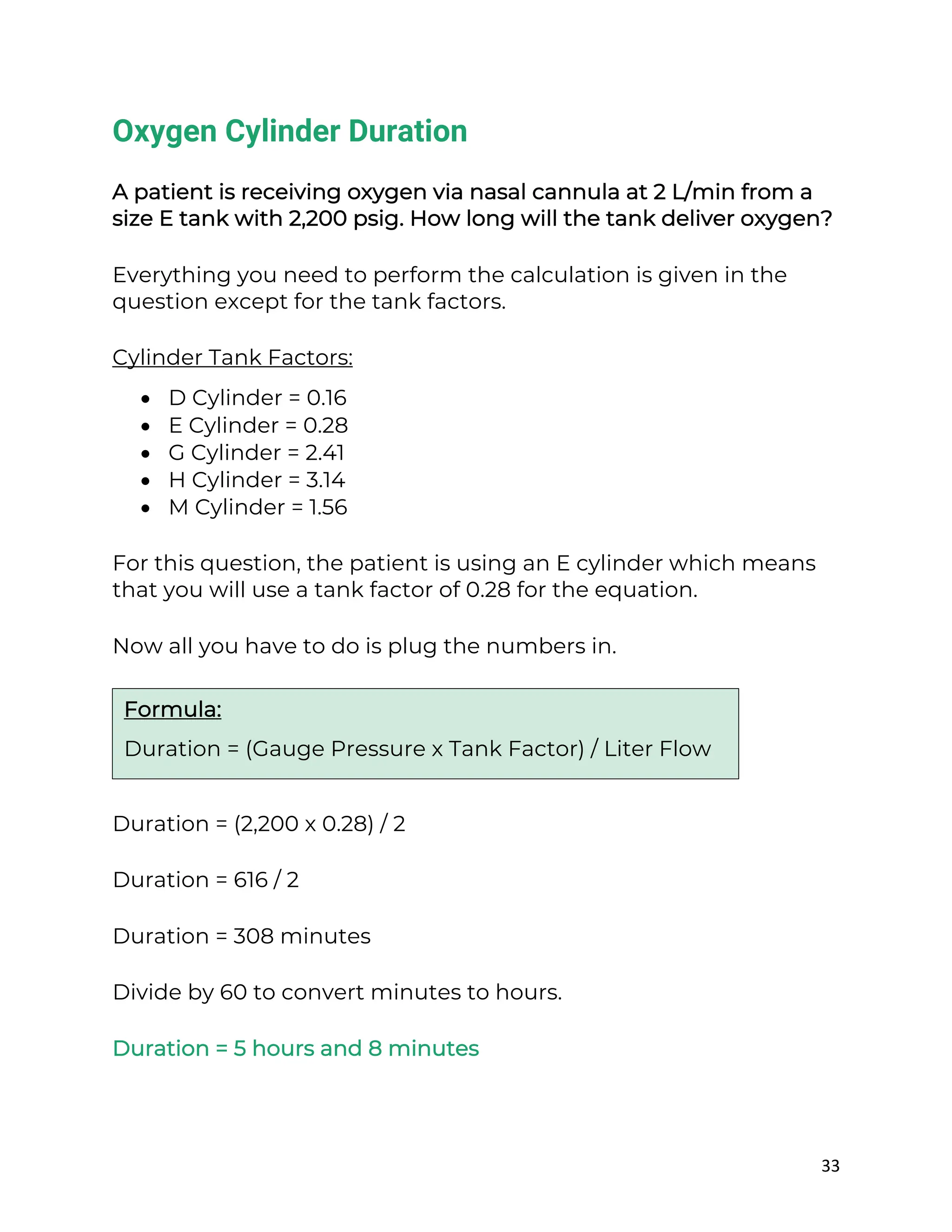
Oxygen Cylinder Duration
A patient is receiving oxygen via nasal cannula at 2 L/min from a
size E tank with 2,200 psig. How long will the tank deliver oxygen?
Everything you need to perform the calculation is given in the
question except for the tank factors.
Cylinder Tank Factors:
• D Cylinder = 0.16
• E Cylinder = 0.28
• G Cylinder = 2.41
• H Cylinder = 3.14
• M Cylinder = 1.56
For this question, the patient is using an E cylinder which means
that you will use a tank factor of 0.28 for the equation.
Now all you have to do is plug the numbers in.
Duration = (2,200 x 0.28) / 2
Duration = 616 / 2
Duration = 308 minutes
Divide by 60 to convert minutes to hours.
Duration = 5 hours and 8 minutes
Formula:
Duration = (Gauge Pressure x Tank Factor) / Liter Flow
34
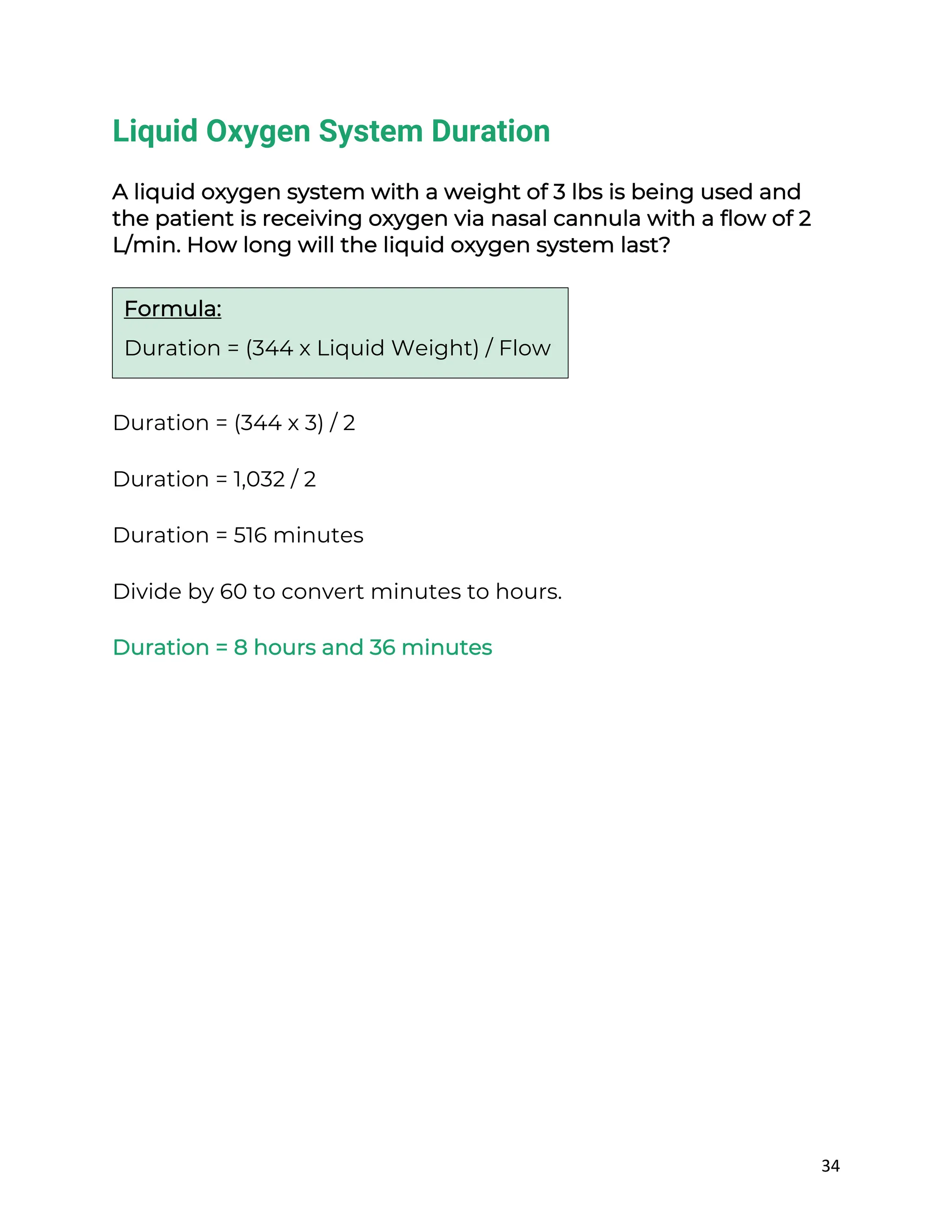
Liquid Oxygen System Duration
A liquid oxygen system with a weight of 3 lbs is being used and
the patient is receiving oxygen via nasal cannula with a flow of 2
L/min. How long will the liquid oxygen system last?
Duration = (344 x 3) / 2
Duration = 1,032 / 2
Duration = 516 minutes
Divide by 60 to convert minutes to hours.
Duration = 8 hours and 36 minutes
Formula:
Duration = (344 x Liquid Weight) / Flow
35
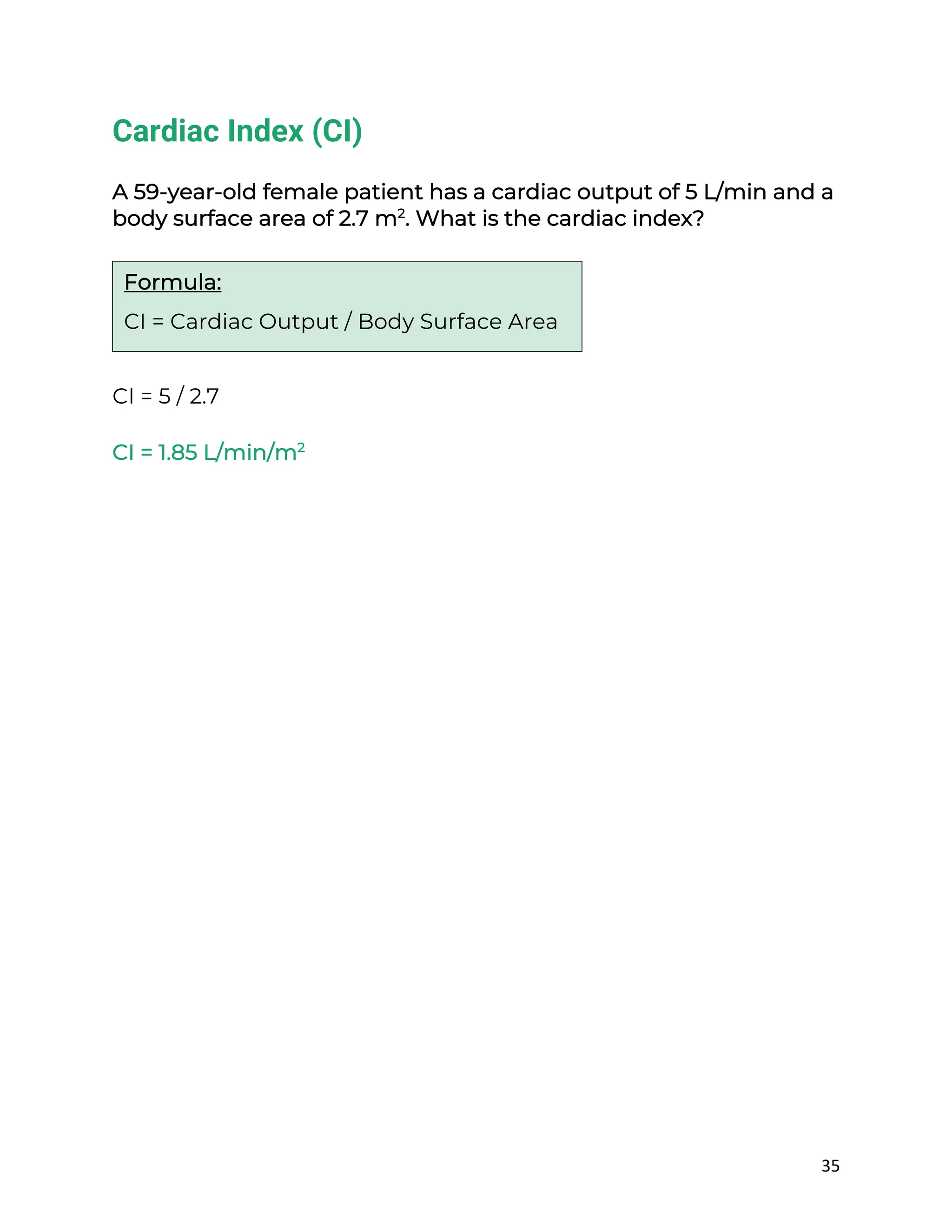
Cardiac Index (CI)
A 59-year-old female patient has a cardiac output of 5 L/min and a
body surface area of 2.7 m2
. What is the cardiac index?
CI = 5 / 2.7
CI = 1.85 L/min/m2
Formula:
CI = Cardiac Output / Body Surface Area
36
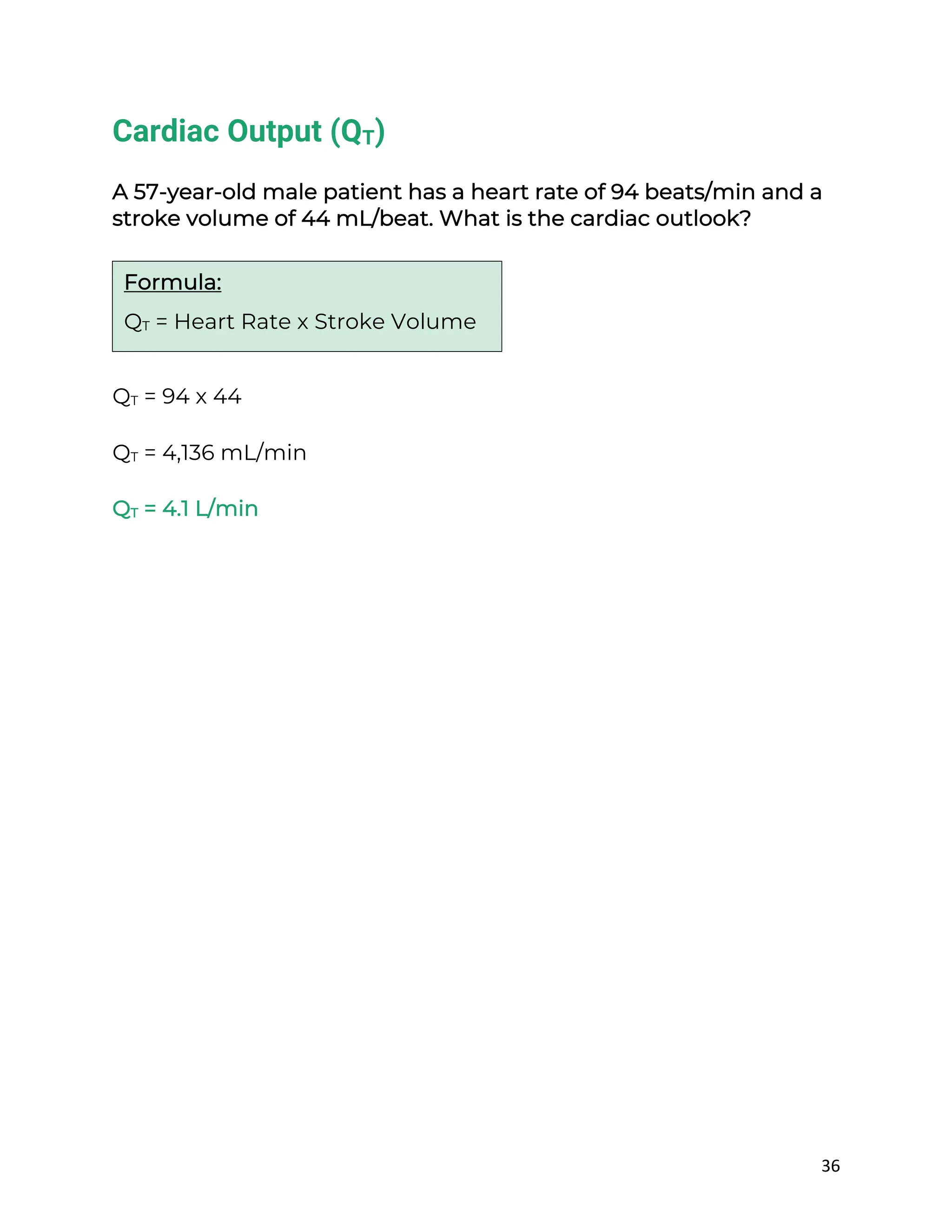
Cardiac Output (QT)
A 57-year-old male patient has a heart rate of 94 beats/min and a
stroke volume of 44 mL/beat. What is the cardiac outlook?
QT = 94 x 44
QT = 4,136 mL/min
QT = 4.1 L/min
Formula:
QT = Heart Rate x Stroke Volume
37
Cardiac Output (CO) Fick’s Method
The following data was obtained on an adult patient:
• Body Surface Area = 1.7 m2
• CaO2 = 21 vol%
• CvO2 = 16 vol%
Calculate the cardiac output using Fick’s method:
First, you need to calculate the O2 Consumption multiply the Body
Surface Area by 130.
O2 Consumption = 130 x 1.7
O2 Consumption = 221
Now, just plug the rest of the numbers into the formula.
CO = (221 / 21 – 16)
CO = (221 / 0.05)
CO = 4,420 mL/min
Divide by 1,000 to convert mL to L.
CO = 4.42 L/min
Formula:
CO = (O2 Consumption / CaO2 – CvO2)
38
Cerebral Perfusion Pressure (CPP)
An adult patient has an MAP of 88 mmHg and an ICP of 15 mmHg.
Calculate the cerebral perfusion pressure:
CPP = 88 mmHg – 15 mmHg
CPP = 73 mmHg
Formula:
CPP = Mean Arterial Pressure – Intracranial Pressure
39
Mean Arterial Pressure (MAP)
An adult patient has a blood pressure measurement of 130/90
mmHg. What is the mean arterial pressure?
MAP = (130 + (2 x 90)) / 3
MAP = 310 / 3
MAP = 103.3 mmHg
Formula:
MAP = (Systolic BP + (2 x Diastolic BP)) / 3
40
Stroke Volume (SV)
A 58-year-old female patient has a heart rate of 92/min and a
cardiac output of 6 L/min. What is her stroke volume?
SV = 6 / 92
SV = 0.065 L
Multiply by 1,000 to convert to mL.
SV = 65 mL
Formula:
SV = Cardiac Output / Heart Rate
41
Maximum Heart Rate (HRmax)
What is the maximum heart rate of a 44-year-old female patient?
HRmax = 220 – 44
HRmax = 176 beats/min
Formula:
HRmax = 220 – Age
42
Heart Rate on an EKG Strip (HR)
An adult patient has the following EKG strip:
What is the patient’s heart rate?
There are 3 large boxes between the R waves on the EKG strip.
HR = 300 / 3
HR = 100 beats/min
Formula:
HR = 300 / # of large boxes between R waves
43
Systemic Vascular Resistance (SVR)
An adult patient has the following measurements:
• Cardiac Output = 4.0 L/min
• Central Venous Pressure = 9 mmHg
• Mean Arterial Pressure = 75 mmHg
What is the calculated Systemic Vascular Resistance?
SVR = (75 – 9) x (80 / 4)
SVR = 66 x 20
SVR = 1,320 dynes/sec/cm5
Formula:
SVR = (MAP – CVP) x (80 / Cardiac Output)
44
Pulmonary Vascular Resistance (PVR)
An adult patient has the following measurements:
• Cardiac Output = 5.0 L/min
• Mean Pulmonary Artery Pressure = 23 mmHg
• Pulmonary Capillary Wedge Pressure = 7 mmHg
What is the calculated Pulmonary Vascular Resistance?
PVR = (23 – 7) x (80 / 5)
PVR = 16 x 16
PVR = 256 dynes/sec/cm5
Formula:
PVR = (MPAP – PCWP) x (80 / Cardiac Output)
45
Static Compliance (Cst)
An adult patient who is receiving mechanical ventilation has a
tidal volume of 450 mL, peak pressure of 30 cmH2O, plateau
pressure of 22 cmH2O, and a PEEP of 5. What is the static
compliance?
Cst = 450 / (22 – 5)
Cst = 26.5 mL/cmH2O
Formula:
Cst = Tidal Volume / (Plateau Pressure – PEEP)
46
Dynamic Compliance (Cdyn)
An adult patient who is receiving mechanical ventilation has a
tidal volume of 450 mL, peak pressure of 30 cmH2O, plateau
pressure of 22 cmH2O, and a PEEP of 5. What is the static
compliance?
Cdyn = 450 / (30 – 5)
Cdyn = 18 mL/cmH2O
Formula:
Cdyn = Tidal Volume / (Peak Pressure – PEEP)
47
Deadspace to Tidal Volume Ratio (VD/VT)
An adult patient has a PaCO2 of 44 mmHg and a PECO2 of 34
mmHg. What is the deadspace to tidal volume ratio?
(VD/VT) = (44 – 34) / 44
(VD/VT) = 10 / 44
(VD/VT) = 23%
Formula:
(VD/VT) = (PaCO2 – PECO2) / PaCO2
48
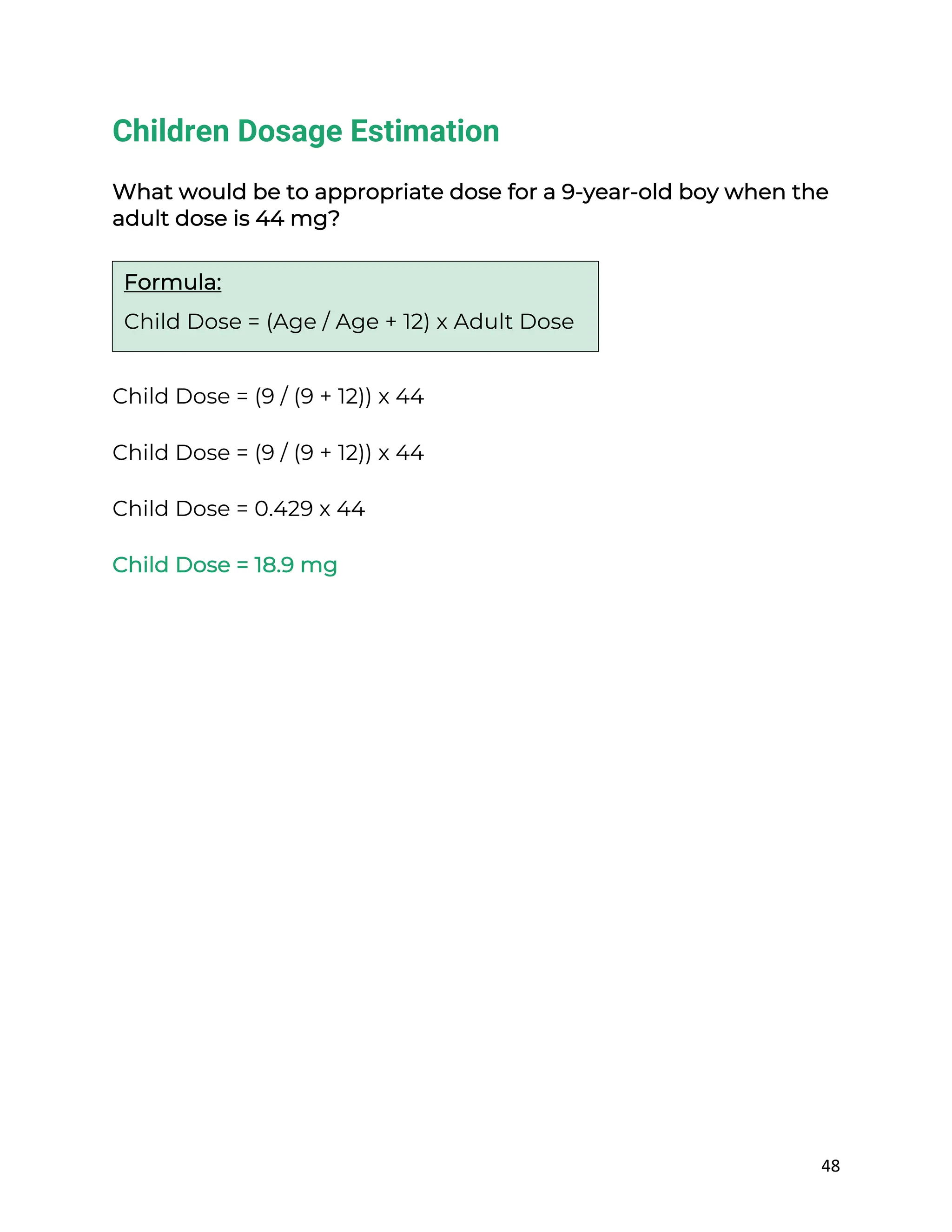
Children Dosage Estimation
What would be to appropriate dose for a 9-year-old boy when the
adult dose is 44 mg?
Child Dose = (9 / (9 + 12)) x 44
Child Dose = 0.429 x 44
Child Dose = 18.9 mg
Formula:
Child Dose = (Age / Age + 12) x Adult Dose
49
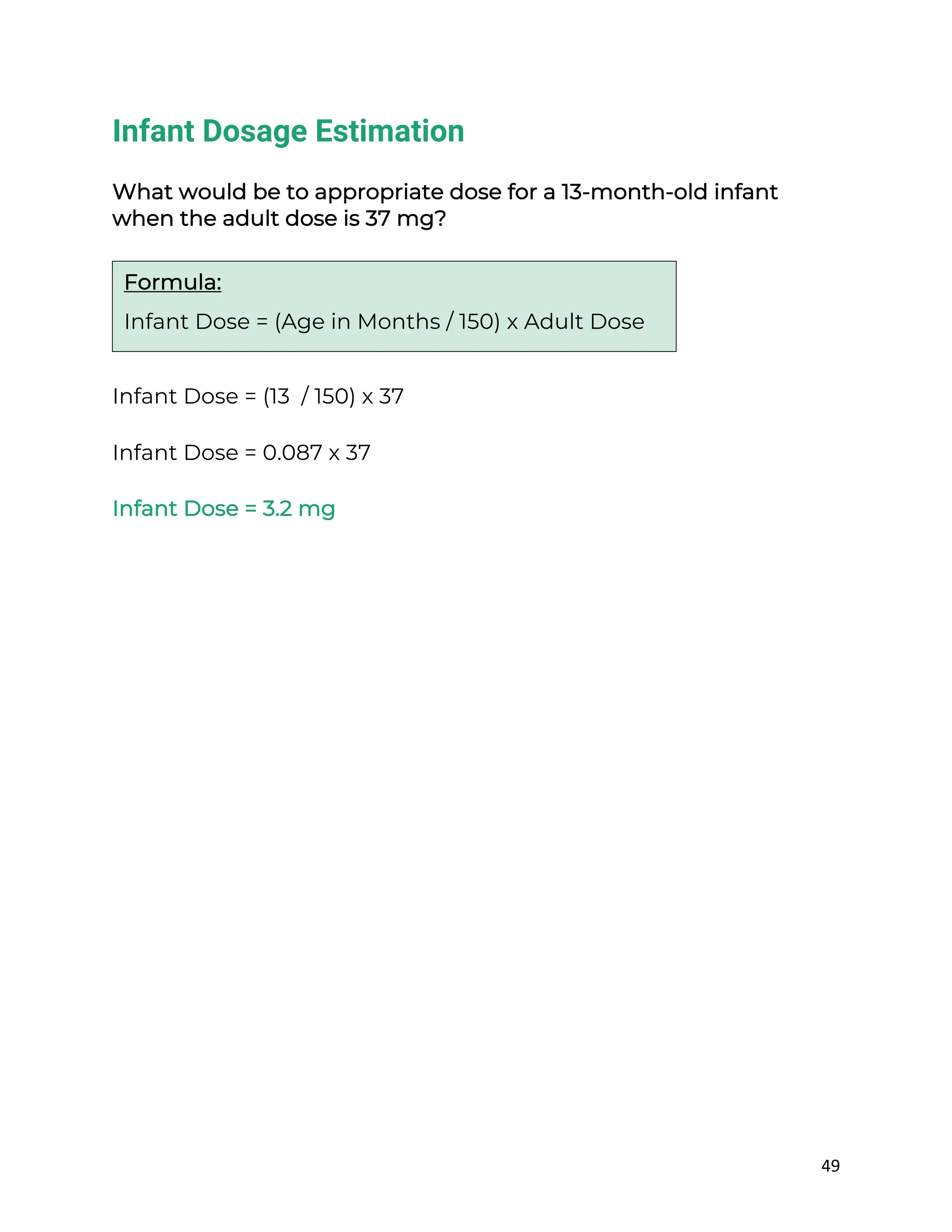
Infant Dosage Estimation
What would be to appropriate dose for a 13-month-old infant
when the adult dose is 37 mg?
Infant Dose = (13 / 150) x 37
Infant Dose = 0.087 x 37
Infant Dose = 3.2 mg
Formula:
Infant Dose = (Age in Months / 150) x Adult Dose
50
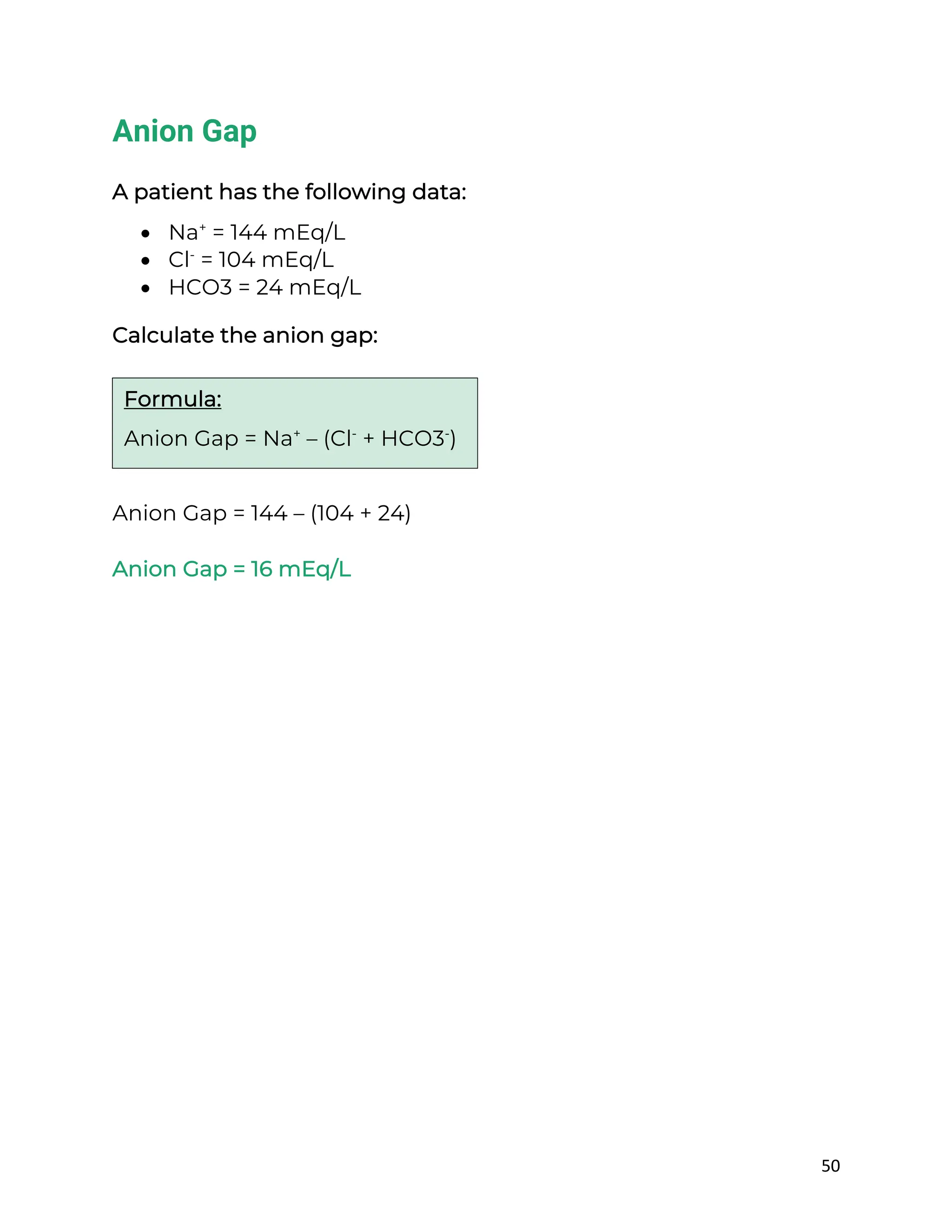
Anion Gap
A patient has the following data:
• Na+
= 144 mEq/L
• Cl-
= 104 mEq/L
• HCO3 = 24 mEq/L
Calculate the anion gap:
Anion Gap = 144 – (104 + 24)
Anion Gap = 16 mEq/L
Formula:
Anion Gap = Na+
– (Cl-
+ HCO3-
)
51
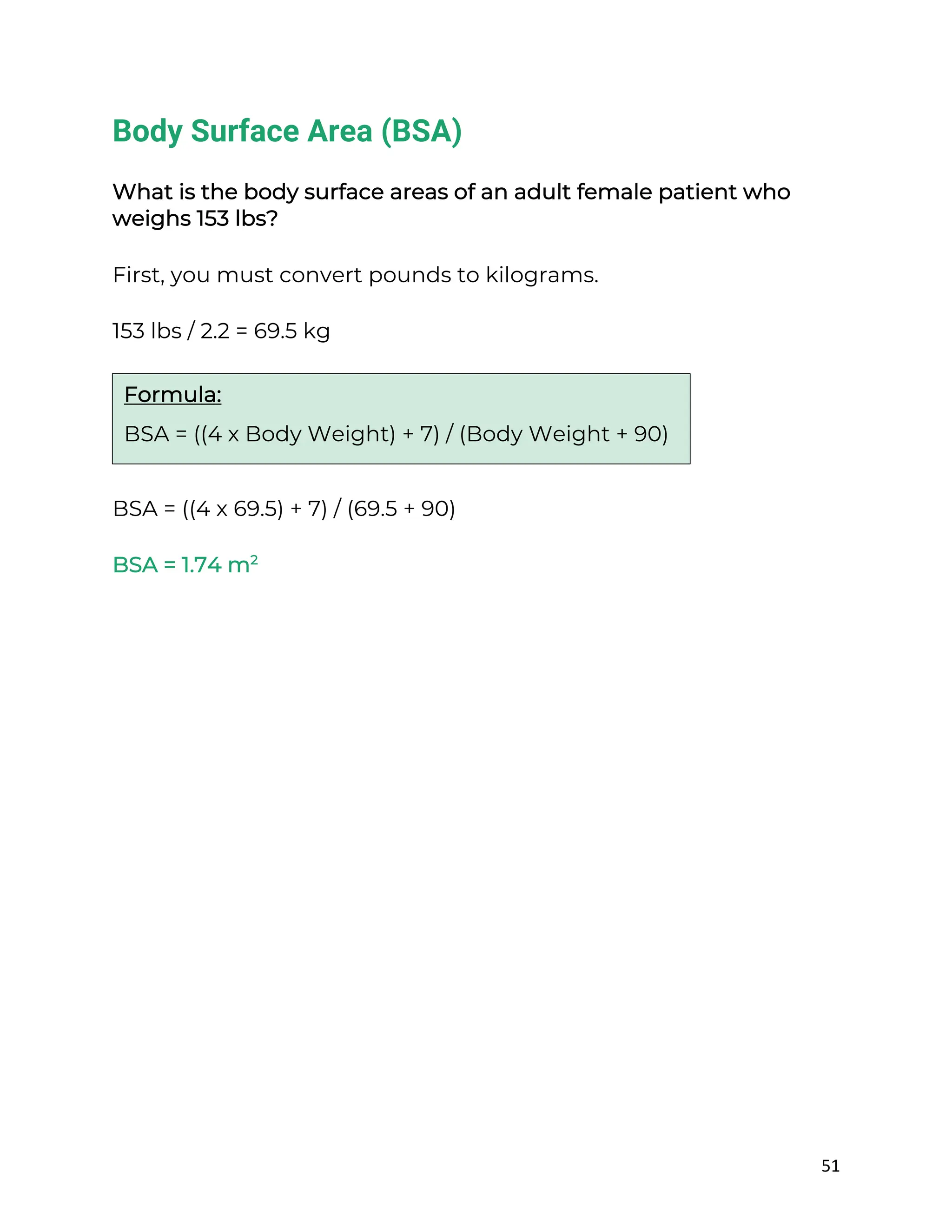
Body Surface Area (BSA)
What is the body surface areas of an adult female patient who
weighs 153 lbs?
First, you must convert pounds to kilograms.
153 lbs / 2.2 = 69.5 kg
BSA = ((4 x 69.5) + 7) / (69.5 + 90)
BSA = 1.74 m2
Formula:
BSA = ((4 x Body Weight) + 7) / (Body Weight + 90)
52
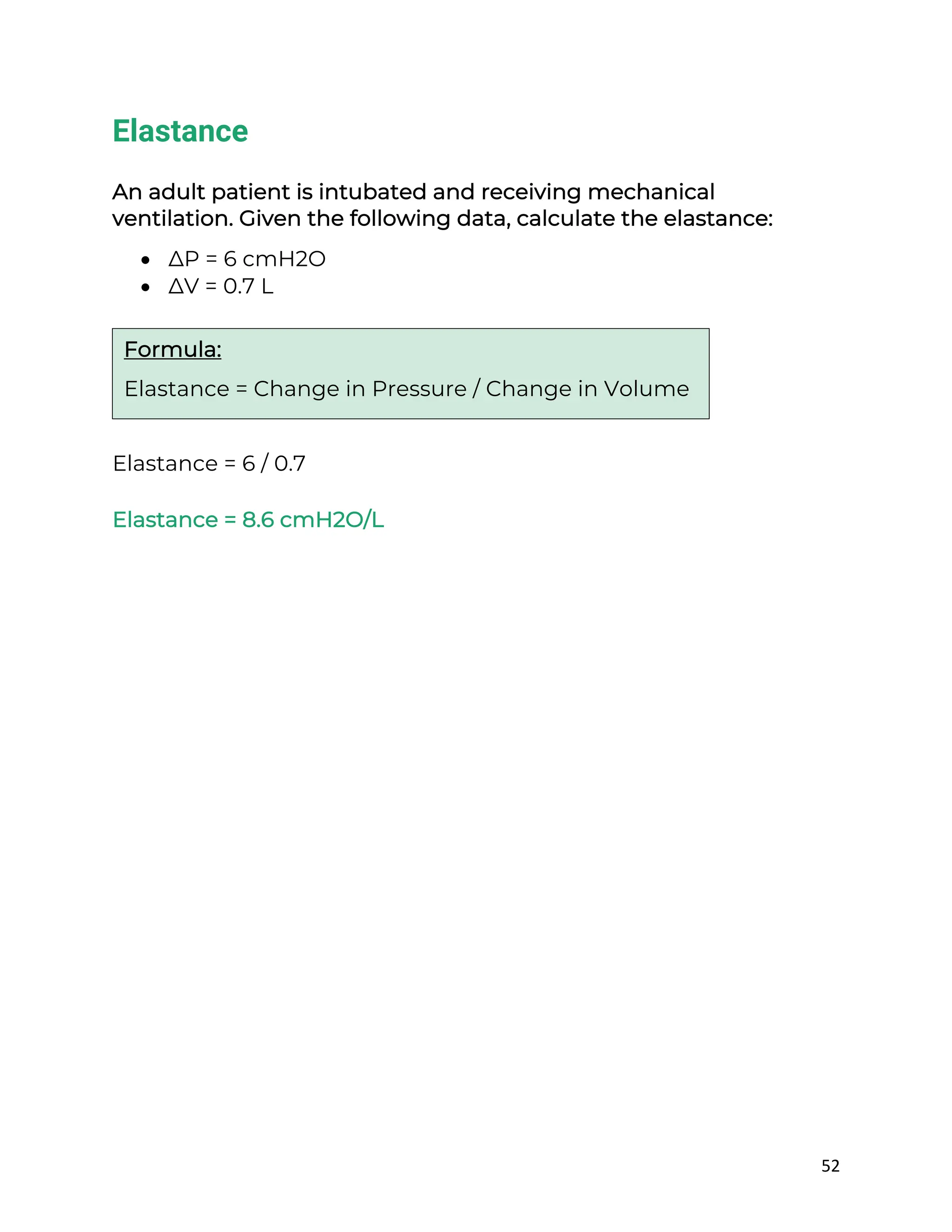
Elastance
An adult patient is intubated and receiving mechanical
ventilation. Given the following data, calculate the elastance:
• ∆P = 6 cmH2O
• ∆V = 0.7 L
Elastance = 6 / 0.7
Elastance = 8.6 cmH2O/L
Formula:
Elastance = Change in Pressure / Change in Volume
53
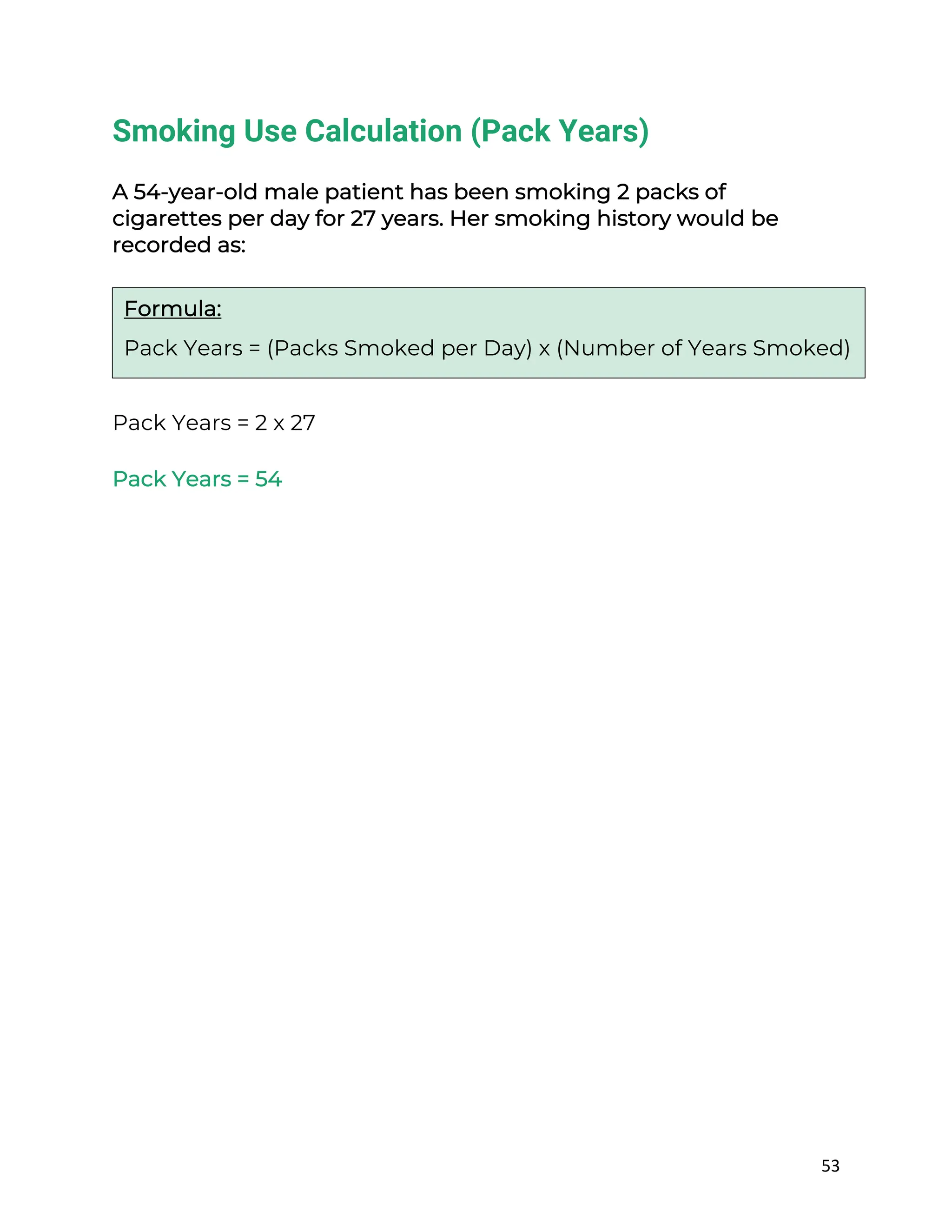
Smoking Use Calculation (Pack Years)
A 54-year-old male patient has been smoking 2 packs of
cigarettes per day for 27 years. Her smoking history would be
recorded as:
Pack Years = 2 x 27
Pack Years = 54
Formula:
Pack Years = (Packs Smoked per Day) x (Number of Years Smoked)
54
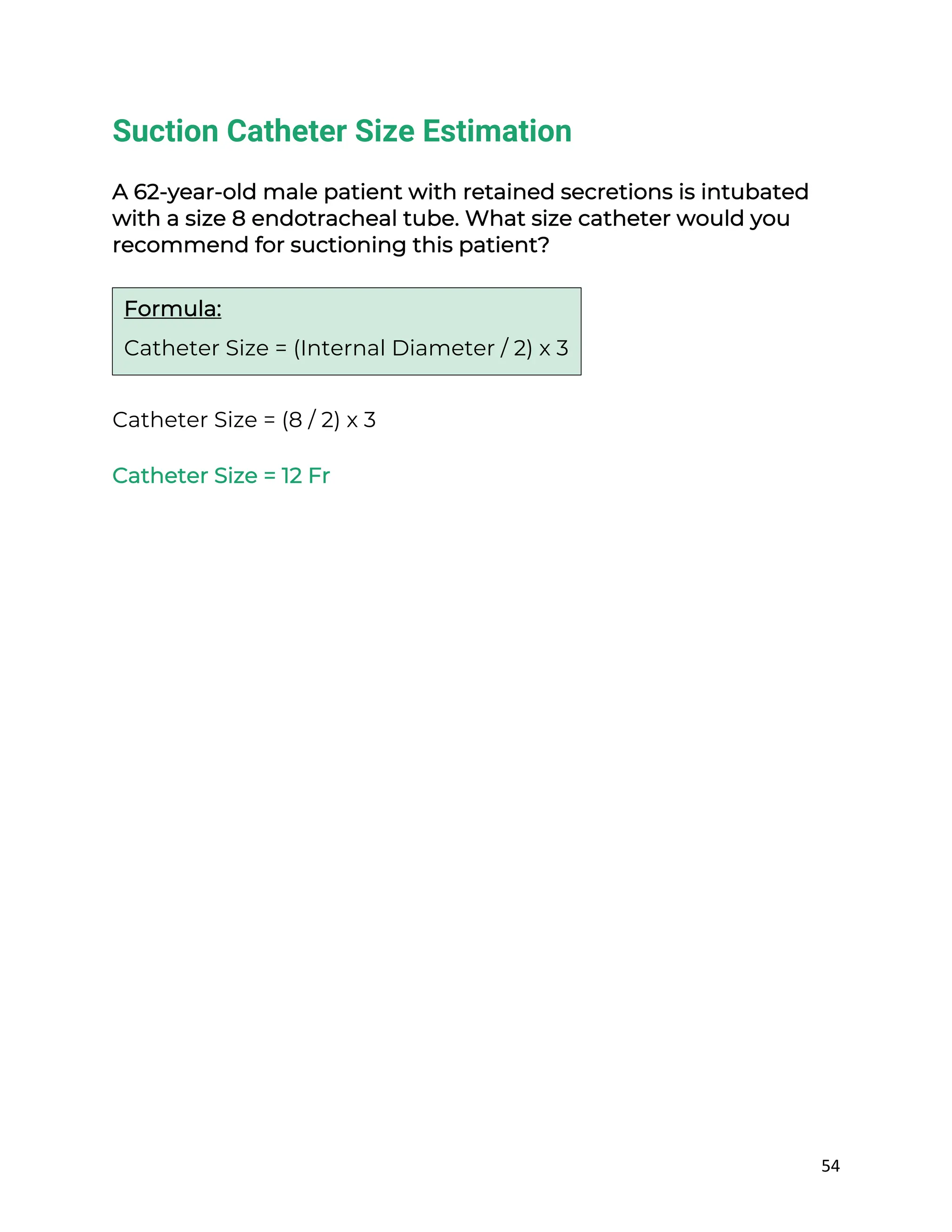
Suction Catheter Size Estimation
A 62-year-old male patient with retained secretions is intubated
with a size 8 endotracheal tube. What size catheter would you
recommend for suctioning this patient?
Catheter Size = (8 / 2) x 3
Catheter Size = 12 Fr
Formula:
Catheter Size = (Internal Diameter / 2) x 3
55
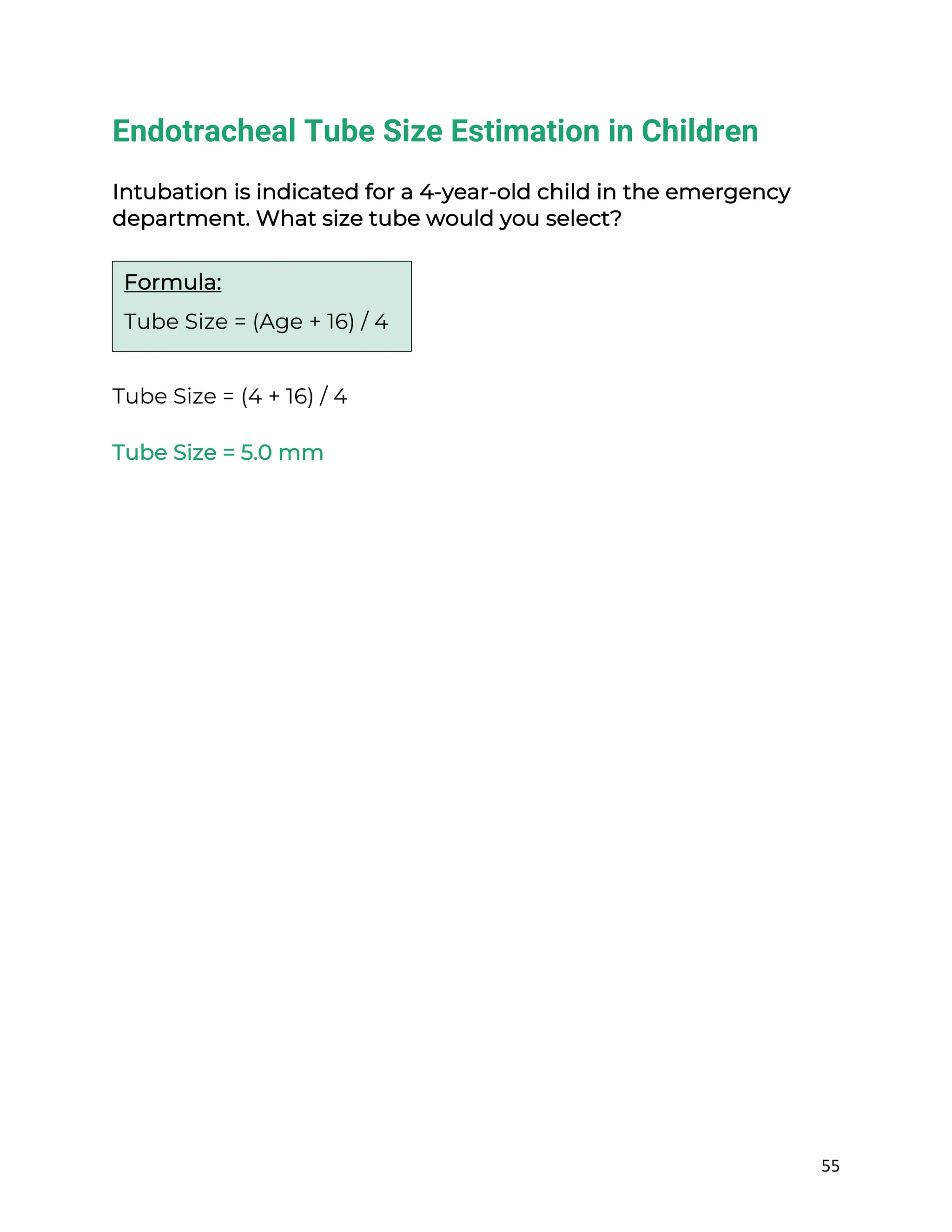
Endotracheal Tube Size Estimation in Children
Intubation is indicated for a 4-year-old child in the emergency
department. What size tube would you select?
Tube Size = (4 + 16) / 4
Tube Size = 5.0 mm
Formula:
Tube Size = (Age + 16) / 4
56
Celsius to Fahrenheit Temperature Conversion
A temperature of 30 ˚C is what temperature in Fahrenheit?
˚F = (30 x 1.8) + 32
˚F = 86
Formula:
˚F = (˚C x 1.8) + 32
57
Fahrenheit Celsius Temperature Conversion
A temperature of 69 ˚F is what temperature in Celsius?
˚C = (69 – 32) x 1.8
˚C = 66.6
Formula:
˚C = (˚F – 32) x 1.8
58
Celsius to Kelvins Temperature Conversion
A temperature of 33 ˚C is what temperature in Kelvins?
K = 33 + 273
K = 306
Formula:
K = ˚C + 273
59
Helium/Oxygen Conversion (He/O2)
A patient is receiving a 70%Helium/30%Oxygen is running that is
running on a flow rate of 8 L/min. What is the actual flow rate of
this He/O2 gas mixture?
To complete this calculation, you must remember the Heliox
factors:
• 80/20% Mixture = 1.8
• 70/30% Mixture = 1.6
For this patient, the question tells you that they are receiving a
70/30% mixtures, which means that you must use 1.6 as the factor
within the equation.
Actual Flow = 8 x 1.6
Actual Flow = 12.8 L/min
Formula:
Actual Flow = Given Flow Rate x Factor
60
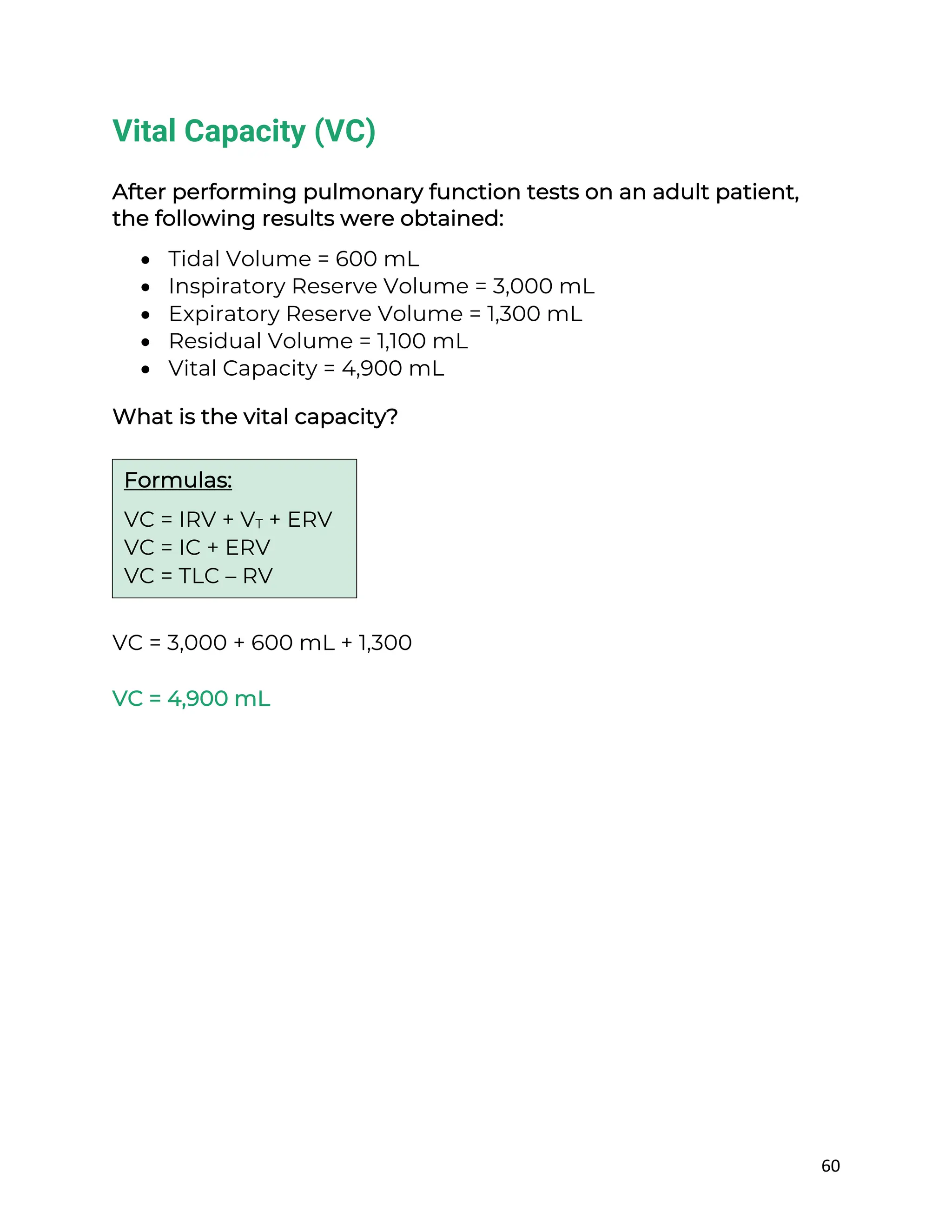
Vital Capacity (VC)
After performing pulmonary function tests on an adult patient,
the following results were obtained:
• Tidal Volume = 600 mL
• Inspiratory Reserve Volume = 3,000 mL
• Expiratory Reserve Volume = 1,300 mL
• Residual Volume = 1,100 mL
• Vital Capacity = 4,900 mL
What is the vital capacity?
VC = 3,000 + 600 mL + 1,300
VC = 4,900 mL
Formulas:
VC = IRV + VT + ERV
VC = IC + ERV
VC = TLC – RV
61
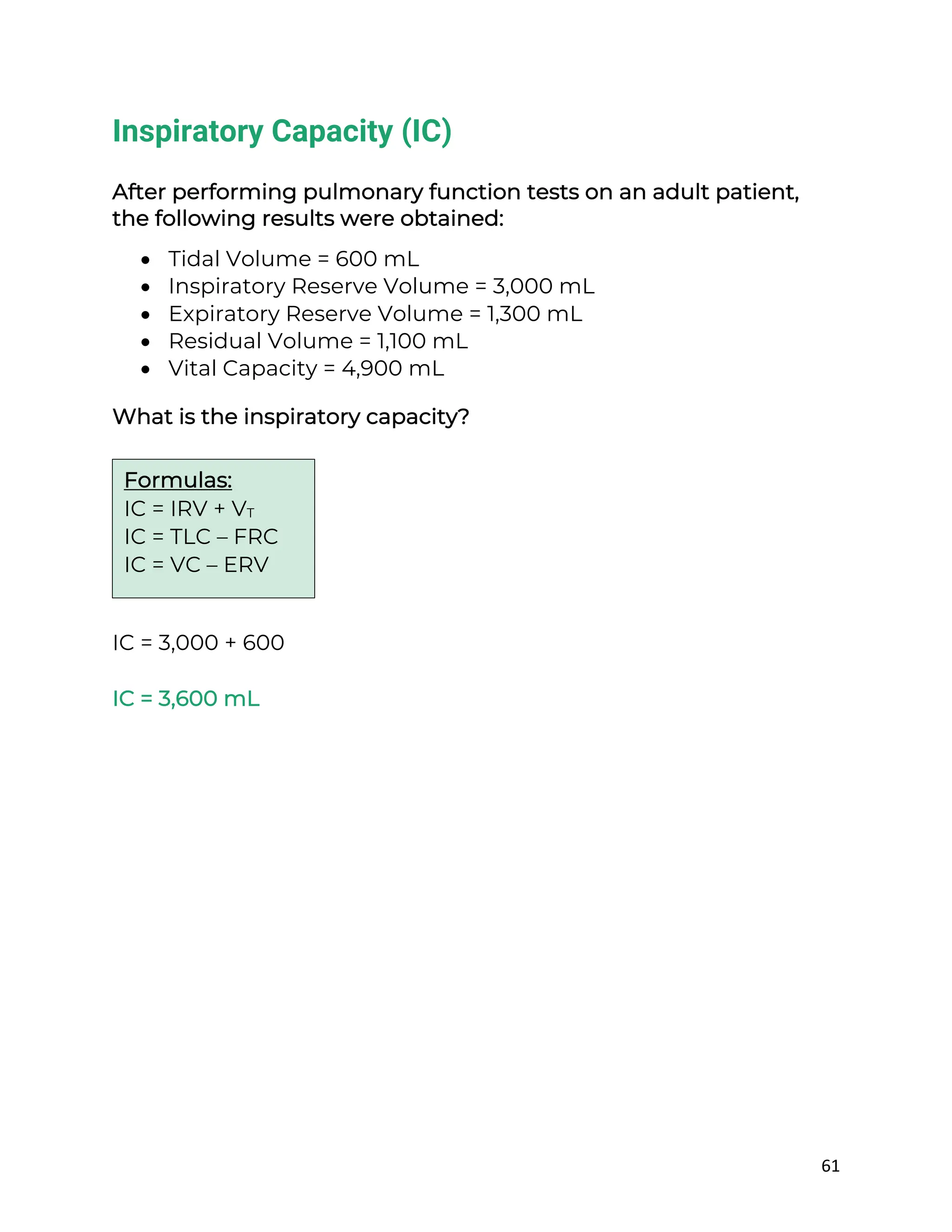
Inspiratory Capacity (IC)
After performing pulmonary function tests on an adult patient,
the following results were obtained:
• Tidal Volume = 600 mL
• Inspiratory Reserve Volume = 3,000 mL
• Expiratory Reserve Volume = 1,300 mL
• Residual Volume = 1,100 mL
• Vital Capacity = 4,900 mL
What is the inspiratory capacity?
IC = 3,000 + 600
IC = 3,600 mL
Formulas:
IC = IRV + VT
IC = TLC – FRC
IC = VC – ERV
62
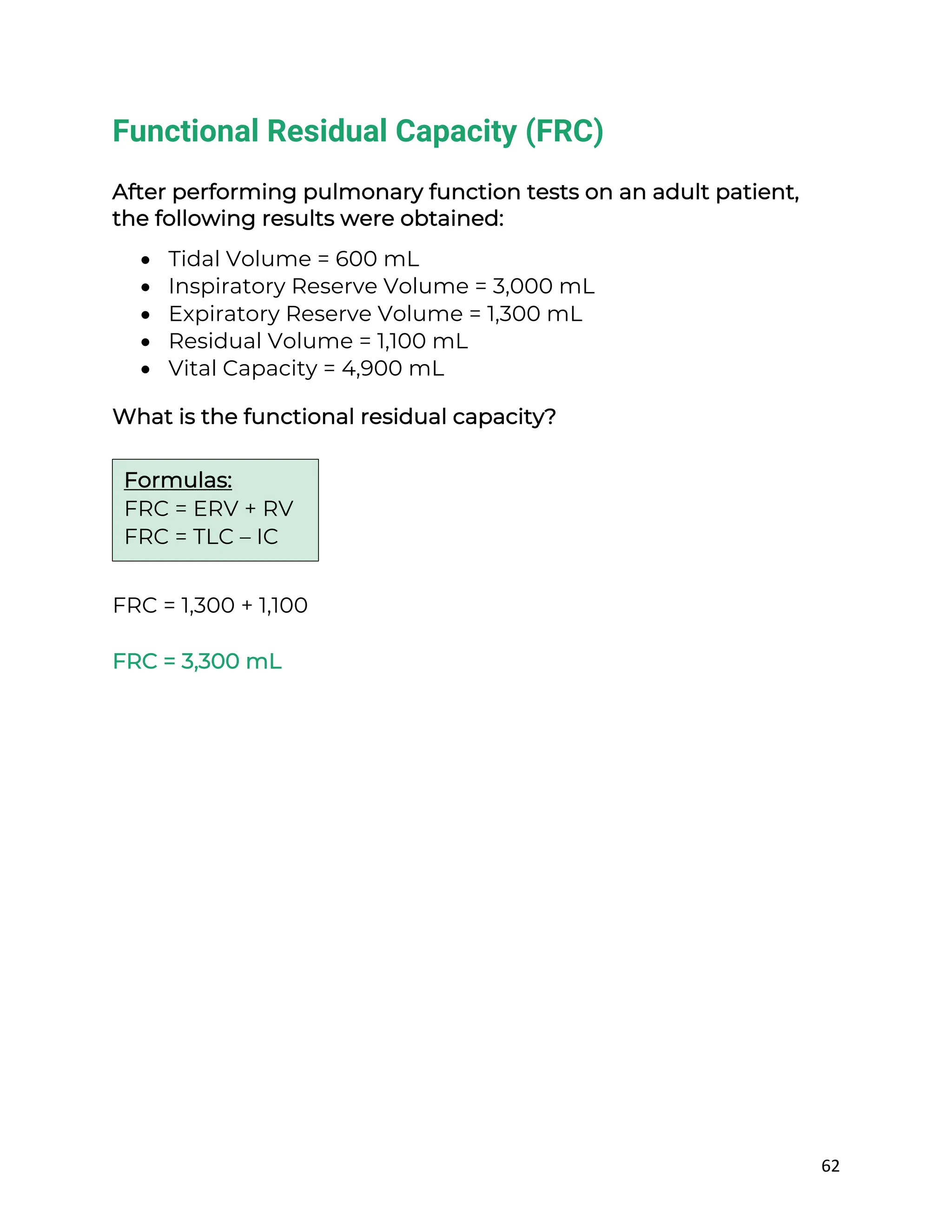
Functional Residual Capacity (FRC)
After performing pulmonary function tests on an adult patient,
the following results were obtained:
• Tidal Volume = 600 mL
• Inspiratory Reserve Volume = 3,000 mL
• Expiratory Reserve Volume = 1,300 mL
• Residual Volume = 1,100 mL
• Vital Capacity = 4,900 mL
What is the functional residual capacity?
FRC = 1,300 + 1,100
FRC = 3,300 mL
Formulas:
FRC = ERV + RV
FRC = TLC – IC
63
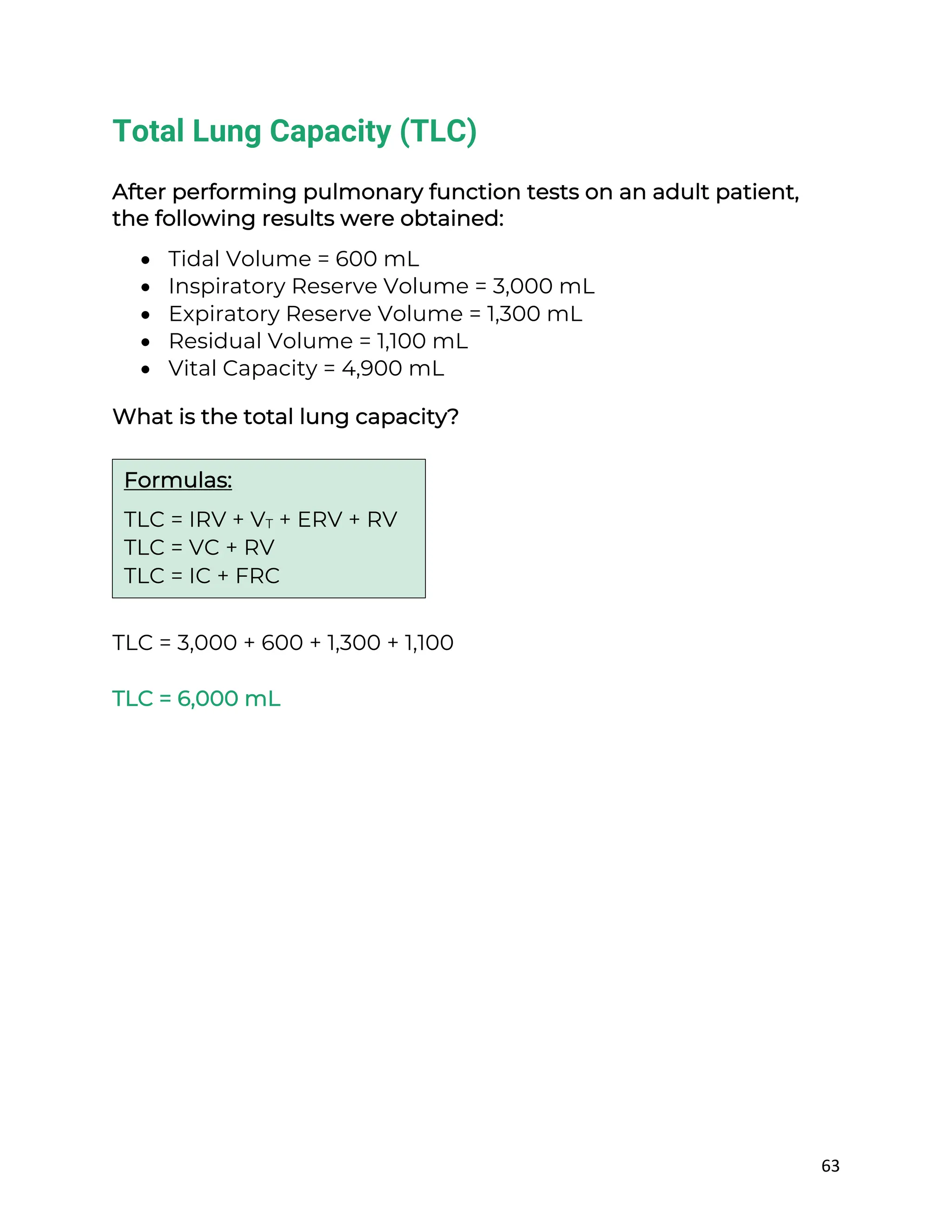
Total Lung Capacity (TLC)
After performing pulmonary function tests on an adult patient,
the following results were obtained:
• Tidal Volume = 600 mL
• Inspiratory Reserve Volume = 3,000 mL
• Expiratory Reserve Volume = 1,300 mL
• Residual Volume = 1,100 mL
• Vital Capacity = 4,900 mL
What is the total lung capacity?
TLC = 3,000 + 600 + 1,300 + 1,100
TLC = 6,000 mL
Formulas:
TLC = IRV + VT + ERV + RV
TLC = VC + RV
TLC = IC + FRC
64
Time Constant (t)
A 63-year-old male patient who is receiving ventilatory support
has a compliance of 0.09 L/cmH2O and a total resistance of 4
cmH2O/L/sec. Calculate the time constant:
t = 0.09 x 4
t = 0.36 seconds
Formula:
t = Compliance x Resistance
65
Ideal Body Weight (IBW)
A 61-year-old female patient is receiving positive pressure
ventilatory support. The patient’s height is 5’7”. What is her ideal
body weight?
IBW = 50 + (2 x 7)
IBW = 50 + 14
IBW = 64 kg
Formula:
IBW = 50 kg + (2 x Number of Inches over 5 feet)
66
Tidal Volume (VT)
An adult patient who is intubated and receiving ventilatory
support has a flow rate of 7 L/min and an inspiratory time of 0.7
seconds. What is the tidal volume?
First, you need to convert the flow rate from L/min to mL/sec.
7 L/min = 7,000 mL/60 seconds
7,000 / 60 = 116.7 mL/sec
Now just plug the numbers in.
VT = 116.7 x 0.7
VT = 8.2 mL
Formula:
VT = Flow Rate x Inspiratory Time
67
Exhaled Tidal Volume (VT)
An adult patient who is receiving mechanical ventilation displays
the following data:
• Rate = 12/min
• Minute Ventilation = 7.2 L/min
What is the exhaled tidal volume?
VT = 7.2 / 12
VT = 0.6 L
Multiply by 1,000 to convert L to mL.
VT = 600 mL
Formula:
VT = Minute Ventilation / Frequency
68
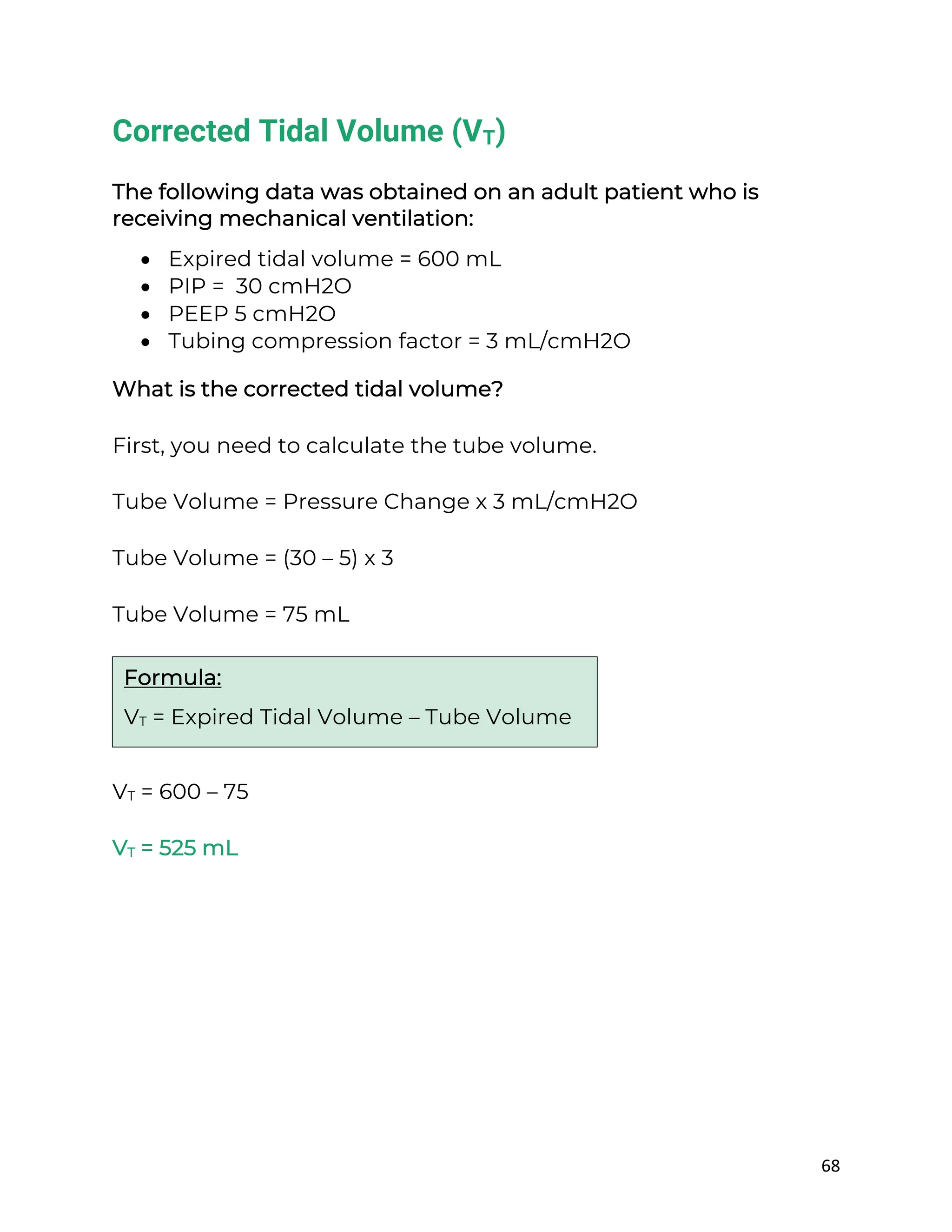
Corrected Tidal Volume (VT)
The following data was obtained on an adult patient who is
receiving mechanical ventilation:
• Expired tidal volume = 600 mL
• PIP = 30 cmH2O
• PEEP 5 cmH2O
• Tubing compression factor = 3 mL/cmH2O
What is the corrected tidal volume?
First, you need to calculate the tube volume.
Tube Volume = Pressure Change x 3 mL/cmH2O
Tube Volume = (30 – 5) x 3
Tube Volume = 75 mL
VT = 600 – 75
VT = 525 mL
Formula:
VT = Expired Tidal Volume – Tube Volume
69
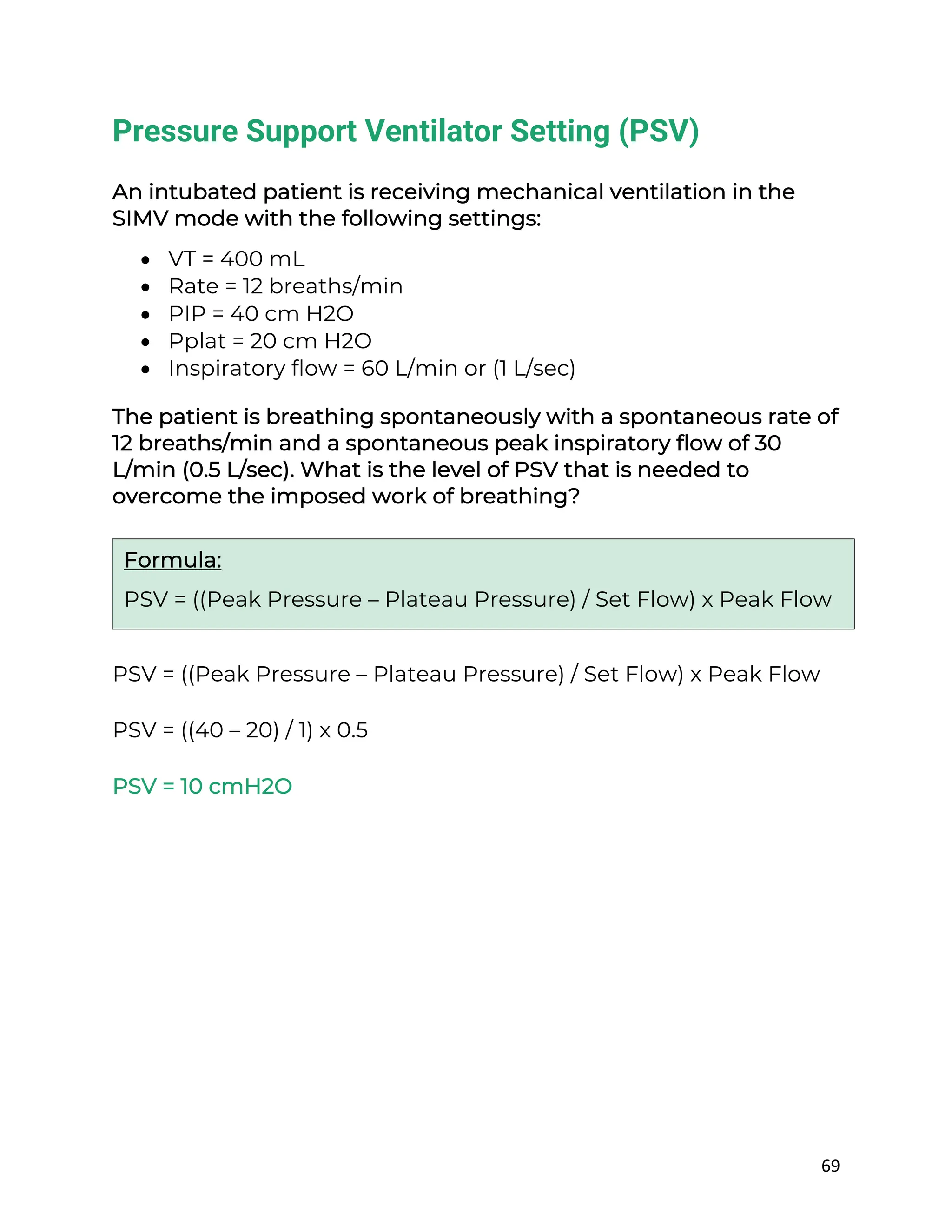
Pressure Support Ventilator Setting (PSV)
An intubated patient is receiving mechanical ventilation in the
SIMV mode with the following settings:
• VT = 400 mL
• Rate = 12 breaths/min
• PIP = 40 cm H2O
• Pplat = 20 cm H2O
• Inspiratory flow = 60 L/min or (1 L/sec)
The patient is breathing spontaneously with a spontaneous rate of
12 breaths/min and a spontaneous peak inspiratory flow of 30
L/min (0.5 L/sec). What is the level of PSV that is needed to
overcome the imposed work of breathing?
PSV = ((Peak Pressure – Plateau Pressure) / Set Flow) x Peak Flow
PSV = ((40 – 20) / 1) x 0.5
PSV = 10 cmH2O
Formula:
PSV = ((Peak Pressure – Plateau Pressure) / Set Flow) x Peak Flow
70
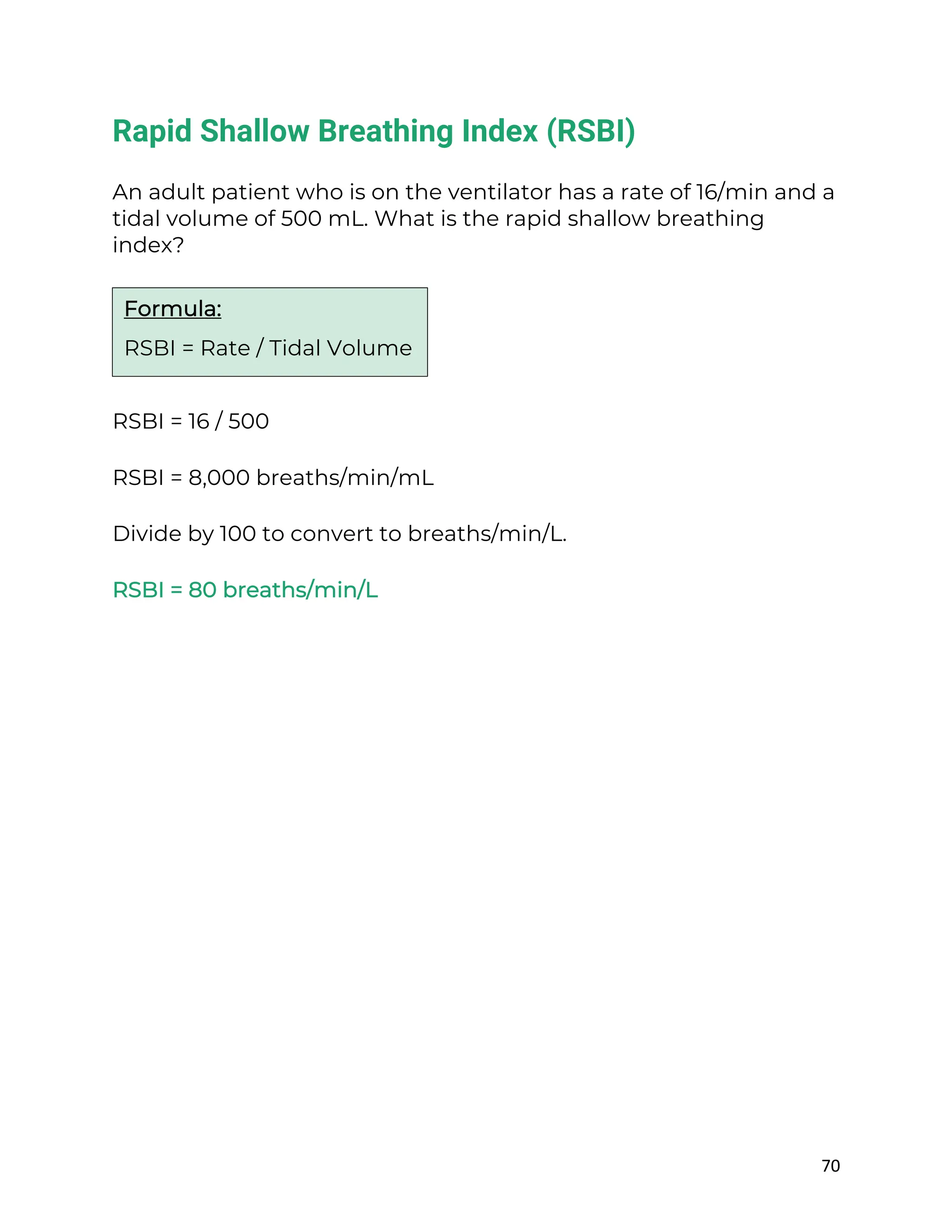
Rapid Shallow Breathing Index (RSBI)
An adult patient who is on the ventilator has a rate of 16/min and a
tidal volume of 500 mL. What is the rapid shallow breathing
index?
RSBI = 16 / 500
RSBI = 8,000 breaths/min/mL
Divide by 100 to convert to breaths/min/L.
RSBI = 80 breaths/min/L
Formula:
RSBI = Rate / Tidal Volume
71
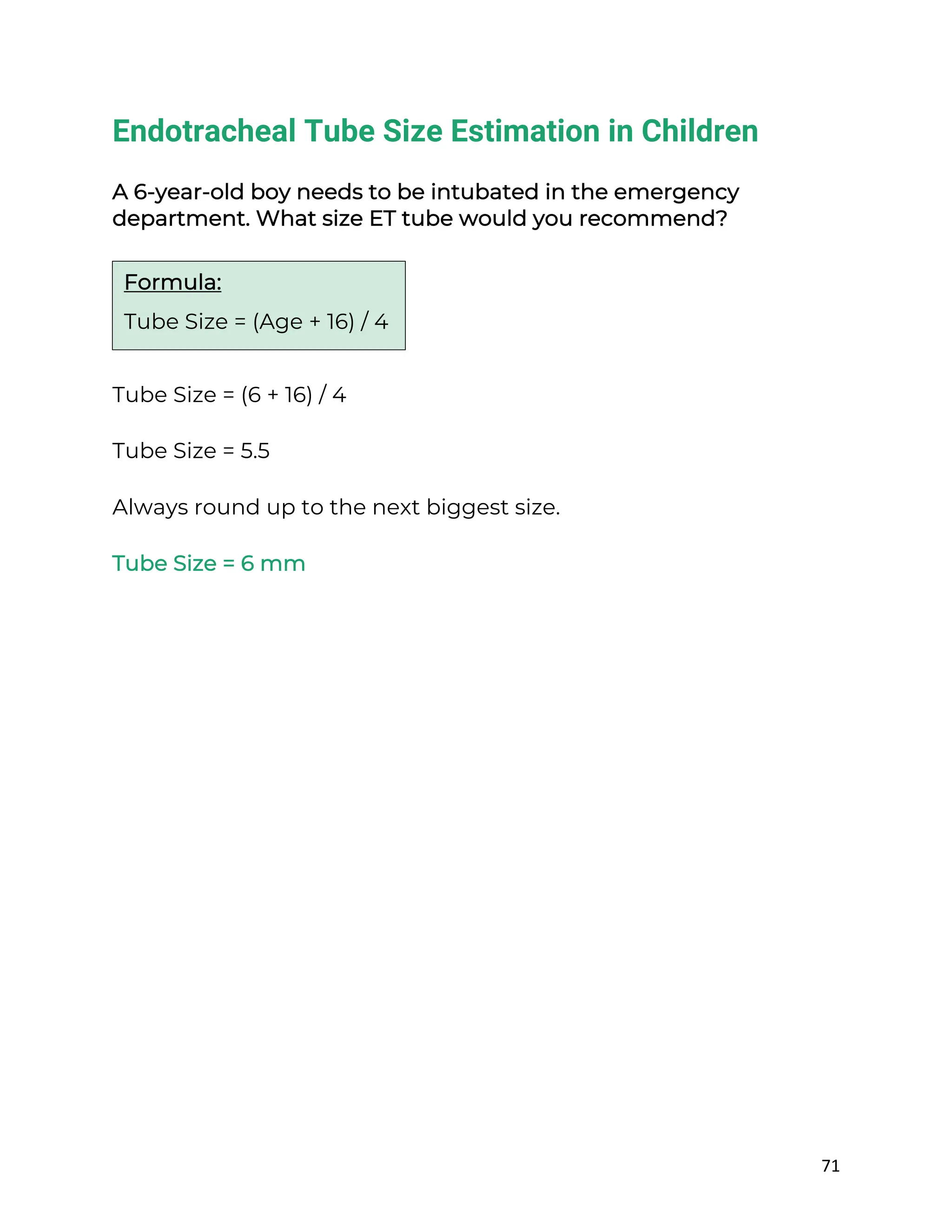
Endotracheal Tube Size Estimation in Children
A 6-year-old boy needs to be intubated in the emergency
department. What size ET tube would you recommend?
Tube Size = (6 + 16) / 4
Tube Size = 5.5
Always round up to the next biggest size.
Tube Size = 6 mm
Formula:
Tube Size = (Age + 16) / 4
72
Minimum Flow Rate in Mechanical Ventilation
An adult patient is receiving mechanical ventilation with the
following settings:
• Tidal Volume = 550 mL
• Rate = 12/min
• I:E ratio = 1:3
What is the required minimum flow rate?
First, you need to calculate the Minute Ventilation.
VE = Rate x Tidal Volume
VE = 12 x 550 mL
VE = 6,600 mL
You can convert mL to L by dividing by 1,000.
VE = 6.6 L
Now you can easily calculate the Minimum Flow Rate
Minimum Flow Rate = 6.6 x (3 + 1)
Minimum Flow Rate = 26.4 L/min
Formula:
Flow Rate = Minute Ventilation x I:E Ratio Sum of Parts
73
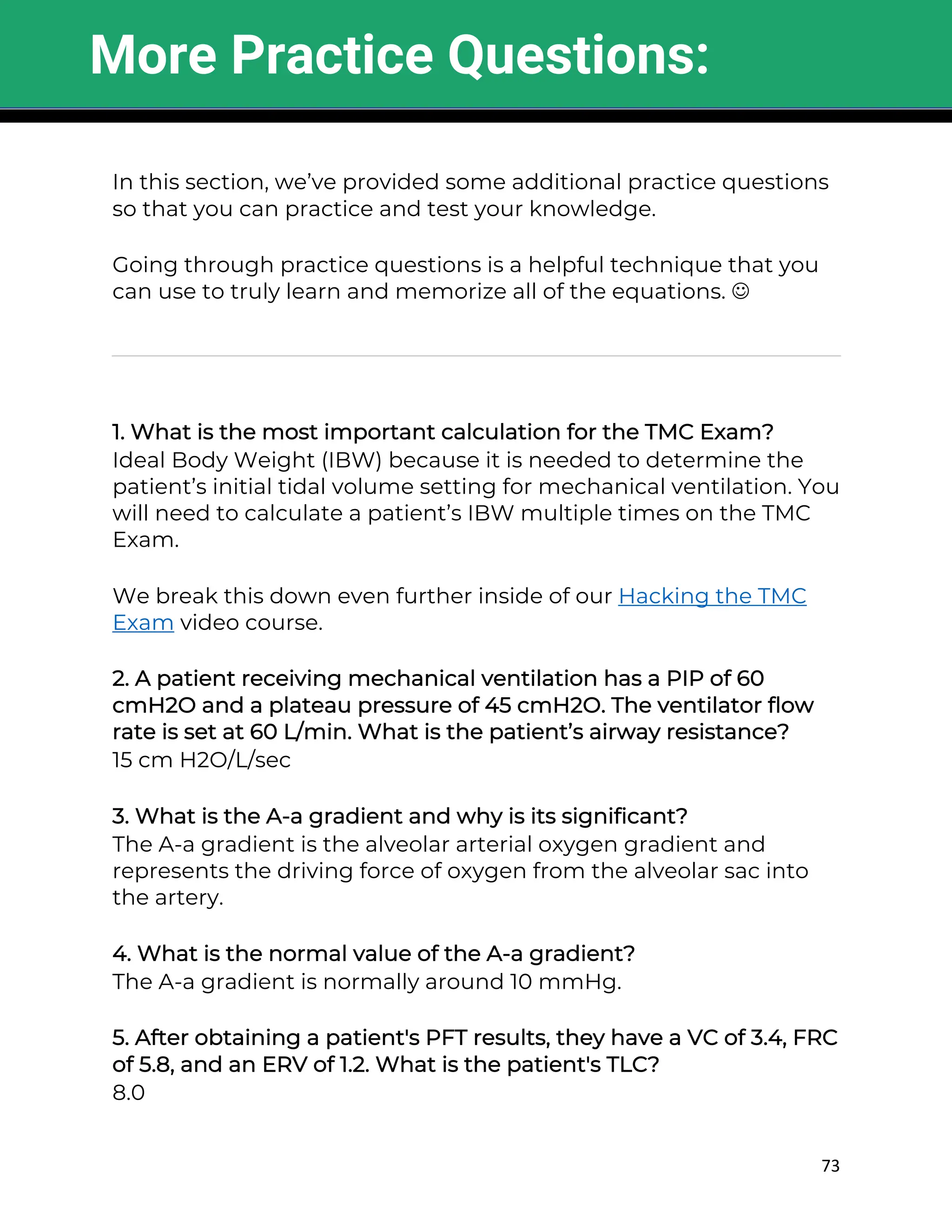
In this section, we’ve provided some additional practice questions
so that you can practice and test your knowledge.
Going through practice questions is a helpful technique that you
can use to truly learn and memorize all of the equations. J
1. What is the most important calculation for the TMC Exam?
Ideal Body Weight (IBW) because it is needed to determine the
patient’s initial tidal volume setting for mechanical ventilation. You
will need to calculate a patient’s IBW multiple times on the TMC
Exam.
We break this down even further inside of our Hacking the TMC
Exam video course.
2. A patient receiving mechanical ventilation has a PIP of 60
cmH2O and a plateau pressure of 45 cmH2O. The ventilator flow
rate is set at 60 L/min. What is the patient’s airway resistance?
15 cm H2O/L/sec
3. What is the A-a gradient and why is its significant?
The A-a gradient is the alveolar arterial oxygen gradient and
represents the driving force of oxygen from the alveolar sac into
the artery.
4. What is the normal value of the A-a gradient?
The A-a gradient is normally around 10 mmHg.
5. After obtaining a patient's PFT results, they have a VC of 3.4, FRC
of 5.8, and an ERV of 1.2. What is the patient's TLC?
8.0
More Practice Questions:
74
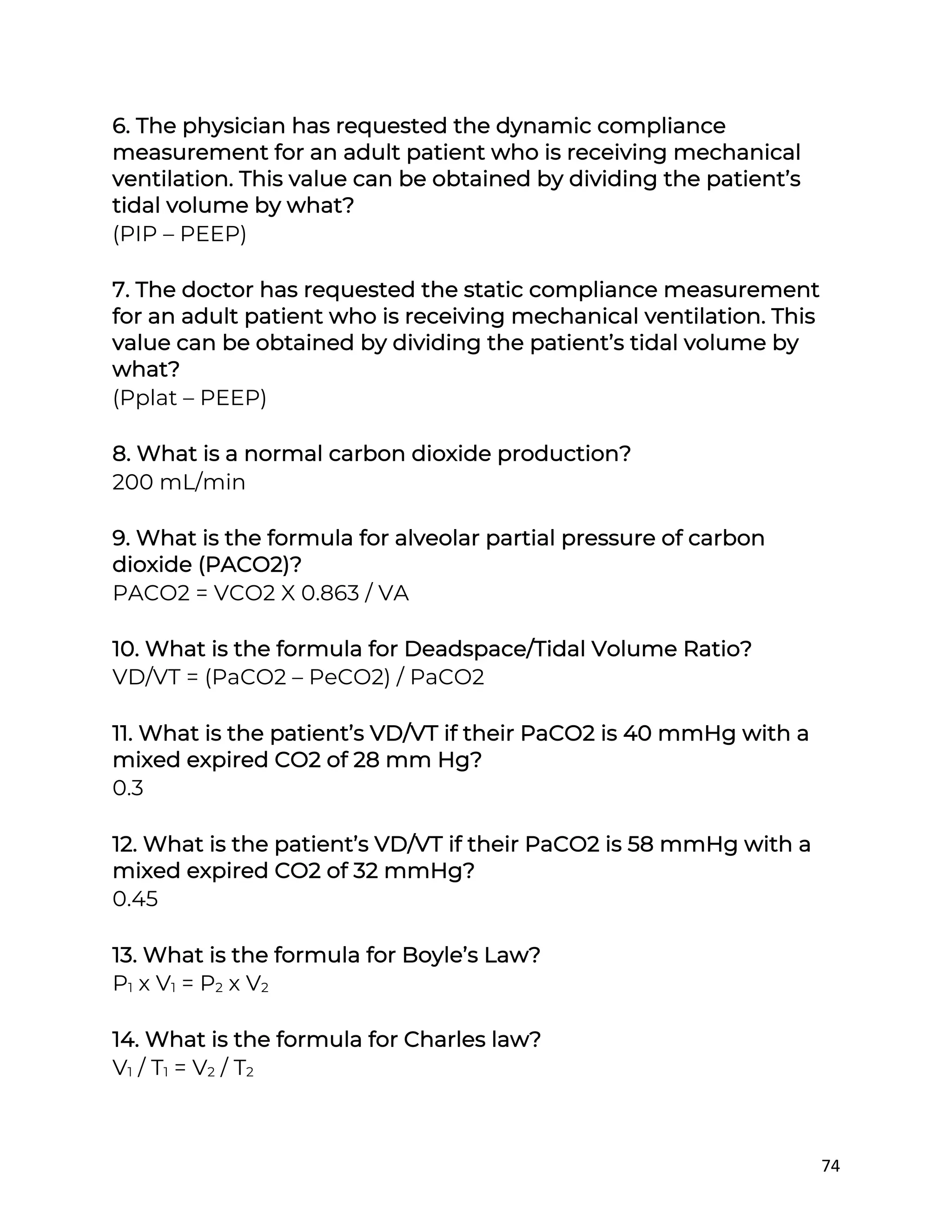
6. The physician has requested the dynamic compliance
measurement for an adult patient who is receiving mechanical
ventilation. This value can be obtained by dividing the patient’s
tidal volume by what?
(PIP – PEEP)
7. The doctor has requested the static compliance measurement
for an adult patient who is receiving mechanical ventilation. This
value can be obtained by dividing the patient’s tidal volume by
what?
(Pplat – PEEP)
8. What is a normal carbon dioxide production?
200 mL/min
9. What is the formula for alveolar partial pressure of carbon
dioxide (PACO2)?
PACO2 = VCO2 X 0.863 / VA
10. What is the formula for Deadspace/Tidal Volume Ratio?
VD/VT = (PaCO2 – PeCO2) / PaCO2
11. What is the patient’s VD/VT if their PaCO2 is 40 mmHg with a
mixed expired CO2 of 28 mm Hg?
0.3
12. What is the patient’s VD/VT if their PaCO2 is 58 mmHg with a
mixed expired CO2 of 32 mmHg?
0.45
13. What is the formula for Boyle’s Law?
P1 x V1 = P2 x V2
14. What is the formula for Charles law?
V1 / T1 = V2 / T2
75
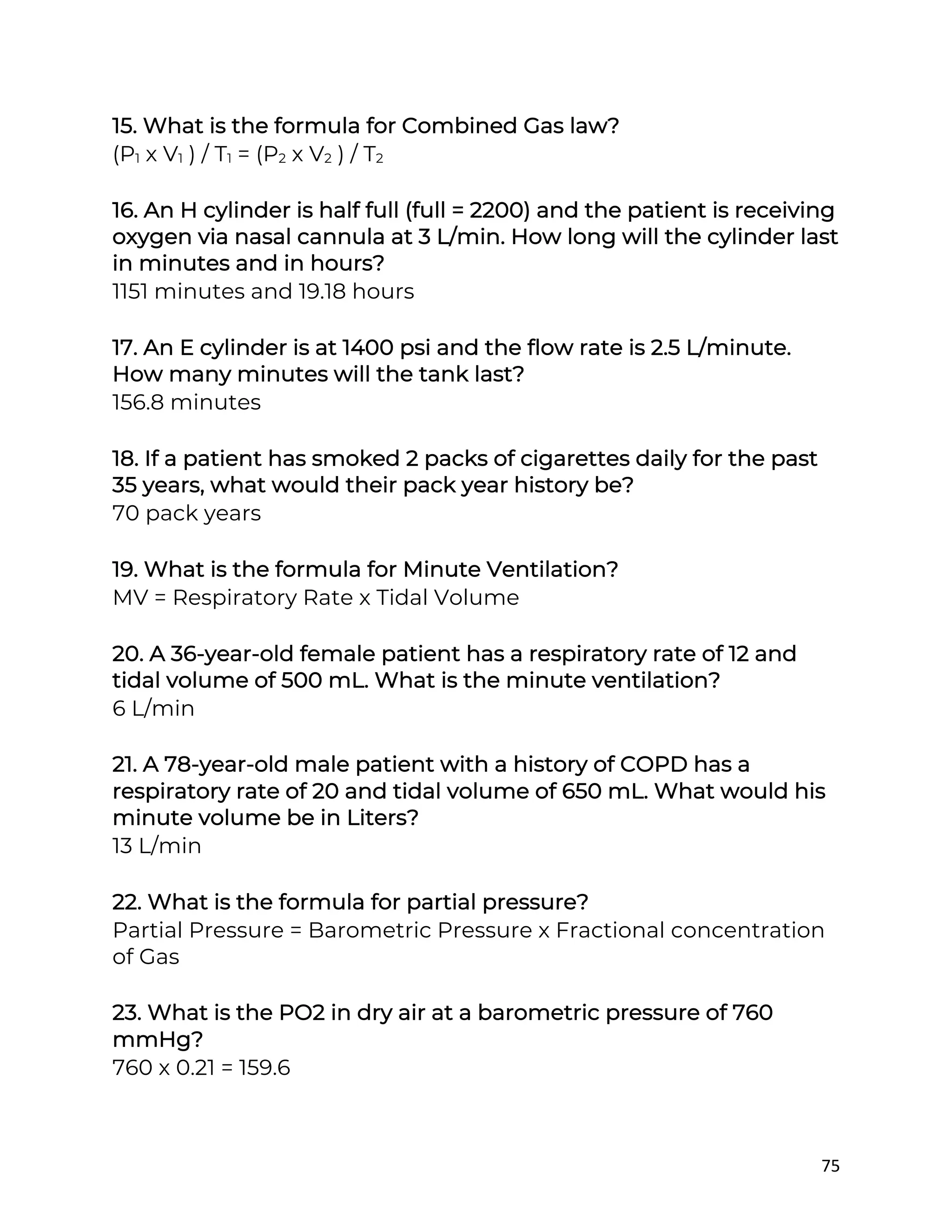
15. What is the formula for Combined Gas law?
(P1 x V1 ) / T1 = (P2 x V2 ) / T2
16. An H cylinder is half full (full = 2200) and the patient is receiving
oxygen via nasal cannula at 3 L/min. How long will the cylinder last
in minutes and in hours?
1151 minutes and 19.18 hours
17. An E cylinder is at 1400 psi and the flow rate is 2.5 L/minute.
How many minutes will the tank last?
156.8 minutes
18. If a patient has smoked 2 packs of cigarettes daily for the past
35 years, what would their pack year history be?
70 pack years
19. What is the formula for Minute Ventilation?
MV = Respiratory Rate x Tidal Volume
20. A 36-year-old female patient has a respiratory rate of 12 and
tidal volume of 500 mL. What is the minute ventilation?
6 L/min
21. A 78-year-old male patient with a history of COPD has a
respiratory rate of 20 and tidal volume of 650 mL. What would his
minute volume be in Liters?
13 L/min
22. What is the formula for partial pressure?
Partial Pressure = Barometric Pressure x Fractional concentration
of Gas
23. What is the PO2 in dry air at a barometric pressure of 760
mmHg?
760 x 0.21 = 159.6
76
24. How do you calculate the PO2 of humidified air?
Partial Pressure = (Barometric Pressure – Water Vapor Pressure) x
Fractional concentration of gas
25. What is the PO2 of humidified tracheal air?
(760 – 47) x 0.21 = 149.7
26. If the alveolar gas has a PO2 of 100 mmHg, what is the PO2 of
the pulmonary capillary blood?
100 mmHg
27. In air, what is the mol percentage of Nitrogen?
78%
28. In air, what is the mol percentage of oxygen?
21%
29. In air, what is the mol percentage of Argon?
1%
30. At a normal body temperature, what is the partial pressure of
water vapor?
47 mmHg
31. PA and Pa in the alveolar gas equation represents the gas
pressures in what locations?
PA represents the gas pressure in the alveoli. Pa represents the
gas pressure in the artery.
32. In the alveolar gas equation, what does R represent?
R represents the V:Q ratio of carbon dioxide and is dependent
upon the type of metabolism that a person is undergoing.
33. What two factors determine cardiac output?
Heart Rate and Stroke volume
77
34. What is the formula for Cardiac Index?
CI= Cardiac Output / BSA
35. A Cardiac Index below what value can be life-threatening?
< 2.2
36. What is the formula for Stroke Index?
SI = Stroke Volume / BSA
37. What is the Fick Equation?
CO = VO2 / CaO2 – CvO2
38. What does the Deadspace-to-Tidal Volume Ratio measure?
It measures the percentage of the tidal volume that is dead space
which does not participate in gas exchange.
39. What is the normal value for (Vd/Vt)?
20 to 40% (or up to 60% for patients on the ventilator)
40. What is the formula to Vd/Vt?
Vd/Vt = (PaCO2 – PeCO2 / PaCO2) x 100
41. What is the average PCO2 of the exhaled air that can be
measured by a capnograph?
PeCO2
42. If you know the patient’s tidal volume but the deadspace must
be calculated, what formula should be used?
Vd/Vt x Vt
41. What is the tubing compliance when the measured volume is
100 mL and the static pressure is 65 cm H2O?
1.5 mL/cm H2O
42. While setting up a new patient on the ventilator the plateau
pressure is 47 cm H2O and the tidal volume is set at 100 mL. The
78
average PIP reached during the delivery of a breath is 28 cm H2O.
What is the amount of volume that was lost in the ventilator
tubing?
60 mL
43. What is the average tidal volume for a patient who has a
minute ventilation of 10 L/min and rate 12/min?
833 mL
44. What is inspiratory time when the tidal volume is set at 800
mL and a flow rate of 40 L/min?
1.2 seconds
45. What is the I:E ratio for a ventilator that is set to deliver a tidal
volume of 850 mL at a frequency of 15/min with a flow rate of 45
L/min?
1:2.5
46. What is the expiratory time when the rate is set to 25/min and
the inspiratory time is 0.75 seconds?
1.65 seconds
47. What flow rate would be necessary in order to deliver a tidal
volume of 600 mL with a constant waveform at a respiratory rate
of 15/min with an I:E of 1:4?
45 L/min
48. What tidal volume setting for mechanical ventilation would be
appropriate for a 5'2" female patient with normal lungs?
400 mL
49. How should the initial minute ventilation setting be adjusted
for an adult patient who has a body temperature of 40 °C?
Increase it by 30% because the minute ventilation would have to
be increased by 10% for each degree above 37° C.
79
50. What is the number of pack years for a COPD patient who has
smoked 2 packs per day for 27 years?
Pack Years = (2 x 27) = 54
51. A 52-year-old female patient has been smoking 1.5 packs of
cigarettes per day for 30 years. Her smoking history would be
recorded as:
45 pack-years
52. A patient is receiving 3 L/min of oxygen from an E-cylinder at
1200 psi. What is the approximate duration of flow?
112 minutes
53. A 5-foot, 6-inch-tall 130-lb. female patient with normal lungs
has a tidal volume of 480 mL and is breathing at a rate of 12
breaths/min. What is her alveolar ventilation?
4.20 L/min
54. A patient 43-year-old male patient is receiving volume
controlled ventilation at a rate of 12/min. The expiratory time is
3.30 seconds. What is the inspiratory time?
1.70 seconds
55. What is the formula for Work of Breathing?
WOB = Change in Pressure x Change in Volume
80
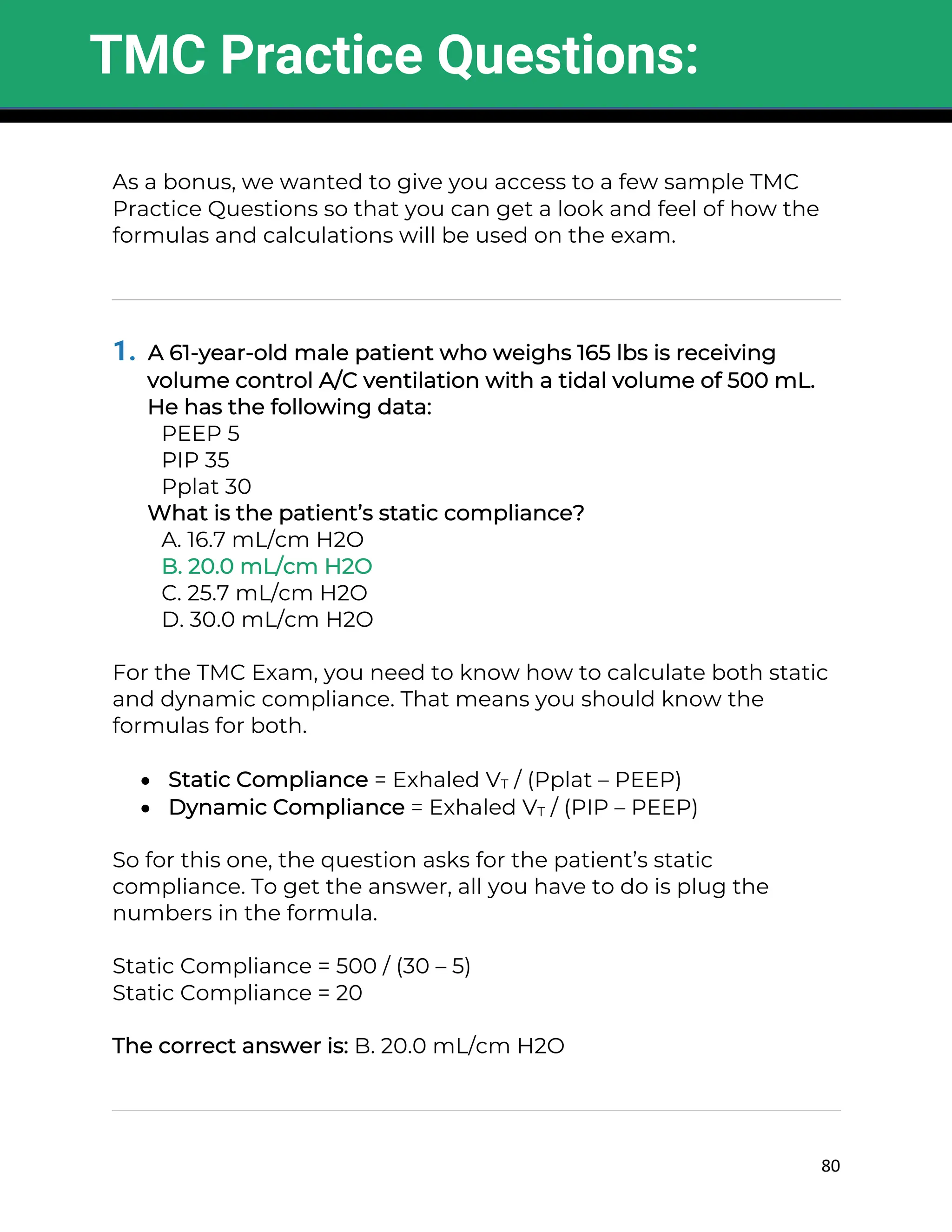
As a bonus, we wanted to give you access to a few sample TMC
Practice Questions so that you can get a look and feel of how the
formulas and calculations will be used on the exam.
1. A 61-year-old male patient who weighs 165 lbs is receiving
volume control A/C ventilation with a tidal volume of 500 mL.
He has the following data:
PEEP 5
PIP 35
Pplat 30
What is the patient’s static compliance?
A. 16.7 mL/cm H2O
B. 20.0 mL/cm H2O
C. 25.7 mL/cm H2O
D. 30.0 mL/cm H2O
For the TMC Exam, you need to know how to calculate both static
and dynamic compliance. That means you should know the
formulas for both.
• Static Compliance = Exhaled VT / (Pplat – PEEP)
• Dynamic Compliance = Exhaled VT / (PIP – PEEP)
So for this one, the question asks for the patient’s static
compliance. To get the answer, all you have to do is plug the
numbers in the formula.
Static Compliance = 500 / (30 – 5)
Static Compliance = 20
The correct answer is: B. 20.0 mL/cm H2O
TMC Practice Questions:
81
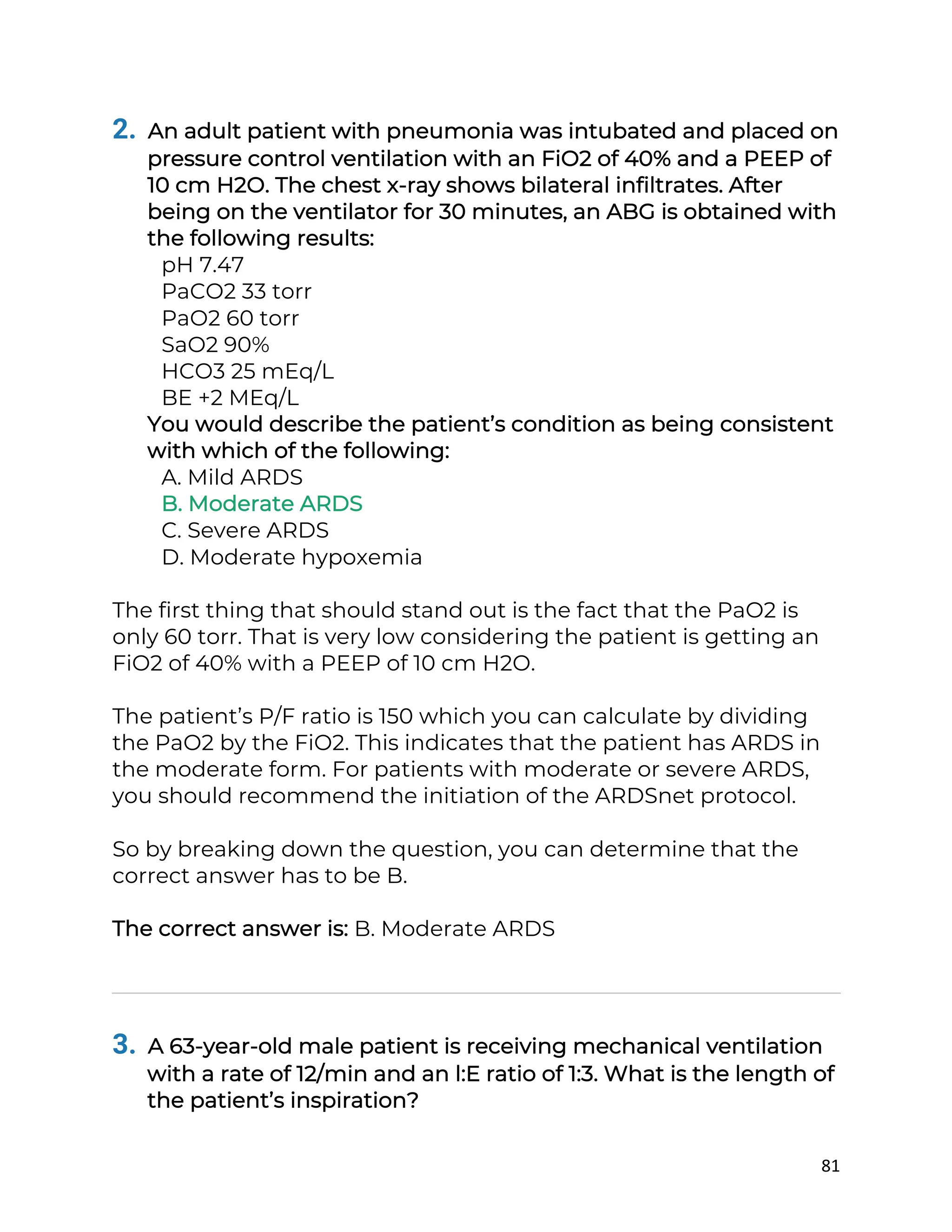
2. An adult patient with pneumonia was intubated and placed on
pressure control ventilation with an FiO2 of 40% and a PEEP of
10 cm H2O. The chest x-ray shows bilateral infiltrates. After
being on the ventilator for 30 minutes, an ABG is obtained with
the following results:
pH 7.47
PaCO2 33 torr
PaO2 60 torr
SaO2 90%
HCO3 25 mEq/L
BE +2 MEq/L
You would describe the patient’s condition as being consistent
with which of the following:
A. Mild ARDS
B. Moderate ARDS
C. Severe ARDS
D. Moderate hypoxemia
The first thing that should stand out is the fact that the PaO2 is
only 60 torr. That is very low considering the patient is getting an
FiO2 of 40% with a PEEP of 10 cm H2O.
The patient’s P/F ratio is 150 which you can calculate by dividing
the PaO2 by the FiO2. This indicates that the patient has ARDS in
the moderate form. For patients with moderate or severe ARDS,
you should recommend the initiation of the ARDSnet protocol.
So by breaking down the question, you can determine that the
correct answer has to be B.
The correct answer is: B. Moderate ARDS
3. A 63-year-old male patient is receiving mechanical ventilation
with a rate of 12/min and an l:E ratio of 1:3. What is the length of
the patient’s inspiration?
82
A. 1.0 second
B. 1.25 seconds
C. 1.5 seconds
D. 2.0 seconds
In order to get this one correct, you needed to know how to
calculate inspiratory time.
The first step is to calculate the total cycle time by simply dividing
the 60 seconds by the rate.
60/12 = 5 seconds
Next, determine how much of the inspiratory time takes of the
total cycle time.
[1/(1+3) x 100] = 25%
Then, 25% of 5 seconds = 1.25 seconds.
The correct answer is: B. 1.25 seconds
Well, How’d You Do?
These were just a few examples to give you an idea of some of the
types of questions that you may see on the TMC Exam.
Most importantly, when it comes to Formulas and Calculations,
don’t panic!
Sure, some of the calculations are difficult, but keep in mind that
they make up a very small percentage of the exam. So you will be
just fine.
83
If you want to learn more about our strategy regarding the
equations for the exam, be sure to check out our Hacking the TMC
Exam video course.
Also, as I mentioned earlier, the more repetitions, the better. So be
sure to keep practicing with as many TMC Practice Questions as
possible. The practice questions that we provided for you here
were actually taken straight from our TMC Test Bank.
It’s one of our bestselling products where we break down
hundreds of practice questions that cover every topic you need to
know for the TMC Exam.
Each question comes with a detailed rationale that explains
exactly why the answer is correct. Thousands of students have
already used it to pass the TMC Exam.
Are you next?
If you thought the practice questions above were helpful,
definitely consider checking it out.
Click Here to Learn More
84
One More Thing!
Before you go, I just wanted to remind you about our Practice
Questions Pro membership.
As you can most likely already tell, our practice questions are
loaded with helpful tidbits of information that can help you
prepare for (and) pass the TMC Exam.
Now, you can get these TMC Practice Questions sent to your inbox
on a daily basis.
And the more practice questions you see, the better.
This way, over time, you can master every single topic that you
need to know to increase your chances of passing the exam on
your first (or next) attempt.
For many students, it’s very convenient to wake up each day and
have a new TMC Practice Question in the inbox waiting for you.
If this is something that sounds interesting to you, definitely
consider signing up.
Click Here to Get Daily Practice Questions via Email
85
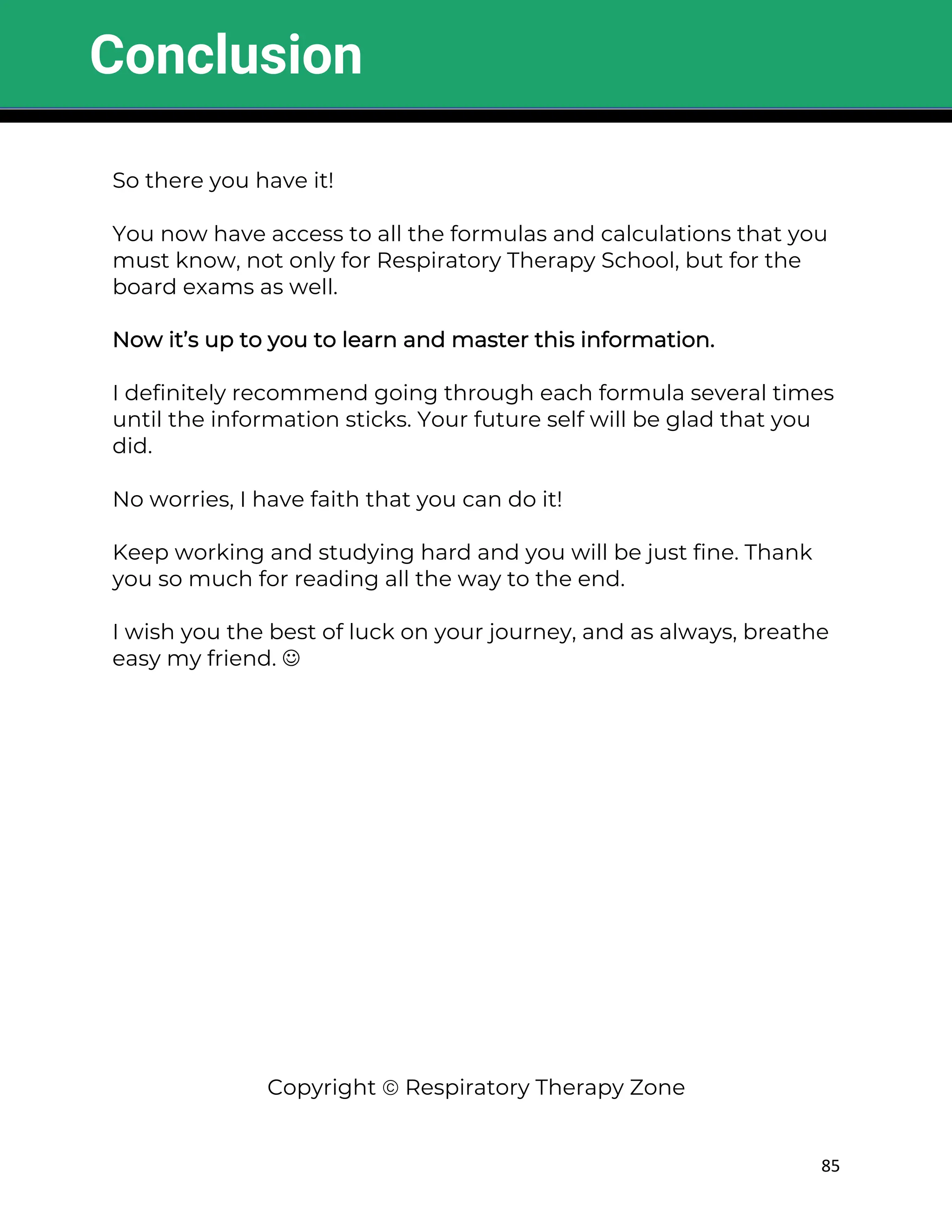
So there you have it!
You now have access to all the formulas and calculations that you
must know, not only for Respiratory Therapy School, but for the
board exams as well.
Now it’s up to you to learn and master this information.
I definitely recommend going through each formula several times
until the information sticks. Your future self will be glad that you
did.
No worries, I have faith that you can do it!
Keep working and studying hard and you will be just fine. Thank
you so much for reading all the way to the end.
I wish you the best of luck on your journey, and as always, breathe
easy my friend. J
Copyright ã Respiratory Therapy Zone
Conclusion
86
1. AARC Clinical Practice Guidelines, (2002-2019) Respirator Care.
www.aarc.org.
2. Egan’s Fundamentals of Respiratory Care. (2010) 11th Edition.
Kacmarek, RM, Stoller, JK, Heur, AH. Elsevier.
3. Mosby’s Respiratory Care Equipment. Cairo, JM. (2014) 9th
Edition. Elsevier.
4. Pilbeam’s Mechanical Ventilation. (2012) Cairo, JM. Physiological
and Clinical Applications. 5th Edition. Saunders, Elsevier.
5. Ruppel’s Manual of Pulmonary Function Testing. (2013) Mottram,
C. 10th Edition. Elsevier.
6. Rau’s Respiratory Care Pharmacology. (2012) Gardenhire, DS. 8th
Edition. Elsevier.
7. Perinatal and Pediatric Respiratory Care. (2010) Walsh, BK,
Czervinske, MP, DiBlasi, RM. 3rd Edition. Saunders.
8. Wilkins’ Clinical Assessment in Respiratory Care (2013) Heuer, Al.
7th Edition. Saunders. Elsevier.
9. Clinical Manifestations and Assessment of Respiratory Disease.
(2010) Des Jardins, T, & Burton, GG. 6th edition. Elsevier.
10. Neonatal and Pediatric Respiratory Care. (2014) Walsh, Brian K.
4th edition. RRT. Elsevier.
11. Clinical Application of Mechanical Ventilation (2013) Chang,
David W. 4th edition. Cengage Learning.
References

FormulasCalculationsCheatSheetRespiratoryTherapy.pdf

  • 2.
    2 Disclaimer: Medicine and respiratorytherapy are continuously changing practices. The author and publisher have reviewed all information in this report with resources believed to be reliable and accurate and have made every effort to provide information that is up to date with the best practices at the time of publication. Despite our best efforts we cannot disregard the possibility of human error and continual changes in best practices the author, publisher, and any other party involved in the production of this work can warrant that the information contained herein is complete or fully accurate. The author, publisher, and all other parties involved in this work disclaim all responsibility from any errors contained within this work and from the results from the use of this information. Readers are encouraged to check all information in this publication with institutional guidelines, other sources, and up to date information. Respiratory Therapy Zone is not affiliated with the NBRC® , AARC® , or any other group at the time of this publication. Copyright ã Respiratory Therapy Zone
  • 3.
    3 Table of Contents Introduction……………………………………………………………..…………………………………...……..4 Formulas ……………………………………………………………..………………………………..………...……..5 Calculations ……………………………………………………………..………………………………....………..11 Practice Questions ………………………………………….………………………………….…….……..73 TMC Practice Questions …………………………………….……………………..………..….……..80 Conclusion …………………………………………………………..…..……..…………………………...……..85 References …………………………………………………….….……..………..………………………...……..86 Copyright ã Respiratory Therapy Zone
  • 4.
    4 Are you readyto learn about the Respiratory Therapy Formulas, Calculations, and Equations? I sure hope so because that is what this guide is all about. Inside of this book, we’ve created an all-in-one stop that you can use as a reference for each and every formula that you’ll see as a Respiratory Therapy Student. Some are hard. Some are easy. But the good news is, I have faith that you can master them all if you set your mind to it. Practice (and lots of repetitions) makes perfect. So the more time you spend going through these formulas, the more likely it is that you’ll actually learn and memorize this information. And as you’ll see, we’ve even included some practice questions that can provide additional help as well. So if you’re ready, let’s go ahead and dive right in. J Copyright ã Respiratory Therapy Zone Note: In general, the formulas and calculations may vary from publication to publication. With that said, we’ve attempted to provide the ones that will be most helpful for the Respiratory Therapy Board Exams. Introduction
  • 5.
    5 First and foremost,before we get into the calculations, let’s first learn the formulas. These are the formulas and equations that you will be required to learn in Respiratory Therapy School. Minute Ventilation (VE) VE = Respiratory Rate x Tidal Volume Alveolar Minute Ventilation (VA) VA = (Tidal Volume – Deadspace) x Respiratory Rate Airway Resistance (Raw) Raw = (PIP – Plateau pressure) / Flow Mean Airway Pressure (Paw) Paw = ((Inspiratory Time x Frequency) / 60) x (PIP – PEEP) +PEEP Work of Breathing (WOB) WOB = Change in Pressure x Change in Volume Alveolar-Arterial Oxygen Tension Gradient (P(A-a)O2) P(A-a)O2 = PAO2 – PaO2 Alveolar Oxygen Tension (PAO2) PAO2 = (PB – PH2O) x FiO2 – (PaCO2 / 0.8) Arterial/Alveolar Oxygen Tension (a/A) Ratio (a/A) Ratio = PaO2/PAO2 Arterial Oxygen Content (CaO2) CaO2 = (Hb x 1.34 x SaO2) + (PaO2 x 0.003) End-Capillary Oxygen Content (CcO2) Respiratory Therapy Formulas
  • 6.
    6 CcO2 = (Hbx 1.34 x SaO2) + (PAO2 x 0.003) Mixed Venous Oxygen Content (CvO2) CvO2 = (Hb x 1.34 x SvO2) + (PvO2 x 0.003) Shunt Equation (QS/QT) QS/QT = (CcO2 – CaO2) / (CcO2 – CvO2) Modified Shunt Equation (QS/QT) QS/QT = ((PAO2 – PaO2) x 0.003) / ((CaO2 – CvO2) + (PAO2 – PaO2) x 0.003) Arterial-Mixed Venous Oxygen Content Difference (C(a-v)O2) C(a-v)O2 = CaO2 – CvO2 Oxygen-to-Air Entrainment Ratio (O2:Air) O2:Air = 1 : (100 – FiO2) / (FiO2 – 2) Arterial Oxygen Saturation Estimation (SaO2) SaO2 = PaO2 + 30 PaO2/FiO2 Ratio (P/F Ratio) P/F Ratio = PaO2 / FiO2 Oxygenation Index (OI) OI = ((Paw x FiO2) / PaO2) x 100 Oxygen Consumption (VO2) VO2 = Cardiac Output x C(a-v)O2 Oxygen Extraction Ratio (O2ER) O2ER = (CaO2 – CvO2) / CaO2 FiO2 Estimation for Nasal Cannula FiO2 = 20 + (4 x Liter Flow)
  • 7.
    7 Oxygen Cylinder Duration Duration= (Gauge Pressure x Tank Factor) / Liter Flow Liquid Oxygen System Duration Duration = (344 x Liquid Weight) / Flow Cardiac Index (CI) CI = Cardiac Output / Body Surface Area Cardiac Output (QT) QT = Heart Rate x Stroke Volume Cardiac Output (CO) Fick’s Method CO = (O2 Consumption / CaO2 – CvO2) Cerebral Perfusion Pressure (CPP) CPP = Mean Arterial Pressure – Intracranial Pressure Mean Arterial Pressure (MAP) MAP = (Systolic BP + (2 x Diastolic BP)) / 3 Stroke Volume (SV) SV = Cardiac Output / Heart Rate Maximum Heart Rate (HRmax) HRmax = 220 – Age Heart Rate on an EKG Strip (HR) HR = 300 / # of large boxes between R waves Respiratory Quotient (RQ) RQ = VCO2 / VO2 Systemic Vascular Resistance (SVR) SVR = (MAP – CVP) x (80 / Cardiac Output)
  • 8.
    8 Pulmonary Vascular Resistance(PVR) PVR = (MPAP – PCWP) x (80 / Cardiac Output) Static Compliance (Cst) Cst = Tidal Volume / (Plateau Pressure – PEEP) Dynamic Compliance (Cdyn) Cdyn = Tidal Volume / (Peak Pressure – PEEP) Deadspace to Tidal Volume Ratio (VD/VT) (VD/VT) = (PaCO2 – PECO2) / PaCO2 Children Dosage Estimation Child Dose = (Age / Age + 12) x Adult Dose Infant Dosage Estimation Infant Dose = (Age in Months / 150) x Adult Dose Anion Gap Anion gap = Na+ – (Cl- + HCO3- ) Body Surface Area (BSA) BSA = ((4 x Body Weight) + 7) / (Body Weight + 90) Elastance Elastance = Change in Pressure / Change in Volume Smoking Use Calculation (Pack Years) Pack Years = (Packs Smoked per Day) x (Number of Years Smoked) Suction Catheter Size Estimation Catheter Size = (Internal Diameter / 2) x 3 Endotracheal Tube Size Estimation in Children Tube Size = (Age + 16) / 4
  • 9.
    9 Boyle’s Law P1 xV1 = P2 x V2 Charles’ Law V1 / T1 = V2 / T2 Gay-Lussac’s Law P1/T1 = P2/T2 LaPlace’s Law P = (2 x Surface Tension) / Radius Celsius to Fahrenheit Temperature Conversion ˚F = (˚C x 1.8) + 32 Fahrenheit Celsius Temperature Conversion ˚C = (˚F – 32) x 1.8 Celsius to Kelvins Temperature Conversion K = ˚C + 273 Helium/Oxygen Conversion (He/O2) Actual Flow = Given Flow Rate x Factor Total Lung Capacity (TLC) TLC = IRV + VT + ERV + RV TLC = VC + RV TLC = IC + FRC Vital Capacity (VC) VC = IRV + VT + ERV VC = IC + ERV VC = TLC – RV Inspiratory Capacity (IC)
  • 10.
    10 IC = IRV+ VT IC = TLC – FRC IC = VC – ERV Functional Residual Capacity (FRC) FRC = ERV + RV FRC = TLC – IC Time Constant (t) t = Compliance x Resistance Ideal Body Weight (IBW) IBW = 50 kg + (2 x Number of Inches over 5 feet) Tidal Volume (VT) VT = Flow Rate x Inspiratory Time Exhaled Tidal Volume (VT) VT = Minute Ventilation / Frequency Corrected Tidal Volume (VT) VT = Expired Tidal Volume – Tube Volume Pressure Support Ventilator Setting (PSV) PSV = ((Peak Pressure – Plateau Pressure) / Set Flow) x Peak Flow Rapid Shallow Breathing Index (RSBI) RSBI = Rate / Tidal Volume Endotracheal Tube Size Estimation in Children Tube Size = (Age + 16) / 4 Minimum Flow Rate in Mechanical Ventilation Flow Rate = Minute Ventilation x I:E Ratio Sum of Parts
  • 11.
    11 Now that youknow the formulas, that means it’s time for us to put them to use. In this section, we’re going to walk you through an example problem for each of the equations that you need to know as a Respiratory Therapy Student. For these practice problems, as long as you know the formula, the math is very simple. All you have to do is just plug the numbers in. So if you’re ready, let’s go ahead and get started. J Respiratory Calculations
  • 12.
    12 Minute Ventilation (VE) Apatient has the following bedside spirometry results: • Respiratory Rate = 12 • Tidal volume = 450 mL • Dead Space = 147 mL • Vital Capacity = 1.2 L Based on this data, what is the patient’s minute ventilation? VE = 12 x 450 VE = 5,400 mL/min Divide by 1,000 to convert mL to L. VE = 5.4 L/min Formula: VE = Respiratory Rate x Tidal Volume
  • 13.
    13 Alveolar Minute Ventilation(VA) A patient has the following bedside spirometry results: • Rate = 12 • Tidal Volume = 450 mL • Dead Space = 147 mL • Vital Capacity = 1.2 L Based on this data, what is the patient’s minute ventilation? VA = (Tidal Volume – Deadspace) x Respiratory Rate VA = (450 – 147) x 12 VA = 3,636 mL/min Divide by 1,000 to convert mL to L. VA = 3.6 L/min Formula: VA = (Tidal Volume – Deadspace) x Respiratory Rate
  • 14.
    14 Airway Resistance (Raw) Anadult patient that is receiving mechanical ventilation has a PIP of 30 cm H2O and a plateau pressure of 10 cm H2O with a set flow rate of 60 L/min. What is the airway resistance? Raw = (PIP – Plateau pressure) / Flow Raw = (30 – 10) / 1 Raw = 20 cm H2O/L/sec Formula: Raw = (PIP – Plateau pressure) / Flow
  • 15.
    15 Mean Airway Pressure(Paw) The following data was obtained on a 63-year-old female patient who is receiving ventilatory support: • Rate = 12/min • Tidal Volume = 450 mL • Inspiratory Time = 1.3 seconds • PIP = 25 • PEEP = 5 Calculate the mean airway pressure: Paw = ((1.3 x 12) / 60) x (25 – 5) + 5 Paw = ((15.6) / 60) x (25 – 5) + 5 Paw = 0.26 x (25 – 5) + 5 Paw = 5.2 + 5 Paw = 10.2 cmH2O Formula: Paw = ((Inspiratory Time x Frequency) / 60) x (PIP – PEEP) +PEEP
  • 16.
    16 Work of Breathing(WOB) An adult patient is intubated and receiving mechanical ventilation. Given the following data, calculate the work of breathing: • ∆P = 6.9 cmH2O • ∆V = 0.8 L WOB = 6.9 x 0.8 WOB = 5.5 cmH2O/L Formula: WOB = Change in Pressure x Change in Volume
  • 17.
    17 Alveolar-Arterial Oxygen TensionGradient (P(A- a)O2) The following data was obtained on an adult patient: • PaO2 = 87 mmHg • PAO2 = 107 mmHg What is the alveolar-arterial oxygen tension gradient? P(A-a)O2 = 107 – 87 P(A-a)O2 = 20 mmHg Formula: P(A-a)O2 = PAO2 – PaO2
  • 18.
    18 Alveolar Oxygen Tension(PAO2) The following data was obtained on an adult patient: • FiO2 = 50% • PaCO2 = 35 mmHg • PB = 760 mmHg • PH2O = 47 mmHg What is the PAO2? PAO2 = (760 – 47) x 0.40 – (35 / 0.8) PAO2 = (713 x 0.40) – 43.75 PAO2 = 241.5 mmHg Formula: PAO2 = (PB – PH2O) x FiO2 – (PaCO2 / 0.8)
  • 19.
    19 Arterial/Alveolar Oxygen Tension(a/A) Ratio A patient has a PaO2 of 108 mmHg and a PAO2 of 300 mmHg. What is the arterial/alveolar oxygen tension ratio? (a/A) Ratio = 108 / 300 (a/A) Ratio = 0.36 mmHg (a/A) Ratio = 35% Formula: (a/A) Ratio = PaO2/PAO2
  • 20.
    20 Arterial Oxygen Content(CaO2) An adult patient has a PaO2 of 95 mmHg, an oxygen saturation of 96%, and a hemoglobin of 13 g/dL. What is the arterial oxygen content? CaO2 = (13 x 1.34 x 0.96) + (95 x 0.003) CaO2 = 16.72 + 0.285 CaO2 = 17 vol% Formula: CaO2 = (Hb x 1.34 x SaO2) + (PaO2 x 0.003)
  • 21.
    21 End-Capillary Oxygen Content(CcO2) An adult patient has a PAO2 of 88 mm Hg, an oxygen saturation of 94%, and a hemoglobin of 16 g/dL. What is the end-capillary oxygen content? CcO2 = (16 x 1.34 x 0.94) + (88 x 0.003) CcO2 = 20.15 + 0.264 CcO2 = 20.4 vol% Formula: CcO2 = (Hb x 1.34 x SaO2) + (PAO2 x 0.003)
  • 22.
    22 Mixed Venous OxygenContent (CvO2) An adult patient has a PvO2 of 38 mm Hg, a mixed venous saturation of 74%, and a hemoglobin of 14 g/dL. What is the mixed venous oxygen content? CvO2 = (14 x 1.34 x 0.74) + (38 x 0.003) CvO2 = 13.88 + 0.114 CvO2 = 14 vol% Formula: CvO2 = (Hb x 1.34 x SvO2) + (PvO2 x 0.003)
  • 23.
    23 Shunt Equation (QS/QT) Thefollowing data was provided for an adult patient: • CcO2 = 20.8 vol% • CaO2 = 19.3 vol% • CvO2 = 13.9 vol% Calculate the physiologic shunt percentage for this patient. QS/QT = (20.8 – 19.3) / (20.8 – 13.9) QS/QT = 1.5 / 6.9 QS/QT = 0.22 Multiply by 100 to convert to a percentage. QS/QT = 22 % Formula: QS/QT = (CcO2 – CaO2) / (CcO2 – CvO2)
  • 24.
    24 Modified Shunt Equation(QS/QT) The following data was provided for an adult patient: • PaO2 = 155 mmHg • PAO2 = 650 mmHg • CaO2 = 19.9 vol% • CvO2 = 13.2 vol% Calculate the shunt percentage for this patient. QS/QT = ((650 – 155) x 0.003)) / ((19.9 – 13.2) + (650 – 155) x 0.003) QS/QT = 1.49 / 6.7 + 495 x 0.003 QS/QT = 1.49 / 8.19 QS/QT = 0.18 Multiply by 100 to convert to a percentage. QS/QT = 18% Formula: QS/QT = ((PAO2 – PaO2) x 0.003) / ((CaO2 – CvO2) + (PAO2 – PaO2) x 0.003)
  • 25.
    25 Arterial-Mixed Venous OxygenContent Difference (C(a-v)O2) An adult patient in the ICU has a CaO2 of 19.2 vol% and a CvO2 of 14.7 vol%. Calculate the Arterial-Mixed Venous Oxygen Content Difference: C(a-v)O2 = 19.2 – 14.7 C(a-v)O2 = 4.5 vol% Formula: C(a-v)O2 = CaO2 – CvO2
  • 26.
    26 Oxygen-to-Air Entrainment Ratio(O2:Air) What is the air-to-oxygen entrainment ratio of 60%? O2:Air = 1 : (100 – 60) / (60 – 2) O2:Air = 1 : (40 / 58) O2:Air = 1 : 0.7 Formula: O2:Air = 1 : (100 – FiO2) / (FiO2 – 2)
  • 27.
    27 Arterial Oxygen SaturationEstimation (SaO2) An adult patient has a PaO2 of 63 mmHg. What is the estimated SaO2? Estimated SaO2 = 63 + 30 Estimated SaO2 = 93 mmHg Formula: SaO2 = PaO2 + 30
  • 28.
    28 PaO2/FiO2 Ratio (P/FRatio) An adult patient who is receiving oxygen at an FiO2 of 40% has a PaO2 of 88 mmHg. What is the PaO2/FiO2 ratio? P/F Ratio = 88 / 0.4 P/F Ratio = 220 mmHg Formula: P/F Ratio = PaO2 / FiO2
  • 29.
    29 Oxygenation Index (OI) Thefollowing data was obtained on an adult patient: • FiO2 = 40% • PaO2 = 80 mmHg • Mean Airway Pressure = 9.8 cmH2O What is the oxygenation index? OI = ((9.8 x 0.4) / 80) x 100 OI = (3.92 / 80) x 100 OI = 0.049 x 100 OI = 4.9 Formula: OI = ((Paw x FiO2) / PaO2) x 100
  • 30.
    30 Oxygen Consumption (VO2) Whatis the total oxygen consumption of an adult patient with the following data: • Cardiac Output = 6.2 L/min • C(a-v)O2 = 5 vol% VO2 = 6.2 x 0.05 VO2 = 0.31 L/min Multiply by 1,000 to convert mL to L. VO2 = 310 mL/min Formula: VO2 = Cardiac Output x C(a-v)O2
  • 31.
    31 Oxygen Extraction Ratio(O2ER) An adult patient has an arterial oxygen content of 18 vol% and a mixed venous oxygen content of 13 vol% . What is the oxygen extraction ratio? O2ER = (18 – 13) / 18 O2ER = 0.2778 O2ER = 27.8 vol% Formula: O2ER = (CaO2 – CvO2) / CaO2
  • 32.
    32 FiO2 Estimation forNasal Cannula An adult patient receiving oxygen therapy via nasal cannula at 4 L/min. What is the estimated FiO2? FiO2 = 20 + (4 x 4) FiO2 = 20 + 16 FiO2 = 36% Formula: FiO2 = 20 + (4 x Liter Flow)
  • 33.
    33 Oxygen Cylinder Duration Apatient is receiving oxygen via nasal cannula at 2 L/min from a size E tank with 2,200 psig. How long will the tank deliver oxygen? Everything you need to perform the calculation is given in the question except for the tank factors. Cylinder Tank Factors: • D Cylinder = 0.16 • E Cylinder = 0.28 • G Cylinder = 2.41 • H Cylinder = 3.14 • M Cylinder = 1.56 For this question, the patient is using an E cylinder which means that you will use a tank factor of 0.28 for the equation. Now all you have to do is plug the numbers in. Duration = (2,200 x 0.28) / 2 Duration = 616 / 2 Duration = 308 minutes Divide by 60 to convert minutes to hours. Duration = 5 hours and 8 minutes Formula: Duration = (Gauge Pressure x Tank Factor) / Liter Flow
  • 34.
    34 Liquid Oxygen SystemDuration A liquid oxygen system with a weight of 3 lbs is being used and the patient is receiving oxygen via nasal cannula with a flow of 2 L/min. How long will the liquid oxygen system last? Duration = (344 x 3) / 2 Duration = 1,032 / 2 Duration = 516 minutes Divide by 60 to convert minutes to hours. Duration = 8 hours and 36 minutes Formula: Duration = (344 x Liquid Weight) / Flow
  • 35.
    35 Cardiac Index (CI) A59-year-old female patient has a cardiac output of 5 L/min and a body surface area of 2.7 m2 . What is the cardiac index? CI = 5 / 2.7 CI = 1.85 L/min/m2 Formula: CI = Cardiac Output / Body Surface Area
  • 36.
    36 Cardiac Output (QT) A57-year-old male patient has a heart rate of 94 beats/min and a stroke volume of 44 mL/beat. What is the cardiac outlook? QT = 94 x 44 QT = 4,136 mL/min QT = 4.1 L/min Formula: QT = Heart Rate x Stroke Volume
  • 37.
    37 Cardiac Output (CO)Fick’s Method The following data was obtained on an adult patient: • Body Surface Area = 1.7 m2 • CaO2 = 21 vol% • CvO2 = 16 vol% Calculate the cardiac output using Fick’s method: First, you need to calculate the O2 Consumption multiply the Body Surface Area by 130. O2 Consumption = 130 x 1.7 O2 Consumption = 221 Now, just plug the rest of the numbers into the formula. CO = (221 / 21 – 16) CO = (221 / 0.05) CO = 4,420 mL/min Divide by 1,000 to convert mL to L. CO = 4.42 L/min Formula: CO = (O2 Consumption / CaO2 – CvO2)
  • 38.
    38 Cerebral Perfusion Pressure(CPP) An adult patient has an MAP of 88 mmHg and an ICP of 15 mmHg. Calculate the cerebral perfusion pressure: CPP = 88 mmHg – 15 mmHg CPP = 73 mmHg Formula: CPP = Mean Arterial Pressure – Intracranial Pressure
  • 39.
    39 Mean Arterial Pressure(MAP) An adult patient has a blood pressure measurement of 130/90 mmHg. What is the mean arterial pressure? MAP = (130 + (2 x 90)) / 3 MAP = 310 / 3 MAP = 103.3 mmHg Formula: MAP = (Systolic BP + (2 x Diastolic BP)) / 3
  • 40.
    40 Stroke Volume (SV) A58-year-old female patient has a heart rate of 92/min and a cardiac output of 6 L/min. What is her stroke volume? SV = 6 / 92 SV = 0.065 L Multiply by 1,000 to convert to mL. SV = 65 mL Formula: SV = Cardiac Output / Heart Rate
  • 41.
    41 Maximum Heart Rate(HRmax) What is the maximum heart rate of a 44-year-old female patient? HRmax = 220 – 44 HRmax = 176 beats/min Formula: HRmax = 220 – Age
  • 42.
    42 Heart Rate onan EKG Strip (HR) An adult patient has the following EKG strip: What is the patient’s heart rate? There are 3 large boxes between the R waves on the EKG strip. HR = 300 / 3 HR = 100 beats/min Formula: HR = 300 / # of large boxes between R waves
  • 43.
    43 Systemic Vascular Resistance(SVR) An adult patient has the following measurements: • Cardiac Output = 4.0 L/min • Central Venous Pressure = 9 mmHg • Mean Arterial Pressure = 75 mmHg What is the calculated Systemic Vascular Resistance? SVR = (75 – 9) x (80 / 4) SVR = 66 x 20 SVR = 1,320 dynes/sec/cm5 Formula: SVR = (MAP – CVP) x (80 / Cardiac Output)
  • 44.
    44 Pulmonary Vascular Resistance(PVR) An adult patient has the following measurements: • Cardiac Output = 5.0 L/min • Mean Pulmonary Artery Pressure = 23 mmHg • Pulmonary Capillary Wedge Pressure = 7 mmHg What is the calculated Pulmonary Vascular Resistance? PVR = (23 – 7) x (80 / 5) PVR = 16 x 16 PVR = 256 dynes/sec/cm5 Formula: PVR = (MPAP – PCWP) x (80 / Cardiac Output)
  • 45.
    45 Static Compliance (Cst) Anadult patient who is receiving mechanical ventilation has a tidal volume of 450 mL, peak pressure of 30 cmH2O, plateau pressure of 22 cmH2O, and a PEEP of 5. What is the static compliance? Cst = 450 / (22 – 5) Cst = 26.5 mL/cmH2O Formula: Cst = Tidal Volume / (Plateau Pressure – PEEP)
  • 46.
    46 Dynamic Compliance (Cdyn) Anadult patient who is receiving mechanical ventilation has a tidal volume of 450 mL, peak pressure of 30 cmH2O, plateau pressure of 22 cmH2O, and a PEEP of 5. What is the static compliance? Cdyn = 450 / (30 – 5) Cdyn = 18 mL/cmH2O Formula: Cdyn = Tidal Volume / (Peak Pressure – PEEP)
  • 47.
    47 Deadspace to TidalVolume Ratio (VD/VT) An adult patient has a PaCO2 of 44 mmHg and a PECO2 of 34 mmHg. What is the deadspace to tidal volume ratio? (VD/VT) = (44 – 34) / 44 (VD/VT) = 10 / 44 (VD/VT) = 23% Formula: (VD/VT) = (PaCO2 – PECO2) / PaCO2
  • 48.
    48 Children Dosage Estimation Whatwould be to appropriate dose for a 9-year-old boy when the adult dose is 44 mg? Child Dose = (9 / (9 + 12)) x 44 Child Dose = (9 / (9 + 12)) x 44 Child Dose = 0.429 x 44 Child Dose = 18.9 mg Formula: Child Dose = (Age / Age + 12) x Adult Dose
  • 49.
    49 Infant Dosage Estimation Whatwould be to appropriate dose for a 13-month-old infant when the adult dose is 37 mg? Infant Dose = (13 / 150) x 37 Infant Dose = 0.087 x 37 Infant Dose = 3.2 mg Formula: Infant Dose = (Age in Months / 150) x Adult Dose
  • 50.
    50 Anion Gap A patienthas the following data: • Na+ = 144 mEq/L • Cl- = 104 mEq/L • HCO3 = 24 mEq/L Calculate the anion gap: Anion Gap = 144 – (104 + 24) Anion Gap = 16 mEq/L Formula: Anion Gap = Na+ – (Cl- + HCO3- )
  • 51.
    51 Body Surface Area(BSA) What is the body surface areas of an adult female patient who weighs 153 lbs? First, you must convert pounds to kilograms. 153 lbs / 2.2 = 69.5 kg BSA = ((4 x 69.5) + 7) / (69.5 + 90) BSA = 1.74 m2 Formula: BSA = ((4 x Body Weight) + 7) / (Body Weight + 90)
  • 52.
    52 Elastance An adult patientis intubated and receiving mechanical ventilation. Given the following data, calculate the elastance: • ∆P = 6 cmH2O • ∆V = 0.7 L Elastance = 6 / 0.7 Elastance = 8.6 cmH2O/L Formula: Elastance = Change in Pressure / Change in Volume
  • 53.
    53 Smoking Use Calculation(Pack Years) A 54-year-old male patient has been smoking 2 packs of cigarettes per day for 27 years. Her smoking history would be recorded as: Pack Years = 2 x 27 Pack Years = 54 Formula: Pack Years = (Packs Smoked per Day) x (Number of Years Smoked)
  • 54.
    54 Suction Catheter SizeEstimation A 62-year-old male patient with retained secretions is intubated with a size 8 endotracheal tube. What size catheter would you recommend for suctioning this patient? Catheter Size = (8 / 2) x 3 Catheter Size = 12 Fr Formula: Catheter Size = (Internal Diameter / 2) x 3
  • 55.
    55 Endotracheal Tube SizeEstimation in Children Intubation is indicated for a 4-year-old child in the emergency department. What size tube would you select? Tube Size = (4 + 16) / 4 Tube Size = 5.0 mm Formula: Tube Size = (Age + 16) / 4
  • 56.
    56 Celsius to FahrenheitTemperature Conversion A temperature of 30 ˚C is what temperature in Fahrenheit? ˚F = (30 x 1.8) + 32 ˚F = 86 Formula: ˚F = (˚C x 1.8) + 32
  • 57.
    57 Fahrenheit Celsius TemperatureConversion A temperature of 69 ˚F is what temperature in Celsius? ˚C = (69 – 32) x 1.8 ˚C = 66.6 Formula: ˚C = (˚F – 32) x 1.8
  • 58.
    58 Celsius to KelvinsTemperature Conversion A temperature of 33 ˚C is what temperature in Kelvins? K = 33 + 273 K = 306 Formula: K = ˚C + 273
  • 59.
    59 Helium/Oxygen Conversion (He/O2) Apatient is receiving a 70%Helium/30%Oxygen is running that is running on a flow rate of 8 L/min. What is the actual flow rate of this He/O2 gas mixture? To complete this calculation, you must remember the Heliox factors: • 80/20% Mixture = 1.8 • 70/30% Mixture = 1.6 For this patient, the question tells you that they are receiving a 70/30% mixtures, which means that you must use 1.6 as the factor within the equation. Actual Flow = 8 x 1.6 Actual Flow = 12.8 L/min Formula: Actual Flow = Given Flow Rate x Factor
  • 60.
    60 Vital Capacity (VC) Afterperforming pulmonary function tests on an adult patient, the following results were obtained: • Tidal Volume = 600 mL • Inspiratory Reserve Volume = 3,000 mL • Expiratory Reserve Volume = 1,300 mL • Residual Volume = 1,100 mL • Vital Capacity = 4,900 mL What is the vital capacity? VC = 3,000 + 600 mL + 1,300 VC = 4,900 mL Formulas: VC = IRV + VT + ERV VC = IC + ERV VC = TLC – RV
  • 61.
    61 Inspiratory Capacity (IC) Afterperforming pulmonary function tests on an adult patient, the following results were obtained: • Tidal Volume = 600 mL • Inspiratory Reserve Volume = 3,000 mL • Expiratory Reserve Volume = 1,300 mL • Residual Volume = 1,100 mL • Vital Capacity = 4,900 mL What is the inspiratory capacity? IC = 3,000 + 600 IC = 3,600 mL Formulas: IC = IRV + VT IC = TLC – FRC IC = VC – ERV
  • 62.
    62 Functional Residual Capacity(FRC) After performing pulmonary function tests on an adult patient, the following results were obtained: • Tidal Volume = 600 mL • Inspiratory Reserve Volume = 3,000 mL • Expiratory Reserve Volume = 1,300 mL • Residual Volume = 1,100 mL • Vital Capacity = 4,900 mL What is the functional residual capacity? FRC = 1,300 + 1,100 FRC = 3,300 mL Formulas: FRC = ERV + RV FRC = TLC – IC
  • 63.
    63 Total Lung Capacity(TLC) After performing pulmonary function tests on an adult patient, the following results were obtained: • Tidal Volume = 600 mL • Inspiratory Reserve Volume = 3,000 mL • Expiratory Reserve Volume = 1,300 mL • Residual Volume = 1,100 mL • Vital Capacity = 4,900 mL What is the total lung capacity? TLC = 3,000 + 600 + 1,300 + 1,100 TLC = 6,000 mL Formulas: TLC = IRV + VT + ERV + RV TLC = VC + RV TLC = IC + FRC
  • 64.
    64 Time Constant (t) A63-year-old male patient who is receiving ventilatory support has a compliance of 0.09 L/cmH2O and a total resistance of 4 cmH2O/L/sec. Calculate the time constant: t = 0.09 x 4 t = 0.36 seconds Formula: t = Compliance x Resistance
  • 65.
    65 Ideal Body Weight(IBW) A 61-year-old female patient is receiving positive pressure ventilatory support. The patient’s height is 5’7”. What is her ideal body weight? IBW = 50 + (2 x 7) IBW = 50 + 14 IBW = 64 kg Formula: IBW = 50 kg + (2 x Number of Inches over 5 feet)
  • 66.
    66 Tidal Volume (VT) Anadult patient who is intubated and receiving ventilatory support has a flow rate of 7 L/min and an inspiratory time of 0.7 seconds. What is the tidal volume? First, you need to convert the flow rate from L/min to mL/sec. 7 L/min = 7,000 mL/60 seconds 7,000 / 60 = 116.7 mL/sec Now just plug the numbers in. VT = 116.7 x 0.7 VT = 8.2 mL Formula: VT = Flow Rate x Inspiratory Time
  • 67.
    67 Exhaled Tidal Volume(VT) An adult patient who is receiving mechanical ventilation displays the following data: • Rate = 12/min • Minute Ventilation = 7.2 L/min What is the exhaled tidal volume? VT = 7.2 / 12 VT = 0.6 L Multiply by 1,000 to convert L to mL. VT = 600 mL Formula: VT = Minute Ventilation / Frequency
  • 68.
    68 Corrected Tidal Volume(VT) The following data was obtained on an adult patient who is receiving mechanical ventilation: • Expired tidal volume = 600 mL • PIP = 30 cmH2O • PEEP 5 cmH2O • Tubing compression factor = 3 mL/cmH2O What is the corrected tidal volume? First, you need to calculate the tube volume. Tube Volume = Pressure Change x 3 mL/cmH2O Tube Volume = (30 – 5) x 3 Tube Volume = 75 mL VT = 600 – 75 VT = 525 mL Formula: VT = Expired Tidal Volume – Tube Volume
  • 69.
    69 Pressure Support VentilatorSetting (PSV) An intubated patient is receiving mechanical ventilation in the SIMV mode with the following settings: • VT = 400 mL • Rate = 12 breaths/min • PIP = 40 cm H2O • Pplat = 20 cm H2O • Inspiratory flow = 60 L/min or (1 L/sec) The patient is breathing spontaneously with a spontaneous rate of 12 breaths/min and a spontaneous peak inspiratory flow of 30 L/min (0.5 L/sec). What is the level of PSV that is needed to overcome the imposed work of breathing? PSV = ((Peak Pressure – Plateau Pressure) / Set Flow) x Peak Flow PSV = ((40 – 20) / 1) x 0.5 PSV = 10 cmH2O Formula: PSV = ((Peak Pressure – Plateau Pressure) / Set Flow) x Peak Flow
  • 70.
    70 Rapid Shallow BreathingIndex (RSBI) An adult patient who is on the ventilator has a rate of 16/min and a tidal volume of 500 mL. What is the rapid shallow breathing index? RSBI = 16 / 500 RSBI = 8,000 breaths/min/mL Divide by 100 to convert to breaths/min/L. RSBI = 80 breaths/min/L Formula: RSBI = Rate / Tidal Volume
  • 71.
    71 Endotracheal Tube SizeEstimation in Children A 6-year-old boy needs to be intubated in the emergency department. What size ET tube would you recommend? Tube Size = (6 + 16) / 4 Tube Size = 5.5 Always round up to the next biggest size. Tube Size = 6 mm Formula: Tube Size = (Age + 16) / 4
  • 72.
    72 Minimum Flow Ratein Mechanical Ventilation An adult patient is receiving mechanical ventilation with the following settings: • Tidal Volume = 550 mL • Rate = 12/min • I:E ratio = 1:3 What is the required minimum flow rate? First, you need to calculate the Minute Ventilation. VE = Rate x Tidal Volume VE = 12 x 550 mL VE = 6,600 mL You can convert mL to L by dividing by 1,000. VE = 6.6 L Now you can easily calculate the Minimum Flow Rate Minimum Flow Rate = 6.6 x (3 + 1) Minimum Flow Rate = 26.4 L/min Formula: Flow Rate = Minute Ventilation x I:E Ratio Sum of Parts
  • 73.
    73 In this section,we’ve provided some additional practice questions so that you can practice and test your knowledge. Going through practice questions is a helpful technique that you can use to truly learn and memorize all of the equations. J 1. What is the most important calculation for the TMC Exam? Ideal Body Weight (IBW) because it is needed to determine the patient’s initial tidal volume setting for mechanical ventilation. You will need to calculate a patient’s IBW multiple times on the TMC Exam. We break this down even further inside of our Hacking the TMC Exam video course. 2. A patient receiving mechanical ventilation has a PIP of 60 cmH2O and a plateau pressure of 45 cmH2O. The ventilator flow rate is set at 60 L/min. What is the patient’s airway resistance? 15 cm H2O/L/sec 3. What is the A-a gradient and why is its significant? The A-a gradient is the alveolar arterial oxygen gradient and represents the driving force of oxygen from the alveolar sac into the artery. 4. What is the normal value of the A-a gradient? The A-a gradient is normally around 10 mmHg. 5. After obtaining a patient's PFT results, they have a VC of 3.4, FRC of 5.8, and an ERV of 1.2. What is the patient's TLC? 8.0 More Practice Questions:
  • 74.
    74 6. The physicianhas requested the dynamic compliance measurement for an adult patient who is receiving mechanical ventilation. This value can be obtained by dividing the patient’s tidal volume by what? (PIP – PEEP) 7. The doctor has requested the static compliance measurement for an adult patient who is receiving mechanical ventilation. This value can be obtained by dividing the patient’s tidal volume by what? (Pplat – PEEP) 8. What is a normal carbon dioxide production? 200 mL/min 9. What is the formula for alveolar partial pressure of carbon dioxide (PACO2)? PACO2 = VCO2 X 0.863 / VA 10. What is the formula for Deadspace/Tidal Volume Ratio? VD/VT = (PaCO2 – PeCO2) / PaCO2 11. What is the patient’s VD/VT if their PaCO2 is 40 mmHg with a mixed expired CO2 of 28 mm Hg? 0.3 12. What is the patient’s VD/VT if their PaCO2 is 58 mmHg with a mixed expired CO2 of 32 mmHg? 0.45 13. What is the formula for Boyle’s Law? P1 x V1 = P2 x V2 14. What is the formula for Charles law? V1 / T1 = V2 / T2
  • 75.
    75 15. What isthe formula for Combined Gas law? (P1 x V1 ) / T1 = (P2 x V2 ) / T2 16. An H cylinder is half full (full = 2200) and the patient is receiving oxygen via nasal cannula at 3 L/min. How long will the cylinder last in minutes and in hours? 1151 minutes and 19.18 hours 17. An E cylinder is at 1400 psi and the flow rate is 2.5 L/minute. How many minutes will the tank last? 156.8 minutes 18. If a patient has smoked 2 packs of cigarettes daily for the past 35 years, what would their pack year history be? 70 pack years 19. What is the formula for Minute Ventilation? MV = Respiratory Rate x Tidal Volume 20. A 36-year-old female patient has a respiratory rate of 12 and tidal volume of 500 mL. What is the minute ventilation? 6 L/min 21. A 78-year-old male patient with a history of COPD has a respiratory rate of 20 and tidal volume of 650 mL. What would his minute volume be in Liters? 13 L/min 22. What is the formula for partial pressure? Partial Pressure = Barometric Pressure x Fractional concentration of Gas 23. What is the PO2 in dry air at a barometric pressure of 760 mmHg? 760 x 0.21 = 159.6
  • 76.
    76 24. How doyou calculate the PO2 of humidified air? Partial Pressure = (Barometric Pressure – Water Vapor Pressure) x Fractional concentration of gas 25. What is the PO2 of humidified tracheal air? (760 – 47) x 0.21 = 149.7 26. If the alveolar gas has a PO2 of 100 mmHg, what is the PO2 of the pulmonary capillary blood? 100 mmHg 27. In air, what is the mol percentage of Nitrogen? 78% 28. In air, what is the mol percentage of oxygen? 21% 29. In air, what is the mol percentage of Argon? 1% 30. At a normal body temperature, what is the partial pressure of water vapor? 47 mmHg 31. PA and Pa in the alveolar gas equation represents the gas pressures in what locations? PA represents the gas pressure in the alveoli. Pa represents the gas pressure in the artery. 32. In the alveolar gas equation, what does R represent? R represents the V:Q ratio of carbon dioxide and is dependent upon the type of metabolism that a person is undergoing. 33. What two factors determine cardiac output? Heart Rate and Stroke volume
  • 77.
    77 34. What isthe formula for Cardiac Index? CI= Cardiac Output / BSA 35. A Cardiac Index below what value can be life-threatening? < 2.2 36. What is the formula for Stroke Index? SI = Stroke Volume / BSA 37. What is the Fick Equation? CO = VO2 / CaO2 – CvO2 38. What does the Deadspace-to-Tidal Volume Ratio measure? It measures the percentage of the tidal volume that is dead space which does not participate in gas exchange. 39. What is the normal value for (Vd/Vt)? 20 to 40% (or up to 60% for patients on the ventilator) 40. What is the formula to Vd/Vt? Vd/Vt = (PaCO2 – PeCO2 / PaCO2) x 100 41. What is the average PCO2 of the exhaled air that can be measured by a capnograph? PeCO2 42. If you know the patient’s tidal volume but the deadspace must be calculated, what formula should be used? Vd/Vt x Vt 41. What is the tubing compliance when the measured volume is 100 mL and the static pressure is 65 cm H2O? 1.5 mL/cm H2O 42. While setting up a new patient on the ventilator the plateau pressure is 47 cm H2O and the tidal volume is set at 100 mL. The
  • 78.
    78 average PIP reachedduring the delivery of a breath is 28 cm H2O. What is the amount of volume that was lost in the ventilator tubing? 60 mL 43. What is the average tidal volume for a patient who has a minute ventilation of 10 L/min and rate 12/min? 833 mL 44. What is inspiratory time when the tidal volume is set at 800 mL and a flow rate of 40 L/min? 1.2 seconds 45. What is the I:E ratio for a ventilator that is set to deliver a tidal volume of 850 mL at a frequency of 15/min with a flow rate of 45 L/min? 1:2.5 46. What is the expiratory time when the rate is set to 25/min and the inspiratory time is 0.75 seconds? 1.65 seconds 47. What flow rate would be necessary in order to deliver a tidal volume of 600 mL with a constant waveform at a respiratory rate of 15/min with an I:E of 1:4? 45 L/min 48. What tidal volume setting for mechanical ventilation would be appropriate for a 5'2" female patient with normal lungs? 400 mL 49. How should the initial minute ventilation setting be adjusted for an adult patient who has a body temperature of 40 °C? Increase it by 30% because the minute ventilation would have to be increased by 10% for each degree above 37° C.
  • 79.
    79 50. What isthe number of pack years for a COPD patient who has smoked 2 packs per day for 27 years? Pack Years = (2 x 27) = 54 51. A 52-year-old female patient has been smoking 1.5 packs of cigarettes per day for 30 years. Her smoking history would be recorded as: 45 pack-years 52. A patient is receiving 3 L/min of oxygen from an E-cylinder at 1200 psi. What is the approximate duration of flow? 112 minutes 53. A 5-foot, 6-inch-tall 130-lb. female patient with normal lungs has a tidal volume of 480 mL and is breathing at a rate of 12 breaths/min. What is her alveolar ventilation? 4.20 L/min 54. A patient 43-year-old male patient is receiving volume controlled ventilation at a rate of 12/min. The expiratory time is 3.30 seconds. What is the inspiratory time? 1.70 seconds 55. What is the formula for Work of Breathing? WOB = Change in Pressure x Change in Volume
  • 80.
    80 As a bonus,we wanted to give you access to a few sample TMC Practice Questions so that you can get a look and feel of how the formulas and calculations will be used on the exam. 1. A 61-year-old male patient who weighs 165 lbs is receiving volume control A/C ventilation with a tidal volume of 500 mL. He has the following data: PEEP 5 PIP 35 Pplat 30 What is the patient’s static compliance? A. 16.7 mL/cm H2O B. 20.0 mL/cm H2O C. 25.7 mL/cm H2O D. 30.0 mL/cm H2O For the TMC Exam, you need to know how to calculate both static and dynamic compliance. That means you should know the formulas for both. • Static Compliance = Exhaled VT / (Pplat – PEEP) • Dynamic Compliance = Exhaled VT / (PIP – PEEP) So for this one, the question asks for the patient’s static compliance. To get the answer, all you have to do is plug the numbers in the formula. Static Compliance = 500 / (30 – 5) Static Compliance = 20 The correct answer is: B. 20.0 mL/cm H2O TMC Practice Questions:
  • 81.
    81 2. An adultpatient with pneumonia was intubated and placed on pressure control ventilation with an FiO2 of 40% and a PEEP of 10 cm H2O. The chest x-ray shows bilateral infiltrates. After being on the ventilator for 30 minutes, an ABG is obtained with the following results: pH 7.47 PaCO2 33 torr PaO2 60 torr SaO2 90% HCO3 25 mEq/L BE +2 MEq/L You would describe the patient’s condition as being consistent with which of the following: A. Mild ARDS B. Moderate ARDS C. Severe ARDS D. Moderate hypoxemia The first thing that should stand out is the fact that the PaO2 is only 60 torr. That is very low considering the patient is getting an FiO2 of 40% with a PEEP of 10 cm H2O. The patient’s P/F ratio is 150 which you can calculate by dividing the PaO2 by the FiO2. This indicates that the patient has ARDS in the moderate form. For patients with moderate or severe ARDS, you should recommend the initiation of the ARDSnet protocol. So by breaking down the question, you can determine that the correct answer has to be B. The correct answer is: B. Moderate ARDS 3. A 63-year-old male patient is receiving mechanical ventilation with a rate of 12/min and an l:E ratio of 1:3. What is the length of the patient’s inspiration?
  • 82.
    82 A. 1.0 second B.1.25 seconds C. 1.5 seconds D. 2.0 seconds In order to get this one correct, you needed to know how to calculate inspiratory time. The first step is to calculate the total cycle time by simply dividing the 60 seconds by the rate. 60/12 = 5 seconds Next, determine how much of the inspiratory time takes of the total cycle time. [1/(1+3) x 100] = 25% Then, 25% of 5 seconds = 1.25 seconds. The correct answer is: B. 1.25 seconds Well, How’d You Do? These were just a few examples to give you an idea of some of the types of questions that you may see on the TMC Exam. Most importantly, when it comes to Formulas and Calculations, don’t panic! Sure, some of the calculations are difficult, but keep in mind that they make up a very small percentage of the exam. So you will be just fine.
  • 83.
    83 If you wantto learn more about our strategy regarding the equations for the exam, be sure to check out our Hacking the TMC Exam video course. Also, as I mentioned earlier, the more repetitions, the better. So be sure to keep practicing with as many TMC Practice Questions as possible. The practice questions that we provided for you here were actually taken straight from our TMC Test Bank. It’s one of our bestselling products where we break down hundreds of practice questions that cover every topic you need to know for the TMC Exam. Each question comes with a detailed rationale that explains exactly why the answer is correct. Thousands of students have already used it to pass the TMC Exam. Are you next? If you thought the practice questions above were helpful, definitely consider checking it out. Click Here to Learn More
  • 84.
    84 One More Thing! Beforeyou go, I just wanted to remind you about our Practice Questions Pro membership. As you can most likely already tell, our practice questions are loaded with helpful tidbits of information that can help you prepare for (and) pass the TMC Exam. Now, you can get these TMC Practice Questions sent to your inbox on a daily basis. And the more practice questions you see, the better. This way, over time, you can master every single topic that you need to know to increase your chances of passing the exam on your first (or next) attempt. For many students, it’s very convenient to wake up each day and have a new TMC Practice Question in the inbox waiting for you. If this is something that sounds interesting to you, definitely consider signing up. Click Here to Get Daily Practice Questions via Email
  • 85.
    85 So there youhave it! You now have access to all the formulas and calculations that you must know, not only for Respiratory Therapy School, but for the board exams as well. Now it’s up to you to learn and master this information. I definitely recommend going through each formula several times until the information sticks. Your future self will be glad that you did. No worries, I have faith that you can do it! Keep working and studying hard and you will be just fine. Thank you so much for reading all the way to the end. I wish you the best of luck on your journey, and as always, breathe easy my friend. J Copyright ã Respiratory Therapy Zone Conclusion
  • 86.
    86 1. AARC ClinicalPractice Guidelines, (2002-2019) Respirator Care. www.aarc.org. 2. Egan’s Fundamentals of Respiratory Care. (2010) 11th Edition. Kacmarek, RM, Stoller, JK, Heur, AH. Elsevier. 3. Mosby’s Respiratory Care Equipment. Cairo, JM. (2014) 9th Edition. Elsevier. 4. Pilbeam’s Mechanical Ventilation. (2012) Cairo, JM. Physiological and Clinical Applications. 5th Edition. Saunders, Elsevier. 5. Ruppel’s Manual of Pulmonary Function Testing. (2013) Mottram, C. 10th Edition. Elsevier. 6. Rau’s Respiratory Care Pharmacology. (2012) Gardenhire, DS. 8th Edition. Elsevier. 7. Perinatal and Pediatric Respiratory Care. (2010) Walsh, BK, Czervinske, MP, DiBlasi, RM. 3rd Edition. Saunders. 8. Wilkins’ Clinical Assessment in Respiratory Care (2013) Heuer, Al. 7th Edition. Saunders. Elsevier. 9. Clinical Manifestations and Assessment of Respiratory Disease. (2010) Des Jardins, T, & Burton, GG. 6th edition. Elsevier. 10. Neonatal and Pediatric Respiratory Care. (2014) Walsh, Brian K. 4th edition. RRT. Elsevier. 11. Clinical Application of Mechanical Ventilation (2013) Chang, David W. 4th edition. Cengage Learning. References