FORMULA 1
Scheme of Presentation Introduction Formula 1 cars Aerodynamic Features of F1 car Teams of Formula 1 Conclusion
INTRODUCTION
F1 roots can be traced all the way back to the first auto races held in the late 1800s and early 1900s  The 'MODERN' era is considered to have begun in 1950. Since then, the sport has been growing steadily Today, Formula One is considered by most to be the peak of automotive technology and driving skills
The Formula 1 Cars
Modern F1 cars are single-seated, open cockpit, open wheel racers. Must be constructed by the racing teams themselves, powered by 3.0-litre, ten-cylinder naturally aspirated engines. Transmission are mostly 6 or 7-speed semi- automatic. The driver must signal a gear change with paddles on the steering wheel
The cars rely heavily on aerodynamics, using large front and rear wings to create about twice as much downforce as weight. The cars are constructed of ultra-lightweight carbon fiber and use a finely tuned blend of fuels which rather closely approximates normal petrol. They use grooved tires made of highly engineered compounds built for maximum grip and very short lifespan.
Aerodynamic features of Formula 1 Car
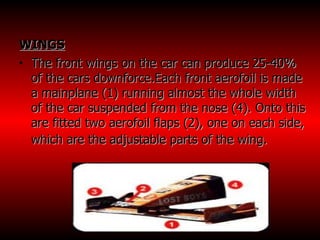
WINGS The front wings on the car can produce 25-40% of the cars downforce.Each front aerofoil is made a mainplane (1) running almost the whole width of the car suspended from the nose (4). Onto this are fitted two aerofoil flaps (2), one on each side, which are the adjustable parts of the wing.
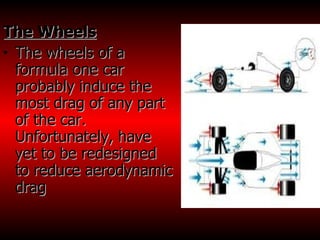
The Wheels The wheels of a formula one car probably induce the most drag of any part of the car. Unfortunately, have yet to be redesigned to reduce aerodynamic drag
Suspension In recent years, suspension members have been streamlined into an aerofoil shape. According to the rules however, they are not allowed to produce downforce, and are simply shaped that way to reduce drag, and to keep the flow heading for the sidepods relatively undisturbed
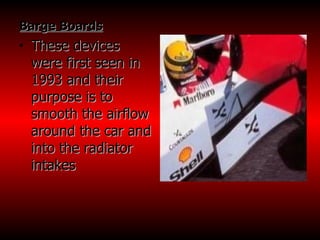
Barge Boards These devices were first seen in 1993 and their purpose is to smooth the airflow around the car and into the radiator intakes
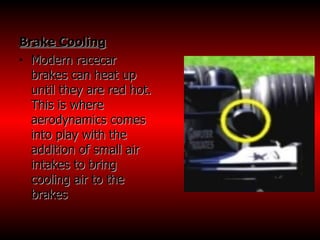
Brake Cooling Modern racecar brakes can heat up until they are red hot. This is where aerodynamics comes into play with the addition of small air intakes to bring cooling air to the brakes
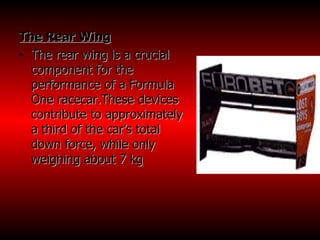
The Rear Wing The rear wing is a crucial component for the performance of a Formula One racecar.These devices contribute to approximately a third of the car’s total down force, while only weighing about 7 kg
Formula 1 Teams
Scuderia Ferrari Marlboro West McLaren Mercedes   TEAMS
BMW  Williams  F1 Team   Sauber Petronas DHL Jordan  Honda   Mild Seven Renault F1 Team
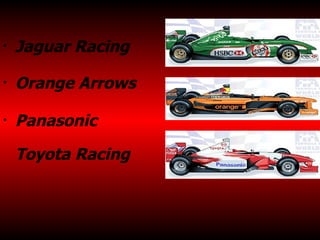
Jaguar Racing Orange Arrows   Panasonic Toyota Racing
Conclusion
The fastest racing car on the road Most aerodynamic racing car ever invented by mankind Very light in weight and very high in speed Very expensive cost around 700,000$  Very difficult to handle and to drive  THE END THANK YOU

Formula 1 race car

  • 1.
  • 2.
  • 3.
    Scheme of PresentationIntroduction Formula 1 cars Aerodynamic Features of F1 car Teams of Formula 1 Conclusion
  • 4.
  • 5.
    F1 roots canbe traced all the way back to the first auto races held in the late 1800s and early 1900s The 'MODERN' era is considered to have begun in 1950. Since then, the sport has been growing steadily Today, Formula One is considered by most to be the peak of automotive technology and driving skills
  • 6.
  • 7.
    Modern F1 carsare single-seated, open cockpit, open wheel racers. Must be constructed by the racing teams themselves, powered by 3.0-litre, ten-cylinder naturally aspirated engines. Transmission are mostly 6 or 7-speed semi- automatic. The driver must signal a gear change with paddles on the steering wheel
  • 8.
    The cars relyheavily on aerodynamics, using large front and rear wings to create about twice as much downforce as weight. The cars are constructed of ultra-lightweight carbon fiber and use a finely tuned blend of fuels which rather closely approximates normal petrol. They use grooved tires made of highly engineered compounds built for maximum grip and very short lifespan.
  • 9.
  • 10.
    WINGS The frontwings on the car can produce 25-40% of the cars downforce.Each front aerofoil is made a mainplane (1) running almost the whole width of the car suspended from the nose (4). Onto this are fitted two aerofoil flaps (2), one on each side, which are the adjustable parts of the wing.
  • 11.
    The Wheels Thewheels of a formula one car probably induce the most drag of any part of the car. Unfortunately, have yet to be redesigned to reduce aerodynamic drag
  • 12.
    Suspension In recentyears, suspension members have been streamlined into an aerofoil shape. According to the rules however, they are not allowed to produce downforce, and are simply shaped that way to reduce drag, and to keep the flow heading for the sidepods relatively undisturbed
  • 13.
    Barge Boards Thesedevices were first seen in 1993 and their purpose is to smooth the airflow around the car and into the radiator intakes
  • 14.
    Brake Cooling Modernracecar brakes can heat up until they are red hot. This is where aerodynamics comes into play with the addition of small air intakes to bring cooling air to the brakes
  • 15.
    The Rear WingThe rear wing is a crucial component for the performance of a Formula One racecar.These devices contribute to approximately a third of the car’s total down force, while only weighing about 7 kg
  • 16.
  • 17.
    Scuderia Ferrari MarlboroWest McLaren Mercedes TEAMS
  • 18.
    BMW Williams F1 Team Sauber Petronas DHL Jordan Honda Mild Seven Renault F1 Team
  • 19.
    Jaguar Racing OrangeArrows Panasonic Toyota Racing
  • 20.
  • 21.
    The fastest racingcar on the road Most aerodynamic racing car ever invented by mankind Very light in weight and very high in speed Very expensive cost around 700,000$ Very difficult to handle and to drive THE END THANK YOU