International Research Journal of Engineering and Technology (IRJET) e-ISSN: 2395-0056
Volume: 09 Issue: 04 | Apr 2022 www.irjet.net p-ISSN: 2395-0072
© 2022, IRJET | Impact Factor value: 7.529 | ISO 9001:2008 Certified Journal | Page 3215
Increasing Downforce In High-Speed Vehicles Using Wheel Rotation
Sudhanshu Srivastava1, Ananthalakshmi S.2 , Dr.A.Sankaran3
1,2M.E. Student, Aeronautical Engineering, Nehru Institute of Engineering and Technology, Coimbatore-641105
3Professor, Aeronautical Engineering, Nehru Institute of Engineering and Technology, Coimbatore-641105
---------------------------------------------------------------------***---------------------------------------------------------------------
Abstract - Downforce, or downward lift force, is created by
a vehicle's aerodynamic properties. The vertical force on the
tires is increased by downforce, resulting in a higher grip. The
purpose of the downforce on a fixed-wing aircraft'shorizontal
stabilizer is to maintain longitudinal stability and allow the
pilot to direct the plane in pitch. Formula 1 vehicles are
propelled off the ground by the same process that propels
airplanes. This impact is referred to as "aerodynamic grip," as
opposed to "mechanical grip," which is governed by the
vehicle's mass, tires, and suspension. Passive devices can only
increase downforce by increasing aerodynamic drag (or
friction). Downforce increases in direct proportion to the
square of the vehicle's speed and requires a specific minimum
speed to have a noticeable effect. Some cars had relatively
unstable aerodynamics, resulting in significant downforce
fluctuations with minor changes in the angle of attack or
vehicle height. In the worst-case scenarios, such as when
passing over a bump or slipstreaming over a crest, this can
result in lift rather than downforce. Sucking air beneath the
car creates a low-pressure region beneath the vehicle, and the
sucked air is sent to the back-end low-pressure region of the
wake. As a result, a lot of work has already been done to
improve this downforce, employing some traditional methods
and their variations. However, because boosting downforce
always increased the coefficient of drag, we made a change to
the back wheels.
Key Words: Aerodynamic grip; Downforce; Lift force;
coefficient of drag; Negative lift.
1. INTRODUCTION
Car stays on the ground because of downforce. The negative
lift is known as downforce. In other words,thesamephysical
law that allows planes to soar upward also forbids carsfrom
flying. This is the shape of an aircraft's airfoil, which
generates lift by creating a low-pressure area on the upper
side and a high-pressure area on the lower side. Lift is
developed by the pressure difference. What if the shape is
flipped around? Due to this, there will be more pressure
upward and less pressure downward, which in turn give a
negative lift. Downforce is the term for this negative lift. Asa
result, the car's wing is bent in the opposite direction,
causing the air deflected beneath it to flow at higher speeds
and generate a lower pressure area than on top. The force
that pushes the car down is referred to as "Downforce," and
it improves grip
In 1977 Lotus team owners ColinChapmanandPeter Wright
introduced their first ‘Wing Car’. They had discovered that
by shaping the whole car like a wing they could speed up the
airflow underneath it relatively to the airflow overthetopof
the car. Thus, creating a vacuum under the car, it would be
pulled down to the track creating a huge amount of
downforce. An extra benefit to this way of creating
downforce is that there would be less drag from the front-
and the rear wing so the car’s speed on the straights would
be less compromised. The Lotus 78 was having reliability
issues in the beginning but those were solved during the
1977 season, by fine-tuning the ‘Venturi Tunnels’
responsible for creating the increased downforce, and in
1978 Lotus won 4 out of the first 7 races. Cox had the
wonderful idea of using a fan not just to create a ground
effect, but also to keep the engine cool. Because most other
builders were completely unaware of the reasons for the
Lotus' success, Gordon Murray of Brabham was the onewho
finally figured out what brilliant solution Chapman had
devised to generate such massive downforce. However,
because of the bigger Alfa-Romeo Flat-12 engine in their
Brabham BT46, the 'VenturiTunnels'requiredtoachieve the
desired ground effect were not achievable due to a shortage
of space under the back of the car. Murray was
brainstorming with David Cox another way to create a
vacuum beneath the car. They were inspired by a Can-Am
sports car known as the 'Sucker Car,' the Chaparral 2J. In
1970, Chaparral competed with two fans in the back of the
car, each using a small two-wheeled engine, pumping air
behind the car, resulting in decreased pressure and
increased downforce. Murray intended to try a similar
concept with BT46 after seeing how fast Chaparral 2J was.
The work made was using an active device to increase the
downforce for the models were banned and use of an active
device to increase the downforce was banned in F1 racing.
But still, passive devices can be usedtocreatethiseffect.And
giving propeller blade structure to the wheel will fulfill this
need.
1.1 LITERATURE SURVEY
This section discusses in brief, various studies conducted
by researchers with regards to the aerodynamics of Formula
One race cars, and the various techniques used to optimize
the bodywork and its components to reduce lap times. The
aerodynamics of race cars talks about the forces on the
vehicle at high speed. The aerodynamics of racing cars is
similar to the aerodynamics of an airplane. While the main
International Research Journal of Engineering and Technology (IRJET) e-ISSN: 2395-0056
Volume: 09 Issue: 04 | Apr 2022 www.irjet.net p-ISSN: 2395-0072
© 2022, IRJET | Impact Factor value: 7.529 | ISO 9001:2008 Certified Journal | Page 3216
purpose of the components of an aircraft is to generate lift,
most of the components on a racing car are designed to
create downforce, i.e., lift in a negative direction.
Aerodynamics allow tons of downforce to be created on the
front and rear axles, without increasing the weight of the
body; thus, increasingtireadhesion,which,inturn,allowsthe
race car to negotiate a turn at a higher speed.
Downforce aids traction as well; however, the
improvement is not as large when compared to braking or
cornering. The acceleration is limited by the engine power
available. When the car turns and brakes simultaneously, a
significant point to be noted is that even though theresultant
force available to the tires is equal to pure cornering or
braking force, the individual capacities of the components of
the resultant force (cornering andbrakingforce)arelesser.It
can be concluded that braking while negotiating a turn will
reduce the cornering force, leading to an unprecedented
slide. Thus, levels of downforce have to be increased
sufficiently to prevent theslidefromoccurring.Theoretically,
the higher the downforce acting on the car, the faster it can
make the turn without sliding.
Nothing comes free of charge though. The penalty for
excessive downforce comes in the form of increaseddrag[3].
Hence, the main task for aerodynamicists in designing the
bodywork is to optimize the balance betweendownforceand
drag forces created to obtain the fastestpossibletimearound
a race track. Aerodynamics of race cars not only involves the
creation of downforce but also includesareas suchasairflow
to engine box and radiators, cooling of brakes, limiting fuel
sloshing, the release ofexhaustgases,etc.However,thiswork
primarily focuses on the issue of obtaining optimized
downforce and drag values for F1 cars.
In [6] Motorsports are all about maximum performance,
to be the fastest is absolute. There is nothingelse.Tobefaster
you need power, but there is a limit to how much power you
can put on the ground. To increase this limit, force to the
ground must be applied to the wheels. Weight gain can do
this, but weight gain makes it worse and requires more
energy. So we need a realistic weight, we call it downforce
and get in the airflow near the car. The wings have been
shown solely to give a sense of proportion.
Usually, the word "lift" is used to describe any kind of
aerodynamically generated energy that works in space. This
is given an indication, either "positive lift" (top) or "negative
lift" (bottom) in terms of its path. In ground aerodynamics
(cars, bicycles, etc.) the word "lift" is often avoided as its
meaning isalmostalways defined as good, that is, liftingacar
off the lane. The Downforce should always give a sense of
negative force, i.e., to get more traction force.
The desire to continue to increase the adhesion of the
wheels led to a major shift in the construction of race cars,
the use of an improper lift or 'downforce'. As for the tires, the
adhesion of the sides is almost equal to the load on it, or the
friction between the wheel and the road, adding low
aerodynamic strength to the weight component improves
adhesion. The downforce also allows tires to transmit more
power without wheel rotation, which increases the potential
for acceleration. Apart from the aerodynamic downforce to
increase grip, modern racing cars are so powerful that they
can spin wheels or travel at speeds in excess of 160 km/h.
A spoiler is a simple plate placed somewhere on the body
of the car so that it can obstruct or "spoil"theflowaroundthe
vehicle, allowing a controlled separation of the flow at the
desired location. This is done because fast, smooth airflow
leads to positive lift, so impeding this flow either reduces or
perhaps cancels lift altogether.
A rear spoiler is a plate mounted at the rear of the vehicle
and in order for it to be considered a spoiler, the plate must
be integrally attached to the body. If there is space between
the plate and the body, it is considered a wing. The spoiler
causes a split in the back of the car, causingadisturbancejust
before flow, this distortioncausestheflowtoslowdown,thus
reducing the minimum pressure in the area in front of the
spoiler. Therefore, the elevator in the back of the car is
removed. When properly designed, the rear spoiler will
create downforce on the back of the car.
The diffusers, behind the wings, are the tools that are
basically used to create inflation on the back of a race car. In
them, the Bernoulli equation is used as we do with the
venturi tube. It can be seen that in a venturi, the square of
pressure and velocity is inversely proportional. Thus, a
diffuser can help reduce the low pressure under the car to
increase speed.
At the front of a vehicle, the main sources of downforce
are the underbody with the front spoiler (also known as a
spoiler, dam, or splitter), cleats (alsoknownasdivingplates),
vortex generators, and front diffusers.
Spoilers, dams, or splitters are better explained by
following the link. They reduce the gap between the ground
and the vehicle (facing it towards the side of the vehicle) by
blocking as much air as it can get under the vehicle, using a
spoiler on a vehicle with very turbulent airflow on a non-
smooth-floored vehicle can result in less air passing through
all elements of the vehicle's floor, significantly reducing drag
and also reducing lift. (and maybe a little downforce) in this
case.
Duck and the vortex generator in detail. A small fin in the
front corner of a car. Although the inclination of this plate is
minimal, it creates downforce in the front of the vehicle. The
same device can be used in other parts of the car. However,
care must be taken to ensure that the vortex on the leading
edgedoes not interfere with the operation oftherearwingor
other aerodynamic devices. This dive plate is sleeker than
any other and is too small to generate as much downforce.
Instead, it is used to adjust car handling before the race.
International Research Journal of Engineering and Technology (IRJET) e-ISSN: 2395-0056
Volume: 09 Issue: 04 | Apr 2022 www.irjet.net p-ISSN: 2395-0072
© 2022, IRJET | Impact Factor value: 7.529 | ISO 9001:2008 Certified Journal | Page 3217
In [1] we can see To achieve the optimized drag for the
vehicle, the research is being carried out on certain add-on
aerodynamicdevicestoreducetheresistanceofferedbywind
and improve the efficiency of the vehicle. In thisresearch,the
effects of various aerodynamic devices like the rear wing,
spoiler, diffuser, and fins are examined and the change in the
coefficient of drag is investigated.
Spoilers are one of the most widely used and important
aerodynamic devices in the automotive industry. Its main
purpose is to help reduce drag by "disturbing" unwanted
airflow and sequencing the airflow. However, the actual use
of the spoiler is noticeable at high speeds above about 120
km/h. Commercial vehicles typically use it to enhance the
appeal of vehicle designs that offer little or no aerodynamic
advantage. So basically, high-performance cars apply it to
achieve higher speeds. The low-pressure area behind the
vehicle is reduced, which creates less turbulence and
consequently reduces drag.
The ultimate aim of every race car designer is to improve
the lap time, without compromisingsafety andotheraspects.
To achieve this objective, the most predominant factor is
cornering ability at high speed. During cornering, the cars
have to reduce their longitudinalacceleration tocompensate
for the lateral acceleration i.e., it has to slow down while
cornering to avoid sliding or deviating from the desiredpath,
as the traction provided by the tire is limited for a given load.
One such way to improve the cornering ability, ultimately
improving lap time, is by improving the traction of the tires
by increasing the load acting on them. Resistance forces
acting on the body are generally of two types: viscous and
forced. Induced drag results from the creation of lift and
viscous drag results from the boundary layer interaction
between the body and the fluid (air in this case). Thus, the
overall drag coefficient for the final wing is calculated.
The best way to increase the load on the tires when
cornering is to increase the car's aerodynamic downforce
coefficient to some extent (up to the critical downforce
coefficient). An important factor in reducing the amount of
resistance is the positive effect of the time delay due to the
decrease in muscle strength on the hip. [2] introduces a
method to determine the most important decelerationfactor
of a vehicle on a specific track. Significant reduction factors
are determined by a series of analytical statistics and
simulations performed using OptimumLap software. The
critical coefficient of downforce for the FSAE- no aero car on
the Buddh International circuit is found to be 2.2 and the
corresponding lap time is 128.950 which isabout10seconds
clear from the lap time by the initial setup without any
aerodynamic downforce.Goingfurtherthecriticalcoefficient,
the lap time increases which is undesirable. So the
aerodynamic add-ons should be designed to reach the
downforce coefficient of 2.2.
2. METHODOLOGY
The challenge is to decrease the lift that is created due to air
moving under the car and creating an undesirable lift force.
So, to eliminate this effect wheels have been used to ignore
unnecessary power consumption. The rotation of the wheel
itself creates a suction effect that makes the air under the car
model to move out and create a low-pressure area which in
turnincreases downforce withoutaffectingthefuelefficiency
of the car as we used a passive device for the job. The air
exhausted from the wheel will increase drag substantially
due to its rotation. So, to ignore this increase indragfurthera
covering is given for the rear wheel and two holes have been
made to guide the flow to thelow-pressure wake zone which
is made behind the car. So that it can increase the pressureat
the rear end of the which further decrease the drag
coefficient.
2.1 MODEL
For designing the base model car,CATIAV5wasusedand
the basic model was created. Then the file was exported for
analysis in .igs format for Ansys.
Fig -1: Base model car
The three-dimensional car model was imported to the
ANSYS™ workbench. Computational Fluid Dynamics (CFD)
was carried out in the FLUENT module. In Design Modeler,
an enclosure is developed of dimensions 1500 × 300 × 600
mm to form a virtual wind tunnel.
Fig -2: Enclosure
International Research Journal of Engineering and Technology (IRJET) e-ISSN: 2395-0056
Volume: 09 Issue: 04 | Apr 2022 www.irjet.net p-ISSN: 2395-0072
© 2022, IRJET | Impact Factor value: 7.529 | ISO 9001:2008 Certified Journal | Page 3218
2.2 MESHING
An appropriate mesh wasdevelopedusingANSYS™Mesh
Tool. The mesh was observed to be coarser at the inner
domain and finer at the contact region with the vehicle as
shown in Figure 4.3. A total of 591,978 nodes and 424,773
elements were formed after the meshing was done.
Fig -3: Mesh
2.3 BOUNDARY CONDITIONS
The fluent was set to work on double precision and
solver processes were made to 4. Duetoitsstabilityandease
of convergence, the Standard k-epsilon model was selected
as a turbulence model.
Table -1: Boundary Conditions
Boundary conditions
Region Boundary Condition
Inlet Velocity Inlet, v=50 m/s
Outlet Pressure outlet, reference
pressure = 0 Pa
2.4 SIMULATION
The streamline diagram of differentcasesislistedbelow:-
Fig -4: Streamline diagram of the base model
Fig -5: Streamline diagram of case 1
Fig -6: Streamline diagram of case 2
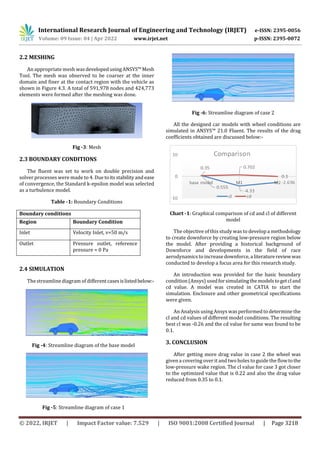
All the designed car models with wheel conditions are
simulated in ANSYS™ 21.0 Fluent. The results of the drag
coefficients obtained are discussed below:-
Chart -1: Graphical comparison of cd and cl of different
model
The objective of this study was to develop a methodology
to create downforce by creating low-pressure region below
the model. After providing a historical background of
Downforce and developments in the field of race
aerodynamics to increase downforce, aliteraturereviewwas
conducted to develop a focus area for this research study.
An introduction was provided for the basic boundary
condition (Ansys) usedforsimulatingthemodelstogetcland
cd value. A model was created in CATIA to start the
simulation. Enclosure and other geometrical specifications
were given.
An Analysis using Ansys was performed to determine the
cl and cd values of different model conditions. The resulting
best cl was -0.26 and the cd value for same was found to be
0.1.
3. CONCLUSION
After getting more drag value in case 2 the wheel was
given a covering over it and two holes to guide the flowtothe
low-pressure wake region. The cl value for case 3 got closer
to the optimized value that is 0.22 and also the drag value
reduced from 0.35 to 0.1.
International Research Journal of Engineering and Technology (IRJET) e-ISSN: 2395-0056
Volume: 09 Issue: 04 | Apr 2022 www.irjet.net p-ISSN: 2395-0072
© 2022, IRJET | Impact Factor value: 7.529 | ISO 9001:2008 Certified Journal | Page 3219
REFERENCES
[1] Devang S. Nath* , Prashant Chandra Pujari,AmitJainand
Vikas Rastogi, Drag reduction by application of
aerodynamic devices in a race car
https://doi.org/10.1186/s42774-020-00054-7.
[2] Brighton George, Jairesh J. V., Chithraiselvan G., Gokul
Nath S, Determination of Critical Downforce Coefficient
of a Vehicle for Optimum Aerodynamic Performance,
e-ISSN: 2395-0056.
[3] Joseph Katz, “Aerodynamics of Race Cars”.
[4] David Cox, “Brabham f1 ‘fan-car’ bt46b”.
[5] Sir Frank Williams, “Downforce”.

Increasing Downforce In High-Speed Vehicles Using Wheel Rotation

  • 1.
    International Research Journalof Engineering and Technology (IRJET) e-ISSN: 2395-0056 Volume: 09 Issue: 04 | Apr 2022 www.irjet.net p-ISSN: 2395-0072 © 2022, IRJET | Impact Factor value: 7.529 | ISO 9001:2008 Certified Journal | Page 3215 Increasing Downforce In High-Speed Vehicles Using Wheel Rotation Sudhanshu Srivastava1, Ananthalakshmi S.2 , Dr.A.Sankaran3 1,2M.E. Student, Aeronautical Engineering, Nehru Institute of Engineering and Technology, Coimbatore-641105 3Professor, Aeronautical Engineering, Nehru Institute of Engineering and Technology, Coimbatore-641105 ---------------------------------------------------------------------***--------------------------------------------------------------------- Abstract - Downforce, or downward lift force, is created by a vehicle's aerodynamic properties. The vertical force on the tires is increased by downforce, resulting in a higher grip. The purpose of the downforce on a fixed-wing aircraft'shorizontal stabilizer is to maintain longitudinal stability and allow the pilot to direct the plane in pitch. Formula 1 vehicles are propelled off the ground by the same process that propels airplanes. This impact is referred to as "aerodynamic grip," as opposed to "mechanical grip," which is governed by the vehicle's mass, tires, and suspension. Passive devices can only increase downforce by increasing aerodynamic drag (or friction). Downforce increases in direct proportion to the square of the vehicle's speed and requires a specific minimum speed to have a noticeable effect. Some cars had relatively unstable aerodynamics, resulting in significant downforce fluctuations with minor changes in the angle of attack or vehicle height. In the worst-case scenarios, such as when passing over a bump or slipstreaming over a crest, this can result in lift rather than downforce. Sucking air beneath the car creates a low-pressure region beneath the vehicle, and the sucked air is sent to the back-end low-pressure region of the wake. As a result, a lot of work has already been done to improve this downforce, employing some traditional methods and their variations. However, because boosting downforce always increased the coefficient of drag, we made a change to the back wheels. Key Words: Aerodynamic grip; Downforce; Lift force; coefficient of drag; Negative lift. 1. INTRODUCTION Car stays on the ground because of downforce. The negative lift is known as downforce. In other words,thesamephysical law that allows planes to soar upward also forbids carsfrom flying. This is the shape of an aircraft's airfoil, which generates lift by creating a low-pressure area on the upper side and a high-pressure area on the lower side. Lift is developed by the pressure difference. What if the shape is flipped around? Due to this, there will be more pressure upward and less pressure downward, which in turn give a negative lift. Downforce is the term for this negative lift. Asa result, the car's wing is bent in the opposite direction, causing the air deflected beneath it to flow at higher speeds and generate a lower pressure area than on top. The force that pushes the car down is referred to as "Downforce," and it improves grip In 1977 Lotus team owners ColinChapmanandPeter Wright introduced their first ‘Wing Car’. They had discovered that by shaping the whole car like a wing they could speed up the airflow underneath it relatively to the airflow overthetopof the car. Thus, creating a vacuum under the car, it would be pulled down to the track creating a huge amount of downforce. An extra benefit to this way of creating downforce is that there would be less drag from the front- and the rear wing so the car’s speed on the straights would be less compromised. The Lotus 78 was having reliability issues in the beginning but those were solved during the 1977 season, by fine-tuning the ‘Venturi Tunnels’ responsible for creating the increased downforce, and in 1978 Lotus won 4 out of the first 7 races. Cox had the wonderful idea of using a fan not just to create a ground effect, but also to keep the engine cool. Because most other builders were completely unaware of the reasons for the Lotus' success, Gordon Murray of Brabham was the onewho finally figured out what brilliant solution Chapman had devised to generate such massive downforce. However, because of the bigger Alfa-Romeo Flat-12 engine in their Brabham BT46, the 'VenturiTunnels'requiredtoachieve the desired ground effect were not achievable due to a shortage of space under the back of the car. Murray was brainstorming with David Cox another way to create a vacuum beneath the car. They were inspired by a Can-Am sports car known as the 'Sucker Car,' the Chaparral 2J. In 1970, Chaparral competed with two fans in the back of the car, each using a small two-wheeled engine, pumping air behind the car, resulting in decreased pressure and increased downforce. Murray intended to try a similar concept with BT46 after seeing how fast Chaparral 2J was. The work made was using an active device to increase the downforce for the models were banned and use of an active device to increase the downforce was banned in F1 racing. But still, passive devices can be usedtocreatethiseffect.And giving propeller blade structure to the wheel will fulfill this need. 1.1 LITERATURE SURVEY This section discusses in brief, various studies conducted by researchers with regards to the aerodynamics of Formula One race cars, and the various techniques used to optimize the bodywork and its components to reduce lap times. The aerodynamics of race cars talks about the forces on the vehicle at high speed. The aerodynamics of racing cars is similar to the aerodynamics of an airplane. While the main
  • 2.
    International Research Journalof Engineering and Technology (IRJET) e-ISSN: 2395-0056 Volume: 09 Issue: 04 | Apr 2022 www.irjet.net p-ISSN: 2395-0072 © 2022, IRJET | Impact Factor value: 7.529 | ISO 9001:2008 Certified Journal | Page 3216 purpose of the components of an aircraft is to generate lift, most of the components on a racing car are designed to create downforce, i.e., lift in a negative direction. Aerodynamics allow tons of downforce to be created on the front and rear axles, without increasing the weight of the body; thus, increasingtireadhesion,which,inturn,allowsthe race car to negotiate a turn at a higher speed. Downforce aids traction as well; however, the improvement is not as large when compared to braking or cornering. The acceleration is limited by the engine power available. When the car turns and brakes simultaneously, a significant point to be noted is that even though theresultant force available to the tires is equal to pure cornering or braking force, the individual capacities of the components of the resultant force (cornering andbrakingforce)arelesser.It can be concluded that braking while negotiating a turn will reduce the cornering force, leading to an unprecedented slide. Thus, levels of downforce have to be increased sufficiently to prevent theslidefromoccurring.Theoretically, the higher the downforce acting on the car, the faster it can make the turn without sliding. Nothing comes free of charge though. The penalty for excessive downforce comes in the form of increaseddrag[3]. Hence, the main task for aerodynamicists in designing the bodywork is to optimize the balance betweendownforceand drag forces created to obtain the fastestpossibletimearound a race track. Aerodynamics of race cars not only involves the creation of downforce but also includesareas suchasairflow to engine box and radiators, cooling of brakes, limiting fuel sloshing, the release ofexhaustgases,etc.However,thiswork primarily focuses on the issue of obtaining optimized downforce and drag values for F1 cars. In [6] Motorsports are all about maximum performance, to be the fastest is absolute. There is nothingelse.Tobefaster you need power, but there is a limit to how much power you can put on the ground. To increase this limit, force to the ground must be applied to the wheels. Weight gain can do this, but weight gain makes it worse and requires more energy. So we need a realistic weight, we call it downforce and get in the airflow near the car. The wings have been shown solely to give a sense of proportion. Usually, the word "lift" is used to describe any kind of aerodynamically generated energy that works in space. This is given an indication, either "positive lift" (top) or "negative lift" (bottom) in terms of its path. In ground aerodynamics (cars, bicycles, etc.) the word "lift" is often avoided as its meaning isalmostalways defined as good, that is, liftingacar off the lane. The Downforce should always give a sense of negative force, i.e., to get more traction force. The desire to continue to increase the adhesion of the wheels led to a major shift in the construction of race cars, the use of an improper lift or 'downforce'. As for the tires, the adhesion of the sides is almost equal to the load on it, or the friction between the wheel and the road, adding low aerodynamic strength to the weight component improves adhesion. The downforce also allows tires to transmit more power without wheel rotation, which increases the potential for acceleration. Apart from the aerodynamic downforce to increase grip, modern racing cars are so powerful that they can spin wheels or travel at speeds in excess of 160 km/h. A spoiler is a simple plate placed somewhere on the body of the car so that it can obstruct or "spoil"theflowaroundthe vehicle, allowing a controlled separation of the flow at the desired location. This is done because fast, smooth airflow leads to positive lift, so impeding this flow either reduces or perhaps cancels lift altogether. A rear spoiler is a plate mounted at the rear of the vehicle and in order for it to be considered a spoiler, the plate must be integrally attached to the body. If there is space between the plate and the body, it is considered a wing. The spoiler causes a split in the back of the car, causingadisturbancejust before flow, this distortioncausestheflowtoslowdown,thus reducing the minimum pressure in the area in front of the spoiler. Therefore, the elevator in the back of the car is removed. When properly designed, the rear spoiler will create downforce on the back of the car. The diffusers, behind the wings, are the tools that are basically used to create inflation on the back of a race car. In them, the Bernoulli equation is used as we do with the venturi tube. It can be seen that in a venturi, the square of pressure and velocity is inversely proportional. Thus, a diffuser can help reduce the low pressure under the car to increase speed. At the front of a vehicle, the main sources of downforce are the underbody with the front spoiler (also known as a spoiler, dam, or splitter), cleats (alsoknownasdivingplates), vortex generators, and front diffusers. Spoilers, dams, or splitters are better explained by following the link. They reduce the gap between the ground and the vehicle (facing it towards the side of the vehicle) by blocking as much air as it can get under the vehicle, using a spoiler on a vehicle with very turbulent airflow on a non- smooth-floored vehicle can result in less air passing through all elements of the vehicle's floor, significantly reducing drag and also reducing lift. (and maybe a little downforce) in this case. Duck and the vortex generator in detail. A small fin in the front corner of a car. Although the inclination of this plate is minimal, it creates downforce in the front of the vehicle. The same device can be used in other parts of the car. However, care must be taken to ensure that the vortex on the leading edgedoes not interfere with the operation oftherearwingor other aerodynamic devices. This dive plate is sleeker than any other and is too small to generate as much downforce. Instead, it is used to adjust car handling before the race.
  • 3.
    International Research Journalof Engineering and Technology (IRJET) e-ISSN: 2395-0056 Volume: 09 Issue: 04 | Apr 2022 www.irjet.net p-ISSN: 2395-0072 © 2022, IRJET | Impact Factor value: 7.529 | ISO 9001:2008 Certified Journal | Page 3217 In [1] we can see To achieve the optimized drag for the vehicle, the research is being carried out on certain add-on aerodynamicdevicestoreducetheresistanceofferedbywind and improve the efficiency of the vehicle. In thisresearch,the effects of various aerodynamic devices like the rear wing, spoiler, diffuser, and fins are examined and the change in the coefficient of drag is investigated. Spoilers are one of the most widely used and important aerodynamic devices in the automotive industry. Its main purpose is to help reduce drag by "disturbing" unwanted airflow and sequencing the airflow. However, the actual use of the spoiler is noticeable at high speeds above about 120 km/h. Commercial vehicles typically use it to enhance the appeal of vehicle designs that offer little or no aerodynamic advantage. So basically, high-performance cars apply it to achieve higher speeds. The low-pressure area behind the vehicle is reduced, which creates less turbulence and consequently reduces drag. The ultimate aim of every race car designer is to improve the lap time, without compromisingsafety andotheraspects. To achieve this objective, the most predominant factor is cornering ability at high speed. During cornering, the cars have to reduce their longitudinalacceleration tocompensate for the lateral acceleration i.e., it has to slow down while cornering to avoid sliding or deviating from the desiredpath, as the traction provided by the tire is limited for a given load. One such way to improve the cornering ability, ultimately improving lap time, is by improving the traction of the tires by increasing the load acting on them. Resistance forces acting on the body are generally of two types: viscous and forced. Induced drag results from the creation of lift and viscous drag results from the boundary layer interaction between the body and the fluid (air in this case). Thus, the overall drag coefficient for the final wing is calculated. The best way to increase the load on the tires when cornering is to increase the car's aerodynamic downforce coefficient to some extent (up to the critical downforce coefficient). An important factor in reducing the amount of resistance is the positive effect of the time delay due to the decrease in muscle strength on the hip. [2] introduces a method to determine the most important decelerationfactor of a vehicle on a specific track. Significant reduction factors are determined by a series of analytical statistics and simulations performed using OptimumLap software. The critical coefficient of downforce for the FSAE- no aero car on the Buddh International circuit is found to be 2.2 and the corresponding lap time is 128.950 which isabout10seconds clear from the lap time by the initial setup without any aerodynamic downforce.Goingfurtherthecriticalcoefficient, the lap time increases which is undesirable. So the aerodynamic add-ons should be designed to reach the downforce coefficient of 2.2. 2. METHODOLOGY The challenge is to decrease the lift that is created due to air moving under the car and creating an undesirable lift force. So, to eliminate this effect wheels have been used to ignore unnecessary power consumption. The rotation of the wheel itself creates a suction effect that makes the air under the car model to move out and create a low-pressure area which in turnincreases downforce withoutaffectingthefuelefficiency of the car as we used a passive device for the job. The air exhausted from the wheel will increase drag substantially due to its rotation. So, to ignore this increase indragfurthera covering is given for the rear wheel and two holes have been made to guide the flow to thelow-pressure wake zone which is made behind the car. So that it can increase the pressureat the rear end of the which further decrease the drag coefficient. 2.1 MODEL For designing the base model car,CATIAV5wasusedand the basic model was created. Then the file was exported for analysis in .igs format for Ansys. Fig -1: Base model car The three-dimensional car model was imported to the ANSYS™ workbench. Computational Fluid Dynamics (CFD) was carried out in the FLUENT module. In Design Modeler, an enclosure is developed of dimensions 1500 × 300 × 600 mm to form a virtual wind tunnel. Fig -2: Enclosure
  • 4.
    International Research Journalof Engineering and Technology (IRJET) e-ISSN: 2395-0056 Volume: 09 Issue: 04 | Apr 2022 www.irjet.net p-ISSN: 2395-0072 © 2022, IRJET | Impact Factor value: 7.529 | ISO 9001:2008 Certified Journal | Page 3218 2.2 MESHING An appropriate mesh wasdevelopedusingANSYS™Mesh Tool. The mesh was observed to be coarser at the inner domain and finer at the contact region with the vehicle as shown in Figure 4.3. A total of 591,978 nodes and 424,773 elements were formed after the meshing was done. Fig -3: Mesh 2.3 BOUNDARY CONDITIONS The fluent was set to work on double precision and solver processes were made to 4. Duetoitsstabilityandease of convergence, the Standard k-epsilon model was selected as a turbulence model. Table -1: Boundary Conditions Boundary conditions Region Boundary Condition Inlet Velocity Inlet, v=50 m/s Outlet Pressure outlet, reference pressure = 0 Pa 2.4 SIMULATION The streamline diagram of differentcasesislistedbelow:- Fig -4: Streamline diagram of the base model Fig -5: Streamline diagram of case 1 Fig -6: Streamline diagram of case 2 All the designed car models with wheel conditions are simulated in ANSYS™ 21.0 Fluent. The results of the drag coefficients obtained are discussed below:- Chart -1: Graphical comparison of cd and cl of different model The objective of this study was to develop a methodology to create downforce by creating low-pressure region below the model. After providing a historical background of Downforce and developments in the field of race aerodynamics to increase downforce, aliteraturereviewwas conducted to develop a focus area for this research study. An introduction was provided for the basic boundary condition (Ansys) usedforsimulatingthemodelstogetcland cd value. A model was created in CATIA to start the simulation. Enclosure and other geometrical specifications were given. An Analysis using Ansys was performed to determine the cl and cd values of different model conditions. The resulting best cl was -0.26 and the cd value for same was found to be 0.1. 3. CONCLUSION After getting more drag value in case 2 the wheel was given a covering over it and two holes to guide the flowtothe low-pressure wake region. The cl value for case 3 got closer to the optimized value that is 0.22 and also the drag value reduced from 0.35 to 0.1.
  • 5.
    International Research Journalof Engineering and Technology (IRJET) e-ISSN: 2395-0056 Volume: 09 Issue: 04 | Apr 2022 www.irjet.net p-ISSN: 2395-0072 © 2022, IRJET | Impact Factor value: 7.529 | ISO 9001:2008 Certified Journal | Page 3219 REFERENCES [1] Devang S. Nath* , Prashant Chandra Pujari,AmitJainand Vikas Rastogi, Drag reduction by application of aerodynamic devices in a race car https://doi.org/10.1186/s42774-020-00054-7. [2] Brighton George, Jairesh J. V., Chithraiselvan G., Gokul Nath S, Determination of Critical Downforce Coefficient of a Vehicle for Optimum Aerodynamic Performance, e-ISSN: 2395-0056. [3] Joseph Katz, “Aerodynamics of Race Cars”. [4] David Cox, “Brabham f1 ‘fan-car’ bt46b”. [5] Sir Frank Williams, “Downforce”.