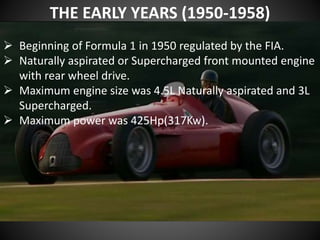
THE EARLY YEARS (1950-1958)
 Beginning of Formula 1 in 1950 regulated by the FIA.
 Naturally aspirated or Supercharged front mounted engine
with rear wheel drive.
 Maximum engine size was 4.5L Naturally aspirated and 3L
Supercharged.
 Maximum power was 425Hp(317Kw).
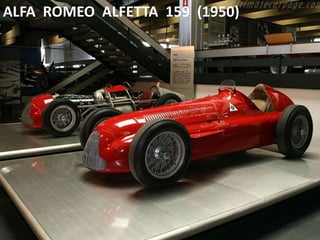
ALFA ROMEO ALFETTA 159 (1950)
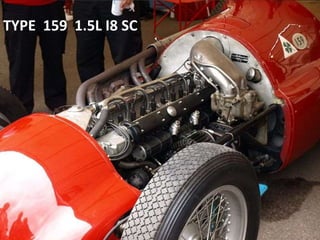
TYPE 159 1.5L I8 SC
MID ENGINE REVOLUTION (1958-1966)
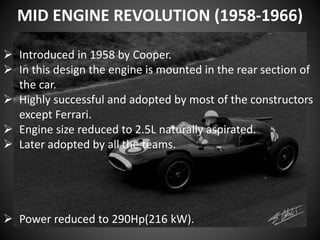
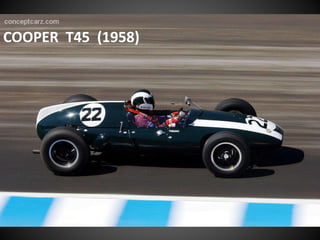
 Introduced in 1958 by Cooper.
 In this design the engine is mounted in the rear section of
the car.
 Highly successful and adopted by most of the constructors
except Ferrari.
 Engine size reduced to 2.5L naturally aspirated.
 Later adopted by all the teams.
 Power reduced to 290Hp(216 kW).
COOPER T45 (1958)
THE AERODYNAMICAL/TECHNOLOGICAL
REVOLUTION (1966 –1995)
 Introduction of aero dynamical technology like wings,
diffusers, ground effect(banned in 1983), side skirts etc… .
 Introduction of Turbo charging
 Introduction of driver aids like active suspension, traction
control, engine control unit, Semi-automatic gearbox.
 New materials like carbon fibre and kevlar for chassis
construction and Aluminum alloys and titanium for engine.
 Commercialization of Formula 1 with entry of Sponsors, TV
coverage and begins to attract large crowds.
 Exponential growth in team budgets.
 Power was increased to 500Hp(370 kW) for 3.0L N/A and
900Hp(670kW) for 1.5LT/C and upto 1,200Hp in qualifying.
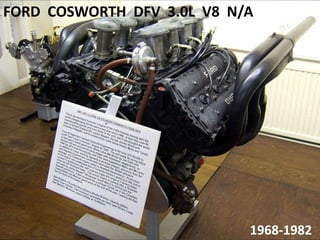
FORD COSWORTH DFV 3.0L V8 N/A
1968-1982
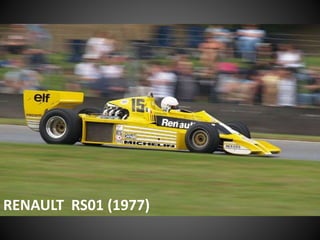
RENAULT RS01 (1977)
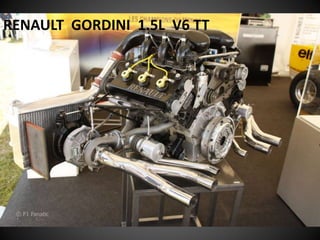
RENAULT GORDINI 1.5L V6 TT
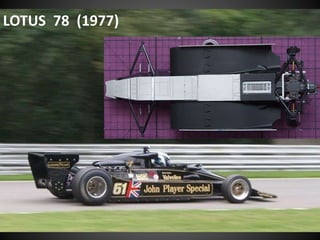
LOTUS 78 (1977)
HONDA RA168E 1.5L V6 TT
FOCUS ON SAFETY (1995-2005)
 Triggered by a series of fatal crashes and pit crew
accidents in the past years.
 Main cause being the death of the sport’s greatest ever
Artyon Senna in the 1994 San Marino Grand Prix, Imola,
Italy.
 Increased cockpit protection and HANS(head and neck
safety).
 Ban of turbos in 1989 followed by reduction of engine size
from 3.5L in 1990 to 3L in 1995.Power output is
950 hp(708 kW).
 Ban on all electronic driver aids like traction
control(reintroduced later in 2001), active suspension,
launch control, ABS.
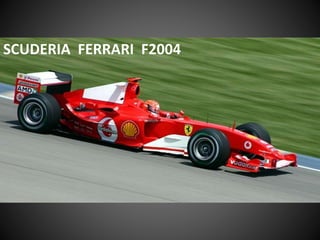
SCUDERIA FERRARI F2004
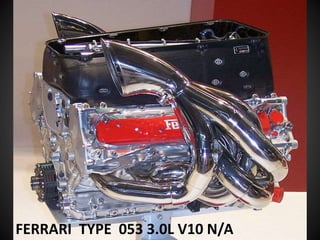
FERRARI TYPE 053 3.0L V10 N/A
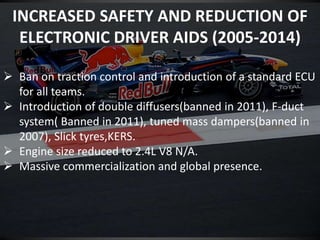
INCREASED SAFETY AND REDUCTION OF
ELECTRONIC DRIVER AIDS (2005-2014)
 Ban on traction control and introduction of a standard ECU
for all teams.
 Introduction of double diffusers(banned in 2011), F-duct
system( Banned in 2011), tuned mass dampers(banned in
2007), Slick tyres,KERS.
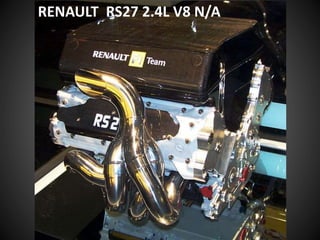
 Engine size reduced to 2.4L V8 N/A.
 Massive commercialization and global presence.
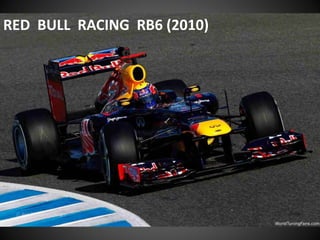
RED BULL RACING RB6 (2010)
RENAULT RS27 2.4L V8 N/A
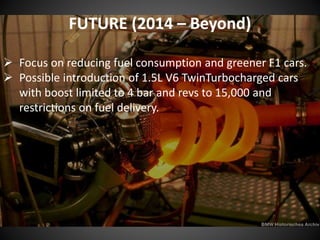
FUTURE (2014 – Beyond)
 Focus on reducing fuel consumption and greener F1 cars.
 Possible introduction of 1.5L V6 TwinTurbocharged cars
with boost limited to 4 bar and revs to 15,000 and
restrictions on fuel delivery.
A PRESENTATION BY
V.M.ARJUN
supercharger360@gmail.com

Evolution of f1

  • 2.
    THE EARLY YEARS(1950-1958)  Beginning of Formula 1 in 1950 regulated by the FIA.  Naturally aspirated or Supercharged front mounted engine with rear wheel drive.  Maximum engine size was 4.5L Naturally aspirated and 3L Supercharged.  Maximum power was 425Hp(317Kw).
  • 3.
  • 4.
  • 5.
    MID ENGINE REVOLUTION(1958-1966)  Introduced in 1958 by Cooper.  In this design the engine is mounted in the rear section of the car.  Highly successful and adopted by most of the constructors except Ferrari.  Engine size reduced to 2.5L naturally aspirated.  Later adopted by all the teams.  Power reduced to 290Hp(216 kW).
  • 6.
  • 7.
    THE AERODYNAMICAL/TECHNOLOGICAL REVOLUTION (1966–1995)  Introduction of aero dynamical technology like wings, diffusers, ground effect(banned in 1983), side skirts etc… .  Introduction of Turbo charging  Introduction of driver aids like active suspension, traction control, engine control unit, Semi-automatic gearbox.  New materials like carbon fibre and kevlar for chassis construction and Aluminum alloys and titanium for engine.  Commercialization of Formula 1 with entry of Sponsors, TV coverage and begins to attract large crowds.  Exponential growth in team budgets.  Power was increased to 500Hp(370 kW) for 3.0L N/A and 900Hp(670kW) for 1.5LT/C and upto 1,200Hp in qualifying.
  • 8.
    FORD COSWORTH DFV3.0L V8 N/A 1968-1982
  • 9.
  • 10.
  • 11.
  • 12.
  • 13.
    FOCUS ON SAFETY(1995-2005)  Triggered by a series of fatal crashes and pit crew accidents in the past years.  Main cause being the death of the sport’s greatest ever Artyon Senna in the 1994 San Marino Grand Prix, Imola, Italy.  Increased cockpit protection and HANS(head and neck safety).  Ban of turbos in 1989 followed by reduction of engine size from 3.5L in 1990 to 3L in 1995.Power output is 950 hp(708 kW).  Ban on all electronic driver aids like traction control(reintroduced later in 2001), active suspension, launch control, ABS.
  • 14.
  • 15.
    FERRARI TYPE 0533.0L V10 N/A
  • 16.
    INCREASED SAFETY ANDREDUCTION OF ELECTRONIC DRIVER AIDS (2005-2014)  Ban on traction control and introduction of a standard ECU for all teams.  Introduction of double diffusers(banned in 2011), F-duct system( Banned in 2011), tuned mass dampers(banned in 2007), Slick tyres,KERS.  Engine size reduced to 2.4L V8 N/A.  Massive commercialization and global presence.
  • 17.
    RED BULL RACINGRB6 (2010)
  • 18.
  • 19.
    FUTURE (2014 –Beyond)  Focus on reducing fuel consumption and greener F1 cars.  Possible introduction of 1.5L V6 TwinTurbocharged cars with boost limited to 4 bar and revs to 15,000 and restrictions on fuel delivery.
  • 20.