Content:---
• Introduction
• Types of Racing
• Engines
• Transmission
• Aerodynamics
• Construction
• Steering Wheel
• Fuel
• Tyres & Brakes
• Performance
• Acceleration
• Mechanics
• Formula-1 in INDIA
Introduction
Formula-1 is the one of the best race in the world.
The cars are burning the roads, to give perfect
Performance. It is very popular in European nations.
All American so an motor companies are gathering together
To give people an enjoy of V-engine sound and Driving
Techniques.
It is so thrilling, surprising and costly.
Types of Racing
Formula-1           WRC
A1GP                Trans-Orientale
Formula-2           Muscle Car Racing
Formula-DRIFT       GO-Carting
D1GP
NASCAR Racing
HUMMER Rally
DRAG Racing
`    Massa       Räikkönen


Cortesía de Volvo Bil Polanco
Fisichela   Kovalainen


Cortesía de Volvo Bil Polanco
Rosberg     Wurz


Cortesía de Volvo Bil Polanco
R.Schumacher   Trulli


Cortesía de Volvo Bil Polanco
Button      Barrichelo


Cortesía de Volvo Bil Polanco
Sato        Davidson


Cortesía de Volvo Bil Polanco
Alonso      Hamiltonn


Cortesía de Volvo Bil Polanco
Engines
•   For a decade F1 cars had run with 3.0 litre normally-aspirated V10
    engines, but in an attempt to slow the cars down, the FIA mandated that
    as of the 2006 season the cars must be powered by 2.4 litre naturally-
    aspirated engines in the V8 configuration that have no more than four
    valves per cylinder.
•    As of the start of the 2006 season most engines on the grid rev up to
    19,000 rpm. The new 2.4L V8 engines are reported to develop between
    720 hp and 750 hp.


                        Cortesía de Volvo Bil Polanco
•   The engines produce over 100,000 BTU per minute of heat that must
    be dumped, usually to the atmosphere via radiators and the exhaust,
    which can reach temperatures over 1,000 degrees Celsius. They
    consume around 650 litres of air per second. Race fuel consumption
    rate is normally around 75 litres per 100 kilometres travelled.
•   As of the 2006 Chinese Grand Prix all development of engines will be
    frozen until 2009, meaning that the teams will use engines of the same
    spec for the next two seasons. The end of the engine freeze has been
    suggested to be the beginning of bio-fuel.


                       Cortesía de Volvo Bil Polanco
Transmission
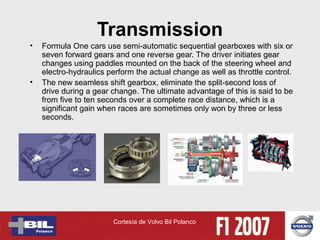
•   Formula One cars use semi-automatic sequential gearboxes with six or
    seven forward gears and one reverse gear. The driver initiates gear
    changes using paddles mounted on the back of the steering wheel and
    electro-hydraulics perform the actual change as well as throttle control.
•   The new seamless shift gearbox, eliminate the split-second loss of
    drive during a gear change. The ultimate advantage of this is said to be
    from five to ten seconds over a complete race distance, which is a
    significant gain when races are sometimes only won by three or less
    seconds.


                        Cortesía de Volvo Bil Polanco
Aerodynamics
•   The cars' aerodynamics are designed to provide maximum downforce
    with a minimum of drag; every part of the bodywork is designed with
    this aim in mind.
•   F1 car produces much more downforce than any other open-wheel
    formula; for example the Indycars produce downforce equal to their
    weight at 190 km/h, while an F1 car achieves the same downforce at
    130 km/h.


                        Cortesía de Volvo Bil Polanco
Construction
The cars are constructed from
composites of carbon fibre and
similar ultra-lightweight
(and incredibly expensive to
manufacture) materials.
The minimum weight permissible
is 605 kg including the driver,
fluids and on-board cameras.
However, all F1 cars weigh some
as little as 440 kg., so teams add
ballast to the cars to bring them up
to the minimum legal weight.
The advantage of using ballast
is that it can be placed anywhere
 in the car to provide ideal weight
distribution


                                       Cortesía de Volvo Bil Polanco
Steering wheel
•   The wheel can be used to alter traction control settings, change gears, apply rev
    limiter, adjust fuel air mix, change brake pressure and call the radio. Data such
    as rpm, laptimes, speed and gear is displayed on an LCD screen.
•   The wheel alone can cost about $40,000, and with carbon fibre construction,
    weighs in at 1.3 kilograms.


                           Cortesía de Volvo Bil Polanco
Fuel
•   Formula One fuel cannot contain compounds that are not found in
    commercial gasoline. Blends are tuned for maximum performance in
    given weather conditions or different circuits.
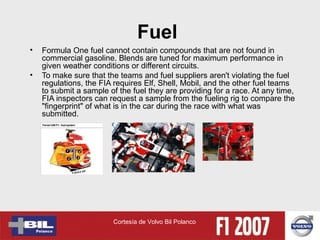
•   To make sure that the teams and fuel suppliers aren't violating the fuel
    regulations, the FIA requires Elf, Shell, Mobil, and the other fuel teams
    to submit a sample of the fuel they are providing for a race. At any time,
    FIA inspectors can request a sample from the fueling rig to compare the
    "fingerprint" of what is in the car during the race with what was
    submitted.


                        Cortesía de Volvo Bil Polanco
Tyres & Brakes
•   By regulation, the tyres feature a minimum of four grooves in them, with the intention of
    slowing the cars down. They can be no wider than 355 mm and 380 mm at the front and
    rear respectively. A tyre is built to last just one race distance, a little over 300 km.

•   These brakes are designed and manufactured to work in extreme temperatures, up to
    1,000 degrees Celsius. The driver can control brake force distribution fore and aft to
    compensate for changes in track conditions.
•   An average F1 car can decelerate from 100-0 km/h in about 17 metres. Usual braking
    forces for an F1 car are 4.5 g to 5.5 g when braking from 300 km/h.


                               Cortesía de Volvo Bil Polanco
Performance
•   Every F1 car on the grid is capable of going from nought to 160 km/h and back to nought in
    less than five seconds. Grand Prix cars can negotiate corners at significantly higher speeds
    than other racing cars because of the intense levels of grip and downforce.
•   Cornering speed is so high that Formula One drivers have strength training routines just for
    the neck muscles. The combination of light weight (605 kg), power (950 bhp),
    aerodynamics, and ultra-high performance tyres is what gives the F1 car its performance
    figures.
•   The principal consideration for F1 designers is acceleration, and not simply top speed.


                              Cortesía de Volvo Bil Polanco
Forward
 acceleration
• 0 to 100 km/h: 1.9 seconds
• 0 to 200 km/h: 3.9 seconds
• 0 to 300 km/h: 8.4 seconds
The acceleration figure is usually
1.4 g up to 200 km/h, which
means the driver is pushed back
 in the seat with 1.4 times his
bodyweight.


                         Cortesía de Volvo Bil Polanco
Deceleration
•   The carbon brakes in combination with the aerodynamics produces
    truly remarkable braking forces.
•   The deceleration force under braking is usually 4 g, and can be as
    high as 5-6 g. The drivers also utilise 'engine braking' by downshifting
    rapidly.
•   As a result of these high braking forces, an F1 car can come to a
    complete stop from 300 km/h in less than 3.5 seconds.


                         Cortesía de Volvo Bil Polanco
Turning acceleration
•   An F1 car is designed principally for high-speed cornering, thus the
    aerodynamic elements can produce as much as three times the car's
    weight in downforce, an F1 car to corner at amazing speeds, seeming
    to defy the laws of physics.
•   As an example of the extreme cornering speeds, the Blanchimont and
    Eau Rouge corners at Spa-Francorchamps are taken flat-out at above
    300 km/h.


                       Cortesía de Volvo Bil Polanco
Top Speeds
•   Top speeds are in practice limited by the longest straight at the track
    and by the need to balance the car's aerodynamic configuration
    between high straight line speed (low downforce) and high cornering
    speed (high downforce) to achieve the fastest lap time.
•   The top recorded speed on track was 372 km/h at Monza in 2005.


                       Cortesía de Volvo Bil Polanco
COMPORTAMIENTO DEL CARRO


Cortesía de Volvo Bil Polanco
Full name       Force India Formula One
     Base          Silverstone,
                   Northamptonshire,
                   United Kingdom


Team principal/s   Colin Kolles (Germany)
Chief Technical    Mike Gascoyne (U.K.)
    Officer
   Technical       James Key (U.K.)
    director
 Race drivers      Adrian Sutil (Germany)
                   Giancarlo Fisichella
                   (France)
  Test drivers     .Vitantonio Liuzzi (France)
    Chassis        Force India VJM-01
    Engine         Ferrari
     Tyres         Bridgestone
Force India will use the VJM-
01 chassis, an updated
version of the previous
year's Spyker car for the first
part of the 2008 season.
 The team will be using
customer Ferrari engines in
2008 with the team's existing
deal with Ferrari running to
2010. The team will also be
using the Indian flag in its
team logo from 2008.
FORCE INDIA
Formula 1
Formula 1
Formula 1
Formula 1
Formula 1

Formula 1

  • 2.
    Content:--- • Introduction • Typesof Racing • Engines • Transmission • Aerodynamics • Construction • Steering Wheel
  • 3.
    • Fuel • Tyres& Brakes • Performance • Acceleration • Mechanics • Formula-1 in INDIA
  • 4.
    Introduction Formula-1 is theone of the best race in the world. The cars are burning the roads, to give perfect Performance. It is very popular in European nations. All American so an motor companies are gathering together To give people an enjoy of V-engine sound and Driving Techniques. It is so thrilling, surprising and costly.
  • 5.
    Types of Racing Formula-1 WRC A1GP Trans-Orientale Formula-2 Muscle Car Racing Formula-DRIFT GO-Carting D1GP NASCAR Racing HUMMER Rally DRAG Racing
  • 6.
    ` Massa Räikkönen Cortesía de Volvo Bil Polanco
  • 7.
    Fisichela Kovalainen Cortesía de Volvo Bil Polanco
  • 8.
    Rosberg Wurz Cortesía de Volvo Bil Polanco
  • 9.
    R.Schumacher Trulli Cortesía de Volvo Bil Polanco
  • 10.
    Button Barrichelo Cortesía de Volvo Bil Polanco
  • 11.
    Sato Davidson Cortesía de Volvo Bil Polanco
  • 12.
    Alonso Hamiltonn Cortesía de Volvo Bil Polanco
  • 13.
    Engines • For a decade F1 cars had run with 3.0 litre normally-aspirated V10 engines, but in an attempt to slow the cars down, the FIA mandated that as of the 2006 season the cars must be powered by 2.4 litre naturally- aspirated engines in the V8 configuration that have no more than four valves per cylinder. • As of the start of the 2006 season most engines on the grid rev up to 19,000 rpm. The new 2.4L V8 engines are reported to develop between 720 hp and 750 hp. Cortesía de Volvo Bil Polanco
  • 14.
    The engines produce over 100,000 BTU per minute of heat that must be dumped, usually to the atmosphere via radiators and the exhaust, which can reach temperatures over 1,000 degrees Celsius. They consume around 650 litres of air per second. Race fuel consumption rate is normally around 75 litres per 100 kilometres travelled. • As of the 2006 Chinese Grand Prix all development of engines will be frozen until 2009, meaning that the teams will use engines of the same spec for the next two seasons. The end of the engine freeze has been suggested to be the beginning of bio-fuel. Cortesía de Volvo Bil Polanco
  • 15.
    Transmission • Formula One cars use semi-automatic sequential gearboxes with six or seven forward gears and one reverse gear. The driver initiates gear changes using paddles mounted on the back of the steering wheel and electro-hydraulics perform the actual change as well as throttle control. • The new seamless shift gearbox, eliminate the split-second loss of drive during a gear change. The ultimate advantage of this is said to be from five to ten seconds over a complete race distance, which is a significant gain when races are sometimes only won by three or less seconds. Cortesía de Volvo Bil Polanco
  • 16.
    Aerodynamics • The cars' aerodynamics are designed to provide maximum downforce with a minimum of drag; every part of the bodywork is designed with this aim in mind. • F1 car produces much more downforce than any other open-wheel formula; for example the Indycars produce downforce equal to their weight at 190 km/h, while an F1 car achieves the same downforce at 130 km/h. Cortesía de Volvo Bil Polanco
  • 17.
    Construction The cars areconstructed from composites of carbon fibre and similar ultra-lightweight (and incredibly expensive to manufacture) materials. The minimum weight permissible is 605 kg including the driver, fluids and on-board cameras. However, all F1 cars weigh some as little as 440 kg., so teams add ballast to the cars to bring them up to the minimum legal weight. The advantage of using ballast is that it can be placed anywhere in the car to provide ideal weight distribution Cortesía de Volvo Bil Polanco
  • 18.
    Steering wheel • The wheel can be used to alter traction control settings, change gears, apply rev limiter, adjust fuel air mix, change brake pressure and call the radio. Data such as rpm, laptimes, speed and gear is displayed on an LCD screen. • The wheel alone can cost about $40,000, and with carbon fibre construction, weighs in at 1.3 kilograms. Cortesía de Volvo Bil Polanco
  • 19.
    Fuel • Formula One fuel cannot contain compounds that are not found in commercial gasoline. Blends are tuned for maximum performance in given weather conditions or different circuits. • To make sure that the teams and fuel suppliers aren't violating the fuel regulations, the FIA requires Elf, Shell, Mobil, and the other fuel teams to submit a sample of the fuel they are providing for a race. At any time, FIA inspectors can request a sample from the fueling rig to compare the "fingerprint" of what is in the car during the race with what was submitted. Cortesía de Volvo Bil Polanco
  • 20.
    Tyres & Brakes • By regulation, the tyres feature a minimum of four grooves in them, with the intention of slowing the cars down. They can be no wider than 355 mm and 380 mm at the front and rear respectively. A tyre is built to last just one race distance, a little over 300 km. • These brakes are designed and manufactured to work in extreme temperatures, up to 1,000 degrees Celsius. The driver can control brake force distribution fore and aft to compensate for changes in track conditions. • An average F1 car can decelerate from 100-0 km/h in about 17 metres. Usual braking forces for an F1 car are 4.5 g to 5.5 g when braking from 300 km/h. Cortesía de Volvo Bil Polanco
  • 21.
    Performance • Every F1 car on the grid is capable of going from nought to 160 km/h and back to nought in less than five seconds. Grand Prix cars can negotiate corners at significantly higher speeds than other racing cars because of the intense levels of grip and downforce. • Cornering speed is so high that Formula One drivers have strength training routines just for the neck muscles. The combination of light weight (605 kg), power (950 bhp), aerodynamics, and ultra-high performance tyres is what gives the F1 car its performance figures. • The principal consideration for F1 designers is acceleration, and not simply top speed. Cortesía de Volvo Bil Polanco
  • 22.
    Forward acceleration • 0to 100 km/h: 1.9 seconds • 0 to 200 km/h: 3.9 seconds • 0 to 300 km/h: 8.4 seconds The acceleration figure is usually 1.4 g up to 200 km/h, which means the driver is pushed back in the seat with 1.4 times his bodyweight. Cortesía de Volvo Bil Polanco
  • 23.
    Deceleration • The carbon brakes in combination with the aerodynamics produces truly remarkable braking forces. • The deceleration force under braking is usually 4 g, and can be as high as 5-6 g. The drivers also utilise 'engine braking' by downshifting rapidly. • As a result of these high braking forces, an F1 car can come to a complete stop from 300 km/h in less than 3.5 seconds. Cortesía de Volvo Bil Polanco
  • 24.
    Turning acceleration • An F1 car is designed principally for high-speed cornering, thus the aerodynamic elements can produce as much as three times the car's weight in downforce, an F1 car to corner at amazing speeds, seeming to defy the laws of physics. • As an example of the extreme cornering speeds, the Blanchimont and Eau Rouge corners at Spa-Francorchamps are taken flat-out at above 300 km/h. Cortesía de Volvo Bil Polanco
  • 25.
    Top Speeds • Top speeds are in practice limited by the longest straight at the track and by the need to balance the car's aerodynamic configuration between high straight line speed (low downforce) and high cornering speed (high downforce) to achieve the fastest lap time. • The top recorded speed on track was 372 km/h at Monza in 2005. Cortesía de Volvo Bil Polanco
  • 26.
  • 27.
    Full name Force India Formula One Base Silverstone, Northamptonshire, United Kingdom Team principal/s Colin Kolles (Germany) Chief Technical Mike Gascoyne (U.K.) Officer Technical James Key (U.K.) director Race drivers Adrian Sutil (Germany) Giancarlo Fisichella (France) Test drivers .Vitantonio Liuzzi (France) Chassis Force India VJM-01 Engine Ferrari Tyres Bridgestone
  • 28.
    Force India willuse the VJM- 01 chassis, an updated version of the previous year's Spyker car for the first part of the 2008 season. The team will be using customer Ferrari engines in 2008 with the team's existing deal with Ferrari running to 2010. The team will also be using the Indian flag in its team logo from 2008.
  • 29.