EUROPEAN LANGUAGES www.euroasia.co.nz 0800 EUROASIA
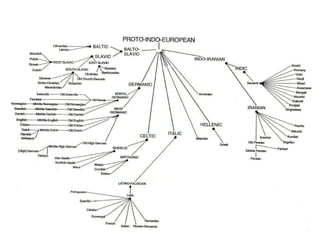
What is a “European language”? All the languages spoken in Europe today? All the languages spoken in the “old Europe”? Members of the Indo-European family of languages?
Families of languages Most languages are related to at least one other language. Philologists look at similarities of vocabulary, grammar etc. In some cases, the links are obvious (e.g. Spanish and Italian) In others, it takes some effort to see the links  (e.g. Finnish and Hungarian)
The Indo-European family The most widely spread of all language families. Links between many European languages had long been obvious. Links with Persian and Indian languages were only discovered in the 18 th  century.
 
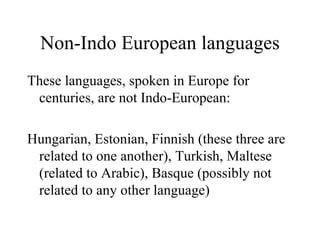
Non-Indo European languages These languages, spoken in Europe for centuries, are not Indo-European: Hungarian, Estonian, Finnish (these three are related to one another), Turkish, Maltese (related to Arabic), Basque (possibly not related to any other language)
Germanic languages One of the “big three” subdivisions of the “European” Indo-European languages. Romance and Slavonic are the other two. English is a Germanic language!
Two of our Germanic cousins Dutch Waar is mijn vader?  Is hij in de straat? Nee, om drie uur was hij daar, maar nu is hij in ons huis.   German Was hast du da?  Warst du im Garten? Ich habe Brot mit Butter, Käse – und drei Äpfel vom Garten!
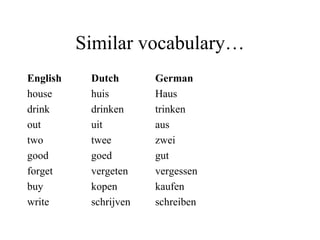
Similar vocabulary… English Dutch German house huis Haus drink drinken trinken out uit aus two twee zwei good goed gut forget vergeten vergessen buy kopen kaufen write schrijven schreiben
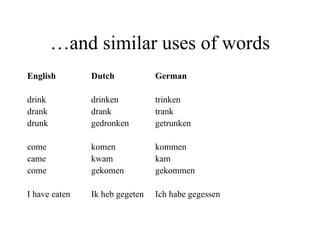
… and similar uses of words English Dutch German drink drinken trinken drank drank trank drunk gedronken getrunken   come  komen kommen came kwam kam come  gekomen gekommen   I have eaten Ik heb gegeten Ich habe gegessen  
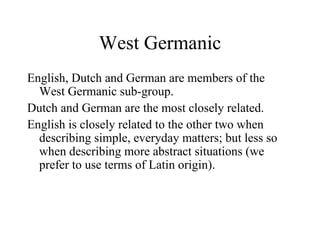
West Germanic English, Dutch and German are members of the West Germanic sub-group. Dutch and German are the most closely related. English is closely related to the other two when describing simple, everyday matters; but less so when describing more abstract situations (we prefer to use terms of Latin origin).
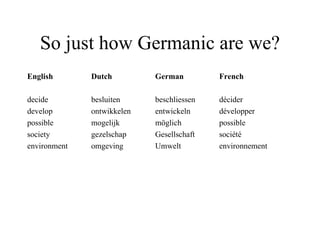
So just how Germanic are we? English Dutch German French   decide besluiten beschliessen décider develop ontwikkelen entwickeln développer possible mogelijk möglich possible society gezelschap Gesellschaft société environment omgeving Umwelt environnement  
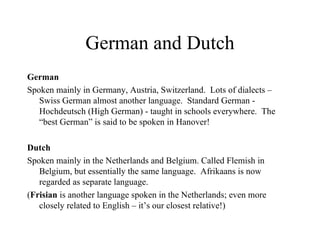
German and Dutch German Spoken mainly in  Germany, Austria, Switzerland.  Lots of dialects  – Swiss German almost another language .  Standard German -  Hochdeutsch  (High German) -  taught in schools  everywhere .  The  “best German”  is said to be spoken in Hanover!   Dutch Spoken mainly in the Netherlands and Belgium.   Called  Flemish in Belgium , but essentially the same language .  Afrikaans is  now  regarded as separate language. ( Frisian  is another language spoken in the Netherlands; even more closely related to English – it’s our closest relative!)
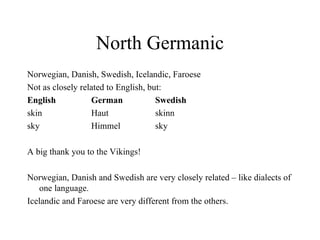
North Germanic Norwegian, Danish, Swedish, Icelandic, Faroese Not as closely related to English, but: English German Swedish  skin Haut skinn sky Himmel sky A big thank you to the Vikings! Norwegian, Danish and Swedish are very closely related – like dialects of one language. Icelandic and Faroese are very different from the others.
Romance languages Descended from Latin French, Portuguese, Spanish, Italian, Romanian Also Catalan, Galician, Sardinian and others
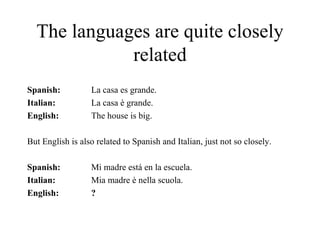
The languages are quite closely related   Spanish: La casa es grande. Italian: La casa è grande. English:  The house is big. But English is also related to Spanish and Italian, just not so closely. Spanish: Mi madre está en la escuela. Italian: Mia madre è nella scuola. English: ?
What do they have in common? Vocabulary often very similar Similar pattern of tenses Masculine and feminine gender Adjectives that always agree with nouns
Spanish and Portuguese Spanish Spoken in Spain and through most of Latin America “ Standard” language is that of central Spain (Castilian) Spanish has some Arabic influences  Latin American Spanish has some different consonantal sounds, some different words Portuguese Spoken in Portugal, Brazil, Mozambique, Angola Brazilian Portuguese has a different feel from European Portuguese, but speakers of both understand one another perfectly well The written language is quite similar to written Spanish, but spoken Portuguese has quite a different sound
French and Italian French Spoken in France, Belgium, Switzerland, Canada, North and West Africa, New Caledonia, Tahiti, various islands in the West Indies… Has moved furthest from Latin – quite a lot of words of Germanic origin Spelling reflects pronunciation of past times (like English!) Unique and complex sound patterns, sometimes difficult for foreigners! Lots of dialects; “new” ones spoken by young people and migrants perhaps hardest to understand Italian Spoken in Italy and in a small part of Switzerland Perhaps the closest Romance language to Latin Many dialects – the standard is based on the language of Florence The vast majority of words end in a vowel – gives Italian a musical feel
Romanian and others Romanian Surrounded by Slavonic! Slavonic influences quite marked Quite a bit different from other Romance languages, but vocabulary is strongly based on Latin Catalan Widely spoken in eastern Spain; Valencian is essentially a dialect Galician Basically a dialect of Portuguese, spoken in NW Spain
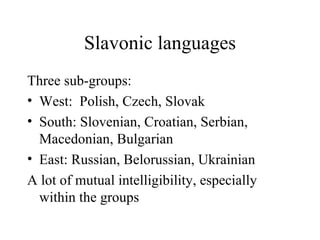
Slavonic languages Three sub-groups: West:  Polish, Czech, Slovak South: Slovenian, Croatian, Serbian, Macedonian, Bulgarian East: Russian, Belorussian, Ukrainian A lot of mutual intelligibility, especially within the groups
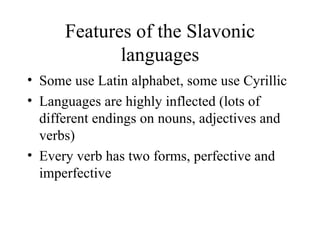
Features of the Slavonic languages Some use Latin alphabet, some use Cyrillic Languages are highly inflected (lots of different endings on nouns, adjectives and verbs) Every verb has two forms, perfective and imperfective
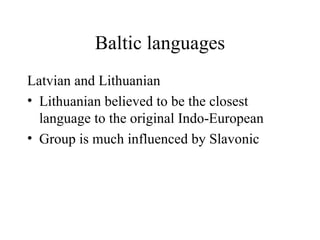
Baltic languages Latvian and Lithuanian Lithuanian believed to be the closest language to the original Indo-European Group is much influenced by Slavonic
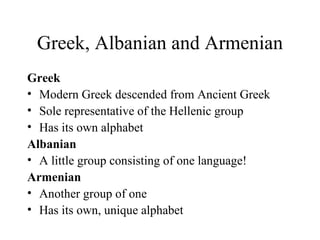
Greek, Albanian and Armenian Greek Modern Greek descended from Ancient Greek Sole representative of the Hellenic group Has its own alphabet Albanian  A little group consisting of one language! Armenian Another group of one Has its own, unique alphabet
Celtic languages Originally widely spoken in Europe, but now spoken regularly by little more than 1m people. Welsh  – spoken by about 25% of Welsh population Irish  – a national language, but only in widespread use in everyday life in certain rural areas Gaelic  – mainly spoken in the islands off the west coast of Scotland Breton  – very limited use in Brittany Manx  and  Cornish  are effectively dead languages
EUROPEAN LANGUAGES www.euroasia.co.nz 0800 EUROASIA

European Languages - history and evolution

  • 1.
  • 2.
    What is a“European language”? All the languages spoken in Europe today? All the languages spoken in the “old Europe”? Members of the Indo-European family of languages?
  • 3.
    Families of languagesMost languages are related to at least one other language. Philologists look at similarities of vocabulary, grammar etc. In some cases, the links are obvious (e.g. Spanish and Italian) In others, it takes some effort to see the links (e.g. Finnish and Hungarian)
  • 4.
    The Indo-European familyThe most widely spread of all language families. Links between many European languages had long been obvious. Links with Persian and Indian languages were only discovered in the 18 th century.
  • 5.
  • 6.
    Non-Indo European languagesThese languages, spoken in Europe for centuries, are not Indo-European: Hungarian, Estonian, Finnish (these three are related to one another), Turkish, Maltese (related to Arabic), Basque (possibly not related to any other language)
  • 7.
    Germanic languages Oneof the “big three” subdivisions of the “European” Indo-European languages. Romance and Slavonic are the other two. English is a Germanic language!
  • 8.
    Two of ourGermanic cousins Dutch Waar is mijn vader? Is hij in de straat? Nee, om drie uur was hij daar, maar nu is hij in ons huis.   German Was hast du da? Warst du im Garten? Ich habe Brot mit Butter, Käse – und drei Äpfel vom Garten!
  • 9.
    Similar vocabulary… EnglishDutch German house huis Haus drink drinken trinken out uit aus two twee zwei good goed gut forget vergeten vergessen buy kopen kaufen write schrijven schreiben
  • 10.
    … and similaruses of words English Dutch German drink drinken trinken drank drank trank drunk gedronken getrunken   come komen kommen came kwam kam come gekomen gekommen   I have eaten Ik heb gegeten Ich habe gegessen  
  • 11.
    West Germanic English,Dutch and German are members of the West Germanic sub-group. Dutch and German are the most closely related. English is closely related to the other two when describing simple, everyday matters; but less so when describing more abstract situations (we prefer to use terms of Latin origin).
  • 12.
    So just howGermanic are we? English Dutch German French   decide besluiten beschliessen décider develop ontwikkelen entwickeln développer possible mogelijk möglich possible society gezelschap Gesellschaft société environment omgeving Umwelt environnement  
  • 13.
    German and DutchGerman Spoken mainly in Germany, Austria, Switzerland. Lots of dialects – Swiss German almost another language . Standard German - Hochdeutsch (High German) - taught in schools everywhere . The “best German” is said to be spoken in Hanover!   Dutch Spoken mainly in the Netherlands and Belgium. Called Flemish in Belgium , but essentially the same language . Afrikaans is now regarded as separate language. ( Frisian is another language spoken in the Netherlands; even more closely related to English – it’s our closest relative!)
  • 14.
    North Germanic Norwegian,Danish, Swedish, Icelandic, Faroese Not as closely related to English, but: English German Swedish skin Haut skinn sky Himmel sky A big thank you to the Vikings! Norwegian, Danish and Swedish are very closely related – like dialects of one language. Icelandic and Faroese are very different from the others.
  • 15.
    Romance languages Descendedfrom Latin French, Portuguese, Spanish, Italian, Romanian Also Catalan, Galician, Sardinian and others
  • 16.
    The languages arequite closely related   Spanish: La casa es grande. Italian: La casa è grande. English: The house is big. But English is also related to Spanish and Italian, just not so closely. Spanish: Mi madre está en la escuela. Italian: Mia madre è nella scuola. English: ?
  • 17.
    What do theyhave in common? Vocabulary often very similar Similar pattern of tenses Masculine and feminine gender Adjectives that always agree with nouns
  • 18.
    Spanish and PortugueseSpanish Spoken in Spain and through most of Latin America “ Standard” language is that of central Spain (Castilian) Spanish has some Arabic influences Latin American Spanish has some different consonantal sounds, some different words Portuguese Spoken in Portugal, Brazil, Mozambique, Angola Brazilian Portuguese has a different feel from European Portuguese, but speakers of both understand one another perfectly well The written language is quite similar to written Spanish, but spoken Portuguese has quite a different sound
  • 19.
    French and ItalianFrench Spoken in France, Belgium, Switzerland, Canada, North and West Africa, New Caledonia, Tahiti, various islands in the West Indies… Has moved furthest from Latin – quite a lot of words of Germanic origin Spelling reflects pronunciation of past times (like English!) Unique and complex sound patterns, sometimes difficult for foreigners! Lots of dialects; “new” ones spoken by young people and migrants perhaps hardest to understand Italian Spoken in Italy and in a small part of Switzerland Perhaps the closest Romance language to Latin Many dialects – the standard is based on the language of Florence The vast majority of words end in a vowel – gives Italian a musical feel
  • 20.
    Romanian and othersRomanian Surrounded by Slavonic! Slavonic influences quite marked Quite a bit different from other Romance languages, but vocabulary is strongly based on Latin Catalan Widely spoken in eastern Spain; Valencian is essentially a dialect Galician Basically a dialect of Portuguese, spoken in NW Spain
  • 21.
    Slavonic languages Threesub-groups: West: Polish, Czech, Slovak South: Slovenian, Croatian, Serbian, Macedonian, Bulgarian East: Russian, Belorussian, Ukrainian A lot of mutual intelligibility, especially within the groups
  • 22.
    Features of theSlavonic languages Some use Latin alphabet, some use Cyrillic Languages are highly inflected (lots of different endings on nouns, adjectives and verbs) Every verb has two forms, perfective and imperfective
  • 23.
    Baltic languages Latvianand Lithuanian Lithuanian believed to be the closest language to the original Indo-European Group is much influenced by Slavonic
  • 24.
    Greek, Albanian andArmenian Greek Modern Greek descended from Ancient Greek Sole representative of the Hellenic group Has its own alphabet Albanian A little group consisting of one language! Armenian Another group of one Has its own, unique alphabet
  • 25.
    Celtic languages Originallywidely spoken in Europe, but now spoken regularly by little more than 1m people. Welsh – spoken by about 25% of Welsh population Irish – a national language, but only in widespread use in everyday life in certain rural areas Gaelic – mainly spoken in the islands off the west coast of Scotland Breton – very limited use in Brittany Manx and Cornish are effectively dead languages
  • 26.