Lecture - 3
Course Teacher
Dr.K.RAMAKRISHNAN
Professor (Agrl .Extn)
Topic
Types of communication
Introduction
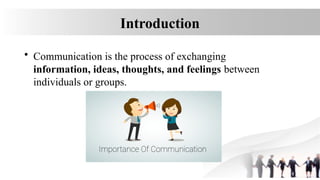
• Communication is the process of exchanging
information, ideas, thoughts, and feelings between
individuals or groups.
Key Elements:
1. Sender: The person or entity initiating the message.
2. Message: The information, idea, or feeling being conveyed.
3. Channel: The medium through which the message is
transmitted (e.g., spoken words, written text, body
language, digital media).
4. Receiver: The person or group for whom the message is
intended.
5. Feedback: The response from the receiver back to the
sender, indicating whether the message was understood.
Types of communication
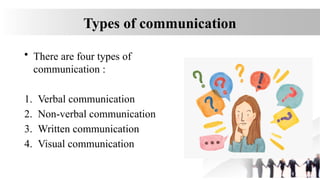
• There are four types of
communication :
1. Verbal communication
2. Non-verbal communication
3. Written communication
4. Visual communication
Verbal Communication
• Verbal communication is the use of spoken or written words to
convey messages. It encompasses oral communication, such as
face-to-face conversations, phone calls, speeches, and video
conferences, as well as written communication, including
emails, letters, reports, and social media posts.
• Effective verbal communication relies on clarity, tone,
appropriate vocabulary, and active listening to ensure
understanding and engagement.
• It plays a crucial role in sharing information, expressing
ideas and emotions, building relationships, and facilitating
collaboration in both personal and professional settings.
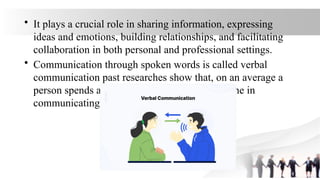
• Communication through spoken words is called verbal
communication past researches show that, on an average a
person spends about 70 percent of his active time in
communicating verbally.
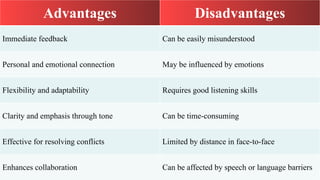
Advantages Disadvantages
Immediate feedback Can be easily misunderstood
Personal and emotional connection May be influenced by emotions
Flexibility and adaptability Requires good listening skills
Clarity and emphasis through tone Can be time-consuming
Effective for resolving conflicts Limited by distance in face-to-face
Enhances collaboration Can be affected by speech or language barriers
Non-verbal communication
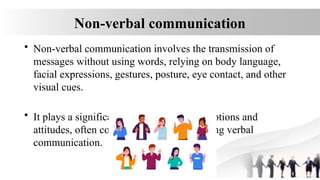
• Non-verbal communication involves the transmission of
messages without using words, relying on body language,
facial expressions, gestures, posture, eye contact, and other
visual cues.
• It plays a significant role in conveying emotions and
attitudes, often complementing or enhancing verbal
communication.
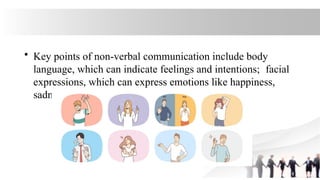
• Key points of non-verbal communication include body
language, which can indicate feelings and intentions; facial
expressions, which can express emotions like happiness,
sadness, or anger; gestures.
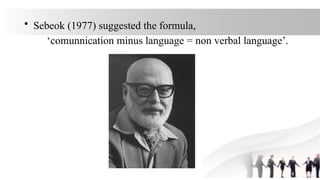
• Sebeok (1977) suggested the formula,
‘comunnication minus language = non verbal language’.
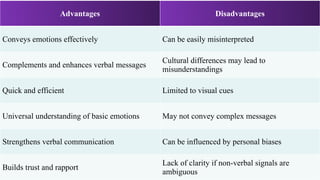
Advantages Disadvantages
Conveys emotions effectively Can be easily misinterpreted
Complements and enhances verbal messages
Cultural differences may lead to
misunderstandings
Quick and efficient Limited to visual cues
Universal understanding of basic emotions May not convey complex messages
Strengthens verbal communication Can be influenced by personal biases
Builds trust and rapport
Lack of clarity if non-verbal signals are
ambiguous
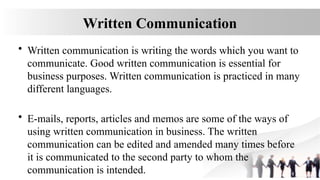
Written Communication
• Written communication is writing the words which you want to
communicate. Good written communication is essential for
business purposes. Written communication is practiced in many
different languages.
• E-mails, reports, articles and memos are some of the ways of
using written communication in business. The written
communication can be edited and amended many times before
it is communicated to the second party to whom the
communication is intended.
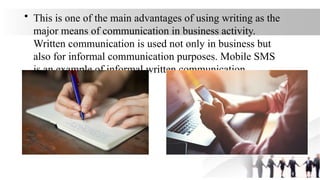
• This is one of the main advantages of using writing as the
major means of communication in business activity.
Written communication is used not only in business but
also for informal communication purposes. Mobile SMS
is an example of informal written communication.
Visual Communication
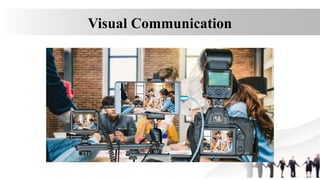
• The last type of communication out of the four types of
communication, is the visual communication. Visual
communication is visual display of information, like,
topography, photography, signs, symbols and designs.
Television and video clips are the electronic form of visual
communication.
• These are the four types of communication. The different types
of communication media are increasing day by day to ensure
clarity and eliminate the ambiguity in communication.
Visual Communication
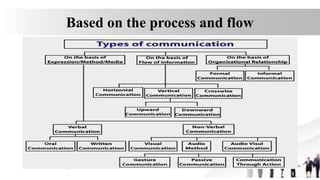
Based on the process and flow
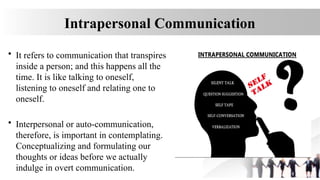
Intrapersonal Communication
• It refers to communication that transpires
inside a person; and this happens all the
time. It is like talking to oneself,
listening to oneself and relating one to
oneself.
• Interpersonal or auto-communication,
therefore, is important in contemplating.
Conceptualizing and formulating our
thoughts or ideas before we actually
indulge in overt communication.
Interpersonal Communication
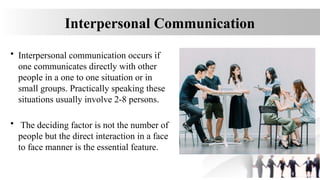
• Interpersonal communication occurs if
one communicates directly with other
people in a one to one situation or in
small groups. Practically speaking these
situations usually involve 2-8 persons.
• The deciding factor is not the number of
people but the direct interaction in a face
to face manner is the essential feature.
Group Communication
• Group Communication is an extension of interpersonal
communication where a group of individuals are involved in
exchange of ideas, skills and interests. Groups provide an
opportunity for people to come together to discuss and
exchange views of common interest.
• Group communication is considered effective as it provides an
opportunity for direct interaction among the members of the
group; it helps in bringing about changes in attitude and beliefs.
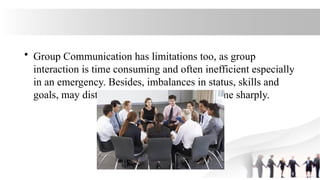
• Group Communication has limitations too, as group
interaction is time consuming and often inefficient especially
in an emergency. Besides, imbalances in status, skills and
goals, may distort the process and the outcome sharply.
Mass Communication
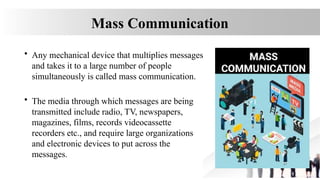
• Any mechanical device that multiplies messages
and takes it to a large number of people
simultaneously is called mass communication.
• The media through which messages are being
transmitted include radio, TV, newspapers,
magazines, films, records videocassette
recorders etc., and require large organizations
and electronic devices to put across the
messages.
Organisational Communication
• An organisation is a stable system of individual who work
together to achieve through a hierarchy or ranks and a
division of labour, common goals and objectives.
• Like human beings organisation also establish and maintain
themselves through communication with their environments
and amongst their parts.
• Organisational communication is a distinct form of
communication as it occurs in a highly structured setting It is
supposed to be a two-way communication where in ideas
should travel to and fro, without distortion or bias. It
determines the quality and climate of human relationship in
an organisation.
Grapevine Communication
• In communication literature, organisational
communication has been classified into first,
formal (follow-lines of authority) and informal
(grape vine) communication. Whether the
authorities wish it or not, informal networks do
exist in all organisations.
• They can be source of clarity or confusions,
depending on how they are viewed and utilised by
the management. The informal channels do not
cater to the employee's information needs.
Cross Communication
• Incumbents in any organisation are naturally, as also
professionally, required to interact with each other
horizontally or diagonally within the administrative
structure and are called cross communication. This
is a basis for healthy cooperation and coordination
at present.
• Such communication takes place more at the lower
levels and should be encouraged and utilised by the
management. For adequate cross-communication an
effective use of meetings, conferences, newsletters,
special bulletins etc., can be made use of.
Downward Communication
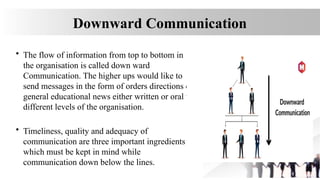
• The flow of information from top to bottom in
the organisation is called down ward
Communication. The higher ups would like to
send messages in the form of orders directions or
general educational news either written or oral to
different levels of the organisation.
• Timeliness, quality and adequacy of
communication are three important ingredients
which must be kept in mind while
communication down below the lines.
Upward Communication
– Two-way communication is an imperative in all types of interaction;
the downward communication will be poor, incomplete and
ineffective in the absence of proper and timely upward
communications for many of the top-down communications are
based on upward communications.
– In the context of the democratic decentralization concept in action, in
our rural reconstruction efforts, upward communication occupies a
still greater significance.
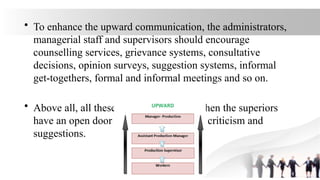
• To enhance the upward communication, the administrators,
managerial staff and supervisors should encourage
counselling services, grievance systems, consultative
decisions, opinion surveys, suggestion systems, informal
get-togethers, formal and informal meetings and so on.
• Above all, all these devices will work when the superiors
have an open door policy -open to facts, criticism and
suggestions.
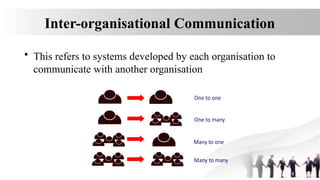
Inter-organisational Communication
• This refers to systems developed by each organisation to
communicate with another organisation
LS NO 3-1.pptx..........................

LS NO 3-1.pptx..........................

  • 1.
    Lecture - 3 CourseTeacher Dr.K.RAMAKRISHNAN Professor (Agrl .Extn)
  • 2.
  • 3.
    Introduction • Communication isthe process of exchanging information, ideas, thoughts, and feelings between individuals or groups.
  • 4.
    Key Elements: 1. Sender:The person or entity initiating the message. 2. Message: The information, idea, or feeling being conveyed. 3. Channel: The medium through which the message is transmitted (e.g., spoken words, written text, body language, digital media). 4. Receiver: The person or group for whom the message is intended. 5. Feedback: The response from the receiver back to the sender, indicating whether the message was understood.
  • 5.
    Types of communication •There are four types of communication : 1. Verbal communication 2. Non-verbal communication 3. Written communication 4. Visual communication
  • 6.
    Verbal Communication • Verbalcommunication is the use of spoken or written words to convey messages. It encompasses oral communication, such as face-to-face conversations, phone calls, speeches, and video conferences, as well as written communication, including emails, letters, reports, and social media posts. • Effective verbal communication relies on clarity, tone, appropriate vocabulary, and active listening to ensure understanding and engagement.
  • 7.
    • It playsa crucial role in sharing information, expressing ideas and emotions, building relationships, and facilitating collaboration in both personal and professional settings. • Communication through spoken words is called verbal communication past researches show that, on an average a person spends about 70 percent of his active time in communicating verbally.
  • 8.
    Advantages Disadvantages Immediate feedbackCan be easily misunderstood Personal and emotional connection May be influenced by emotions Flexibility and adaptability Requires good listening skills Clarity and emphasis through tone Can be time-consuming Effective for resolving conflicts Limited by distance in face-to-face Enhances collaboration Can be affected by speech or language barriers
  • 9.
    Non-verbal communication • Non-verbalcommunication involves the transmission of messages without using words, relying on body language, facial expressions, gestures, posture, eye contact, and other visual cues. • It plays a significant role in conveying emotions and attitudes, often complementing or enhancing verbal communication.
  • 10.
    • Key pointsof non-verbal communication include body language, which can indicate feelings and intentions; facial expressions, which can express emotions like happiness, sadness, or anger; gestures.
  • 11.
    • Sebeok (1977)suggested the formula, ‘comunnication minus language = non verbal language’.
  • 12.
    Advantages Disadvantages Conveys emotionseffectively Can be easily misinterpreted Complements and enhances verbal messages Cultural differences may lead to misunderstandings Quick and efficient Limited to visual cues Universal understanding of basic emotions May not convey complex messages Strengthens verbal communication Can be influenced by personal biases Builds trust and rapport Lack of clarity if non-verbal signals are ambiguous
  • 13.
    Written Communication • Writtencommunication is writing the words which you want to communicate. Good written communication is essential for business purposes. Written communication is practiced in many different languages. • E-mails, reports, articles and memos are some of the ways of using written communication in business. The written communication can be edited and amended many times before it is communicated to the second party to whom the communication is intended.
  • 14.
    • This isone of the main advantages of using writing as the major means of communication in business activity. Written communication is used not only in business but also for informal communication purposes. Mobile SMS is an example of informal written communication.
  • 15.
    Visual Communication • Thelast type of communication out of the four types of communication, is the visual communication. Visual communication is visual display of information, like, topography, photography, signs, symbols and designs. Television and video clips are the electronic form of visual communication. • These are the four types of communication. The different types of communication media are increasing day by day to ensure clarity and eliminate the ambiguity in communication.
  • 16.
  • 17.
    Based on theprocess and flow
  • 18.
    Intrapersonal Communication • Itrefers to communication that transpires inside a person; and this happens all the time. It is like talking to oneself, listening to oneself and relating one to oneself. • Interpersonal or auto-communication, therefore, is important in contemplating. Conceptualizing and formulating our thoughts or ideas before we actually indulge in overt communication.
  • 19.
    Interpersonal Communication • Interpersonalcommunication occurs if one communicates directly with other people in a one to one situation or in small groups. Practically speaking these situations usually involve 2-8 persons. • The deciding factor is not the number of people but the direct interaction in a face to face manner is the essential feature.
  • 20.
    Group Communication • GroupCommunication is an extension of interpersonal communication where a group of individuals are involved in exchange of ideas, skills and interests. Groups provide an opportunity for people to come together to discuss and exchange views of common interest. • Group communication is considered effective as it provides an opportunity for direct interaction among the members of the group; it helps in bringing about changes in attitude and beliefs.
  • 21.
    • Group Communicationhas limitations too, as group interaction is time consuming and often inefficient especially in an emergency. Besides, imbalances in status, skills and goals, may distort the process and the outcome sharply.
  • 22.
    Mass Communication • Anymechanical device that multiplies messages and takes it to a large number of people simultaneously is called mass communication. • The media through which messages are being transmitted include radio, TV, newspapers, magazines, films, records videocassette recorders etc., and require large organizations and electronic devices to put across the messages.
  • 23.
    Organisational Communication • Anorganisation is a stable system of individual who work together to achieve through a hierarchy or ranks and a division of labour, common goals and objectives. • Like human beings organisation also establish and maintain themselves through communication with their environments and amongst their parts.
  • 24.
    • Organisational communicationis a distinct form of communication as it occurs in a highly structured setting It is supposed to be a two-way communication where in ideas should travel to and fro, without distortion or bias. It determines the quality and climate of human relationship in an organisation.
  • 25.
    Grapevine Communication • Incommunication literature, organisational communication has been classified into first, formal (follow-lines of authority) and informal (grape vine) communication. Whether the authorities wish it or not, informal networks do exist in all organisations. • They can be source of clarity or confusions, depending on how they are viewed and utilised by the management. The informal channels do not cater to the employee's information needs.
  • 26.
    Cross Communication • Incumbentsin any organisation are naturally, as also professionally, required to interact with each other horizontally or diagonally within the administrative structure and are called cross communication. This is a basis for healthy cooperation and coordination at present. • Such communication takes place more at the lower levels and should be encouraged and utilised by the management. For adequate cross-communication an effective use of meetings, conferences, newsletters, special bulletins etc., can be made use of.
  • 27.
    Downward Communication • Theflow of information from top to bottom in the organisation is called down ward Communication. The higher ups would like to send messages in the form of orders directions or general educational news either written or oral to different levels of the organisation. • Timeliness, quality and adequacy of communication are three important ingredients which must be kept in mind while communication down below the lines.
  • 28.
    Upward Communication – Two-waycommunication is an imperative in all types of interaction; the downward communication will be poor, incomplete and ineffective in the absence of proper and timely upward communications for many of the top-down communications are based on upward communications. – In the context of the democratic decentralization concept in action, in our rural reconstruction efforts, upward communication occupies a still greater significance.
  • 29.
    • To enhancethe upward communication, the administrators, managerial staff and supervisors should encourage counselling services, grievance systems, consultative decisions, opinion surveys, suggestion systems, informal get-togethers, formal and informal meetings and so on. • Above all, all these devices will work when the superiors have an open door policy -open to facts, criticism and suggestions.
  • 30.
    Inter-organisational Communication • Thisrefers to systems developed by each organisation to communicate with another organisation