Why do TESTA?
@solentlearning
@tansyjtweets
Tansy Jessop
University of Liverpool
13 September 2017
Your thoughts
Go to www.menti.com and use the code 61 78 63
Type in three words or phrases to answer this
question:
What do you already know about TESTA?
What do you know about TESTA?
Your thoughts
Go to www.menti.com and use the code 35 68 38
Type in three words or phrases to answer this
question:
What is the main assessment & feedback
challenges you face?
Challenges you face
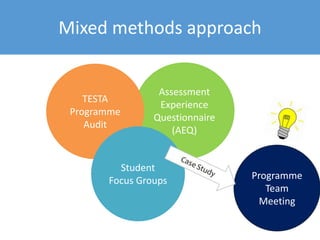
Mixed methods approach
Programme
Team
Meeting
Assessment
Experience
Questionnaire
(AEQ)
TESTA
Programme
Audit
Student
Focus Groups
Sustained growth
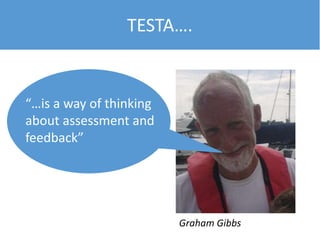
TESTA….
“…is a way of thinking
about assessment and
feedback”
Graham Gibbs
So why do TESTA?
Because assessment & feedback
are at the heart of student learning
1) Assessment drives what students pay attention
to, and defines the actual curriculum (Ramsden
2003).
2) Feedback is the single most important factor in
learning (Hattie 2009; Black and Wiliam 1998).
Because there is a problem
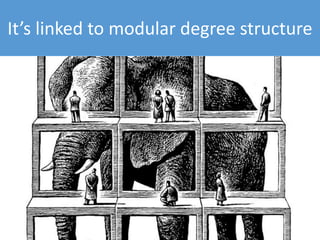
The modular degree
IKEA 101: great for flat-pack furniture but…
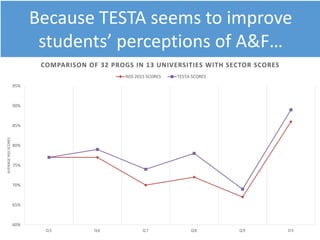
Because TESTA seems to improve
students’ perceptions of A&F…
60%
65%
70%
75%
80%
85%
90%
95%
Q5 Q6 Q7 Q8 Q9 OS
AVERAGENSSSCORES
COMPARISON OF 32 PROGS IN 13 UNIVERSITIES WITH SECTOR SCORES
NSS 2015 SCORES TESTA SCORES
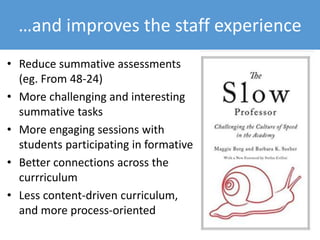
…and improves the staff experience
• Reduce summative assessments
(eg. From 48-24)
• More challenging and interesting
summative tasks
• More engaging sessions with
students participating in formative
• Better connections across the
curriculum
• Less content-driven curriculum,
and more process-oriented
TESTA: evidence to action
1. High summative and low formative diets
2. Disconnected feedback
3. Confusion about goals and standards
1. High summative: low formative
• High summative on UK, Irish, NZ and Indian degrees
• Summative a ‘pedagogy of control’
• Low formative: ratio of 1:8 formative to summative
• Weakly practised and understood
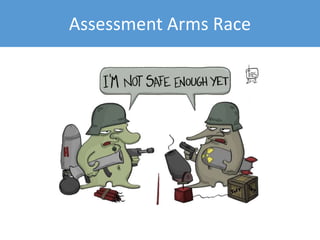
Assessment Arms Race
Your experience
Which of these
quotations resonates,
and why?
Any ideas to address the
problem?
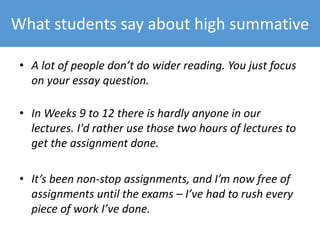
What students say about high summative
• A lot of people don’t do wider reading. You just focus
on your essay question.
• In Weeks 9 to 12 there is hardly anyone in our
lectures. I'd rather use those two hours of lectures to
get the assignment done.
• It’s been non-stop assignments, and I’m now free of
assignments until the exams – I’ve had to rush every
piece of work I’ve done.
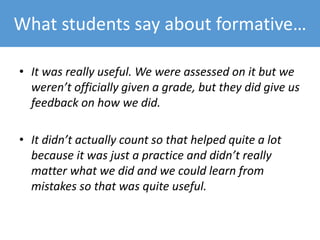
What students say about formative…
• It was really useful. We were assessed on it but we
weren’t officially given a grade, but they did give us
feedback on how we did.
• It didn’t actually count so that helped quite a lot
because it was just a practice and didn’t really
matter what we did and we could learn from
mistakes so that was quite useful.
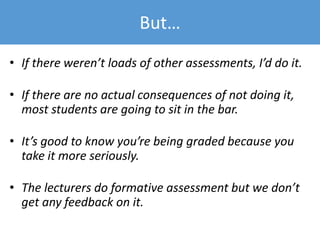
But…
• If there weren’t loads of other assessments, I’d do it.
• If there are no actual consequences of not doing it,
most students are going to sit in the bar.
• It’s good to know you’re being graded because you
take it more seriously.
• The lecturers do formative assessment but we don’t
get any feedback on it.
1) Low-risk opportunities for students to learn from
feedback (Sadler, 1989)
2) Helps students to fine-tune and understand
requirements and standards (Boud 2000, Nicol, 2006)
3) Feedback to lecturers from formative tasks helps to
adapt teaching (Hattie, 2009)
4) Engages students in cycles of reflection and
collaboration (Biggs 2003; Nicol & McFarlane Dick 2006)
5) Encourages and distributes student effort (Gibbs 2004).
Yet formative is the ‘silver bullet’
With the potential to deepen learning…
So, how do we do formative?
Three case studies of
successful formative
What made them
work?
Case Study 1: Business School
• Reduction from average 2 x summative, zero
formative per module
• …to 1 x summative and 3 x formative
• Required by students in entire business school
• All working to similar script
• Systematic shift, experimentation, less risky
together
Case Study 2: Social Sciences
• Problem: silent seminar, students not reading
• Public platform blogging
• Current academic texts
• In-class
• Threads and live discussion
• Linked to summative
Case study 3: Film and TV
• Seminar
• Problem: lack of discrimination about sources
• Students bring 1 x book, 1 x chapter, 1 x
journal article, 2 x pop culture articles
• Justify choices to group
• Reach consensus about five best sources
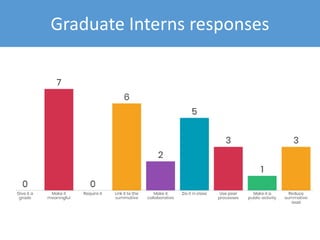
How to encourage formative assessment
Go to www.menti.com and use the code 22 20 43
Choose the three which you think work best
Graduate Interns responses
2. Disconnected feedback
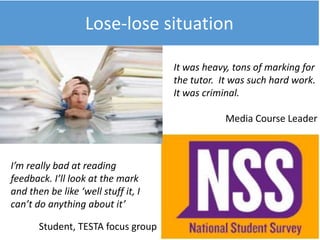
It was heavy, tons of marking for
the tutor. It was such hard work.
It was criminal.
Media Course Leader
I’m really bad at reading
feedback. I’ll look at the mark
and then be like ‘well stuff it, I
can’t do anything about it’
Student, TESTA focus group
Lose-lose situation
What students say…
It’s difficult because your assignments are so detached
from the next one you do for that subject. They don’t
relate to each other.
Because it’s at the end of the module, it doesn’t feed into
our future work.
Because they have to mark so many that our essay
becomes lost in the sea that they have to mark.
It was like ‘Who’s Holly?’ It’s that relationship where
you’re just a student.
Feedback as Dialogue?
• Conversation: who starts the dialogue?
• Cycles of reflection across modules
• Giving feedback to feedforward to next task
• Quick generic feedback
• Feedback synthesis tasks
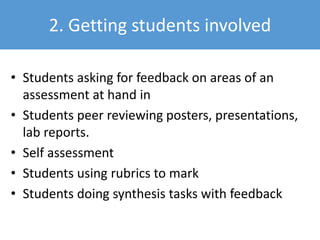
• Peer feedback (especially on formative)
• Technology: audio, screencast and blogging
• From feedback as ‘telling’…
• … to feedback as asking questions
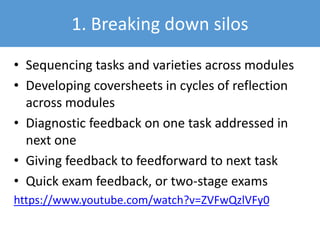
Strategies taken by TESTA programmes
The TESTA Effect
• Rebalancing formative and summative
• Greater connections across modules
• Better sequencing and progression of
assessment across the programme
• New approaches to formative, including more
authentic assessment
• Revives and refreshes curriculum design
• Improved student learning and NSS scores.
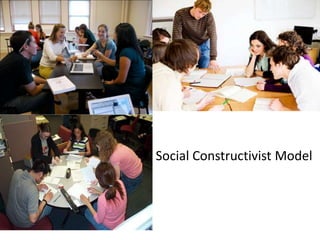
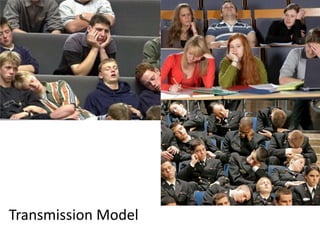
From this educational paradigm…
Transmission Model
Social Constructivist Model
Learning-oriented summative
https://www.youtube.com/watch?v=ZVFwQzlVFy0
References
Blaich, C., & Wise, K. (2011). From Gathering to Using Assessment Results: Lessons from the Wabash
National Study. Occasional Paper #8. University of Illinois: National Institution for Learning Outcomes
Assessment.
Boud, D. and Molloy, E. (2013) ‘Rethinking models of feedback for learning: The challenge of
design’, Assessment & Evaluation in Higher Education, 38(6), pp. 698–712. doi:
10.1080/02602938.2012.691462.
Gibbs, G. & Simpson, C. (2004) Conditions r which assessment supports students' learning. Learning and
Teaching in Higher Education. 1(1): 3-31.
Harland, T., McLean, A., Wass, R., Miller, E. and Sim, K. N. (2014) ‘An assessment arms race and its
fallout: High-stakes grading and the case for slow scholarship’, Assessment & Evaluation in Higher
Jessop, T. and Tomas, C. 2016 The implications of programme assessment on student learning.
Assessment and Evaluation in Higher Education. Published online 2 August 2016.
Jessop, T. and Maleckar, B. (2014). The Influence of disciplinary assessment patterns on student
learning: a comparative study. Studies in Higher Education. Published Online 27 August 2014
http://www.tandfonline.com/doi/abs/10.1080/03075079.2014.943170
Jessop, T. , El Hakim, Y. and Gibbs, G. (2014) The whole is greater than the sum of its parts: a large-scale
study of students’ learning in response to different assessment patterns. Assessment and Evaluation in
Higher Education. 39(1) 73-88.
Nicol, D. (2010) From monologue to dialogue: improving written feedback processes in mass higher
education, Assessment & Evaluation in Higher Education, 35: 5, 501 – 517.
O'Donovan, B , Price, M. and Rust, C. (2008) 'Developing student understanding of assessment
standards: a nested hierarchy of approaches', Teaching in Higher Education, 13: 2, 205 — 217
Sadler, D. R. (1989) ‘Formative assessment and the design of instructional systems’, Instructional
Science, 18(2), pp. 119–144. doi: 10.1007/bf00117714.

1 why do testa

  • 1.
    Why do TESTA? @solentlearning @tansyjtweets TansyJessop University of Liverpool 13 September 2017
  • 2.
    Your thoughts Go towww.menti.com and use the code 61 78 63 Type in three words or phrases to answer this question: What do you already know about TESTA?
  • 3.
    What do youknow about TESTA?
  • 4.
    Your thoughts Go towww.menti.com and use the code 35 68 38 Type in three words or phrases to answer this question: What is the main assessment & feedback challenges you face?
  • 5.
  • 7.
  • 8.
  • 9.
    TESTA…. “…is a wayof thinking about assessment and feedback” Graham Gibbs
  • 10.
    So why doTESTA?
  • 11.
    Because assessment &feedback are at the heart of student learning 1) Assessment drives what students pay attention to, and defines the actual curriculum (Ramsden 2003). 2) Feedback is the single most important factor in learning (Hattie 2009; Black and Wiliam 1998).
  • 12.
  • 13.
  • 14.
    IKEA 101: greatfor flat-pack furniture but…
  • 15.
    Because TESTA seemsto improve students’ perceptions of A&F… 60% 65% 70% 75% 80% 85% 90% 95% Q5 Q6 Q7 Q8 Q9 OS AVERAGENSSSCORES COMPARISON OF 32 PROGS IN 13 UNIVERSITIES WITH SECTOR SCORES NSS 2015 SCORES TESTA SCORES
  • 16.
    …and improves thestaff experience • Reduce summative assessments (eg. From 48-24) • More challenging and interesting summative tasks • More engaging sessions with students participating in formative • Better connections across the curriculum • Less content-driven curriculum, and more process-oriented
  • 17.
    TESTA: evidence toaction 1. High summative and low formative diets 2. Disconnected feedback 3. Confusion about goals and standards
  • 18.
    1. High summative:low formative • High summative on UK, Irish, NZ and Indian degrees • Summative a ‘pedagogy of control’ • Low formative: ratio of 1:8 formative to summative • Weakly practised and understood
  • 19.
  • 20.
    Your experience Which ofthese quotations resonates, and why? Any ideas to address the problem?
  • 21.
    What students sayabout high summative • A lot of people don’t do wider reading. You just focus on your essay question. • In Weeks 9 to 12 there is hardly anyone in our lectures. I'd rather use those two hours of lectures to get the assignment done. • It’s been non-stop assignments, and I’m now free of assignments until the exams – I’ve had to rush every piece of work I’ve done.
  • 22.
    What students sayabout formative… • It was really useful. We were assessed on it but we weren’t officially given a grade, but they did give us feedback on how we did. • It didn’t actually count so that helped quite a lot because it was just a practice and didn’t really matter what we did and we could learn from mistakes so that was quite useful.
  • 23.
    But… • If thereweren’t loads of other assessments, I’d do it. • If there are no actual consequences of not doing it, most students are going to sit in the bar. • It’s good to know you’re being graded because you take it more seriously. • The lecturers do formative assessment but we don’t get any feedback on it.
  • 24.
    1) Low-risk opportunitiesfor students to learn from feedback (Sadler, 1989) 2) Helps students to fine-tune and understand requirements and standards (Boud 2000, Nicol, 2006) 3) Feedback to lecturers from formative tasks helps to adapt teaching (Hattie, 2009) 4) Engages students in cycles of reflection and collaboration (Biggs 2003; Nicol & McFarlane Dick 2006) 5) Encourages and distributes student effort (Gibbs 2004). Yet formative is the ‘silver bullet’
  • 25.
    With the potentialto deepen learning…
  • 26.
    So, how dowe do formative? Three case studies of successful formative What made them work?
  • 27.
    Case Study 1:Business School • Reduction from average 2 x summative, zero formative per module • …to 1 x summative and 3 x formative • Required by students in entire business school • All working to similar script • Systematic shift, experimentation, less risky together
  • 28.
    Case Study 2:Social Sciences • Problem: silent seminar, students not reading • Public platform blogging • Current academic texts • In-class • Threads and live discussion • Linked to summative
  • 29.
    Case study 3:Film and TV • Seminar • Problem: lack of discrimination about sources • Students bring 1 x book, 1 x chapter, 1 x journal article, 2 x pop culture articles • Justify choices to group • Reach consensus about five best sources
  • 30.
    How to encourageformative assessment Go to www.menti.com and use the code 22 20 43 Choose the three which you think work best
  • 31.
  • 32.
  • 33.
    It was heavy,tons of marking for the tutor. It was such hard work. It was criminal. Media Course Leader I’m really bad at reading feedback. I’ll look at the mark and then be like ‘well stuff it, I can’t do anything about it’ Student, TESTA focus group Lose-lose situation
  • 34.
    What students say… It’sdifficult because your assignments are so detached from the next one you do for that subject. They don’t relate to each other. Because it’s at the end of the module, it doesn’t feed into our future work. Because they have to mark so many that our essay becomes lost in the sea that they have to mark. It was like ‘Who’s Holly?’ It’s that relationship where you’re just a student.
  • 35.
  • 36.
    • Conversation: whostarts the dialogue? • Cycles of reflection across modules • Giving feedback to feedforward to next task • Quick generic feedback • Feedback synthesis tasks • Peer feedback (especially on formative) • Technology: audio, screencast and blogging • From feedback as ‘telling’… • … to feedback as asking questions Strategies taken by TESTA programmes
  • 37.
    The TESTA Effect •Rebalancing formative and summative • Greater connections across modules • Better sequencing and progression of assessment across the programme • New approaches to formative, including more authentic assessment • Revives and refreshes curriculum design • Improved student learning and NSS scores.
  • 38.
  • 39.
  • 40.
  • 41.
  • 42.
    References Blaich, C., &Wise, K. (2011). From Gathering to Using Assessment Results: Lessons from the Wabash National Study. Occasional Paper #8. University of Illinois: National Institution for Learning Outcomes Assessment. Boud, D. and Molloy, E. (2013) ‘Rethinking models of feedback for learning: The challenge of design’, Assessment & Evaluation in Higher Education, 38(6), pp. 698–712. doi: 10.1080/02602938.2012.691462. Gibbs, G. & Simpson, C. (2004) Conditions r which assessment supports students' learning. Learning and Teaching in Higher Education. 1(1): 3-31. Harland, T., McLean, A., Wass, R., Miller, E. and Sim, K. N. (2014) ‘An assessment arms race and its fallout: High-stakes grading and the case for slow scholarship’, Assessment & Evaluation in Higher Jessop, T. and Tomas, C. 2016 The implications of programme assessment on student learning. Assessment and Evaluation in Higher Education. Published online 2 August 2016. Jessop, T. and Maleckar, B. (2014). The Influence of disciplinary assessment patterns on student learning: a comparative study. Studies in Higher Education. Published Online 27 August 2014 http://www.tandfonline.com/doi/abs/10.1080/03075079.2014.943170 Jessop, T. , El Hakim, Y. and Gibbs, G. (2014) The whole is greater than the sum of its parts: a large-scale study of students’ learning in response to different assessment patterns. Assessment and Evaluation in Higher Education. 39(1) 73-88. Nicol, D. (2010) From monologue to dialogue: improving written feedback processes in mass higher education, Assessment & Evaluation in Higher Education, 35: 5, 501 – 517. O'Donovan, B , Price, M. and Rust, C. (2008) 'Developing student understanding of assessment standards: a nested hierarchy of approaches', Teaching in Higher Education, 13: 2, 205 — 217 Sadler, D. R. (1989) ‘Formative assessment and the design of instructional systems’, Instructional Science, 18(2), pp. 119–144. doi: 10.1007/bf00117714.

Editor's Notes

  • #2 Tansy
  • #9 How do you measure soft stuff? 5 day cricket match versus 20/20
  • #10 What started as a research methodology has become a way of thinking. David Nicol – changing the discourse, the way we think about assessment and feedback; not only technical, research, mapping, also shaping our thinking. Evidence, assessment principles. Habermas framework.
  • #13 Data – persistent problem A&F scores. NSS not a good enough diagnostic tool. Green, amber, red - more luck than judgement. Traffic light systems – green for good. DVC find the people wo are doing well so we can share best practice. Three programmes. We don’t actually know why.
  • #14 Disconnected seeing the whole degree in silos – my module, lecturer perspective (Elephant, trunk, ears, tusks etc) compared to student perspective of the whole huge beast. I realise that what we were saying is two per module
  • #15 Not so good for complex learning, integrating knowledge, lends itself to disposable curriculum fragmented learning. Amplified summative, less time for formative. Hard to make connections, difficult to see the joins between assessments, much more assessment, much more assessment to accredit each little box. Multiplier effect. Less challenge, less integration. Lots of little neo-liberal tasks. The Assessment Arms Race.
  • #17 The TESTA report back of programme findings was by far the most significant meeting I have attended in ten years of sitting through many meetings at this university. For the first time, I felt as though I was a player on the pitch, rather than someone watching from the side-lines. We were discussing real issues. (Senior Lecturer, Education
  • #20 Summative as a ‘pedagogy of control’ Teach Less, learn more. Assess less, learn more.
  • #34 Feedback: all that effort, but what is the effect? Margaret Price But lots of projects and programmes do….