Forest Carbon
Partnership Facility &
BioCarbon Fund
Ellysar Baroudy
May 2018
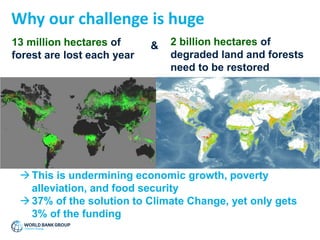
Why our challenge is huge
13 million hectares of
forest are lost each year
2 billion hectares of
degraded land and forests
need to be restored
This is undermining economic growth, poverty
alleviation, and food security
37% of the solution to Climate Change, yet only gets
3% of the funding
&
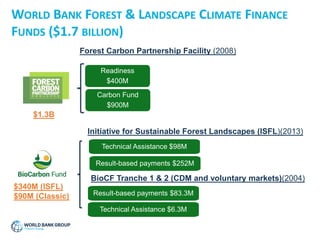
WORLD BANK FOREST & LANDSCAPE CLIMATE FINANCE
FUNDS ($1.7 BILLION)
Technical Assistance $98M
Result-based payments $252M
Initiative for Sustainable Forest Landscapes (ISFL)(2013)
BioCF Tranche 1 & 2 (CDM and voluntary markets)(2004)
Technical Assistance $6.3M
Result-based payments $83.3M
$340M (ISFL)
$90M (Classic)
Readiness
$400M
Carbon Fund
$900M
Forest Carbon Partnership Facility (2008)
$1.3B
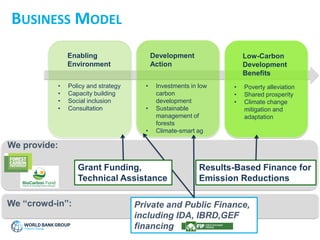
BUSINESS MODEL
Enabling
Environment
Low-Carbon
Development
Benefits
Development
Action
• Policy and strategy
• Capacity building
• Social inclusion
• Consultation
• Investments in low
carbon
development
• Sustainable
management of
forests
• Climate-smart ag
• Poverty alleviation
• Shared prosperity
• Climate change
mitigation and
adaptation
Results-Based Finance for
Emission Reductions
Private and Public Finance,
including IDA, IBRD,GEF
financing
Grant Funding,
Technical Assistance
We provide:
We “crowd-in”:
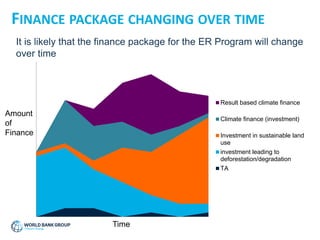
FINANCE PACKAGE CHANGING OVER TIME
It is likely that the finance package for the ER Program will change
over time
Result based climate finance
Climate finance (investment)
Investment in sustainable land
use
investment leading to
deforestation/degradation
TA
Time
Amount
of
Finance
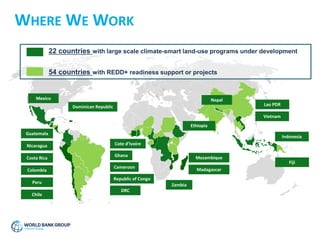
WHERE WE WORK
Zambia
Ethiopia
Ghana
Colombia
Indonesia
Costa Rica
Mexico Nepal
DRC
Republic of Congo
Chile
Vietnam
22 countries with large scale climate-smart land-use programs under development
54 countries with REDD+ readiness support or projects
Guatemala
Peru
Mozambique
Madagascar
Dominican Republic Lao PDR
Nicaragua
Fiji
Cameroon
Cote d’Ivoire
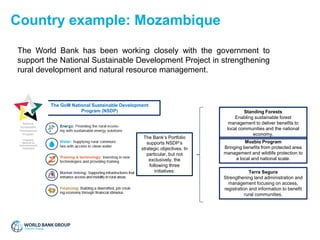
Working Together: World Bank and the Government of Mozambique
The GoM National Sustainable Development
Program (NSDP) Standing Forests
Enabling sustainable forest
management to deliver benefits to
local communities and the national
economy.
Mozbio Program
Bringing benefits from protected area
management and wildlife protection to
a local and national scale.
Terra Segura
Strengthening land administration and
management focusing on access,
registration and information to benefit
rural communities.
The Bank’s Portfolio
supports NSDP’s
strategic objectives. In
particular, but not
exclusively, the
following three
initiatives:
Country example: Mozambique
The World Bank has been working closely with the government to
support the National Sustainable Development Project in strengthening
rural development and natural resource management.
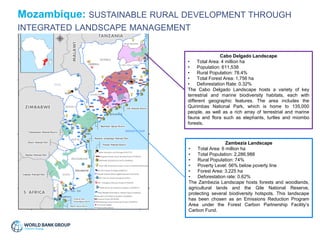
Cabo Delgado Landscape
• Total Area: 4 million ha
• Population: 611,538
• Rural Population: 78.4%
• Total Forest Area: 1,756 ha
• Deforestation Rate: 0.32%
The Cabo Delgado Landscape hosts a variety of key
terrestrial and marine biodiversity habitats, each with
different geographic features. The area includes the
Quirimbas National Park, which is home to 135,000
people, as well as a rich array of terrestrial and marine
fauna and flora such as elephants, turtles and miombo
forests.
Zambezia Landscape
• Total Area: 6 million ha
• Total Population: 2,286,988
• Rural Population: 74%
• Poverty Level: 56% below poverty line
• Forest Area: 3,225 ha
• Deforestation rate: 0.62%
The Zambezia Landscape hosts forests and woodlands,
agricultural lands and the Gile National Reserve,
protecting several biodiversity hotspots. This landscape
has been chosen as an Emissions Reduction Program
Area under the Forest Carbon Partnership Facility’s
Carbon Fund.
Mozambique: SUSTAINABLE RURAL DEVELOPMENT THROUGH
INTEGRATED LANDSCAPE MANAGEMENT
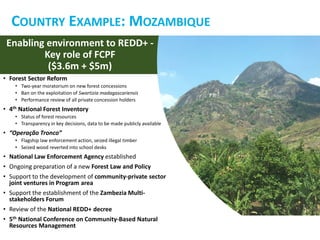
Enabling environment to REDD+ -
Key role of FCPF
($3.6m + $5m)
• Forest Sector Reform
• Two-year moratorium on new forest concessions
• Ban on the exploitation of Swartizia madagascariensis
• Performance review of all private concession holders
• 4th National Forest Inventory
• Status of forest resources
• Transparency in key decisions, data to be made publicly available
• “Operação Tronco”
• Flagship law enforcement action, seized illegal timber
• Seized wood reverted into school desks
• National Law Enforcement Agency established
• Ongoing preparation of a new Forest Law and Policy
• Support to the development of community-private sector
joint ventures in Program area
• Support the establishment of the Zambezia Multi-
stakeholders Forum
• Review of the National REDD+ decree
• 5th National Conference on Community-Based Natural
Resources Management
COUNTRY EXAMPLE: MOZAMBIQUE
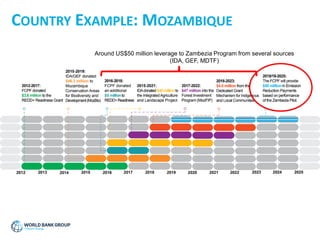
Around US$50 million leverage to Zambezia Program from several sources
(IDA, GEF, MDTF)
COUNTRY EXAMPLE: MOZAMBIQUE
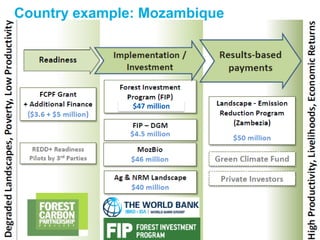
Country example: Mozambique
$47 million
Finance & Partnerships Established
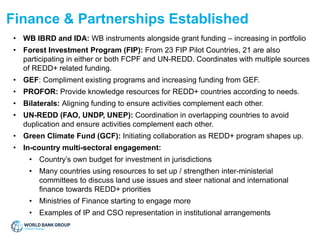
• WB IBRD and IDA: WB instruments alongside grant funding – increasing in portfolio
• Forest Investment Program (FIP): From 23 FIP Pilot Countries, 21 are also
participating in either or both FCPF and UN-REDD. Coordinates with multiple sources
of REDD+ related funding.
• GEF: Compliment existing programs and increasing funding from GEF.
• PROFOR: Provide knowledge resources for REDD+ countries according to needs.
• Bilaterals: Aligning funding to ensure activities complement each other.
• UN-REDD (FAO, UNDP, UNEP): Coordination in overlapping countries to avoid
duplication and ensure activities complement each other.
• Green Climate Fund (GCF): Initiating collaboration as REDD+ program shapes up.
• In-country multi-sectoral engagement:
• Country’s own budget for investment in jurisdictions
• Many countries using resources to set up / strengthen inter-ministerial
committees to discuss land use issues and steer national and international
finance towards REDD+ priorities
• Ministries of Finance starting to engage more
• Examples of IP and CSO representation in institutional arrangements
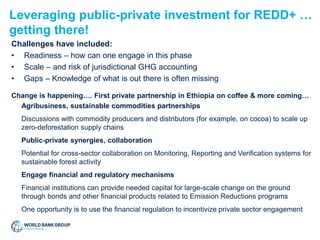
Challenges have included:
• Readiness – how can one engage in this phase
• Scale – and risk of jurisdictional GHG accounting
• Gaps – Knowledge of what is out there is often missing
Change is happening…. First private partnership in Ethiopia on coffee & more coming…
Agribusiness, sustainable commodities partnerships
Discussions with commodity producers and distributors (for example, on cocoa) to scale up
zero-deforestation supply chains
Public-private synergies, collaboration
Potential for cross-sector collaboration on Monitoring, Reporting and Verification systems for
sustainable forest activity
Engage financial and regulatory mechanisms
Financial institutions can provide needed capital for large-scale change on the ground
through bonds and other financial products related to Emission Reductions programs
One opportunity is to use the financial regulation to incentivize private sector engagement
Leveraging public-private investment for REDD+ …
getting there!
CONCLUSION
• Combining and coordinating public and private resources is
the only way to realize the poverty reduction potential and
reach the national climate change commitments that
REDD+ Emission Reductions programs contribute to
• As countries’ REDD+ programs are maturing we are seeing
the full breadth of opportunity for collaboration and
investments across sectors to ensure changes to business-
as-usual practices that will lead to greener, healthier
ecosystems
• Countries need our collective support – changes at scale
need time and need diverse sources of funding. For
REDD+ finance to succeed inter-ministerial and inter-
sectoral, inclusive collaboration is key
Thank you
For more information:
www.forestcarbonpartnership.org
www.biocarbonfund-isfl.org

Forest Carbon Partnership Facility & BioCarbon Fund

  • 1.
    Forest Carbon Partnership Facility& BioCarbon Fund Ellysar Baroudy May 2018
  • 2.
    Why our challengeis huge 13 million hectares of forest are lost each year 2 billion hectares of degraded land and forests need to be restored This is undermining economic growth, poverty alleviation, and food security 37% of the solution to Climate Change, yet only gets 3% of the funding &
  • 3.
    WORLD BANK FOREST& LANDSCAPE CLIMATE FINANCE FUNDS ($1.7 BILLION) Technical Assistance $98M Result-based payments $252M Initiative for Sustainable Forest Landscapes (ISFL)(2013) BioCF Tranche 1 & 2 (CDM and voluntary markets)(2004) Technical Assistance $6.3M Result-based payments $83.3M $340M (ISFL) $90M (Classic) Readiness $400M Carbon Fund $900M Forest Carbon Partnership Facility (2008) $1.3B
  • 4.
    BUSINESS MODEL Enabling Environment Low-Carbon Development Benefits Development Action • Policyand strategy • Capacity building • Social inclusion • Consultation • Investments in low carbon development • Sustainable management of forests • Climate-smart ag • Poverty alleviation • Shared prosperity • Climate change mitigation and adaptation Results-Based Finance for Emission Reductions Private and Public Finance, including IDA, IBRD,GEF financing Grant Funding, Technical Assistance We provide: We “crowd-in”:
  • 5.
    FINANCE PACKAGE CHANGINGOVER TIME It is likely that the finance package for the ER Program will change over time Result based climate finance Climate finance (investment) Investment in sustainable land use investment leading to deforestation/degradation TA Time Amount of Finance
  • 6.
    WHERE WE WORK Zambia Ethiopia Ghana Colombia Indonesia CostaRica Mexico Nepal DRC Republic of Congo Chile Vietnam 22 countries with large scale climate-smart land-use programs under development 54 countries with REDD+ readiness support or projects Guatemala Peru Mozambique Madagascar Dominican Republic Lao PDR Nicaragua Fiji Cameroon Cote d’Ivoire
  • 7.
    Working Together: WorldBank and the Government of Mozambique The GoM National Sustainable Development Program (NSDP) Standing Forests Enabling sustainable forest management to deliver benefits to local communities and the national economy. Mozbio Program Bringing benefits from protected area management and wildlife protection to a local and national scale. Terra Segura Strengthening land administration and management focusing on access, registration and information to benefit rural communities. The Bank’s Portfolio supports NSDP’s strategic objectives. In particular, but not exclusively, the following three initiatives: Country example: Mozambique The World Bank has been working closely with the government to support the National Sustainable Development Project in strengthening rural development and natural resource management.
  • 8.
    Cabo Delgado Landscape •Total Area: 4 million ha • Population: 611,538 • Rural Population: 78.4% • Total Forest Area: 1,756 ha • Deforestation Rate: 0.32% The Cabo Delgado Landscape hosts a variety of key terrestrial and marine biodiversity habitats, each with different geographic features. The area includes the Quirimbas National Park, which is home to 135,000 people, as well as a rich array of terrestrial and marine fauna and flora such as elephants, turtles and miombo forests. Zambezia Landscape • Total Area: 6 million ha • Total Population: 2,286,988 • Rural Population: 74% • Poverty Level: 56% below poverty line • Forest Area: 3,225 ha • Deforestation rate: 0.62% The Zambezia Landscape hosts forests and woodlands, agricultural lands and the Gile National Reserve, protecting several biodiversity hotspots. This landscape has been chosen as an Emissions Reduction Program Area under the Forest Carbon Partnership Facility’s Carbon Fund. Mozambique: SUSTAINABLE RURAL DEVELOPMENT THROUGH INTEGRATED LANDSCAPE MANAGEMENT
  • 9.
    Enabling environment toREDD+ - Key role of FCPF ($3.6m + $5m) • Forest Sector Reform • Two-year moratorium on new forest concessions • Ban on the exploitation of Swartizia madagascariensis • Performance review of all private concession holders • 4th National Forest Inventory • Status of forest resources • Transparency in key decisions, data to be made publicly available • “Operação Tronco” • Flagship law enforcement action, seized illegal timber • Seized wood reverted into school desks • National Law Enforcement Agency established • Ongoing preparation of a new Forest Law and Policy • Support to the development of community-private sector joint ventures in Program area • Support the establishment of the Zambezia Multi- stakeholders Forum • Review of the National REDD+ decree • 5th National Conference on Community-Based Natural Resources Management COUNTRY EXAMPLE: MOZAMBIQUE
  • 10.
    Around US$50 millionleverage to Zambezia Program from several sources (IDA, GEF, MDTF) COUNTRY EXAMPLE: MOZAMBIQUE
  • 11.
  • 12.
    Finance & PartnershipsEstablished • WB IBRD and IDA: WB instruments alongside grant funding – increasing in portfolio • Forest Investment Program (FIP): From 23 FIP Pilot Countries, 21 are also participating in either or both FCPF and UN-REDD. Coordinates with multiple sources of REDD+ related funding. • GEF: Compliment existing programs and increasing funding from GEF. • PROFOR: Provide knowledge resources for REDD+ countries according to needs. • Bilaterals: Aligning funding to ensure activities complement each other. • UN-REDD (FAO, UNDP, UNEP): Coordination in overlapping countries to avoid duplication and ensure activities complement each other. • Green Climate Fund (GCF): Initiating collaboration as REDD+ program shapes up. • In-country multi-sectoral engagement: • Country’s own budget for investment in jurisdictions • Many countries using resources to set up / strengthen inter-ministerial committees to discuss land use issues and steer national and international finance towards REDD+ priorities • Ministries of Finance starting to engage more • Examples of IP and CSO representation in institutional arrangements
  • 13.
    Challenges have included: •Readiness – how can one engage in this phase • Scale – and risk of jurisdictional GHG accounting • Gaps – Knowledge of what is out there is often missing Change is happening…. First private partnership in Ethiopia on coffee & more coming… Agribusiness, sustainable commodities partnerships Discussions with commodity producers and distributors (for example, on cocoa) to scale up zero-deforestation supply chains Public-private synergies, collaboration Potential for cross-sector collaboration on Monitoring, Reporting and Verification systems for sustainable forest activity Engage financial and regulatory mechanisms Financial institutions can provide needed capital for large-scale change on the ground through bonds and other financial products related to Emission Reductions programs One opportunity is to use the financial regulation to incentivize private sector engagement Leveraging public-private investment for REDD+ … getting there!
  • 14.
    CONCLUSION • Combining andcoordinating public and private resources is the only way to realize the poverty reduction potential and reach the national climate change commitments that REDD+ Emission Reductions programs contribute to • As countries’ REDD+ programs are maturing we are seeing the full breadth of opportunity for collaboration and investments across sectors to ensure changes to business- as-usual practices that will lead to greener, healthier ecosystems • Countries need our collective support – changes at scale need time and need diverse sources of funding. For REDD+ finance to succeed inter-ministerial and inter- sectoral, inclusive collaboration is key
  • 15.
    Thank you For moreinformation: www.forestcarbonpartnership.org www.biocarbonfund-isfl.org