Responsible Tourism and Economic Diversification
                               !"#$%&'()*+,(-&&
                       !.'()*+,(-/$0*#.-1.23&
                                   4567764874&
9#,)$%21:$#&;&<*=*>$0?*#,&
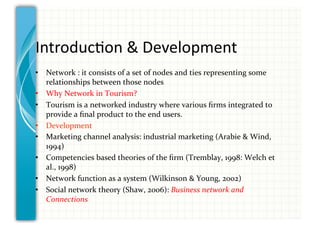
•  !"#$%&'()(*#(+%,-*-#-(%.(/(-"#(%.(,%0"-(/,0(#*"-(&"1&"-",#*,2(-%3"(
   &"4/#*%,-5*1-(6"#$"",(#5%-"(,%0"-(
•  758(!"#$%&'(*,(9%:&*-3;(
•  9%:&*-3(*-(/(,"#$%&'"0(*,0:-#&8($5"&"(</&*%:-(=&3-(*,#"2&/#"0(#%(
   1&%<*0"(/(=,/4(1&%0:+#(#%(#5"(",0(:-"&->(
•  ?"<"4%13",#(
•  @/&'"#*,2(+5/,,"4(/,/48-*-)(*,0:-#&*/4(3/&'"#*,2(AB&/6*"(C(7*,0D(
   EFFGH(
•  I%31"#",+*"-(6/-"0(#5"%&*"-(%.(#5"(=&3(A9&"364/8D(EFFJ)(7"4+5("#(
   /4>D(EFFJH(
•  !"#$%&'(.:,+#*%,(/-(/(-8-#"3(A7*4'*,-%,(C(K%:,2D(LMMLH(
•  N%+*/4(,"#$%&'(#5"%&8(AN5/$D(LMMOH)(!"#$%&##'%&()*+,'-%.'
   /*%%&0($*%#'
@*+*-)1(&A-0+&
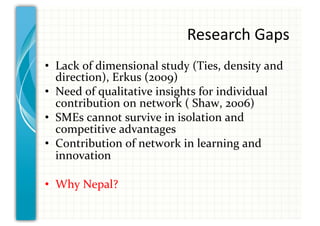
•  P/+'(%.(0*3",-*%,/4(-#:08(A9*"-D(0",-*#8(/,0(
   0*&"+#*%,HD(Q&':-(ALMMFH(
•  !""0(%.(R:/4*#/#*<"(*,-*25#-(.%&(*,0*<*0:/4(
   +%,#&*6:#*%,(%,(,"#$%&'(A(N5/$D(LMMOH(
•  N@Q-(+/,,%#(-:&<*<"(*,(*-%4/#*%,(/,0(
   +%31"#*#*<"(/0</,#/2"-(
•  I%,#&*6:#*%,(%.(,"#$%&'(*,(4"/&,*,2(/,0(
   *,,%</#*%,(

•  758(!"1/4;(
@*+*-)1(&B2*+:$#+&
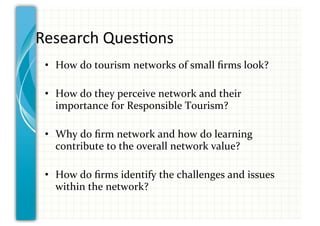
 •  S%$(0%(#%:&*-3(,"#$%&'-(%.(-3/44(=&3-(4%%';((

 •  S%$(0%(#5"8(1"&+"*<"(,"#$%&'(/,0(#5"*&(
    *31%&#/,+"(.%&(T"-1%,-*64"(9%:&*-3;(

 •  758(0%(=&3(,"#$%&'(/,0(5%$(0%(4"/&,*,2(
    +%,#&*6:#"(#%(#5"(%<"&/44(,"#$%&'(</4:";(

 •  S%$(0%(=&3-(*0",#*.8(#5"(+5/44",2"-(/,0(*--:"-(
    $*#5*,(#5"(,"#$%&';(
@*+*-)1(&?*,($%$>$CD&-#%&?*,($%+&
•    U*&-#(V5/-"(
•    W,#"&<*"$-($*#5('"8(14/8"&-(%.(#5"(#%:&*-3(*,0:-#&8(
•    @/11*,2(%.(,"#$%&'(/3%,2('"8(=&3-(*,(V%'5/&/(
•    N"+%,0/&8(-%:&+"(

•  95"(I/-"(-#:08(N+",/&*%(
•  9$%(0*X"&",#(#81"-(%.(,"#$%&'-("Y*-#",+"(/,0(+%31"#*#*%,Z+%,[*+#(

•  N"+%,0(V5/-"(
•  N"3*-#&:+#:&"(R:"-#*%,,/*&"-(
•  ]1",(^",0"0(*,#"&<*"$-(
•  U%+:-(2&%:1(0*-+:--*%,($*#5(-:11%&#(%&2/,*_/#*%,-(AB--%+*/#*%,-D(#&/<"4(
   /2",#-D(+5/36"&-`H(
•  I%0*,2(/,0(/,/48-*-(A!<*<%H(
•  !"#$%&'(V*+#:&"-(/,0(P*,'(2","&/#*%,(#"+5,*R:"-(
E*,F$)3&-+&-&G($>*&
                         'JH+&


                                          '2+,-"#-K">",D&
                                             ,()$2C(&
                                         0)*+*)=-:$#&$L&
   H#1$2)-C*+&I2?-#&
                          MNO&           *1$+D+,*?&-#%&
                                           %"=*)+"LD"#C&
      '*)="1*+&-#%&
       #*,F$)3+&                       *1$#$?"1&-1:=":*+&


                          P,(*)&
                       +,-3*($>%*)+&
M$++"K>*&P2,1$?*+&

•  N)-%":$#->&#*,F$)3&1$##*1:$#&-#%&J$%*)#&L-+,&0-1*&#*,F$)3+&

•  O>-++"1&,$2)"+?&K2+"#*++&-#%&?$)*&-%=-#1*%&+0$),&-#%&-%=*#,2)*+&
   K2+"#*++*+&#*,F$)3&Q,*1(#"1->>D&-#%&3#$F>*%C*&K-+*%R&

•  E*,F$)3&-+&K2+"#*++&#**%&-#%&1$#+2?*)&#**%&Q,$$>R&

•  S",->&L$)&)*+0$#+"K>*&,$2)"+?&Q*#=")$#?*#,T&0*$0>*&-#%&*1$#$?"1&
   %"=*)+"U1-:$#R&

•  E*,F$)3&-+&-&0)"?*&L-1,$)&L$)&"##$=-:$#&-#%&1$>>-K$)-:$#&L$)&
   >*-)#"#C&-?$#C&+?->>&U)?+&Q&>$F&-?$2#,&$L&"#=*+,?*#,&-#%&:?*&
   L$)&1(-#C*R&
V#D&B2*+:$#+W&
MULTILEVEL REDD+ GOVERNANCE
          ANALYSIS IN KENYA  
                  Who benefits from the interplay of
          forests ecosystems and climate change institutions
By: Anne Fidelis Itubo – University of Nairobi Center for Advanced Studies in Environmental Law and Policy
Introduction-Outline
•   Brief Country profile
•   Defining REDD+, Good Forest Governance
•   Data Collection
•   REDD+ Governance in Kenya

     •   Who benefits from the interplay of forest and
         climate change institution?
     •   Forest Ecosystem for Sustainable Development
     •   Conclusions
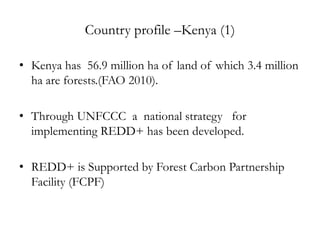
Country profile –Kenya (1)

• Kenya has 56.9 million ha of land of which 3.4 million
  ha are forests.(FAO 2010).

• Through UNFCCC a national strategy for
  implementing REDD+ has been developed.

• REDD+ is Supported by Forest Carbon Partnership
  Facility (FCPF)
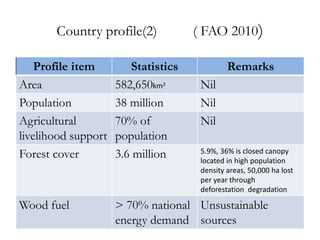
Country profile(2)            ( FAO 2010)

    Profile item        Statistics             Remarks
Area                 582,650km2       Nil
Population           38 million       Nil
Agricultural         70% of           Nil
livelihood support   population
Forest cover         3.6 million      5.9%,  36%  is  closed  canopy  
                                      located  in  high  population  
                                      density  areas,  50,000  ha  lost  
                                      per  year  through  
                                      deforestation    degradation

Wood fuel            > 70% national Unsustainable
                     energy demand sources
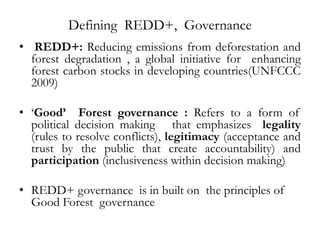
Defining REDD+, Governance
• REDD+: Reducing emissions from deforestation and
  forest degradation , a global initiative for enhancing
  forest carbon stocks in developing countries(UNFCCC
  2009)

• ‘Good’ Forest governance : Refers to a form of
  political decision making that emphasizes legality
  (rules to resolve conflicts), legitimacy (acceptance and
  trust by the public that create accountability) and
  participation (inclusiveness within decision making)

• REDD+ governance is in built on the principles of
  Good Forest governance
    
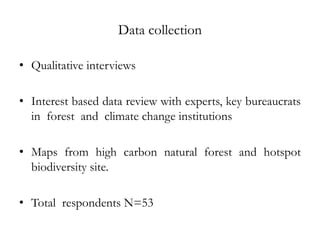
Data collection

• Qualitative interviews

• Interest based data review with experts, key bureaucrats
  in forest and climate change institutions

• Maps from high carbon natural forest and hotspot
  biodiversity site.

• Total respondents N=53
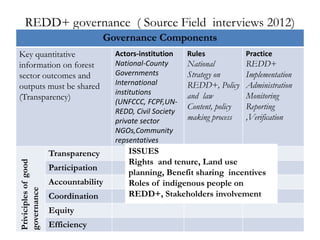
REDD+ governance ( Source Field interviews 2012)
                                      Governance Components
Key quantitative                        Actors-­‐institution      Rules             Practice  
information on forest                   National-­‐County         National          REDD+
sector outcomes and                     Governments               Strategy on       Implementation
outputs must be shared                  International             REDD+, Policy     Administration
                                        institutions              and law           Monitoring
(Transparency)
                                        (UNFCCC,  FCPF,UN-­‐
                                                                  Content, policy   Reporting
                                        REDD,  Civil  Society  
                                        private  sector           making process    ,Verification
                                        NGOs,Community  
                                        repsentatives  
                      Transparency          ISSUES
                                            Rights and tenure, Land use
Priviciples of good


                      Participation
                                            planning, Benefit sharing incentives
                      Accountability        Roles of indigenous people on
governance


                      Coordination          REDD+, Stakeholders involvement  
                      Equity
                      Efficiency
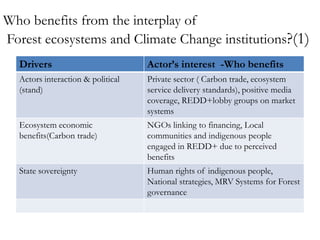
Who benefits from the interplay of
Forest ecosystems and Climate Change institutions?(1)
  Drivers                          Actor’s interest -Who benefits
  Actors interaction & political   Private sector ( Carbon trade, ecosystem
  (stand)                          service delivery standards), positive media
                                   coverage, REDD+lobby groups on market
                                   systems
  Ecosystem economic               NGOs linking to financing, Local
  benefits(Carbon trade)           communities and indigenous people
                                   engaged in REDD+ due to perceived
                                   benefits
  State sovereignty                Human rights of indigenous people,
                                   National strategies, MRV Systems for Forest
                                   governance
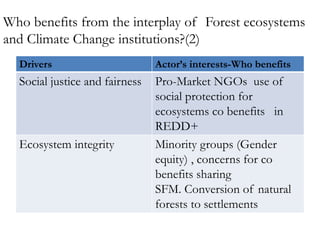
Who benefits from the interplay of Forest ecosystems
and Climate Change institutions?(2)
  Drivers                       Actor’s interests-Who benefits
  Social justice and fairness   Pro-Market NGOs use of
                                social protection for
                                ecosystems co benefits in
                                REDD+
  Ecosystem integrity           Minority groups (Gender
                                equity) , concerns for co
                                benefits sharing
                                SFM. Conversion of natural
                                forests to settlements
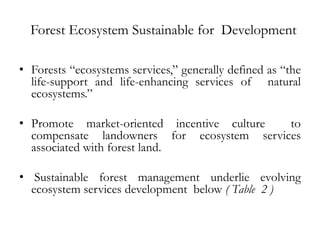
Forest Ecosystem Sustainable for Development

• Forests “ecosystems services,” generally defined as “the
  life-support and life-enhancing services of natural
  ecosystems.”

• Promote market-oriented incentive culture to
  compensate landowners for ecosystem services
  associated with forest land.

• Sustainable forest management underlie evolving
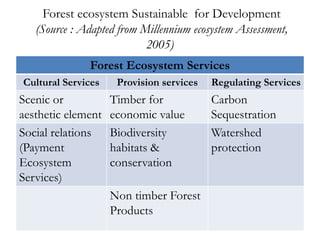
  ecosystem services development below ( Table 2 )
Forest ecosystem Sustainable for Development
   (Source : Adapted from Millennium ecosystem Assessment,
                           2005)
              Forest Ecosystem Services
Cultural Services    Provision services   Regulating Services
Scenic or           Timber for            Carbon
aesthetic element   economic value        Sequestration
Social relations    Biodiversity          Watershed
(Payment            habitats &            protection
Ecosystem           conservation
Services)
                    Non timber Forest
                    Products
Forest Ecosystem Sustainable for Development  

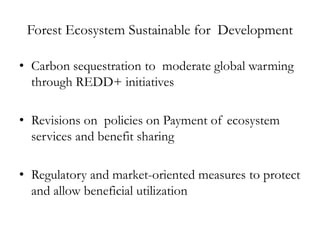
• Carbon sequestration to moderate global warming
  through REDD+ initiatives

• Revisions on policies on Payment of ecosystem
  services and benefit sharing

• Regulatory and market-oriented measures to protect
  and allow beneficial utilization
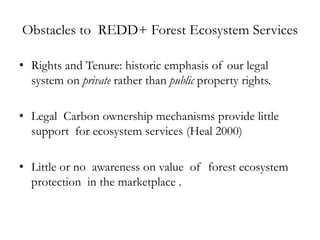
Obstacles to REDD+ Forest Ecosystem Services

• Rights and Tenure: historic emphasis of our legal
  system on private rather than public property rights.

• Legal Carbon ownership mechanisms provide little
  support for ecosystem services (Heal 2000)

• Little or no awareness on value of forest ecosystem
  protection in the marketplace .
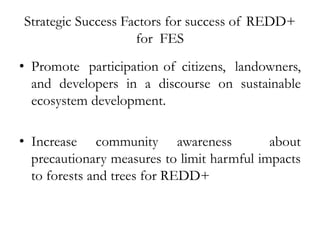
Strategic Success Factors for success of REDD+
                    for FES   
• Promote participation
                          of citizens, landowners,
  and developers in a discourse on sustainable
  ecosystem development.

• Increase community awareness              about
  precautionary measures to limit harmful impacts
  to forests and trees for REDD+
    
Conclusion

• Actor coalitions on setting economic incentives reflects
  market-based approaches that attach monetary values
  to socially desired forest ecosystem Services( Carbon
  trade)

• Correlation between Private sector actors and states’
  that support of market based approach to have
  equitability in benefit sharing.

• REDD+ governance, indicate Partipation and
  transparency as key challenges to benefit sharing.
End !!   Thanks you!!

Leipzig 7 u 8

  • 1.
    Responsible Tourism andEconomic Diversification !"#$%&'()*+,(-&& !.'()*+,(-/$0*#.-1.23& 4567764874&
  • 2.
    9#,)$%21:$#&;&<*=*>$0?*#,& •  !"#$%&'()(*#(+%,-*-#-(%.(/(-"#(%.(,%0"-(/,0(#*"-(&"1&"-",#*,2(-%3"( &"4/#*%,-5*1-(6"#$"",(#5%-"(,%0"-( •  758(!"#$%&'(*,(9%:&*-3;( •  9%:&*-3(*-(/(,"#$%&'"0(*,0:-#&8($5"&"(</&*%:-(=&3-(*,#"2&/#"0(#%( 1&%<*0"(/(=,/4(1&%0:+#(#%(#5"(",0(:-"&->( •  ?"<"4%13",#( •  @/&'"#*,2(+5/,,"4(/,/48-*-)(*,0:-#&*/4(3/&'"#*,2(AB&/6*"(C(7*,0D( EFFGH( •  I%31"#",+*"-(6/-"0(#5"%&*"-(%.(#5"(=&3(A9&"364/8D(EFFJ)(7"4+5("#( /4>D(EFFJH( •  !"#$%&'(.:,+#*%,(/-(/(-8-#"3(A7*4'*,-%,(C(K%:,2D(LMMLH( •  N%+*/4(,"#$%&'(#5"%&8(AN5/$D(LMMOH)(!"#$%&##'%&()*+,'-%.' /*%%&0($*%#'
  • 3.
    @*+*-)1(&A-0+& •  P/+'(%.(0*3",-*%,/4(-#:08(A9*"-D(0",-*#8(/,0( 0*&"+#*%,HD(Q&':-(ALMMFH( •  !""0(%.(R:/4*#/#*<"(*,-*25#-(.%&(*,0*<*0:/4( +%,#&*6:#*%,(%,(,"#$%&'(A(N5/$D(LMMOH( •  N@Q-(+/,,%#(-:&<*<"(*,(*-%4/#*%,(/,0( +%31"#*#*<"(/0</,#/2"-( •  I%,#&*6:#*%,(%.(,"#$%&'(*,(4"/&,*,2(/,0( *,,%</#*%,( •  758(!"1/4;(
  • 4.
    @*+*-)1(&B2*+:$#+& •  S%$(0%(#%:&*-3(,"#$%&'-(%.(-3/44(=&3-(4%%';(( •  S%$(0%(#5"8(1"&+"*<"(,"#$%&'(/,0(#5"*&( *31%&#/,+"(.%&(T"-1%,-*64"(9%:&*-3;( •  758(0%(=&3(,"#$%&'(/,0(5%$(0%(4"/&,*,2( +%,#&*6:#"(#%(#5"(%<"&/44(,"#$%&'(</4:";( •  S%$(0%(=&3-(*0",#*.8(#5"(+5/44",2"-(/,0(*--:"-( $*#5*,(#5"(,"#$%&';(
  • 5.
    @*+*-)1(&?*,($%$>$CD&-#%&?*,($%+& •  U*&-#(V5/-"( •  W,#"&<*"$-($*#5('"8(14/8"&-(%.(#5"(#%:&*-3(*,0:-#&8( •  @/11*,2(%.(,"#$%&'(/3%,2('"8(=&3-(*,(V%'5/&/( •  N"+%,0/&8(-%:&+"( •  95"(I/-"(-#:08(N+",/&*%( •  9$%(0*X"&",#(#81"-(%.(,"#$%&'-("Y*-#",+"(/,0(+%31"#*#*%,Z+%,[*+#( •  N"+%,0(V5/-"( •  N"3*-#&:+#:&"(R:"-#*%,,/*&"-( •  ]1",(^",0"0(*,#"&<*"$-( •  U%+:-(2&%:1(0*-+:--*%,($*#5(-:11%&#(%&2/,*_/#*%,-(AB--%+*/#*%,-D(#&/<"4( /2",#-D(+5/36"&-`H( •  I%0*,2(/,0(/,/48-*-(A!<*<%H( •  !"#$%&'(V*+#:&"-(/,0(P*,'(2","&/#*%,(#"+5,*R:"-(
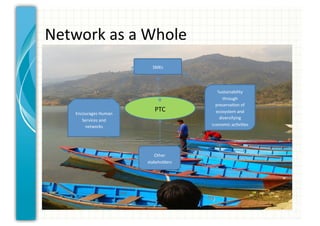
  • 6.
    E*,F$)3&-+&-&G($>*& 'JH+& '2+,-"#-K">",D& ,()$2C(& 0)*+*)=-:$#&$L& H#1$2)-C*+&I2?-#& MNO& *1$+D+,*?&-#%& %"=*)+"LD"#C& '*)="1*+&-#%& #*,F$)3+& *1$#$?"1&-1:=":*+& P,(*)& +,-3*($>%*)+&
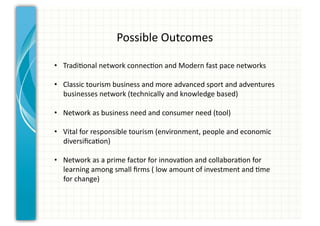
  • 7.
    M$++"K>*&P2,1$?*+& •  N)-%":$#->&#*,F$)3&1$##*1:$#&-#%&J$%*)#&L-+,&0-1*&#*,F$)3+& •  O>-++"1&,$2)"+?&K2+"#*++&-#%&?$)*&-%=-#1*%&+0$),&-#%&-%=*#,2)*+& K2+"#*++*+&#*,F$)3&Q,*1(#"1->>D&-#%&3#$F>*%C*&K-+*%R& •  E*,F$)3&-+&K2+"#*++&#**%&-#%&1$#+2?*)&#**%&Q,$$>R& •  S",->&L$)&)*+0$#+"K>*&,$2)"+?&Q*#=")$#?*#,T&0*$0>*&-#%&*1$#$?"1& %"=*)+"U1-:$#R& •  E*,F$)3&-+&-&0)"?*&L-1,$)&L$)&"##$=-:$#&-#%&1$>>-K$)-:$#&L$)& >*-)#"#C&-?$#C&+?->>&U)?+&Q&>$F&-?$2#,&$L&"#=*+,?*#,&-#%&:?*& L$)&1(-#C*R&
  • 8.
  • 9.
    MULTILEVEL REDD+ GOVERNANCE ANALYSIS IN KENYA   Who benefits from the interplay of forests ecosystems and climate change institutions By: Anne Fidelis Itubo – University of Nairobi Center for Advanced Studies in Environmental Law and Policy
  • 10.
    Introduction-Outline • Brief Country profile • Defining REDD+, Good Forest Governance • Data Collection • REDD+ Governance in Kenya • Who benefits from the interplay of forest and climate change institution? • Forest Ecosystem for Sustainable Development • Conclusions
  • 11.
    Country profile –Kenya(1) • Kenya has 56.9 million ha of land of which 3.4 million ha are forests.(FAO 2010). • Through UNFCCC a national strategy for implementing REDD+ has been developed. • REDD+ is Supported by Forest Carbon Partnership Facility (FCPF)
  • 12.
    Country profile(2) ( FAO 2010) Profile item Statistics Remarks Area 582,650km2 Nil Population 38 million Nil Agricultural 70% of Nil livelihood support population Forest cover 3.6 million 5.9%,  36%  is  closed  canopy   located  in  high  population   density  areas,  50,000  ha  lost   per  year  through   deforestation    degradation Wood fuel > 70% national Unsustainable energy demand sources
  • 13.
    Defining REDD+, Governance •REDD+: Reducing emissions from deforestation and forest degradation , a global initiative for enhancing forest carbon stocks in developing countries(UNFCCC 2009) • ‘Good’ Forest governance : Refers to a form of political decision making that emphasizes legality (rules to resolve conflicts), legitimacy (acceptance and trust by the public that create accountability) and participation (inclusiveness within decision making) • REDD+ governance is in built on the principles of Good Forest governance  
  • 14.
    Data collection • Qualitativeinterviews • Interest based data review with experts, key bureaucrats in forest and climate change institutions • Maps from high carbon natural forest and hotspot biodiversity site. • Total respondents N=53
  • 15.
    REDD+ governance (Source Field interviews 2012) Governance Components Key quantitative Actors-­‐institution   Rules   Practice   information on forest National-­‐County   National REDD+ sector outcomes and Governments   Strategy on Implementation outputs must be shared International   REDD+, Policy Administration institutions   and law Monitoring (Transparency) (UNFCCC,  FCPF,UN-­‐ Content, policy Reporting REDD,  Civil  Society   private  sector   making process ,Verification NGOs,Community   repsentatives   Transparency ISSUES Rights and tenure, Land use Priviciples of good Participation planning, Benefit sharing incentives Accountability Roles of indigenous people on governance Coordination REDD+, Stakeholders involvement   Equity Efficiency
  • 16.
    Who benefits fromthe interplay of Forest ecosystems and Climate Change institutions?(1) Drivers Actor’s interest -Who benefits Actors interaction & political Private sector ( Carbon trade, ecosystem (stand) service delivery standards), positive media coverage, REDD+lobby groups on market systems Ecosystem economic NGOs linking to financing, Local benefits(Carbon trade) communities and indigenous people engaged in REDD+ due to perceived benefits State sovereignty Human rights of indigenous people, National strategies, MRV Systems for Forest governance
  • 17.
    Who benefits fromthe interplay of Forest ecosystems and Climate Change institutions?(2) Drivers Actor’s interests-Who benefits Social justice and fairness Pro-Market NGOs use of social protection for ecosystems co benefits in REDD+ Ecosystem integrity Minority groups (Gender equity) , concerns for co benefits sharing SFM. Conversion of natural forests to settlements
  • 18.
    Forest Ecosystem Sustainablefor Development • Forests “ecosystems services,” generally defined as “the life-support and life-enhancing services of natural ecosystems.” • Promote market-oriented incentive culture to compensate landowners for ecosystem services associated with forest land. • Sustainable forest management underlie evolving ecosystem services development below ( Table 2 )
  • 19.
    Forest ecosystem Sustainablefor Development (Source : Adapted from Millennium ecosystem Assessment, 2005) Forest Ecosystem Services Cultural Services Provision services Regulating Services Scenic or Timber for Carbon aesthetic element economic value Sequestration Social relations Biodiversity Watershed (Payment habitats & protection Ecosystem conservation Services) Non timber Forest Products
  • 20.
    Forest Ecosystem Sustainablefor Development   • Carbon sequestration to moderate global warming through REDD+ initiatives • Revisions on policies on Payment of ecosystem services and benefit sharing • Regulatory and market-oriented measures to protect and allow beneficial utilization
  • 21.
    Obstacles to REDD+Forest Ecosystem Services • Rights and Tenure: historic emphasis of our legal system on private rather than public property rights. • Legal Carbon ownership mechanisms provide little support for ecosystem services (Heal 2000) • Little or no awareness on value of forest ecosystem protection in the marketplace .
  • 22.
    Strategic Success Factorsfor success of REDD+ for FES   • Promote participation  of citizens, landowners, and developers in a discourse on sustainable ecosystem development. • Increase community awareness about precautionary measures to limit harmful impacts to forests and trees for REDD+  
  • 23.
    Conclusion • Actor coalitionson setting economic incentives reflects market-based approaches that attach monetary values to socially desired forest ecosystem Services( Carbon trade) • Correlation between Private sector actors and states’ that support of market based approach to have equitability in benefit sharing. • REDD+ governance, indicate Partipation and transparency as key challenges to benefit sharing.
  • 24.
    End !! Thanks you!!