Engaging logging concessions in
REDD+
Case study in Mai Ndombe, DRC
IIED event
Engaging men and women in REDD+ business
Adeline Dontenville, European Forest Institute
Paris, 4 December 2015
Outline
1. The logging industry in Mai Ndombe
province
2. Using legality as a safeguard for
REDD+
3. Incentivising REDD+ participation and
improved forest governance
1
The logging industry
in Mai Ndombe
The DRC logging
sector
• 115 Mha of forests, twice the
size of France
• Low historical deforestation
rate, but increasing
• About 10% of forests
designated for logging
• 10 companies – 90% of export
timber
• Up to 87% of logging is illegal
(CH, 2014)
• Serious governance issues
and non-compliance
International
processes
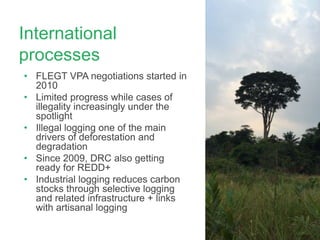
• FLEGT VPA negotiations started in
2010
• Limited progress while cases of
illegality increasingly under the
spotlight
• Illegal logging one of the main
drivers of deforestation and
degradation
• Since 2009, DRC also getting
ready for REDD+
• Industrial logging reduces carbon
stocks through selective logging
and related infrastructure + links
with artisanal logging
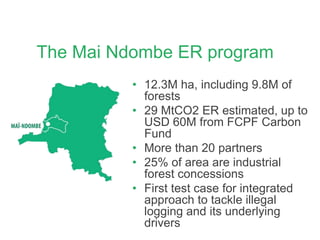
The Mai Ndombe ER program
• 12.3M ha, including 9.8M of
forests
• 29 MtCO2 ER estimated, up to
USD 60M from FCPF Carbon
Fund
• More than 20 partners
• 25% of area are industrial
forest concessions
• First test case for integrated
approach to tackle illegal
logging and its underlying
drivers
Source: CN REDD
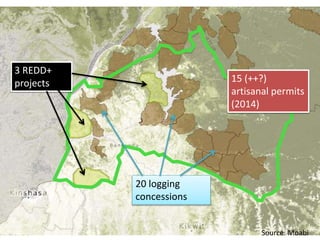
Source: Moabi
20 logging
concessions
3 REDD+
projects 15 (++?)
artisanal permits
(2014)
Challenges and opportunities
at the intersect of legality and
REDD+
• 20 concessions in Mai Ndombe, several illegalities
observed
• Reference levels based on intermediary
management plans, adjusted
• Illegal artisanal logging: main source of emissions
from timber sector but unaccounted for
 How can we ensure that industrial logging is not
jeopardizing the environmental and social integrity
of the REDD+ program?
 How can we incentivise logging companies to take
an active role in REDD+?
2
Using legality as a
safeguard for
REDD+
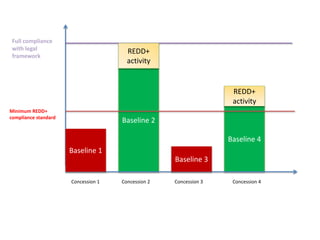
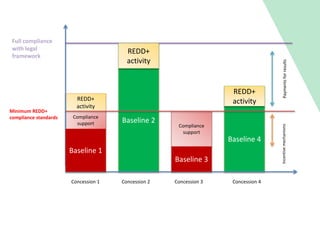
Baseline 4
Baseline 2
Baseline 1
Baseline 3
REDD+
activity
REDD+
activity
Full compliance
with legal
framework
Minimum REDD+
compliance standard
Concession 1 Concession 2 Concession 3 Concession 4
The REDD+ compliance standard
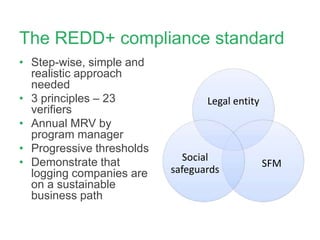
• Step-wise, simple and
realistic approach
needed
• 3 principles – 23
verifiers
• Annual MRV by
program manager
• Progressive thresholds
• Demonstrate that
logging companies are
on a sustainable
business path
Legal entity
SFM
Social
safeguards
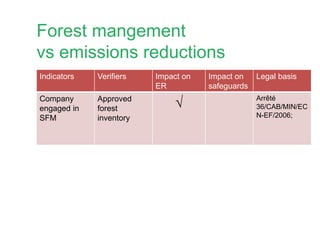
Forest mangement
vs emissions reductions
Indicators Verifiers Impact on
ER
Impact on
safeguards
Legal basis
Company
engaged in
SFM
Approved
forest
inventory
√ Arrêté
36/CAB/MIN/EC
N-EF/2006;
Respect of
cutting
allowances
Coherence
between
cutting permit
and
management
doc.
√ √ Arrêté
34/CAB/MIN/EC
N-EF/2015
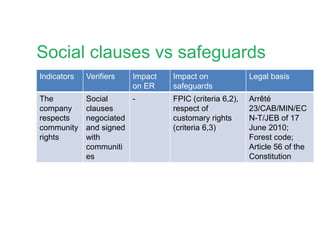
Social clauses vs safeguards
Indicators Verifiers Impact
on ER
Impact on
safeguards
Legal basis
The
company
respects
community
rights
Social
clauses
negociated
and signed
with
communiti
es
- FPIC (criteria 6,2),
respect of
customary rights
(criteria 6,3)
Arrêté
23/CAB/MIN/EC
N-T/JEB of 17
June 2010;
Forest code;
Article 56 of the
Constitution
Labour
rights are
respected
Workers
contracts
existing
and
compliante
with labour
law
- Workers rights are
respected (criteria
7,1)
Arrêté
6/CAB/PVPM/ET
PS/2010 du 1
avril 2010, Code
du travail
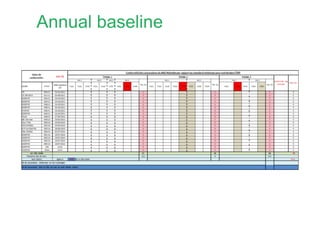
Annual baseline
3
Incentivising REDD+
activities
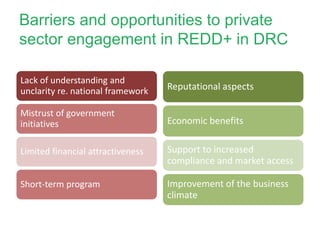
Barriers and opportunities to private
sector engagement in REDD+ in DRC
Lack of understanding and
unclarity re. national framework
Mistrust of government
initiatives
Limited financial attractiveness
Short-term program
Reputational aspects
Economic benefits
Support to increased
compliance and market access
Improvement of the business
climate
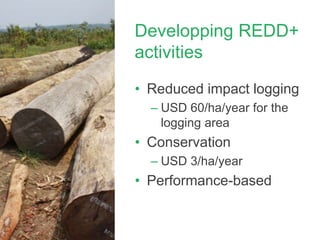
Developping REDD+
activities
• Reduced impact logging
– USD 60/ha/year for the
logging area
• Conservation
– USD 3/ha/year
• Performance-based
REDD+
activity
Compliance
support
Compliance
support
Baseline 4
Baseline 2
Baseline 1
Baseline 3
REDD+
activity
REDD+
activity
Full compliance
with legal
framework
Minimum REDD+
compliance standards
Concession 1 Concession 2 Concession 3 Concession 4
PaymentsforresultsIncentivemechanisms
REDD+ compliance measures
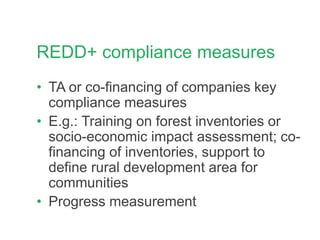
• TA or co-financing of companies key
compliance measures
• E.g.: Training on forest inventories or
socio-economic impact assessment; co-
financing of inventories, support to
define rural development area for
communities
• Progress measurement
Improving the
enabling
environment
• TA to forest administration
for processing of
management plans
• Support to control of
forest inventories
• Support to forest control
and tracability
• Rural development zoning
to reduce informal logging
Conclusion
• REDD+ compliance standard, incentive
framework and proposals to improve the
enabling environment featured in draft
ERPD
• 13 concessions engaged, 6
unpronounced, 1 against
• Test case of trust building with private
sector
Thank you for your
attention
adeline.dontenville@efi.int
euredd.efi.int

Engaging logging concessions in REDD+

  • 1.
    Engaging logging concessionsin REDD+ Case study in Mai Ndombe, DRC IIED event Engaging men and women in REDD+ business Adeline Dontenville, European Forest Institute Paris, 4 December 2015
  • 2.
    Outline 1. The loggingindustry in Mai Ndombe province 2. Using legality as a safeguard for REDD+ 3. Incentivising REDD+ participation and improved forest governance
  • 3.
  • 4.
    The DRC logging sector •115 Mha of forests, twice the size of France • Low historical deforestation rate, but increasing • About 10% of forests designated for logging • 10 companies – 90% of export timber • Up to 87% of logging is illegal (CH, 2014) • Serious governance issues and non-compliance
  • 5.
    International processes • FLEGT VPAnegotiations started in 2010 • Limited progress while cases of illegality increasingly under the spotlight • Illegal logging one of the main drivers of deforestation and degradation • Since 2009, DRC also getting ready for REDD+ • Industrial logging reduces carbon stocks through selective logging and related infrastructure + links with artisanal logging
  • 6.
    The Mai NdombeER program • 12.3M ha, including 9.8M of forests • 29 MtCO2 ER estimated, up to USD 60M from FCPF Carbon Fund • More than 20 partners • 25% of area are industrial forest concessions • First test case for integrated approach to tackle illegal logging and its underlying drivers
  • 7.
    Source: CN REDD Source:Moabi 20 logging concessions 3 REDD+ projects 15 (++?) artisanal permits (2014)
  • 8.
    Challenges and opportunities atthe intersect of legality and REDD+ • 20 concessions in Mai Ndombe, several illegalities observed • Reference levels based on intermediary management plans, adjusted • Illegal artisanal logging: main source of emissions from timber sector but unaccounted for  How can we ensure that industrial logging is not jeopardizing the environmental and social integrity of the REDD+ program?  How can we incentivise logging companies to take an active role in REDD+?
  • 9.
    2 Using legality asa safeguard for REDD+
  • 10.
    Baseline 4 Baseline 2 Baseline1 Baseline 3 REDD+ activity REDD+ activity Full compliance with legal framework Minimum REDD+ compliance standard Concession 1 Concession 2 Concession 3 Concession 4
  • 11.
    The REDD+ compliancestandard • Step-wise, simple and realistic approach needed • 3 principles – 23 verifiers • Annual MRV by program manager • Progressive thresholds • Demonstrate that logging companies are on a sustainable business path Legal entity SFM Social safeguards
  • 12.
    Forest mangement vs emissionsreductions Indicators Verifiers Impact on ER Impact on safeguards Legal basis Company engaged in SFM Approved forest inventory √ Arrêté 36/CAB/MIN/EC N-EF/2006; Respect of cutting allowances Coherence between cutting permit and management doc. √ √ Arrêté 34/CAB/MIN/EC N-EF/2015
  • 13.
    Social clauses vssafeguards Indicators Verifiers Impact on ER Impact on safeguards Legal basis The company respects community rights Social clauses negociated and signed with communiti es - FPIC (criteria 6,2), respect of customary rights (criteria 6,3) Arrêté 23/CAB/MIN/EC N-T/JEB of 17 June 2010; Forest code; Article 56 of the Constitution Labour rights are respected Workers contracts existing and compliante with labour law - Workers rights are respected (criteria 7,1) Arrêté 6/CAB/PVPM/ET PS/2010 du 1 avril 2010, Code du travail
  • 14.
  • 15.
  • 16.
    Barriers and opportunitiesto private sector engagement in REDD+ in DRC Lack of understanding and unclarity re. national framework Mistrust of government initiatives Limited financial attractiveness Short-term program Reputational aspects Economic benefits Support to increased compliance and market access Improvement of the business climate
  • 17.
    Developping REDD+ activities • Reducedimpact logging – USD 60/ha/year for the logging area • Conservation – USD 3/ha/year • Performance-based
  • 18.
    REDD+ activity Compliance support Compliance support Baseline 4 Baseline 2 Baseline1 Baseline 3 REDD+ activity REDD+ activity Full compliance with legal framework Minimum REDD+ compliance standards Concession 1 Concession 2 Concession 3 Concession 4 PaymentsforresultsIncentivemechanisms
  • 19.
    REDD+ compliance measures •TA or co-financing of companies key compliance measures • E.g.: Training on forest inventories or socio-economic impact assessment; co- financing of inventories, support to define rural development area for communities • Progress measurement
  • 20.
    Improving the enabling environment • TAto forest administration for processing of management plans • Support to control of forest inventories • Support to forest control and tracability • Rural development zoning to reduce informal logging
  • 21.
    Conclusion • REDD+ compliancestandard, incentive framework and proposals to improve the enabling environment featured in draft ERPD • 13 concessions engaged, 6 unpronounced, 1 against • Test case of trust building with private sector
  • 22.
    Thank you foryour attention adeline.dontenville@efi.int euredd.efi.int

Editor's Notes

  • #5 -The DRC is one of the world’s largest rainforest nations. The country has more dense forests than all other Congo Basin countries combined. More than half of the DRC’s massive land area is covered by dense forest – 115 million hectares, an area twice the size of France. This represents 7% of the world’s total tropical forest area. -The DRC has a relatively low recent historical deforestation rate compared with countries in Southeast Asia and Latin America, but the rate is increasing rapidly and is the highest among the countries of the Congo Basin (twice that of Cameroon and four times that of Gabon). The annual deforestation rate in 2000–05 was double that during the previous decade.3 The rate increased further in 2005–10, particularly in primary forests. Almost half a million hectares of forest are currently being lost each year. -Only around one-10th of the DRC’s forests are currently designated for logging. This remains very low by comparison with other Congo Basin countries and in relation to the scale of the DRC’s forests, and is only half what the country was producing at its peak in the early 1990s -10 large logging companies are responsible for around 90% of all licensed harvesting in the country. More than three-quarters of the DRC’s timber production is exported as logs, and most of the remainder is exported as sawn timber, -Until 2007 more than 90% of the DRC’s timber exports were destined for the EU, but this proportion has declined rapidly: in 2012 only 40% of timber exports were to the EU, while a further 40% went to China. As in other Congo Basin countries, the DRC’s domestic market is mostly supplied by artisanal timber (i.e. harvested using simple technology). -The most blatant form of illegality with regard to industrial logging in the DRC in recent years has been the widespread misuse of artisanal logging permits. These permits are supposed to be issued for small-scale logging by DRC nationals using simple technology. Since 2010, however, they have been issued illegally to companies for industrial logging, circumventing the moratorium on issuance of industrial logging licences that has been in place since 2002. The majority of industrial logging is still being carried out under concession licences. While this logging is carried out under licence, the information from the investigations of the OI-FLEG suggests that much – or perhaps most – of this timber is illegal in some way
  • #6  Reduction of that impact is a potential REDD+ activity Companies getting involved (voluntarily or not) in REDD+ program development (eg. RoC, DRC,…)
  • #12 Principe 1 : Les entités des concessionnaires forestiers engagés dans des projets/initiatives REDD+ doivent avoir une existence légale en RDC et détenir les droits d’accès légaux aux ressources forestières qu’elles valorisent. Principe 2 : Les concessionnaires forestiers engagés dans des projets/initiatives REDD+ doivent s’inscrire dans l’aménagement durable des forêts concédées, favoriser l’accroissement de services environnementaux notamment en limitant les dommages de l’exploitation sur le couvert forestier et renforcer la préservation de la biodiversité. Principe 3 : Les concessionnaires forestiers engagés dans des projets/initiatives REDD+ doivent s’assurer que les droits des populations riveraines de la concession ainsi que ceux des ayants droits de la société soient respectés Standards de conformité avec la REDD+ : ne créent pas une légalité à double vitesse ne désengagent en aucun cas les concessionnaires vis-à-vis de leurs obligations légales au titre de l’ensemble du cadre qui leur est appliqué L’objectif est de dégager des marqueurs clairs prouvant qu’une entreprise s’est engagée à travailler correctement.
  • #18 The ERP allows for the implementation of two principal mitigation activities within forestry concessions. These are: Reduced Impact Logging’ (RIL). RIL entails emission reductions achieved through a reduction in forest road and skidtrail density, reducing damage to the residual forest stand as well as reducing the overall logging volume, e.g. by increasing the target diameters of merchantable species (e.g. at DBH 70 instead of 60 for a particular species) ’Conservation Concession’, which is the set-aside of forests foreseen for industrial logging operations. This comprises Set-aside of an entire forestry concession which is converted into a conservation concession; or Set-aside part of a logging concession (e.g. HCVF areas), whereas exploitation continues around/next to these protected forest areas. This option may be combined with Option 1 (RIL), whereas RIL would be implemented in the non-HCVF areas.
  • #19 Option 2, with certification