Funds and Financing: Promoting REDD approaches that protect and strengthen local rights Katharine Thoday UK Government
Emergence of REDD COP 11 Montreal 2005  - Papua New Guinea and the Coalition for Rainforest Nations proposed that developing countries participate in future climate change agreements by taking voluntary targets to reduce deforestation below  national  (rather than project specific) baselines or reference levels.  COP 13 Bali 2007  - agreed  that deforestation should be included in post-2012 climate agreement and sets out a process under the Bali Action Plan for establishing how to achieve this by COP 15 Copenhagen 2009.
Bali conclusion Recognises the “ needs of local and indigenous communities should be addressed when action is taken to reduce emissions from deforestation and degradation in developing countries .” Need to take forest  degradation  as well as  deforestation  into account. Further consideration of how to reward the  sustainable management of forests  (increase and/or maintenance of forest C stocks). Encouragement of  demonstration activities  and indicative guidance for these activities, including accurate reporting and expert review, sub-national v national approach, historical basis Recognition that demonstration activities should be taken into account in future negotiations under BAP.
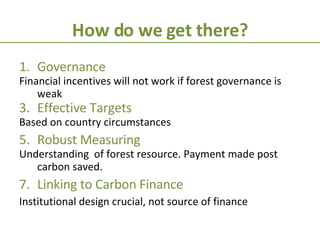
How do we get there? Governance  Financial incentives will not work if forest governance is weak Effective Targets Based on country circumstances Robust Measuring Understanding  of forest resource. Payment made post carbon saved. Linking to Carbon Finance Institutional design crucial, not source of finance
Capacity Building To encourage multi-stakeholder processes To clarify and secure land tenure and user rights  To carry out land-use planning (based on national consensus) To build capacity for application and enforcement  wider development programmes
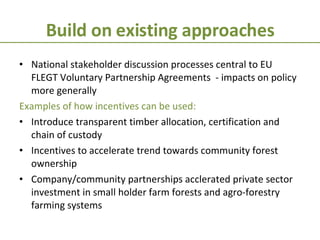
Build on existing approaches National stakeholder discussion processes central to EU FLEGT Voluntary Partnership Agreements  - impacts on policy more generally Examples of how incentives can be used: Introduce transparent timber allocation, certification and chain of custody Incentives to accelerate trend towards community forest ownership Company/community partnerships acclerated private sector investment in small holder farm forests and agro-forestry farming systems
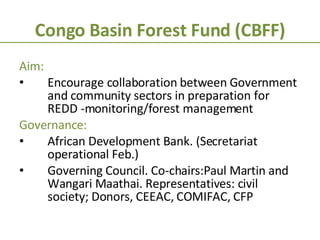
Congo Basin Forest Fund (CBFF) Aim:  Encourage collaboration between Government and community sectors in preparation for REDD -monitoring/forest management Governance: African Development Bank. (Secretariat operational Feb.) Governing Council. Co-chairs:Paul Martin and Wangari Maathai. Representatives: civil society; Donors, CEEAC, COMIFAC, CFP
Addressing drivers Not all about payments – UNFCCC Agreement needs to take into account potential for leakage to international markets FLEGT – improve markets for legal and sustainable timber products Responsible Timber Purchasing Policy Biofuels – impacts on land/sustainability criteria
What next? Poznan: Resolve outstanding methodological issues Establish basis for scaled up projects Broad rinciples for international architecture : Transparency; Accountability; Participation Copenhagen : Agree financial mechanism and link to final deal Ensure voices are being heard Feed lessons from demonstration projects into negotiations  Development of guidance
Thank you [email_address] +44(0)20 7238 5228

DFID forests and climate change strategy

  • 1.
    Funds and Financing:Promoting REDD approaches that protect and strengthen local rights Katharine Thoday UK Government
  • 2.
    Emergence of REDDCOP 11 Montreal 2005 - Papua New Guinea and the Coalition for Rainforest Nations proposed that developing countries participate in future climate change agreements by taking voluntary targets to reduce deforestation below national (rather than project specific) baselines or reference levels. COP 13 Bali 2007 - agreed that deforestation should be included in post-2012 climate agreement and sets out a process under the Bali Action Plan for establishing how to achieve this by COP 15 Copenhagen 2009.
  • 3.
    Bali conclusion Recognisesthe “ needs of local and indigenous communities should be addressed when action is taken to reduce emissions from deforestation and degradation in developing countries .” Need to take forest degradation as well as deforestation into account. Further consideration of how to reward the sustainable management of forests (increase and/or maintenance of forest C stocks). Encouragement of demonstration activities and indicative guidance for these activities, including accurate reporting and expert review, sub-national v national approach, historical basis Recognition that demonstration activities should be taken into account in future negotiations under BAP.
  • 4.
    How do weget there? Governance Financial incentives will not work if forest governance is weak Effective Targets Based on country circumstances Robust Measuring Understanding of forest resource. Payment made post carbon saved. Linking to Carbon Finance Institutional design crucial, not source of finance
  • 5.
    Capacity Building Toencourage multi-stakeholder processes To clarify and secure land tenure and user rights To carry out land-use planning (based on national consensus) To build capacity for application and enforcement wider development programmes
  • 6.
    Build on existingapproaches National stakeholder discussion processes central to EU FLEGT Voluntary Partnership Agreements - impacts on policy more generally Examples of how incentives can be used: Introduce transparent timber allocation, certification and chain of custody Incentives to accelerate trend towards community forest ownership Company/community partnerships acclerated private sector investment in small holder farm forests and agro-forestry farming systems
  • 7.
    Congo Basin ForestFund (CBFF) Aim: Encourage collaboration between Government and community sectors in preparation for REDD -monitoring/forest management Governance: African Development Bank. (Secretariat operational Feb.) Governing Council. Co-chairs:Paul Martin and Wangari Maathai. Representatives: civil society; Donors, CEEAC, COMIFAC, CFP
  • 8.
    Addressing drivers Notall about payments – UNFCCC Agreement needs to take into account potential for leakage to international markets FLEGT – improve markets for legal and sustainable timber products Responsible Timber Purchasing Policy Biofuels – impacts on land/sustainability criteria
  • 9.
    What next? Poznan:Resolve outstanding methodological issues Establish basis for scaled up projects Broad rinciples for international architecture : Transparency; Accountability; Participation Copenhagen : Agree financial mechanism and link to final deal Ensure voices are being heard Feed lessons from demonstration projects into negotiations Development of guidance
  • 10.
    Thank you [email_address]+44(0)20 7238 5228