 Poverty reduction, biodiversity
conservation and climate protection
through improved management of
forests
 Equipping of policymakers and
practitioners in developing countries
with strategic knowledge, comparable
evidence, reliable tools and systematic
analysis on forests and climate
 Recognition that many forest policies
and projects are poorly underpinned by
science, evidence and knowledge
KNOW-FOR
Improving the way knowledge on forests
is understood, communicated and used internationally
 CIFOR, IUCN and PROFOR have
been working jointly on a
number of areas
 DFID saw a great opportunity to
emphasise the value added of
globally important organisations
working together on knowledge
uptake
 Capitalizes on respective,
complementary strengths and
networks of partners:
- CIFOR, IUCN, PROFOR
KNOW-FOR
Improving the way knowledge on forests
is understood, communicated and used internationally
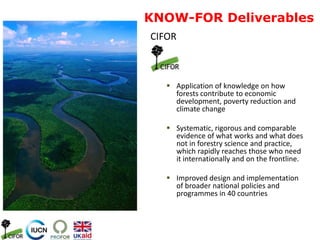
KNOW-FOR Deliverables
This programme will develop:
 Application of knowledge on how forests
contribute to economic
development, poverty reduction and
climate change
 Systematic, rigorous and comparable
evidence of what works and what does not
in forestry science and practice, which
rapidly reaches those who need it
internationally and on the frontline
 Improved design and implementation of
broader national policies and programmes
in 40 countries
 Techniques and practices for forest
restoration (the “+” in REDD +) creating
healthy landscapes in up to15 countries
 A broad suite of toolkits, analyses and
knowledge products that are mainstreamed
into in 30 countries
KNOW-FOR Deliverables
CIFOR
 Application of knowledge on how
forests contribute to economic
development, poverty reduction and
climate change
 Systematic, rigorous and comparable
evidence of what works and what does
not in forestry science and practice,
which rapidly reaches those who need
it internationally and on the frontline.
 Improved design and implementation
of broader national policies and
programmes in 40 countries
DFID KNOW-FOR: CIFOR investments
Cross-cutting & emerging issues
 Evidence-based forestry
 Communications & knowledge sharing
 Future emerging issues
Environment portfolio
 Planted forests
 SFM capacity building
Governance portfolio
 Global & regional trade & investment impacts
 Property rights & REDD+
Livelihoods portfolio
 Forests & food security
 Livelihoods in the context of REDD+
 Poverty-Environment Network
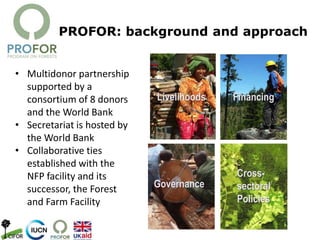
PROFOR: background and approach
Livelihoods Financing
Governance
Cross-
sectoral
Policies
• Multidonor partnership
supported by a
consortium of 8 donors
and the World Bank
• Secretariat is hosted by
the World Bank
• Collaborative ties
established with the
NFP facility and its
successor, the Forest
and Farm Facility
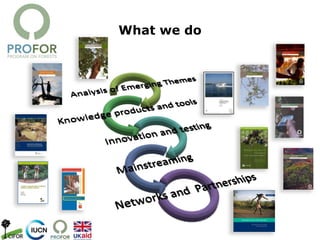
What we do
KNOW-FOR Deliverables
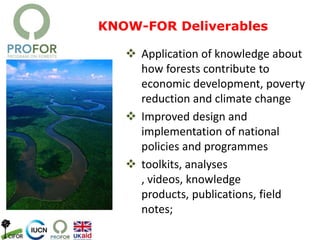
 Application of knowledge about
how forests contribute to
economic development, poverty
reduction and climate change
 Improved design and
implementation of national
policies and programmes
 toolkits, analyses
, videos, knowledge
products, publications, field
notes;
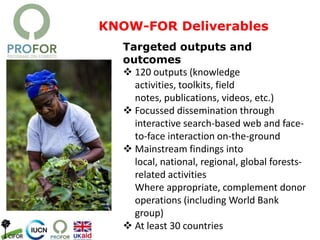
Targeted outputs and
outcomes
 120 outputs (knowledge
activities, toolkits, field
notes, publications, videos, etc.)
 Focussed dissemination through
interactive search-based web and face-
to-face interaction on-the-ground
 Mainstream findings into
local, national, regional, global forests-
related activities
Where appropriate, complement donor
operations (including World Bank
group)
 At least 30 countries
KNOW-FOR Deliverables
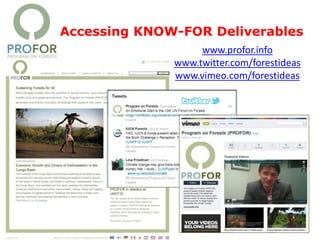
Accessing KNOW-FOR Deliverables
www.profor.info
www.twitter.com/forestideas
www.vimeo.com/forestideas
KNOW-FOR: IUCN investments
in support of the Bonn Challenge
Key deliverables
1. Production and uptake of new
knowledge and analysis on key
economic, social and biophysical
opportunities for and constraints to
landscape restoration
2. Development and testing of robust
and easy-to-use tools to assist local,
national and regional actors to
identify, negotiate, implement, and
monitor locally suited landscape
restoration strategies
3. Strengthening capacity for scaling
up landscape restoration efforts and
investment
Thematic focus
1. Restoration as a vehicle for carbon-
intensive land stewardship
2. Land-use dynamics as a
contribution to LR (farm fallow)
3. Adaptation/mitigation synergies
through landscape restoration
4. Links between water, water flows
and LR, including implications for
urban areas
5.
Governance, institutional, monitoring
arrangements for LR
6. Models for private and public
sector investment in LR
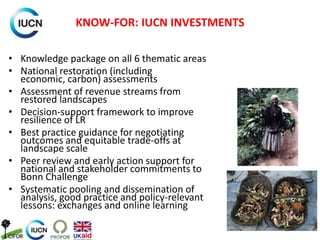
KNOW-FOR: IUCN INVESTMENTS
• Knowledge package on all 6 thematic areas
• National restoration (including
economic, carbon) assessments
• Assessment of revenue streams from
restored landscapes
• Decision-support framework to improve
resilience of LR
• Best practice guidance for negotiating
outcomes and equitable trade-offs at
landscape scale
• Peer review and early action support for
national and stakeholder commitments to
Bonn Challenge
• Systematic pooling and dissemination of
analysis, good practice and policy-relevant
lessons: exchanges and online learning
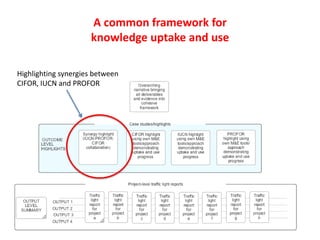
A common framework for
knowledge uptake and use
Highlighting synergies between
CIFOR, IUCN and PROFOR
For more information:
DFID: G-allison@dfid.gov.uk
IUCN: carole.saint-laurent@iucn.org
www.iucn.org; www.forestlandscaperestoration.org
PROFOR: profor@worldbank.org; pdewees@worldbank.org
www.profor.info; www.twitter.com/forestideas; www.vimeo.com/forestideas
CIFOR: j.colmey@cgiar.org
cifor.org

UNFF 10: Knowfor

  • 1.
     Poverty reduction,biodiversity conservation and climate protection through improved management of forests  Equipping of policymakers and practitioners in developing countries with strategic knowledge, comparable evidence, reliable tools and systematic analysis on forests and climate  Recognition that many forest policies and projects are poorly underpinned by science, evidence and knowledge KNOW-FOR Improving the way knowledge on forests is understood, communicated and used internationally
  • 2.
     CIFOR, IUCNand PROFOR have been working jointly on a number of areas  DFID saw a great opportunity to emphasise the value added of globally important organisations working together on knowledge uptake  Capitalizes on respective, complementary strengths and networks of partners: - CIFOR, IUCN, PROFOR KNOW-FOR Improving the way knowledge on forests is understood, communicated and used internationally
  • 3.
    KNOW-FOR Deliverables This programmewill develop:  Application of knowledge on how forests contribute to economic development, poverty reduction and climate change  Systematic, rigorous and comparable evidence of what works and what does not in forestry science and practice, which rapidly reaches those who need it internationally and on the frontline  Improved design and implementation of broader national policies and programmes in 40 countries  Techniques and practices for forest restoration (the “+” in REDD +) creating healthy landscapes in up to15 countries  A broad suite of toolkits, analyses and knowledge products that are mainstreamed into in 30 countries
  • 4.
    KNOW-FOR Deliverables CIFOR  Applicationof knowledge on how forests contribute to economic development, poverty reduction and climate change  Systematic, rigorous and comparable evidence of what works and what does not in forestry science and practice, which rapidly reaches those who need it internationally and on the frontline.  Improved design and implementation of broader national policies and programmes in 40 countries
  • 5.
    DFID KNOW-FOR: CIFORinvestments Cross-cutting & emerging issues  Evidence-based forestry  Communications & knowledge sharing  Future emerging issues Environment portfolio  Planted forests  SFM capacity building Governance portfolio  Global & regional trade & investment impacts  Property rights & REDD+ Livelihoods portfolio  Forests & food security  Livelihoods in the context of REDD+  Poverty-Environment Network
  • 6.
    PROFOR: background andapproach Livelihoods Financing Governance Cross- sectoral Policies • Multidonor partnership supported by a consortium of 8 donors and the World Bank • Secretariat is hosted by the World Bank • Collaborative ties established with the NFP facility and its successor, the Forest and Farm Facility
  • 7.
  • 8.
    KNOW-FOR Deliverables  Applicationof knowledge about how forests contribute to economic development, poverty reduction and climate change  Improved design and implementation of national policies and programmes  toolkits, analyses , videos, knowledge products, publications, field notes;
  • 9.
    Targeted outputs and outcomes 120 outputs (knowledge activities, toolkits, field notes, publications, videos, etc.)  Focussed dissemination through interactive search-based web and face- to-face interaction on-the-ground  Mainstream findings into local, national, regional, global forests- related activities Where appropriate, complement donor operations (including World Bank group)  At least 30 countries KNOW-FOR Deliverables
  • 10.
  • 11.
    KNOW-FOR: IUCN investments insupport of the Bonn Challenge Key deliverables 1. Production and uptake of new knowledge and analysis on key economic, social and biophysical opportunities for and constraints to landscape restoration 2. Development and testing of robust and easy-to-use tools to assist local, national and regional actors to identify, negotiate, implement, and monitor locally suited landscape restoration strategies 3. Strengthening capacity for scaling up landscape restoration efforts and investment Thematic focus 1. Restoration as a vehicle for carbon- intensive land stewardship 2. Land-use dynamics as a contribution to LR (farm fallow) 3. Adaptation/mitigation synergies through landscape restoration 4. Links between water, water flows and LR, including implications for urban areas 5. Governance, institutional, monitoring arrangements for LR 6. Models for private and public sector investment in LR
  • 12.
    KNOW-FOR: IUCN INVESTMENTS •Knowledge package on all 6 thematic areas • National restoration (including economic, carbon) assessments • Assessment of revenue streams from restored landscapes • Decision-support framework to improve resilience of LR • Best practice guidance for negotiating outcomes and equitable trade-offs at landscape scale • Peer review and early action support for national and stakeholder commitments to Bonn Challenge • Systematic pooling and dissemination of analysis, good practice and policy-relevant lessons: exchanges and online learning
  • 13.
    A common frameworkfor knowledge uptake and use Highlighting synergies between CIFOR, IUCN and PROFOR
  • 14.
    For more information: DFID:G-allison@dfid.gov.uk IUCN: carole.saint-laurent@iucn.org www.iucn.org; www.forestlandscaperestoration.org PROFOR: profor@worldbank.org; pdewees@worldbank.org www.profor.info; www.twitter.com/forestideas; www.vimeo.com/forestideas CIFOR: j.colmey@cgiar.org cifor.org

Editor's Notes

  • #2 Intro: Forests are fundamental to DFID’s development efforts on three fronts. Forests reduce carbon emissions, help reduce poverty in rural communities and protect global and local environmental services such as water, soils and biodiversity. Developing countries are ramping up their practical efforts to reduce and reverse deforestation and forest degradation on the ground. Demand has grown for knowledge, evidence and information on international forestry. Policymakers and practitioners wish to know what works best where; and be able to apply that knowledge to what they do. Forest policies and projects that are poorly underpinned by science and evidence, or do not use the best combination of technology and local know-how, run the risk of repeating and replicating past mistakes; for example, high mortality of tree seedlings in tree planting schemes; poor match between tree species and site-specific conditions; unworkable park conservation projects; limited participation of local people in design and monitoring of projects with subsequent poor project results; and inequitable arrangements for sharing the benefits from trees and forests, leading to lack of care and maintenance of trees and other elements of forest ecosystems. There are gaps in knowledge. There is a need for, first, systematically gathered and rigorous information that is comparable across sites and countries; second, more knowledge about how forests contribute to livelihoods, poverty reduction and economic development in developing countries; third, measurement of the range of impacts on the ground from projects that aim to deliver Reduced Emissions from Deforestation and Degradation (REDD+); and fourth, understanding about the varying cost of different land use practices and the benefits they provide. Finally, practitioners and policymakers need to know what kinds of financing and investment arrangements work for forests.
  • #3 Intro: Forests are fundamental to DFID’s development efforts on three fronts. Forests reduce carbon emissions, help reduce poverty in rural communities and protect global and local environmental services such as water, soils and biodiversity. Developing countries are ramping up their practical efforts to reduce and reverse deforestation and forest degradation on the ground. Demand has grown for knowledge, evidence and information on international forestry. Policymakers and practitioners wish to know what works best where; and be able to apply that knowledge to what they do. Forest policies and projects that are poorly underpinned by science and evidence, or do not use the best combination of technology and local know-how, run the risk of repeating and replicating past mistakes; for example, high mortality of tree seedlings in tree planting schemes; poor match between tree species and site-specific conditions; unworkable park conservation projects; limited participation of local people in design and monitoring of projects with subsequent poor project results; and inequitable arrangements for sharing the benefits from trees and forests, leading to lack of care and maintenance of trees and other elements of forest ecosystems. There are gaps in knowledge. There is a need for, first, systematically gathered and rigorous information that is comparable across sites and countries; second, more knowledge about how forests contribute to livelihoods, poverty reduction and economic development in developing countries; third, measurement of the range of impacts on the ground from projects that aim to deliver Reduced Emissions from Deforestation and Degradation (REDD+); and fourth, understanding about the varying cost of different land use practices and the benefits they provide. Finally, practitioners and policymakers need to know what kinds of financing and investment arrangements work for forests.