Introduction to PES and REDD+Implications for participating land managersTraining Workshop on Payments for Ecosystem Services (PES) and Reducing Emissions from Deforestation and Degradation (REDD+)Nairobi, Kenya - August 8th, 2011SARA NAMIREMBEWorld Agroforestry Center
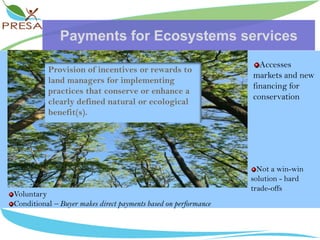
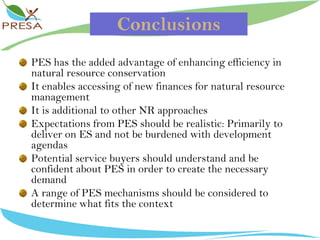
Payments for Ecosystems servicesAccesses markets and new financing for conservationProvision of incentives or rewards to land managers for implementing practices that conserve or enhance a clearly defined natural or ecological benefit(s).Not a win-win solution - hard trade-offsVoluntaryConditional – Buyer makes direct payments based on performance
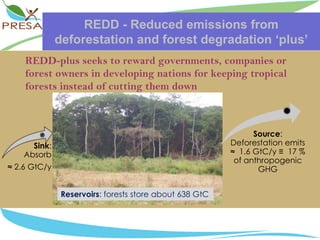
REDD - Reduced emissions from deforestation and forest degradation ‘plus’REDD-plus seeks to reward governments, companies or forest owners in developing nations for keeping tropical forests instead of cutting them down Reservoirs: forests store about 638 GtC
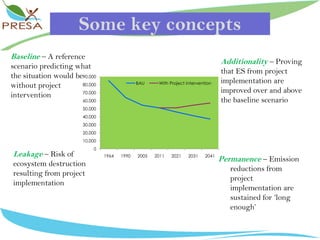
SomekeyconceptsBaseline– A referencescenariopredictingwhatthesituationwouldbewithoutprojectinterventionAdditionality–Provingthat ES fromprojectimplementation are improvedover and abovethebaselinescenarioLeakage–Risk of ecosystemdestructionresultingfromprojectimplementationPermanence– Emissionreductionsfromprojectimplementation are sustainedfor ‘longenough’
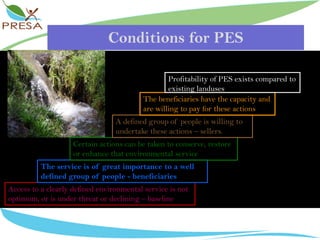
Conditions for PESProfitability of PES exists compared to existing landusesThe beneficiaries have the capacity and are willing to pay for these actionsA defined group of people is willing to undertake these actions – sellers. Certain actions can be taken to conserve, restore or enhance that environmental serviceThe service is of great importance to a well defined group of people - beneficiariesAccess to a clearly defined environmental service is not optimum, or is under threat or declining – baseline
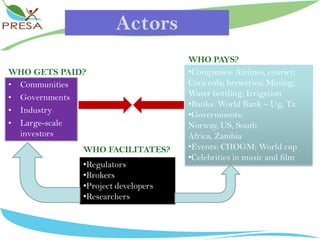
ActorsWHO PAYS?Companies: Airlines, courier; Coca cola; breweries; Mining; Water bottling; Irrigation
Banks: World Bank – Ug, Tz
Governments: Norway, US, South Africa, Zambia
Events: CHOGM; World cup
Celebrities in music and filmWHO GETS PAID?CommunitiesGovernmentsIndustryLarge-scale investorsWHO FACILITATES?Regulators
Brokers

Introduction to PES and REDD+: Implications for participating land managers

  • 1.
    Introduction to PESand REDD+Implications for participating land managersTraining Workshop on Payments for Ecosystem Services (PES) and Reducing Emissions from Deforestation and Degradation (REDD+)Nairobi, Kenya - August 8th, 2011SARA NAMIREMBEWorld Agroforestry Center
  • 2.
    Payments for EcosystemsservicesAccesses markets and new financing for conservationProvision of incentives or rewards to land managers for implementing practices that conserve or enhance a clearly defined natural or ecological benefit(s).Not a win-win solution - hard trade-offsVoluntaryConditional – Buyer makes direct payments based on performance
  • 3.
    REDD - Reducedemissions from deforestation and forest degradation ‘plus’REDD-plus seeks to reward governments, companies or forest owners in developing nations for keeping tropical forests instead of cutting them down Reservoirs: forests store about 638 GtC
  • 4.
    SomekeyconceptsBaseline– A referencescenariopredictingwhatthesituationwouldbewithoutprojectinterventionAdditionality–ProvingthatES fromprojectimplementation are improvedover and abovethebaselinescenarioLeakage–Risk of ecosystemdestructionresultingfromprojectimplementationPermanence– Emissionreductionsfromprojectimplementation are sustainedfor ‘longenough’
  • 5.
    Conditions for PESProfitabilityof PES exists compared to existing landusesThe beneficiaries have the capacity and are willing to pay for these actionsA defined group of people is willing to undertake these actions – sellers. Certain actions can be taken to conserve, restore or enhance that environmental serviceThe service is of great importance to a well defined group of people - beneficiariesAccess to a clearly defined environmental service is not optimum, or is under threat or declining – baseline
  • 6.
    ActorsWHO PAYS?Companies: Airlines,courier; Coca cola; breweries; Mining; Water bottling; Irrigation
  • 7.
  • 8.
    Governments: Norway, US,South Africa, Zambia
  • 9.
  • 10.
    Celebrities in musicand filmWHO GETS PAID?CommunitiesGovernmentsIndustryLarge-scale investorsWHO FACILITATES?Regulators
  • 11.

Editor's Notes

  • #6 Profitability of PES exists compared to existing landuses, risks, price fluctuations, expected future returns, legality of use, security of land tenure etc.
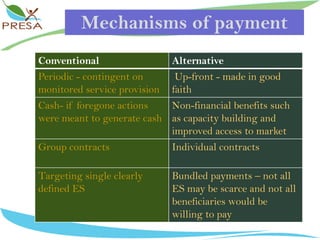
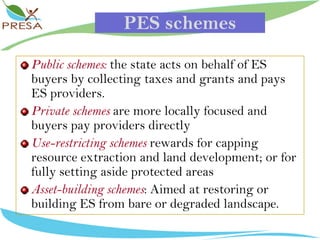
  • #9 Public schemes (e.g. in Costa Rica, Mexico, China, South Africa, Zambia).Public schemes tend to be generally larger in scope and have the state providing legitimacycan become overloaded with side objectives Use-restricting schemes e.g., setting aside protected habitat. Landowners are paid for their conservation opportunity cost, plus other project implementation costsare less flexible vis-à-vis targeting of strategic ES sellerstend to be less efficient in securing additional ES provision