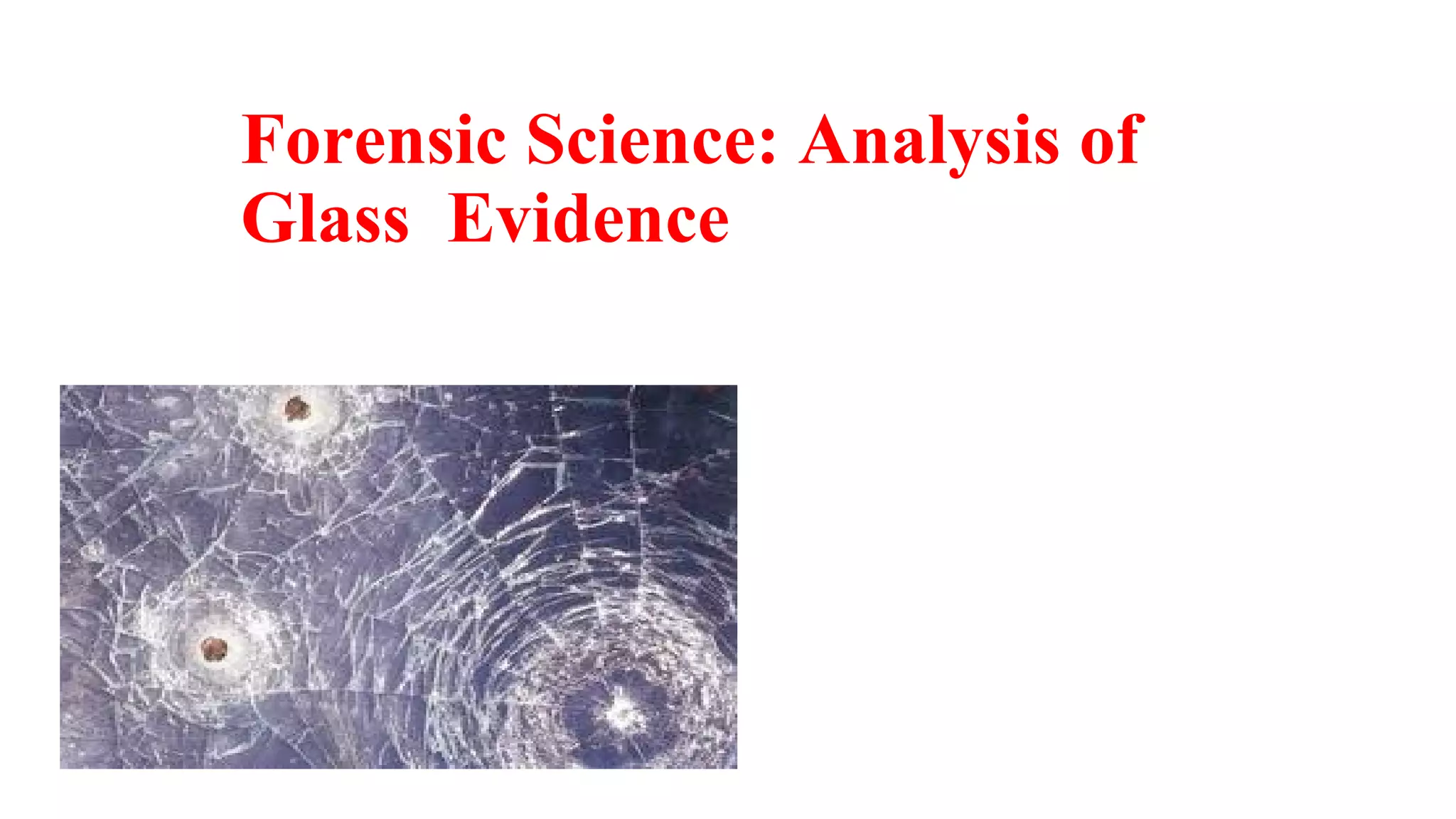
Forensic Science: Analysis of
Glass Evidence
Glass evidence can be found at many crime
scenes.
• Automobile accident sites may be littered with broken headlight or
windshield glass.
• The site of a store break-in may contain shards of window glass with
fibers or blood on them.
• If shots are fired into a window, the sequence and direction of the
bullets can often be determined by examining the glass.
• Minute particles of glass may be transferred to a suspect’s shoes or
clothing and can provide a source of trace evidence linking a suspect
to a crime.
Glass & Forensics
• How was it broken?
• Link a suspect to a crime scene
• Fingerprints
• Blood
Chemical and Physical Properties
• Physical properties describe a substance without comparing with
another substance. They are measurements like weight, volume,
boiling point, melting point.
• Chemical properties describe what happens when you combine it
with something else in a chemical reaction. Examples are burning,
coloring reagent tests, decomposing, synthesis of an alloy from
individual elements
How is glass formed?
• Long before humans began making glass, glass formed naturally.
• When certain types of rock are exposed to extremely high
temperatures, such as lightning strikes or erupting volcanoes, glass
can form.
• Obsidian is a type of glass formed by volcanoes.
Timeline of Events
• Prehistoric humans used obsidian as a cutting tool.
• The earliest man-made glass objects (glass beads) were found in
Egypt dating back to 2500 BC.
• Glass blowing began sometime during the first century BC.
• By the 14th century, knowledge of glass making spread throughout
Europe.
• The Industrial Revolution brought the mass production of many kinds
of glass.
Glass evidence has a special role within trace evidence in that it represents a
“model matrix” due to the following characteristics of this evidentiary material:
It is a common type of trace evidence as a consequence of its fragile nature and wide use in
society.
It is easily transferred from a broken source to the scene/victim(s)/suspect(s).
It is easily recovered from a scene/object.
It can persist after transfer but its chemical composition does not degrade or vary over time
after transfer.
The sizes of the fragments that are typically recovered from breaking events are normally
sufficient for analysis by a variety of methods.
Sensitive methods for the determination of the optical and chemical properties of glass
currently exist in the form of standard methods of analysis and suitable reference materials
also exist for calibration and/or bias determination.
Glass is defined as an inorganic product of fusion that has been cooled to
a rigid condition without crystallization .
This material is composed of a mixture of inorganic materials that are
responsible of its different physical properties.
The inorganic materials may be present in the final product at high, minor
or trace levels.
Some components determine the glass structure; others are added
intentionally to decrease the cost of manufacture or to provide desired
properties such as color, viscosity, heat resistance and safety.
How is Glass Formed?
• Glass is a hard, brittle, amorphous material made by melting sand
(aka silica, silicon dioxide, SiO2) lime (aka calcium oxide CaO) and
soda, sodium carbonate (Na2CO3) at very high temperatures.
• The lime (CaO) is added to prevent the glass from being soluble in
water.
• The soda (Na2CO3) is added to lower the melting point of silica (sand)
and make it easier to work with.
• In some types of glass with special requirements, trace amounts of
other elements are added. Example: Boron is added to make Pyrex
glass.
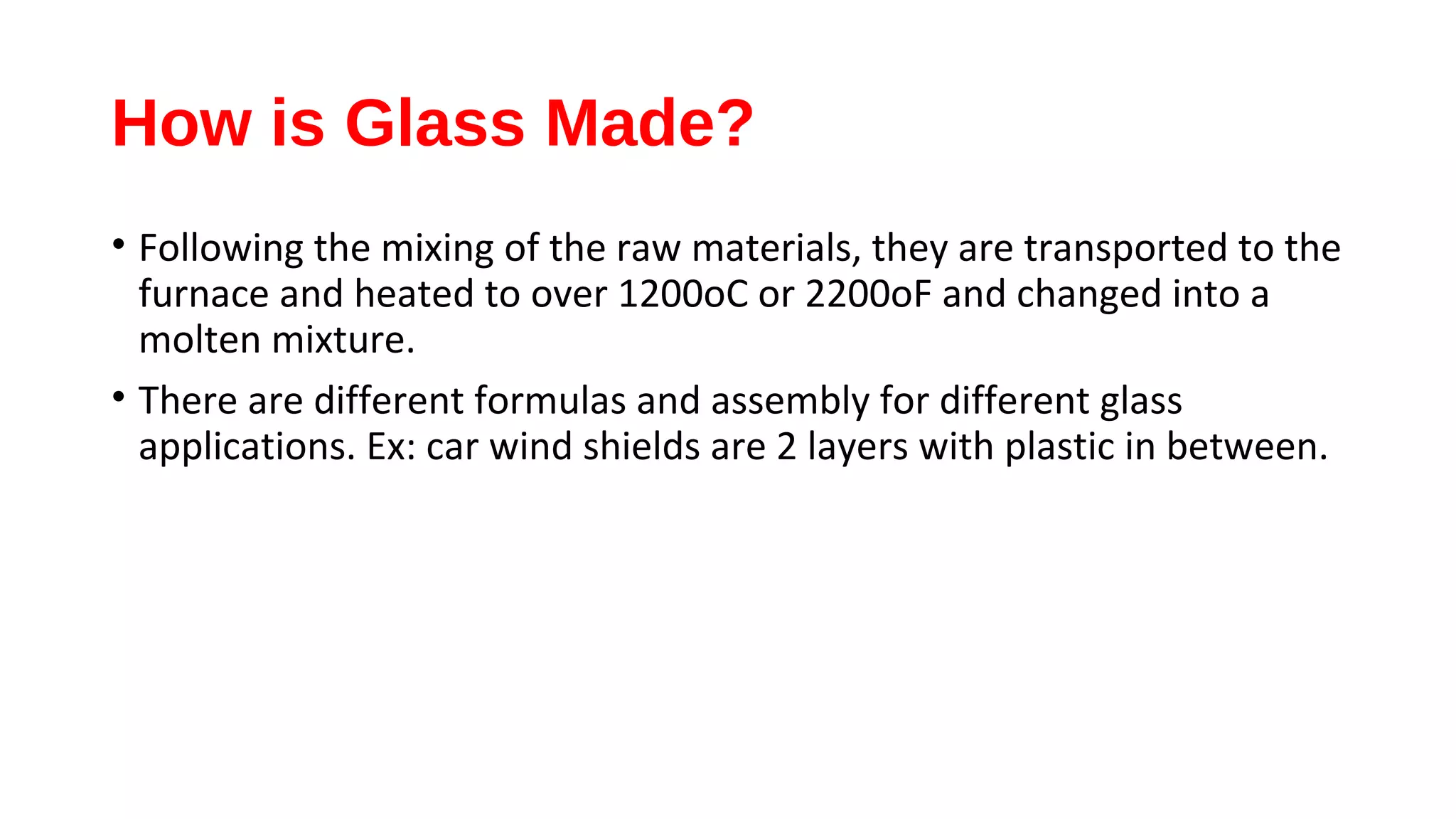
How is Glass Made?
• Following the mixing of the raw materials, they are transported to the
furnace and heated to over 1200oC or 2200oF and changed into a
molten mixture.
• There are different formulas and assembly for different glass
applications. Ex: car wind shields are 2 layers with plastic in between.
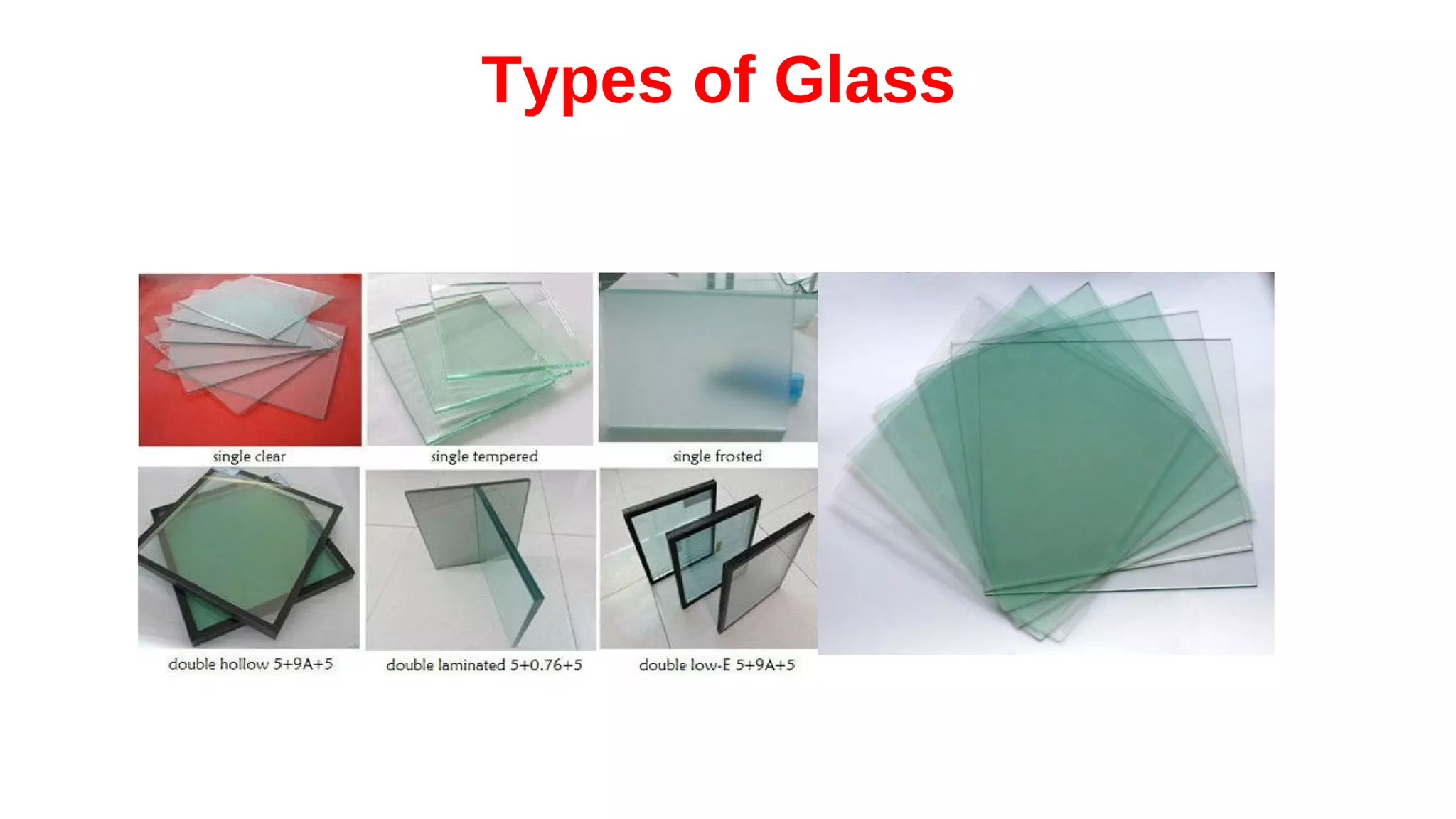
Types of Glass
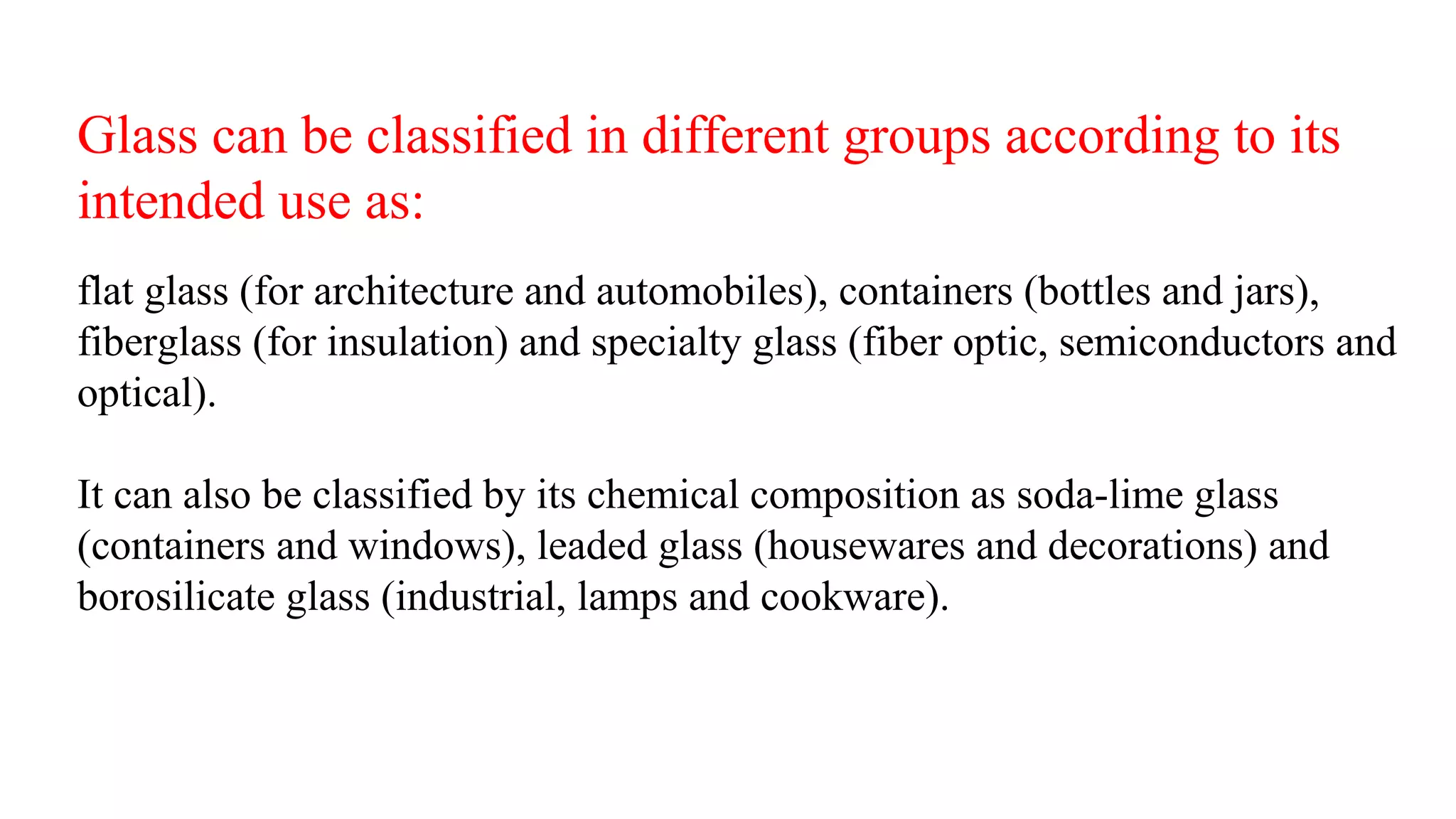
Glass can be classified in different groups according to its
intended use as:
flat glass (for architecture and automobiles), containers (bottles and jars),
fiberglass (for insulation) and specialty glass (fiber optic, semiconductors and
optical).
It can also be classified by its chemical composition as soda-lime glass
(containers and windows), leaded glass (housewares and decorations) and
borosilicate glass (industrial, lamps and cookware).
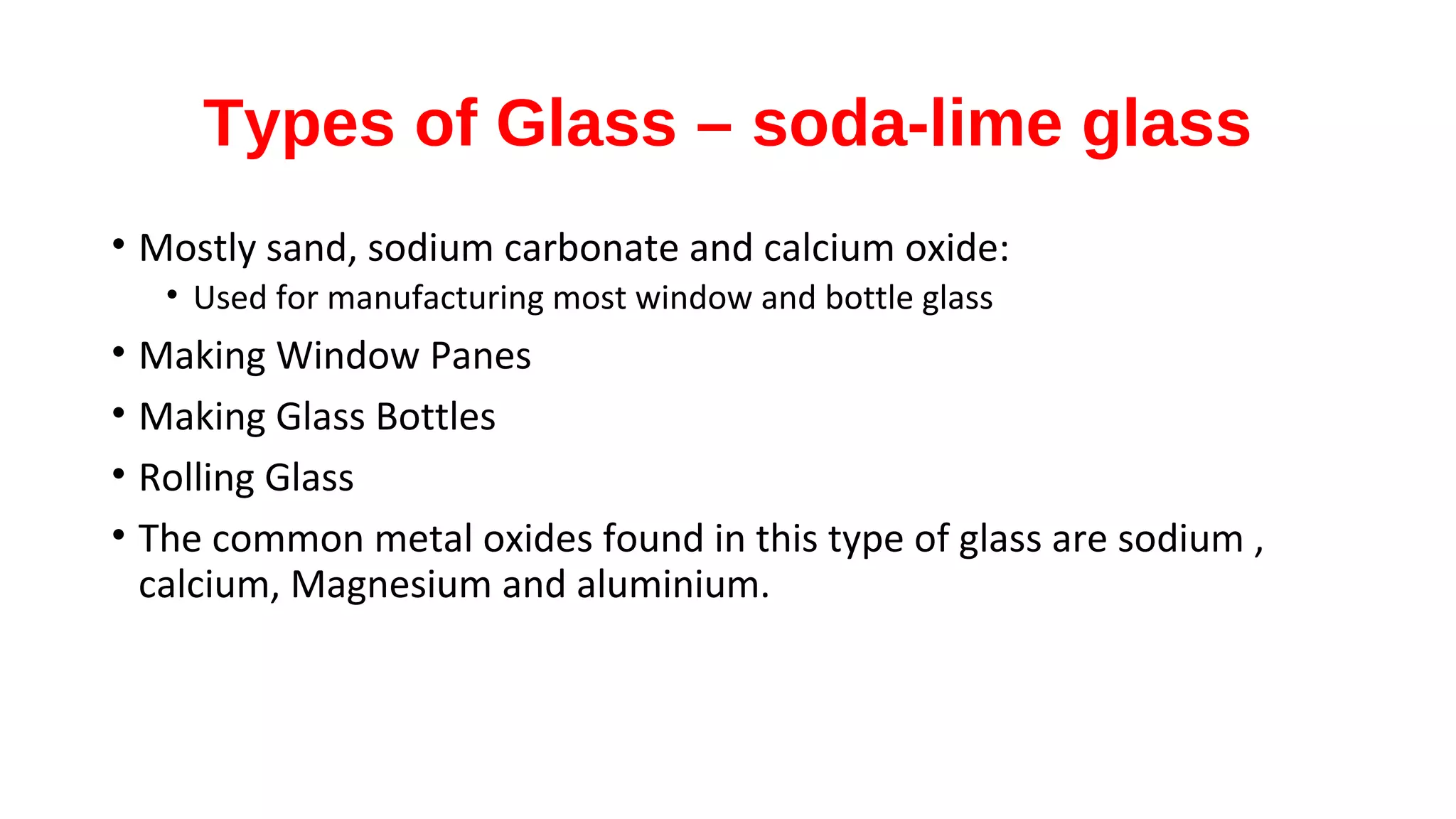
Types of Glass – soda-lime glass
• Mostly sand, sodium carbonate and calcium oxide:
• Used for manufacturing most window and bottle glass
• Making Window Panes
• Making Glass Bottles
• Rolling Glass
• The common metal oxides found in this type of glass are sodium ,
calcium, Magnesium and aluminium.
Types of Glass - Float Glass
• Flat glass typically used for windows.
• Soda-lime glass that has been cooled on top of a bath of molten tin.
Types of glass - Leaded Glass
• Fine glassware and decorative art glass, called crystal or leaded glass
substitutes lead oxide for calcium oxide (lime).
• The addition of lead oxide makes the glass denser. As light passes
through the more-dense glass, the light waves are bent, giving the
glass a sparkling effect.
Types of glass - Tempered Glass
• This glass is made stronger than ordinary window glass by introducing
stress through rapid heating and cooling of the glass surfaces.
• When tempered glass breaks, it does not shatter but rather
fragments or “dices” into small squares with little splintering.
• Used for side and rear windows of automobiles sold in the United
States.
Types of glass - Bulletproof Glass
• Bulletproof glass is a combination of two or more types of glass, one
hard and one soft.
• The softer layer makes the glass more elastic so it can flex instead of
shatter.
• The index of refraction for both of the glasses used in the bulletproof
layers must be almost the same to keep the glass transparent and
allow a clear view through the glass.
• Bulletproof glass varies in thickness from three-quarter inch to three
inches.
BOROSILICATE GLASS:
This is any glass having a substantial amount of boron (over 5% of B2
O3) which is resistant to heat, acid corrosion and alkalies.
This type of glass, also known as “Pyrex” glass is used to manufacture
laboratory glasswares, thermometers, household cookware and
automobile head light.
Wire glass:
It is single sheet of glass with a layer of meshed wire completely
embedded inside the glass, which will be usually thicker. It may or may
not be ground and/or polished on both sides.
Colored glass: These are produced by the addition of metallic oxides to
soda lime silica glass. Chromium oxide produces green color, cobalt
produces blue color, Iron produces greenish blue, gold, copper, selenium,
colloidal particles produces red color.
Light sensitive glass: These glasses contain colloidal particles of silver
halide.
The components of glass are classified according to their function
as:
formers, fluxes, modifiers, stabilizers, colorants, decolorants, accelerants,
and refining and opaliser agents.
Former agents are products that generally form the framework of the glass structure; when
cooled quickly after melting they solidify without crystallizing.
Fluxes are components that are added to the formers to lower the melting temperature and
to reduce cost of production.
Stabilizers are added to offer chemical resistance to the glass, while decolorants are used
to clarify the glass.
Refining agents are also important components of glass that help to remove trapped
bubbles from the molten glass during its production.
Physical measurements
The first step in any glass analysis is to identify the glass by physical and optical
properties such as hardness, amorphous structure and isotropism.
Physical observations such as color, thickness, curvature, flatness, presence of
manufacture markings, fluorescence and fracture characteristics are made in the
preliminary stages of the analysis.
Forensic examiners should be meticulous during the physical examination
of glass as it can address important information such as:
type of impact that caused the fracture of glass, for example, a fracture caused by a
gunshot or by a hard object such as a baseball bat;
direction of the force, for example, to establish if a window was broken from inside or
from outside;
type of material, for example, a flat architectural window, a tempered glass, a
headlamp, an eyeglass lens or a colored bottle;
source of origin of the glass fragment, for example, to establish that two or more
pieces of glass were originally joined.
Physical measurements
This include mainly two parameters namely, the thickness and curvature of the
glass pieces under comparison. It is observed that the thickness of glass sheet
vary significantly from one place to the other and do not have uniform thickness
throughout.
Therefore, it is very much desirable to obtain larger pieces of at least, the control
glass samples and study the variations in their thickness before comparing the
thickness of the control sample with that of the crime exhibit.
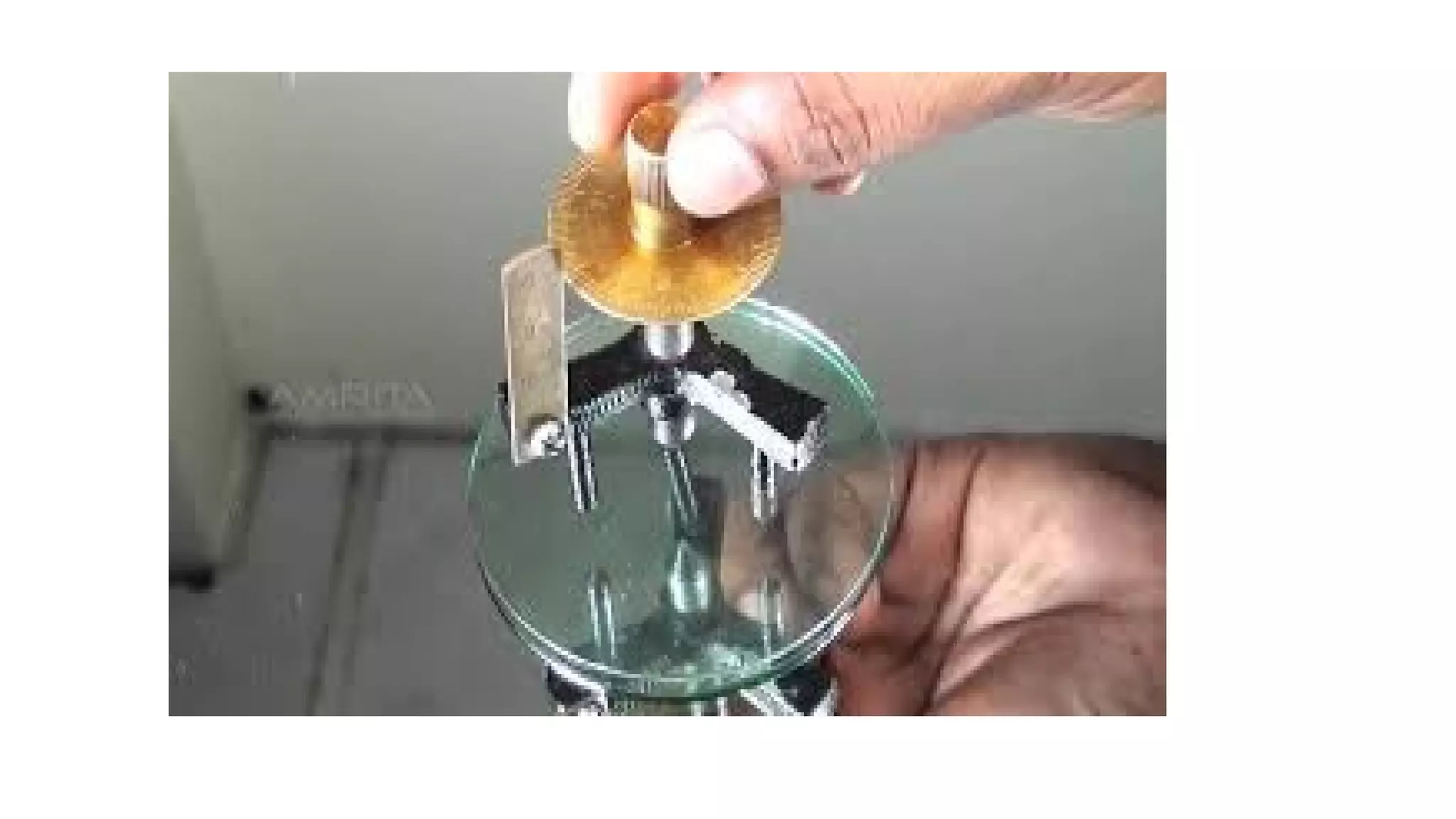
a) Edge thickness:
A micrometer is used to measure accurately the edge thickness of the
glass fragments. Readings should be taken all around the broken edged to find
out at which point, the crime exhibits matches with any portion of the
broken glass.
This will further help during the matching of surface patterns and other
identifying characteristics, along the broken edges.
b) Curvature:
A spherometer is used to measure the radius of curvature of the glass
fragments having curved surface. The radius of curvature of the fragment
is calculated using the formulae.
R = (l2/6h)+(h/2)
Where
1 = the mean distance between the legs of the spherometer.
h = height of the curved surface
Fluorescence under UV radiation
Some types of glass fluorescence under ultraviolet radiation with different colours which may
be brown, violet, purple, blue or green etc.
This examination has to be conducted in a dark room and the glass pieces to be exposed to UV
radiation should be of similar size and thickness and they are to be thoroughly washed with
acetone or any other suitable solvent to remove any grease or dirt.
When there is a clear difference in the fluorescence of the two glasses, it indicates different
sources of their origin.
On the other hand, the similarity in fluorescence by itself cannot be a conclusive proof of
source correspondence and further tests are to be conducted to arrive at the possible
commonness of origin.
Physical fit
A perfect physical fit or physical “match” is the best-case scenario that a forensic examiner
could have during the physical evaluation of glass, but it is rarely found in real cases.
For comparison purposes, the fragments are inspected visually in order to determine
whether or not there is a “fracture match” between any of the recovered fragments to any of
the source fragments. Such a match requires the edges of one fragment to perfectly fit into
the corresponding edges of another, much like a jigsaw puzzle .
The physical match of the broken edges of glass is three-dimensional and the analyst should
document the details by photography and written documentation. The match can also be
observed under the microscope in order to determine microscopic marks (conchoidal or
hackle marks).
This is most conclusive proof of source correspondence, since no two
fractures will ever be identical over any appreciable length.
A complimentary lateral fit along the broken edges over
a length of quarter inch (1/4) or more establishes that the two glass garments
were continuous before breakage.
By naked eye or under a microscope, we should search carefully the edges of
the samples, which will exactly fit into each other, taking into consideration,
the factors contributing to the matching, such as general appearance, colour,
edge thickness, shape of breakage, all the irregularities and striations near the
broken surfaces.
Thickness
Sometimes glass can be recovered from the scene as pieces that present the full
thickness of the source of origin.
In such cases, it may be useful to measure the thickness of the glass, as it can
provide information about the type of object from where it came, for example, a
vehicle side window, tempered glass, or beverage bottle.
For comparison purposes thickness measurements provide limited information
when the thickness is found to be the same but may be used to exclude a
fragment as originating from a source that clearly presents a different thickness.
Density
Density comparisons of glass can be accomplished using the sink-float method. The
comparison of density has the disadvantages of involving toxic liquids and requiring at
least 5 mg of sample.
Another limitation of density measurements is that measurements of small, irregular or
dirty fragments of glass may be inaccurate .
Density measurements have been mostly replaced by RI measurements, which provide
good optical property information with the advantage of being faster, more accurate
and more precise.
Density of Glass Determination
• To determine the density of glass, it is best to use the immersion
method.
• Density = mass/volume
• Mass is measured on a balance / scale.
• Volume is determined by immersing parts of the glass and seeing the
level change in a measurement glassware.
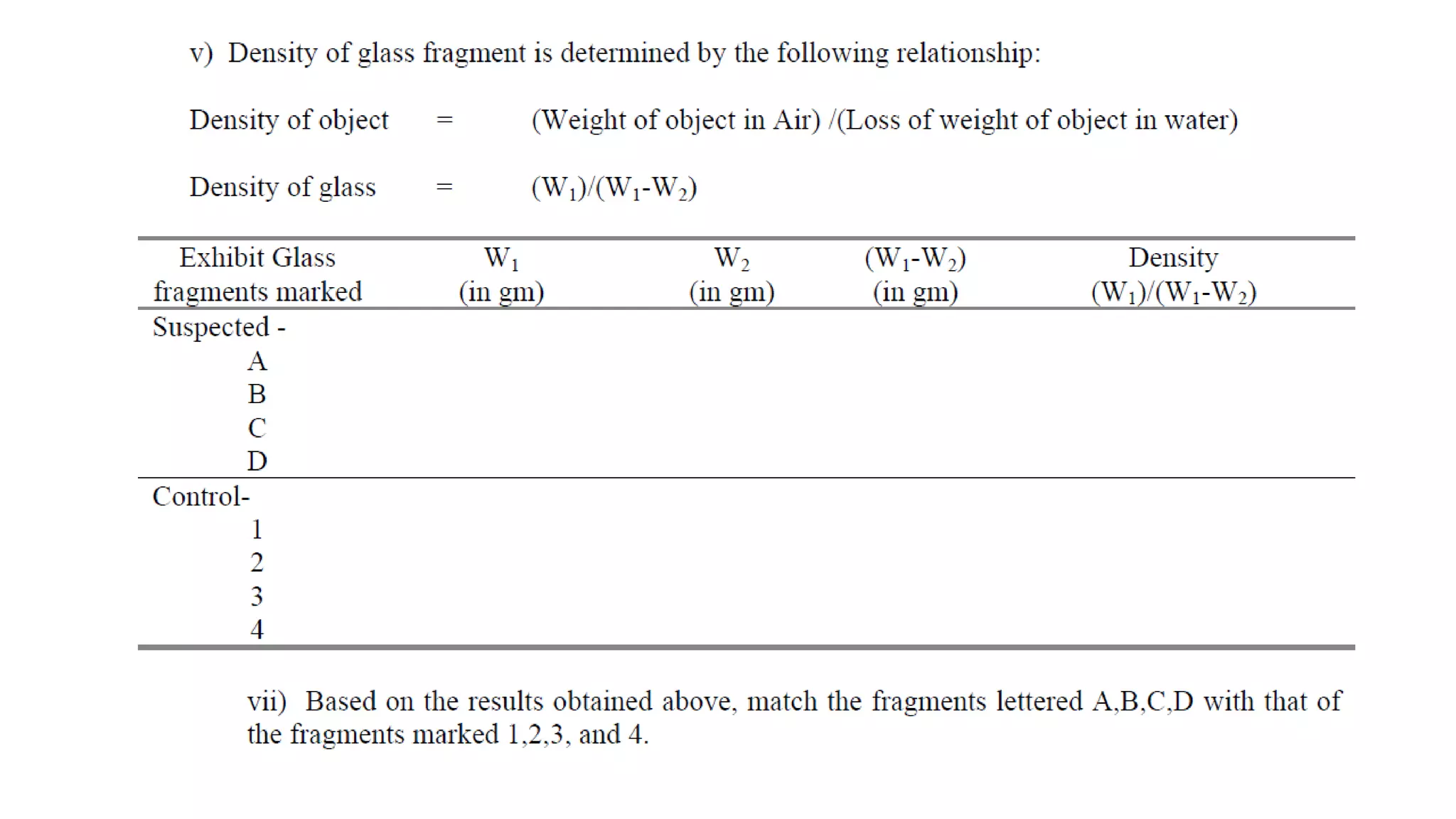
Density measurements for bigger fragments of glass
i) Use a laboratory balance with sensitivity ± 0.01 gms or better, along with support rack
provision, a 250 ml. capacity beaker and a piece of string about 1 meter in length.
ii) Tie the string around the glass fragment and suspend it from the pan support hook of
the balance, after the preliminary adjustments are made with the balance, before weighing.
iii) Weigh the glass fragment in air to the nearest 0.01gm and record its value (W1).
iv) Place the 250 ml. beaker nearly filled with water on the beaker. Support and suspend
the glass in the water. Adjust the glass height, so that it does not touch the walls of the
beaker, inside the water. Weigh the glass fragment suspended in water to the nearest
0.01gm and record this value (W2).
Comparing Densities: Flotation
• A solid particle will either float, sink, or remain suspended in a liquid, depending
upon its density relative to the liquid medium.
• Flotation = a standard / reference glass particle is immersed in a liquid; a
mixture of bromoform or bromobenzene may be used. The composition of the
liquid is carefully adjusted by adding small amounts of bromoform or
bromobenzene until the glass chip remains suspended in the liquid medium.
• At this point, the standard / reference glass sample and the liquid each have the
same density. Glass chips (same size and shape as reference sample) are added
to the liquid for comparison. If both the unknown and standard / reference
samples remain suspended, they have the same density.
Density comparison by flotation
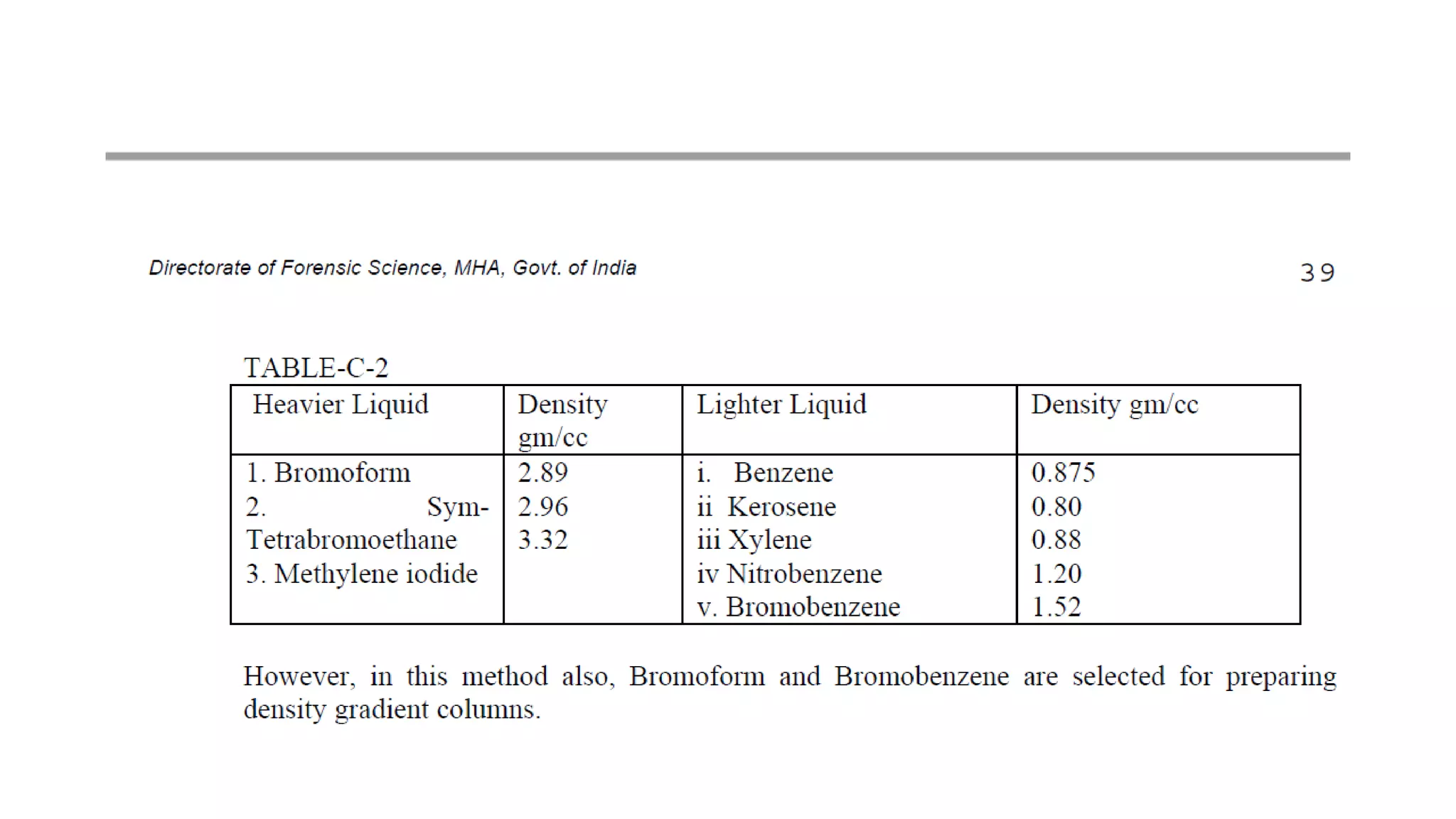
i)For the heavier liquid, methylene iodide or Bromoform can be used. For
the lighter liquid, Xylene, Bromobenzene, Nitrobenzene, Benzene or
Kerosene can be used.
For this method, Bromoform (d=2.89) and Bromobenzene (d=1.52) are
selected.
ii) The crime and control glass piece samples are to be crushed to comparable sizes with
similar shape. Each piece of glass is briefly sketched and marked for reference to return
it to its original packet after examination.
iii) A cleaned and dried sample of crime glass particle is placed in a small beaker
containing bromoform. The glass will float on the liquid surface. This indicates that the
density of the liquid is greater than that of the glass.
iv) Slowly add the less denser liquid, Bromobenzene, drop wise with stirring, until the
particle is exactly suspended. If the addition of Bromobenzene is in excess, which is
indicated by the sinking of the glass particle, then bromoform is added, until the glass
chip remains suspended in the liquid medium.
Care is taken to see that the mixture is stirred with each addition and the air bubbles, if
any, are removed.
v) Add similar size, clean and dry sample of control glass. If both the crime and the
control glass particles remain suspended in the liquid, then, their densities are equal to
each other and to that of the liquid mixture.
Particles of different densities will either sink or float, depending on whether they are
more dense or less dense than the liquid medium.
vi) The density value of the particles of glass can be determined by calculating the
density/specific gravity of the flotation mixture using specific gravity bottle or a
pycnometer.
Density comparison by density gradient tubes
An alternative technique of comparing densities of glass particles is to use density
gradient tubes having length of 30cms and diameter 1 cm.
A standard density gradient tube is made up of layers of two liquids, mixed in varying
proportions so that each layer has a different density value.
When completed, a density gradient tube will usually have 6 to 10 layers, in which bottom
layers have higher density. In this experiment, we not only compare glass particles but
also calibrate the density column, so that a fairly accurate estimate of density can
be made.
This is done by adding small crystals of ionic salts to the column, whose densities are
known.
Procedure:
i) Place seven test tubes in a test tube rack.
ii) Prepare the mixtures of bromobenzene and bromoform in the following ratios, by
pipetting out the respective liquids into the test tubes.
a) Pure bromoform-6ml (density -2.89)
b) 1 ml of bromobenzene 5 ml of bromoform
c) 2 ml of bromobenzene 4 ml of bromoform
d) 3 ml of bromobenzene 3 ml of bromoform
e) 4 ml of bromobenzene 2 ml of bromoform
f) 5 ml of bromobenzene 1 ml of bromoform
g) Pure bromobenzene-6ml (density -1.52)
iii) Mark off seven equal spaces-say 4 cm apart-along each of the two glass tubes of
length 30 cm and place them in the tube stand.
BECKE LINE CONCEPT:
The image of a transparent object observed through a microscope is formed by refraction
and reflection.
Due to this behavior of light, a dark boundary line is observed at the borders of
the object. Many objects are surrounded by a narrow band of light, when immersed in a
liquid. This band is called “Becke line”.
Thus, Becke line is the contrast (halo or bright border), which outlines the transparent
irregular particle, immersed in a liquid of different refractive index.
This halo disappears, when the liquid medium and the transparent object have the same
refractive index.
Thus, when glass particles are immersed in a liquid medium, the Becke lines will appear
due to the difference in the refractive indices of the glass and liquid. When the indices are
equal, the Becke lines will disappear and this point is known as ‘match point.’
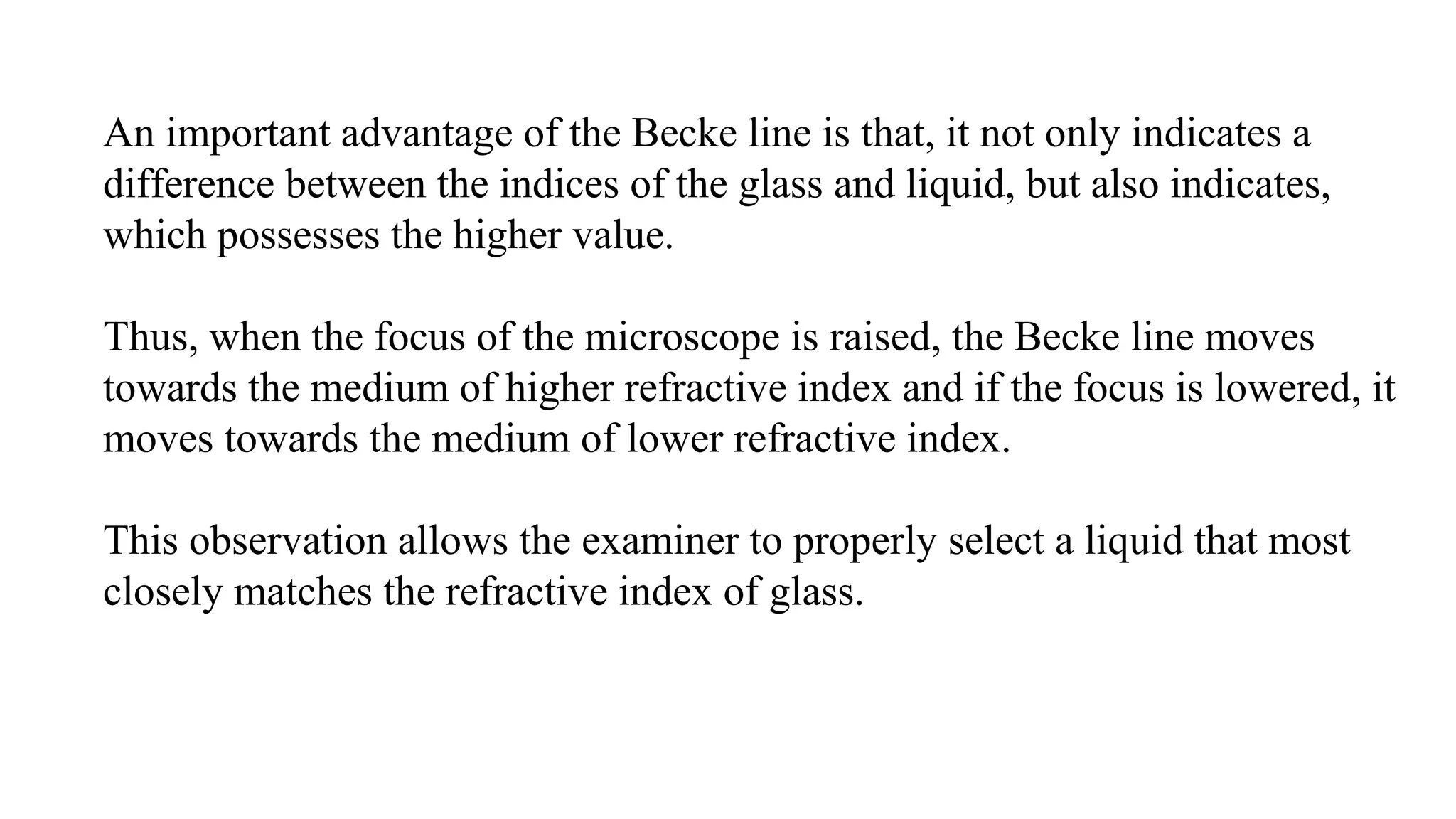
An important advantage of the Becke line is that, it not only indicates a
difference between the indices of the glass and liquid, but also indicates,
which possesses the higher value.
Thus, when the focus of the microscope is raised, the Becke line moves
towards the medium of higher refractive index and if the focus is lowered, it
moves towards the medium of lower refractive index.
This observation allows the examiner to properly select a liquid that most
closely matches the refractive index of glass.
When a colorless transparent object, such as glass, is being examined with a
microscope by transmitted light, visibility of the object is enhanced, as the
condenser diaphragm is closed, although the resolution is sacrificed.
Further more, reducing the aperture of the optical system of the microscope
enhances the visibility, by emphasizing the RI difference between
the glass and the mounting medium.
Therefore, a minimum numerical aperture should be used in examining the
glass chips for refractive index.
Refraction of Light
• Refraction of light is the bending of the light as it passes the boundary
between two different optically dense mediums. It changes directions
because it changes speed
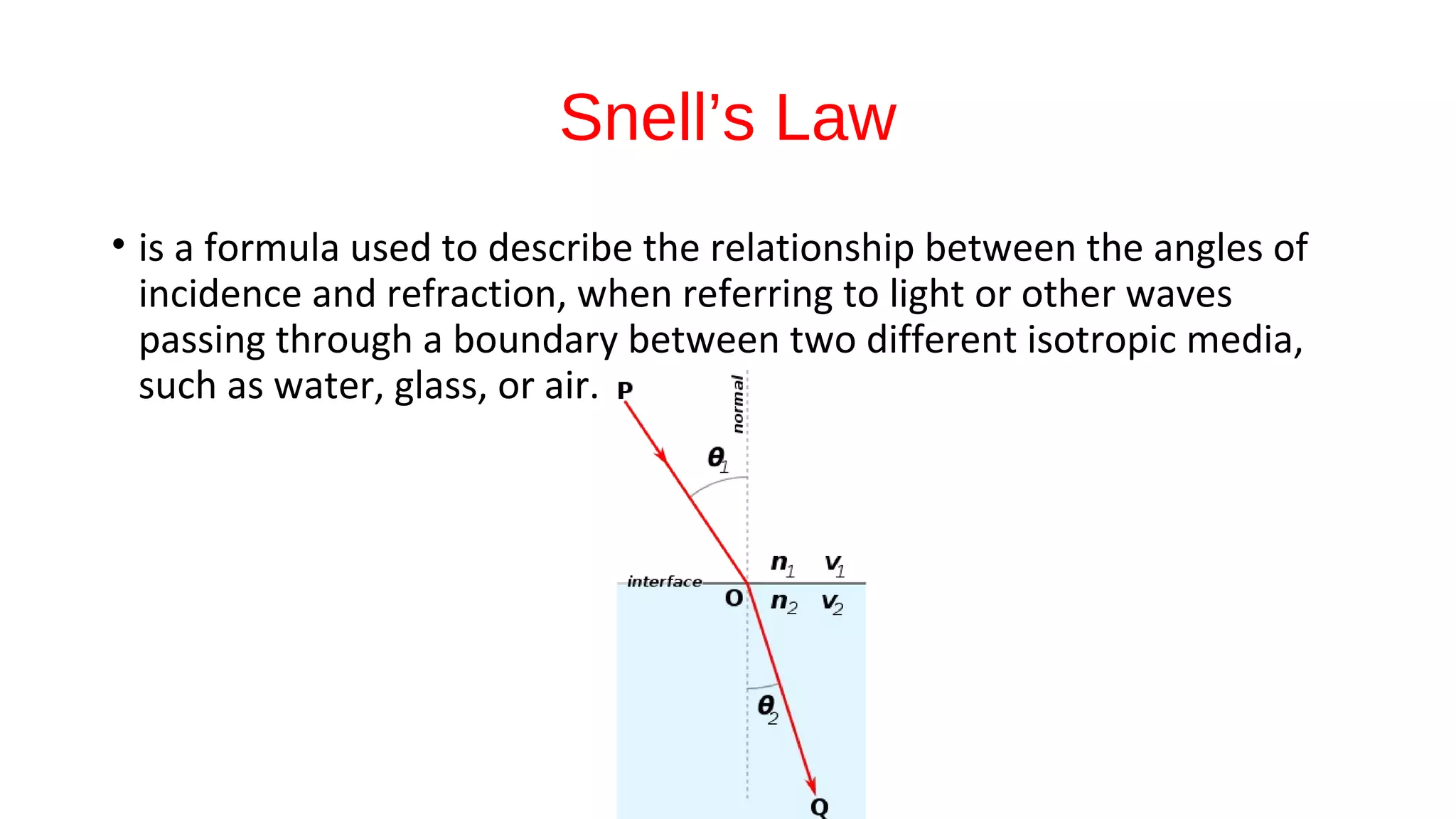
Snell’s Law
• is a formula used to describe the relationship between the angles of
incidence and refraction, when referring to light or other waves
passing through a boundary between two different isotropic media,
such as water, glass, or air.
Refractive Index
• When light changes from space to air to water, it slows down. This
changes the path it takes. That’s refraction.
• The refractive index is the ratio of the velocity of light in space to the
velocity inside a different material.
• Refractive index = Velocity in space
• Velocity in medium
• Think of it as the optical density of a material. The thicker it is the
slower you go
Dispersion of Light
• Dispersion of light is when white light passes through a prism and is
separated into the different colored wavelengths by the refraction of
the prism.
Chemical measurements: elemental analysis
SEM-EDS
X-ray detection methods such as scanning electron microscopy-energy dispersive
spectroscopy (SEM-EDS) are also used in forensic laboratories for elemental analysis of
glass.
SEM is used for imaging the microstructural characteristics of solid objects by using
electrons
produced when a focused beam, at a given accelerating voltage, interacts with the surface of a
material.
This beam produces a number of electron products that are picked up by detectors capable of
analyzing the specific electron, photon or X-ray. The created X-rays are detected and
identified by EDS for multi-elemental analysis.
Glass is refractory and non-conductive in nature, requiring a coating process that is usually
made with carbon. The coating step prevents the sample from “charging”, otherwise the
sample will build a charge in the interaction volume, affecting the ability of the SEM to
properly image the sample.
Although the classification of glass fragments into categories is important for
forensic examinations of glass, the ability to discriminate between glasses of
the same type is even more valuable for comparisons.
In this sense, SEM-EDS has some limitations due to the lack of sensitivity for
trace elemental analysis. Its detection limits allow the identification of minor
and major elements only (>0.1%).
In addition, precision and accuracy is generally poor, quantitative analysis is
usually not possible and the amount of elements that can be detected is limited
in comparison to other methods.
SEM-EDS has some advantages in that it is non-destructive and
can be used in the forensic analysis of glass debris in bullets,
where the sample size may not be suitable to other elemental
analysis methods.
Nonetheless, glass examiners are encouraged to use analytical
methods with superior sensitivity to fully characterize the
elemental signature of glass exhibits.
SEM-EDS is not recommended for elemental analysis in
forensic casework unless the fragment size does not
allow for other elemental analysis methods, such as cases
involving small glass debris on bullet surfaces.
XRF
The X-ray fluorescence methods (μ-XRF) use similar fundamental principals to
SEM-EDS, with the main difference being the excitation source used.
During XRF analysis, a primary X-ray excitation source from an X-ray tube strikes
a sample and is either absorbed by the atom or scattered through the material. The
process in which the X-ray is absorbed by the atom by transferring all of its energy
to an innermost electron is called the “photoelectric effect”.
During this process, if the primary X-ray has sufficient energy, electrons are
ejected
from the inner shells, creating vacancies. These vacancies present an unstable
condition for the
atom.
As the atom returns to its stable condition, electrons from the
outer shell are transferred to the inner shells and in the
process give off characteristic X-rays with an energy
difference specific to the binding energies between the
corresponding shells.
Because each element has a unique set of energy levels, each
element produces X-rays at different energies, allowing the
characterization of the elemental composition of a sample.
The process of emitting characteristic X-rays is called “X-
ray fluorescence” or XRF.
Although XRF is limited to semi-quantitative analysis, it has been
demonstrated that it provides useful information and can be used as a
complementary tool for discrimination of glasses.
In 1976, Reeve et al. (1976) were able to distinguish 97.5% of the glass
sources under study.
In 1980, Dudley et al. (1980) were able to distinguish 98% of the glasses
originating from a set composed of 50 pairs of glasses, including
window and non-window glasses.
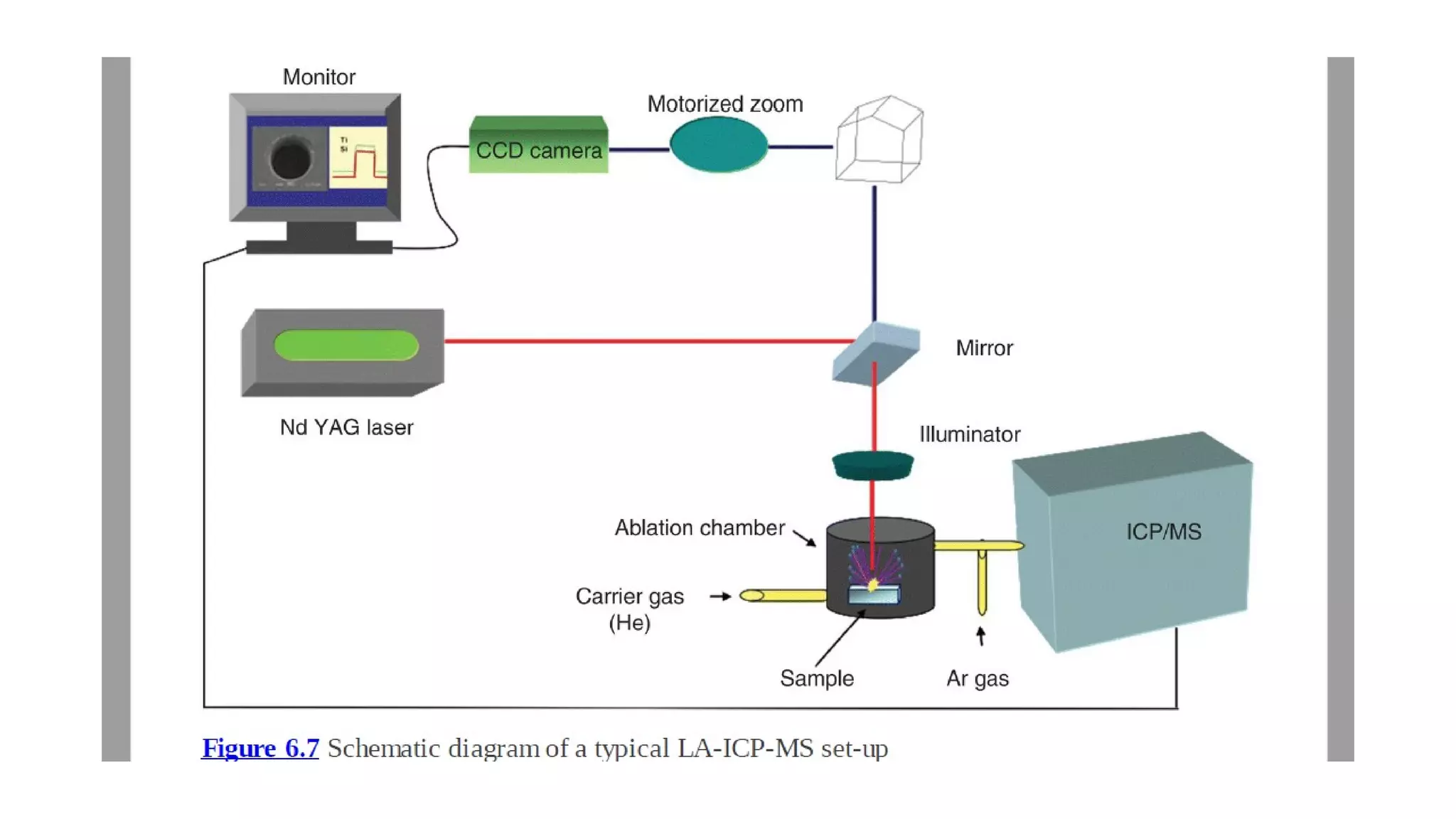
ICP-AES and ICP-MS
Inductively coupled plasma methods (ICP-AES and ICP-MS) are also currently used as
standard methods for the analysis of glass samples in forensic laboratories.
Since the early
1980s, numerous scientists have demonstrated the relevance of applying ICP methods to
conduct elemental analysis of glass samples.
In general terms, ICP instruments are composed of three main parts: the sample
introduction
system, the ionization source and the detector. The most common sample introduction
system introduces liquid samples into the torch with the help of two key components: the
nebulizer and the spray chamber.
The nebulizer produces an aerosol of liquid particles that are then selected according to
their size in the spray chamber. Only the liquid particles that are small enough will pass
from the spray chamber to the torch and the rest will be drained to the waste.
Forensics of Broken Glass
• When broken glass is found at a crime scene it is gathered and
checked for several things:
• Puzzle pieces fitting together.
• Fracture pattern.
• Blood or any DNA source
• Fingerprints
• Composition or type of glass
• Density – mass per unit of volume.
• Determining refractive index.
• Any unique characteristics: ex. Paint, scratches
Proper Collection of Glass Evidence
• Standard reference glass should be taken from the crime scene (1 in2)
• Package in solid containers to prevent breakage
• Preserve garment (shoe, pants, shirt) with glass on it
• All broken glass must be recovered and submitted for analysis when
direction of impact is desired.
• Whenever possible, the exterior and interior surfaces of the glass
must be indicated. The presence of dirt, paint, grease or putty may
indicate the exterior surface of the glass.
Jigsaw Effect – Most Beneficial
• When the suspect and crime-scene fragments are assembled and
physically fitted together.
• Comparisons of this type require piecing together irregular edges of
broken glass as well as matching all irregularities and striations on the
broken surfaces. The possibility that two pieces of glass originating
from different sources will fit together exactly is so unlikely as to
exclude all other sources from practical consideration.
• Unfortunately, most glass evidence is either too fragmentary or too
minute to permit a comparison of this type
Soil Analysis
“Life is hard. Then you die.
Then they throw dirt in your face. Then the worms
eat you.
Be grateful it happens in that order.”
—David Gerrold, American science fiction writer
64
Soil Analysis
 Identify a soil’s common constituents
 Determine the origin of a soil sample
 Why soils can be used as class evidence
 When soils can be used as
circumstantial evidence
Students will learn to:
65
Forensic Geology
 The legal application of earth and soil science
 Characterization of earthen materials that have been transferred
between objects or locations and the analysis of possible origin or
sources
66
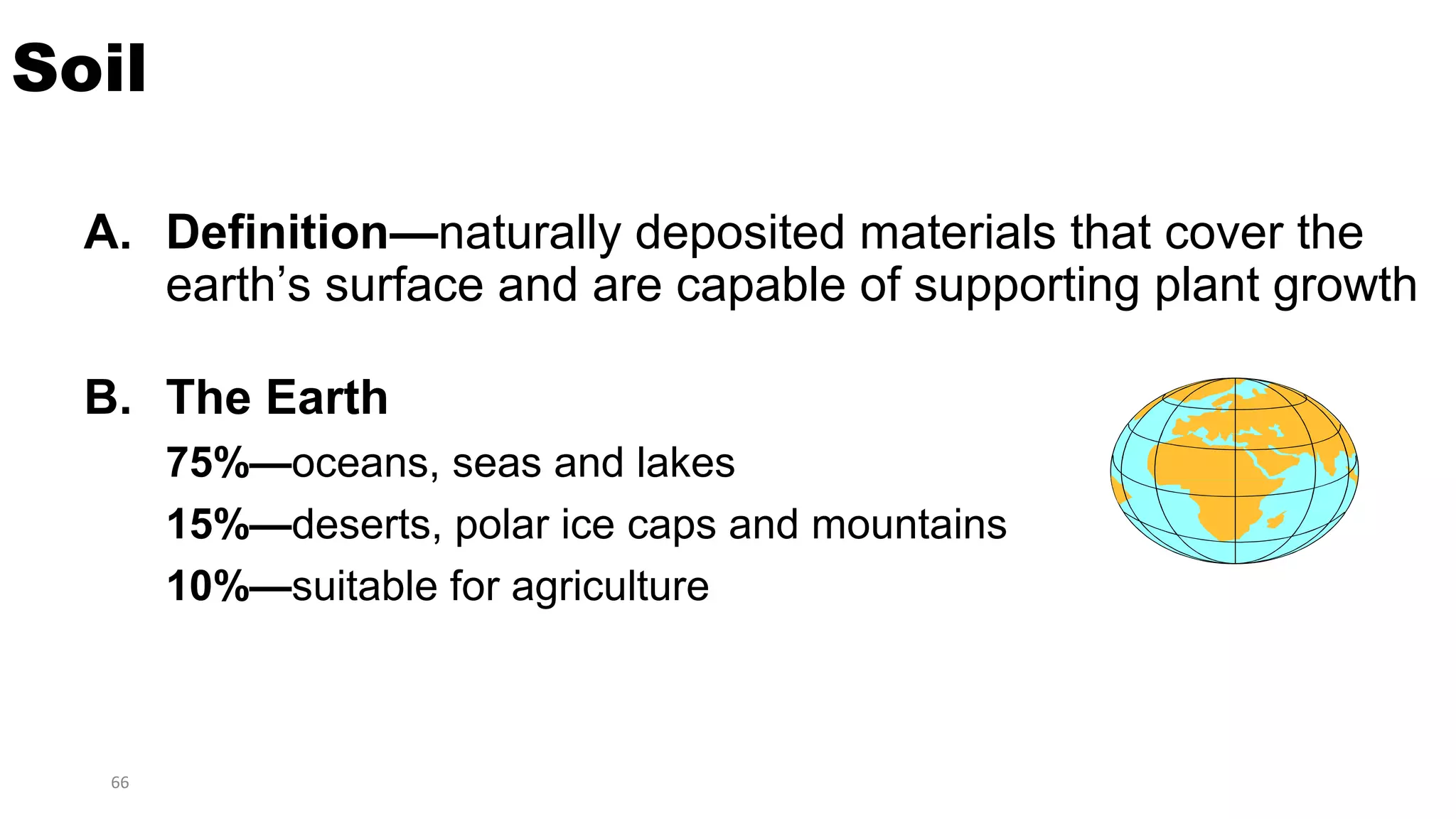
Soil
A. Definition—naturally deposited materials that cover the
earth’s surface and are capable of supporting plant growth
B. The Earth
75%—oceans, seas and lakes
15%—deserts, polar ice caps and mountains
10%—suitable for agriculture
67
Soil
C. Formation
 Living matter—plants, animals, microorganisms
 Inorganic materials
 Climate
 Parent materials
 Relief—slope and land form
 Time
68
Soil
D. Profile
 Topsoil
 Subsoil
 Parent material
E. Composition
 Sand
 Silt
 Clay
 Organic matter
69
Soil
F. Nutrients—macro
 Nitrogen
 Phosphorus
 Potassium
 Calcium
 Magnesium
 Sulfur
G. Nutrients—micro
 Manganese
 Iron
 Boron
 Copper
 Zinc
 Molybdenum
 Chlorine
70
Soil Comparisons
 May establish a relationship or link to the crime, the victim, or
the suspect(s)
 Physical properties—density, magnetism, particle size,
mineralogy
 Chemical properties—pH, trace elements
71
Probative Value
of Soil
Types of earth material are virtually unlimited. They have
a wide distribution and change over short distances.
As a result, the statistical probability of a given sample
having properties the same as another is very small
Evidential value of soil can be excellent
72
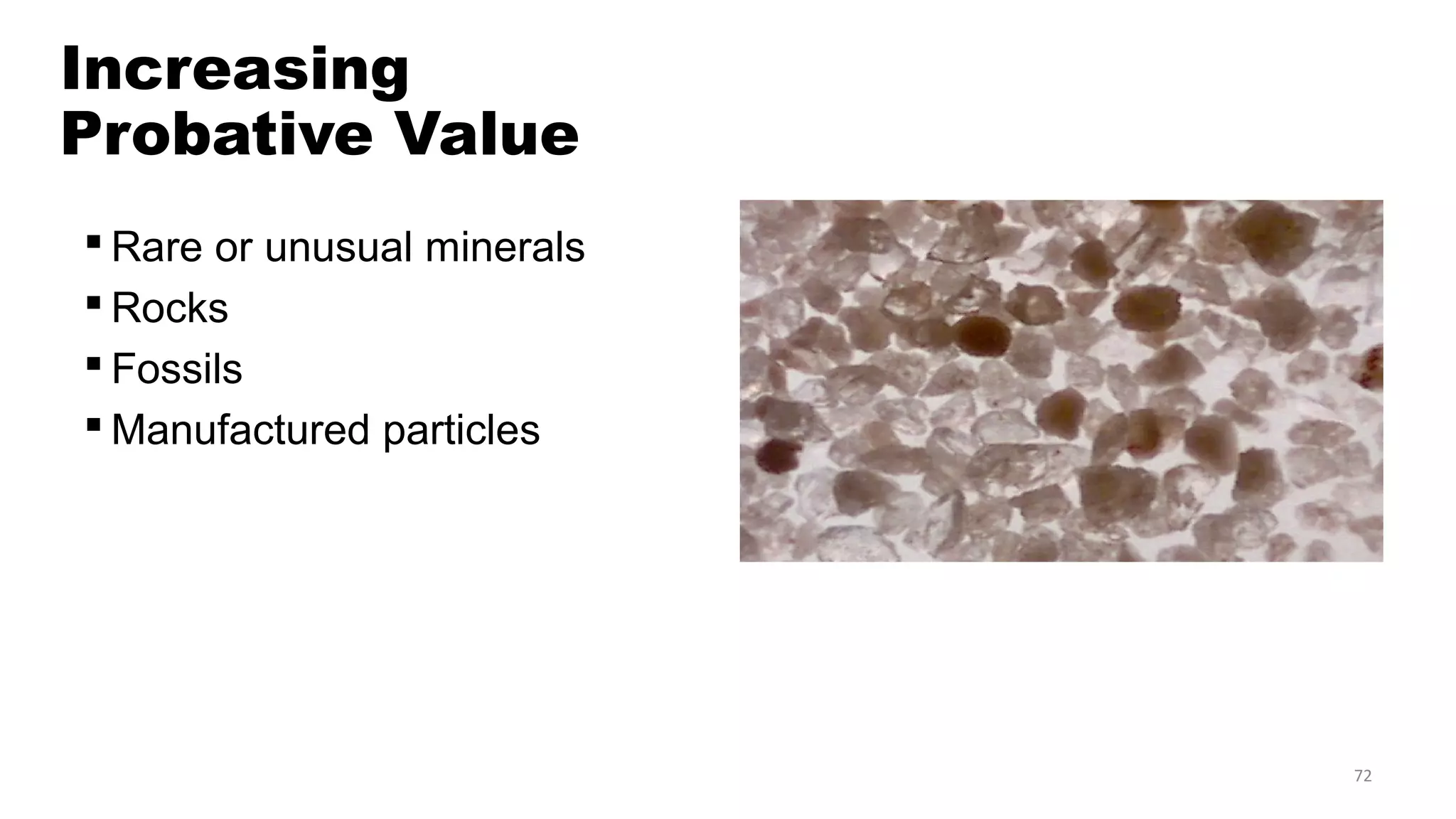
Increasing
Probative Value
 Rare or unusual minerals
 Rocks
 Fossils
 Manufactured particles
73
Minerals
 More than 2000 have been identified
 Twenty or so are commonly found in soils; most soil samples
contain only 3 to 5
 Characteristics for identification—size, density, color, luster,
fracture, streak, or magnetism
74
Rocks
 Aggregates of minerals
 Types
 Natural—like granite
 Man-made—like concrete
 Formation
 Igneous
 Sedimentary
 Metamorphic
75
Palynology
 The study of pollen and spores
 Important to know:
 What is produced in a given area
 The dispersal pattern
 Variation in size and weight
• Any disintegrated surface material,
natural or artificial that lies on or near
the Earth’s surface.
• Natural= rocks, minerals, vegetation,
animal matter
• Manufactured= glass, paint, asphalt,
brick fragments, cinders
Forensic Definition of Soil
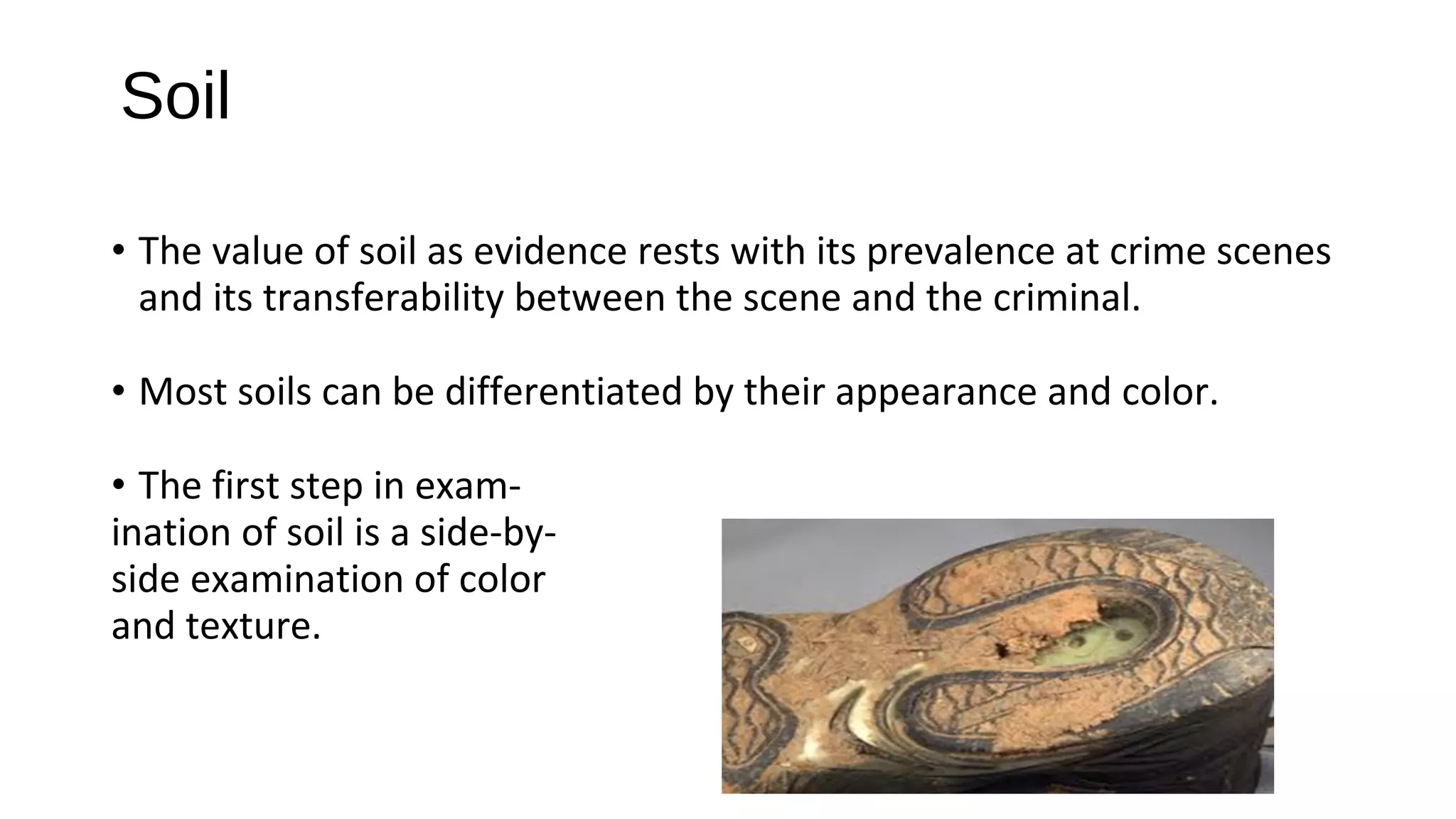
• The value of soil as evidence rests with its prevalence at crime scenes
and its transferability between the scene and the criminal.
• Most soils can be differentiated by their appearance and color.
• The first step in exam-
ination of soil is a side-by-
side examination of color
and texture.
Soil
                                                                                                                                                        
                              
• People describe soil types in all kinds of ways such as heavy, light,
sandy, clay, loam, poor or good.
• Soil scientists describe soil types by how much
sand, silt and clay are present. This is called texture.
Soil Types-Texture
Side-by-side comparison of color and texture
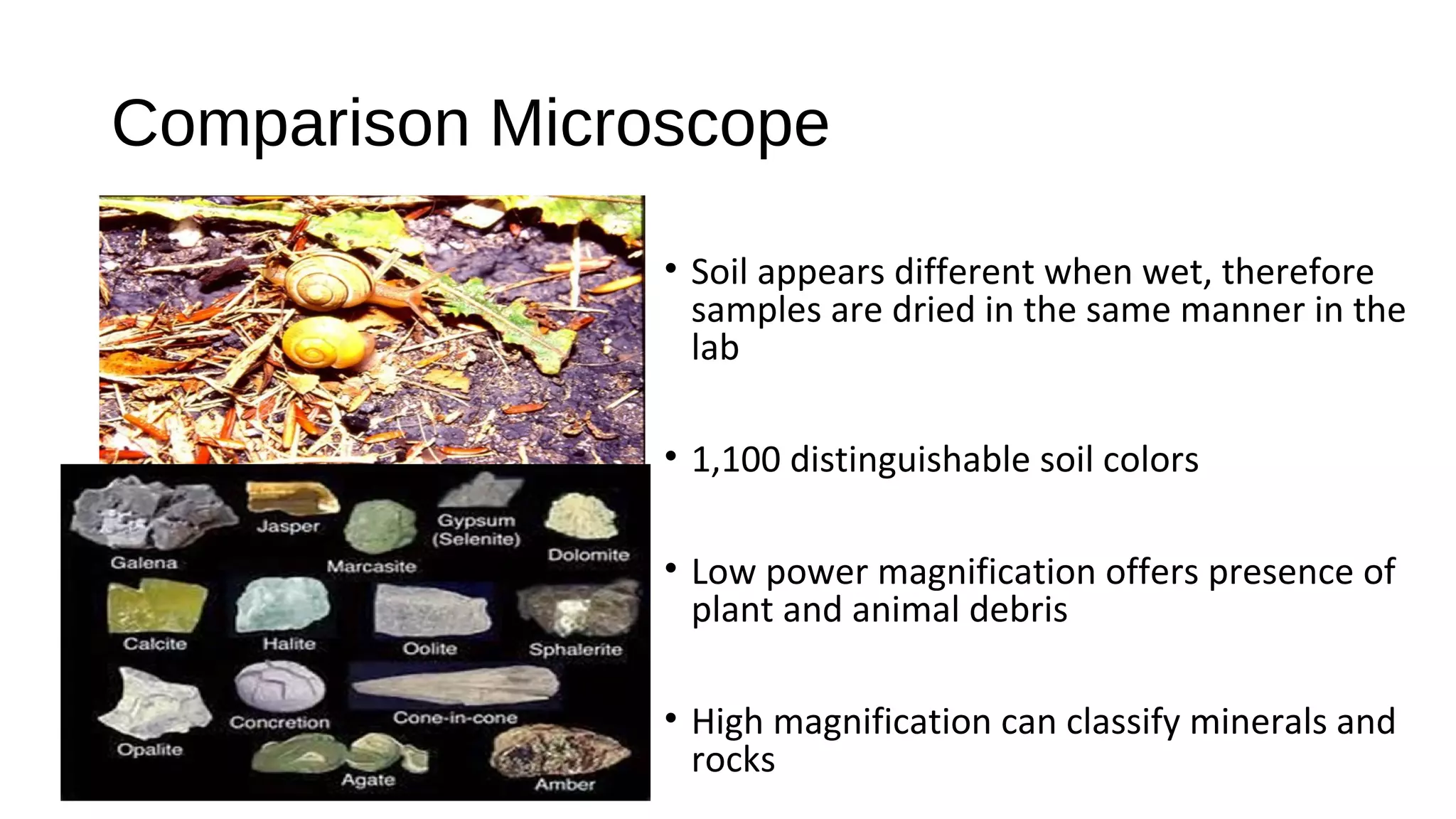
• Soil appears different when wet, therefore
samples are dried in the same manner in the
lab
• 1,100 distinguishable soil colors
• Low power magnification offers presence of
plant and animal debris
• High magnification can classify minerals and
rocks
Comparison Microscope
• Naturally occurring crystalline solid
• UNIQUE
• COLOR
• GEOMETRIC SHAPE
• DENSITY
• REFRACTIVE INDEX
• 2200 exist, but only 20 are common and found readily at the surface
surface
Mineral
• Made of a combination of minerals
• Characterized by their mineral content and grain size
Rocks
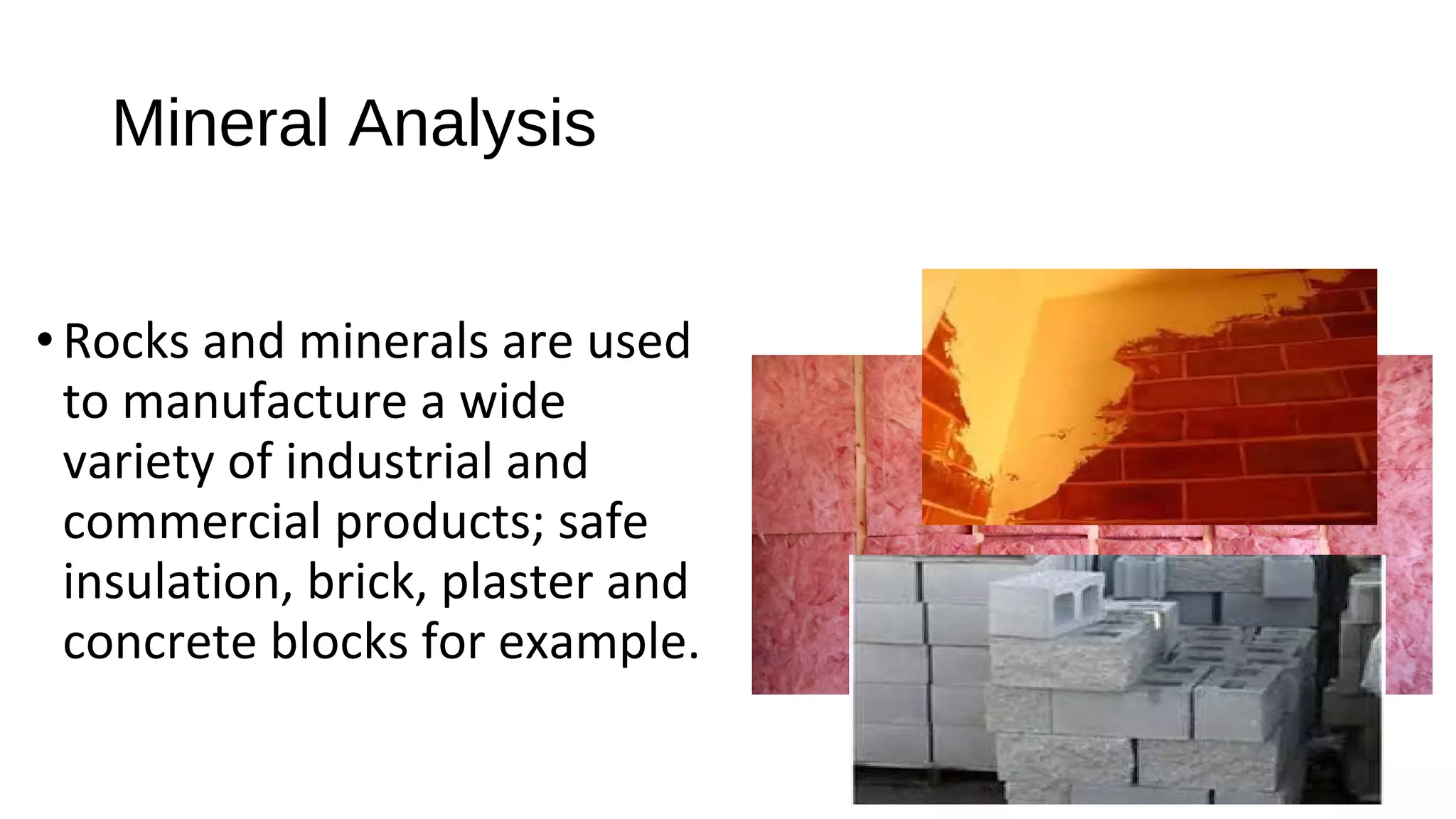
• Rocks and minerals are used
to manufacture a wide
variety of industrial and
commercial products; safe
insulation, brick, plaster and
concrete blocks for example.
Mineral Analysis
High Magnification
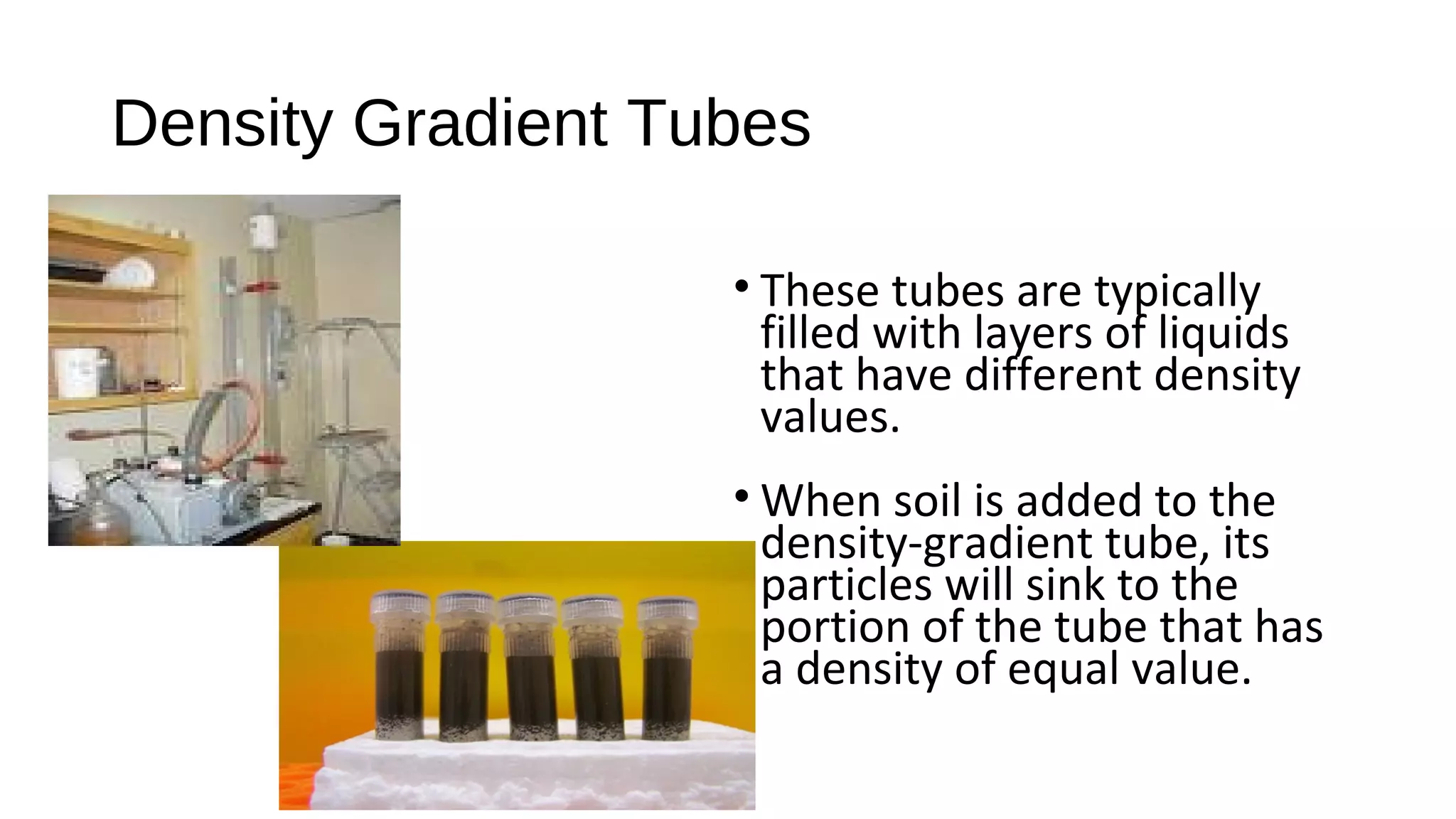
• These tubes are typically
filled with layers of liquids
that have different density
values.
• When soil is added to the
density-gradient tube, its
particles will sink to the
portion of the tube that has
a density of equal value.
Density Gradient Tubes
•Many soils from different areas yield similar
densities
What is the main issue with the use of
Density Gradient tubes?
• Ultimate value depends on its variation at the crime scene
• If the soil is indistinguishable for miles surrounding the crime scene, it
will have limited value in associating soil found on the suspect with
that particular site.
• Variations in soil composition must be made every 10-100 yards from
the crime site.
Variations in Soil
Crime Scene
• Standard/reference soils are to be collected at various intervals
within a 100-yard radius of the crime scene, as well as the site of the
crime, for comparison to the questioned soil.
• Soil found on the suspect, such as adhering to a shoe or garments,
must not be removed.
• Instead, each object should be individually wrapped in paper, and
stored in either plastic jars or ziplock plastic bags and transmitted to
the laboratory.
Collection of Soil
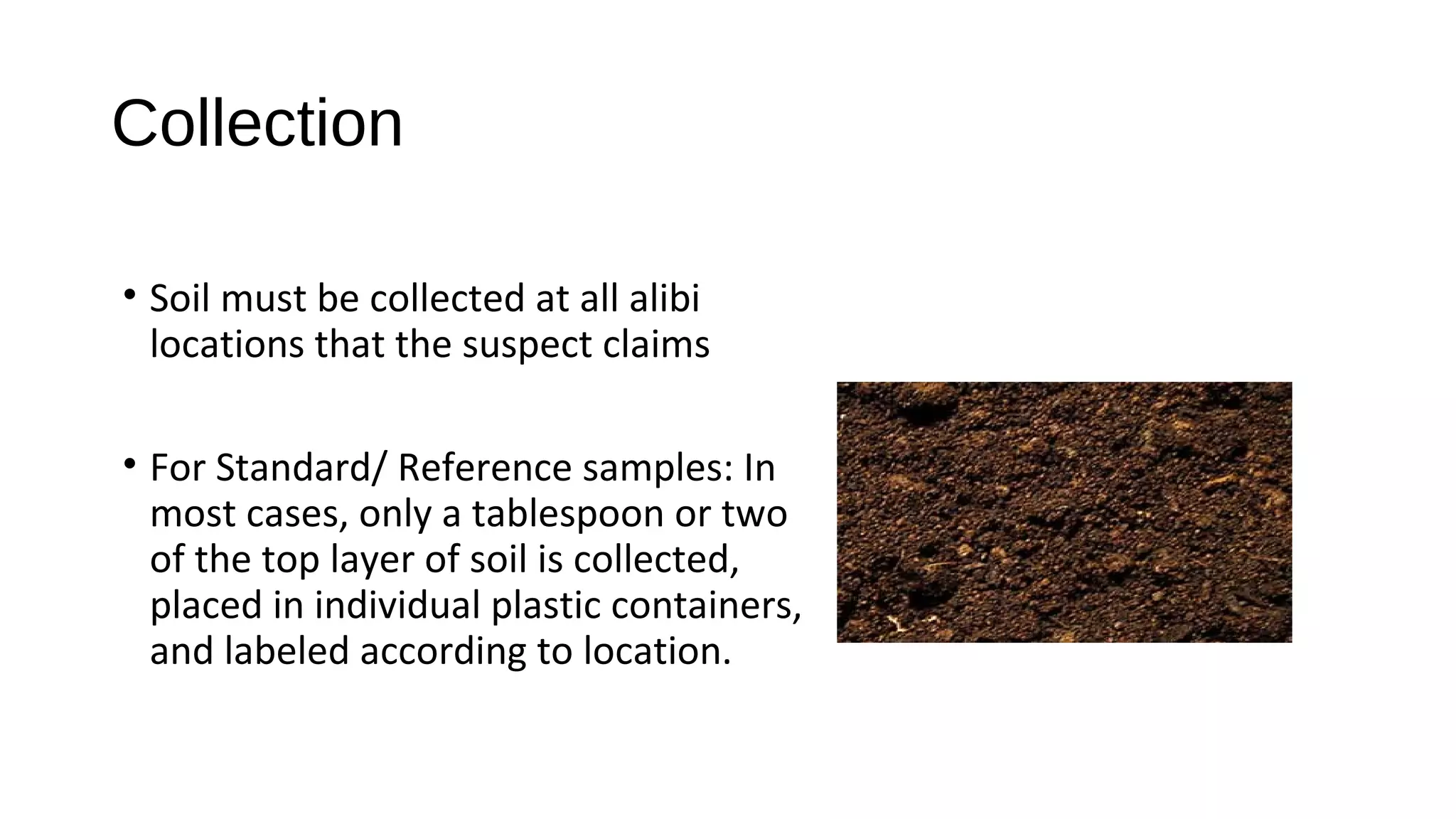
• Soil must be collected at all alibi
locations that the suspect claims
• For Standard/ Reference samples: In
most cases, only a tablespoon or two
of the top layer of soil is collected,
placed in individual plastic containers,
and labeled according to location.
Collection
Crime scene, 100 yds radius of crime scene, alibi
locations, any object or clothing of interest that
contains soil
Forensic science   soil and glass final

Forensic science soil and glass final

  • 1.
    Forensic Science: Analysisof Glass Evidence
  • 2.
    Glass evidence canbe found at many crime scenes. • Automobile accident sites may be littered with broken headlight or windshield glass. • The site of a store break-in may contain shards of window glass with fibers or blood on them. • If shots are fired into a window, the sequence and direction of the bullets can often be determined by examining the glass. • Minute particles of glass may be transferred to a suspect’s shoes or clothing and can provide a source of trace evidence linking a suspect to a crime.
  • 3.
    Glass & Forensics •How was it broken? • Link a suspect to a crime scene • Fingerprints • Blood
  • 4.
    Chemical and PhysicalProperties • Physical properties describe a substance without comparing with another substance. They are measurements like weight, volume, boiling point, melting point. • Chemical properties describe what happens when you combine it with something else in a chemical reaction. Examples are burning, coloring reagent tests, decomposing, synthesis of an alloy from individual elements
  • 5.
    How is glassformed? • Long before humans began making glass, glass formed naturally. • When certain types of rock are exposed to extremely high temperatures, such as lightning strikes or erupting volcanoes, glass can form. • Obsidian is a type of glass formed by volcanoes.
  • 6.
    Timeline of Events •Prehistoric humans used obsidian as a cutting tool. • The earliest man-made glass objects (glass beads) were found in Egypt dating back to 2500 BC. • Glass blowing began sometime during the first century BC. • By the 14th century, knowledge of glass making spread throughout Europe. • The Industrial Revolution brought the mass production of many kinds of glass.
  • 7.
    Glass evidence hasa special role within trace evidence in that it represents a “model matrix” due to the following characteristics of this evidentiary material: It is a common type of trace evidence as a consequence of its fragile nature and wide use in society. It is easily transferred from a broken source to the scene/victim(s)/suspect(s). It is easily recovered from a scene/object. It can persist after transfer but its chemical composition does not degrade or vary over time after transfer. The sizes of the fragments that are typically recovered from breaking events are normally sufficient for analysis by a variety of methods. Sensitive methods for the determination of the optical and chemical properties of glass currently exist in the form of standard methods of analysis and suitable reference materials also exist for calibration and/or bias determination.
  • 8.
    Glass is definedas an inorganic product of fusion that has been cooled to a rigid condition without crystallization . This material is composed of a mixture of inorganic materials that are responsible of its different physical properties. The inorganic materials may be present in the final product at high, minor or trace levels. Some components determine the glass structure; others are added intentionally to decrease the cost of manufacture or to provide desired properties such as color, viscosity, heat resistance and safety.
  • 9.
    How is GlassFormed? • Glass is a hard, brittle, amorphous material made by melting sand (aka silica, silicon dioxide, SiO2) lime (aka calcium oxide CaO) and soda, sodium carbonate (Na2CO3) at very high temperatures. • The lime (CaO) is added to prevent the glass from being soluble in water. • The soda (Na2CO3) is added to lower the melting point of silica (sand) and make it easier to work with. • In some types of glass with special requirements, trace amounts of other elements are added. Example: Boron is added to make Pyrex glass.
  • 10.
    How is GlassMade? • Following the mixing of the raw materials, they are transported to the furnace and heated to over 1200oC or 2200oF and changed into a molten mixture. • There are different formulas and assembly for different glass applications. Ex: car wind shields are 2 layers with plastic in between.
  • 11.
  • 12.
    Glass can beclassified in different groups according to its intended use as: flat glass (for architecture and automobiles), containers (bottles and jars), fiberglass (for insulation) and specialty glass (fiber optic, semiconductors and optical). It can also be classified by its chemical composition as soda-lime glass (containers and windows), leaded glass (housewares and decorations) and borosilicate glass (industrial, lamps and cookware).
  • 13.
    Types of Glass– soda-lime glass • Mostly sand, sodium carbonate and calcium oxide: • Used for manufacturing most window and bottle glass • Making Window Panes • Making Glass Bottles • Rolling Glass • The common metal oxides found in this type of glass are sodium , calcium, Magnesium and aluminium.
  • 14.
    Types of Glass- Float Glass • Flat glass typically used for windows. • Soda-lime glass that has been cooled on top of a bath of molten tin.
  • 15.
    Types of glass- Leaded Glass • Fine glassware and decorative art glass, called crystal or leaded glass substitutes lead oxide for calcium oxide (lime). • The addition of lead oxide makes the glass denser. As light passes through the more-dense glass, the light waves are bent, giving the glass a sparkling effect.
  • 16.
    Types of glass- Tempered Glass • This glass is made stronger than ordinary window glass by introducing stress through rapid heating and cooling of the glass surfaces. • When tempered glass breaks, it does not shatter but rather fragments or “dices” into small squares with little splintering. • Used for side and rear windows of automobiles sold in the United States.
  • 17.
    Types of glass- Bulletproof Glass • Bulletproof glass is a combination of two or more types of glass, one hard and one soft. • The softer layer makes the glass more elastic so it can flex instead of shatter. • The index of refraction for both of the glasses used in the bulletproof layers must be almost the same to keep the glass transparent and allow a clear view through the glass. • Bulletproof glass varies in thickness from three-quarter inch to three inches.
  • 18.
    BOROSILICATE GLASS: This isany glass having a substantial amount of boron (over 5% of B2 O3) which is resistant to heat, acid corrosion and alkalies. This type of glass, also known as “Pyrex” glass is used to manufacture laboratory glasswares, thermometers, household cookware and automobile head light.
  • 19.
    Wire glass: It issingle sheet of glass with a layer of meshed wire completely embedded inside the glass, which will be usually thicker. It may or may not be ground and/or polished on both sides. Colored glass: These are produced by the addition of metallic oxides to soda lime silica glass. Chromium oxide produces green color, cobalt produces blue color, Iron produces greenish blue, gold, copper, selenium, colloidal particles produces red color. Light sensitive glass: These glasses contain colloidal particles of silver halide.
  • 20.
    The components ofglass are classified according to their function as: formers, fluxes, modifiers, stabilizers, colorants, decolorants, accelerants, and refining and opaliser agents. Former agents are products that generally form the framework of the glass structure; when cooled quickly after melting they solidify without crystallizing. Fluxes are components that are added to the formers to lower the melting temperature and to reduce cost of production. Stabilizers are added to offer chemical resistance to the glass, while decolorants are used to clarify the glass. Refining agents are also important components of glass that help to remove trapped bubbles from the molten glass during its production.
  • 21.
    Physical measurements The firststep in any glass analysis is to identify the glass by physical and optical properties such as hardness, amorphous structure and isotropism. Physical observations such as color, thickness, curvature, flatness, presence of manufacture markings, fluorescence and fracture characteristics are made in the preliminary stages of the analysis.
  • 22.
    Forensic examiners shouldbe meticulous during the physical examination of glass as it can address important information such as: type of impact that caused the fracture of glass, for example, a fracture caused by a gunshot or by a hard object such as a baseball bat; direction of the force, for example, to establish if a window was broken from inside or from outside; type of material, for example, a flat architectural window, a tempered glass, a headlamp, an eyeglass lens or a colored bottle; source of origin of the glass fragment, for example, to establish that two or more pieces of glass were originally joined.
  • 23.
    Physical measurements This includemainly two parameters namely, the thickness and curvature of the glass pieces under comparison. It is observed that the thickness of glass sheet vary significantly from one place to the other and do not have uniform thickness throughout. Therefore, it is very much desirable to obtain larger pieces of at least, the control glass samples and study the variations in their thickness before comparing the thickness of the control sample with that of the crime exhibit.
  • 24.
    a) Edge thickness: Amicrometer is used to measure accurately the edge thickness of the glass fragments. Readings should be taken all around the broken edged to find out at which point, the crime exhibits matches with any portion of the broken glass. This will further help during the matching of surface patterns and other identifying characteristics, along the broken edges.
  • 25.
    b) Curvature: A spherometeris used to measure the radius of curvature of the glass fragments having curved surface. The radius of curvature of the fragment is calculated using the formulae. R = (l2/6h)+(h/2) Where 1 = the mean distance between the legs of the spherometer. h = height of the curved surface
  • 27.
    Fluorescence under UVradiation Some types of glass fluorescence under ultraviolet radiation with different colours which may be brown, violet, purple, blue or green etc. This examination has to be conducted in a dark room and the glass pieces to be exposed to UV radiation should be of similar size and thickness and they are to be thoroughly washed with acetone or any other suitable solvent to remove any grease or dirt. When there is a clear difference in the fluorescence of the two glasses, it indicates different sources of their origin. On the other hand, the similarity in fluorescence by itself cannot be a conclusive proof of source correspondence and further tests are to be conducted to arrive at the possible commonness of origin.
  • 28.
    Physical fit A perfectphysical fit or physical “match” is the best-case scenario that a forensic examiner could have during the physical evaluation of glass, but it is rarely found in real cases. For comparison purposes, the fragments are inspected visually in order to determine whether or not there is a “fracture match” between any of the recovered fragments to any of the source fragments. Such a match requires the edges of one fragment to perfectly fit into the corresponding edges of another, much like a jigsaw puzzle . The physical match of the broken edges of glass is three-dimensional and the analyst should document the details by photography and written documentation. The match can also be observed under the microscope in order to determine microscopic marks (conchoidal or hackle marks).
  • 30.
    This is mostconclusive proof of source correspondence, since no two fractures will ever be identical over any appreciable length. A complimentary lateral fit along the broken edges over a length of quarter inch (1/4) or more establishes that the two glass garments were continuous before breakage. By naked eye or under a microscope, we should search carefully the edges of the samples, which will exactly fit into each other, taking into consideration, the factors contributing to the matching, such as general appearance, colour, edge thickness, shape of breakage, all the irregularities and striations near the broken surfaces.
  • 32.
    Thickness Sometimes glass canbe recovered from the scene as pieces that present the full thickness of the source of origin. In such cases, it may be useful to measure the thickness of the glass, as it can provide information about the type of object from where it came, for example, a vehicle side window, tempered glass, or beverage bottle. For comparison purposes thickness measurements provide limited information when the thickness is found to be the same but may be used to exclude a fragment as originating from a source that clearly presents a different thickness.
  • 33.
    Density Density comparisons ofglass can be accomplished using the sink-float method. The comparison of density has the disadvantages of involving toxic liquids and requiring at least 5 mg of sample. Another limitation of density measurements is that measurements of small, irregular or dirty fragments of glass may be inaccurate . Density measurements have been mostly replaced by RI measurements, which provide good optical property information with the advantage of being faster, more accurate and more precise.
  • 34.
    Density of GlassDetermination • To determine the density of glass, it is best to use the immersion method. • Density = mass/volume • Mass is measured on a balance / scale. • Volume is determined by immersing parts of the glass and seeing the level change in a measurement glassware.
  • 35.
    Density measurements forbigger fragments of glass i) Use a laboratory balance with sensitivity ± 0.01 gms or better, along with support rack provision, a 250 ml. capacity beaker and a piece of string about 1 meter in length. ii) Tie the string around the glass fragment and suspend it from the pan support hook of the balance, after the preliminary adjustments are made with the balance, before weighing. iii) Weigh the glass fragment in air to the nearest 0.01gm and record its value (W1). iv) Place the 250 ml. beaker nearly filled with water on the beaker. Support and suspend the glass in the water. Adjust the glass height, so that it does not touch the walls of the beaker, inside the water. Weigh the glass fragment suspended in water to the nearest 0.01gm and record this value (W2).
  • 37.
    Comparing Densities: Flotation •A solid particle will either float, sink, or remain suspended in a liquid, depending upon its density relative to the liquid medium. • Flotation = a standard / reference glass particle is immersed in a liquid; a mixture of bromoform or bromobenzene may be used. The composition of the liquid is carefully adjusted by adding small amounts of bromoform or bromobenzene until the glass chip remains suspended in the liquid medium. • At this point, the standard / reference glass sample and the liquid each have the same density. Glass chips (same size and shape as reference sample) are added to the liquid for comparison. If both the unknown and standard / reference samples remain suspended, they have the same density.
  • 38.
    Density comparison byflotation i)For the heavier liquid, methylene iodide or Bromoform can be used. For the lighter liquid, Xylene, Bromobenzene, Nitrobenzene, Benzene or Kerosene can be used. For this method, Bromoform (d=2.89) and Bromobenzene (d=1.52) are selected.
  • 39.
    ii) The crimeand control glass piece samples are to be crushed to comparable sizes with similar shape. Each piece of glass is briefly sketched and marked for reference to return it to its original packet after examination. iii) A cleaned and dried sample of crime glass particle is placed in a small beaker containing bromoform. The glass will float on the liquid surface. This indicates that the density of the liquid is greater than that of the glass. iv) Slowly add the less denser liquid, Bromobenzene, drop wise with stirring, until the particle is exactly suspended. If the addition of Bromobenzene is in excess, which is indicated by the sinking of the glass particle, then bromoform is added, until the glass chip remains suspended in the liquid medium. Care is taken to see that the mixture is stirred with each addition and the air bubbles, if any, are removed.
  • 40.
    v) Add similarsize, clean and dry sample of control glass. If both the crime and the control glass particles remain suspended in the liquid, then, their densities are equal to each other and to that of the liquid mixture. Particles of different densities will either sink or float, depending on whether they are more dense or less dense than the liquid medium. vi) The density value of the particles of glass can be determined by calculating the density/specific gravity of the flotation mixture using specific gravity bottle or a pycnometer.
  • 41.
    Density comparison bydensity gradient tubes An alternative technique of comparing densities of glass particles is to use density gradient tubes having length of 30cms and diameter 1 cm. A standard density gradient tube is made up of layers of two liquids, mixed in varying proportions so that each layer has a different density value. When completed, a density gradient tube will usually have 6 to 10 layers, in which bottom layers have higher density. In this experiment, we not only compare glass particles but also calibrate the density column, so that a fairly accurate estimate of density can be made. This is done by adding small crystals of ionic salts to the column, whose densities are known.
  • 43.
    Procedure: i) Place seventest tubes in a test tube rack. ii) Prepare the mixtures of bromobenzene and bromoform in the following ratios, by pipetting out the respective liquids into the test tubes. a) Pure bromoform-6ml (density -2.89) b) 1 ml of bromobenzene 5 ml of bromoform c) 2 ml of bromobenzene 4 ml of bromoform d) 3 ml of bromobenzene 3 ml of bromoform e) 4 ml of bromobenzene 2 ml of bromoform f) 5 ml of bromobenzene 1 ml of bromoform g) Pure bromobenzene-6ml (density -1.52) iii) Mark off seven equal spaces-say 4 cm apart-along each of the two glass tubes of length 30 cm and place them in the tube stand.
  • 44.
    BECKE LINE CONCEPT: Theimage of a transparent object observed through a microscope is formed by refraction and reflection. Due to this behavior of light, a dark boundary line is observed at the borders of the object. Many objects are surrounded by a narrow band of light, when immersed in a liquid. This band is called “Becke line”. Thus, Becke line is the contrast (halo or bright border), which outlines the transparent irregular particle, immersed in a liquid of different refractive index. This halo disappears, when the liquid medium and the transparent object have the same refractive index. Thus, when glass particles are immersed in a liquid medium, the Becke lines will appear due to the difference in the refractive indices of the glass and liquid. When the indices are equal, the Becke lines will disappear and this point is known as ‘match point.’
  • 45.
    An important advantageof the Becke line is that, it not only indicates a difference between the indices of the glass and liquid, but also indicates, which possesses the higher value. Thus, when the focus of the microscope is raised, the Becke line moves towards the medium of higher refractive index and if the focus is lowered, it moves towards the medium of lower refractive index. This observation allows the examiner to properly select a liquid that most closely matches the refractive index of glass.
  • 46.
    When a colorlesstransparent object, such as glass, is being examined with a microscope by transmitted light, visibility of the object is enhanced, as the condenser diaphragm is closed, although the resolution is sacrificed. Further more, reducing the aperture of the optical system of the microscope enhances the visibility, by emphasizing the RI difference between the glass and the mounting medium. Therefore, a minimum numerical aperture should be used in examining the glass chips for refractive index.
  • 47.
    Refraction of Light •Refraction of light is the bending of the light as it passes the boundary between two different optically dense mediums. It changes directions because it changes speed
  • 48.
    Snell’s Law • isa formula used to describe the relationship between the angles of incidence and refraction, when referring to light or other waves passing through a boundary between two different isotropic media, such as water, glass, or air.
  • 49.
    Refractive Index • Whenlight changes from space to air to water, it slows down. This changes the path it takes. That’s refraction. • The refractive index is the ratio of the velocity of light in space to the velocity inside a different material. • Refractive index = Velocity in space • Velocity in medium • Think of it as the optical density of a material. The thicker it is the slower you go
  • 50.
    Dispersion of Light •Dispersion of light is when white light passes through a prism and is separated into the different colored wavelengths by the refraction of the prism.
  • 51.
    Chemical measurements: elementalanalysis SEM-EDS X-ray detection methods such as scanning electron microscopy-energy dispersive spectroscopy (SEM-EDS) are also used in forensic laboratories for elemental analysis of glass. SEM is used for imaging the microstructural characteristics of solid objects by using electrons produced when a focused beam, at a given accelerating voltage, interacts with the surface of a material. This beam produces a number of electron products that are picked up by detectors capable of analyzing the specific electron, photon or X-ray. The created X-rays are detected and identified by EDS for multi-elemental analysis. Glass is refractory and non-conductive in nature, requiring a coating process that is usually made with carbon. The coating step prevents the sample from “charging”, otherwise the sample will build a charge in the interaction volume, affecting the ability of the SEM to properly image the sample.
  • 52.
    Although the classificationof glass fragments into categories is important for forensic examinations of glass, the ability to discriminate between glasses of the same type is even more valuable for comparisons. In this sense, SEM-EDS has some limitations due to the lack of sensitivity for trace elemental analysis. Its detection limits allow the identification of minor and major elements only (>0.1%). In addition, precision and accuracy is generally poor, quantitative analysis is usually not possible and the amount of elements that can be detected is limited in comparison to other methods.
  • 53.
    SEM-EDS has someadvantages in that it is non-destructive and can be used in the forensic analysis of glass debris in bullets, where the sample size may not be suitable to other elemental analysis methods. Nonetheless, glass examiners are encouraged to use analytical methods with superior sensitivity to fully characterize the elemental signature of glass exhibits. SEM-EDS is not recommended for elemental analysis in forensic casework unless the fragment size does not allow for other elemental analysis methods, such as cases involving small glass debris on bullet surfaces.
  • 54.
    XRF The X-ray fluorescencemethods (μ-XRF) use similar fundamental principals to SEM-EDS, with the main difference being the excitation source used. During XRF analysis, a primary X-ray excitation source from an X-ray tube strikes a sample and is either absorbed by the atom or scattered through the material. The process in which the X-ray is absorbed by the atom by transferring all of its energy to an innermost electron is called the “photoelectric effect”. During this process, if the primary X-ray has sufficient energy, electrons are ejected from the inner shells, creating vacancies. These vacancies present an unstable condition for the atom.
  • 55.
    As the atomreturns to its stable condition, electrons from the outer shell are transferred to the inner shells and in the process give off characteristic X-rays with an energy difference specific to the binding energies between the corresponding shells. Because each element has a unique set of energy levels, each element produces X-rays at different energies, allowing the characterization of the elemental composition of a sample. The process of emitting characteristic X-rays is called “X- ray fluorescence” or XRF.
  • 57.
    Although XRF islimited to semi-quantitative analysis, it has been demonstrated that it provides useful information and can be used as a complementary tool for discrimination of glasses. In 1976, Reeve et al. (1976) were able to distinguish 97.5% of the glass sources under study. In 1980, Dudley et al. (1980) were able to distinguish 98% of the glasses originating from a set composed of 50 pairs of glasses, including window and non-window glasses.
  • 58.
    ICP-AES and ICP-MS Inductivelycoupled plasma methods (ICP-AES and ICP-MS) are also currently used as standard methods for the analysis of glass samples in forensic laboratories. Since the early 1980s, numerous scientists have demonstrated the relevance of applying ICP methods to conduct elemental analysis of glass samples. In general terms, ICP instruments are composed of three main parts: the sample introduction system, the ionization source and the detector. The most common sample introduction system introduces liquid samples into the torch with the help of two key components: the nebulizer and the spray chamber. The nebulizer produces an aerosol of liquid particles that are then selected according to their size in the spray chamber. Only the liquid particles that are small enough will pass from the spray chamber to the torch and the rest will be drained to the waste.
  • 60.
    Forensics of BrokenGlass • When broken glass is found at a crime scene it is gathered and checked for several things: • Puzzle pieces fitting together. • Fracture pattern. • Blood or any DNA source • Fingerprints • Composition or type of glass • Density – mass per unit of volume. • Determining refractive index. • Any unique characteristics: ex. Paint, scratches
  • 61.
    Proper Collection ofGlass Evidence • Standard reference glass should be taken from the crime scene (1 in2) • Package in solid containers to prevent breakage • Preserve garment (shoe, pants, shirt) with glass on it • All broken glass must be recovered and submitted for analysis when direction of impact is desired. • Whenever possible, the exterior and interior surfaces of the glass must be indicated. The presence of dirt, paint, grease or putty may indicate the exterior surface of the glass.
  • 62.
    Jigsaw Effect –Most Beneficial • When the suspect and crime-scene fragments are assembled and physically fitted together. • Comparisons of this type require piecing together irregular edges of broken glass as well as matching all irregularities and striations on the broken surfaces. The possibility that two pieces of glass originating from different sources will fit together exactly is so unlikely as to exclude all other sources from practical consideration. • Unfortunately, most glass evidence is either too fragmentary or too minute to permit a comparison of this type
  • 63.
    Soil Analysis “Life ishard. Then you die. Then they throw dirt in your face. Then the worms eat you. Be grateful it happens in that order.” —David Gerrold, American science fiction writer
  • 64.
    64 Soil Analysis  Identifya soil’s common constituents  Determine the origin of a soil sample  Why soils can be used as class evidence  When soils can be used as circumstantial evidence Students will learn to:
  • 65.
    65 Forensic Geology  Thelegal application of earth and soil science  Characterization of earthen materials that have been transferred between objects or locations and the analysis of possible origin or sources
  • 66.
    66 Soil A. Definition—naturally depositedmaterials that cover the earth’s surface and are capable of supporting plant growth B. The Earth 75%—oceans, seas and lakes 15%—deserts, polar ice caps and mountains 10%—suitable for agriculture
  • 67.
    67 Soil C. Formation  Livingmatter—plants, animals, microorganisms  Inorganic materials  Climate  Parent materials  Relief—slope and land form  Time
  • 68.
    68 Soil D. Profile  Topsoil Subsoil  Parent material E. Composition  Sand  Silt  Clay  Organic matter
  • 69.
    69 Soil F. Nutrients—macro  Nitrogen Phosphorus  Potassium  Calcium  Magnesium  Sulfur G. Nutrients—micro  Manganese  Iron  Boron  Copper  Zinc  Molybdenum  Chlorine
  • 70.
    70 Soil Comparisons  Mayestablish a relationship or link to the crime, the victim, or the suspect(s)  Physical properties—density, magnetism, particle size, mineralogy  Chemical properties—pH, trace elements
  • 71.
    71 Probative Value of Soil Typesof earth material are virtually unlimited. They have a wide distribution and change over short distances. As a result, the statistical probability of a given sample having properties the same as another is very small Evidential value of soil can be excellent
  • 72.
    72 Increasing Probative Value  Rareor unusual minerals  Rocks  Fossils  Manufactured particles
  • 73.
    73 Minerals  More than2000 have been identified  Twenty or so are commonly found in soils; most soil samples contain only 3 to 5  Characteristics for identification—size, density, color, luster, fracture, streak, or magnetism
  • 74.
    74 Rocks  Aggregates ofminerals  Types  Natural—like granite  Man-made—like concrete  Formation  Igneous  Sedimentary  Metamorphic
  • 75.
    75 Palynology  The studyof pollen and spores  Important to know:  What is produced in a given area  The dispersal pattern  Variation in size and weight
  • 77.
    • Any disintegratedsurface material, natural or artificial that lies on or near the Earth’s surface. • Natural= rocks, minerals, vegetation, animal matter • Manufactured= glass, paint, asphalt, brick fragments, cinders Forensic Definition of Soil
  • 78.
    • The valueof soil as evidence rests with its prevalence at crime scenes and its transferability between the scene and the criminal. • Most soils can be differentiated by their appearance and color. • The first step in exam- ination of soil is a side-by- side examination of color and texture. Soil
  • 79.
  • 80.
    • People describesoil types in all kinds of ways such as heavy, light, sandy, clay, loam, poor or good. • Soil scientists describe soil types by how much sand, silt and clay are present. This is called texture. Soil Types-Texture
  • 81.
    Side-by-side comparison ofcolor and texture
  • 82.
    • Soil appearsdifferent when wet, therefore samples are dried in the same manner in the lab • 1,100 distinguishable soil colors • Low power magnification offers presence of plant and animal debris • High magnification can classify minerals and rocks Comparison Microscope
  • 83.
    • Naturally occurringcrystalline solid • UNIQUE • COLOR • GEOMETRIC SHAPE • DENSITY • REFRACTIVE INDEX • 2200 exist, but only 20 are common and found readily at the surface surface Mineral
  • 84.
    • Made ofa combination of minerals • Characterized by their mineral content and grain size Rocks
  • 85.
    • Rocks andminerals are used to manufacture a wide variety of industrial and commercial products; safe insulation, brick, plaster and concrete blocks for example. Mineral Analysis
  • 86.
  • 87.
    • These tubesare typically filled with layers of liquids that have different density values. • When soil is added to the density-gradient tube, its particles will sink to the portion of the tube that has a density of equal value. Density Gradient Tubes
  • 88.
    •Many soils fromdifferent areas yield similar densities What is the main issue with the use of Density Gradient tubes?
  • 89.
    • Ultimate valuedepends on its variation at the crime scene • If the soil is indistinguishable for miles surrounding the crime scene, it will have limited value in associating soil found on the suspect with that particular site. • Variations in soil composition must be made every 10-100 yards from the crime site. Variations in Soil Crime Scene
  • 90.
    • Standard/reference soilsare to be collected at various intervals within a 100-yard radius of the crime scene, as well as the site of the crime, for comparison to the questioned soil. • Soil found on the suspect, such as adhering to a shoe or garments, must not be removed. • Instead, each object should be individually wrapped in paper, and stored in either plastic jars or ziplock plastic bags and transmitted to the laboratory. Collection of Soil
  • 91.
    • Soil mustbe collected at all alibi locations that the suspect claims • For Standard/ Reference samples: In most cases, only a tablespoon or two of the top layer of soil is collected, placed in individual plastic containers, and labeled according to location. Collection
  • 92.
    Crime scene, 100yds radius of crime scene, alibi locations, any object or clothing of interest that contains soil