Introduction
Tire track impressions are classified as pattern evidence
because the tire track impressions leave behind a unique
pattern.
Tire tread impressions reflect the tread design and
dimensional features of the individual tires on a vehicle.
Tire tracks are the relative dimensions between two or more
tires of a vehicle. Tire tracks reflect general information
about the vehicle that left the impressions.
Types of Tire Marks
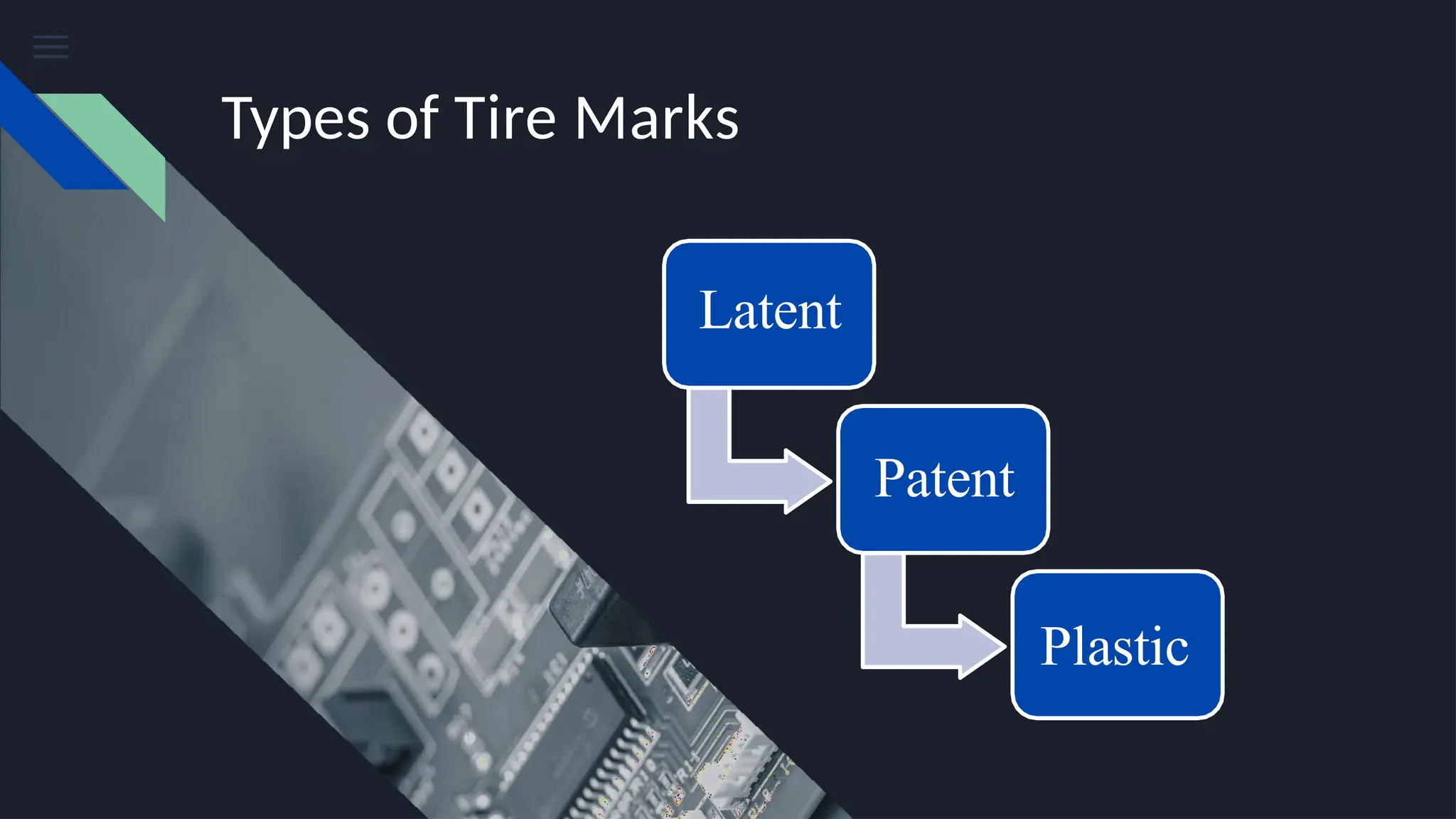
Latent
Patent
Plastic
Types of Tire Marks
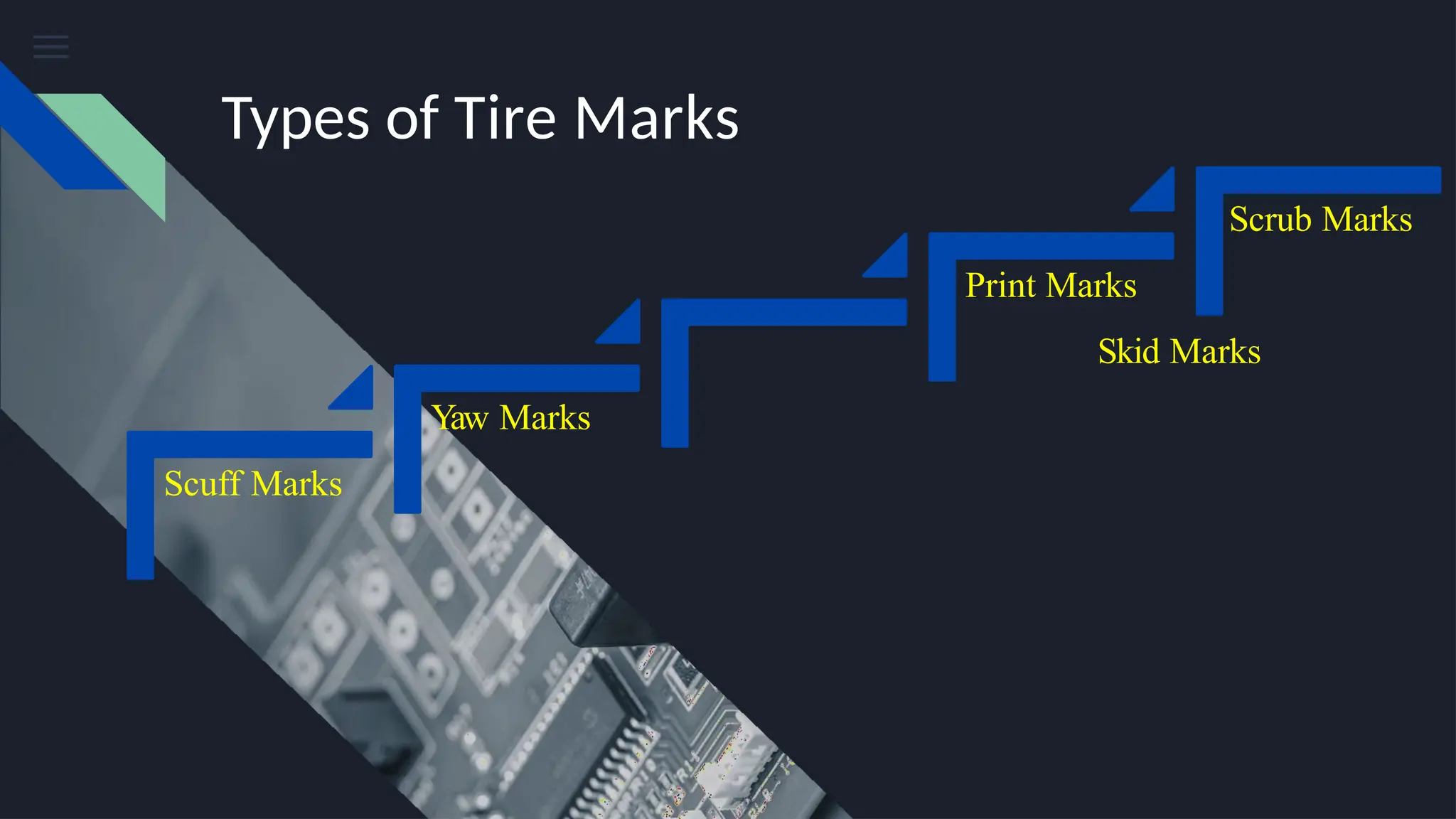
Scrub Marks
Print Marks
Skid Marks
Yaw Marks
Scuff Marks
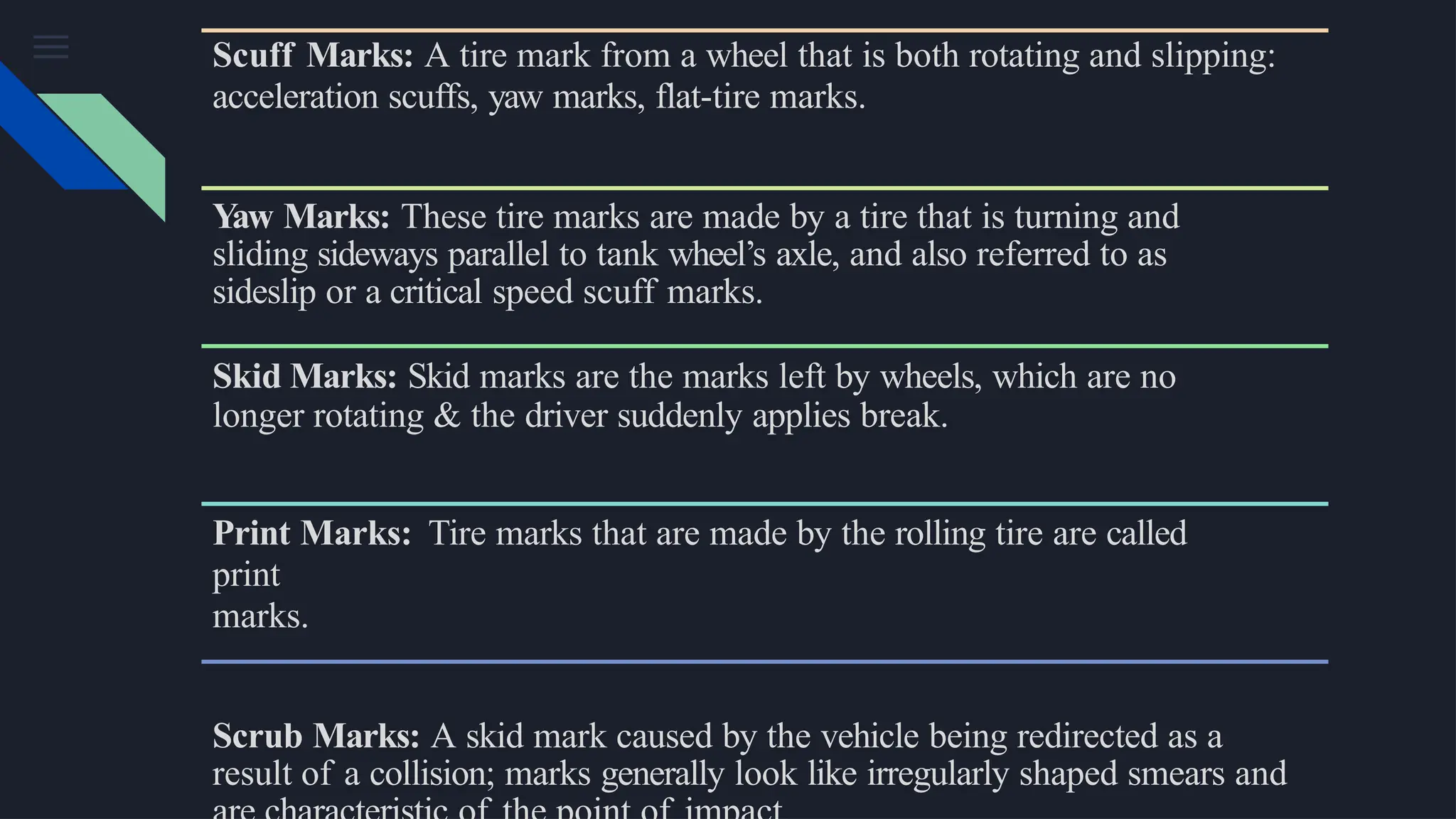
Scuff Marks: A tire mark from a wheel that is both rotating and slipping:
acceleration scuffs, yaw marks, flat-tire marks.
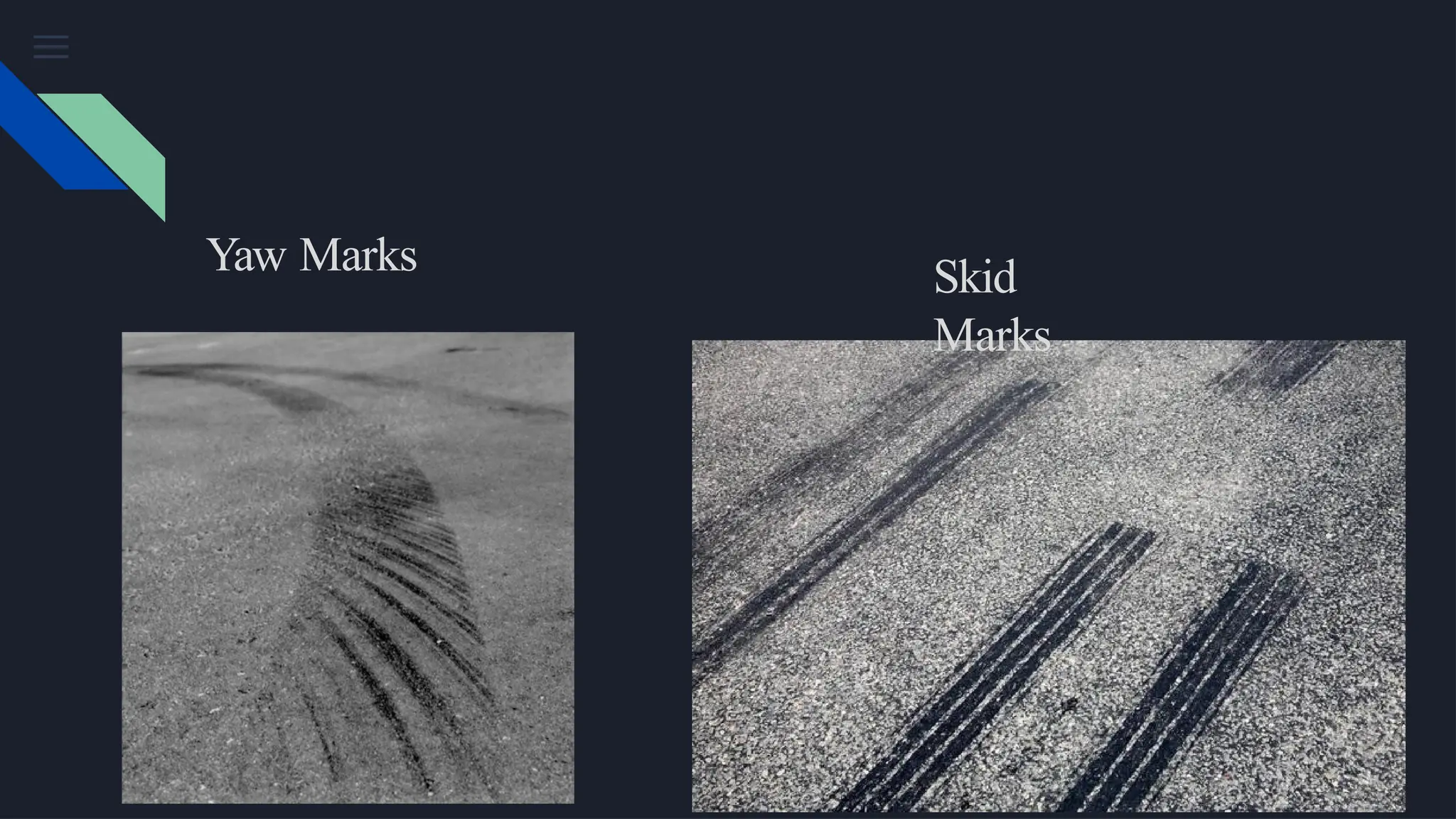
Yaw Marks: These tire marks are made by a tire that is turning and
sliding sideways parallel to tank wheel’s axle, and also referred to as
sideslip or a critical speed scuff marks.
Skid Marks: Skid marks are the marks left by wheels, which are no
longer rotating & the driver suddenly applies break.
Print Marks: Tire marks that are made by the rolling tire are called
print
marks.
Scrub Marks: A skid mark caused by the vehicle being redirected as a
result of a collision; marks generally look like irregularly shaped smears and
Yaw Marks Skid
Marks
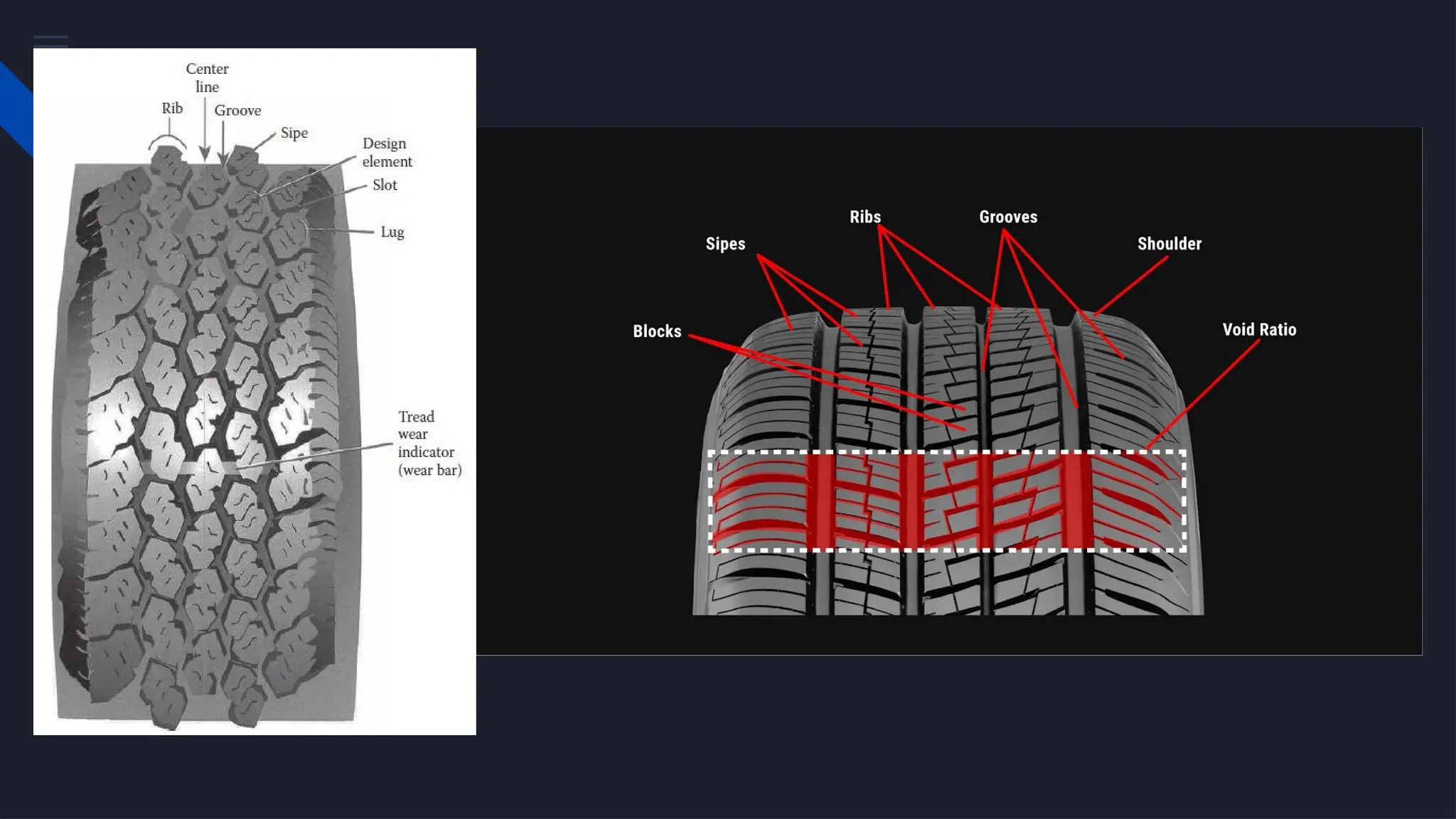
Basic terminology of a Tire Tread
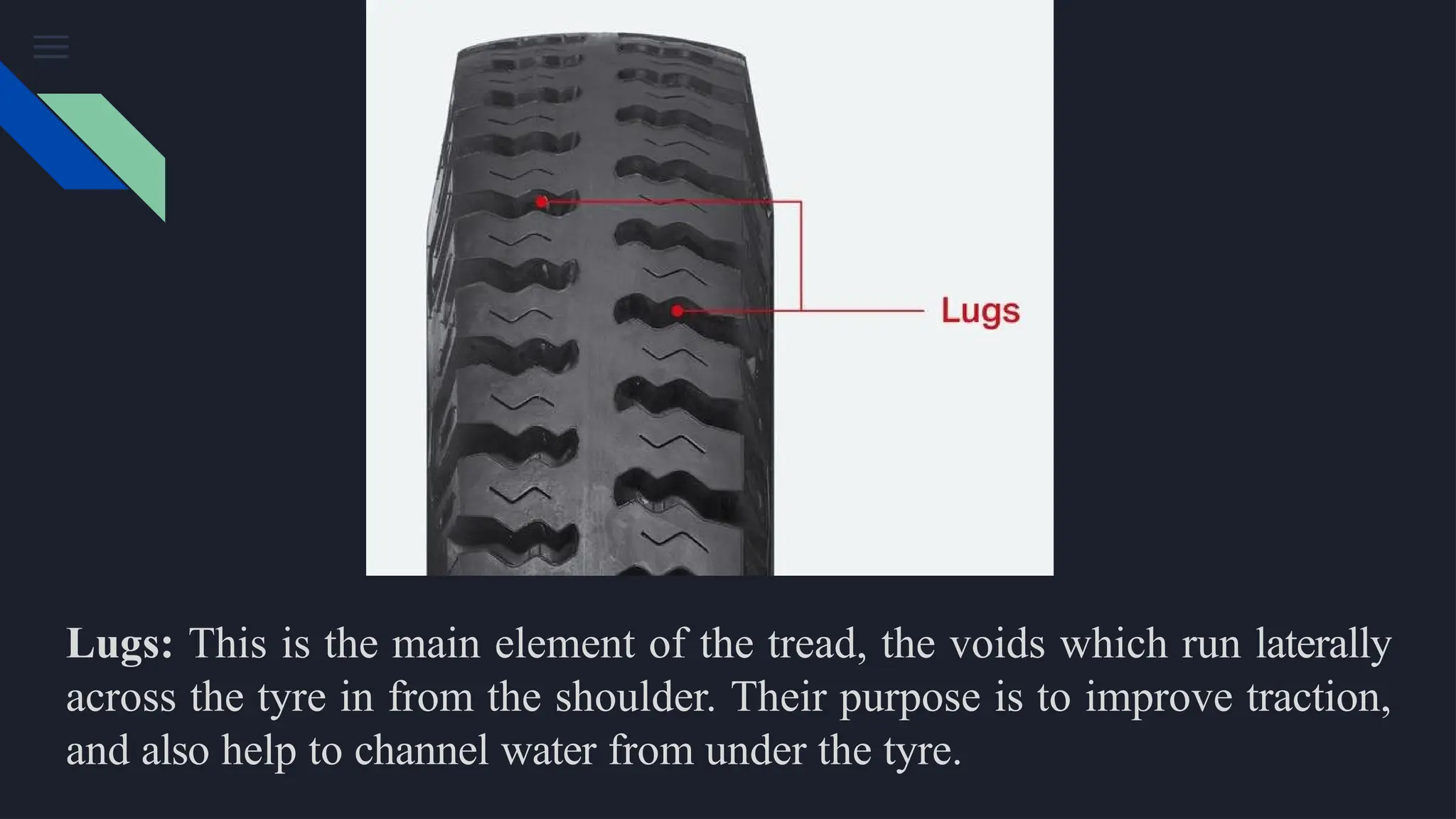
Lugs: This is the main element of the tread, the voids which run laterally
across the tyre in from the shoulder. Their purpose is to improve traction,
and also help to channel water from under the tyre.
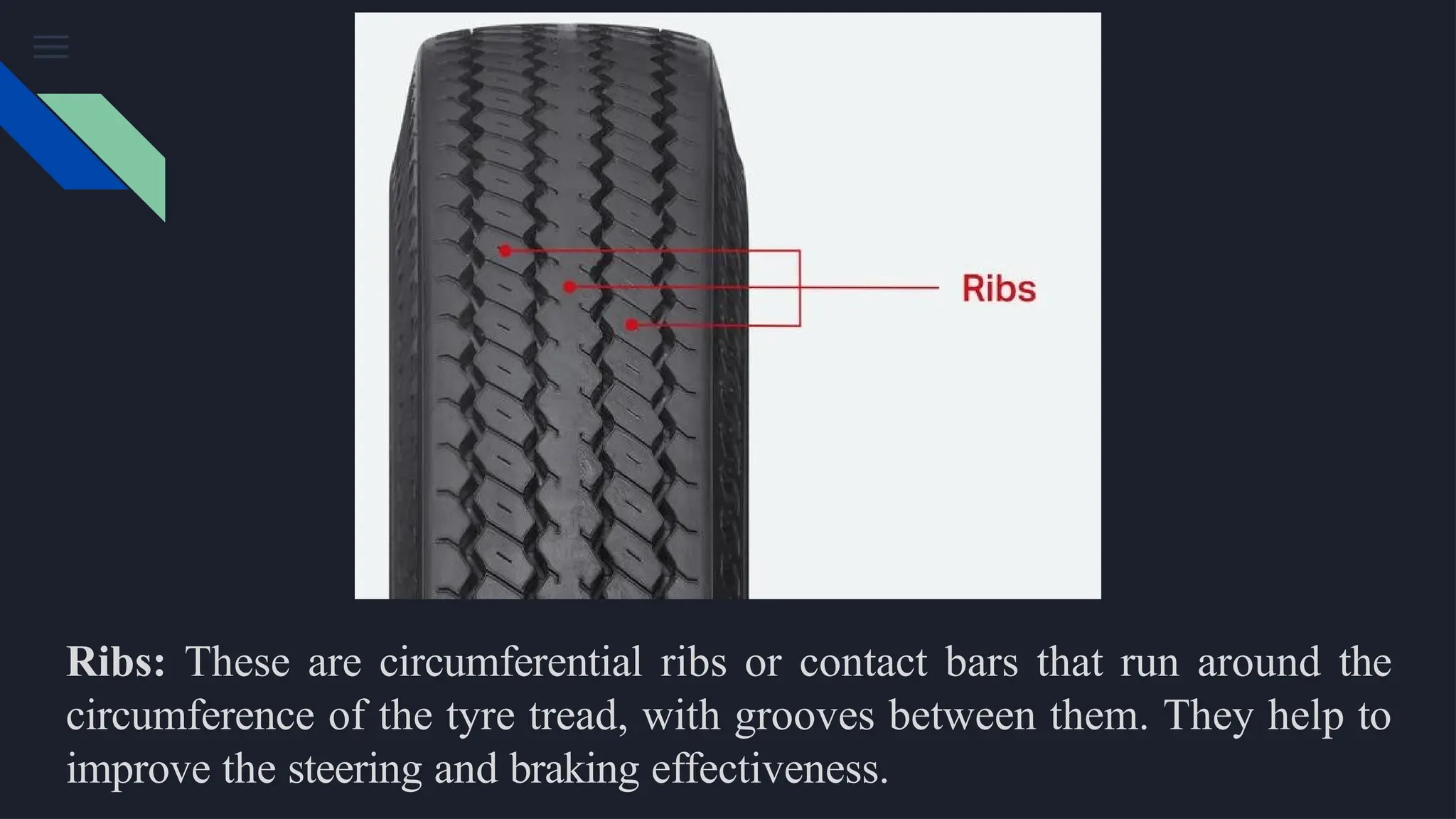
Ribs: These are circumferential ribs or contact bars that run around the
circumference of the tyre tread, with grooves between them. They help to
improve the steering and braking effectiveness.
Blocks: The segments making up a tire's tread. The primary function of
tread blocks is to provide traction.
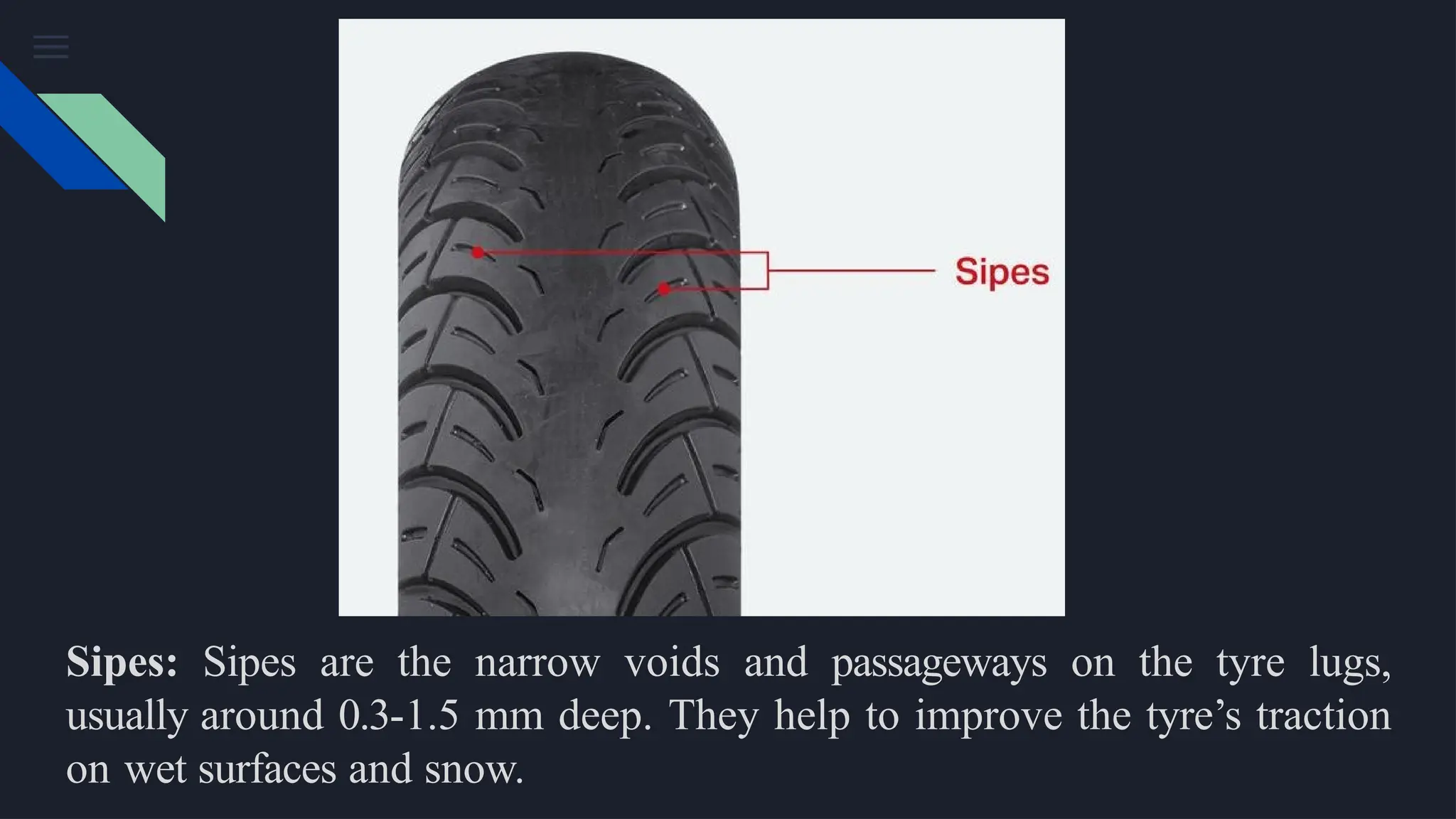
Sipes: Sipes are the narrow voids and passageways on the tyre lugs,
usually around 0.3-1.5 mm deep. They help to improve the tyre’s traction
on wet surfaces and snow.
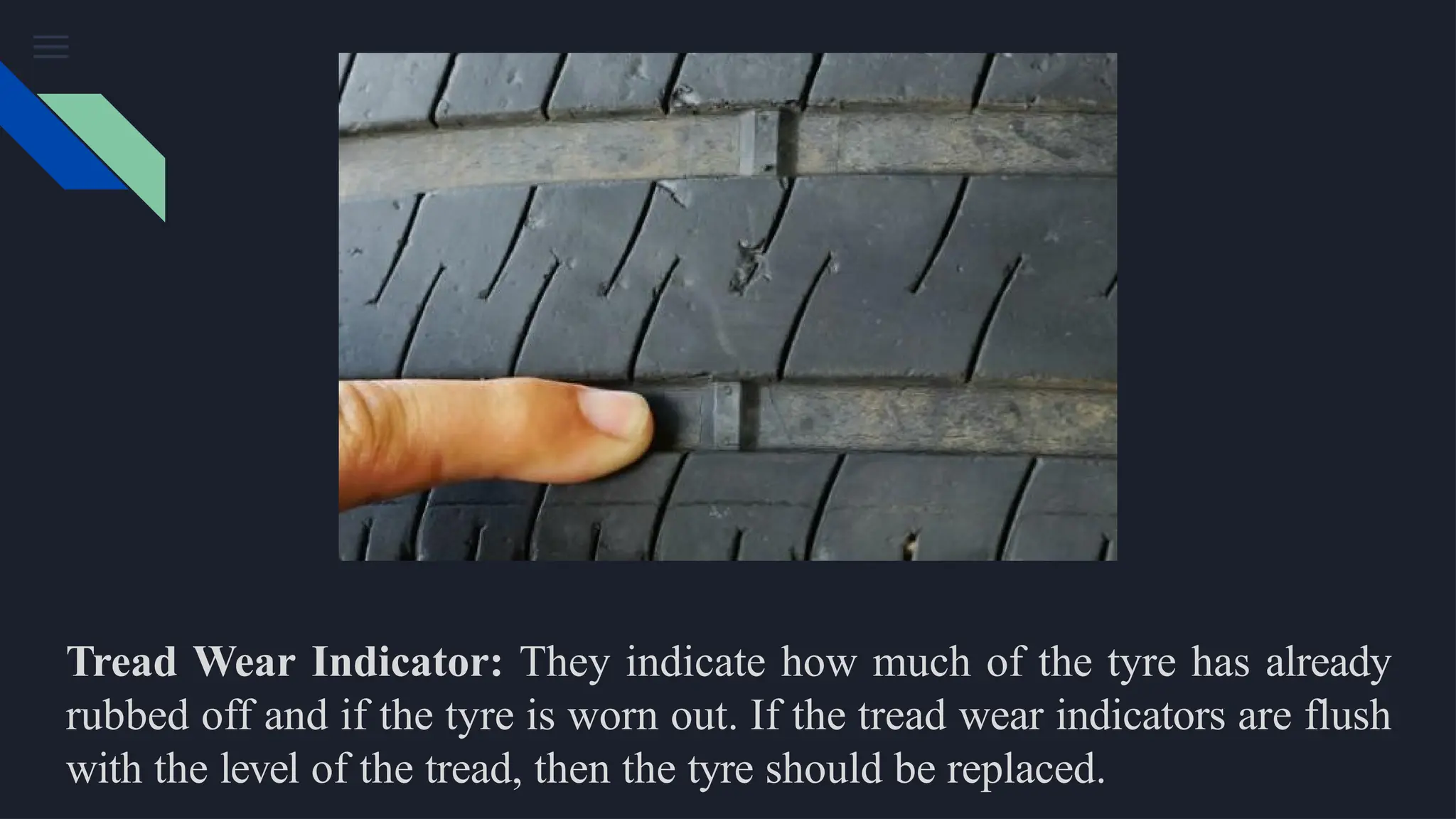
Tread Wear Indicator: They indicate how much of the tyre has already
rubbed off and if the tyre is worn out. If the tread wear indicators are flush
with the level of the tread, then the tyre should be replaced.
A tread wear indicator, also known as a wear bar, is a raised rubber
bar that is 2/32 inch above the base of the tire grooves. The
Department of Transportation requires that all tires over 12 inches
in diameter contain a minimum of six tread wear indicators around
the circumference of a tire. As the tire tread wears down to the
height of 2/32 inch, the wear bars become very noticeable. The
purpose is to indicate to the car’s owner that the tire should be
replaced. Tread wear indicators will only record in a two-
dimensional impression after the tire tread has worn down to the
remaining 2/32-inch depth. Tread wear indicators can be retained in
three-dimensional impressions, regardless of the condition of the
tire, as long as the impression is sufficiently deep to record them.
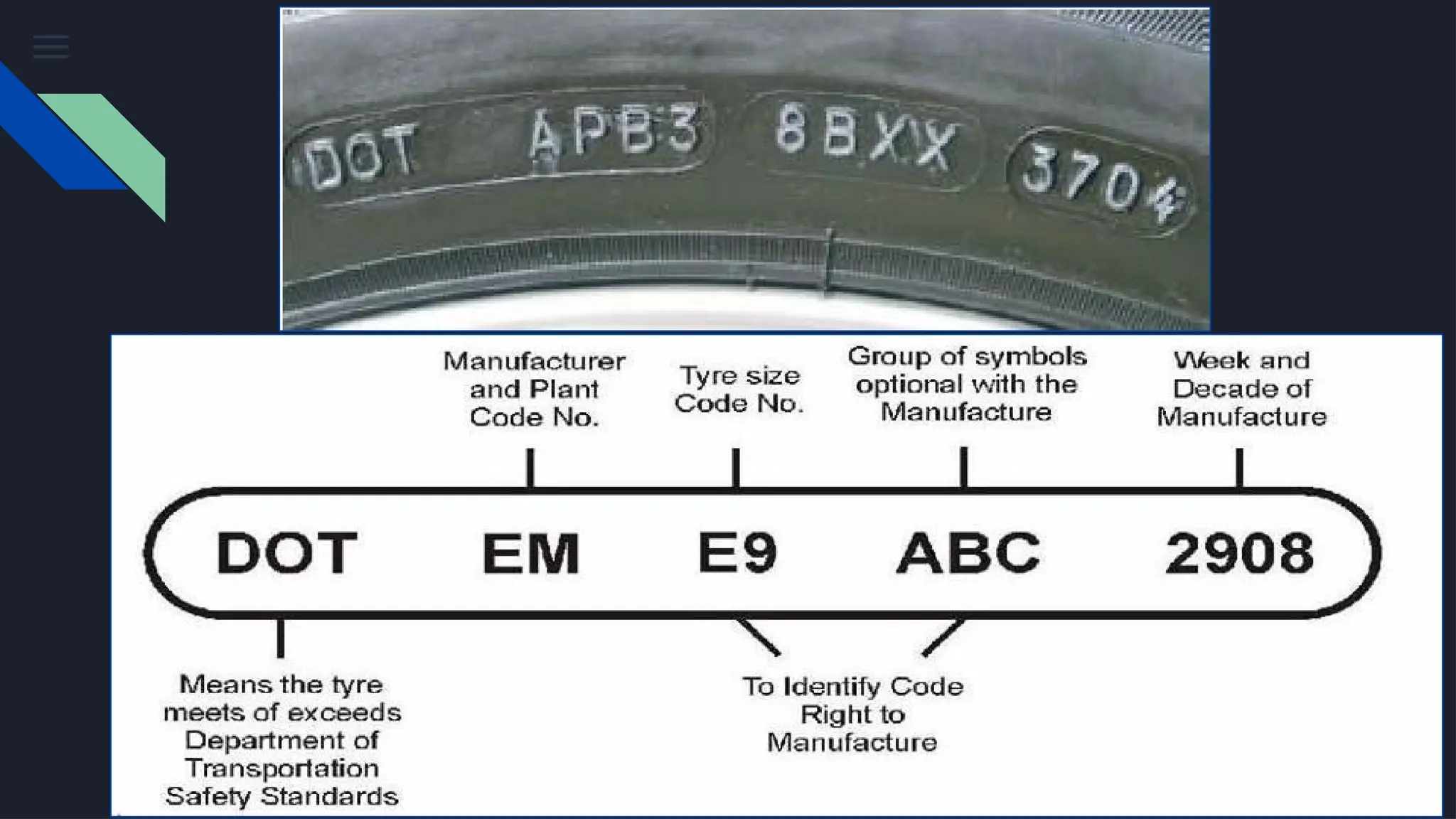
Tread Nomenclature and Sidewall Information
Each tire has two sidewalls. The outer sidewall or label side
is the side that a whitewall or raised white lettering is on.
This is the side intended to face outward on the car. The
inner sidewall, known as the serial side of the tire, is the
side that is normally not visible.
Noise Treatment
As a tire turns under load, the tire tread blocks vibrate and
produce harmonics or noise. If a tire’s tread blocks were all
one size and pitch, the noise would be more than
desirable. To reduce this type of noise emitted by the
tires, the tire industry has created tire designs that change
the size (pitch) of the tread blocks around the tire, thus
creating a variety of pitches. This and other engineered
factors that help reduce the noise a tire generates are
referred to in the industry as noise treatment.
Tire Track Evidence
• Tire track width
• Wheelbase
• Turning diameter
• The relative positions of multiple turning tracks
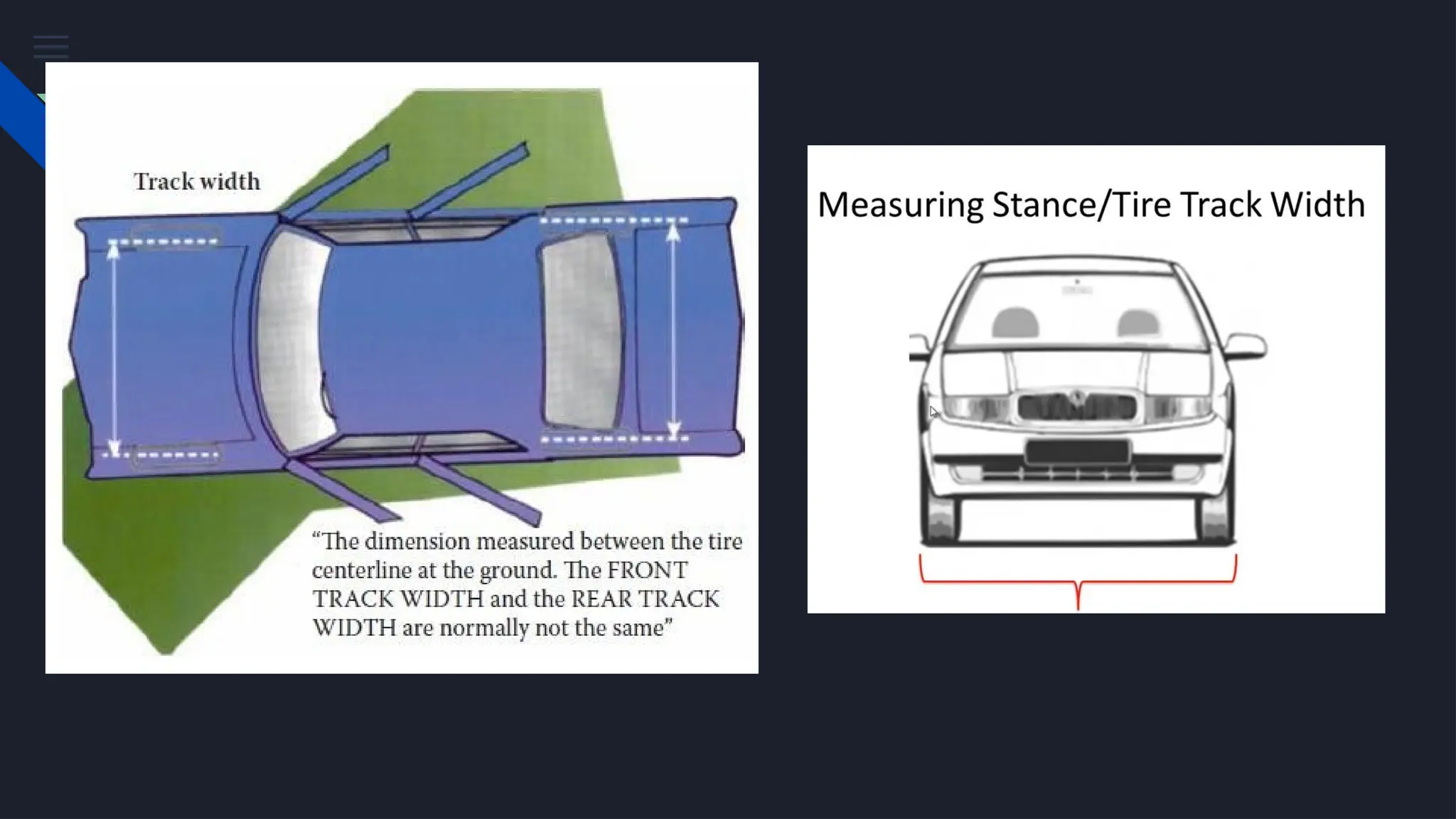
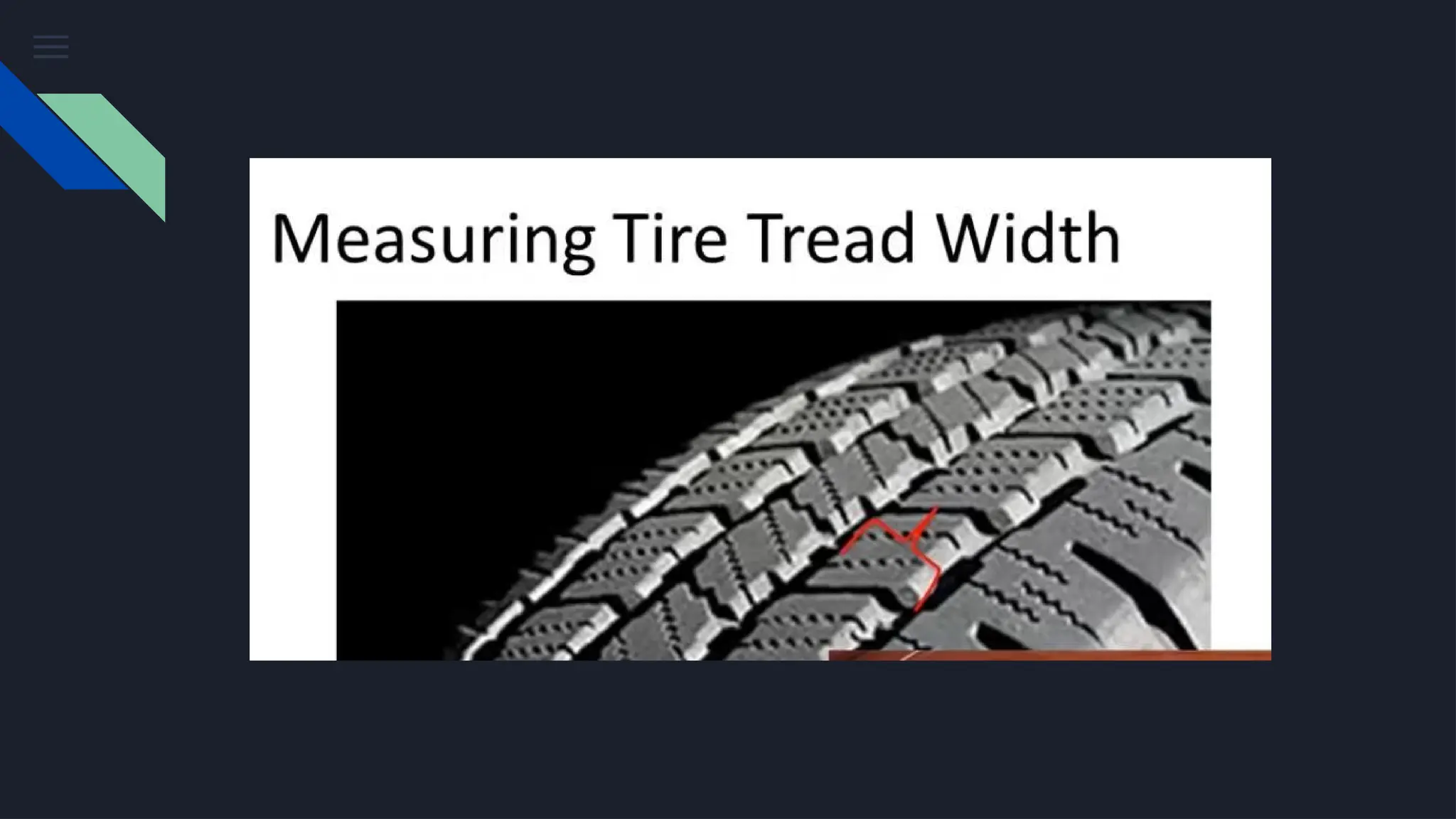
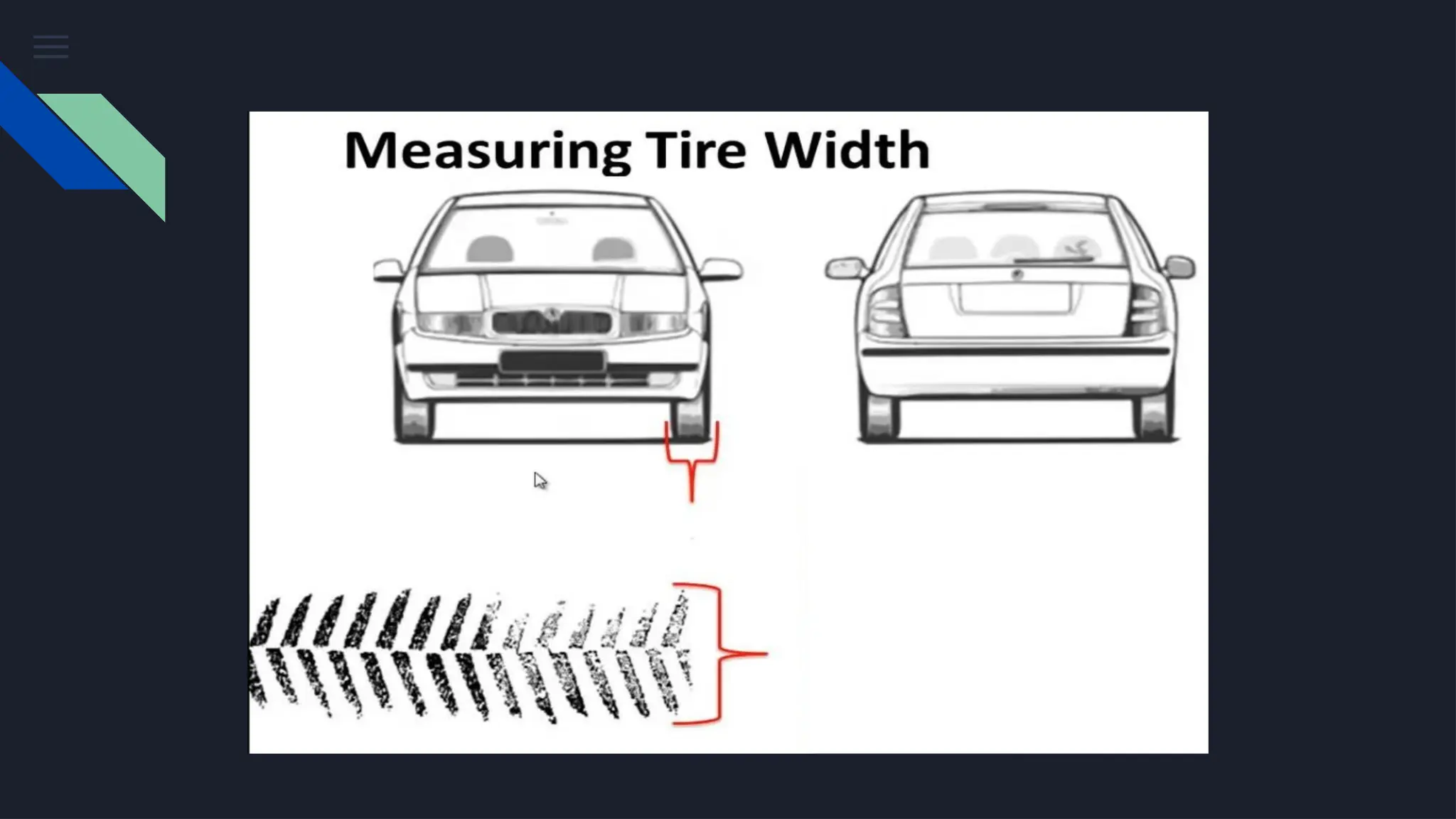
Track Width (Stance)
Track width is the measurement made from the center of
one wheel or impression to the opposite wheel or
impression. As a vehicle travels forward in a straight line,
the rear tire tracks will track over top of all or most of
the tracks left by the front tires. The front wheel
measurement is therefore not often clearly present at a
crime scene for measurement. Regardless of traveling
straight or in a turn, the rear track width will always
record accurately so the most reliable crime scene track
width will always be obtained from the rear tire tracks.
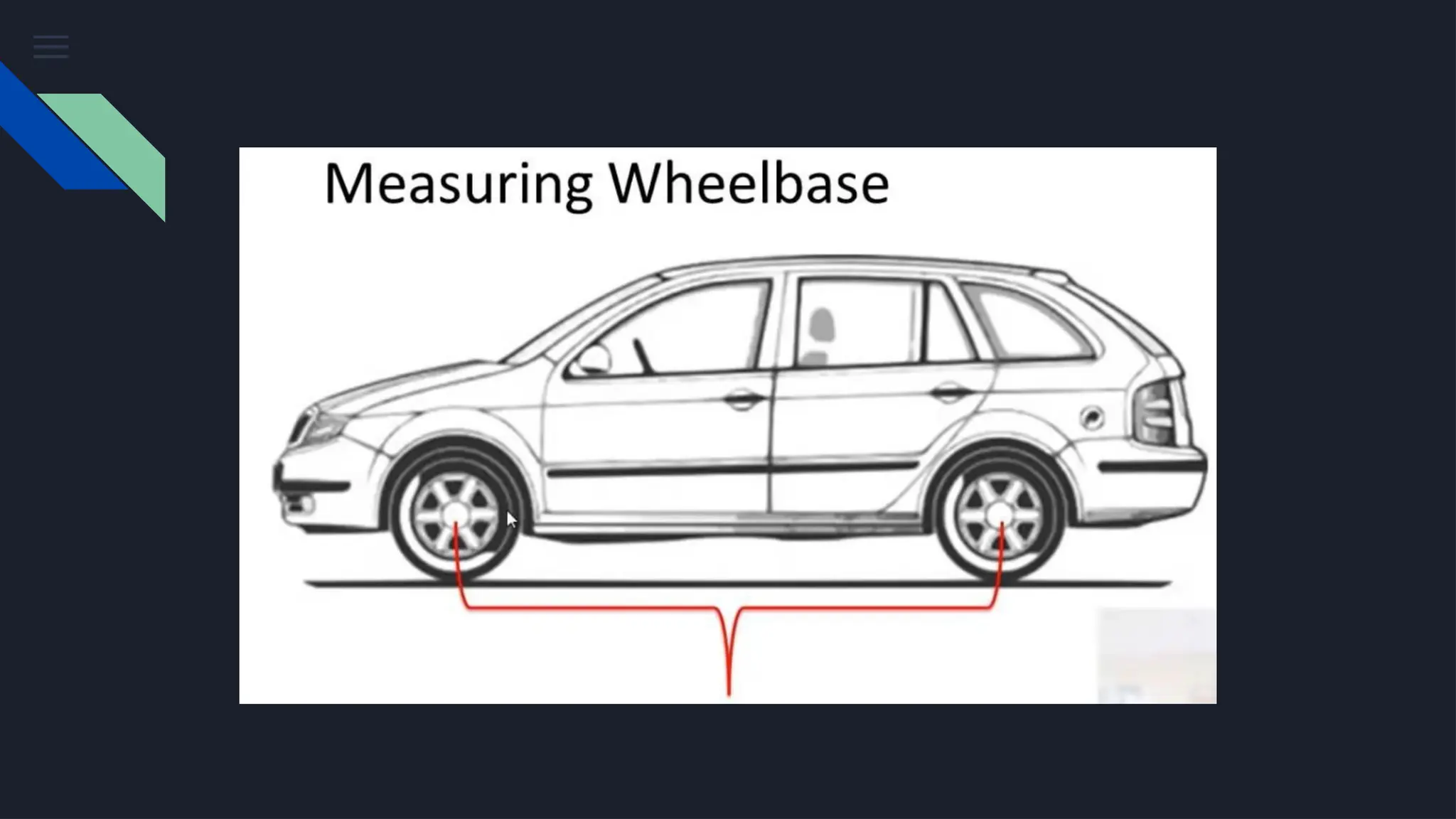
Wheelbase
The wheelbase of a vehicle is the measurement between the
centers of the hubs of the front wheels to the centers of the
hubs of the rear wheels. At a crime scene different points
needed to make this measurement are rarely present. In
some instances, a vehicle parked in snow, or a vehicle
parked briefly during a light rain, will leave four patches
that mark the bottoms of the four tires.
Turning Diameter
The turning diameter of a vehicle is the diameter of the
circle a vehicle makes when its steering wheel is fully
turned. The measurement pertains to the tracks of the front
wheels only, since they are the turning wheels. Some
vehicles are capable of smaller turning diameters while
others are limited to a larger turning diameter. In general,
smaller cars have a much smaller turning diameter than
larger cars. In addition, vehicles often turn at less than their
minimum turning diameter. So any turning diameter
measured at a crime scene does not necessarily represent
a vehicle’s minimum turning diameter and can only be used
to eliminate any other vehicle that is not capable of turning
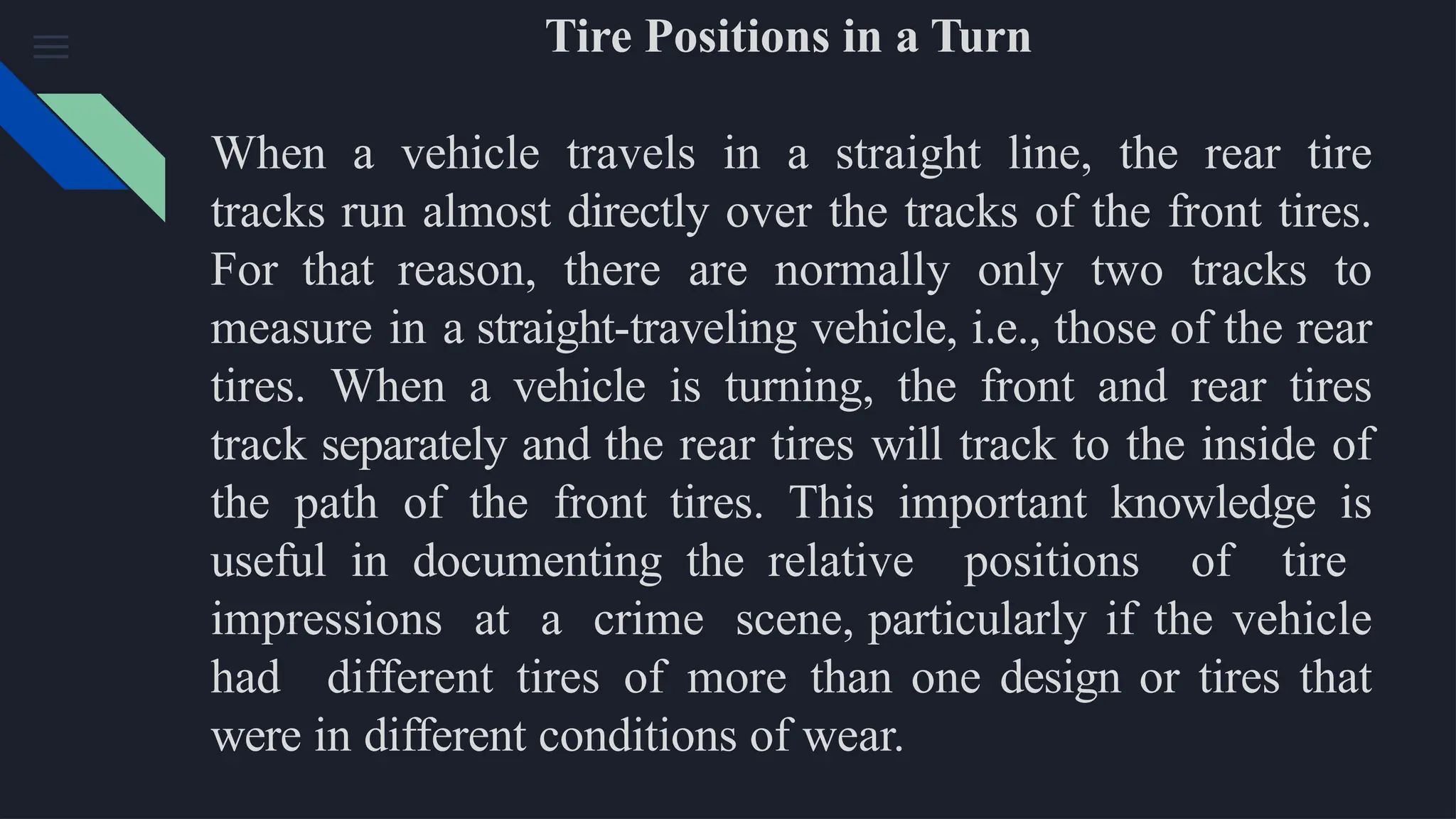
Tire Positions in a Turn
When a vehicle travels in a straight line, the rear tire
tracks run almost directly over the tracks of the front tires.
For that reason, there are normally only two tracks to
measure in a straight-traveling vehicle, i.e., those of the rear
tires. When a vehicle is turning, the front and rear tires
track separately and the rear tires will track to the inside of
the path of the front tires. This important knowledge is
useful in documenting the relative positions of tire
impressions at a crime scene, particularly if the vehicle
had different tires of more than one design or tires that
were in different conditions of wear.
Evidence Processing
- Searching
- Documentation
- Collection
- Analysis
To photographically document long tire impressions, a series of
overlapping photographs must be taken. This picture depicts how a
3-foot impression could be photographed with three
overlapping photographs. The photographs, once enlarged to
natural size, could then be spliced together to recreate the crime
scene impression.
Dental Stone Casting
Materials:
- Dental stone (pink and buff are commonly used)
- Ziplock bags (gallon size)
- Wide mouth jar for water
- Potassium sulfate
1.Place approximately 2 cups of dental stone in a ziplock bag.
Add a tablespoon of potassium sulfate to the dental stone, and
mix. The purpose of the potassium sulfate is to accelerate the
curing process, before the cast material freezes.
2. Place the bag with dental stone in the snow to cool down to
snow
3. Photograph the impression, apply a spray coating material,
and
rephotograph.
4. Cool the mixing water by adding snow until a slight amount of slush is
present.
5.Add the cold water to the dental stone until a consistency of thick
pancake batter is achieved.
6.Pour the casting material into the impression, taking care that the
initial drop of material does not damage the impression. Wiggle the surface
of the wet casting material to aid distribution.

7. Pull up cast when hardened. Let the cast thaw and cure at room
Sulfur Casting
Materials:
-Sulfur (1.5 kg for one impression or approx. 3
cups of pellets)
- Pot
- Spoon
- Heating plate or burner
Melting the sulfur
Place the sulfur in the pot, and turn the heat to medium to
begin melting the sulfur. The sulfur should slowly turn from a
yellow solid to a translucent amber liquid. Melt until all solids
have turned to liquid.
Cooling the sulfur
Cool the melted sulfur by stirring it with a big spoon or scoop
continuously until the sulfur becomes grainy. The sulfur should be a
liquid, nonelastic gruel, and its color will have lightened. Stir the sulfur
constantly as it cools. Do not put the pot in the snow, water, or any place
where it will begin to cool quickly, because then the sulfur will harden
too quickly and you may not have enough time to pour it into the
impression. If this occurs, it will require the sulfur to be melted again.
Pouring the sulfur into the impression
When you pour the sulfur into the impression, it must be grainy and the
temperature must be as close as possible to the melting point. This is
because the sulfur hardens instantly after pouring.
Cool the sulfur very near to the impression you are going to cast so
you
can pour as soon as it is ready. The casting should be at least 2 cm
thick.
Lifting the sulfur cast
Let the cast cool until it is warm (not hot) to the touch. Then lift up
the cast from the snow. Do not leave the sulfur cast in the impression
for a long time because it can freeze to the ground. Place the cast on a
firm surface and handle the cast very carefully. It will be fragile and will
Tire Impressions & the Examination Process
The following areas are examined.
Tread Design
Tread designs contain a very specific and detailed arrangement of tread
blocks, grooves, and sipes. Some tread designs have similar appearances
to others, but to conclude that a design corresponds means that the design
is the same and that all of the design portions visible in the
questioned impression are also present in the known tire.
Tread Dimension and Noise Treatment
Tread dimension, or size, refers to the specific physical tire tread size,
whereas noise treatment is the variance of the pitch (size) of the tread
blocks as they are arranged around the circumference of the tire. Most tires
come in several sizes.
The tread dimension and noise treatment features in the questioned
impression should correspond with the known tire.
Wear Features
As tire treads wear, the frictional forces cause erosion of the rubber and
ultimately change the visible features of the tread blocks, sipes, and some
grooves.
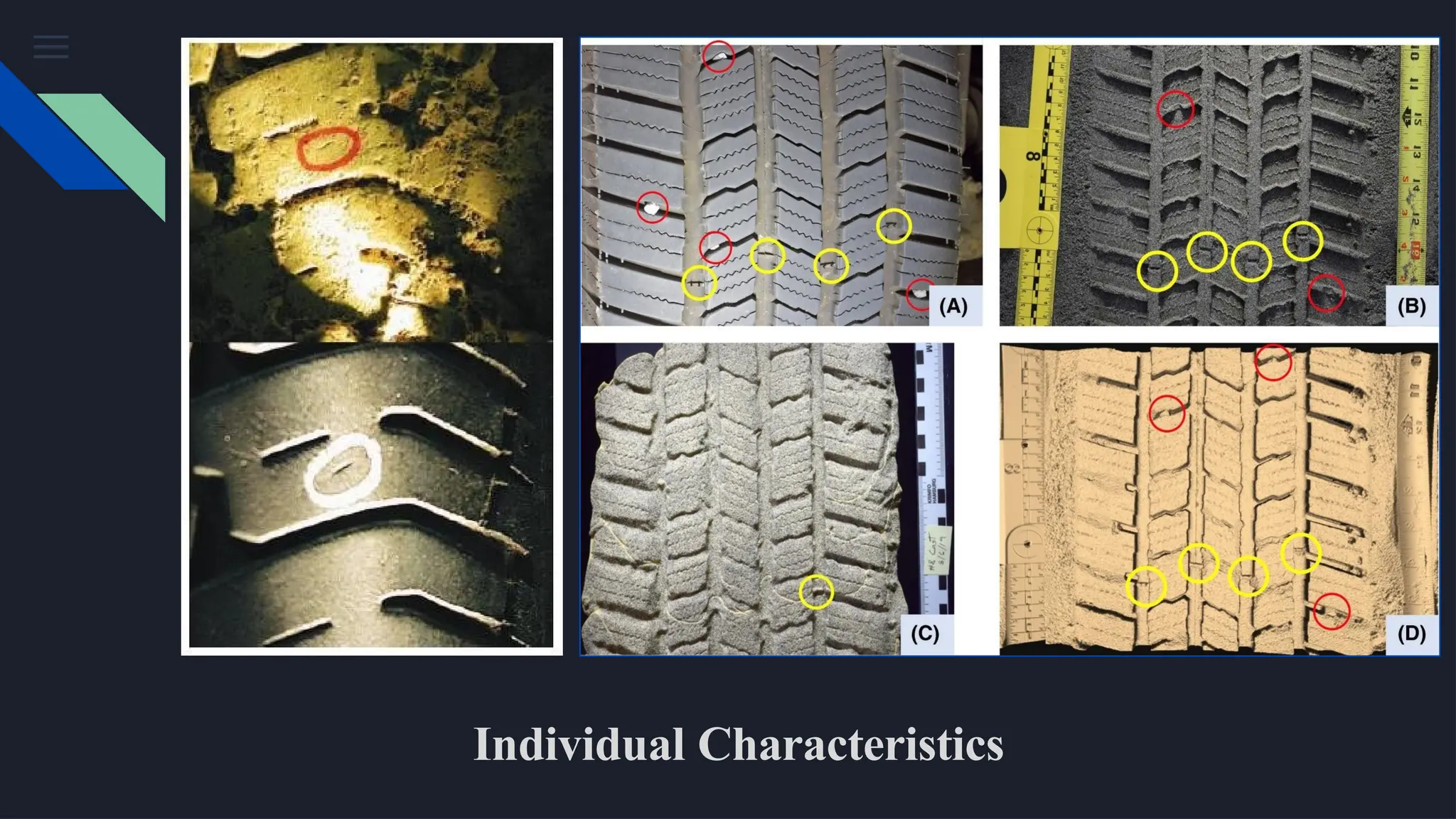
Random Individual Characteristics
Random, individual characteristics include scratches, cuts, tears, and
abrasions that have occurred to a tire in a random manner during its use.
They also include the acquisition of stones, glass, nails, and other artifacts
that have been either temporarily or permanently embedded themselves in
the tread surface in a random manner.
Its size, shape, and orientation, as well as its precise position on the tire, as
confirmed by the corresponding noise treatment and other features, make it
highly valuable for purposes of identifying this tire as having made this
impression.
Multiple Tires of Different Designs
Whereas most vehicles are equipped with four tires of the same size and
design, occasionally a vehicle will have a mixture of tire tread designs.
When this occurs, the likelihood of finding another vehicle with the
same combination of tire designs is small or nonexistent.
Individual Characteristics
Forensic Application

Tyre impressions and Forensic examination of Tyre Impression.pptx

  • 1.
    Introduction Tire track impressionsare classified as pattern evidence because the tire track impressions leave behind a unique pattern. Tire tread impressions reflect the tread design and dimensional features of the individual tires on a vehicle. Tire tracks are the relative dimensions between two or more tires of a vehicle. Tire tracks reflect general information about the vehicle that left the impressions.
  • 2.
    Types of TireMarks Latent Patent Plastic
  • 3.
    Types of TireMarks Scrub Marks Print Marks Skid Marks Yaw Marks Scuff Marks
  • 4.
    Scuff Marks: Atire mark from a wheel that is both rotating and slipping: acceleration scuffs, yaw marks, flat-tire marks. Yaw Marks: These tire marks are made by a tire that is turning and sliding sideways parallel to tank wheel’s axle, and also referred to as sideslip or a critical speed scuff marks. Skid Marks: Skid marks are the marks left by wheels, which are no longer rotating & the driver suddenly applies break. Print Marks: Tire marks that are made by the rolling tire are called print marks. Scrub Marks: A skid mark caused by the vehicle being redirected as a result of a collision; marks generally look like irregularly shaped smears and
  • 5.
  • 6.
  • 8.
    Lugs: This isthe main element of the tread, the voids which run laterally across the tyre in from the shoulder. Their purpose is to improve traction, and also help to channel water from under the tyre.
  • 9.
    Ribs: These arecircumferential ribs or contact bars that run around the circumference of the tyre tread, with grooves between them. They help to improve the steering and braking effectiveness.
  • 10.
    Blocks: The segmentsmaking up a tire's tread. The primary function of tread blocks is to provide traction.
  • 11.
    Sipes: Sipes arethe narrow voids and passageways on the tyre lugs, usually around 0.3-1.5 mm deep. They help to improve the tyre’s traction on wet surfaces and snow.
  • 12.
    Tread Wear Indicator:They indicate how much of the tyre has already rubbed off and if the tyre is worn out. If the tread wear indicators are flush with the level of the tread, then the tyre should be replaced.
  • 13.
    A tread wearindicator, also known as a wear bar, is a raised rubber bar that is 2/32 inch above the base of the tire grooves. The Department of Transportation requires that all tires over 12 inches in diameter contain a minimum of six tread wear indicators around the circumference of a tire. As the tire tread wears down to the height of 2/32 inch, the wear bars become very noticeable. The purpose is to indicate to the car’s owner that the tire should be replaced. Tread wear indicators will only record in a two- dimensional impression after the tire tread has worn down to the remaining 2/32-inch depth. Tread wear indicators can be retained in three-dimensional impressions, regardless of the condition of the tire, as long as the impression is sufficiently deep to record them.
  • 14.
    Tread Nomenclature andSidewall Information
  • 15.
    Each tire hastwo sidewalls. The outer sidewall or label side is the side that a whitewall or raised white lettering is on. This is the side intended to face outward on the car. The inner sidewall, known as the serial side of the tire, is the side that is normally not visible.
  • 17.
    Noise Treatment As atire turns under load, the tire tread blocks vibrate and produce harmonics or noise. If a tire’s tread blocks were all one size and pitch, the noise would be more than desirable. To reduce this type of noise emitted by the tires, the tire industry has created tire designs that change the size (pitch) of the tread blocks around the tire, thus creating a variety of pitches. This and other engineered factors that help reduce the noise a tire generates are referred to in the industry as noise treatment.
  • 18.
  • 19.
    • Tire trackwidth • Wheelbase • Turning diameter • The relative positions of multiple turning tracks
  • 20.
    Track Width (Stance) Trackwidth is the measurement made from the center of one wheel or impression to the opposite wheel or impression. As a vehicle travels forward in a straight line, the rear tire tracks will track over top of all or most of the tracks left by the front tires. The front wheel measurement is therefore not often clearly present at a crime scene for measurement. Regardless of traveling straight or in a turn, the rear track width will always record accurately so the most reliable crime scene track width will always be obtained from the rear tire tracks.
  • 25.
    Wheelbase The wheelbase ofa vehicle is the measurement between the centers of the hubs of the front wheels to the centers of the hubs of the rear wheels. At a crime scene different points needed to make this measurement are rarely present. In some instances, a vehicle parked in snow, or a vehicle parked briefly during a light rain, will leave four patches that mark the bottoms of the four tires.
  • 27.
    Turning Diameter The turningdiameter of a vehicle is the diameter of the circle a vehicle makes when its steering wheel is fully turned. The measurement pertains to the tracks of the front wheels only, since they are the turning wheels. Some vehicles are capable of smaller turning diameters while others are limited to a larger turning diameter. In general, smaller cars have a much smaller turning diameter than larger cars. In addition, vehicles often turn at less than their minimum turning diameter. So any turning diameter measured at a crime scene does not necessarily represent a vehicle’s minimum turning diameter and can only be used to eliminate any other vehicle that is not capable of turning
  • 29.
    Tire Positions ina Turn When a vehicle travels in a straight line, the rear tire tracks run almost directly over the tracks of the front tires. For that reason, there are normally only two tracks to measure in a straight-traveling vehicle, i.e., those of the rear tires. When a vehicle is turning, the front and rear tires track separately and the rear tires will track to the inside of the path of the front tires. This important knowledge is useful in documenting the relative positions of tire impressions at a crime scene, particularly if the vehicle had different tires of more than one design or tires that were in different conditions of wear.
  • 30.
    Evidence Processing - Searching -Documentation - Collection - Analysis
  • 33.
    To photographically documentlong tire impressions, a series of overlapping photographs must be taken. This picture depicts how a 3-foot impression could be photographed with three overlapping photographs. The photographs, once enlarged to natural size, could then be spliced together to recreate the crime scene impression.
  • 34.
    Dental Stone Casting Materials: -Dental stone (pink and buff are commonly used) - Ziplock bags (gallon size) - Wide mouth jar for water - Potassium sulfate 1.Place approximately 2 cups of dental stone in a ziplock bag. Add a tablespoon of potassium sulfate to the dental stone, and mix. The purpose of the potassium sulfate is to accelerate the curing process, before the cast material freezes. 2. Place the bag with dental stone in the snow to cool down to snow
  • 35.
    3. Photograph theimpression, apply a spray coating material, and rephotograph. 4. Cool the mixing water by adding snow until a slight amount of slush is present. 5.Add the cold water to the dental stone until a consistency of thick pancake batter is achieved. 6.Pour the casting material into the impression, taking care that the initial drop of material does not damage the impression. Wiggle the surface of the wet casting material to aid distribution. 7. Pull up cast when hardened. Let the cast thaw and cure at room
  • 36.
    Sulfur Casting Materials: -Sulfur (1.5kg for one impression or approx. 3 cups of pellets) - Pot - Spoon - Heating plate or burner Melting the sulfur Place the sulfur in the pot, and turn the heat to medium to begin melting the sulfur. The sulfur should slowly turn from a yellow solid to a translucent amber liquid. Melt until all solids have turned to liquid.
  • 37.
    Cooling the sulfur Coolthe melted sulfur by stirring it with a big spoon or scoop continuously until the sulfur becomes grainy. The sulfur should be a liquid, nonelastic gruel, and its color will have lightened. Stir the sulfur constantly as it cools. Do not put the pot in the snow, water, or any place where it will begin to cool quickly, because then the sulfur will harden too quickly and you may not have enough time to pour it into the impression. If this occurs, it will require the sulfur to be melted again. Pouring the sulfur into the impression When you pour the sulfur into the impression, it must be grainy and the temperature must be as close as possible to the melting point. This is because the sulfur hardens instantly after pouring.
  • 38.
    Cool the sulfurvery near to the impression you are going to cast so you can pour as soon as it is ready. The casting should be at least 2 cm thick. Lifting the sulfur cast Let the cast cool until it is warm (not hot) to the touch. Then lift up the cast from the snow. Do not leave the sulfur cast in the impression for a long time because it can freeze to the ground. Place the cast on a firm surface and handle the cast very carefully. It will be fragile and will
  • 39.
    Tire Impressions &the Examination Process
  • 40.
    The following areasare examined. Tread Design Tread designs contain a very specific and detailed arrangement of tread blocks, grooves, and sipes. Some tread designs have similar appearances to others, but to conclude that a design corresponds means that the design is the same and that all of the design portions visible in the questioned impression are also present in the known tire. Tread Dimension and Noise Treatment Tread dimension, or size, refers to the specific physical tire tread size, whereas noise treatment is the variance of the pitch (size) of the tread blocks as they are arranged around the circumference of the tire. Most tires come in several sizes.
  • 41.
    The tread dimensionand noise treatment features in the questioned impression should correspond with the known tire. Wear Features As tire treads wear, the frictional forces cause erosion of the rubber and ultimately change the visible features of the tread blocks, sipes, and some grooves. Random Individual Characteristics Random, individual characteristics include scratches, cuts, tears, and abrasions that have occurred to a tire in a random manner during its use. They also include the acquisition of stones, glass, nails, and other artifacts that have been either temporarily or permanently embedded themselves in the tread surface in a random manner.
  • 42.
    Its size, shape,and orientation, as well as its precise position on the tire, as confirmed by the corresponding noise treatment and other features, make it highly valuable for purposes of identifying this tire as having made this impression. Multiple Tires of Different Designs Whereas most vehicles are equipped with four tires of the same size and design, occasionally a vehicle will have a mixture of tire tread designs. When this occurs, the likelihood of finding another vehicle with the same combination of tire designs is small or nonexistent.
  • 43.
  • 44.