GLASS
Physical Properties the forensic scientist must constantly determine those properties that impart distinguishing characteristics to matter, giving it a  unique  identity. properties  are the identifying characteristics of substances
physical properties  describe a substance without reference to any other substance example:  weight, volume, color, boiling  point, melting point can be measured for a particular substance without altering the material’s composition associated only with the physical existence of that substance
chemical properties  describe the behavior of a substance when it reacts or combines with another substance examples: - when wood burns, it combines  with oxygen in the air to form  new substances - Marquis reagent turns purple  in the presence of heroin
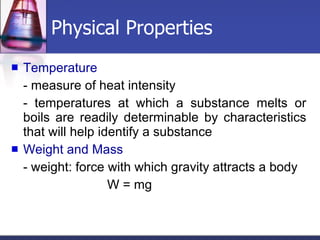
Physical Properties Temperature - measure of heat intensity - temperatures at which a substance melts or boils are readily determinable by characteristics that will help identify a substance Weight and Mass - weight: force with which gravity attracts a body W = mg
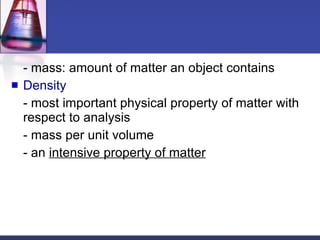
- mass: amount of matter an object contains Density - most important physical property of matter with respect to analysis - mass per unit volume - an  intensive property of matter
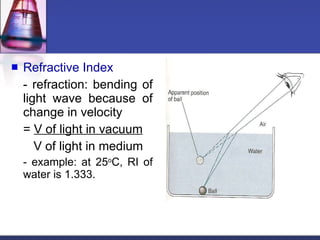
Refractive Index - refraction: bending of light wave because of change in velocity =  V of light in vacuum   V of light in medium - example: at 25 o C, RI of water is 1.333.
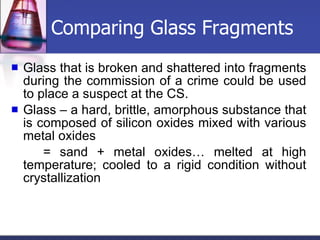
Comparing Glass Fragments Glass that is broken and shattered into fragments during the commission of a crime could be used to place a suspect at the CS. Glass – a hard, brittle, amorphous substance that is composed of silicon oxides mixed with various metal oxides = sand + metal oxides… melted at high temperature; cooled to a rigid condition without crystallization
by adding  Na 2 CO 3  to the sand, melting point and viscosity are both lowered making it easier to work  sand +  Na 2 CO 3  +  CaO  = soda-lime glass = used for manufacturing most window and bottle glass = common metal oxides: Na, Ca, Mg, Al
Special glass (substituting Si and other M.O.) = automobile headlights and heat resistant glass (Pyrex) uses boron oxide [ borosilicates ] Tempered glass : made stronger by introducing stress through rapid heating and cooling of the glass surfaces = when it breaks, it does not shatter but fragments into small squares = used in the side and rear windows (US)
Laminated glass: sandwiched one layer of plastic between two ordinary window glass = windshield (US) FS problem: need to find and measure those properties that will associate one glass fragment with another while eliminating the existence of other sources
density and refractive index are used BUT, these properties are CLASS CHARACTERISTICS.
Forensic analysis of glass Physical, fracture matching Best evidence, but very rare Density determination Float test Results subjective Refractive index (R.I.) determination Chemical testing, destructive Test for silicates, metal oxides, trace evidence
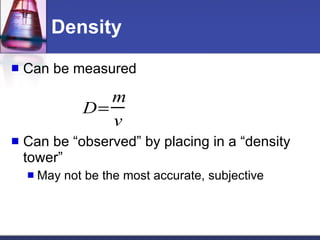
Density Can be measured Can be “observed” by placing in a “density tower” May not be the most accurate, subjective
Refractive index (R.I.) measurement Becke - immersion method Emmons & Winchell - temp. variation method Saylor - double diaphragm contrast method Oettle - phase contrast method
Refractive index measurement Refraction is the change of direction and/or speed of light as it passes from one medium to another RI is a ratio of the speed of light between two mediums (e.g. glass & oil) RI is dependant on: The wavelength of light The temperature of the medium
RI measurement technique RI of material varies with temp. The change in RI for liquids is in the order of 10 -4  RI units The change in RI for solids is in the order of 10 -6  RI units What does this mean? When the temp. of a liquid is changed, the RI changes rapidly, but the RI of an immersed solid will not
RI measurement technique Silicon oil usually used  Oil is calibrated so RI can be determined from its temp. Sample glass is immersed in oil Oil is heated/cooled to determine match temp. Glass “disappears” Oil RI = Glass RI
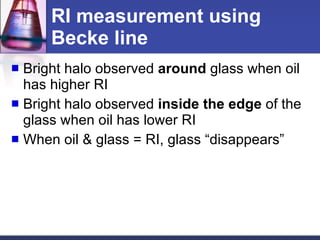
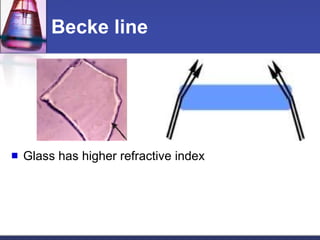
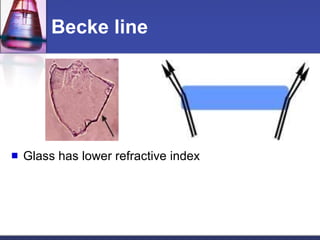
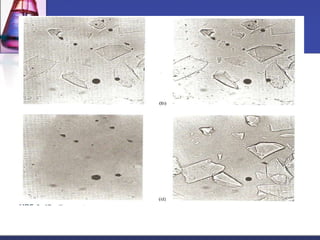
RI measurement using Becke line Bright halo observed  around  glass when oil has higher RI Bright halo observed  inside   the edge  of the glass when oil has lower RI When oil & glass = RI, glass “disappears”
Becke line Glass has higher refractive index
Becke line Glass has lower refractive index
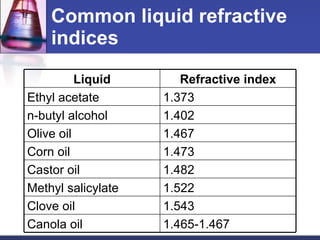
Common liquid refractive indices 1.465-1.467 Canola oil 1.543 Clove oil 1.522 Methyl salicylate 1.482 Castor oil 1.473 Corn oil 1.467 Olive oil 1.402 n-butyl alcohol 1.373 Ethyl acetate Refractive index Liquid
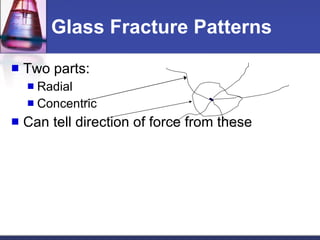
Glass Fracture Patterns Two parts: Radial Concentric Can tell direction of force from these
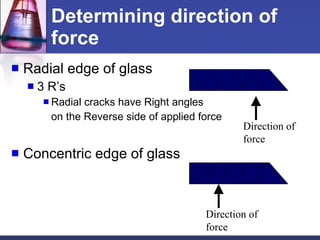
Determining direction of force Radial edge of glass 3 R’s Radial cracks have Right angles on the Reverse side of applied force Concentric edge of glass Direction of force Direction of force
Procedures in Analyzing Glass FLOTATION a solid particles will either float, sink or remain suspended in a liquid depending on its density relative to the liquid medium procedure: a standard/reference glass is immersed in a liquid composition of the liquid is carefully adjusted by the addition of bromoform or bromobenzene until the glass chip remains  suspended
the standard/reference glass and liquid have the same density glass chips of approximately the same size and shape as the SR are added to the liquid if they both remain suspended, their densities are equal to each other and the liquid liquid is transferred to a density meter
IMMERSION METHOD added comparison of refractive indices procedure: glass particles are immersed in a liquid medium whose refractive index is varied until it is equal to that of the glass particles =  match point you will note the disappearance of the Becke line
 
GLASS FRACTURES glass bends in response to any force that is exerted on any one of its surfaces when the limit of elasticity is reached, the glass fractures fractured window glass reveal information that can be related to the force and direction of impact = useful in crime scene investigation
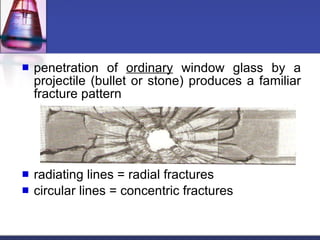
penetration of  ordinary  window glass by a projectile (bullet or stone) produces a familiar fracture pattern radiating lines = radial fractures circular lines = concentric fractures
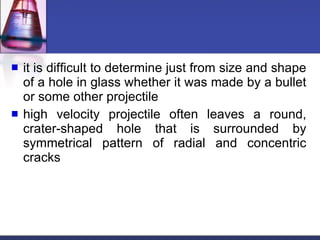
it is difficult to determine just from size and shape of a hole in glass whether it was made by a bullet or some other projectile high velocity projectile often leaves a round, crater-shaped hole that is surrounded by symmetrical pattern of radial and concentric cracks
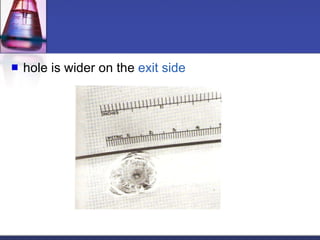
hole is wider on the  exit side
but as the velocity of the penetrating projectile decreases, the irregularity of the shape of the hole and of its surrounding cracks increases hole shape could no longer determine the direction of impact
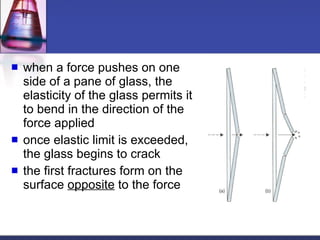
when a force pushes on one side of a pane of glass, the elasticity of the glass permits it to bend in the direction of the force applied once elastic limit is exceeded, the glass begins to crack the first fractures form on the surface  opposite  to the force
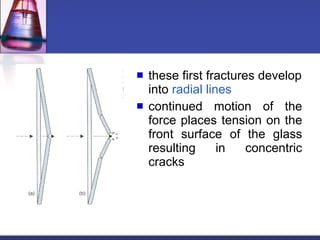
these first fractures develop into  radial lines continued motion of the force places tension on the front surface of the glass resulting in concentric cracks
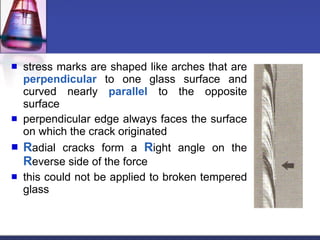
stress marks are shaped like arches that are  perpendicular  to one glass surface and curved nearly  parallel  to the opposite surface perpendicular edge always faces the surface on which the crack originated R adial cracks form a  R ight angle on the  R everse side of the force this could not be applied to broken tempered glass
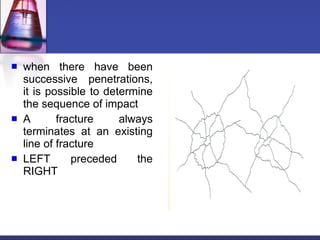
when there have been successive penetrations, it is possible to determine the sequence of impact A fracture always terminates at an existing line of fracture LEFT preceded the RIGHT

Glass Analysis

  • 1.
  • 2.
    Physical Properties theforensic scientist must constantly determine those properties that impart distinguishing characteristics to matter, giving it a unique identity. properties are the identifying characteristics of substances
  • 3.
    physical properties describe a substance without reference to any other substance example: weight, volume, color, boiling point, melting point can be measured for a particular substance without altering the material’s composition associated only with the physical existence of that substance
  • 4.
    chemical properties describe the behavior of a substance when it reacts or combines with another substance examples: - when wood burns, it combines with oxygen in the air to form new substances - Marquis reagent turns purple in the presence of heroin
  • 5.
    Physical Properties Temperature- measure of heat intensity - temperatures at which a substance melts or boils are readily determinable by characteristics that will help identify a substance Weight and Mass - weight: force with which gravity attracts a body W = mg
  • 6.
    - mass: amountof matter an object contains Density - most important physical property of matter with respect to analysis - mass per unit volume - an intensive property of matter
  • 7.
    Refractive Index -refraction: bending of light wave because of change in velocity = V of light in vacuum V of light in medium - example: at 25 o C, RI of water is 1.333.
  • 8.
    Comparing Glass FragmentsGlass that is broken and shattered into fragments during the commission of a crime could be used to place a suspect at the CS. Glass – a hard, brittle, amorphous substance that is composed of silicon oxides mixed with various metal oxides = sand + metal oxides… melted at high temperature; cooled to a rigid condition without crystallization
  • 9.
    by adding Na 2 CO 3 to the sand, melting point and viscosity are both lowered making it easier to work sand + Na 2 CO 3 + CaO = soda-lime glass = used for manufacturing most window and bottle glass = common metal oxides: Na, Ca, Mg, Al
  • 10.
    Special glass (substitutingSi and other M.O.) = automobile headlights and heat resistant glass (Pyrex) uses boron oxide [ borosilicates ] Tempered glass : made stronger by introducing stress through rapid heating and cooling of the glass surfaces = when it breaks, it does not shatter but fragments into small squares = used in the side and rear windows (US)
  • 11.
    Laminated glass: sandwichedone layer of plastic between two ordinary window glass = windshield (US) FS problem: need to find and measure those properties that will associate one glass fragment with another while eliminating the existence of other sources
  • 12.
    density and refractiveindex are used BUT, these properties are CLASS CHARACTERISTICS.
  • 13.
    Forensic analysis ofglass Physical, fracture matching Best evidence, but very rare Density determination Float test Results subjective Refractive index (R.I.) determination Chemical testing, destructive Test for silicates, metal oxides, trace evidence
  • 14.
    Density Can bemeasured Can be “observed” by placing in a “density tower” May not be the most accurate, subjective
  • 15.
    Refractive index (R.I.)measurement Becke - immersion method Emmons & Winchell - temp. variation method Saylor - double diaphragm contrast method Oettle - phase contrast method
  • 16.
    Refractive index measurementRefraction is the change of direction and/or speed of light as it passes from one medium to another RI is a ratio of the speed of light between two mediums (e.g. glass & oil) RI is dependant on: The wavelength of light The temperature of the medium
  • 17.
    RI measurement techniqueRI of material varies with temp. The change in RI for liquids is in the order of 10 -4 RI units The change in RI for solids is in the order of 10 -6 RI units What does this mean? When the temp. of a liquid is changed, the RI changes rapidly, but the RI of an immersed solid will not
  • 18.
    RI measurement techniqueSilicon oil usually used Oil is calibrated so RI can be determined from its temp. Sample glass is immersed in oil Oil is heated/cooled to determine match temp. Glass “disappears” Oil RI = Glass RI
  • 19.
    RI measurement usingBecke line Bright halo observed around glass when oil has higher RI Bright halo observed inside the edge of the glass when oil has lower RI When oil & glass = RI, glass “disappears”
  • 20.
    Becke line Glasshas higher refractive index
  • 21.
    Becke line Glasshas lower refractive index
  • 22.
    Common liquid refractiveindices 1.465-1.467 Canola oil 1.543 Clove oil 1.522 Methyl salicylate 1.482 Castor oil 1.473 Corn oil 1.467 Olive oil 1.402 n-butyl alcohol 1.373 Ethyl acetate Refractive index Liquid
  • 23.
    Glass Fracture PatternsTwo parts: Radial Concentric Can tell direction of force from these
  • 24.
    Determining direction offorce Radial edge of glass 3 R’s Radial cracks have Right angles on the Reverse side of applied force Concentric edge of glass Direction of force Direction of force
  • 25.
    Procedures in AnalyzingGlass FLOTATION a solid particles will either float, sink or remain suspended in a liquid depending on its density relative to the liquid medium procedure: a standard/reference glass is immersed in a liquid composition of the liquid is carefully adjusted by the addition of bromoform or bromobenzene until the glass chip remains suspended
  • 26.
    the standard/reference glassand liquid have the same density glass chips of approximately the same size and shape as the SR are added to the liquid if they both remain suspended, their densities are equal to each other and the liquid liquid is transferred to a density meter
  • 27.
    IMMERSION METHOD addedcomparison of refractive indices procedure: glass particles are immersed in a liquid medium whose refractive index is varied until it is equal to that of the glass particles = match point you will note the disappearance of the Becke line
  • 28.
  • 29.
    GLASS FRACTURES glassbends in response to any force that is exerted on any one of its surfaces when the limit of elasticity is reached, the glass fractures fractured window glass reveal information that can be related to the force and direction of impact = useful in crime scene investigation
  • 30.
    penetration of ordinary window glass by a projectile (bullet or stone) produces a familiar fracture pattern radiating lines = radial fractures circular lines = concentric fractures
  • 31.
    it is difficultto determine just from size and shape of a hole in glass whether it was made by a bullet or some other projectile high velocity projectile often leaves a round, crater-shaped hole that is surrounded by symmetrical pattern of radial and concentric cracks
  • 32.
    hole is wideron the exit side
  • 33.
    but as thevelocity of the penetrating projectile decreases, the irregularity of the shape of the hole and of its surrounding cracks increases hole shape could no longer determine the direction of impact
  • 34.
    when a forcepushes on one side of a pane of glass, the elasticity of the glass permits it to bend in the direction of the force applied once elastic limit is exceeded, the glass begins to crack the first fractures form on the surface opposite to the force
  • 35.
    these first fracturesdevelop into radial lines continued motion of the force places tension on the front surface of the glass resulting in concentric cracks
  • 36.
    stress marks areshaped like arches that are perpendicular to one glass surface and curved nearly parallel to the opposite surface perpendicular edge always faces the surface on which the crack originated R adial cracks form a R ight angle on the R everse side of the force this could not be applied to broken tempered glass
  • 37.
    when there havebeen successive penetrations, it is possible to determine the sequence of impact A fracture always terminates at an existing line of fracture LEFT preceded the RIGHT