IMPRESSION OF BITE
MARK
Bite marks or Bite
Patterns
๏‚—Occurs when teeth actively
contact and compress softer
material such as human flesh,
food material such as cheese or
an apple, or other inanimate
objects such as Styrofoam cups.
๏‚—These bite marks
may be one of the
physical and
biological
evidences left by
criminals at the
site of criminal act.
๏‚—In order to collect
evidence from these bite
marks, one of the
method used by
investigators is to
establish a good Bite
Mark Impression.
Bite Mark Impression
๏‚—Plays a very important role
in solving the criminal
cases.
๏‚—Should be taken only after
taking the photographs and
swabs of the injury site.
Bite Mark Impression
Taking
๏‚—Various dental materials have
been used (e.g. alginate,
silicone) for taking the
impressions of the bite marks,
but the most commonly used
is the Polyvinyl Siloxane.
Polyโ€“vinyl Siloxanes and one of Alginate
๏‚—The advantage of Polyvinyl
Siloxane is that they can be
poured numerous times if there is
an error.
๏‚—Alginate can also be used for
taking the impressions. However
the main drawback in using alginate
as an impression material is that
they have to be poured with one to
two hours to prevent contraction.
Steps: Bite Mark
Impression
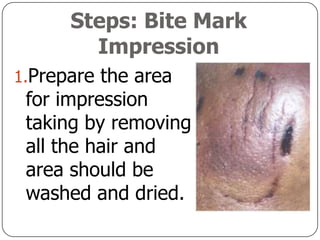
1.Prepare the area
for impression
taking by removing
all the hair and
area should be
washed and dried.
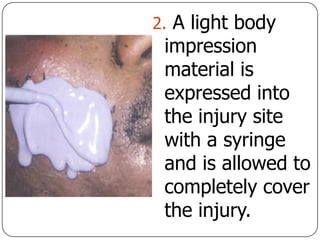
2. A light body
impression
material is
expressed into
the injury site
with a syringe
and is allowed to
completely cover
the injury.
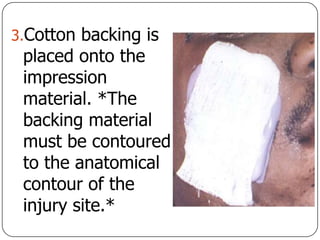
3.Cotton backing is
placed onto the
impression
material. *The
backing material
must be contoured
to the anatomical
contour of the
injury site.*
4. Dental plaster is
placed onto the
cotton packing.
*This
reinforcement will
prevent the
inaccuracies being
developed in the
impressions due to
physical distortion.
๏‚—These impressions are then
used to create dental stone
models.
๏‚—We should make two stone
casts. One is used for analysis
purpose and the second cast is
preserved for presentation in
the court.
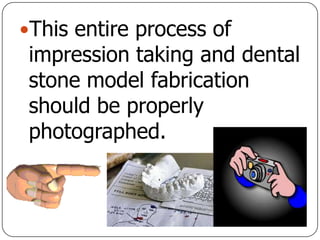
๏‚—This entire process of
impression taking and dental
stone model fabrication
should be properly
photographed.
๏‚—Impressions of the bite mark
are not always practical.
๏‚—If the victim is living,
normally this procedure Is
not performed because the
indentions will disappear by
the time of examination.
๏‚—Furthermore, if thereโ€™s an
extensive amount of
swelling and bleeding in the
injury site, the impression
procedure may not anymore
be practical.

Bite mark impression

  • 1.
  • 2.
    Bite marks orBite Patterns ๏‚—Occurs when teeth actively contact and compress softer material such as human flesh, food material such as cheese or an apple, or other inanimate objects such as Styrofoam cups.
  • 4.
    ๏‚—These bite marks maybe one of the physical and biological evidences left by criminals at the site of criminal act.
  • 5.
    ๏‚—In order tocollect evidence from these bite marks, one of the method used by investigators is to establish a good Bite Mark Impression.
  • 6.
    Bite Mark Impression ๏‚—Playsa very important role in solving the criminal cases. ๏‚—Should be taken only after taking the photographs and swabs of the injury site.
  • 7.
    Bite Mark Impression Taking ๏‚—Variousdental materials have been used (e.g. alginate, silicone) for taking the impressions of the bite marks, but the most commonly used is the Polyvinyl Siloxane.
  • 8.
  • 9.
    ๏‚—The advantage ofPolyvinyl Siloxane is that they can be poured numerous times if there is an error. ๏‚—Alginate can also be used for taking the impressions. However the main drawback in using alginate as an impression material is that they have to be poured with one to two hours to prevent contraction.
  • 10.
    Steps: Bite Mark Impression 1.Preparethe area for impression taking by removing all the hair and area should be washed and dried.
  • 11.
    2. A lightbody impression material is expressed into the injury site with a syringe and is allowed to completely cover the injury.
  • 12.
    3.Cotton backing is placedonto the impression material. *The backing material must be contoured to the anatomical contour of the injury site.*
  • 13.
    4. Dental plasteris placed onto the cotton packing. *This reinforcement will prevent the inaccuracies being developed in the impressions due to physical distortion.
  • 14.
    ๏‚—These impressions arethen used to create dental stone models. ๏‚—We should make two stone casts. One is used for analysis purpose and the second cast is preserved for presentation in the court.
  • 15.
    ๏‚—This entire processof impression taking and dental stone model fabrication should be properly photographed.
  • 16.
    ๏‚—Impressions of thebite mark are not always practical. ๏‚—If the victim is living, normally this procedure Is not performed because the indentions will disappear by the time of examination.
  • 17.
    ๏‚—Furthermore, if thereโ€™san extensive amount of swelling and bleeding in the injury site, the impression procedure may not anymore be practical.