
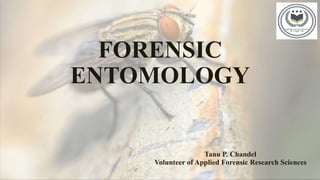
FORENSIC
ENTOMOLOGY
Tanu P. Chandel
Volunteer of Applied Forensic Research Sciences
Contents:
■ Introduction
■ Basic Principle of Insect Biology
■ Life Cycle of the Blow Fly
■ Life Cycle of Flesh Fly
■ Stages Of Decomposition Fueled By Insect Activity
■ Estimation Of Time Since Death
■ Collection and Preservation of Entomological Evidences
■ MCQs
Introduction:-
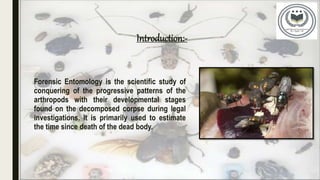
Forensic Entomology is the scientific study of
conquering of the progressive patterns of the
arthropods with their developmental stages
found on the decomposed corpse during legal
investigations. It is primarily used to estimate
the time since death of the dead body.
Basic principle of insect biology:-
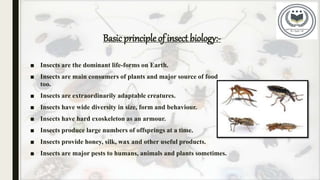
■ Insects are the dominant life-forms on Earth.
■ Insects are main consumers of plants and major source of food
too.
■ Insects are extraordinarily adaptable creatures.
■ Insects have wide diversity in size, form and behaviour.
■ Insects have hard exoskeleton as an armour.
■ Insects produce large numbers of offsprings at a time.
■ Insects provide honey, silk, wax and other useful products.
■ Insects are major pests to humans, animals and plants sometimes.
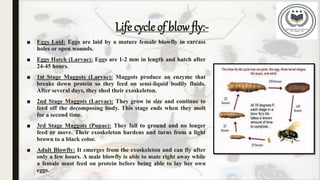
■ Eggs Laid: Eggs are laid by a mature female blowfly in carcass
holes or open wounds.
■ Eggs Hatch (Larvae): Eggs are 1-2 mm in length and hatch after
24-45 hours.
■ 1st Stage Maggots (Larvae): Maggots produce an enzyme that
breaks down protein so they feed on semi-liquid bodily fluids.
After several days, they shed their exoskeleton.
■ 2nd Stage Maggots (Larvae): They grow in size and continue to
feed off the decomposing body. This stage ends when they molt
for a second time.
■ 3rd Stage Maggots (Pupae): They fall to ground and no longer
feed or move. Their exoskeleton hardens and turns from a light
brown to a black color.
■ Adult Blowfly: It emerges from the exoskeleton and can fly after
only a few hours. A male blowfly is able to mate right away while
a female must feed on protein before being able to lay her own
eggs.
Life cycle of blow fly:-
Life cycle of flesh fly:-
■ The lifecycle of a fly begins as an egg.
■ After some time the egg hatches and larva
comes out of it. Larva feeds on the organic
matter and when it has stored sufficient
nutrients it goes into pupal stage.
■ Pupal stage can again be of several days or
months. During the pupal period the
development of the actual fly like features
begin.
■ From the pupa, the adult fly comes out
and is ready to start the cycle again
StAges of decomposition fueled by insect activity:-
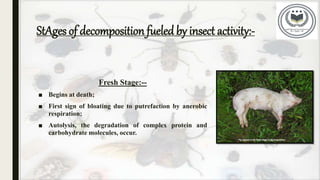
Fresh Stage:--
■ Begins at death;
■ First sign of bloating due to putrefaction by anerobic
respiration;
■ Autolysis, the degradation of complex protein and
carbohydrate molecules, occur.
StAges of decomposition fueled by insect activity:-
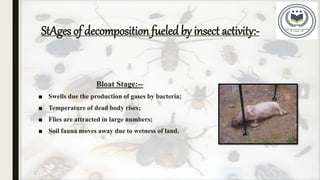
Bloat Stage:--
■ Swells due the production of gases by bacteria;
■ Temperature of dead body rises;
■ Flies are attracted in large numbers;
■ Soil fauna moves away due to wetness of land.
StAges of decomposition fueled by insect activity:-
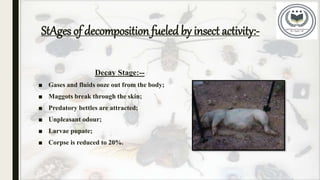
Decay Stage:--
■ Gases and fluids ooze out from the body;
■ Maggots break through the skin;
■ Predatory bettles are attracted;
■ Unpleasant odour;
■ Larvae pupate;
■ Corpse is reduced to 20%.
StAges of decomposition fueled by insect activity:-
Post-Decay Stage:--
■ Corpse get reduced to hair, bones and skin.
StAges of decomposition fueled by insect activity:-
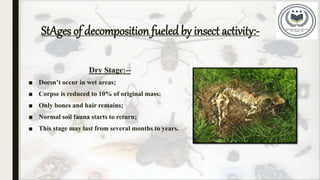
Dry Stage:--
■ Doesn’t occur in wet areas;
■ Corpse is reduced to 10% of original mass;
■ Only bones and hair remains;
■ Normal soil fauna starts to return;
■ This stage may last from several months to years.
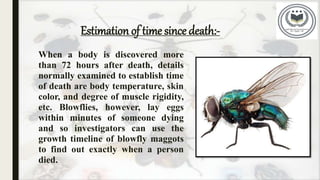
Estimation of time since death:-
When a body is discovered more
than 72 hours after death, details
normally examined to establish time
of death are body temperature, skin
color, and degree of muscle rigidity,
etc. Blowflies, however, lay eggs
within minutes of someone dying
and so investigators can use the
growth timeline of blowfly maggots
to find out exactly when a person
died.
Collection and preservation of entomological evidence:-
■ Camera and video should be fixed to
evidence site.
■ Net or sticky traps are used to catch
fly.
■ Collect insects in live specimen
containers using forceps.
■ Preserve evidences in 98% alcohol.
■ Record details about crime scene.
■ Contamination of evidences must be
avoided by using gloves and hand
towels.
Mcqs
■ What method of forensic entomology is
used to determine time since death
when the corpse has been dead from one
month to a year or more?
A) Accumulated degree hour technique
B) Maggot age and development
C) Successional waves of insects
D) Questioned epistemological
examination
References:-
■ https://www.terminix.com/blog/science-nature/how-are-insects-used-in-forensic-
entomology/
■ https://www.pctonline.com/article/forensic-entomology/
■ https://sites.google.com/site/magicofforensicscience/lesson-4
■ https://bekkabrodie.com/2014/10/29/the-beginning-of-the-end-how-blow-flies-find-
corpses/amp/
■ https://medium.com/@stopwatch740/brief-history-of-stopwatch-227b3071ba82
■ https://entomologytoday.org/2020/04/15/why-forensic-entomologists-say-crime-scene-
investigators-should-carry-cans-tuna/
■ https://en.m.wikipedia.org/wiki/Insect
■ https://sites.google.com/site/magicofforensicscience/lesson-4
■ https://www.nlm.nih.gov/ visibleproofs/galleries/technologies/blowfly.html
Thank you!!!

Forensic Entomology

  • 2.
    FORENSIC ENTOMOLOGY Tanu P. Chandel Volunteerof Applied Forensic Research Sciences
  • 3.
    Contents: ■ Introduction ■ BasicPrinciple of Insect Biology ■ Life Cycle of the Blow Fly ■ Life Cycle of Flesh Fly ■ Stages Of Decomposition Fueled By Insect Activity ■ Estimation Of Time Since Death ■ Collection and Preservation of Entomological Evidences ■ MCQs
  • 4.
    Introduction:- Forensic Entomology isthe scientific study of conquering of the progressive patterns of the arthropods with their developmental stages found on the decomposed corpse during legal investigations. It is primarily used to estimate the time since death of the dead body.
  • 5.
    Basic principle ofinsect biology:- ■ Insects are the dominant life-forms on Earth. ■ Insects are main consumers of plants and major source of food too. ■ Insects are extraordinarily adaptable creatures. ■ Insects have wide diversity in size, form and behaviour. ■ Insects have hard exoskeleton as an armour. ■ Insects produce large numbers of offsprings at a time. ■ Insects provide honey, silk, wax and other useful products. ■ Insects are major pests to humans, animals and plants sometimes.
  • 6.
    ■ Eggs Laid:Eggs are laid by a mature female blowfly in carcass holes or open wounds. ■ Eggs Hatch (Larvae): Eggs are 1-2 mm in length and hatch after 24-45 hours. ■ 1st Stage Maggots (Larvae): Maggots produce an enzyme that breaks down protein so they feed on semi-liquid bodily fluids. After several days, they shed their exoskeleton. ■ 2nd Stage Maggots (Larvae): They grow in size and continue to feed off the decomposing body. This stage ends when they molt for a second time. ■ 3rd Stage Maggots (Pupae): They fall to ground and no longer feed or move. Their exoskeleton hardens and turns from a light brown to a black color. ■ Adult Blowfly: It emerges from the exoskeleton and can fly after only a few hours. A male blowfly is able to mate right away while a female must feed on protein before being able to lay her own eggs. Life cycle of blow fly:-
  • 7.
    Life cycle offlesh fly:- ■ The lifecycle of a fly begins as an egg. ■ After some time the egg hatches and larva comes out of it. Larva feeds on the organic matter and when it has stored sufficient nutrients it goes into pupal stage. ■ Pupal stage can again be of several days or months. During the pupal period the development of the actual fly like features begin. ■ From the pupa, the adult fly comes out and is ready to start the cycle again
  • 8.
    StAges of decompositionfueled by insect activity:- Fresh Stage:-- ■ Begins at death; ■ First sign of bloating due to putrefaction by anerobic respiration; ■ Autolysis, the degradation of complex protein and carbohydrate molecules, occur.
  • 9.
    StAges of decompositionfueled by insect activity:- Bloat Stage:-- ■ Swells due the production of gases by bacteria; ■ Temperature of dead body rises; ■ Flies are attracted in large numbers; ■ Soil fauna moves away due to wetness of land.
  • 10.
    StAges of decompositionfueled by insect activity:- Decay Stage:-- ■ Gases and fluids ooze out from the body; ■ Maggots break through the skin; ■ Predatory bettles are attracted; ■ Unpleasant odour; ■ Larvae pupate; ■ Corpse is reduced to 20%.
  • 11.
    StAges of decompositionfueled by insect activity:- Post-Decay Stage:-- ■ Corpse get reduced to hair, bones and skin.
  • 12.
    StAges of decompositionfueled by insect activity:- Dry Stage:-- ■ Doesn’t occur in wet areas; ■ Corpse is reduced to 10% of original mass; ■ Only bones and hair remains; ■ Normal soil fauna starts to return; ■ This stage may last from several months to years.
  • 13.
    Estimation of timesince death:- When a body is discovered more than 72 hours after death, details normally examined to establish time of death are body temperature, skin color, and degree of muscle rigidity, etc. Blowflies, however, lay eggs within minutes of someone dying and so investigators can use the growth timeline of blowfly maggots to find out exactly when a person died.
  • 14.
    Collection and preservationof entomological evidence:- ■ Camera and video should be fixed to evidence site. ■ Net or sticky traps are used to catch fly. ■ Collect insects in live specimen containers using forceps. ■ Preserve evidences in 98% alcohol. ■ Record details about crime scene. ■ Contamination of evidences must be avoided by using gloves and hand towels.
  • 15.
    Mcqs ■ What methodof forensic entomology is used to determine time since death when the corpse has been dead from one month to a year or more? A) Accumulated degree hour technique B) Maggot age and development C) Successional waves of insects D) Questioned epistemological examination
  • 16.
    References:- ■ https://www.terminix.com/blog/science-nature/how-are-insects-used-in-forensic- entomology/ ■ https://www.pctonline.com/article/forensic-entomology/ ■https://sites.google.com/site/magicofforensicscience/lesson-4 ■ https://bekkabrodie.com/2014/10/29/the-beginning-of-the-end-how-blow-flies-find- corpses/amp/ ■ https://medium.com/@stopwatch740/brief-history-of-stopwatch-227b3071ba82 ■ https://entomologytoday.org/2020/04/15/why-forensic-entomologists-say-crime-scene- investigators-should-carry-cans-tuna/ ■ https://en.m.wikipedia.org/wiki/Insect ■ https://sites.google.com/site/magicofforensicscience/lesson-4 ■ https://www.nlm.nih.gov/ visibleproofs/galleries/technologies/blowfly.html
  • 17.