AUDIO AUTHENTICATION TECHNIQUES
Presented by: Yogesh Pandey
1
AUDIO AUTHENTICATION.. WHAT IT IS?
Simply it means that providing proof to your audio that it is
authentic or it is without any illegal modification and your
audio is not copied somewhere else without your
copyright.
Technically it is a complex process of establishing the
origin of a questioned recording to determine whether it is
consistent with an original one or if there is evidence of
tampering.
2
GOAL OF AUDIO AUTHENTICATION
The goal of audio authentication is to establish if the
questioned recording is :
 Original.
 Continuous.
 Unaltered.
3
TECHNIQUES
 Audio Watermarking.
 File Structure Analysis.
 Waveform Analysis.
 Phase Consistency.
 ENF Comparison.
 Compression Analysis.
 Long-Term Average Spectrum (LTAS).
 DC Offset.
 Butt-Splice Detection.
4
AUDIO WATERMARKING
 Spread spectrum watermarking.
 Least significant bit (LSB) substitution.
 Quantization index modulation (QIM).
 Self-Marking Method (Time-Scale Modification).
5
SPREAD SPECTRUM WATERMARKING
 This scheme is an example of the correlation method
which embeds pseudorandom sequence and detects
watermark by calculating correlation between pseudo-
random noise sequence and watermarked audio signal.
 The main idea is to embed a narrow-band signal (the
watermark) into a wide-band channel (the audio file).
 There are two basic approaches to spread spectrum
techniques: direct sequence and frequency hopping.
 In both of these approaches the idea is to spread the
watermark data across a large frequency band, namely
the entire audible spectrum.
6
LEAST SIGNIFICANT BIT (LSB) SUBSTITUTION
In this, the information is encoded into the least
significant bits of the audio data.
7
QUANTIZATION INDEX MODULATION
 It is a technique which uses quantization of samples to
embed watermark.
 The basic principle of QIM is to find the maximum value
of the samples and to divide the range 0 to the
maximum value into intervals of step size Δ.
 The intervals are assigned a value of 0 or 1 depending
on any pseudo random sequence.
 Each sample has quantized value, thus, a polarity is
assigned based on the location of the interval.
 The watermark is embedded by changing the value of
the median for created interval and by the similarity of
the polarity and watermark bit.
8
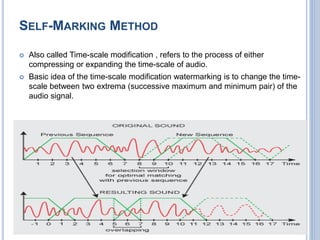
SELF-MARKING METHOD
 Also called Time-scale modification , refers to the process of either
compressing or expanding the time-scale of audio.
 Basic idea of the time-scale modification watermarking is to change the time-
scale between two extrema (successive maximum and minimum pair) of the
audio signal.
9
FILE STRUCTURE ANALYSIS
Format Analysis
Header Analysis
Hexadecimal Analysis
10
FORMAT ANALYSIS
 File format analysis consists of previewing the file
to look at the sampling rate, quantization (bit
depth), bit rate, number of channels, etc.
 The goal is to ensure these are consistent with the
file type, extension, codec, and capabilities of the
device claimed to have made the original recording.
11
HEADER ANALYSIS
 Header analysis is done in a hexadecimal viewer or
editor.
 Using a hexadecimal reader, we can see if the file
format matches the file name extension (such as
RIFF 32 or hex 52 49 46 46 indicating WAV, hex 49
44 33 indicating MP3, hex 30 26 B2 indicating
WMA, etc.).
12
HEXADECIMAL ANALYSIS
 The raw digital data of the file may contain useful
information that can be examined in a hexadecimal
reader with an ASCII character viewer.
13
WAVEFORM ANALYSIS
 It can be performed in any standard DAW(Digital Audio
Workstation) or editor program.
 Waveform analysis is primarily used to inspect possible
edits and discontinuities.
 A waveform with a drastic change in amplitude that is not
typical of sounds that occur in Nature may be an
indication of an edit.
14
PHASE CONSISTENCY
 Audio phase is the pattern of peaks in a sinusoidal waveform,
which can be viewed on an oscilloscope.
 The phase of a wave is a measure of the relative locations of
the peaks and valleys in the wave.
 As long as the peaks and valleys follow each other by the
exact same amount, the phase is said to be continuous.
 If at some point the wave pattern shifts abruptly one way or
the other, then a phase discontinuity is occurred at that point.
 Phase consistency can also be viewed by using a computer
generated sine wave, aligning it to a sinusoidal waveform
(tone) present in the questioned recording, and using visual or
automatic methods to compare their differences.
15
ENF COMPARISON
 Electric Network Frequency (ENF) is a
characteristic of alternating current (AC).
 If ENF is captured in a digital audio recording, the
signal can be extracted and the fluctuations
compared to an ENF database as part of an
authentication analysis.
16
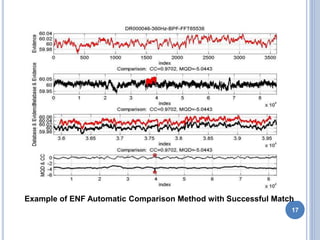
Example of ENF Automatic Comparison Method with Successful Match
17
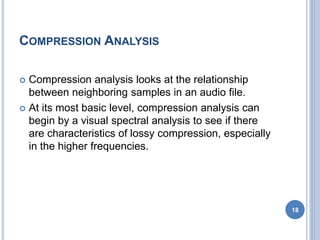
COMPRESSION ANALYSIS
 Compression analysis looks at the relationship
between neighboring samples in an audio file.
 At its most basic level, compression analysis can
begin by a visual spectral analysis to see if there
are characteristics of lossy compression, especially
in the higher frequencies.
18
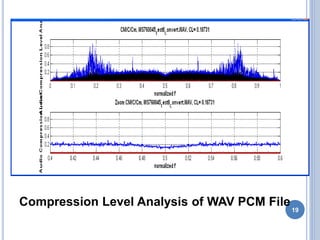
Compression Level Analysis of WAV PCM File
19
LONG-TERM AVERAGE SPECTRUM
 A signal’s long-term average spectrum (LTAS) can
reveal information about the environment,
characteristics of the recording equipment and
transmission channel, other signals picked up by
the transmission channel and/or the recording
equipment, possible traces of filtering, down
sampling, or lossy (re)compression.
 To obtain LTAS, the signal is divided into short time
windows, then frame functions are applied, FFT
and power spectral density are computed on each
resulting frame, and the results for each frame are
averaged. 20
CONTD..
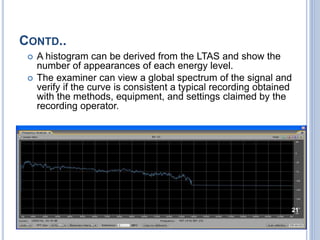
 A histogram can be derived from the LTAS and show the
number of appearances of each energy level.
 The examiner can view a global spectrum of the signal and
verify if the curve is consistent a typical recording obtained
with the methods, equipment, and settings claimed by the
recording operator.
21
DC OFFSET
 DC Offset analysis can indicate forgeries where
regions were copied and pasted from separate
recordings, because it is unlikely that the gain for
both recordings was identical.
 It can also reveal changes in amplification within a
single recording.
22
BUTT-SPLICE DETECTION
 Butt-splice detection functions can be run over the
entire signal (if uncompressed) to show the rate of
change of one value in relation to the previous.
 By calculating the differences between consecutive
values in a vector, algorithms detect butt-splice
edits where the shift to a high level transient is very
rapid in relation to the quantization levels of
surrounding samples.
23
CONTD..
 Since samples generated from naturally occurring
acoustic events do not exhibit such a fast transition
compared to buttsplices, inconsistencies can be
located automatically even in long signals
containing millions of samples.
 This method is effective for showing buttsplice
edits, but not smooth edits that were done at zero
crossings, or with cross fades.
 Therefore, it must be combined with other analysis
tools to determine if the recording is likely free of
edits.
24
25
THANK YOU
26

Audio authentication techniques

  • 1.
  • 2.
    AUDIO AUTHENTICATION.. WHATIT IS? Simply it means that providing proof to your audio that it is authentic or it is without any illegal modification and your audio is not copied somewhere else without your copyright. Technically it is a complex process of establishing the origin of a questioned recording to determine whether it is consistent with an original one or if there is evidence of tampering. 2
  • 3.
    GOAL OF AUDIOAUTHENTICATION The goal of audio authentication is to establish if the questioned recording is :  Original.  Continuous.  Unaltered. 3
  • 4.
    TECHNIQUES  Audio Watermarking. File Structure Analysis.  Waveform Analysis.  Phase Consistency.  ENF Comparison.  Compression Analysis.  Long-Term Average Spectrum (LTAS).  DC Offset.  Butt-Splice Detection. 4
  • 5.
    AUDIO WATERMARKING  Spreadspectrum watermarking.  Least significant bit (LSB) substitution.  Quantization index modulation (QIM).  Self-Marking Method (Time-Scale Modification). 5
  • 6.
    SPREAD SPECTRUM WATERMARKING This scheme is an example of the correlation method which embeds pseudorandom sequence and detects watermark by calculating correlation between pseudo- random noise sequence and watermarked audio signal.  The main idea is to embed a narrow-band signal (the watermark) into a wide-band channel (the audio file).  There are two basic approaches to spread spectrum techniques: direct sequence and frequency hopping.  In both of these approaches the idea is to spread the watermark data across a large frequency band, namely the entire audible spectrum. 6
  • 7.
    LEAST SIGNIFICANT BIT(LSB) SUBSTITUTION In this, the information is encoded into the least significant bits of the audio data. 7
  • 8.
    QUANTIZATION INDEX MODULATION It is a technique which uses quantization of samples to embed watermark.  The basic principle of QIM is to find the maximum value of the samples and to divide the range 0 to the maximum value into intervals of step size Δ.  The intervals are assigned a value of 0 or 1 depending on any pseudo random sequence.  Each sample has quantized value, thus, a polarity is assigned based on the location of the interval.  The watermark is embedded by changing the value of the median for created interval and by the similarity of the polarity and watermark bit. 8
  • 9.
    SELF-MARKING METHOD  Alsocalled Time-scale modification , refers to the process of either compressing or expanding the time-scale of audio.  Basic idea of the time-scale modification watermarking is to change the time- scale between two extrema (successive maximum and minimum pair) of the audio signal. 9
  • 10.
    FILE STRUCTURE ANALYSIS FormatAnalysis Header Analysis Hexadecimal Analysis 10
  • 11.
    FORMAT ANALYSIS  Fileformat analysis consists of previewing the file to look at the sampling rate, quantization (bit depth), bit rate, number of channels, etc.  The goal is to ensure these are consistent with the file type, extension, codec, and capabilities of the device claimed to have made the original recording. 11
  • 12.
    HEADER ANALYSIS  Headeranalysis is done in a hexadecimal viewer or editor.  Using a hexadecimal reader, we can see if the file format matches the file name extension (such as RIFF 32 or hex 52 49 46 46 indicating WAV, hex 49 44 33 indicating MP3, hex 30 26 B2 indicating WMA, etc.). 12
  • 13.
    HEXADECIMAL ANALYSIS  Theraw digital data of the file may contain useful information that can be examined in a hexadecimal reader with an ASCII character viewer. 13
  • 14.
    WAVEFORM ANALYSIS  Itcan be performed in any standard DAW(Digital Audio Workstation) or editor program.  Waveform analysis is primarily used to inspect possible edits and discontinuities.  A waveform with a drastic change in amplitude that is not typical of sounds that occur in Nature may be an indication of an edit. 14
  • 15.
    PHASE CONSISTENCY  Audiophase is the pattern of peaks in a sinusoidal waveform, which can be viewed on an oscilloscope.  The phase of a wave is a measure of the relative locations of the peaks and valleys in the wave.  As long as the peaks and valleys follow each other by the exact same amount, the phase is said to be continuous.  If at some point the wave pattern shifts abruptly one way or the other, then a phase discontinuity is occurred at that point.  Phase consistency can also be viewed by using a computer generated sine wave, aligning it to a sinusoidal waveform (tone) present in the questioned recording, and using visual or automatic methods to compare their differences. 15
  • 16.
    ENF COMPARISON  ElectricNetwork Frequency (ENF) is a characteristic of alternating current (AC).  If ENF is captured in a digital audio recording, the signal can be extracted and the fluctuations compared to an ENF database as part of an authentication analysis. 16
  • 17.
    Example of ENFAutomatic Comparison Method with Successful Match 17
  • 18.
    COMPRESSION ANALYSIS  Compressionanalysis looks at the relationship between neighboring samples in an audio file.  At its most basic level, compression analysis can begin by a visual spectral analysis to see if there are characteristics of lossy compression, especially in the higher frequencies. 18
  • 19.
    Compression Level Analysisof WAV PCM File 19
  • 20.
    LONG-TERM AVERAGE SPECTRUM A signal’s long-term average spectrum (LTAS) can reveal information about the environment, characteristics of the recording equipment and transmission channel, other signals picked up by the transmission channel and/or the recording equipment, possible traces of filtering, down sampling, or lossy (re)compression.  To obtain LTAS, the signal is divided into short time windows, then frame functions are applied, FFT and power spectral density are computed on each resulting frame, and the results for each frame are averaged. 20
  • 21.
    CONTD..  A histogramcan be derived from the LTAS and show the number of appearances of each energy level.  The examiner can view a global spectrum of the signal and verify if the curve is consistent a typical recording obtained with the methods, equipment, and settings claimed by the recording operator. 21
  • 22.
    DC OFFSET  DCOffset analysis can indicate forgeries where regions were copied and pasted from separate recordings, because it is unlikely that the gain for both recordings was identical.  It can also reveal changes in amplification within a single recording. 22
  • 23.
    BUTT-SPLICE DETECTION  Butt-splicedetection functions can be run over the entire signal (if uncompressed) to show the rate of change of one value in relation to the previous.  By calculating the differences between consecutive values in a vector, algorithms detect butt-splice edits where the shift to a high level transient is very rapid in relation to the quantization levels of surrounding samples. 23
  • 24.
    CONTD..  Since samplesgenerated from naturally occurring acoustic events do not exhibit such a fast transition compared to buttsplices, inconsistencies can be located automatically even in long signals containing millions of samples.  This method is effective for showing buttsplice edits, but not smooth edits that were done at zero crossings, or with cross fades.  Therefore, it must be combined with other analysis tools to determine if the recording is likely free of edits. 24
  • 25.
  • 26.