

Overview of Methods
Quantitative Techniques Moving Average Trend Analysis Exponential Smoothing ARIMA models Econometric models
Moving Average A simple average of the previous X months/years A six-month moving average forecast is an average of the previous six months
“I always avoid prophesying beforehand because it much better to prophesy after the event has already taken place.” Winston Churchill
Moving Average – When To Use Extremely “noisy” or little data Time constraint Degree of accuracy not important
Moving Average - Advantages Extremely simple Easy to implement
Moving Average - Disadvantages Not accurate; slow adjustment to changes in data Misses turning points All history is created equal
Moving Average Example
Trend Regression A straight ( or curved) line drawn through historical data “taking a ruler through your data”
“The best qualification of a prophet is to have a good memory.” Marquis of Halifax
Trend Regression – When To Use Steady rise or decline in data Time or software constraint Need easy explanation Little data
Trend Regression - Advantages Very simple Can be done in Excel
Trend Regression – Disadvantages Assumes future is exactly like past (prices, economy, etc.) All history is created equal One bad data point can greatly affect forecast
Trend Regression Example
Exponential Smoothing Simple Double (Brown) or Holt Winters
“A good forecaster is not smarter than everyone else, he merely has his ignorance better organized.” C. W. J. Granger
Simple Exponential Smoothing Weighted average of past values with exponentially decreasing weights Forecast this month equals last month’s forecast plus a proportion of the forecast error last month
Simple Exponential Smoothing – When To Use Stationary data with no trend or seasonality
Double (Brown) or Holt Exponential Smoothing Smooth the smoothed data with a weighted average of past values with exponentially decreasing weights Changes linearly with time (like linear regression) with recent data given more weight
Double (Brown) or Holt Exponential Smoothing – When to Use Data with a trend but no seasonality
Winter’s Exponential Smoothing Deseasonalize data, then find trend, then smooth
Winter’s Exponential Smoothing – When to Use Data with trend and seasonality
Exponential Smoothing Advantages Somewhat simple Recent data given more weight Fairly good accuracy for short-term forecasts Software can automate process
Exponential Smoothing - Disadvantages Requires forecasting software Bad data in recent month can cause great error in forecast Less accurate for medium to long-term forecasts Assumes history is like (recent) history
Exponential Smoothing Example
ARIMA (Box-Jenkins) Models A uto R egressive  I ntegrative  M oving  A verage Autoregressive  – future values depend on previous values of the data Moving average  – future values depend on previous values of the errors Integrated  – refers to differencing the data
“An unsophisticated forecaster uses statistics as a drunken man uses lamp-posts – for support rather than illumination” - after Andrew Lang
ARIMA (Box-Jenkins) Models – When to Use Stable data that has regular correlations
ARIMA ( Box-Jenkins) Models - Advantages Outperforms exponential smoothing on homogenous and stable data Software can automate Sounds impressive
ARIMA (Box-Jenkins) Models - Disadvantages Requires software Needs a minimum of 40 data points Complicated to understand
ARIMA (Box-Jenkins) Models Example
Econometric Models Relates data series to explanatory variables Economists build demand models which relate Price, competition, income, population, etc.
“An economist is an expert who will know tomorrow why the things he predicted yesterday didn’t happen today.” Evan Esar
Econometric Models – When to Use Important to understand market Influences on product demand are changing Historically more acceptable in regulation
Econometric Models - Advantages Can give price elasticity Formally integrates economic impact Permits varied assumptions, i.e., “what if?” Forces you to make assumptions explicit Methods to deal with short time
Econometric Models - Disadvantages Large data gathering Expertise to build Requires forecasts of explanatory variables Not always best forecasting technique
Econometric Models Example
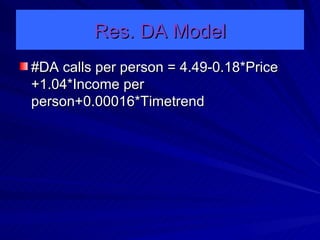
Res. DA Model #DA calls per person = 4.49-0.18*Price +1.04*Income per person+0.00016*Timetrend
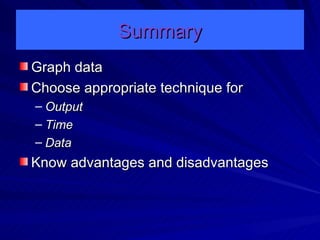
Summary Graph data Choose appropriate technique for Output Time Data Know advantages and disadvantages

Forecasting6

  • 1.
  • 2.
    Quantitative Techniques MovingAverage Trend Analysis Exponential Smoothing ARIMA models Econometric models
  • 3.
    Moving Average Asimple average of the previous X months/years A six-month moving average forecast is an average of the previous six months
  • 4.
    “I always avoidprophesying beforehand because it much better to prophesy after the event has already taken place.” Winston Churchill
  • 5.
    Moving Average –When To Use Extremely “noisy” or little data Time constraint Degree of accuracy not important
  • 6.
    Moving Average -Advantages Extremely simple Easy to implement
  • 7.
    Moving Average -Disadvantages Not accurate; slow adjustment to changes in data Misses turning points All history is created equal
  • 8.
  • 9.
    Trend Regression Astraight ( or curved) line drawn through historical data “taking a ruler through your data”
  • 10.
    “The best qualificationof a prophet is to have a good memory.” Marquis of Halifax
  • 11.
    Trend Regression –When To Use Steady rise or decline in data Time or software constraint Need easy explanation Little data
  • 12.
    Trend Regression -Advantages Very simple Can be done in Excel
  • 13.
    Trend Regression –Disadvantages Assumes future is exactly like past (prices, economy, etc.) All history is created equal One bad data point can greatly affect forecast
  • 14.
  • 15.
    Exponential Smoothing SimpleDouble (Brown) or Holt Winters
  • 16.
    “A good forecasteris not smarter than everyone else, he merely has his ignorance better organized.” C. W. J. Granger
  • 17.
    Simple Exponential SmoothingWeighted average of past values with exponentially decreasing weights Forecast this month equals last month’s forecast plus a proportion of the forecast error last month
  • 18.
    Simple Exponential Smoothing– When To Use Stationary data with no trend or seasonality
  • 19.
    Double (Brown) orHolt Exponential Smoothing Smooth the smoothed data with a weighted average of past values with exponentially decreasing weights Changes linearly with time (like linear regression) with recent data given more weight
  • 20.
    Double (Brown) orHolt Exponential Smoothing – When to Use Data with a trend but no seasonality
  • 21.
    Winter’s Exponential SmoothingDeseasonalize data, then find trend, then smooth
  • 22.
    Winter’s Exponential Smoothing– When to Use Data with trend and seasonality
  • 23.
    Exponential Smoothing AdvantagesSomewhat simple Recent data given more weight Fairly good accuracy for short-term forecasts Software can automate process
  • 24.
    Exponential Smoothing -Disadvantages Requires forecasting software Bad data in recent month can cause great error in forecast Less accurate for medium to long-term forecasts Assumes history is like (recent) history
  • 25.
  • 26.
    ARIMA (Box-Jenkins) ModelsA uto R egressive I ntegrative M oving A verage Autoregressive – future values depend on previous values of the data Moving average – future values depend on previous values of the errors Integrated – refers to differencing the data
  • 27.
    “An unsophisticated forecasteruses statistics as a drunken man uses lamp-posts – for support rather than illumination” - after Andrew Lang
  • 28.
    ARIMA (Box-Jenkins) Models– When to Use Stable data that has regular correlations
  • 29.
    ARIMA ( Box-Jenkins)Models - Advantages Outperforms exponential smoothing on homogenous and stable data Software can automate Sounds impressive
  • 30.
    ARIMA (Box-Jenkins) Models- Disadvantages Requires software Needs a minimum of 40 data points Complicated to understand
  • 31.
  • 32.
    Econometric Models Relatesdata series to explanatory variables Economists build demand models which relate Price, competition, income, population, etc.
  • 33.
    “An economist isan expert who will know tomorrow why the things he predicted yesterday didn’t happen today.” Evan Esar
  • 34.
    Econometric Models –When to Use Important to understand market Influences on product demand are changing Historically more acceptable in regulation
  • 35.
    Econometric Models -Advantages Can give price elasticity Formally integrates economic impact Permits varied assumptions, i.e., “what if?” Forces you to make assumptions explicit Methods to deal with short time
  • 36.
    Econometric Models -Disadvantages Large data gathering Expertise to build Requires forecasts of explanatory variables Not always best forecasting technique
  • 37.
  • 38.
    Res. DA Model#DA calls per person = 4.49-0.18*Price +1.04*Income per person+0.00016*Timetrend
  • 39.
    Summary Graph dataChoose appropriate technique for Output Time Data Know advantages and disadvantages