What is calculus?
• Calculus originally meant “mathematics”.
• Derived from the Latin “calx” (counter) –
ancient Babylonians would use pebbles to
represent units, tens, hundreds, etc..
• Later, defined as measuring varying rates of
change.
Calculus is everywhere
The differentiation and integration methods of calculus have many
real-world applications from sports to engineering to astronomy
and space travel.
Yes! Even in
Pizza!
Calculus in the engineering field
 Calculus initially developed for better navigation system.
 Engineers use calculus for building skyscrapers , bridges.
 In robotics calculus is used how robotic parts will work
on given command.
 Electrical and Computer engineers use calculus for
system design.
 Calculus is used to improve safety of vehicles.
Calculus in Biology
 To study the interaction of different
species within an ecosystem calculus
is used.
 The concentration of drugs in a living
organism can be answered with calculus.
 Physical attributes, such as backbone length
and skull length measured by calculus.
 Calculus is used for measuring growth rate
of bacteria and certain species.
Calculus in Science
• Isaac Newton developed the use of calculus
in his laws of motion and gravitation.
• Astronomical science deeply depend on calculus.
• Space technology use calculus in many ways.
• Calculus is used to build tracks.
Calculus in other fields
• Business and politicians often conduct surveys
with the help of calculus.
• Investment plans do not pass before mathematicians
approves.
• Doctors often use calculus in the estimation of the
progression of the illness.
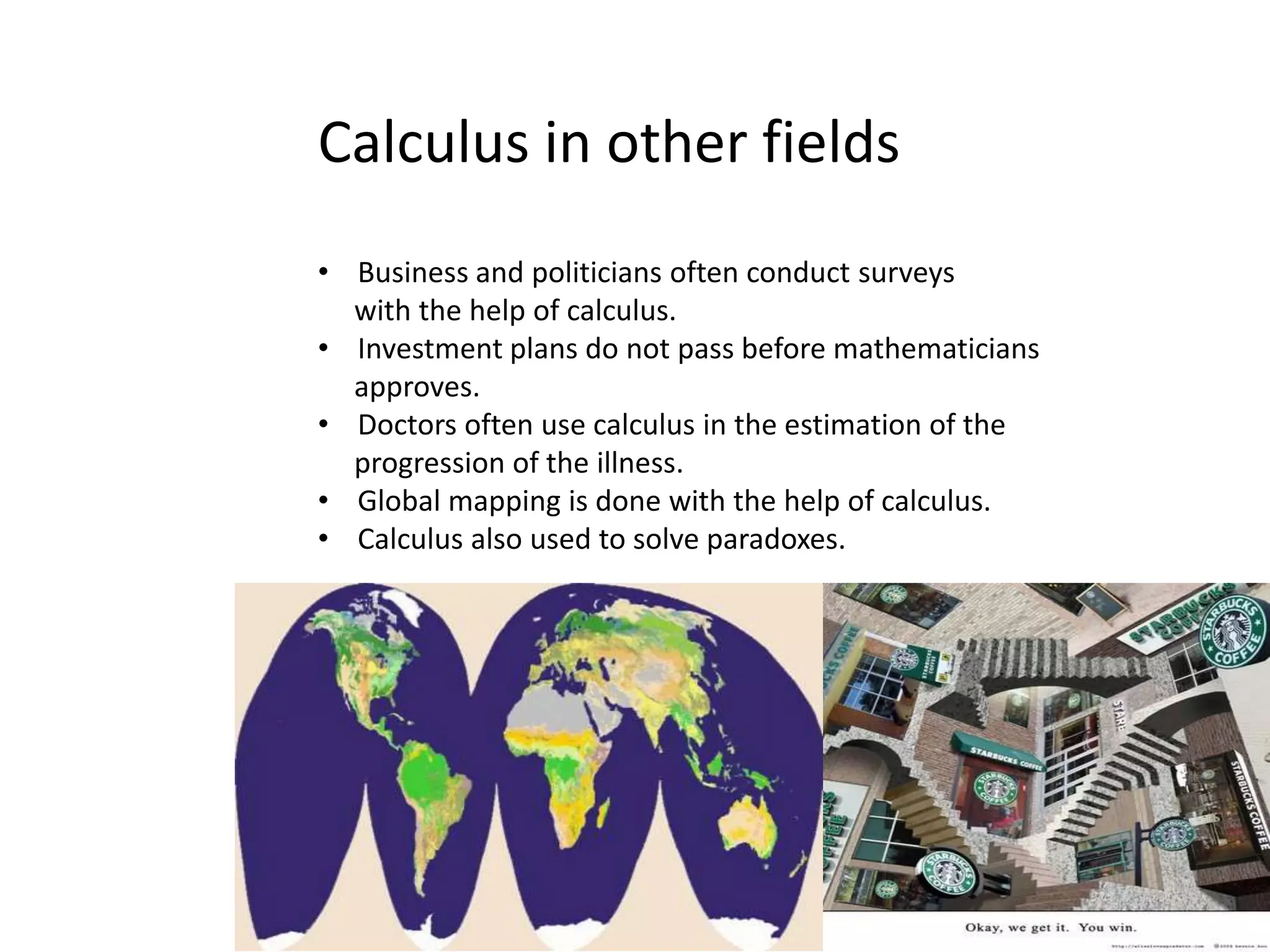
• Global mapping is done with the help of calculus.
• Calculus also used to solve paradoxes.
An example of the use of calculus in real life is the following.
2. Write the formula that relates the
variables in the problem: x, y, and s.
3. Differentiate with respect to t.
4. Use the Pythagorean Theorem again
to solve for s.
1.List all given rates and the unkown
rate.
5. Substitute into the differentiation
result and solve for ds/dt.
References
i. www.Wikipedia.org
ii. www.ehow.com
iii. Answers.yahoo.com
iv. www.youtube.com
v. www.enotes.com
vi. www.studymode.com
Thanks!
Jad Daccache
Daniel Khazaal

Calculus in real life

  • 1.
    What is calculus? •Calculus originally meant “mathematics”. • Derived from the Latin “calx” (counter) – ancient Babylonians would use pebbles to represent units, tens, hundreds, etc.. • Later, defined as measuring varying rates of change.
  • 2.
    Calculus is everywhere Thedifferentiation and integration methods of calculus have many real-world applications from sports to engineering to astronomy and space travel. Yes! Even in Pizza!
  • 3.
    Calculus in theengineering field  Calculus initially developed for better navigation system.  Engineers use calculus for building skyscrapers , bridges.  In robotics calculus is used how robotic parts will work on given command.  Electrical and Computer engineers use calculus for system design.  Calculus is used to improve safety of vehicles.
  • 4.
    Calculus in Biology To study the interaction of different species within an ecosystem calculus is used.  The concentration of drugs in a living organism can be answered with calculus.  Physical attributes, such as backbone length and skull length measured by calculus.  Calculus is used for measuring growth rate of bacteria and certain species.
  • 5.
    Calculus in Science •Isaac Newton developed the use of calculus in his laws of motion and gravitation. • Astronomical science deeply depend on calculus. • Space technology use calculus in many ways. • Calculus is used to build tracks.
  • 6.
    Calculus in otherfields • Business and politicians often conduct surveys with the help of calculus. • Investment plans do not pass before mathematicians approves. • Doctors often use calculus in the estimation of the progression of the illness. • Global mapping is done with the help of calculus. • Calculus also used to solve paradoxes.
  • 7.
    An example ofthe use of calculus in real life is the following. 2. Write the formula that relates the variables in the problem: x, y, and s. 3. Differentiate with respect to t. 4. Use the Pythagorean Theorem again to solve for s. 1.List all given rates and the unkown rate. 5. Substitute into the differentiation result and solve for ds/dt.
  • 8.
    References i. www.Wikipedia.org ii. www.ehow.com iii.Answers.yahoo.com iv. www.youtube.com v. www.enotes.com vi. www.studymode.com
  • 9.