CAPACITY
Requirements
September 2017
Planning
At the end of the
session,
all participants should
be able to plan for the
capacity of their own
area, line, and plant.
SESSION
OBJECTIVE
Dr. Eliyahu M. Goldratt
He was an internationally recognized leader in the development
of new business management philosophies and systems.
He created and developed the Theory of Constraints (TOC), an
overall framework for helping organizations and individuals to
determine:
• What to change - find and use the leverage point
• What to change to - create the simple, practical solutions
• How to cause the change - build a secure and stable
improvement environment.
Dr. F. Robert Jacobs
He is a Professor Emeritus of Operation and Decision
Technologies, Kelly School of Business, Indiana University. He is
the author of three textbooks for McGraw-Hill including
Operations and Supply Chain Management, Operations and
Supply Management-The Core, and Manufacturing Planning
and Control for Supply Chain Management.
Dr. Richard B. ChaseHe is a Professor Emeritus of Operations Management Marshall
School of Business, University of Southern California. He
specializes in service operations management which involves
applying concepts from OM, organizational theory, and services
marketing to the design of service processes.
Dr. R. Dan ReidHe is an Emeritus Associate Professor of Operations Management
who specializes in Production/operations management,
purchasing, business logistics, supply chain management.
Dr. Nada SandersShe is an internationally recognized expert in forecasting,
predictive analytics, risk management, and supply chain
management.
Maximum output produced in a given period
with the available resources
What happens if capacity is less than demand
placed on resource
What happens when capacity is greater than
demand placed on resource
Capacity
Bottleneck
Non-bottleneck
Utilization
Extent or level to which the productive capacity
of a plant or firm is being used in generation of
goods and services
CAPACITY PLANNING- the process of establishing the output
rate that can be achieved at a facility
 Capacity is usually purchased in “chunks”
 Strategic issues: how much and when to
spend capital for additional facility &
equipment
 Tactical issues: workforce & inventory
levels, & day-to-day use of equipment
CAPACITY PLANNING
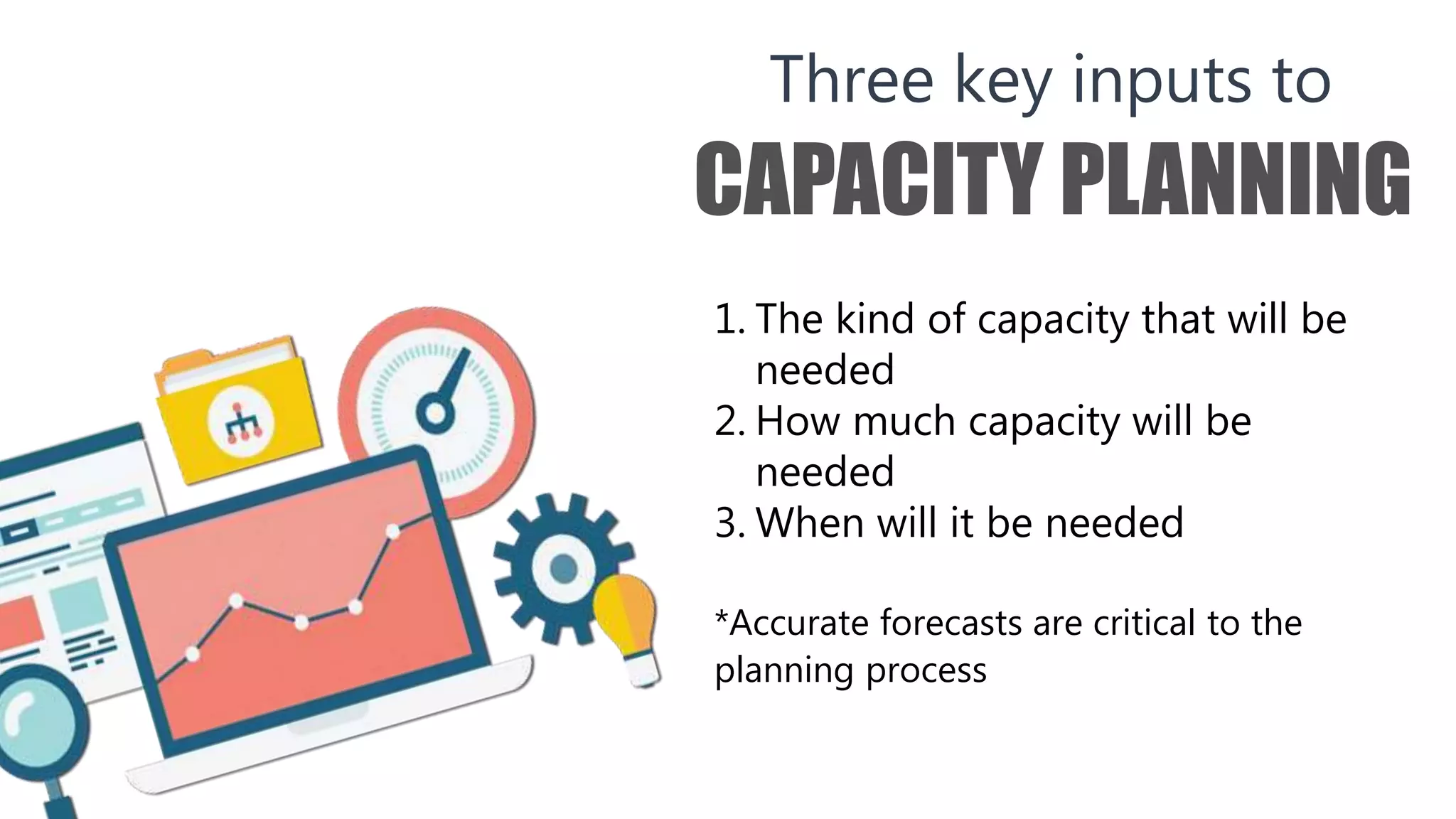
Three key inputs to
1. The kind of capacity that will be
needed
2. How much capacity will be
needed
3. When will it be needed
*Accurate forecasts are critical to the
planning process
COMMON STRATEGIES
Managers should
recognize the
broader effects
capacity decisions
have on the entire
organization.
Leading
Capacity
When capacity is
increased to meet
expected demand
Following
Capacity
When companies
wait for demand
increases before
expanding
capabilities
Tracking
Capacity
When adding
incremental capacity
over time to meet
demand
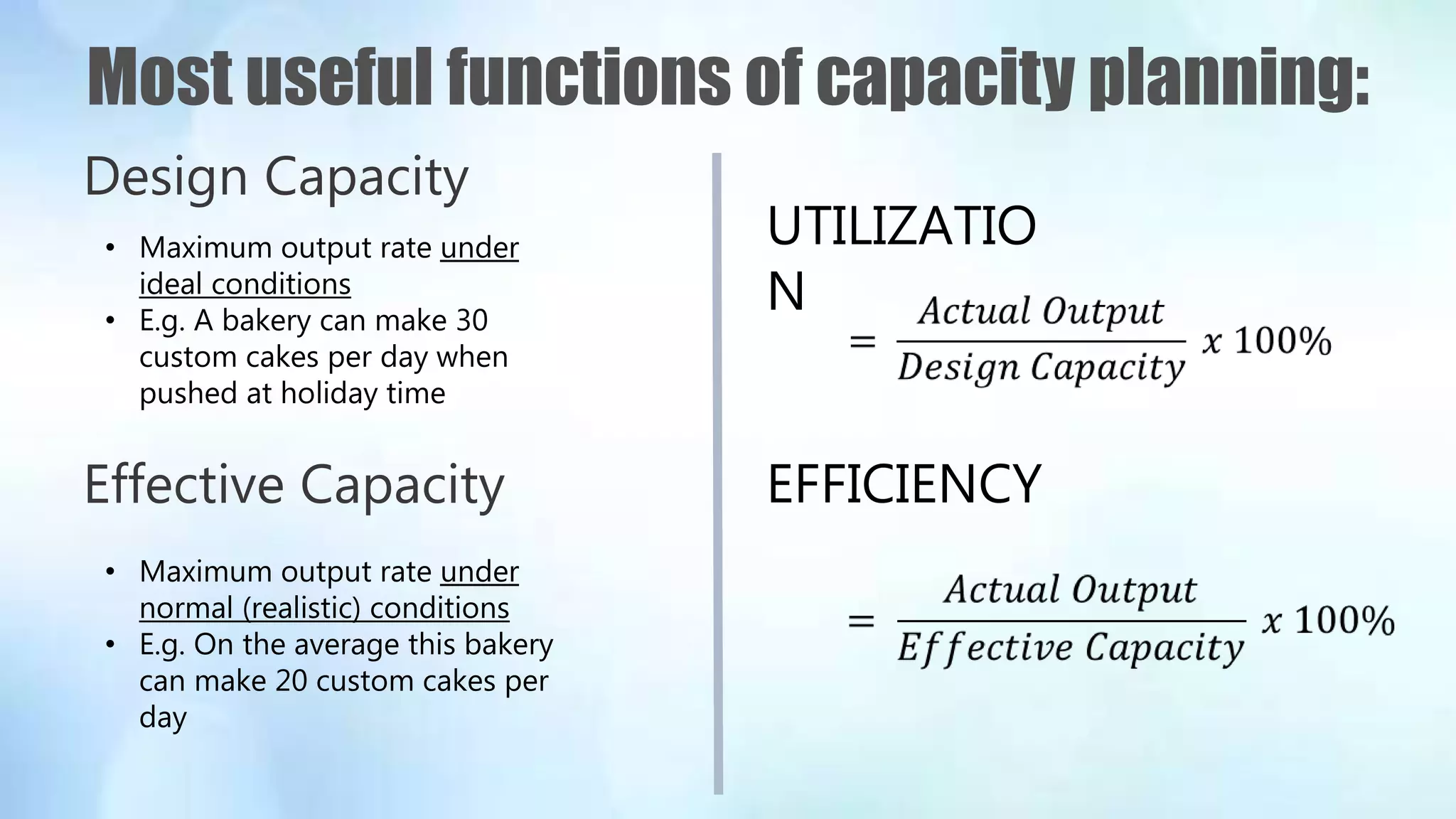
Most useful functions of capacity planning:
Design Capacity
Effective Capacity
• Maximum output rate under
ideal conditions
• E.g. A bakery can make 30
custom cakes per day when
pushed at holiday time
• Maximum output rate under
normal (realistic) conditions
• E.g. On the average this bakery
can make 20 custom cakes per
day
EFFICIENCY
UTILIZATIO
N
MEASURING CAPACITY
When dealing with more than one
product, it is best to measure capacity
in terms of each product.
Another method of
measuring capacity is by referring to
the availability of inputs.
DETERMINANTS OF EFFECTIVE CAPACITY
Facilities
Product and
Service Factors
Process Factors
Size and provision for expansion,
locational factors, and layout of work
area
The more uniform the output, the more
opportunities there are for standardization of
methods and materials.
Quality capability, output quality, and time it takes
to change over equipment settings for different
products or services
DETERMINANTS OF EFFECTIVE CAPACITY
Human Factors
Policy Factors
Operational
Factors
The tasks that are needed in certain jobs, the array
of activities involved and the training, skill, and
experience required to perform a job
Management policy can affect capacity by
allowing or not allowing capacity options
Scheduling problems, inventory stocking
decisions, late deliveries, purchasing requirements,
acceptability of purchased materials and parts, and
quality inspection and control procedures
DETERMINANTS OF EFFECTIVE CAPACITY
Supply Chain
Factors
External Factors
Inadequate
Planning
Changes on suppliers, warehousing,
transportation, and distributors
Minimum quality and performance standards
• The rate at which
money is
generated by the
system through
sales
Throughput
• All the money that
the system has
invested in
purchasing things
it intends to sell
Inventory
• All the money that
the system spends
to turn inventory
into throughput
Operating
Expense
Do not balance capacity, balance the flow.
The level utilization of a non-bottleneck
resource is not determined by its own
potential but by some other constraint in
the system.
Utilization and activation of a resource are
not the same.
GOLDRATT’S RULES OF
PRODUCTION SCHEDULE
An hour lost at a bottleneck is an hour lost
for the entire system.
An hour saved at a non-bottleneck is a
mirage.
Bottlenecks govern both throughput and
inventory in the system.
GOLDRATT’S RULES OF
PRODUCTION SCHEDULE
Transfer batch may not, and many times
should not be equal to the process batch.
A process batch should be variable, not fixed.
Priorities can be set only by examining the
system’s constraints, and lead time is a
derivative of the schedule.
GOLDRATT’S RULES OF
PRODUCTION SCHEDULE
EXERCISE:
1. Identify your constraint.
2. What is your design capacity?
3. What is your effective capacity? (based on your priority list/current
inventory)
Take into consideration all variables that may affect capacity.
GOLDRATT’S
THEORY OF
CONSTRAINTS
Identify the
constraint
Utilize the
constraint
Subordinate
everything
else to the
constraint
Elevate the
constraint
Repeat the
process
DRUM BUFFER ROPE- pace of the
bottleneck
- allotment of
materials or time
- demand
signal to pull
new material
into the system
END.
REFERENCES:
• Operations and Supply Chain Management by Chase, Shankar & Jacobs
• Theory of Constraints by Eliyahu Goldratt
• Capacity Planning & Facility Location by R. Dan Reid & Nada R. Sanders
• Ch. 5 Strategic Capacity Planning for Products and Services by Saylor.org
Academy (retrieved from https://learn.saylor.org/mod/page/view.php?id=9282
on August 31, 2017)

Capacity Planning

  • 1.
  • 2.
    At the endof the session, all participants should be able to plan for the capacity of their own area, line, and plant. SESSION OBJECTIVE
  • 3.
    Dr. Eliyahu M.Goldratt He was an internationally recognized leader in the development of new business management philosophies and systems. He created and developed the Theory of Constraints (TOC), an overall framework for helping organizations and individuals to determine: • What to change - find and use the leverage point • What to change to - create the simple, practical solutions • How to cause the change - build a secure and stable improvement environment.
  • 4.
    Dr. F. RobertJacobs He is a Professor Emeritus of Operation and Decision Technologies, Kelly School of Business, Indiana University. He is the author of three textbooks for McGraw-Hill including Operations and Supply Chain Management, Operations and Supply Management-The Core, and Manufacturing Planning and Control for Supply Chain Management. Dr. Richard B. ChaseHe is a Professor Emeritus of Operations Management Marshall School of Business, University of Southern California. He specializes in service operations management which involves applying concepts from OM, organizational theory, and services marketing to the design of service processes.
  • 5.
    Dr. R. DanReidHe is an Emeritus Associate Professor of Operations Management who specializes in Production/operations management, purchasing, business logistics, supply chain management. Dr. Nada SandersShe is an internationally recognized expert in forecasting, predictive analytics, risk management, and supply chain management.
  • 6.
    Maximum output producedin a given period with the available resources What happens if capacity is less than demand placed on resource What happens when capacity is greater than demand placed on resource Capacity Bottleneck Non-bottleneck Utilization Extent or level to which the productive capacity of a plant or firm is being used in generation of goods and services
  • 7.
    CAPACITY PLANNING- theprocess of establishing the output rate that can be achieved at a facility  Capacity is usually purchased in “chunks”  Strategic issues: how much and when to spend capital for additional facility & equipment  Tactical issues: workforce & inventory levels, & day-to-day use of equipment
  • 8.
    CAPACITY PLANNING Three keyinputs to 1. The kind of capacity that will be needed 2. How much capacity will be needed 3. When will it be needed *Accurate forecasts are critical to the planning process
  • 9.
    COMMON STRATEGIES Managers should recognizethe broader effects capacity decisions have on the entire organization. Leading Capacity When capacity is increased to meet expected demand Following Capacity When companies wait for demand increases before expanding capabilities Tracking Capacity When adding incremental capacity over time to meet demand
  • 10.
    Most useful functionsof capacity planning: Design Capacity Effective Capacity • Maximum output rate under ideal conditions • E.g. A bakery can make 30 custom cakes per day when pushed at holiday time • Maximum output rate under normal (realistic) conditions • E.g. On the average this bakery can make 20 custom cakes per day EFFICIENCY UTILIZATIO N
  • 11.
    MEASURING CAPACITY When dealingwith more than one product, it is best to measure capacity in terms of each product. Another method of measuring capacity is by referring to the availability of inputs.
  • 12.
    DETERMINANTS OF EFFECTIVECAPACITY Facilities Product and Service Factors Process Factors Size and provision for expansion, locational factors, and layout of work area The more uniform the output, the more opportunities there are for standardization of methods and materials. Quality capability, output quality, and time it takes to change over equipment settings for different products or services
  • 13.
    DETERMINANTS OF EFFECTIVECAPACITY Human Factors Policy Factors Operational Factors The tasks that are needed in certain jobs, the array of activities involved and the training, skill, and experience required to perform a job Management policy can affect capacity by allowing or not allowing capacity options Scheduling problems, inventory stocking decisions, late deliveries, purchasing requirements, acceptability of purchased materials and parts, and quality inspection and control procedures
  • 14.
    DETERMINANTS OF EFFECTIVECAPACITY Supply Chain Factors External Factors Inadequate Planning Changes on suppliers, warehousing, transportation, and distributors Minimum quality and performance standards
  • 15.
    • The rateat which money is generated by the system through sales Throughput • All the money that the system has invested in purchasing things it intends to sell Inventory • All the money that the system spends to turn inventory into throughput Operating Expense
  • 16.
    Do not balancecapacity, balance the flow. The level utilization of a non-bottleneck resource is not determined by its own potential but by some other constraint in the system. Utilization and activation of a resource are not the same. GOLDRATT’S RULES OF PRODUCTION SCHEDULE
  • 17.
    An hour lostat a bottleneck is an hour lost for the entire system. An hour saved at a non-bottleneck is a mirage. Bottlenecks govern both throughput and inventory in the system. GOLDRATT’S RULES OF PRODUCTION SCHEDULE
  • 18.
    Transfer batch maynot, and many times should not be equal to the process batch. A process batch should be variable, not fixed. Priorities can be set only by examining the system’s constraints, and lead time is a derivative of the schedule. GOLDRATT’S RULES OF PRODUCTION SCHEDULE
  • 19.
    EXERCISE: 1. Identify yourconstraint. 2. What is your design capacity? 3. What is your effective capacity? (based on your priority list/current inventory) Take into consideration all variables that may affect capacity.
  • 20.
    GOLDRATT’S THEORY OF CONSTRAINTS Identify the constraint Utilizethe constraint Subordinate everything else to the constraint Elevate the constraint Repeat the process
  • 21.
    DRUM BUFFER ROPE-pace of the bottleneck - allotment of materials or time - demand signal to pull new material into the system
  • 22.
    END. REFERENCES: • Operations andSupply Chain Management by Chase, Shankar & Jacobs • Theory of Constraints by Eliyahu Goldratt • Capacity Planning & Facility Location by R. Dan Reid & Nada R. Sanders • Ch. 5 Strategic Capacity Planning for Products and Services by Saylor.org Academy (retrieved from https://learn.saylor.org/mod/page/view.php?id=9282 on August 31, 2017)

Editor's Notes

  • #13 Facilities: The size and provision for expansion are key in the design of facilities. Other facility factors include locational factors (transportation costs, distance to market, labor supply, energy sources). The layout of the work area can determine how smoothly work can be performed. Product and Service Factors: The more uniform the output, the more opportunities there are for standardization of methods and materials. This leads to greater capacity. Process Factors: Quantity capability is an important determinant of capacity, but so is output quality. If the quality does not meet standards, then output rate decreases because of need of inspection and rework activities. Process improvements that increase quality and productivity can result in increased capacity. Another process factor to consider is the time it takes to change over equipment settings for different products or services.
  • #14 Human Factors: the tasks that are needed in certain jobs, the array of activities involved and the training, skill, and experience required to perform a job all affect the potential and actual output. Employee motivation, absenteeism, and labor turnover all affect the output rate as well. Policy Factors: Management policy can affect capacity by allowing or not allowing capacity options such as overtime or second or third shifts Operational Factors: Scheduling problems may occur when an organization has differences in equipment capabilities among different pieces of equipment or differences in job requirements. Other areas of impact on effective capacity include inventory stocking decisions, late deliveries, purchasing requirements, acceptability of purchased materials and parts, and quality inspection and control procedures.
  • #15 Supply Chain Factors: Questions include: What impact will the changes have on suppliers, warehousing, transportation, and distributors? If capacity will be increased, will these elements of the supply chain be able to handle the increase? If capacity is to be decreased, what impact will the loss of business have on these elements of the supply chain? External Factors: Minimum quality and performance standards can restrict management's options for increasing and using capacity. Inadequate planning can be a major limiting determining of effective capacity.
  • #17 1. Balance flow, not capacity.  During the manufacturing of a product there will inevitably be faster and slower processes.  Therefore effort should be made to achieve continuous flow of materials.  2. The utilization of a non-bottleneck is determined not by its own capacity but by some other constraint in the system.  It is the bottleneck operation that should govern flow, therefore the capacity and utilization of non-bottleneck resources is mostly irrelevant. 3. Utilization and activation are not synonymous.  A non-bottleneck machine should not be 'activated' all the time because overproduction will result.  Utilization of the machine occurs when the machine is activated to produce at a balanced rate.
  • #18 4. An hour lost at a bottleneck is an hour lost for the whole system.  Since the bottleneck governs the amount of throughput for the factory, if the bottleneck stops it is equivalent to stopping the entire factory. 5. An hour saved at a non-bottleneck is merely a mirage.  In effect increased capacity at a non-bottleneck is worthless. 6. Bottlenecks govern both throughput and inventory systems.  A factory's output is the same as the bottleneck's output, and inventory should only enter the factory at a rate that the bottleneck is capable of handling.
  • #19 7. The transfer batch may not, and many times should not, equal the process batch.  A transfer batch is the amount of work in process inventory that is moved along between workstations.  To maintain flow and minimize inventory costs this batch should not necessarily equal the production batch quantity. 8. The process batch should be variable, not fixed.  The system should not be constrained by the artificial requirements that product must be made in one large batch.  The batch size of a bottleneck machine should not necessarily equal the batch size of non-bottleneck machine. 9. Priorities can be set only by examining the system’s constraints, and lead time is a derivative of the schedule. Constraints may be in the form of machines, labor, and material.  You must consider them all together when scheduling. Pre-specified lead times of typical MRP solution will not reflect the true situation. 
  • #21 Change exploit word > utilize Change subordinate everything > manage everything (1) Identify the constraint. The weakest link that limits the system’s capacity. The system’s efficiency, the system’s throughput rate, the system’s cost, is defined solely by the weakest link. It may be a physical or behavioral constraint. Look for piles of built-up inventory (2) Exploit the constraint. Use 100%. Maximize the performance of the constraint. That pace is the heartbeat of the operation. Usually, there are multiple steps that increase this throughput rate. (3) Subordinate everything else to the constraint. All other processes support the constraint, even if some portions of the process are made less efficient or actually slow down. Capacity lost on a non- bottleneck has no effect. That resource had extra capacity anyway. (4) Elevate the constraint. If performance cannot meet demand, acquire more capability. (5) Once constraint is addressed, go back to step (1). TOC is iterative. Once one constraint is solved, the next slowest process becomes the new constraint